Japan Specialty Reagent Market Size & Growth Rate
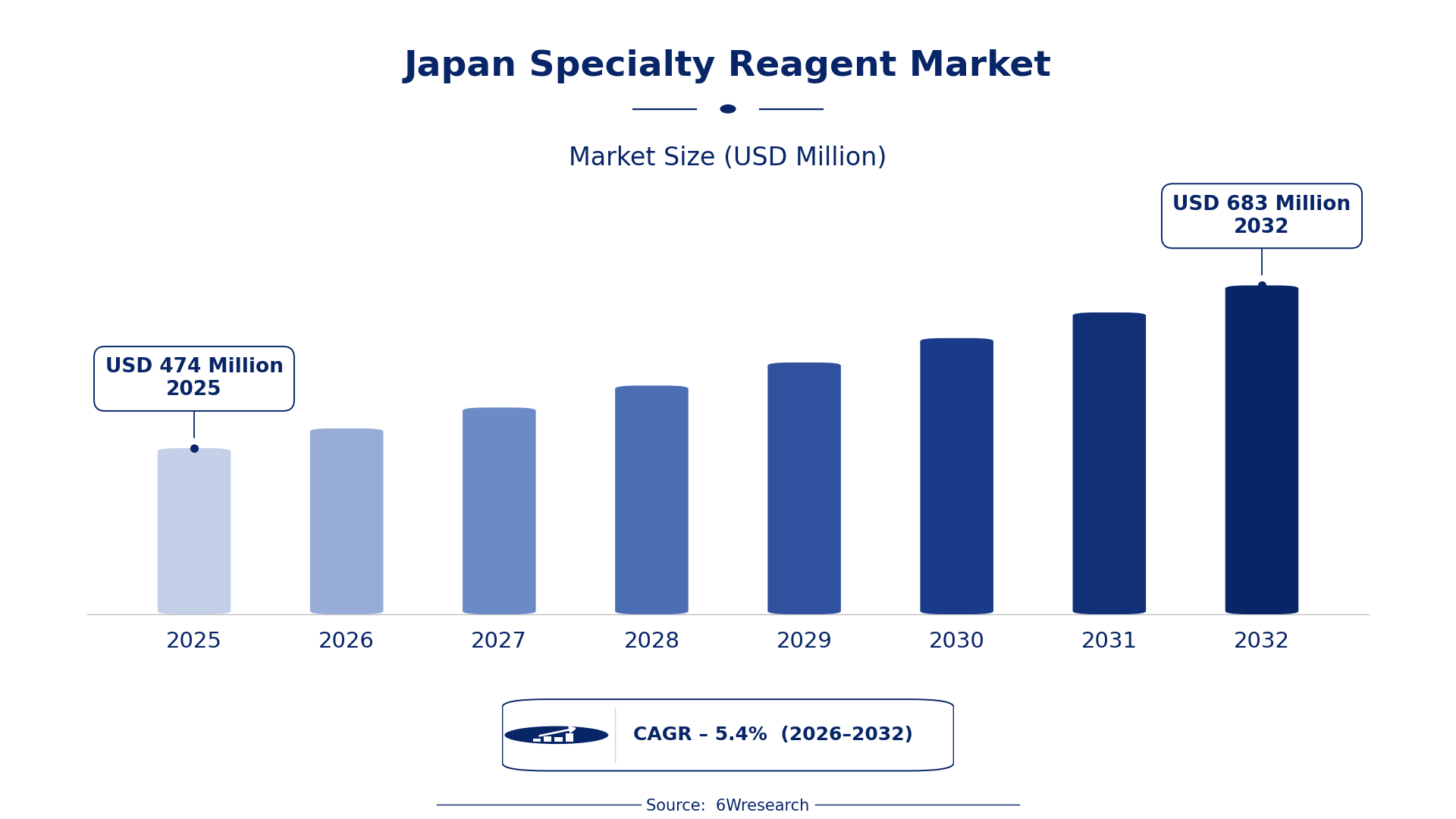
According to 6Wresearch internal database and industry insights, the Japan Specialty Reagent Market was valued at USD 474 Million in 2025 and is projected to reach USD 683 Million by 2032, growing at a CAGR of approximately 5.4% during 2026–2032.
Japan Specialty Reagent Market Highlights
| Report Metric | Details |
| Report Name | Japan Specialty Reagent Market (2026-2032) |
| Market Size 2025 | USD 474 Million |
| Market Size 2032 | USD 683 Million |
| Absolute Growth 2025–2032 | USD 209 Million |
| CAGR 2026–2032 | 5.4% |
| Peak Annual Growth | 6.7% in 2030 |
| Forecast Period | 2026–2032 |
| Historical Data | 2022–2025 |
| Base Year | 2025 |
| Leading Reagent Type, 2025 | Diagnostic Reagents (48% share) |
| Leading Application Area, 2025 | Clinical Chemistry (38% share) |
| Leading Purity Level, 2025 | Clinical Grade (43% share) |
| Leading End User, 2025 | Hospitals & Labs (53% share) |
| Fastest-Growing Reagent Type | Molecular Biology Reagents (7.9% CAGR) |
| Fastest-Growing Application Area | PCR/RT-PCR (6.4% CAGR) |
| Fastest-Growing Purity Level | High Purity (6.8% CAGR) |
| Fastest-Growing End User | Genetic Testing Firms (7.3% CAGR) |
| Growing Sector | Healthcare and Diagnostics |
| Key End Users | Hospitals, Laboratories, Biotech Companies, Diagnostic Kit Providers |
Japan Specialty Reagent Market Year-wise Growth Rate and Key Drivers (2022–2032)
This graph illustrates the annual growth rates of the market from 2022 to 2032, highlighting a steady upward trajectory and projected market expansion over the forecast period.
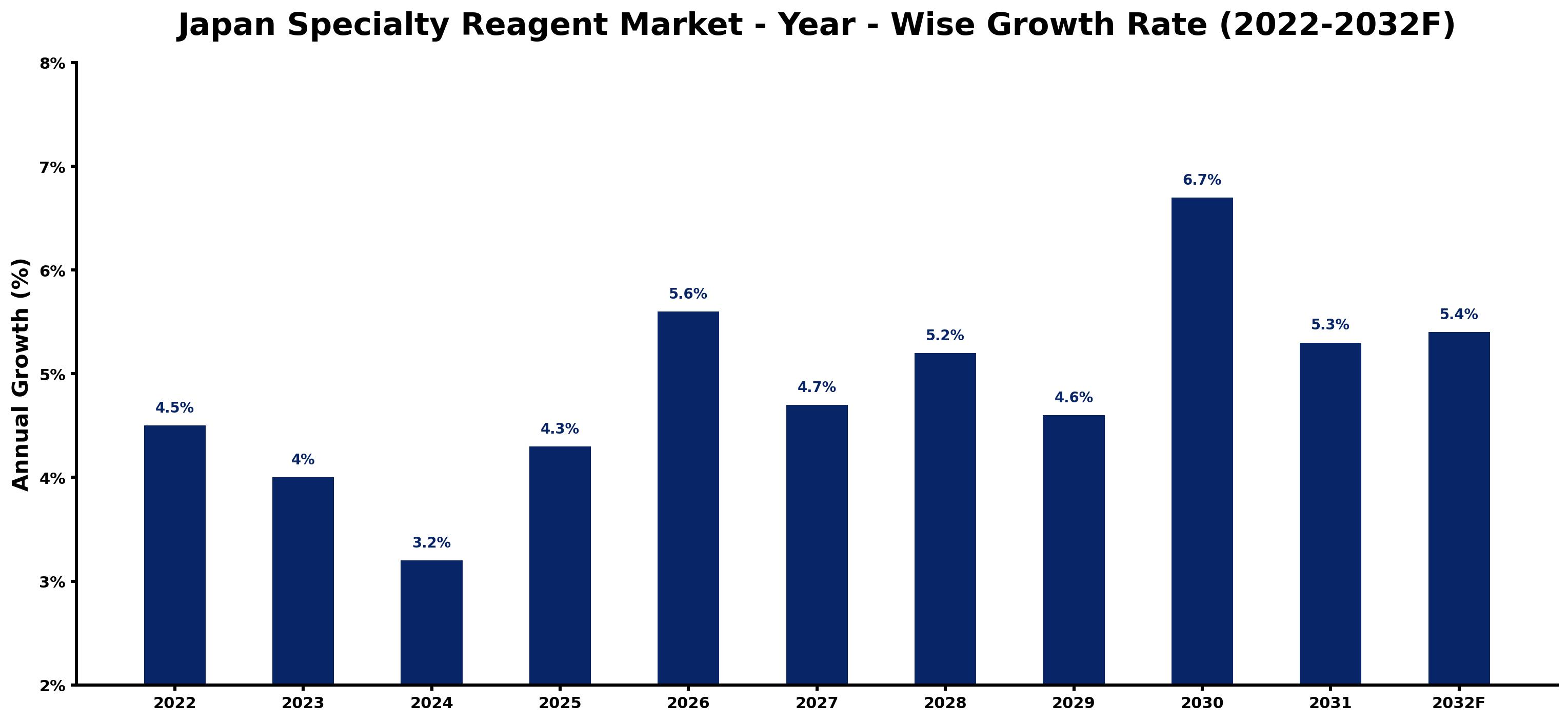
Below, each year's estimated growth is shown next to the factor that most influenced it.
| Year | Estimated Annual Growth (%) | Market Rationale |
| 2022 | 4.5 | The market showed solid growth due to increased healthcare spending and research activities. |
| 2023 | 4.0 | Growth slowed as the market adjusted to previous high levels of demand and investment. |
| 2024 | 3.2 | A further slowdown occurred as companies focused on efficiency amid rising operational costs. |
| 2025 | 4.3 | Demand accelerated again as hospitals expanded services and invested in advanced diagnostics. |
| 2026 | 5.6 | Growth is expected to strengthen with increased funding for life sciences research and development initiatives. |
| 2027 | 4.7 | A slight slowdown is projected as market saturation begins to affect growth rates. |
| 2028 | 5.2 | Demand is expected to pick up as innovations in clinical chemistry drive new applications for reagents. |
| 2029 | 4.6 | Growth is projected to slow again as competition intensifies among reagent suppliers. |
| 2030 | 6.7 | The market is expected to peak due to heightened investment in biotechnology and clinical diagnostics. |
| 2031 | 5.3 | Demand is projected to moderate as the market begins to stabilise after a period of rapid expansion. |
| 2032 | 5.4 | Growth is expected to continue as healthcare needs evolve and new technologies emerge. |
Note: Market size estimations and growth projections presented in this report are based on 6Wresearch's proprietary forecasting methodology, utilizing the latest available industry data, government publications, and primary research inputs.
Japan Specialty Reagent Market Synopsis
Specialty reagents are chemical substances used in laboratories for specific analytical applications, produced through precise synthesis and purification processes. The Japan Specialty Reagent Market is expanding, driven by over 8,000 hospitals and clinics that rely on these reagents for diagnostics and research. Increased life sciences R&D investment, which reached ¥1 trillion in 2022, along with the growing demand for diagnostic testing, where over 70% is performed using these reagents, propels market growth.
Market Dynamics Impact Analysis (2026–2032)
| Factor | Type | Impact | Primary Segment Affected |
| Growing healthcare expenditure | Driver | High | Diagnostic Reagents |
| Rising investment in life sciences research | Driver | High | Molecular Biology Reagents |
| Increasing demand for high purity reagents | Opportunity | Medium | High Purity |
| Expansion of clinical laboratories | Opportunity | Medium | Clinical Chemistry |
| Stringent regulatory requirements | Restraint | High | Clinical Grade |
| High competition among suppliers | Restraint | Medium | Diagnostic Reagents |
| Challenges in meeting JIS standards | Challenge | High | Clinical Grade |
| Rising costs of raw materials | Challenge | Medium | Diagnostic Reagents |
Evaluation of Drivers in Japan Specialty Reagent Market (2026–2032)
The following drivers explain most of the expected growth.
| Drivers | Primary Segment Affected | Why It Matters (Evidence) |
| Increased healthcare spending | Diagnostic Reagents | With over 8,000 hospitals and clinics in Japan, healthcare spending drives demand for diagnostic reagents, increasing purchases significantly. |
| Growing life sciences R&D investment | Molecular Biology Reagents | Life Sciences R&D investment reached ¥1 trillion in 2022, boosting the need for molecular biology reagents in research applications. |
| Rising prevalence of chronic diseases | Immunoassay Reagents | The aging population in Japan increases the demand for immunoassay reagents, essential for accurate disease testing. |
| Advancements in genetic testing | PCR/RT-PCR | Innovations in PCR techniques are expanding the market for molecular biology reagents, as laboratories seek efficient solutions for genetic analysis. |
| Expansion of diagnostic capabilities | Clinical Chemistry | Hospitals are expanding their diagnostic capabilities, driving demand for clinical chemistry reagents to improve patient outcomes. |
Volumes grow on the back of increased healthcare spending, with over 8,000 hospitals and clinics utilising specialty reagents for diagnostics. Life Sciences R&D investment reached ¥1 trillion in 2022, boosting demand for diagnostic reagents. The prevalence of chronic diseases among Japan's aging population drives the need for immunoassay reagents, essential for accurate testing. Innovations in PCR techniques are expanding the market for molecular biology reagents, as laboratories seek efficient and reliable solutions for genetic analysis. Consequently, diagnostic testing continues to rise, increasing the demand for specialty reagents across various applications.
Evaluation of Restraints in Japan Specialty Reagent Market
The following restraints limit how fast demand can grow.
| Market Restraint | Primary Segment Affected | Why It Matters (Evidence) |
| Challenges in meeting quality guidelines | High Purity | The National Institute of Health Sciences sets strict guidelines for reagent quality, complicating compliance and increasing costs by approximately 12%. |
| High competition among suppliers | Diagnostic Reagents | Intense competition in the market leads to price pressures, affecting profit margins for suppliers by up to 10%. |
| Rising raw material costs | Diagnostic Reagents | Fluctuations in raw material prices impact the overall production costs of specialty reagents, raising expenses by around 12%. |
| Regulatory delays in approvals | Clinical Chemistry | The Ministry of Health, Labour and Welfare oversees regulations, which can delay product approvals by several months. |
| Stringent JIS standards compliance | Clinical Grade | Compliance with JIS standards for safety and efficacy increases production costs by approximately 15%. |
Japan Specialty Reagent Market Challenges
Hospitals struggle with delays in acquiring specialty reagents due to outdated production technology, which raises lead times by 30%. Regulatory compliance with JIS standards adds complexity, resulting in quality assurance costs that can exceed ¥50 million annually for clinics. Limited domestic suppliers create supply chain disruptions, leading to price increases of 15% for hospitals during shortages. Competition from international markets forces local producers to lower prices, risking quality and reliability for buyers in the healthcare sector.
Trends in the Japan Specialty Reagent Market
Four trends stand out in the Japan Specialty Reagent Market.
- Shift towards High Purity Reagents: High Purity reagents are becoming increasingly important for pharmaceutical applications, particularly in drug development. In 2023, demand for these reagents rose, accounting for a notable share of the market.
- Increased Adoption of ELISA Testing: The use of ELISA tests in hospitals for disease screening and monitoring has surged, reflecting a growing reliance on these methods. In 2023, ELISA tests represented a significant portion of diagnostic testing in Japan.
- Expansion of PCR/RT-PCR Applications: PCR/RT-PCR techniques are gaining traction in clinical laboratories, driven by advancements in genetic testing. This segment is projected to grow at a CAGR of 6.4% from 2026 to 2032.
- Rising Focus on Clinical Chemistry: Clinical Chemistry is witnessing increased investment as hospitals expand their diagnostic capabilities. This application area is expected to dominate the market, holding a 38% share in 2025.
Investment Opportunities in the Japan Specialty Reagent Market
The openings below show where demand in the Japan Specialty Reagent Market is visible and how suppliers can enter.
- Supply of High Purity Reagents: The demand for High Purity reagents is growing, with the market gap indicating a need for suppliers to invest in this segment. Genetic testing firms are particularly in need of these reagents to ensure accuracy.
- Development of Diagnostic Kits: With over 70% of diagnostic testing performed using specialty reagents, there is a significant opportunity to develop diagnostic kits. Diagnostic kit providers are actively seeking partnerships to enhance their product offerings.
- Investment in Clinical Chemistry Solutions: The Clinical Chemistry segment is expanding, creating opportunities for suppliers to invest in innovative solutions. Hospitals and labs are looking for advanced reagents to improve diagnostic accuracy.
- Partnerships for Biotech Innovation: The Japanese government supports biotech innovation through grants, creating opportunities for joint ventures. Collaborating with local firms can facilitate entry into the growing specialty reagent market.
Government Initiatives in the Japan Specialty Reagent Market
The Medical Care Act sets standards for hospitals and clinics, ensuring compliance with regulations that include the use of specialty reagents. The act also mandates regular inspections, ensuring that facilities meet established guidelines for reagent usage, which is crucial for patient safety.
Hospitals and labs utilise the NHI drug price standard to ensure compliance with pricing regulations for specialty reagents. This standard influences reimbursement rates, allowing healthcare providers to manage costs effectively while ensuring access to necessary diagnostic tools. Compliance with these regulations is essential for maintaining market access and profitability for producers.
Future Insight of the Japan Specialty Reagent Market
By 2032, new biotech research facilities will emerge, improving production processes and increasing reagent availability for hospitals. Automated synthesis technologies will reduce production costs by approximately 20%, benefiting both suppliers and buyers. Increased government funding will drive innovation in reagent development, expanding options for clinical applications. As the Tokyo region strengthens its position as a biotech hub, collaboration among research institutions will improve the quality of specialty reagents.
Market Segmentation Analysis
Japan Specialty Reagent Market report covers a detailed analysis of the following market segments:
By Reagent Type – Diagnostic Reagents Lead, Molecular Biology Reagents Expected to Grow Fastest
According to Saurav Kr Singh, Senior Research Analyst at 6Wresearch, in 2025, Diagnostic Reagents led the reagent type split with a 48% share. Diagnostic reagents dominate the market as they are essential for clinical diagnostics, with over 70% of diagnostic testing in Japan relying on them. Their widespread use across more than 8,000 hospitals and clinics solidifies their leading position in the industry. Molecular Biology Reagents are projected to grow fastest, at a CAGR of 7.9% during 2026–2032. Molecular biology reagents are witnessing rapid growth, spurred by substantial investments in life sciences R&D, which reached ¥1 trillion in 2022. This surge in funding is critical for advancing genetic analysis and research, thereby increasing the demand for these reagents. Suppliers should prioritise expanding their offerings in molecular biology reagents to take advantage of this growth trend.
By Application Area – Clinical Chemistry Leads, PCR/RT-PCR Expected to Grow Fastest
Clinical Chemistry accounted for 38% of the market by application area in 2025. Clinical chemistry holds the largest share as it is fundamental for biochemical analysis in healthcare settings. Its critical role in diagnosing various health conditions ensures consistent demand from hospitals and laboratories. PCR/RT-PCR is set to record the highest CAGR in this split, 6.4% over 2026–2032. The PCR/RT-PCR segment is expanding quickly, primarily due to the rising need for DNA amplification in diagnostics, particularly in infectious disease testing. This growth reflects the increasing emphasis on rapid and accurate diagnostic methods. Buyers will benefit from investing in PCR/RT-PCR technologies to stay ahead in diagnostic capabilities.
By Purity Level – Clinical Grade Leads, High Purity Expected to Grow Fastest
Clinical Grade held 43% of the Japan Specialty Reagent Market by purity level in 2025. Clinical grade reagents lead the market as they comply with rigorous standards for human use in diagnostics, ensuring both safety and efficacy. Their adherence to JIS standards makes them indispensable for healthcare providers throughout Japan. The quickest growth will come from High Purity, forecast to expand at a CAGR of 6.8% between 2026 and 2032. High purity reagents are growing swiftly due to their vital role in sensitive analytical applications, particularly in pharmaceutical development. As drug development becomes more complex, the demand for these high-quality reagents is anticipated to rise significantly. Suppliers must enhance their production capabilities for high purity reagents to meet the increasing demands of the pharmaceutical sector.
By End User – Hospitals & Labs Lead, Genetic Testing Firms Expected to Grow Fastest
Hospitals & Labs took 53% of end user revenue in 2025, more than any other category. Hospitals and laboratories represent the largest end user group, as they are the primary consumers of specialty reagents for various diagnostic and research purposes. Their extensive use of reagents for clinical testing solidifies their dominant position in the market. Over 2026–2032, Genetic Testing Firms are expected to post the fastest growth, at a CAGR of 7.3%. Genetic testing firms are the fastest-growing segment, driven by the increasing prevalence of genetic testing for various conditions. This trend is supported by advancements in technology and a growing awareness of genetic health. Suppliers should target genetic testing firms to capitalise on the rapid growth in this sector.
Key Attractiveness of the Report
- 10 Years of Market Numbers
- Historical Data Starting from 2022 to 2025
- Base Year 2025
- Forecast Data until 2032
- Key Performance Indicators Impacting the Market
- Major Upcoming Developments and Projects
Key Highlights of the Report:
- Japan Specialty Reagent Market Outlook
- Market Size of Japan Specialty Reagent Market, 2025
- Forecast of Japan Specialty Reagent Market, 2032
- Historical Data and Forecast of Japan Specialty Reagent Revenues & Volume for the Period 2022-2032F
- Japan Specialty Reagent Market Trend Evolution
- Japan Specialty Reagent Market Drivers and Challenges
- Japan Specialty Reagent Price Trends
- Japan Specialty Reagent Porter's Five Forces
- Japan Specialty Reagent Industry Life Cycle
- Historical Data and Forecast of Japan Specialty Reagent Market Revenues & Volume By Reagent Type for the Period 2022-2032F
- Historical Data and Forecast of Japan Specialty Reagent Market Revenues & Volume By Diagnostic Reagents for the Period 2022-2032F
- Historical Data and Forecast of Japan Specialty Reagent Market Revenues & Volume By Molecular Biology Reagents for the Period 2022-2032F
- Historical Data and Forecast of Japan Specialty Reagent Market Revenues & Volume By Immunoassay Reagents for the Period 2022-2032F
- Historical Data and Forecast of Japan Specialty Reagent Market Revenues & Volume By Cell Culture Reagents for the Period 2022-2032F
- Historical Data and Forecast of Japan Specialty Reagent Market Revenues & Volume By Application Area for the Period 2022-2032F
- Historical Data and Forecast of Japan Specialty Reagent Market Revenues & Volume By Clinical Chemistry for the Period 2022-2032F
- Historical Data and Forecast of Japan Specialty Reagent Market Revenues & Volume By PCR/RT-PCR for the Period 2022-2032F
- Historical Data and Forecast of Japan Specialty Reagent Market Revenues & Volume By ELISA for the Period 2022-2032F
- Historical Data and Forecast of Japan Specialty Reagent Market Revenues & Volume By Life Sciences R&D for the Period 2022-2032F
- Historical Data and Forecast of Japan Specialty Reagent Market Revenues & Volume By Purity Level for the Period 2022-2032F
- Historical Data and Forecast of Japan Specialty Reagent Market Revenues & Volume By Clinical Grade for the Period 2022-2032F
- Historical Data and Forecast of Japan Specialty Reagent Market Revenues & Volume By High Purity for the Period 2022-2032F
- Historical Data and Forecast of Japan Specialty Reagent Market Revenues & Volume By Diagnostic Grade for the Period 2022-2032F
- Historical Data and Forecast of Japan Specialty Reagent Market Revenues & Volume By Research Grade for the Period 2022-2032F
- Historical Data and Forecast of Japan Specialty Reagent Market Revenues & Volume By End User for the Period 2022-2032F
- Historical Data and Forecast of Japan Specialty Reagent Market Revenues & Volume By Hospitals & Labs for the Period 2022-2032F
- Historical Data and Forecast of Japan Specialty Reagent Market Revenues & Volume By Genetic Testing Firms for the Period 2022-2032F
- Historical Data and Forecast of Japan Specialty Reagent Market Revenues & Volume By Diagnostic Kit Providers for the Period 2022-2032F
- Historical Data and Forecast of Japan Specialty Reagent Market Revenues & Volume By Biotech Companies for the Period 2022-2032F
- Japan Specialty Reagent Import Export Trade Statistics
- Market Opportunity Assessment By Reagent Type
- Market Opportunity Assessment By Application Area
- Market Opportunity Assessment By Purity Level
- Market Opportunity Assessment By End User
- Japan Specialty Reagent Top Companies Market Share
- Japan Specialty Reagent Competitive Benchmarking By Technical and Operational Parameters
- Japan Specialty Reagent Company Profiles
- Japan Specialty Reagent Key Strategic Recommendations
Market Covered
The following segment groups are covered in the report.
By Reagent Type
- Diagnostic Reagents
- Molecular Biology Reagents
- Immunoassay Reagents
- Cell Culture Reagents
By Application Area
- Clinical Chemistry
- PCR/RT-PCR
- ELISA
- Life Sciences R&D
By Purity Level
- Clinical Grade
- High Purity
- Diagnostic Grade
- Research Grade
By End User
- Hospitals & Labs
- Genetic Testing Firms
- Diagnostic Kit Providers
- Biotech Companies































