Japan Specimen Tracking Market Size & Growth Rate
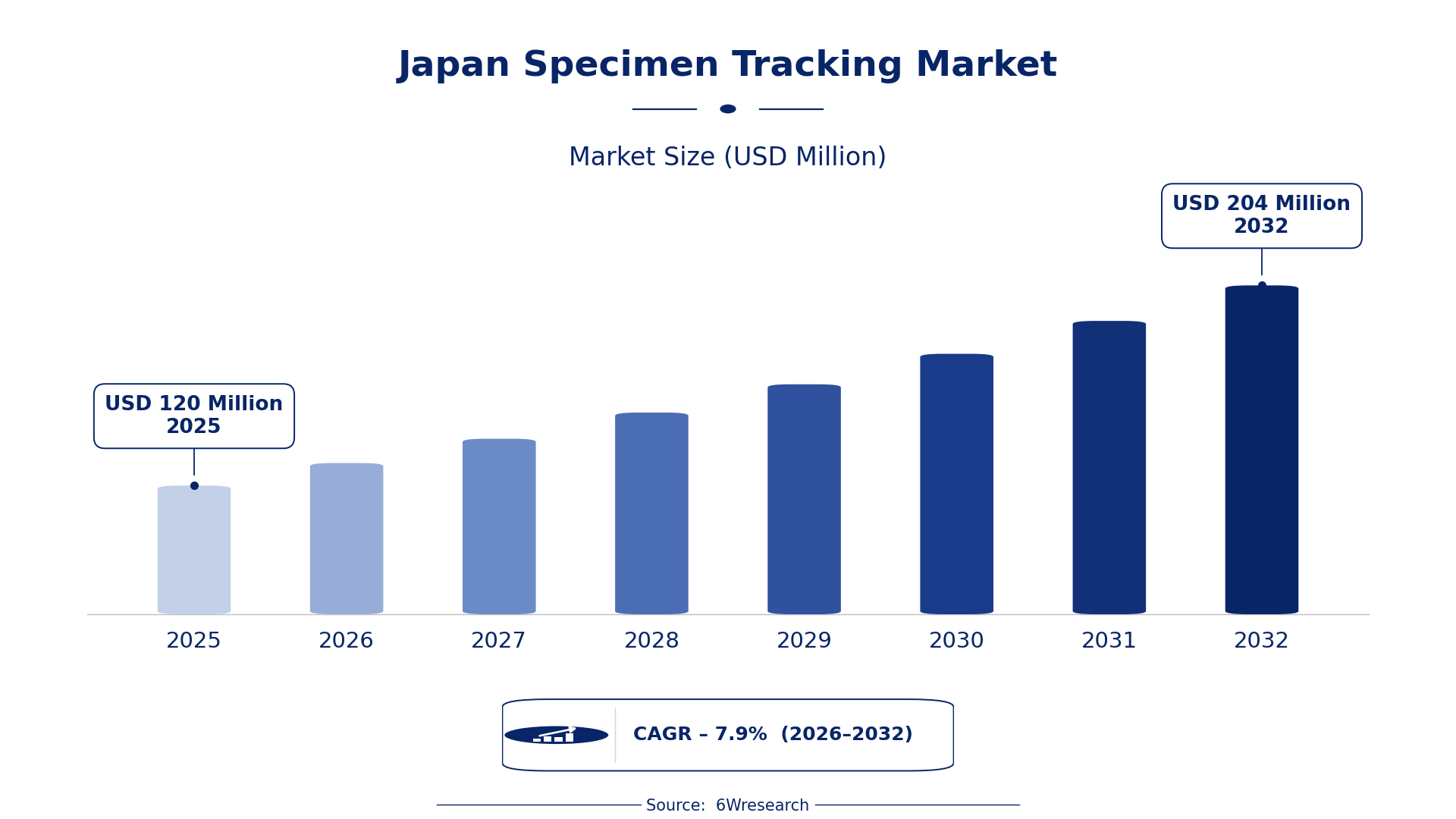
According to 6Wresearch internal database and industry insights, the Japan Specimen Tracking Market was valued at USD 120 Million in 2025 and is projected to reach USD 204 Million by 2032, growing at a CAGR of approximately 7.9% during 2026–2032.
Japan Specimen Tracking Market Highlights
| Report Metric | Details |
| Report Name | Japan Specimen Tracking Market (2026-2032) |
| Market Size 2025 | USD 120 Million |
| Market Size 2032 | USD 204 Million |
| Absolute Growth 2025–2032 | USD 84 Million |
| CAGR 2026–2032 | 7.9% |
| Peak Annual Growth | 9.6% in 2032 |
| Forecast Period | 2026–2032 |
| Historical Data | 2022–2025 |
| Base Year | 2025 |
| Leading Tracking Method, 2025 | Barcode Tracking (42% share) |
| Leading Technology Used, 2025 | 1D/2D Codes (40% share) |
| Leading Facility Type, 2025 | Pathology Labs (44% share) |
| Leading End User, 2025 | Hospitals & Labs (45% share) |
| Fastest-Growing Tracking Method | RFID-Based Tracking (11.2% CAGR) |
| Fastest-Growing Technology Used | Active/Passive RFID (11.5% CAGR) |
| Fastest-Growing Facility Type | Biobanks (10.6% CAGR) |
| Fastest-Growing End User | Research Centers (10.5% CAGR) |
| Growing Sector | Healthcare |
| Key End Users | Hospitals, Laboratories, Clinical Research Firms, Biobanks |
Japan Specimen Tracking Market Year-wise Growth Rate and Key Drivers (2022–2032)
This graph illustrates the annual growth rates of the market from 2022 to 2032, highlighting a steady upward trajectory and projected market expansion over the forecast period.
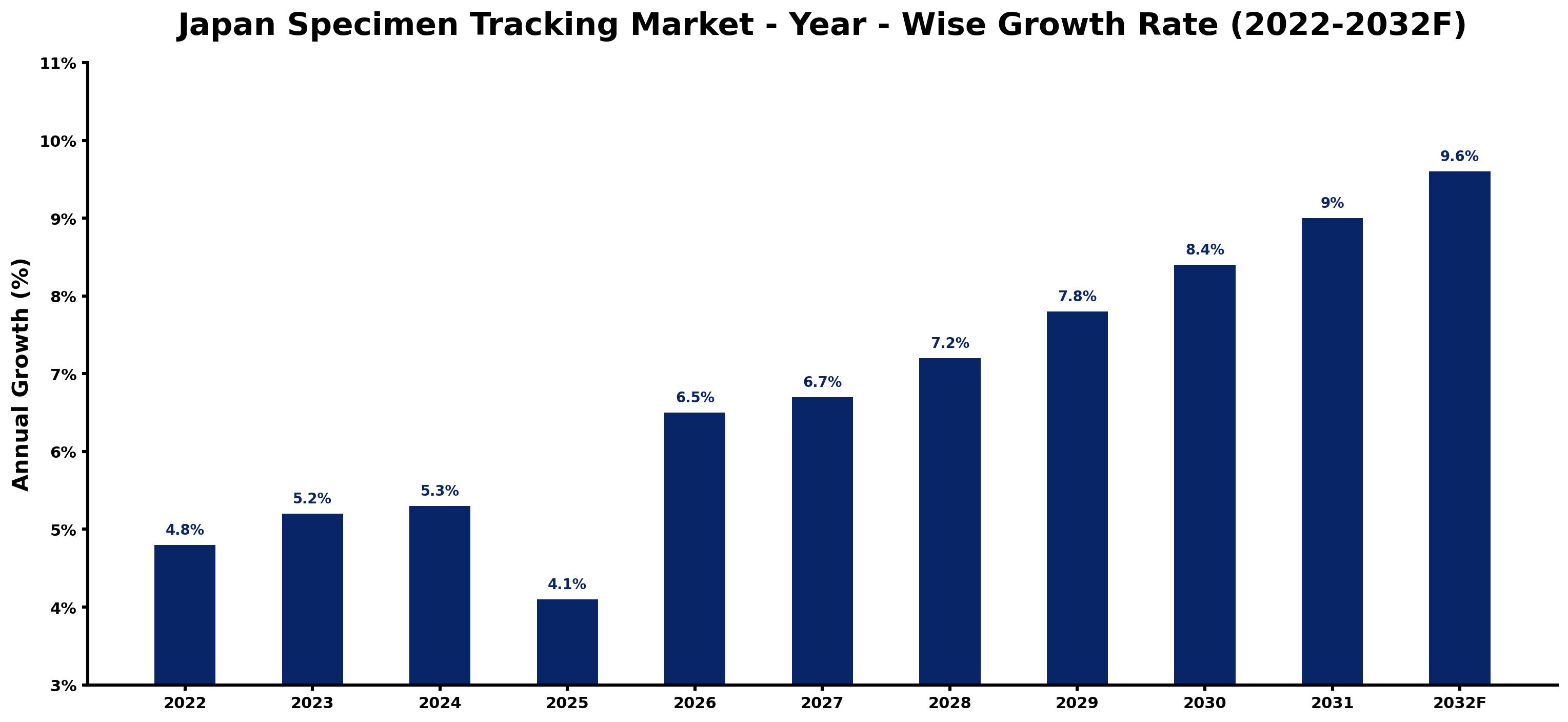
Below, each year's estimated growth is shown next to the factor that most influenced it.
| Year | Estimated Annual Growth (%) | Market Rationale |
| 2022 | 4.8 | The market experienced steady growth driven by increased adoption of tracking systems. |
| 2023 | 5.2 | Demand rose as hospitals upgraded their specimen management technologies. |
| 2024 | 5.3 | Growth continued as more facilities implemented RFID systems for efficiency. |
| 2025 | 4.1 | Growth slowed as some hospitals faced budget constraints on new technologies. |
| 2026 | 6.5 | Demand is expected to increase with the launch of new tracking initiatives in healthcare. |
| 2027 | 6.7 | The market will expand as hospitals invest in advanced tracking solutions. |
| 2028 | 7.2 | Growth is projected to accelerate as more facilities adopt automated tracking systems. |
| 2029 | 7.8 | Demand is expected to surge with the rising number of clinical trials requiring tracking. |
| 2030 | 8.4 | Healthcare investments will increase, boosting the need for specimen tracking. |
| 2031 | 9.0 | Demand is projected to rise as hospitals improve operational efficiency through tracking. |
| 2032 | 9.6 | The market is expected to peak as hospitals fully integrate advanced tracking technologies. |
Note: Market size estimations and growth projections presented in this report are based on 6Wresearch's proprietary forecasting methodology, utilizing the latest available industry data, government publications, and primary research inputs.
Japan Specimen Tracking Market Synopsis
Specimen tracking employs technologies like barcode and RFID systems to monitor biological samples, ensuring integrity in healthcare and research environments. In Japan, more than 8,000 hospitals utilise these systems, driven by the demand for efficient specimen management. The rising number of clinical trials and new tracking programmes launched by the Ministry of Health are stimulating market growth. Technological advancements and increased investment in healthcare infrastructure further support this upward trend.
Market Dynamics Impact Analysis (2026–2032)
| Factor | Type | Impact | Primary Segment Affected |
| Increased adoption of RFID technology | Driver | High | RFID-Based Tracking |
| Growing demand for efficient specimen management in hospitals | Driver | High | Barcode Tracking |
| Rising number of clinical trials requiring robust tracking systems | Opportunity | High | Clinical Research Firms |
| Expansion of biobanks necessitating advanced tracking solutions | Opportunity | Medium | Biobanks |
| Budget constraints limiting hospital investments in tracking systems | Restraint | High | Hospitals & Labs |
| Slow adoption of blockchain technology for specimen tracking | Restraint | Medium | Blockchain Tracking |
| Limited supply chain integration affecting tracking efficiency | Challenge | High | Pharma Logistics |
| Regulatory compliance challenges for tracking systems | Challenge | Medium | Pathology Labs |
Evaluation of Drivers in Japan Specimen Tracking Market (2026–2032)
The main growth drivers and the segments they affect most are set out below.
| Drivers | Primary Segment Affected | Why It Matters (Evidence) |
| Increased investment in healthcare technology | RFID-Based Tracking | Over 1,000 healthcare facilities have adopted RFID technology to improve tracking efficiency. |
| Demand for improved patient outcomes | Barcode Tracking | The need for accurate specimen management in hospitals drives the use of barcode systems. |
| Growth in clinical trials | Clinical Research Firms | Thousands of trials conducted annually require effective specimen tracking solutions. |
| Expansion of biobanks | Biobanks | Millions of biological samples stored necessitate advanced tracking for research. |
| Implementation of ISO 15189 standards | Pathology Labs | Quality management standards drive laboratories to adopt reliable tracking systems. |
Behind the steady rise in orders is heightened investment in healthcare technology, with over 1,000 healthcare facilities adopting RFID systems to improve tracking efficiency. The necessity for precise specimen management drives hospitals to implement barcode systems, ensuring quality control. The expanding number of clinical trials requires effective tracking solutions, prompting clinical research firms to invest in advanced technologies. Biobanks, which store millions of biological samples, need efficient tracking mechanisms to maintain integrity, while the adoption of ISO 15189 standards compels pathology labs to implement reliable systems for quality assurance.
Evaluation of Restraints in Japan Specimen Tracking Market
These are the pressures that could keep growth below its potential.
| Market Restraint | Primary Segment Affected | Why It Matters (Evidence) |
| Budget constraints limiting hospital investments | Hospitals & Labs | Many hospitals face financial limitations, restricting their ability to upgrade tracking systems. |
| Slow adoption of blockchain technology | Blockchain Tracking | Emerging interest in blockchain for data integrity has not yet translated into widespread use. |
| Limited integration with supply chain systems | Pharma Logistics | Inefficient supply chain integration affects approximately 30% of tracking solutions. |
| Regulatory compliance challenges | Pathology Labs | Pathology labs must navigate complex regulations, which can delay implementation of tracking systems. |
| Resistance to change from traditional methods | Biobanks | Some biobanks are hesitant to transition from established tracking methods to newer technologies. |
Japan Specimen Tracking Market Challenges
Hospitals face issues with outdated specimen tracking technology, leading to mislabelled samples that can delay diagnoses for patients by up to three weeks. Training gaps among healthcare staff result in inefficient use of existing systems, increasing operational costs for hospitals by approximately 15%. Supply chain disruptions impact the availability of essential components, causing delays in implementing tracking systems for over 1,000 laboratories. New regulatory requirements from the Ministry of Health impose additional compliance costs on biobanks, restricting their ability to manage millions of biological samples effectively.
Trends in the Japan Specimen Tracking Market
Four trends stand out in the Japan Specimen Tracking Market.
- Shift towards Automated Tracking Systems: Hospitals in the Tokyo region are increasingly adopting automated tracking systems, with over 30% implementing RFID solutions in 2023. This transition improves operational efficiency and specimen integrity.
- Emergence of Blockchain for Data Integrity: The Tokyo Medical University has initiated a pilot project implementing blockchain for specimen tracking, aiming to improve data integrity. This reflects a growing trend towards secure tracking methods.
- Increased Focus on Quality Management Standards: The application of ISO 15189 standards in Japanese laboratories is driving the adoption of advanced tracking systems. Approximately 60% of labs are now compliant, enhancing specimen management.
- Growing Demand from Clinical Research Firms: Clinical research firms increasingly require effective tracking solutions, with thousands of trials conducted annually. This demand is driving investments in advanced tracking technologies.
Investment Opportunities in the Japan Specimen Tracking Market
Below are the investment opportunities with the strongest case in the Japan Specimen Tracking Market.
- Hospitals Seeking Efficient Tracking Solutions: With over 8,000 hospitals in Japan, there is an opportunity for suppliers to provide efficient tracking systems, particularly as hospitals strive to enhance operational efficiency.
- Partnerships with Biobanks for Advanced Technologies: Biobanks are in search of advanced tracking solutions to manage millions of samples. Collaborating with local technology providers can facilitate entry into this expanding market.
- Investing in Clinical Research Tracking Systems: The increasing number of clinical trials presents an opportunity for investment in tracking technologies. Suppliers can target clinical research firms to address their growing needs.
- Approval Pathways for Blockchain Solutions: As blockchain technology gains traction, suppliers can explore approval pathways with regulatory bodies to introduce new tracking solutions in healthcare.
Government Initiatives in the Japan Specimen Tracking Market
The Medical Care Act of 1948 establishes standards for hospitals, including requirements for specimen management, which influences the adoption of tracking technologies. The NHI drug price standard, regularly revised by the Ministry of Health, affects the costs associated with specimen tracking systems, ensuring that hospitals can afford necessary upgrades. Together, these measures encourage the integration of advanced tracking systems across healthcare facilities.
The Next-Generation Medical Infrastructure Act, which promotes the use of anonymised medical data for research, is supported by the PMDA, which reviews pharmaceuticals and medical devices. This act encourages the integration of advanced tracking systems in healthcare, facilitating research and product development.
Future Insight of the Japan Specimen Tracking Market
A new initiative focused on specimen tracking will drive the adoption of advanced technologies in healthcare facilities. By 2032, hospitals are anticipated to implement improved tracking systems, ensuring better sample integrity across the board. The testing of geolocation technology in field collection units will enhance accuracy in specimen handling. As laboratories comply with ISO 15189 standards, they will improve quality management, ultimately benefiting both healthcare providers and research institutions.
Market Segmentation Analysis
Japan Specimen Tracking Market report covers a detailed analysis of the following market segments:
By Tracking Method – Barcode Tracking Leads, RFID-Based Tracking Expected to Grow Fastest
According to Saurav Kr Singh, Senior Research Analyst at 6Wresearch, with 42% of tracking method revenue in 2025, Barcode Tracking was the largest category. Barcode tracking holds the largest share due to its widespread use in over 8,000 hospitals across Japan, ensuring efficient management of biological specimens. This method is particularly favoured in laboratories for its simplicity and reliability in tracking samples. RFID-Based Tracking is set to record the highest CAGR in this split, 11.2% over 2026–2032. RFID-based tracking is rapidly expanding as over 1,000 healthcare facilities adopt this technology for real-time specimen monitoring. The need for accurate and instantaneous data in healthcare operations is propelling this segment's growth. Suppliers should focus on enhancing RFID solutions to meet the rising demand for advanced tracking technologies.
By Technology Used – 1D/2D Codes Lead, Active/Passive RFID Expected to Grow Fastest
1D/2D Codes took 40% of technology used revenue in 2025, more than any other category. 1D/2D codes dominate the market as the standard method for lab specimen tracking, providing a reliable and cost-effective solution. Their established presence in healthcare facilities ensures consistent demand for this technology. Active/Passive RFID is projected to grow fastest, at a CAGR of 11.5% during 2026–2032. Active/passive RFID technology is gaining traction as it is essential for automated tracking in laboratories, thereby improving operational efficiency. The increasing push for automation in healthcare is driving this segment's rapid growth. Buyers should consider investing in active/passive RFID systems to enhance tracking efficiency and accuracy.
By Facility Type – Pathology Labs Lead, Biobanks Expected to Grow Fastest
The largest facility type category in 2025 was Pathology Labs, at 44% of revenue. Pathology labs account for the largest share of the market as they are critical for managing patient samples, especially in regions like Tokyo with a high concentration of such facilities. Their essential role in healthcare drives the demand for effective tracking solutions. The quickest growth will come from Biobanks, forecast to expand at a CAGR of 10.6% between 2026 and 2032. Biobanks are witnessing the fastest growth due to their vital function in specimen preservation and tracking, storing millions of biological samples for research purposes. The increasing focus on biobanking in Japan is fuelling this segment's expansion. Suppliers need to tailor solutions for biobanks to capitalise on the growing importance of specimen tracking in research.
By End User – Hospitals & Labs Lead, Research Centers Expected to Grow Fastest
Hospitals & Labs held 45% of the Japan Specimen Tracking Market by end user in 2025. Hospitals and labs represent the largest share as the primary users of tracking systems, ensuring the integrity of specimens in patient care. The extensive network of over 8,000 hospitals in Japan underscores this segment's significance. Over 2026–2032, Research Centers are expected to post the fastest growth, at a CAGR of 10.5%. Research centers are experiencing the fastest growth as they require robust tracking systems to effectively manage research specimens. The rising number of clinical trials in Japan is driving demand in this segment. Suppliers should develop targeted offerings for research centres to address their specific tracking needs.
Key Attractiveness of the Report
- 10 Years of Market Numbers
- Historical Data Starting from 2022 to 2025
- Base Year 2025
- Forecast Data until 2032
- Key Performance Indicators Impacting the Market
- Major Upcoming Developments and Projects
Key Highlights of the Report:
- Japan Specimen Tracking Market Outlook
- Market Size of Japan Specimen Tracking Market, 2025
- Forecast of Japan Specimen Tracking Market, 2032
- Historical Data and Forecast of Japan Specimen Tracking Revenues & Volume for the Period 2022-2032F
- Japan Specimen Tracking Market Trend Evolution
- Japan Specimen Tracking Market Drivers and Challenges
- Japan Specimen Tracking Price Trends
- Japan Specimen Tracking Porter's Five Forces
- Japan Specimen Tracking Industry Life Cycle
- Historical Data and Forecast of Japan Specimen Tracking Market Revenues & Volume By Tracking Method for the Period 2022-2032F
- Historical Data and Forecast of Japan Specimen Tracking Market Revenues & Volume By Barcode Tracking for the Period 2022-2032F
- Historical Data and Forecast of Japan Specimen Tracking Market Revenues & Volume By RFID-Based Tracking for the Period 2022-2032F
- Historical Data and Forecast of Japan Specimen Tracking Market Revenues & Volume By GPS-Enabled Systems for the Period 2022-2032F
- Historical Data and Forecast of Japan Specimen Tracking Market Revenues & Volume By Blockchain Tracking for the Period 2022-2032F
- Historical Data and Forecast of Japan Specimen Tracking Market Revenues & Volume By Technology Used for the Period 2022-2032F
- Historical Data and Forecast of Japan Specimen Tracking Market Revenues & Volume By 1D/2D Codes for the Period 2022-2032F
- Historical Data and Forecast of Japan Specimen Tracking Market Revenues & Volume By Active/Passive RFID for the Period 2022-2032F
- Historical Data and Forecast of Japan Specimen Tracking Market Revenues & Volume By Geolocation Integration for the Period 2022-2032F
- Historical Data and Forecast of Japan Specimen Tracking Market Revenues & Volume By Immutable Recordkeeping for the Period 2022-2032F
- Historical Data and Forecast of Japan Specimen Tracking Market Revenues & Volume By Facility Type for the Period 2022-2032F
- Historical Data and Forecast of Japan Specimen Tracking Market Revenues & Volume By Pathology Labs for the Period 2022-2032F
- Historical Data and Forecast of Japan Specimen Tracking Market Revenues & Volume By Biobanks for the Period 2022-2032F
- Historical Data and Forecast of Japan Specimen Tracking Market Revenues & Volume By Field Collection Units for the Period 2022-2032F
- Historical Data and Forecast of Japan Specimen Tracking Market Revenues & Volume By Pharma Logistics for the Period 2022-2032F
- Historical Data and Forecast of Japan Specimen Tracking Market Revenues & Volume By End User for the Period 2022-2032F
- Historical Data and Forecast of Japan Specimen Tracking Market Revenues & Volume By Hospitals & Labs for the Period 2022-2032F
- Historical Data and Forecast of Japan Specimen Tracking Market Revenues & Volume By Research Centers for the Period 2022-2032F
- Historical Data and Forecast of Japan Specimen Tracking Market Revenues & Volume By Clinical Research Firms for the Period 2022-2032F
- Historical Data and Forecast of Japan Specimen Tracking Market Revenues & Volume By Diagnostic Providers for the Period 2022-2032F
- Japan Specimen Tracking Import Export Trade Statistics
- Market Opportunity Assessment By Tracking Method
- Market Opportunity Assessment By Technology Used
- Market Opportunity Assessment By Facility Type
- Market Opportunity Assessment By End User
- Japan Specimen Tracking Top Companies Market Share
- Japan Specimen Tracking Competitive Benchmarking By Technical and Operational Parameters
- Japan Specimen Tracking Company Profiles
- Japan Specimen Tracking Key Strategic Recommendations
Market Covered
This report examines the market across the segments below.
By Tracking Method
- Barcode Tracking
- RFID-Based Tracking
- GPS-Enabled Systems
- Blockchain Tracking
By Technology Used
- 1D/2D Codes
- Active/Passive RFID
- Geolocation Integration
- Immutable Recordkeeping
By Facility Type
- Pathology Labs
- Biobanks
- Field Collection Units
- Pharma Logistics
By End User
- Hospitals & Labs
- Research Centers
- Clinical Research Firms
- Diagnostic Providers































