Japan Spectrochemical Analysis Market Size & Growth Rate
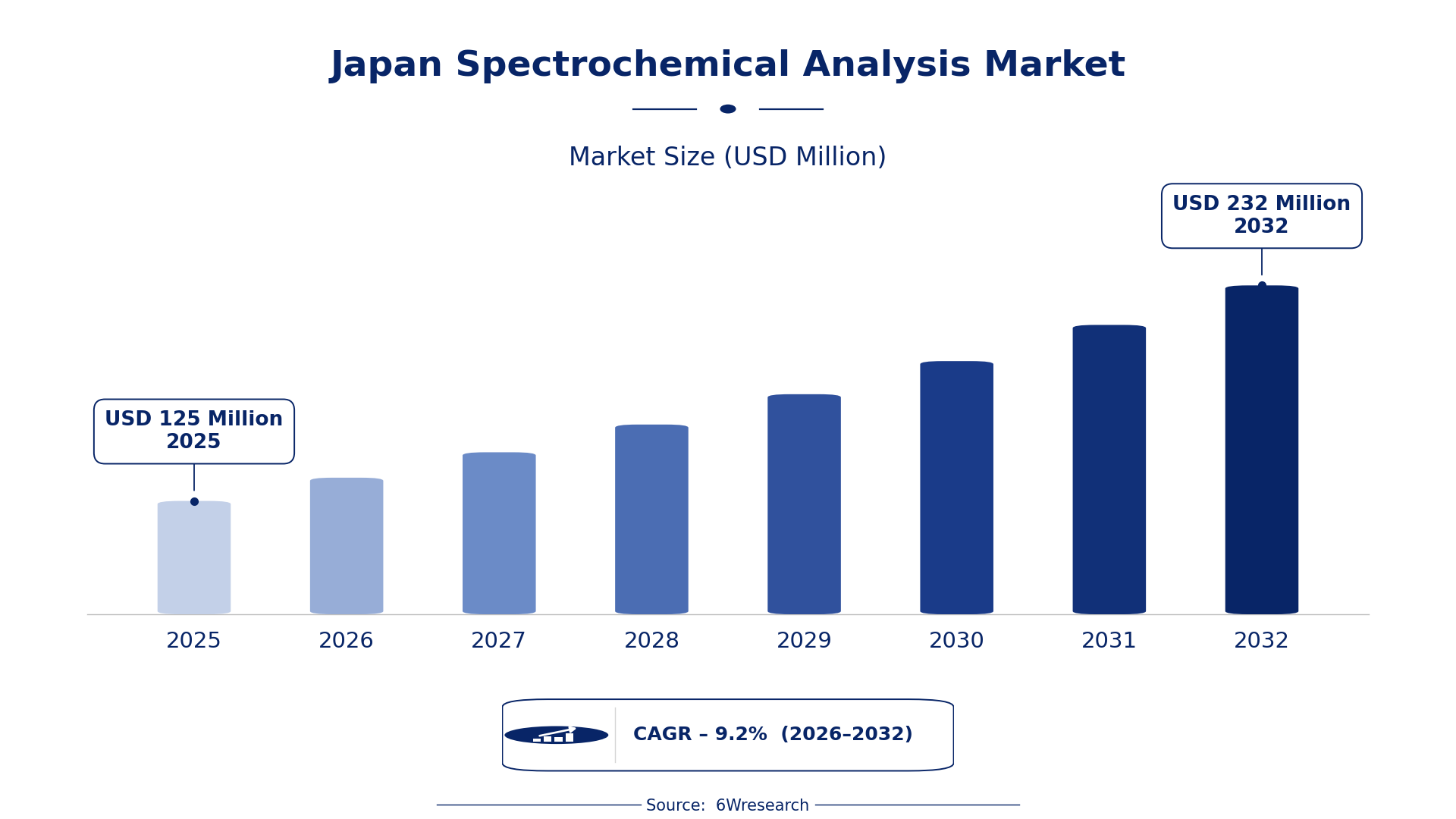
According to 6Wresearch internal database and industry insights, the Japan Spectrochemical Analysis Market was valued at USD 125 Million in 2025 and is projected to reach USD 232 Million by 2032, growing at a CAGR of approximately 9.2% during 2026–2032.
Japan Spectrochemical Analysis Market Highlights
| Report Metric | Details |
| Report Name | Japan Spectrochemical Analysis Market (2026-2032) |
| Market Size 2025 | USD 125 Million |
| Market Size 2032 | USD 232 Million |
| Absolute Growth 2025–2032 | USD 107 Million |
| CAGR 2026–2032 | 9.2% |
| Peak Annual Growth | 10.3% in 2029 |
| Forecast Period | 2026–2032 |
| Historical Data | 2022–2025 |
| Base Year | 2025 |
| Leading Analysis Type, 2025 | Atomic Spectroscopy (39% share) |
| Leading Technique Used, 2025 | AAS/ICP-MS (37% share) |
| Leading Application Sector, 2025 | Pharma Analysis (35% share) |
| Leading End User, 2025 | Material Testing Labs (38% share) |
| Fastest-Growing Analysis Type | Molecular Spectroscopy (13.1% CAGR) |
| Fastest-Growing Technique Used | FTIR/NMR (12.6% CAGR) |
| Fastest-Growing Application Sector | Mining (11.7% CAGR) |
| Fastest-Growing End User | Geological Survey Firms (11.8% CAGR) |
| Growing Sector | Pharmaceutical Analysis |
| Key End Users | Material Testing Labs, Drug Testing Labs, Geological Survey Firms |
Japan Spectrochemical Analysis Market Year-wise Growth Rate and Key Drivers (2022–2032)
This graph illustrates the annual growth rates of the market from 2022 to 2032, highlighting a steady upward trajectory and projected market expansion over the forecast period.
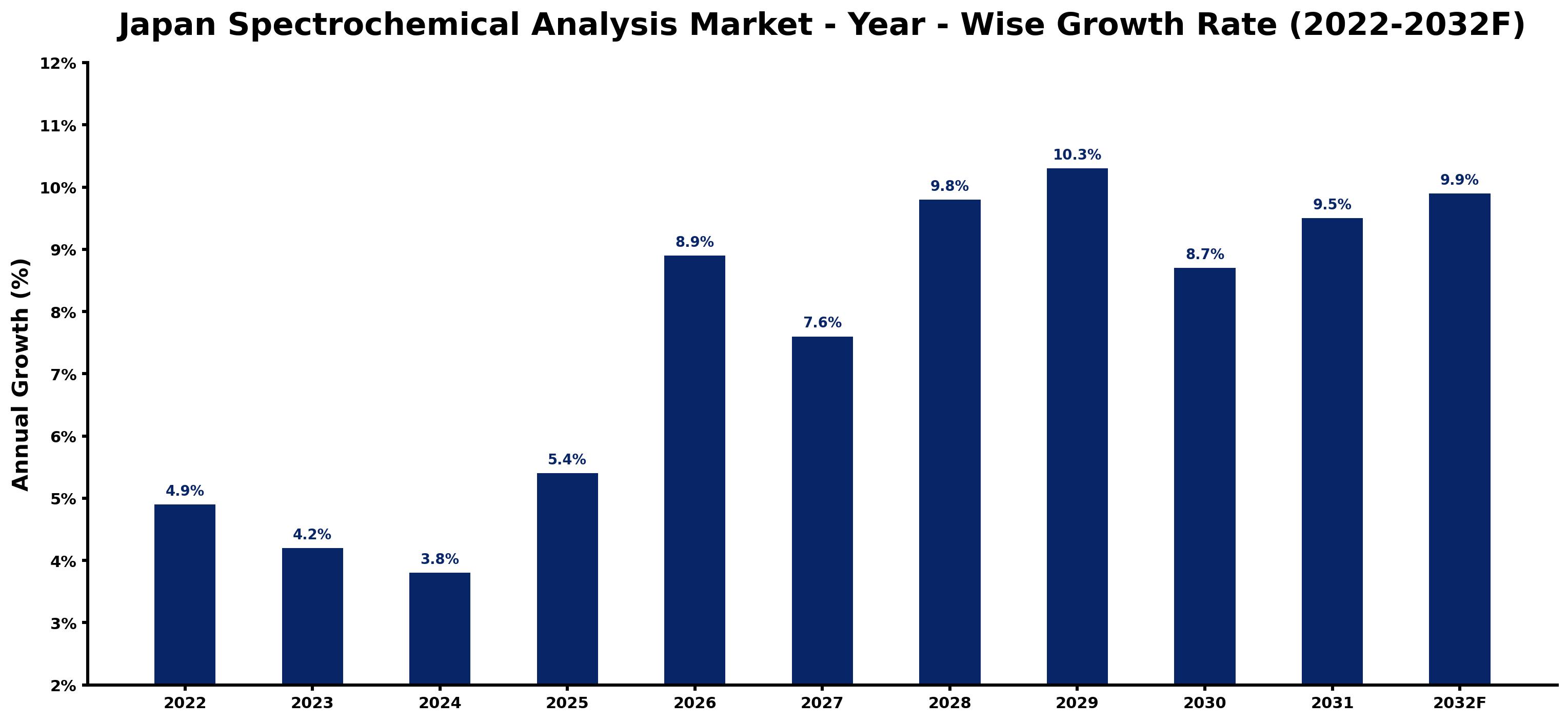
Each row of the following table gives one year's estimated growth and the event or demand shift that explains it.
| Year | Estimated Annual Growth (%) | Market Rationale |
| 2022 | 4.9 | The market experienced steady growth due to ongoing demand from research institutions. |
| 2023 | 4.2 | Growth slowed as the pharmaceutical sector faced temporary supply chain issues. |
| 2024 | 3.8 | Market expansion continued but at a slower rate as investment stabilised. |
| 2025 | 5.4 | The market rebounded with increased spending in pharmaceutical analysis. |
| 2026 | 8.9 | Demand surged as new technologies were adopted in material testing. |
| 2027 | 7.6 | Growth slowed slightly as the market adjusted to previous peaks. |
| 2028 | 9.8 | A resurgence in environmental monitoring boosted market activity. |
| 2029 | 10.3 | The market peaked with heightened investments in analytical capabilities. |
| 2030 | 8.7 | Growth slowed as companies focused on operational efficiencies. |
| 2031 | 9.5 | Demand accelerated again due to rising environmental regulations. |
| 2032 | 9.9 | The market continues to grow as new applications emerge in various sectors. |
Note: Market size estimations and growth projections presented in this report are based on 6Wresearch's proprietary forecasting methodology, utilizing the latest available industry data, government publications, and primary research inputs.
Japan Spectrochemical Analysis Market Synopsis
Spectrochemical analysis involves techniques that identify and quantify materials based on their spectral properties, essential in pharmaceuticals, metallurgy, and environmental monitoring. In Japan, the pharmaceutical sector, valued at ¥9 trillion, drives demand for analytical services, supported by over 1,200 registered laboratories. The GX Basic Policy aims for JPY 150 trillion in decarbonisation investment, further stimulating the market as industries seek advanced analytical methods to comply with environmental standards.
Market Dynamics Impact Analysis (2026–2032)
| Factor | Type | Impact | Primary Segment Affected |
| Growing pharmaceutical sector | Driver | High | Pharma Analysis |
| Increased environmental monitoring requirements | Driver | High | Emission Spectroscopy |
| Rising demand for advanced analytical techniques | Opportunity | High | Molecular Spectroscopy |
| Investment in laboratory infrastructure | Opportunity | Medium | Material Testing Labs |
| Limited availability of skilled technicians | Restraint | High | Material Testing Labs |
| High operational costs for advanced instrumentation | Restraint | Medium | Pharma Analysis |
| Regulatory compliance costs | Challenge | High | Drug Testing Labs |
| Technological obsolescence in existing labs | Challenge | Medium | Material Testing Labs |
Evaluation of Drivers in Japan Spectrochemical Analysis Market (2026–2032)
Below are the drivers that matter most for revenue growth, with supporting evidence.
| Drivers | Primary Segment Affected | Why It Matters (Evidence) |
| Expansion of the pharmaceutical sector | Pharma Analysis | The sector's value of ¥9 trillion drives demand for spectrochemical analysis in drug formulation and testing. |
| Increased focus on environmental monitoring | Emission Spectroscopy | Government funding for environmental programs rose by 20% in 2023, boosting demand for analytical services. |
| Technological advancements in instrumentation | Molecular Spectroscopy | New technologies are projected to improve analysis capabilities, leading to more purchases by research institutions. |
| Growing investment in laboratory infrastructure | Material Testing Labs | With over 1,200 registered labs, increased funding supports the adoption of advanced analytical methods. |
| Rising public awareness of safety standards | Drug Testing Labs | Increased scrutiny on drug safety drives demand for compliance testing in laboratories. |
Much of the new demand traces back to the pharmaceutical sector, valued at ¥9 trillion, which increases the need for spectrochemical analysis in drug formulation. Advancements in instrumentation are prompting research institutions to invest in new equipment. The presence of over 1,200 registered laboratories in Japan supports the adoption of advanced analytical methods, as public awareness of safety standards rises, increasing compliance testing in drug testing labs.
Evaluation of Restraints in Japan Spectrochemical Analysis Market
The following restraints limit how fast demand can grow.
| Market Restraint | Primary Segment Affected | Why It Matters (Evidence) |
| Limited availability of skilled technicians | Material Testing Labs | With over 1,200 labs, the shortage of qualified personnel hampers operational efficiency. |
| High operational costs for advanced instrumentation | Pharma Analysis | The cost of maintaining and operating sophisticated instruments can deter investment. |
| Regulatory compliance costs | Drug Testing Labs | Compliance with stringent regulations increases operational expenses for testing labs, raising costs by up to 15%. |
| Technological obsolescence in existing labs | Material Testing Labs | Older equipment may not meet current analytical standards, requiring costly upgrades that can exceed ¥1 billion. |
| Market saturation in certain sectors | Emission Spectroscopy | As more labs adopt similar technologies, competition increases, impacting profitability and reducing margins. |
Japan Spectrochemical Analysis Market Challenges
Testing laboratories in Japan encounter supply chain disruptions, raising operational costs by ¥2 billion annually for buyers in the pharmaceutical sector. Buyers face delays in product launches, which can extend by six months due to challenges in sourcing advanced spectrometers. Clinics grapple with a shortage of trained professionals in analytical chemistry, costing them valuable time and resources in recruitment and training. Local producers face competition from international markets, resulting in price cuts that can diminish profit margins by up to 15%.
Trends in the Japan Spectrochemical Analysis Market
Several trends are reshaping the Japan Spectrochemical Analysis Market; the most important are set out below.
- Shift from Traditional to Advanced Spectroscopy Techniques: Japan is experiencing a shift towards advanced spectroscopy techniques, particularly in the pharmaceutical sector. For instance, the adoption of FTIR has increased, with over 300 material testing labs implementing this method.
- Transition from Manual to Automated Analysis: The trend towards automation in spectrochemical analysis is evident in the Tokyo region, where numerous drug testing labs are integrating automated systems. This shift is expected to enhance efficiency and accuracy in testing processes.
- Molecular Spectroscopy Gaining Prominence: Molecular spectroscopy is becoming increasingly important in pharmaceuticals, with a projected CAGR of 13.1% from 2026 to 2032. This growth reflects the rising demand for precise molecular structure identification.
- Increased Focus on Environmental Compliance: Environmental monitoring is prioritised in Japan, particularly in Hokkaido's mining sector, where emission spectroscopy is essential for compliance. This focus is driven by government initiatives to reduce greenhouse gas emissions.
Investment Opportunities in the Japan Spectrochemical Analysis Market
The opportunities below stand out in the Japan Spectrochemical Analysis Market for new entrants and existing suppliers.
- Partnerships with Research Institutions: Now is an opportune time for partnerships with research institutions, given the ¥500 million allocated for analytical chemistry research in 2023. Collaborating can improve technological capabilities and market reach.
- Investment in Laboratory Infrastructure: With over 1,200 registered laboratories, there is a gap in advanced infrastructure. Investing in state-of-the-art facilities in the Tokyo region can attract more clients and projects.
- Growing Demand for Environmental Monitoring Solutions: As Japan targets a 46% cut in greenhouse gas emissions by 2030, there is a pressing need for advanced analytical solutions. Suppliers can target environmental monitoring firms to meet this demand.
- Expansion into Emerging Markets: The increasing focus on mining and mineral analysis presents opportunities for suppliers. Entering regions like Hokkaido with tailored solutions can capture new market segments.
Government Initiatives in the Japan Spectrochemical Analysis Market
The GX Promotion Act (2023) establishes a framework for improving analytical capabilities in laboratories, building on previous laws such as the PRTR Law (1999) that mandates reporting of chemical substances. This new act encourages investment in advanced technologies and methodologies to improve analysis standards across sectors, directly benefiting spectrochemical analysis.
Laboratories, particularly in the pharmaceutical sector, benefit from the government's initiatives to improve analytical capabilities. The Ministry of Education's allocation of ¥500 million for research in analytical chemistry supports the development of new methods and technologies, enabling labs to meet evolving industry standards and improve their analytical services.
Future Insight of the Japan Spectrochemical Analysis Market
By 2032, a shift towards decarbonisation will drive investments in advanced spectrochemical technologies, prompting suppliers to adopt new methodologies. The JIS Z 8801 standard will improve testing accuracy, benefiting buyers in pharmaceuticals and environmental monitoring. Increased government funding for analytical chemistry research will lead to breakthroughs that enhance quality control processes. The expansion of laboratory standards in Tokyo will elevate service quality, enabling local firms to compete more effectively in the global market.
Market Segmentation Analysis
Japan Spectrochemical Analysis Market report covers a detailed analysis of the following market segments:
By Analysis Type – Atomic Spectroscopy Leads, Molecular Spectroscopy Expected to Grow Fastest
According to Saurav Kr Singh, Senior Research Analyst at 6Wresearch, Atomic Spectroscopy held 39% of the Japan Spectrochemical Analysis Market by analysis type in 2025. Atomic Spectroscopy holds the largest share due to its widespread use for elemental analysis in various industries, including pharmaceuticals and environmental monitoring. For example, over 300 material testing labs in Japan rely on this technique for quality assurance and compliance with industry standards. Molecular Spectroscopy is set to record the highest CAGR in this split, 13.1% over 2026–2032. Molecular Spectroscopy is experiencing rapid growth driven by its critical role in identifying molecular structures, particularly in the thriving pharmaceutical sector valued at ¥9 trillion. This growth is further supported by increased government funding for research initiatives in analytical chemistry. Suppliers should prioritise advancements in molecular spectroscopy to align with the rising demand from the pharmaceutical industry.
By Technique Used – AAS/ICP-MS Leads, FTIR/NMR Expected to Grow Fastest
The largest technique used category in 2025 was AAS/ICP-MS, at 37% of revenue. AAS/ICP-MS dominates the market as it is a key technique for trace element analysis, widely used in over 1,200 registered laboratories across Japan. This extensive installed base underscores its importance in ensuring quality control in various applications. Over 2026–2032, FTIR/NMR is expected to post the fastest growth, at a CAGR of 12.6%. FTIR/NMR is rapidly gaining traction due to its critical role in organic compound identification, particularly in research settings. The increasing emphasis on advanced analytical capabilities in universities further propels this growth. Buyers should consider investing in FTIR/NMR technologies to stay competitive in research and development activities.
By Application Sector – Pharma Analysis Leads, Mining Expected to Grow Fastest
In 2025, Pharma Analysis led the application sector split with a 35% share. Pharma Analysis holds the largest share due to its critical importance in drug formulation and testing, particularly within Japan's ¥9 trillion pharmaceutical sector. The concentration of over 1,200 registered laboratories in the Tokyo region further solidifies its dominance in this market. The quickest growth will come from Mining, forecast to expand at a CAGR of 11.7% between 2026 and 2032. Mining is experiencing the fastest growth because of its essential role in analysing mineral compositions, particularly in Hokkaido. The increasing demand for raw materials across various industries is propelling this sector's rapid expansion. This trend suggests that suppliers should focus on enhancing their offerings to meet the rising demand in the mining sector.
By End User – Material Testing Labs Lead, Geological Survey Firms Expected to Grow Fastest
With 38% of end user revenue in 2025, Material Testing Labs was the largest category. Material Testing Labs represent the largest user group of spectrochemical analysis, primarily for quality assurance across various industries. Their extensive use of advanced techniques ensures compliance with stringent regulations, making them a critical segment. Geological Survey Firms are projected to grow fastest, at a CAGR of 11.8% during 2026–2032. Geological Survey Firms are experiencing the fastest growth due to their importance in mineral analysis and exploration, which is increasingly vital in resource management. The rising demand for natural resources drives this sector's expansion. Suppliers should tailor their offerings to meet the specific needs of geological survey firms to capture this growth opportunity.
Key Attractiveness of the Report
- 10 Years of Market Numbers
- Historical Data Starting from 2022 to 2025
- Base Year 2025
- Forecast Data until 2032
- Key Performance Indicators Impacting the Market
- Major Upcoming Developments and Projects
Key Highlights of the Report:
- Japan Spectrochemical Analysis Market Outlook
- Market Size of Japan Spectrochemical Analysis Market, 2025
- Forecast of Japan Spectrochemical Analysis Market, 2032
- Historical Data and Forecast of Japan Spectrochemical Analysis Revenues & Volume for the Period 2022-2032F
- Japan Spectrochemical Analysis Market Trend Evolution
- Japan Spectrochemical Analysis Market Drivers and Challenges
- Japan Spectrochemical Analysis Price Trends
- Japan Spectrochemical Analysis Porter's Five Forces
- Japan Spectrochemical Analysis Industry Life Cycle
- Historical Data and Forecast of Japan Spectrochemical Analysis Market Revenues & Volume By Analysis Type for the Period 2022-2032F
- Historical Data and Forecast of Japan Spectrochemical Analysis Market Revenues & Volume By Atomic Spectroscopy for the Period 2022-2032F
- Historical Data and Forecast of Japan Spectrochemical Analysis Market Revenues & Volume By Molecular Spectroscopy for the Period 2022-2032F
- Historical Data and Forecast of Japan Spectrochemical Analysis Market Revenues & Volume By Emission Spectroscopy for the Period 2022-2032F
- Historical Data and Forecast of Japan Spectrochemical Analysis Market Revenues & Volume By UV-Vis Spectroscopy for the Period 2022-2032F
- Historical Data and Forecast of Japan Spectrochemical Analysis Market Revenues & Volume By Technique Used for the Period 2022-2032F
- Historical Data and Forecast of Japan Spectrochemical Analysis Market Revenues & Volume By AAS/ICP-MS for the Period 2022-2032F
- Historical Data and Forecast of Japan Spectrochemical Analysis Market Revenues & Volume By FTIR/NMR for the Period 2022-2032F
- Historical Data and Forecast of Japan Spectrochemical Analysis Market Revenues & Volume By Arc/Spark Methods for the Period 2022-2032F
- Historical Data and Forecast of Japan Spectrochemical Analysis Market Revenues & Volume By Absorbance/Transmittance for the Period 2022-2032F
- Historical Data and Forecast of Japan Spectrochemical Analysis Market Revenues & Volume By Application Sector for the Period 2022-2032F
- Historical Data and Forecast of Japan Spectrochemical Analysis Market Revenues & Volume By Metallurgy for the Period 2022-2032F
- Historical Data and Forecast of Japan Spectrochemical Analysis Market Revenues & Volume By Polymer Chemistry for the Period 2022-2032F
- Historical Data and Forecast of Japan Spectrochemical Analysis Market Revenues & Volume By Mining for the Period 2022-2032F
- Historical Data and Forecast of Japan Spectrochemical Analysis Market Revenues & Volume By Pharma Analysis for the Period 2022-2032F
- Historical Data and Forecast of Japan Spectrochemical Analysis Market Revenues & Volume By End User for the Period 2022-2032F
- Historical Data and Forecast of Japan Spectrochemical Analysis Market Revenues & Volume By Material Testing Labs for the Period 2022-2032F
- Historical Data and Forecast of Japan Spectrochemical Analysis Market Revenues & Volume By Plastic Manufacturers for the Period 2022-2032F
- Historical Data and Forecast of Japan Spectrochemical Analysis Market Revenues & Volume By Geological Survey Firms for the Period 2022-2032F
- Historical Data and Forecast of Japan Spectrochemical Analysis Market Revenues & Volume By Drug Testing Labs for the Period 2022-2032F
- Japan Spectrochemical Analysis Import Export Trade Statistics
- Market Opportunity Assessment By Analysis Type
- Market Opportunity Assessment By Technique Used
- Market Opportunity Assessment By Application Sector
- Market Opportunity Assessment By End User
- Japan Spectrochemical Analysis Top Companies Market Share
- Japan Spectrochemical Analysis Competitive Benchmarking By Technical and Operational Parameters
- Japan Spectrochemical Analysis Company Profiles
- Japan Spectrochemical Analysis Key Strategic Recommendations
Market Covered
Coverage by segment is as follows.
By Analysis Type
- Atomic Spectroscopy
- Molecular Spectroscopy
- Emission Spectroscopy
- UV-Vis Spectroscopy
By Technique Used
- AAS/ICP-MS
- FTIR/NMR
- Arc/Spark Methods
- Absorbance/Transmittance
By Application Sector
- Metallurgy
- Polymer Chemistry
- Mining
- Pharma Analysis
By End User
- Material Testing Labs
- Plastic Manufacturers
- Geological Survey Firms
- Drug Testing Labs































