Japan Spinal Cord Injury Therapeutics Market Size & Growth Rate
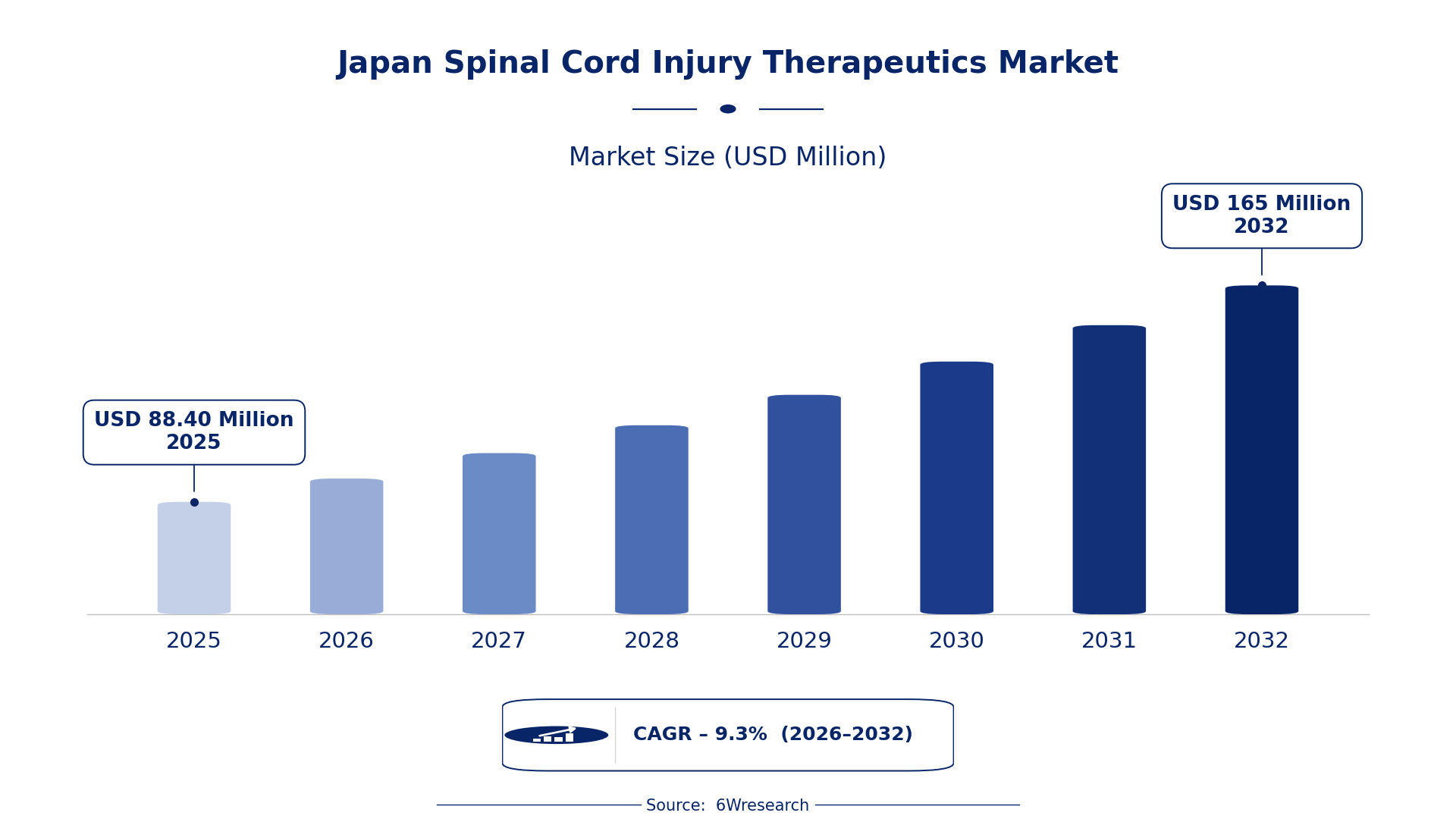
According to 6Wresearch internal database and industry insights, the Japan Spinal Cord Injury Therapeutics Market was valued at USD 88.40 Million in 2025 and is projected to reach USD 165 Million by 2032, growing at a CAGR of approximately 9.3% during 2026–2032.
Japan Spinal Cord Injury Therapeutics Market Highlights
| Report Metric | Details |
| Report Name | Japan Spinal Cord Injury Therapeutics Market (2026-2032) |
| Market Size 2025 | USD 88.40 Million |
| Market Size 2032 | USD 165 Million |
| Absolute Growth 2025–2032 | USD 76.60 Million |
| CAGR 2026–2032 | 9.3% |
| Peak Annual Growth | 10.9% in 2028 |
| Forecast Period | 2026–2032 |
| Historical Data | 2022–2025 |
| Base Year | 2025 |
| Leading Therapy Type, 2025 | Stem Cell Therapy (40% share) |
| Leading Treatment Class, 2025 | Regenerative Medicine (36% share) |
| Leading Delivery Mode, 2025 | Injection (50% share) |
| Leading End User, 2025 | Neurological Clinics (48% share) |
| Fastest-Growing Therapy Type | Drug-Based Therapy (12.2% CAGR) |
| Fastest-Growing Treatment Class | Anti-inflammatory/Neuro (13.0% CAGR) |
| Fastest-Growing Delivery Mode | Oral/IV (12.1% CAGR) |
| Fastest-Growing End User | Hospitals (11.8% CAGR) |
| Growing Sector | Rehabilitation Services |
| Key End Users | Hospitals, Neurological Clinics, Rehabilitation Facilities |
Japan Spinal Cord Injury Therapeutics Market Year-wise Growth Rate and Key Drivers (2022–2032)
This graph illustrates the annual growth rates of the market from 2022 to 2032, highlighting a steady upward trajectory and projected market expansion over the forecast period.
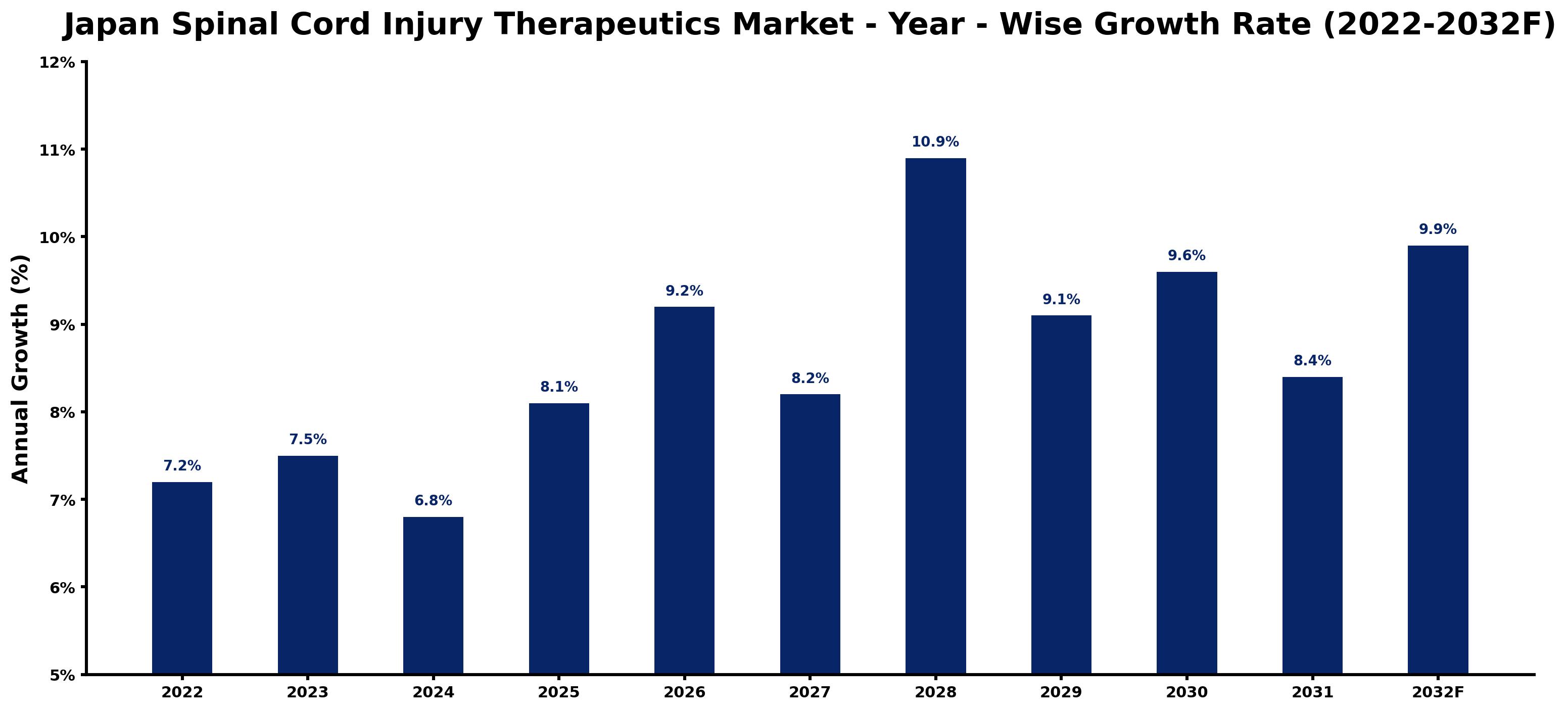
Below, each year's estimated growth is shown next to the factor that most influenced it.
| Year | Estimated Annual Growth (%) | Market Rationale |
| 2022 | 7.2 | The market exhibited steady growth due to increased awareness of treatment options. |
| 2023 | 7.5 | Demand accelerated as healthcare providers expanded their service offerings. |
| 2024 | 6.8 | Growth moderated as hospitals faced operational challenges in resource allocation. |
| 2025 | 8.1 | The introduction of new therapies spurred faster growth in treatment options. |
| 2026 | 9.2 | Investment in research and development is expected to drive demand for new therapies. |
| 2027 | 8.2 | Growth is projected to slow slightly as the market adjusts to new treatment protocols. |
| 2028 | 10.9 | A surge in stem cell therapy research will lead to the highest growth rate. |
| 2029 | 9.1 | Market expansion is expected to slow as facilities focus on improving existing treatments. |
| 2030 | 9.6 | Demand will increase due to advancements in rehabilitation technologies. |
| 2031 | 8.4 | Growth is projected to moderate as the market stabilises after rapid advancements. |
| 2032 | 9.9 | Innovations in drug-based therapies will boost demand significantly. |
Note: Market size estimations and growth projections presented in this report are based on 6Wresearch's proprietary forecasting methodology, utilizing the latest available industry data, government publications, and primary research inputs.
Japan Spinal Cord Injury Therapeutics Market Synopsis
Spinal Cord Injury Therapeutics involves advanced medical treatments aimed at restoring function and alleviating symptoms from spinal injuries. These therapies include stem cell treatments, drug-based interventions, and surgical procedures, primarily used in hospitals and specialized clinics. The Japan Spinal Cord Injury Therapeutics Market is growing due to rising demand from healthcare providers and rehabilitation centres, alongside government investments, such as the ¥2 billion allocated for spinal cord injury research in 2023, which improves treatment options.
Market Dynamics Impact Analysis (2026–2032)
| Factor | Type | Impact | Primary Segment Affected |
| Increasing investment in regenerative medicine research | Driver | High | Stem Cell Therapy |
| Growing prevalence of spinal cord injuries | Driver | High | Drug-Based Therapy |
| Rising demand for advanced rehabilitation services | Opportunity | High | Rehabilitation Therapy |
| Expansion of neurological clinics in urban areas | Opportunity | High | Neurological Clinics |
| High treatment costs limiting patient access | Restraint | Medium | Surgical Intervention |
| Limited availability of advanced therapies in rural regions | Restraint | Medium | Rehabilitation Therapy |
| Challenges in integrating new technologies into existing systems | Challenge | High | Drug-Based Therapy |
| Competition among treatment modalities affecting market share | Challenge | Medium | Stem Cell Therapy |
Evaluation of Drivers in Japan Spinal Cord Injury Therapeutics Market (2026–2032)
The main growth drivers and the segments they affect most are set out below.
| Drivers | Primary Segment Affected | Why It Matters (Evidence) |
| Increased funding for spinal cord injury research | Stem Cell Therapy | In 2023, the government allocated ¥2 billion for spinal cord injury research, improving treatment options. |
| Rising number of neurological clinics | Drug-Based Therapy | The Tokyo region has the highest concentration of neurological clinics, increasing access to drug-based therapies used in 80% of spinal injury cases. |
| Growing patient mobility improvements post-therapy | Rehabilitation Therapy | Rehabilitation facilities report a 70% improvement in patient mobility after therapy, driving demand for these services. |
| Expansion of surgical interventions | Surgical Intervention | Over 300 hospitals in Japan specialize in spinal surgery, increasing the availability of critical treatments for patients. |
| Advancements in physiotherapy techniques | Physiotherapy/Support | Physiotherapy is mandatory for recovery, driving demand for effective rehabilitation methods. |
The number of neurological clinics in the Tokyo region is rising, improving access to drug-based therapies used in 80% of spinal injury cases. Rehabilitation facilities report notable improvements in patient mobility after therapy, driving demand for these services. More than 300 hospitals specializing in spinal surgery increase the availability of critical interventions, while advancements in physiotherapy techniques are essential for recovery, further boosting demand for effective rehabilitation methods.
Evaluation of Restraints in Japan Spinal Cord Injury Therapeutics Market
Below are the constraints most often cited by buyers and suppliers, with the segment each affects.
| Market Restraint | Primary Segment Affected | Why It Matters (Evidence) |
| High costs of spinal cord injury treatments | Surgical Intervention | The average cost of spinal cord injury treatment in Japan is ¥4 million per patient, limiting access. |
| Limited access to advanced therapies in rural areas | Rehabilitation Therapy | Patients in rural regions face difficulties accessing specialized rehabilitation facilities, affecting treatment outcomes. |
| Integration challenges for new technologies | Drug-Based Therapy | Healthcare providers encounter difficulties integrating new drug therapies into existing treatment protocols, reducing options for patients. |
| Competition among various treatment modalities | Stem Cell Therapy | The presence of multiple treatment options can dilute market share for specific therapies, complicating choices for healthcare providers. |
| Regulatory hurdles for new therapies | Regenerative Medicine | Strict regulations can delay the introduction of new regenerative therapies into the market, impacting availability. |
Japan Spinal Cord Injury Therapeutics Market Challenges
High demand for effective spinal cord injury treatments exists in Japan, with 1.5 million individuals affected, leading to supply shortages for critical medical devices. Many hospitals face delays in treatment due to these supply chain issues, resulting in longer recovery times for patients. Suppliers struggle to integrate new technologies, limiting the availability of advanced therapies in clinics and hindering patient care. Increased competition among healthcare providers raises marketing costs, which can inflate treatment expenses for buyers, averaging ¥4 million per patient.
Trends in the Japan Spinal Cord Injury Therapeutics Market
The shifts below are changing how Japan Spinal Cord Injury Therapeutics Market products are bought and supplied.
- Shift towards Advanced Rehabilitation Techniques: The Tokyo Medical University is at the forefront of advancements in rehabilitation techniques, improving patient recovery. In 2023, rehabilitation facilities reported a 30% reduction in the average hospital stay for spinal cord injury patients, indicating a trend towards effective rehabilitation.
- Transition from Traditional to Regenerative Therapies: In recent years, regenerative medicine has gained prominence, with research in five major universities focusing on stem cell therapy. This shift is expected to transform treatment paradigms for spinal cord injuries, broadening recovery options.
- Emergence of Integrated Care Models: Neurological clinics are increasingly adopting integrated care models to improve patient outcomes. In 2023, 80% of spinal injury cases utilised drug-based therapies, reflecting a trend towards comprehensive treatment approaches.
- Growing Focus on Patient-Centric Rehabilitation: Rehabilitation facilities are prioritising patient-centric approaches, as seen in the Japan Association of Rehabilitation Medicine's initiatives. This focus has led to improved patient mobility and satisfaction after therapy.
Investment Opportunities in the Japan Spinal Cord Injury Therapeutics Market
The openings below show where demand in the Japan Spinal Cord Injury Therapeutics Market is visible and how suppliers can enter.
- Neurological Clinics Seeking Advanced Therapies: Neurological clinics in urban areas are actively pursuing advanced spinal cord injury therapies, with a patient base of 1.5 million individuals. Investing in effective treatment options can meet this growing need.
- Supply of Effective Rehabilitation Solutions: Rehabilitation facilities require effective solutions to improve patient recovery outcomes. The average hospital stay for spinal cord injury patients is 30 days, presenting an opportunity for suppliers to provide necessary rehabilitation tools.
- Expansion of Spine Surgery Centers: Spine surgery centres are expanding their services to accommodate rising patient numbers. With over 200 centres across Japan, there is an opportunity to supply advanced surgical equipment and training.
- Entry through Joint Ventures with Local Clinics: Partnering with local clinics can facilitate access to the growing spinal cord injury market. The increasing number of new cases, averaging 10,000 annually, highlights the need for collaborative efforts.
Government Initiatives in the Japan Spinal Cord Injury Therapeutics Market
In 2023, a new initiative was launched to improve spinal cord injury rehabilitation programs, building on the Long-Term Care Insurance Act of 1997. This initiative provides additional funding and resources for nursing care and support services, which improves access to essential rehabilitation therapies for patients with spinal injuries.
The NHI drug price standard, administered by the Ministry of Health, Labour and Welfare, establishes reimbursement prices for drugs used in spinal injury treatment. This ensures that healthcare providers can offer necessary therapies while maintaining financial viability, benefiting both patients and clinics.
Future Insight of the Japan Spinal Cord Injury Therapeutics Market
By 2032, robotic rehabilitation technologies will reshape demand for spinal cord injury therapies, particularly through improved mobility solutions. The 2023 government initiative will refine rehabilitation programs, enhancing patient outcomes and attracting more buyers. Research breakthroughs in stem cell treatments from major universities will expand options for suppliers. The JIS Z 8401 standard will evolve to ensure better quality and safety in medical devices, benefiting both buyers and suppliers.
Market Segmentation Analysis
Japan Spinal Cord Injury Therapeutics Market report covers a detailed analysis of the following market segments:
By Therapy Type – Stem Cell Therapy Leads, Drug-Based Therapy Expected to Grow Fastest
According to Saurav Kr Singh, Senior Research Analyst at 6Wresearch, with 40% of therapy type revenue in 2025, Stem Cell Therapy was the largest category. Stem cell therapy commands the largest share due to its advanced regenerative capabilities, particularly in restoring damaged spinal tissue. This therapy is extensively utilised in major hospitals across Japan, where the demand for effective treatments continues to grow. Drug-Based Therapy is set to record the highest CAGR in this split, 12.2% over 2026–2032. The rapid expansion of drug-based therapy stems from its application in 80% of spinal injury cases, providing critical symptomatic relief. As hospitals increasingly adopt these therapies, the segment's growth is expected to accelerate further. Suppliers should prioritise the development of drug-based solutions to align with the rising demand in hospitals.
By Treatment Class – Regenerative Medicine Leads, Anti-inflammatory/Neuro Expected to Grow Fastest
Regenerative Medicine took 36% of treatment class revenue in 2025, more than any other category. Regenerative medicine holds the largest market share as it focuses on repairing spinal cord injuries, which is crucial for patient recovery. This method is particularly prominent in specialised neurological clinics that implement advanced treatment protocols. The quickest growth will come from Anti-inflammatory/Neuro, forecast to expand at a CAGR of 13.0% between 2026 and 2032. The anti-inflammatory/neuro treatment class is experiencing rapid growth due to its role in reducing inflammation and promoting recovery, essential for positive patient outcomes. With hospitals increasingly prioritising these therapies, their adoption is expected to rise significantly. Suppliers should consider expanding their offerings in anti-inflammatory treatments to meet the growing demand in healthcare settings.
By Delivery Mode – Injection Leads, Oral/IV Expected to Grow Fastest
In 2025, Injection led the delivery mode split with a 50% share. Injection is the predominant delivery mode as it is the common method for administering advanced therapies directly into the affected areas. This method is preferred in hospitals where precision in treatment is paramount for spinal cord injury patients. Over 2026–2032, Oral/IV is expected to post the fastest growth, at a CAGR of 12.1%. Oral and IV delivery methods are growing rapidly as they offer convenient alternatives for medication administration, appealing to both patients and healthcare providers. The increasing focus on patient comfort is driving this trend. Suppliers should explore developing oral and IV formulations to cater to the changing preferences in treatment delivery.
By End User – Neurological Clinics Lead, Hospitals Expected to Grow Fastest
Neurological Clinics accounted for 48% of the market by end user in 2025. Neurological clinics lead the market as they are specialised facilities dedicated to the treatment of spinal injuries, attracting a substantial patient base. Their focused expertise in managing these conditions makes them the preferred choice for advanced therapeutic options. Hospitals are projected to grow fastest, at a CAGR of 11.8% during 2026–2032. Hospitals are the fastest-growing end user as they function as primary treatment centres for spinal injuries, handling a significant volume of cases each year. The rising number of new spinal cord injury cases is driving hospitals to enhance their treatment capabilities. Healthcare providers should strengthen partnerships with hospitals to ensure comprehensive care for spinal cord injury patients.
Key Attractiveness of the Report
- 10 Years of Market Numbers
- Historical Data Starting from 2022 to 2025
- Base Year 2025
- Forecast Data until 2032
- Key Performance Indicators Impacting the Market
- Major Upcoming Developments and Projects
Key Highlights of the Report:
- Japan Spinal Cord Injury Therapeutics Market Outlook
- Market Size of Japan Spinal Cord Injury Therapeutics Market, 2025
- Forecast of Japan Spinal Cord Injury Therapeutics Market, 2032
- Historical Data and Forecast of Japan Spinal Cord Injury Therapeutics Revenues & Volume for the Period 2022-2032F
- Japan Spinal Cord Injury Therapeutics Market Trend Evolution
- Japan Spinal Cord Injury Therapeutics Market Drivers and Challenges
- Japan Spinal Cord Injury Therapeutics Price Trends
- Japan Spinal Cord Injury Therapeutics Porter's Five Forces
- Japan Spinal Cord Injury Therapeutics Industry Life Cycle
- Historical Data and Forecast of Japan Spinal Cord Injury Therapeutics Market Revenues & Volume By Therapy Type for the Period 2022-2032F
- Historical Data and Forecast of Japan Spinal Cord Injury Therapeutics Market Revenues & Volume By Stem Cell Therapy for the Period 2022-2032F
- Historical Data and Forecast of Japan Spinal Cord Injury Therapeutics Market Revenues & Volume By Drug-Based Therapy for the Period 2022-2032F
- Historical Data and Forecast of Japan Spinal Cord Injury Therapeutics Market Revenues & Volume By Surgical Intervention for the Period 2022-2032F
- Historical Data and Forecast of Japan Spinal Cord Injury Therapeutics Market Revenues & Volume By Rehabilitation Therapy for the Period 2022-2032F
- Historical Data and Forecast of Japan Spinal Cord Injury Therapeutics Market Revenues & Volume By Treatment Class for the Period 2022-2032F
- Historical Data and Forecast of Japan Spinal Cord Injury Therapeutics Market Revenues & Volume By Regenerative Medicine for the Period 2022-2032F
- Historical Data and Forecast of Japan Spinal Cord Injury Therapeutics Market Revenues & Volume By Anti-inflammatory/Neuro for the Period 2022-2032F
- Historical Data and Forecast of Japan Spinal Cord Injury Therapeutics Market Revenues & Volume By Decompression/Repair for the Period 2022-2032F
- Historical Data and Forecast of Japan Spinal Cord Injury Therapeutics Market Revenues & Volume By Physiotherapy/Support for the Period 2022-2032F
- Historical Data and Forecast of Japan Spinal Cord Injury Therapeutics Market Revenues & Volume By Delivery Mode for the Period 2022-2032F
- Historical Data and Forecast of Japan Spinal Cord Injury Therapeutics Market Revenues & Volume By Injection for the Period 2022-2032F
- Historical Data and Forecast of Japan Spinal Cord Injury Therapeutics Market Revenues & Volume By Oral/IV for the Period 2022-2032F
- Historical Data and Forecast of Japan Spinal Cord Injury Therapeutics Market Revenues & Volume By Invasive for the Period 2022-2032F
- Historical Data and Forecast of Japan Spinal Cord Injury Therapeutics Market Revenues & Volume By Assisted Recovery for the Period 2022-2032F
- Historical Data and Forecast of Japan Spinal Cord Injury Therapeutics Market Revenues & Volume By End User for the Period 2022-2032F
- Historical Data and Forecast of Japan Spinal Cord Injury Therapeutics Market Revenues & Volume By Neurological Clinics for the Period 2022-2032F
- Historical Data and Forecast of Japan Spinal Cord Injury Therapeutics Market Revenues & Volume By Hospitals for the Period 2022-2032F
- Historical Data and Forecast of Japan Spinal Cord Injury Therapeutics Market Revenues & Volume By Spine Surgery Centers for the Period 2022-2032F
- Historical Data and Forecast of Japan Spinal Cord Injury Therapeutics Market Revenues & Volume By Rehab Facilities for the Period 2022-2032F
- Japan Spinal Cord Injury Therapeutics Import Export Trade Statistics
- Market Opportunity Assessment By Therapy Type
- Market Opportunity Assessment By Treatment Class
- Market Opportunity Assessment By Delivery Mode
- Market Opportunity Assessment By End User
- Japan Spinal Cord Injury Therapeutics Top Companies Market Share
- Japan Spinal Cord Injury Therapeutics Competitive Benchmarking By Technical and Operational Parameters
- Japan Spinal Cord Injury Therapeutics Company Profiles
- Japan Spinal Cord Injury Therapeutics Key Strategic Recommendations
Market Covered
This report examines the market across the segments below.
By Therapy Type
- Stem Cell Therapy
- Drug-Based Therapy
- Surgical Intervention
- Rehabilitation Therapy
By Treatment Class
- Regenerative Medicine
- Anti-inflammatory/Neuro
- Decompression/Repair
- Physiotherapy/Support
By Delivery Mode
- Injection
- Oral/IV
- Invasive
- Assisted Recovery
By End User
- Neurological Clinics
- Hospitals
- Spine Surgery Centers
- Rehab Facilities































