Japan Spirometry Interpretation AI Market Size & Growth Rate
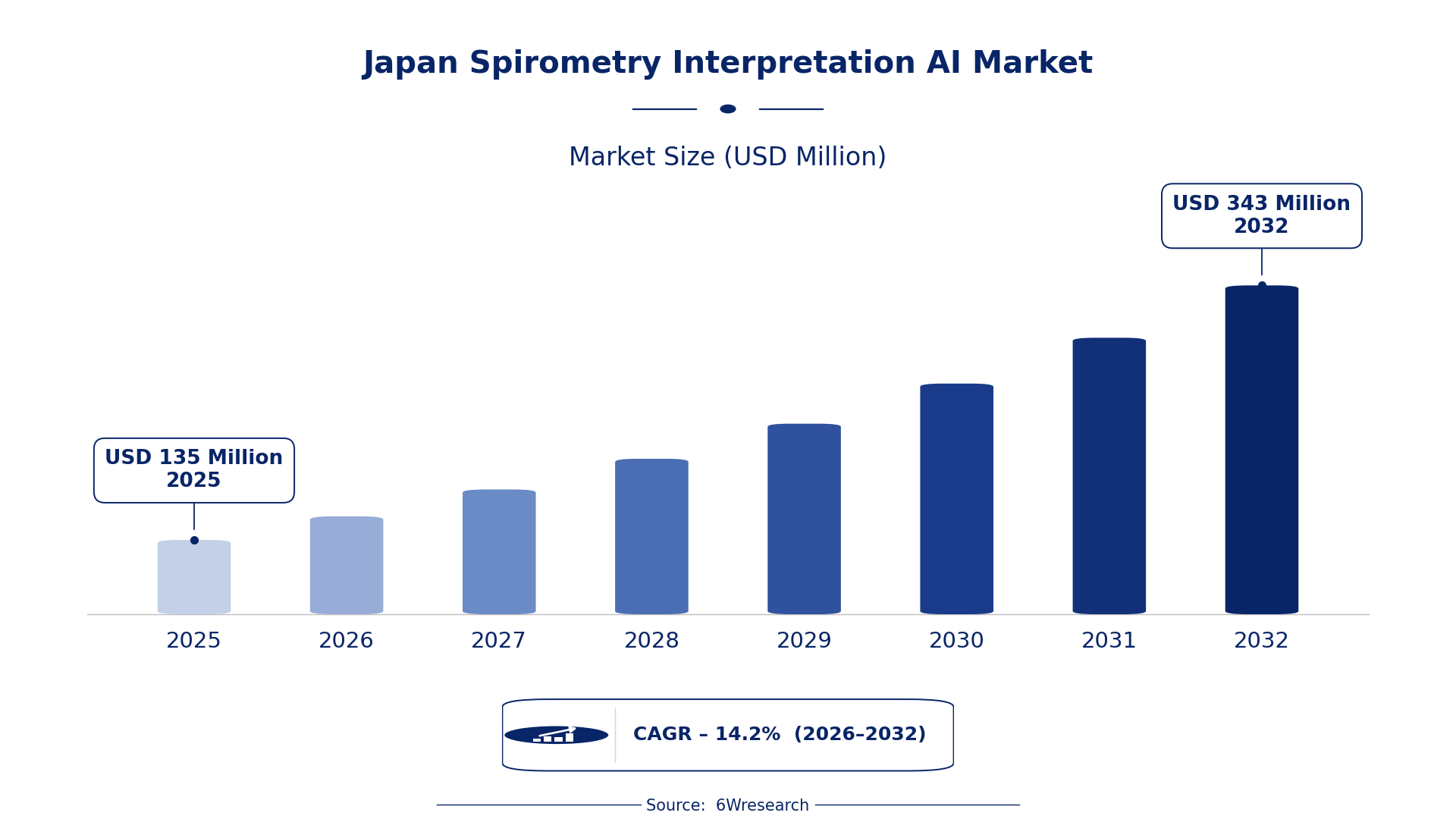
According to 6Wresearch internal database and industry insights, the Japan Spirometry Interpretation AI Market was valued at USD 135 Million in 2025 and is projected to reach USD 343 Million by 2032, growing at a CAGR of approximately 14.2% during 2026–2032.
Japan Spirometry Interpretation AI Market Highlights
| Report Metric | Details |
| Report Name | Japan Spirometry Interpretation AI Market (2026-2032) |
| Market Size 2025 | USD 135 Million |
| Market Size 2032 | USD 343 Million |
| Absolute Growth 2025–2032 | USD 208 Million |
| CAGR 2026–2032 | 14.2% |
| Peak Annual Growth | 19.8% in 2026 |
| Forecast Period | 2026–2032 |
| Historical Data | 2022–2025 |
| Base Year | 2025 |
| Leading AI Type, 2025 | Diagnostic AI (47% share) |
| Leading Output Function, 2025 | Lung Function Scoring (37% share) |
| Leading Deployment Mode, 2025 | Cloud/On-Premise (43% share) |
| Leading End User, 2025 | Hospitals (40% share) |
| Fastest-Growing AI Type | Predictive AI (19.6% CAGR) |
| Fastest-Growing Output Function | Risk Assessment (18.6% CAGR) |
| Fastest-Growing Deployment Mode | SaaS (16.2% CAGR) |
| Fastest-Growing End User | Health Monitoring Apps (17.5% CAGR) |
| Growing Sector | Healthcare |
| Key End Users | Hospitals, Pulmonary Clinics, Medical Device Firms, Health Monitoring Apps |
Japan Spirometry Interpretation AI Market Year-wise Growth Rate and Key Drivers (2022–2032)
This graph illustrates the annual growth rates of the market from 2022 to 2032, highlighting a steady upward trajectory and projected market expansion over the forecast period.
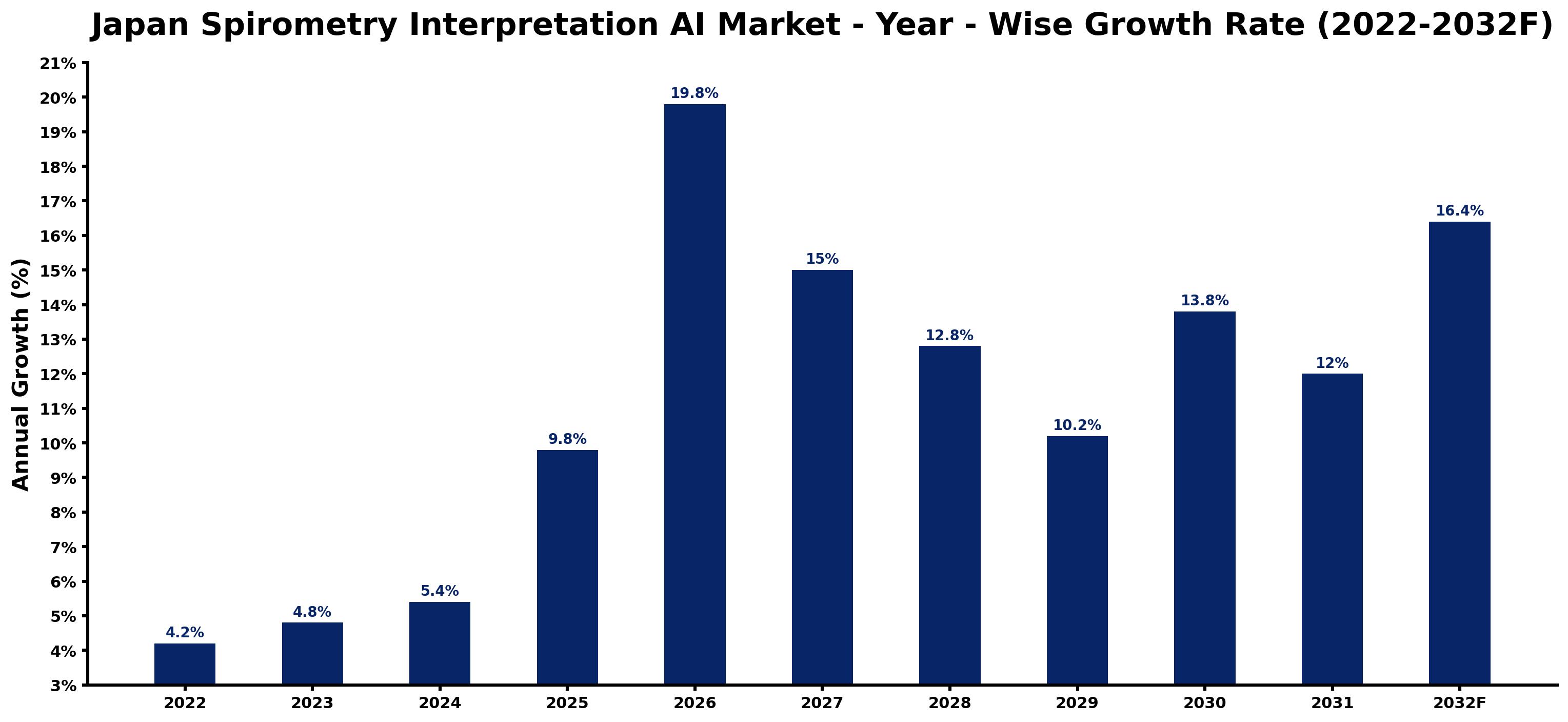
Below, each year's estimated growth is shown next to the factor that most influenced it.
| Year | Estimated Annual Growth (%) | Market Rationale |
| 2022 | 4.2 | The market experienced steady growth as healthcare providers began integrating AI solutions. |
| 2023 | 4.8 | Demand increased as more hospitals adopted AI for respiratory diagnostics and monitoring. |
| 2024 | 5.4 | Healthcare investments rose, driving the adoption of AI technologies in clinical settings. |
| 2025 | 9.8 | A surge in telemedicine initiatives significantly boosted demand for spirometry interpretation solutions. |
| 2026 | 19.8 | The peak growth year is driven by the rapid expansion of AI capabilities in healthcare. |
| 2027 | 15.0 | Growth slowed as the market began to stabilise after the peak in AI adoption. |
| 2028 | 12.8 | The market continued to grow but at a slower rate as competition intensified. |
| 2029 | 10.2 | Demand remained strong, supported by ongoing investments in digital health technologies. |
| 2030 | 13.8 | Growth accelerated again as new AI applications emerged in respiratory care. |
| 2031 | 12.0 | The market saw a slowdown as saturation in certain segments began to occur. |
| 2032 | 16.4 | Increased patient awareness and technological advancements will drive renewed growth. |
Note: Market size estimations and growth projections presented in this report are based on 6Wresearch's proprietary forecasting methodology, utilizing the latest available industry data, government publications, and primary research inputs.
Japan Spirometry Interpretation AI Market Synopsis
Spirometry Interpretation AI is a technology that uses artificial intelligence to analyse lung function data and improve diagnostic accuracy. The Japan Spirometry Interpretation AI Market is growing due to rising rates of chronic respiratory diseases, with approximately 10 million patients diagnosed. Increased telemedicine initiatives, such as the 2023 program to enhance respiratory care services, further stimulate demand from healthcare providers, particularly hospitals and pulmonary clinics, seeking advanced solutions for patient management.
Market Dynamics Impact Analysis (2026–2032)
| Factor | Type | Impact | Primary Segment Affected |
| Rising prevalence of chronic respiratory diseases | Driver | High | Diagnostic AI |
| Integration of AI in healthcare systems | Driver | High | Real-Time Analytics |
| Growing telemedicine adoption | Opportunity | High | Cloud/On-Premise |
| Increased funding for digital health initiatives | Opportunity | High | SaaS |
| High costs of AI implementation | Restraint | Medium | Predictive AI |
| Limited awareness among healthcare providers | Restraint | Medium | NLP-based Reporting |
| Competition from traditional diagnostic methods | Challenge | High | Lung Function Scoring |
| Regulatory hurdles for AI technologies | Challenge | Medium | Automated Reports |
Evaluation of Drivers in Japan Spirometry Interpretation AI Market (2026–2032)
The factors lifting demand, and the evidence behind each, are summarised below.
| Drivers | Primary Segment Affected | Why It Matters (Evidence) |
| Increasing patient population diagnosed with chronic respiratory diseases | Diagnostic AI | With around 10 million patients in Japan, healthcare providers are investing more in AI for accurate diagnoses. |
| High adoption rate of electronic medical records in hospitals | Real-Time Analytics | Over 80% of hospitals use electronic records, facilitating the integration of AI solutions for immediate assessments. |
| Growing telemedicine initiatives supporting remote patient monitoring | Cloud/On-Premise | The 2023 program to enhance telemedicine services is driving demand for AI solutions in respiratory care. |
| Support from health authorities for AI integration in healthcare | SaaS | Subsidies from the Health, Labour and Welfare Ministry are encouraging healthcare providers to adopt AI technologies. |
| Rising investments in digital health technologies | Predictive AI | The ¥1 billion allocated for digital health initiatives in 2022 is boosting the development of AI tools. |
A wider customer base explains much of the growth, as approximately 10 million patients diagnosed with chronic respiratory diseases are driving demand for AI solutions. The high adoption rate of electronic medical records, exceeding 80% in hospitals, facilitates the integration of AI for immediate assessments. Telemedicine initiatives are boosting demand for AI solutions in respiratory care. Support from health authorities through subsidies encourages the adoption of AI applications. The ¥1 billion allocated for digital health initiatives in 2022 stimulates investments in AI technologies.
Evaluation of Restraints in Japan Spirometry Interpretation AI Market
The key brakes on demand, and where they bite hardest, are shown below.
| Market Restraint | Primary Segment Affected | Why It Matters (Evidence) |
| High costs associated with AI implementation | Predictive AI | Healthcare providers face financial barriers, limiting their ability to adopt advanced AI technologies. |
| Limited awareness of AI benefits among healthcare providers | NLP-based Reporting | Many providers remain unaware of how AI can improve diagnostic accuracy, hindering market growth. |
| Competition from traditional diagnostic methods | Lung Function Scoring | Conventional techniques are still favoured by some healthcare providers, affecting AI adoption rates. |
| Regulatory hurdles for AI technologies | Automated Reports | Complex regulations can delay the approval and integration of AI solutions in healthcare settings. |
| Data privacy concerns regarding patient information | Real-Time Analytics | Strict data protection laws create apprehension among providers about using AI tools. |
Japan Spirometry Interpretation AI Market Challenges
In Japan, over 10 million individuals diagnosed with chronic respiratory diseases struggle with inadequate technology integration in spirometry, which hampers timely diagnoses for pulmonary clinics. This gap in advanced analytical tools results in delays that can prolong patient suffering and complicate treatment. A lack of skilled professionals in AI and data interpretation restricts healthcare providers' capacity to implement these technologies, causing longer wait times for patients seeking care. Stringent regulatory standards, such as ISO 13485, impose additional operational costs on producers, which can inflate prices for clinics and ultimately burden patients needing effective diagnostic solutions.
Trends in the Japan Spirometry Interpretation AI Market
Several trends are reshaping the Japan Spirometry Interpretation AI Market; the most important are set out below.
- Shift in Focus to Telemedicine: Healthcare providers are increasingly adopting telemedicine solutions, with the 2023 program improving respiratory care services. This shift is reflected as more hospitals integrate AI for remote monitoring, indicating a growing trend in patient management.
- Transition from Traditional to AI-Driven Diagnostics: The integration of AI technologies is transforming diagnostic practices, particularly in respiratory care. The Japan Respiratory Society's guidelines support this shift, resulting in improved diagnostic accuracy and patient outcomes.
- Emergence of Real-Time Analytics: Real-Time Analytics is gaining traction as hospitals seek immediate assessments of lung function. This trend is supported by the high adoption rate of electronic medical records, exceeding 80% in Japan.
- Prioritisation of Cloud Solutions in Healthcare: Cloud/On-Premise deployment modes are becoming preferred as healthcare facilities seek scalable AI solutions. The Tokyo region, accounting for 30% of healthcare facilities, is at the forefront of this transition.
Investment Opportunities in the Japan Spirometry Interpretation AI Market
Where to invest in the Japan Spirometry Interpretation AI Market: the main openings are set out below.
- Increased Demand for Remote Monitoring Solutions: Pulmonary clinics are seeking advanced AI tools to improve remote patient monitoring, driven by the growing patient population. The demand is amplified by the 2023 telemedicine program, creating opportunities for suppliers.
- Investment in Predictive AI Technologies: Healthcare providers are looking for advanced AI solutions to forecast respiratory issues, especially with the rising chronic disease rates. The ¥1 billion funding for digital health initiatives in 2022 presents a timely opportunity for investment.
- Expansion of SaaS Applications in Healthcare: The growing need for scalable AI solutions among hospitals creates a significant opportunity for SaaS providers. The high adoption rate of electronic medical records supports this trend, making it an ideal time to enter the market.
- Collaboration with Health Monitoring Apps: Health monitoring apps are increasingly integrating AI for supplementary health tracking, presenting opportunities for partnerships. The rising patient awareness of respiratory health creates a favourable environment for new entrants.
Government Initiatives in the Japan Spirometry Interpretation AI Market
The Next-Generation Medical Infrastructure Act, enacted in 2017, allows certified bodies to anonymise medical data for research, facilitating the development of AI technologies in healthcare. The Clinical Trials Act, effective from 2018, sets rules for clinical research, ensuring compliance and safety in AI applications, which benefits both producers and buyers.
The PMDA reviews medical devices and monitors post-market safety, supporting the integration of AI technologies. AMED funds medical research and development, enabling buyers to access advanced AI solutions that improve diagnostic capabilities.
Future Insight of the Japan Spirometry Interpretation AI Market
By 2032, the integration of AI technology will transform spirometry interpretation and patient management in respiratory care. The Ministry of Health's telemedicine initiative will improve remote monitoring capabilities, broadening access for individuals throughout Japan. Government funding for digital health initiatives will drive the uptake of AI solutions, simplifying diagnostic processes for healthcare providers. With over 1,200 pulmonary clinics available, the incorporation of AI will enable better data sharing and refine treatment plans, resulting in improved outcomes for patients.
Market Segmentation Analysis
Japan Spirometry Interpretation AI Market report covers a detailed analysis of the following market segments:
By AI Type – Diagnostic AI Leads, Predictive AI Expected to Grow Fastest
According to Saurav Kr Singh, Senior Research Analyst at 6Wresearch, Diagnostic AI took 47% of ai type revenue in 2025, more than any other category. Diagnostic AI holds the largest share as it is vital for analysing lung conditions, which healthcare providers rely on for accurate patient assessments. With over 10 million patients diagnosed with chronic respiratory diseases, the need for precise diagnostics is critical. Over 2026–2032, Predictive AI is expected to post the fastest growth, at a CAGR of 19.6%. Predictive AI is experiencing rapid growth as healthcare providers increasingly seek tools for forecasting potential respiratory issues, particularly given the ageing population. The average age of spirometry patients, around 65 years, underscores the urgency for proactive health management solutions. Suppliers should enhance their predictive capabilities to align with the rising demand for preventive healthcare solutions.
By Output Function – Lung Function Scoring Leads, Risk Assessment Expected to Grow Fastest
Lung Function Scoring held 37% of the Japan Spirometry Interpretation AI Market by output function in 2025. Lung Function Scoring leads in output functions due to its critical role in evaluating patient lung health, widely used in clinical practices. This function is essential for the approximately 10 million patients requiring regular assessments of their lung conditions. Risk Assessment is projected to grow fastest, at a CAGR of 18.6% during 2026–2032. Risk Assessment is witnessing rapid growth because it plays a crucial role in identifying patients at risk of complications, especially in a healthcare landscape prioritising preventive care. The recent allocation of ¥1 billion for digital health initiatives further drives this trend. Buyers should prioritise solutions that incorporate comprehensive risk assessment features to enhance patient outcomes.
By Deployment Mode – Cloud/On-Premise Leads, SaaS Expected to Grow Fastest
The largest deployment mode category in 2025 was Cloud/On-Premise, at 43% of revenue. Cloud/On-Premise deployment is the dominant mode, enabling healthcare providers to effectively implement AI solutions across diverse settings. This flexibility is essential for the more than 1,200 pulmonary clinics in Japan that require tailored deployment strategies. SaaS are set to record the highest CAGR in this split, 16.2% over 2026–2032. SaaS is the fastest-growing deployment mode, propelled by the increasing need for scalable access to AI tools that can adapt to changing healthcare demands. The high adoption rate of electronic medical records supports this transition towards cloud-based solutions. Suppliers must ensure their SaaS offerings are robust and user-friendly to attract a growing customer base.
By End User – Hospitals Lead, Health Monitoring Apps Expected to Grow Fastest
Hospitals accounted for 40% of the market by end user in 2025. Hospitals are the primary end users of Spirometry Interpretation AI, serving as key environments for applying this technology in managing respiratory conditions. Given that a significant portion of Japan's population suffers from respiratory diseases, hospitals are central to effective patient care. The quickest growth will come from Health Monitoring Apps, forecast to expand at a CAGR of 17.5% between 2026 and 2032. Health Monitoring Apps are rapidly expanding as they utilise AI for supplementary health tracking, reflecting the increasing emphasis on remote patient management. The Ministry of Health's telemedicine programme further accelerates this trend. Suppliers should explore partnerships with health app developers to broaden their reach in the consumer health market.
Key Attractiveness of the Report
- 10 Years of Market Numbers
- Historical Data Starting from 2022 to 2025
- Base Year 2025
- Forecast Data until 2032
- Key Performance Indicators Impacting the Market
- Major Upcoming Developments and Projects
Key Highlights of the Report:
- Japan Spirometry Interpretation AI Market Outlook
- Market Size of Japan Spirometry Interpretation AI Market, 2025
- Forecast of Japan Spirometry Interpretation AI Market, 2032
- Historical Data and Forecast of Japan Spirometry Interpretation AI Revenues & Volume for the Period 2022-2032F
- Japan Spirometry Interpretation AI Market Trend Evolution
- Japan Spirometry Interpretation AI Market Drivers and Challenges
- Japan Spirometry Interpretation AI Price Trends
- Japan Spirometry Interpretation AI Porter's Five Forces
- Japan Spirometry Interpretation AI Industry Life Cycle
- Historical Data and Forecast of Japan Spirometry Interpretation AI Market Revenues & Volume By AI Type for the Period 2022-2032F
- Historical Data and Forecast of Japan Spirometry Interpretation AI Market Revenues & Volume By Diagnostic AI for the Period 2022-2032F
- Historical Data and Forecast of Japan Spirometry Interpretation AI Market Revenues & Volume By Predictive AI for the Period 2022-2032F
- Historical Data and Forecast of Japan Spirometry Interpretation AI Market Revenues & Volume By Real-Time Analytics for the Period 2022-2032F
- Historical Data and Forecast of Japan Spirometry Interpretation AI Market Revenues & Volume By NLP-based Reporting for the Period 2022-2032F
- Historical Data and Forecast of Japan Spirometry Interpretation AI Market Revenues & Volume By Output Function for the Period 2022-2032F
- Historical Data and Forecast of Japan Spirometry Interpretation AI Market Revenues & Volume By Lung Function Scoring for the Period 2022-2032F
- Historical Data and Forecast of Japan Spirometry Interpretation AI Market Revenues & Volume By Risk Assessment for the Period 2022-2032F
- Historical Data and Forecast of Japan Spirometry Interpretation AI Market Revenues & Volume By Breathing Pattern Alerts for the Period 2022-2032F
- Historical Data and Forecast of Japan Spirometry Interpretation AI Market Revenues & Volume By Automated Reports for the Period 2022-2032F
- Historical Data and Forecast of Japan Spirometry Interpretation AI Market Revenues & Volume By Deployment Mode for the Period 2022-2032F
- Historical Data and Forecast of Japan Spirometry Interpretation AI Market Revenues & Volume By Cloud/On-Premise for the Period 2022-2032F
- Historical Data and Forecast of Japan Spirometry Interpretation AI Market Revenues & Volume By EMR-Integrated for the Period 2022-2032F
- Historical Data and Forecast of Japan Spirometry Interpretation AI Market Revenues & Volume By Embedded in Devices for the Period 2022-2032F
- Historical Data and Forecast of Japan Spirometry Interpretation AI Market Revenues & Volume By SaaS for the Period 2022-2032F
- Historical Data and Forecast of Japan Spirometry Interpretation AI Market Revenues & Volume By End User for the Period 2022-2032F
- Historical Data and Forecast of Japan Spirometry Interpretation AI Market Revenues & Volume By Pulmonary Clinics for the Period 2022-2032F
- Historical Data and Forecast of Japan Spirometry Interpretation AI Market Revenues & Volume By Hospitals for the Period 2022-2032F
- Historical Data and Forecast of Japan Spirometry Interpretation AI Market Revenues & Volume By Medical Device Firms for the Period 2022-2032F
- Historical Data and Forecast of Japan Spirometry Interpretation AI Market Revenues & Volume By Health Monitoring Apps for the Period 2022-2032F
- Japan Spirometry Interpretation AI Import Export Trade Statistics
- Market Opportunity Assessment By AI Type
- Market Opportunity Assessment By Output Function
- Market Opportunity Assessment By Deployment Mode
- Market Opportunity Assessment By End User
- Japan Spirometry Interpretation AI Top Companies Market Share
- Japan Spirometry Interpretation AI Competitive Benchmarking By Technical and Operational Parameters
- Japan Spirometry Interpretation AI Company Profiles
- Japan Spirometry Interpretation AI Key Strategic Recommendations
Market Covered
This report examines the market across the segments below.
By AI Type
- Diagnostic AI
- Predictive AI
- Real-Time Analytics
- NLP-based Reporting
By Output Function
- Lung Function Scoring
- Risk Assessment
- Breathing Pattern Alerts
- Automated Reports
By Deployment Mode
- Cloud/On-Premise
- EMR-Integrated
- Embedded in Devices
- SaaS
By End User
- Pulmonary Clinics
- Hospitals
- Medical Device Firms
- Health Monitoring Apps































