Japan Sports Biomechanics Market Size & Growth Rate
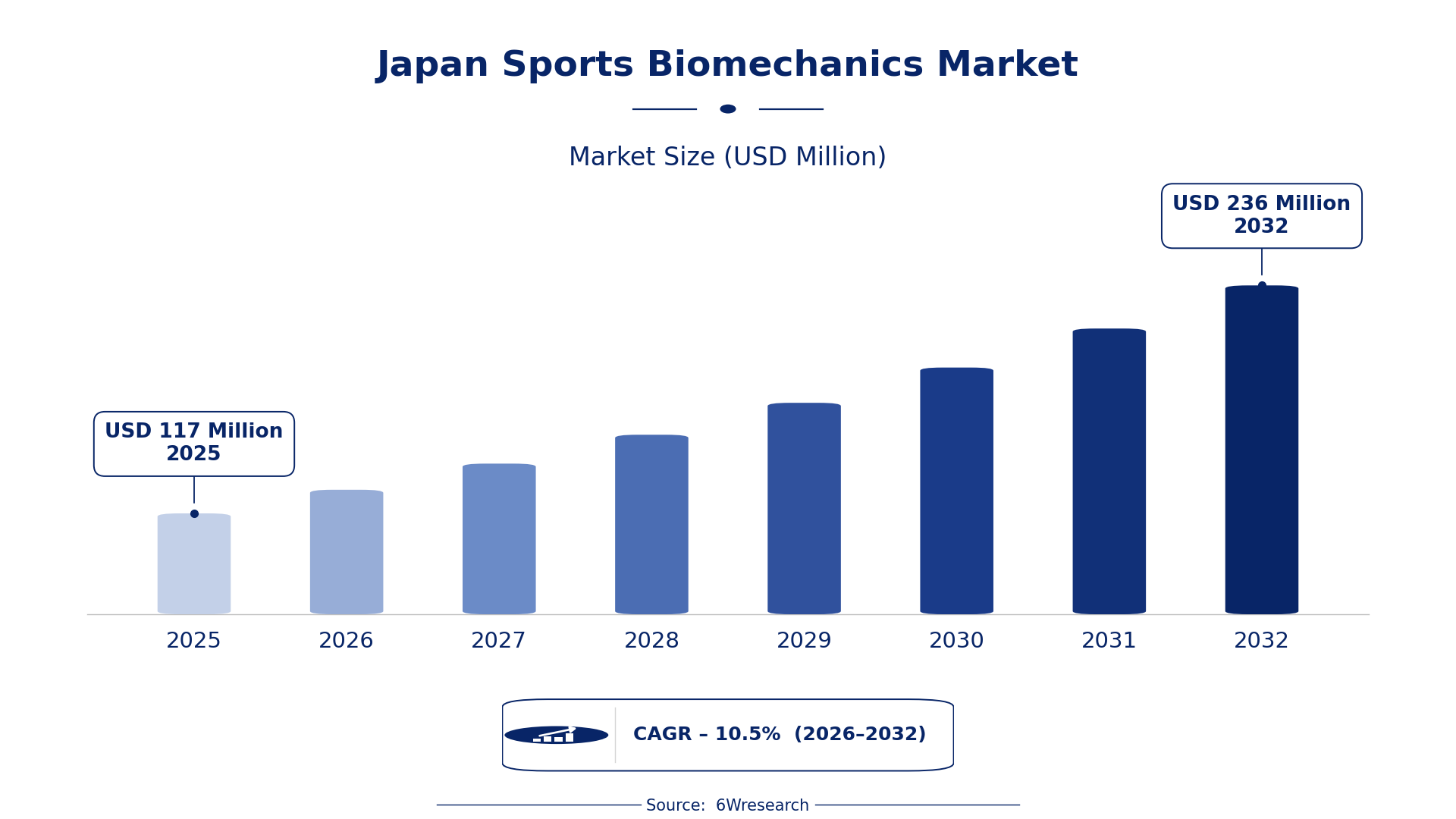
According to 6Wresearch internal database and industry insights, the Japan Sports Biomechanics Market was valued at USD 117 Million in 2025 and is projected to reach USD 236 Million by 2032, growing at a CAGR of approximately 10.5% during 2026–2032.
Japan Sports Biomechanics Market Highlights
| Report Metric | Details |
| Report Name | Japan Sports Biomechanics Market (2026-2032) |
| Market Size 2025 | USD 117 Million |
| Market Size 2032 | USD 236 Million |
| Absolute Growth 2025–2032 | USD 119 Million |
| CAGR 2026–2032 | 10.5% |
| Peak Annual Growth | 12.1% in 2026 |
| Forecast Period | 2026–2032 |
| Historical Data | 2022–2025 |
| Base Year | 2025 |
| Leading Measurement Type, 2025 | Gait Analysis (38% share) |
| Leading Motion Area, 2025 | Lower Limbs (39% share) |
| Leading Equipment Used, 2025 | Treadmill + Sensors (39% share) |
| Leading End User, 2025 | Rehab Centers (34% share) |
| Fastest-Growing Measurement Type | Throwing Mechanics (14.3% CAGR) |
| Fastest-Growing Motion Area | Upper Limbs (12.4% CAGR) |
| Fastest-Growing Equipment Used | Motion Capture Systems (13.4% CAGR) |
| Fastest-Growing End User | Athletic Teams (13.1% CAGR) |
| Growing Sector | rehabilitation |
| Key End Users | rehab centers, athletic teams, fitness labs, sports scientists |
Japan Sports Biomechanics Market Year-wise Growth Rate and Key Drivers (2022–2032)
This graph illustrates the annual growth rates of the market from 2022 to 2032, highlighting a steady upward trajectory and projected market expansion over the forecast period.
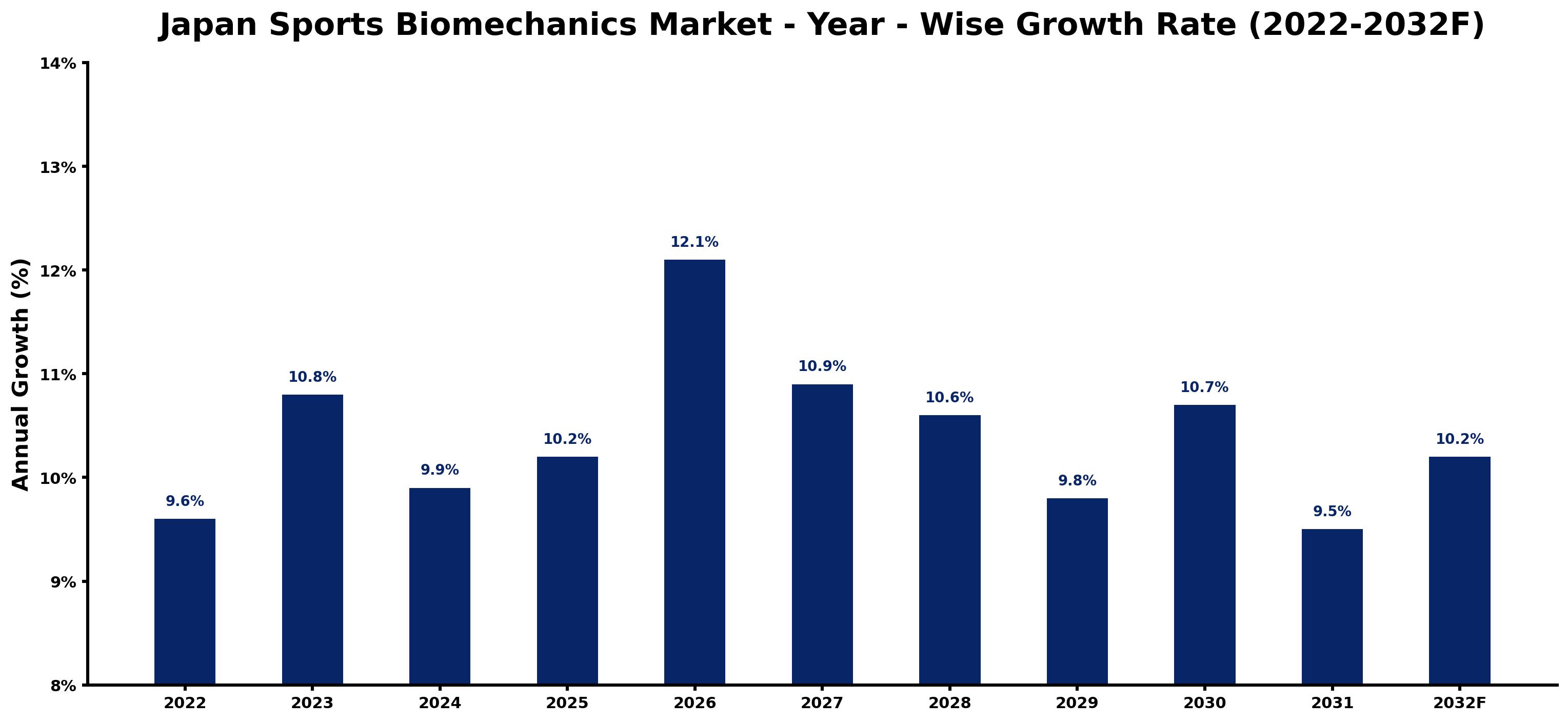
The table below sets out the estimated growth rate for each year and the main factor behind it.
| Year | Estimated Annual Growth (%) | Market Rationale |
| 2022 | 9.6 | The market experienced solid growth due to increased awareness of biomechanics in sports. |
| 2023 | 10.8 | Demand rose as athletic teams invested more in performance analysis technologies. |
| 2024 | 9.9 | Growth slowed slightly as some facilities faced budget constraints in spending. |
| 2025 | 10.2 | Rehabilitation centers expanded their services, boosting demand for biomechanics applications. |
| 2026 | 12.1 | The market is expected to surge as the government launches new sports science initiatives. |
| 2027 | 10.9 | Growth will decelerate as competition intensifies among service providers in the biomechanics sector. |
| 2028 | 10.6 | Demand is projected to continue slowing as market saturation begins to take effect. |
| 2029 | 9.8 | The market will see a further slowdown as some buyers delay investments. |
| 2030 | 10.7 | Growth is expected to pick up again as new technologies enter the market. |
| 2031 | 9.5 | A slowdown will occur as the market adjusts to changing consumer preferences. |
| 2032 | 10.2 | Demand is expected to rise again as athletic teams seek advanced performance solutions. |
Note: Market size estimations and growth projections presented in this report are based on 6Wresearch's proprietary forecasting methodology, utilizing the latest available industry data, government publications, and primary research inputs.
Japan Sports Biomechanics Market Synopsis
This field employs technologies like motion capture and force analysis, with applications in performance improvement and rehabilitation. The Japan Sports Biomechanics Market is expanding, driven by increasing demand from athletic teams and rehabilitation centres, alongside government initiatives such as the 2023 programme aimed at enhancing athlete performance through biomechanics, which allocated substantial funding for research.
Market Dynamics Impact Analysis (2026–2032)
| Factor | Type | Impact | Primary Segment Affected |
| Increasing adoption of gait analysis technology in rehab centers | Driver | High | Gait Analysis |
| Growing interest in performance optimization among athletic teams | Driver | High | Throwing Mechanics |
| Expansion of rehabilitation centers incorporating biomechanics | Opportunity | High | Rehab Centers |
| Rising demand for motion capture systems in elite sports training | Opportunity | High | Motion Capture Systems |
| High costs associated with advanced biomechanics equipment | Restraint | Medium | Force Platforms |
| Limited awareness among smaller athletic teams about biomechanics benefits | Restraint | Medium | Jump Testing |
| Competition from alternative training methods in sports performance | Challenge | High | Upper Limbs |
| Technological advancements outpacing current training methods | Challenge | Medium | Full-Body |
Evaluation of Drivers in Japan Sports Biomechanics Market (2026–2032)
The main growth drivers and the segments they affect most are set out below.
| Drivers | Primary Segment Affected | Why It Matters (Evidence) |
| Increased investment in gait analysis technology | Gait Analysis | 30% of athletic teams in Japan employ biomechanics for training, driving demand for gait analysis. |
| Growing focus on injury prevention in sports training | Throwing Mechanics | The average population of athletes in Japan is around 2 million, increasing the need for throwing mechanics analysis. |
| Rising number of rehab centers integrating biomechanics | Rehab Centers | Japan has over 1,200 rehab centers utilizing sports biomechanics for injury recovery, boosting demand. |
| Expansion of elite sports training facilities | Motion Capture Systems | Motion capture systems are widely used in elite sports training facilities, improving performance analysis. |
| Increased funding for sports science research | Fitness Labs | In 2023, the government allocated ¥500 million for sports science research initiatives, promoting biomechanics. |
The strongest pull on demand comes from the Tokyo region, where elite sports training facilities are increasingly adopting motion capture systems. The average population of athletes in Japan is around 2 million, leading to a growing focus on injury prevention in sports training. This funding supports the rising number of rehab centres incorporating biomechanics for injury recovery, improving overall performance outcomes.
Evaluation of Restraints in Japan Sports Biomechanics Market
These restraints slow adoption and weigh on supplier margins.
| Market Restraint | Primary Segment Affected | Why It Matters (Evidence) |
| High costs associated with advanced biomechanics equipment | Force Platforms | The average cost of force platforms can exceed JPY 1 million, limiting accessibility for smaller facilities. |
| Limited awareness among smaller athletic teams about biomechanics benefits | Jump Testing | Many smaller athletic teams lack knowledge of biomechanics, resulting in underutilization of jump testing technologies. |
| Competition from alternative training methods in sports performance | Upper Limbs | Some teams prefer traditional training methods, which can hinder the adoption of biomechanics for upper limb analysis. |
| Technological advancements outpacing current training methods | Full-Body | Rapid technological changes create challenges for facilities to keep up with the latest applications in biomechanics. |
| Regulatory hurdles for new biomechanics equipment approval | Throwing Mechanics | Compliance with standards like ISO 9001 can delay the introduction of new technologies for throwing mechanics. |
Japan Sports Biomechanics Market Challenges
High regulatory costs from the Pharmaceuticals and Medical Devices Agency can delay product approvals by up to six months, causing producers to miss critical market opportunities. Importers struggle with high prices for advanced biomechanics equipment, which can reach JPY 10 million per unit, limiting their ability to stock essential items and raising costs for clinics. Buyers face increased expenses as rehabilitation programs integrating biomechanics can raise costs by 20%, making treatments less accessible. Clinics encounter longer patient recovery times due to a shortage of trained professionals, resulting in extended wait times for patients needing biomechanics services.
Trends in the Japan Sports Biomechanics Market
Several trends are reshaping the Japan Sports Biomechanics Market; the most important are set out below.
- Shift from Traditional to Advanced Biomechanics: A shift is occurring from traditional training methods to advanced biomechanics technologies. The Tokyo region is at the forefront, with a growing number of facilities adopting motion capture systems for performance analysis, reflecting a notable increase in demand for gait analysis technology.
- Emergence of Rehabilitation Programs: Rehabilitation centres are increasingly integrating biomechanics into their patient recovery programs. In 2023, the Japan Sports Agency launched a programme to enhance athlete performance using biomechanics, allocating substantial funding to support this integration.
- Growing Importance of Performance Optimization: Athletic teams are prioritising performance optimisation through biomechanics. Approximately 30% of athletic teams in Japan are now employing biomechanics in training, highlighting a trend towards data-driven performance improvement.
- Expansion of Sports Science Research Initiatives: The Tokyo region is experiencing an expansion of sports science research initiatives. In 2023, the government allocated substantial funding for sports science research, promoting collaboration between universities and sports organisations.
Investment Opportunities in the Japan Sports Biomechanics Market
The following areas offer the clearest openings for investors and suppliers in the Japan Sports Biomechanics Market.
- Investment in Rehabilitation Centers: Rehabilitation centres are increasingly adopting biomechanics for injury recovery. This presents an opportunity to supply advanced biomechanics technologies, addressing the growing demand for effective rehabilitation solutions.
- Supply of Motion Capture Systems: The demand for motion capture systems is rising, particularly in elite sports training facilities. With a projected increase in gait analysis technology demand, suppliers can target athletic teams looking to improve performance.
- Expansion of Biomechanics in Fitness Labs: Fitness labs are expanding their services to include biomechanics research and testing. The average population of athletes in Japan is around 2 million, indicating a strong market for biomechanics equipment and services.
- Collaboration with Athletic Teams: Athletic teams are increasingly investing in biomechanics for competitive advantage. Suppliers can enter this market by forming partnerships with teams to provide tailored biomechanics solutions.
Government Initiatives in the Japan Sports Biomechanics Market
The Next-Generation Medical Infrastructure Act, enacted in 2017, strengthens the framework for integrating medical data in research, building on previous laws. This act facilitates the anonymisation of medical data, improving research and product development in sports biomechanics, which enhances the quality of care and performance outcomes for athletes.
In 2023, the government allocated ¥500 million for sports science research initiatives, administered by the Japan Agency for Medical Research and Development (AMED). This funding supports various projects aimed at improving athlete performance through biomechanics, ensuring that research aligns with industry needs.
Future Insight of the Japan Sports Biomechanics Market
A policy-driven shift will prioritise athlete performance, prompting suppliers to invest in advanced rehabilitation technologies and enhanced training programmes. The Japan Sports Agency's funding will support initiatives that integrate biomechanics into training, benefiting athletes and rehab centres. As the population ages, the demand for biomechanics in injury recovery will rise, with an estimated increase of 25% in rehab centre utilisation. Collaborations between universities and sports organisations will drive research, ensuring a continuous flow of new technologies and methodologies.
Market Segmentation Analysis
Japan Sports Biomechanics Market report covers a detailed analysis of the following market segments:
By Measurement Type – Gait Analysis Leads, Throwing Mechanics Expected to Grow Fastest
According to Saurav Kr Singh, Senior Research Analyst at 6Wresearch, in 2025, Gait Analysis led the measurement type split with a 38% share. Gait analysis holds the largest share as it is crucial for assessing walking patterns and improving athletic performance. For instance, over 1,200 rehab centres in Japan utilise this method to support effective recovery for athletes. Throwing Mechanics are set to record the highest CAGR in this split, 14.3% over 2026–2032. The rapid growth of throwing mechanics is attributed to increased investments from athletic teams focused on enhancing performance and preventing injuries. This trend is evident as the demand for related technology has risen significantly in recent years. Suppliers should prioritise the development of gait analysis tools to meet the increasing needs of rehab centres.
By Motion Area – Lower Limbs Lead, Upper Limbs Expected to Grow Fastest
Lower Limbs took 39% of motion area revenue in 2025, more than any other category. Lower limbs dominate the market due to their critical role in leg movement and injury prevention, especially in sports. This focus is highlighted by the fact that more than 30% of athletic teams in Japan analyse lower limb performance regularly. The quickest growth will come from Upper Limbs, forecast to expand at a CAGR of 12.4% between 2026 and 2032. Upper limb analysis is growing quickly as awareness increases regarding the impact of arm and shoulder movements on sports performance. The interest in this area has notably intensified following the Tokyo 2020 Olympics, driving further research and application. Buyers should consider investing in upper limb analysis technologies to enhance their competitive position in the sports industry.
By Equipment Used – Treadmill + Sensors Lead, Motion Capture Systems Expected to Grow Fastest
Treadmill + Sensors accounted for 39% of the market by equipment used in 2025. Treadmill and sensors are at the forefront as they are critical for gait analysis and performance testing, widely used across rehabilitation facilities. Their adoption in rehab centres guarantees precise evaluations of patient progress. Motion Capture Systems are projected to grow fastest, at a CAGR of 13.4% during 2026–2032. Motion capture systems are rapidly gaining traction as they deliver detailed movement data essential for analysis in elite sports training. The increasing dependence on accurate movement tracking in athletic training is propelling this segment's growth. Suppliers should focus on developing motion capture systems to meet the escalating demand from athletic teams.
By End User – Rehab Centers Lead, Athletic Teams Expected to Grow Fastest
Rehab Centers held 34% of the Japan Sports Biomechanics Market by end user in 2025. Rehab centres lead the market as they extensively apply biomechanics for patient rehabilitation, ensuring effective recovery protocols. The existence of around 1,200 rehab centres in Japan reflects a strong and ongoing demand for these services. Over 2026–2032, Athletic Teams are expected to post the fastest growth, at a CAGR of 13.1%. Athletic teams are rapidly adopting biomechanics for training and performance analysis, indicating a shift towards data-driven methodologies in sports. The heightened focus on performance optimisation, particularly after the Tokyo 2020 Olympics, has accelerated this trend. Buyers in the sports sector should enhance their biomechanics capabilities to improve athlete performance and recovery outcomes.
Key Attractiveness of the Report
- 10 Years of Market Numbers
- Historical Data Starting from 2022 to 2025
- Base Year 2025
- Forecast Data until 2032
- Key Performance Indicators Impacting the Market
- Major Upcoming Developments and Projects
Key Highlights of the Report:
- Japan Sports Biomechanics Market Outlook
- Market Size of Japan Sports Biomechanics Market, 2025
- Forecast of Japan Sports Biomechanics Market, 2032
- Historical Data and Forecast of Japan Sports Biomechanics Revenues & Volume for the Period 2022-2032F
- Japan Sports Biomechanics Market Trend Evolution
- Japan Sports Biomechanics Market Drivers and Challenges
- Japan Sports Biomechanics Price Trends
- Japan Sports Biomechanics Porter's Five Forces
- Japan Sports Biomechanics Industry Life Cycle
- Historical Data and Forecast of Japan Sports Biomechanics Market Revenues & Volume By Measurement Type for the Period 2022-2032F
- Historical Data and Forecast of Japan Sports Biomechanics Market Revenues & Volume By Gait Analysis for the Period 2022-2032F
- Historical Data and Forecast of Japan Sports Biomechanics Market Revenues & Volume By Throwing Mechanics for the Period 2022-2032F
- Historical Data and Forecast of Japan Sports Biomechanics Market Revenues & Volume By Jump Testing for the Period 2022-2032F
- Historical Data and Forecast of Japan Sports Biomechanics Market Revenues & Volume By Reaction Analysis for the Period 2022-2032F
- Historical Data and Forecast of Japan Sports Biomechanics Market Revenues & Volume By Motion Area for the Period 2022-2032F
- Historical Data and Forecast of Japan Sports Biomechanics Market Revenues & Volume By Lower Limbs for the Period 2022-2032F
- Historical Data and Forecast of Japan Sports Biomechanics Market Revenues & Volume By Upper Limbs for the Period 2022-2032F
- Historical Data and Forecast of Japan Sports Biomechanics Market Revenues & Volume By Full-Body for the Period 2022-2032F
- Historical Data and Forecast of Japan Sports Biomechanics Market Revenues & Volume By Reflex & Coordination for the Period 2022-2032F
- Historical Data and Forecast of Japan Sports Biomechanics Market Revenues & Volume By Equipment Used for the Period 2022-2032F
- Historical Data and Forecast of Japan Sports Biomechanics Market Revenues & Volume By Treadmill + Sensors for the Period 2022-2032F
- Historical Data and Forecast of Japan Sports Biomechanics Market Revenues & Volume By Motion Capture Systems for the Period 2022-2032F
- Historical Data and Forecast of Japan Sports Biomechanics Market Revenues & Volume By Force Platforms for the Period 2022-2032F
- Historical Data and Forecast of Japan Sports Biomechanics Market Revenues & Volume By High-Speed Cameras for the Period 2022-2032F
- Historical Data and Forecast of Japan Sports Biomechanics Market Revenues & Volume By End User for the Period 2022-2032F
- Historical Data and Forecast of Japan Sports Biomechanics Market Revenues & Volume By Rehab Centers for the Period 2022-2032F
- Historical Data and Forecast of Japan Sports Biomechanics Market Revenues & Volume By Athletic Teams for the Period 2022-2032F
- Historical Data and Forecast of Japan Sports Biomechanics Market Revenues & Volume By Fitness Labs for the Period 2022-2032F
- Historical Data and Forecast of Japan Sports Biomechanics Market Revenues & Volume By Sports Scientists for the Period 2022-2032F
- Japan Sports Biomechanics Import Export Trade Statistics
- Market Opportunity Assessment By Measurement Type
- Market Opportunity Assessment By Motion Area
- Market Opportunity Assessment By Equipment Used
- Market Opportunity Assessment By End User
- Japan Sports Biomechanics Top Companies Market Share
- Japan Sports Biomechanics Competitive Benchmarking By Technical and Operational Parameters
- Japan Sports Biomechanics Company Profiles
- Japan Sports Biomechanics Key Strategic Recommendations
Market Covered
This report examines the market across the segments below.
By Measurement Type
- Gait Analysis
- Throwing Mechanics
- Jump Testing
- Reaction Analysis
By Motion Area
- Lower Limbs
- Upper Limbs
- Full-Body
- Reflex & Coordination
By Equipment Used
- Treadmill + Sensors
- Motion Capture Systems
- Force Platforms
- High-Speed Cameras
By End User
- Rehab Centers
- Athletic Teams
- Fitness Labs
- Sports Scientists































