Japan Sports Turf Market Size & Growth Rate
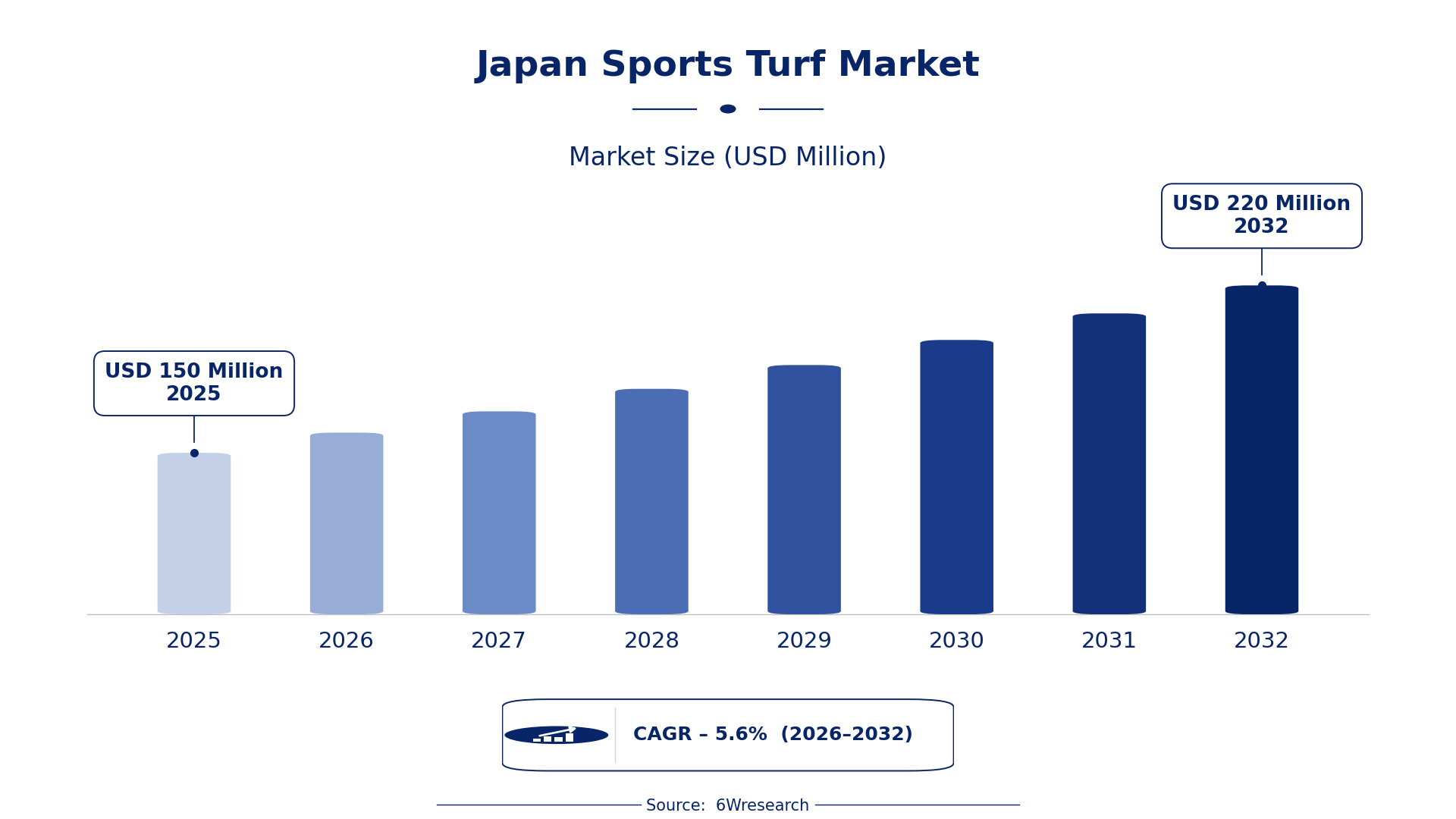
According to 6Wresearch internal database and industry insights, the Japan Sports Turf Market was valued at USD 150 Million in 2025 and is projected to reach USD 220 Million by 2032, growing at a CAGR of approximately 5.6% during 2026–2032.
Japan Sports Turf Market Highlights
| Report Metric | Details |
| Report Name | Japan Sports Turf Market (2026-2032) |
| Market Size 2025 | USD 150 Million |
| Market Size 2032 | USD 220 Million |
| Absolute Growth 2025–2032 | USD 70 Million |
| CAGR 2026–2032 | 5.6% |
| Peak Annual Growth | 7.0% in 2028 |
| Forecast Period | 2026–2032 |
| Historical Data | 2022–2025 |
| Base Year | 2025 |
| Leading Turf Type, 2025 | Synthetic Turf (46% share) |
| Leading Application Field, 2025 | Stadiums & Arenas (47% share) |
| Leading Base Material, 2025 | PE/PP Blend (50% share) |
| Leading End User, 2025 | Sports Infrastructure Firms (55% share) |
| Fastest-Growing Turf Type | Hybrid Turf (7.7% CAGR) |
| Fastest-Growing Application Field | Football/Cricket Fields (7.5% CAGR) |
| Fastest-Growing Base Material | Natural + Synthetic Mix (8.0% CAGR) |
| Fastest-Growing End User | National Stadium Projects (6.9% CAGR) |
| Growing Sector | Sports Infrastructure |
| Key End Users | Sports Infrastructure Firms, Fitness Centers, National Stadium Projects, Local Municipalities |
Japan Sports Turf Market Year-wise Growth Rate and Key Drivers (2022–2032)
This graph illustrates the annual growth rates of the market from 2022 to 2032, highlighting a steady upward trajectory and projected market expansion over the forecast period.
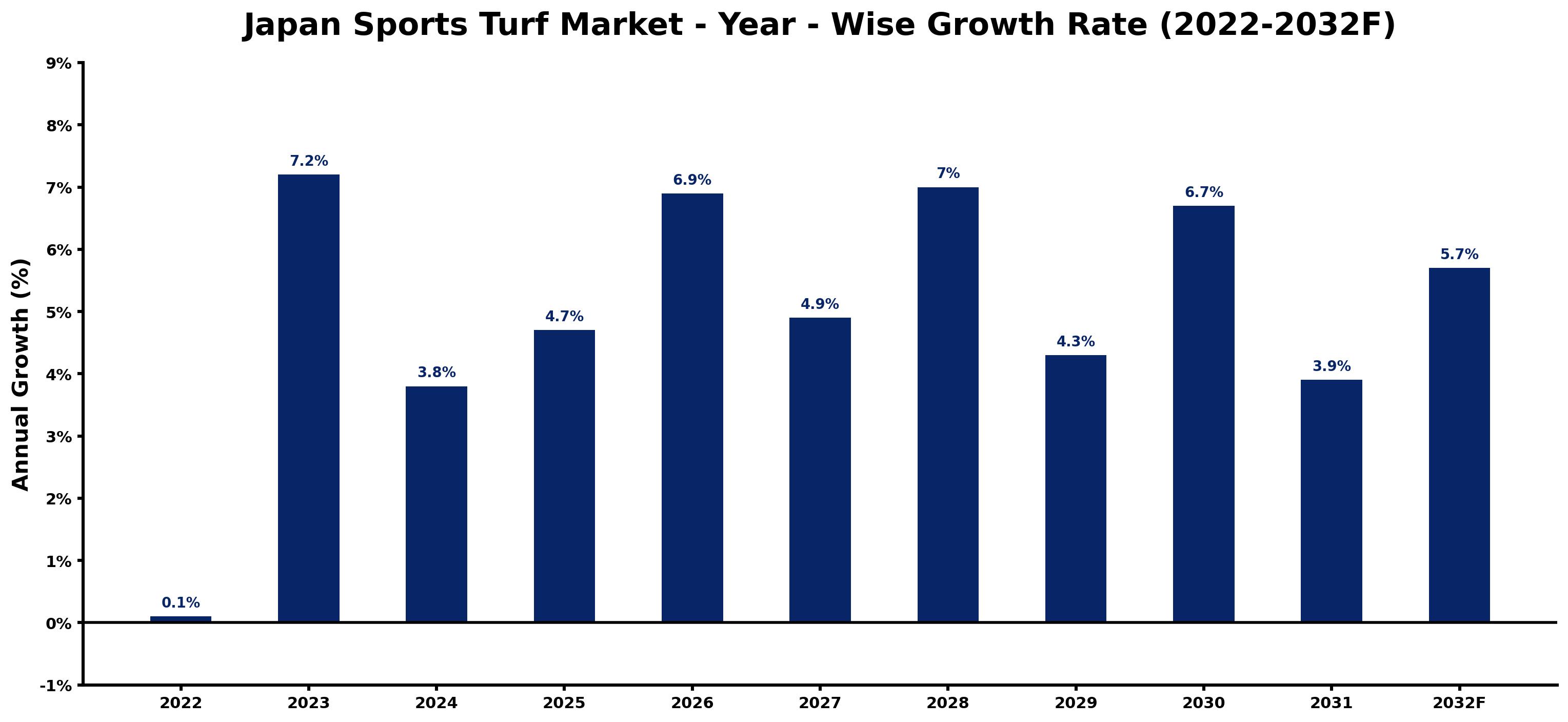
The table below sets out the estimated growth rate for each year and the main factor behind it.
| Year | Estimated Annual Growth (%) | Market Rationale |
| 2022 | 0.1 | The market experienced minimal growth due to limited new projects and installations. |
| 2023 | 7.2 | Increased investments from the Tokyo 2020 Olympics boosted demand for sports turf installations. |
| 2024 | 3.8 | The market growth slowed as projects from the previous year completed, reducing new demand. |
| 2025 | 4.7 | Demand rose again as local municipalities began investing in public sports facilities. |
| 2026 | 6.9 | The market is expected to see a surge in demand driven by the ongoing National Stadium Projects. |
| 2027 | 4.9 | Growth is projected to slow as competition intensifies among turf suppliers and installers. |
| 2028 | 7.0 | A strong rebound is anticipated as major sports events reignite interest in turf installations. |
| 2029 | 4.3 | Growth is expected to slow again as market saturation begins to impact new installations. |
| 2030 | 6.7 | Demand will increase with new initiatives for improving community sports facilities. |
| 2031 | 3.9 | Growth is projected to slow as buyers become more selective in turf quality and pricing. |
| 2032 | 5.7 | The market is expected to grow as sustainable materials gain traction in sports infrastructure. |
Note: Market size estimations and growth projections presented in this report are based on 6Wresearch's proprietary forecasting methodology, utilizing the latest available industry data, government publications, and primary research inputs.
Japan Sports Turf Market Synopsis
Sports turf, primarily made from synthetic materials like polyethylene or polypropylene, is widely used in stadiums, gyms, and recreational areas. The Japan Sports Turf Market is growing due to investments in sports infrastructure, particularly following the Tokyo 2020 Olympics. With over 200 professional stadiums employing sports turf and an increasing number of fitness centres, the demand for durable and high-quality turf solutions is on the rise, driven by domestic users and public projects.
Market Dynamics Impact Analysis (2026–2032)
| Factor | Type | Impact | Primary Segment Affected |
| Increased investment in sports infrastructure projects | Driver | High | Stadiums & Arenas |
| Growing participation in sports and fitness activities | Driver | High | Fitness Centers |
| Expansion of National Stadium Projects | Opportunity | High | National Stadium Projects |
| Rising interest in sustainable turf solutions | Opportunity | Medium | Synthetic Turf |
| High initial costs of installation and maintenance | Restraint | High | Synthetic Turf |
| Limited awareness of turf quality standards among buyers | Restraint | Medium | Fitness Centers |
| Compliance with JIS standards for turf quality | Challenge | High | Synthetic Turf |
| Capacity constraints in production and supply chains | Challenge | Medium | Stadiums & Arenas |
Evaluation of Drivers in Japan Sports Turf Market (2026–2032)
The main growth drivers and the segments they affect most are set out below.
| Drivers | Primary Segment Affected | Why It Matters (Evidence) |
| Investment in sports infrastructure projects | Stadiums & Arenas | Over ¥5 billion allocated for sports infrastructure improvements in 2023 drives demand for turf. |
| Increased sports participation rates | Fitness Centers | The population of approximately 126 million leads to more fitness centers utilizing sports turf. |
| National Stadium Projects | National Stadium Projects | The New National Stadium in Tokyo showcases advanced turf technology, boosting demand for quality installations. |
| Growing interest in hybrid turf solutions | Hybrid Turf | Hybrid turf is gaining traction for multi-sport facilities, with a projected CAGR of 7.7%. |
| Rising demand for indoor sports facilities | Indoor Turf | Over 1,500 fitness centers in Japan are increasingly utilizing synthetic turf for gyms. |
Buyers are adding capacity as investments in sports infrastructure projects increase across Japan. The allocation of ¥5 billion for improvements in 2023 has spurred demand for synthetic turf, particularly in stadiums and arenas. With a population of approximately 126 million, participation rates in sports are rising, leading to more fitness centers adopting turf solutions. The New National Stadium in Tokyo, featuring advanced turf technology, highlights the growing focus on quality installations. Hybrid turf is becoming popular for multi-sport facilities, projected to grow through 2032.
Evaluation of Restraints in Japan Sports Turf Market
The following restraints limit how fast demand can grow.
| Market Restraint | Primary Segment Affected | Why It Matters (Evidence) |
| High initial costs of synthetic turf installation | Synthetic Turf | The average installation cost deters some municipalities from upgrading their facilities. |
| Limited awareness of turf quality standards | Fitness Centers | Many buyers lack knowledge about JIS standards, which affects purchasing decisions. |
| Maintenance challenges for synthetic turf | Stadiums & Arenas | The average lifespan of synthetic turf is 8-10 years, requiring ongoing maintenance investment. |
| Dependence on imported materials | Synthetic Turf | Supply chain disruptions can affect the availability of quality turf materials. |
| Regulatory compliance costs | Hybrid Turf | Meeting JIS standards increases costs for manufacturers and installers. |
Japan Sports Turf Market Challenges
Annual demand for sports turf in Japan is estimated at 1 million square meters, yet producers face a shortage of skilled labour, delaying installation projects for municipalities by up to six months. Importers contend with supply chain disruptions caused by strict regulations on synthetic materials, resulting in lead times that can extend by 20% for fitness centres. Competition from lower-cost alternatives pressures suppliers to reduce prices, risking quality and leading to dissatisfaction among buyers who require durable solutions. Compliance with JIS standards raises operational costs for producers by approximately 15%, ultimately increasing prices for local governments and limiting their investment in new facilities.
Trends in the Japan Sports Turf Market
The trends below show where the Japan Sports Turf Market is heading.
- Shift towards Hybrid Turf Solutions: The trend towards hybrid turf began gaining traction in 2023, particularly for multi-sport facilities. This shift is supported by a projected CAGR of 7.7%.
- Increased Focus on Sustainable Materials: Since 2021, there has been a notable shift towards using sustainable materials in sports infrastructure projects. The Japanese government encourages this trend, with a ¥5 billion investment in 2023 for eco-friendly initiatives.
- Expansion of Indoor Sports Facilities: The rise in indoor sports facilities has accelerated since 2020, with over 1,500 fitness centres now utilising sports turf. This growth reflects changing consumer preferences for year-round sports activities.
- Growing Demand for Quality Standards: The emphasis on quality standards has intensified since the introduction of JIS standards. Buyers are increasingly seeking certified turf solutions, ensuring durability and performance.
Investment Opportunities in the Japan Sports Turf Market
Where to invest in the Japan Sports Turf Market: the main openings are set out below.
- Supply of High-Quality Synthetic Turf: With an annual demand of 1 million square meters, there is an opportunity for suppliers to meet quality standards. Sports Infrastructure Firms are increasingly investing in durable turf solutions.
- Investment in National Stadium Projects: The ongoing National Stadium Projects present a prime opportunity for turf suppliers. With over ¥5 billion allocated in 2023, local partnerships can facilitate entry into this market.
- Improvement of Community Sports Facilities: Local municipalities are investing in public sports facilities, creating a demand for synthetic turf. This opportunity arises from a growing focus on community health and fitness.
- Development of Eco-Friendly Turf Solutions: With the government's push for sustainable materials, suppliers can capitalise on this trend. The Japan Sports Turf Association promotes best practices for eco-friendly turf solutions.
Government Initiatives in the Japan Sports Turf Market
The Plastic Resource Circulation Act, enacted in 2021, impacts producers and buyers of sports turf by promoting the reduction, reuse, and recycling of plastics. This law encourages manufacturers to adopt sustainable practices, ensuring that turf products meet environmental standards while appealing to eco-conscious buyers.
In 2023, the Ministry of Education allocated ¥5 billion to improve school sports facilities with synthetic turf. The Japan Sports Agency oversees this initiative, aiming to enhance community sports infrastructure and increase access to quality sports facilities.
Future Insight of the Japan Sports Turf Market
A policy-driven shift towards improved sports infrastructure will drive the adoption of synthetic turf in public facilities by 2032. The Ministry of Education's initiative to enhance school sports facilities will significantly increase demand for high-quality turf solutions. Technological advancements in turf materials will improve durability and performance, benefiting both producers and buyers. The Japan Sports Turf Association's commitment to promoting best practices will elevate industry standards, fostering a more competitive environment for suppliers.
Market Segmentation Analysis
Japan Sports Turf Market report covers a detailed analysis of the following market segments:
By Turf Type – Synthetic Turf Leads, Hybrid Turf Expected to Grow Fastest
According to Saurav Kr Singh, Senior Research Analyst at 6Wresearch, in 2025, Synthetic Turf led the turf type split with a 46% share. Synthetic turf holds the largest share due to its widespread use in over 200 professional sports stadiums across Japan, offering durability and low maintenance. The average lifespan of synthetic turf, around 8-10 years, makes it a preferred choice for various sports applications. The quickest growth will come from Hybrid Turf, forecast to expand at a CAGR of 7.7% between 2026 and 2032. Hybrid turf is experiencing rapid growth as it gains traction in multi-sport facilities, appealing to users seeking versatile playing surfaces. The increasing investments in advanced turf technology, particularly for the New National Stadium in Tokyo, further support this trend. Suppliers should focus on developing hybrid solutions to meet the rising demand in multi-sport applications.
By Application Field – Stadiums & Arenas Lead, Football/Cricket Fields Expected to Grow Fastest
Stadiums & Arenas held 47% of the Japan Sports Turf Market by application field in 2025. Stadiums and arenas represent the largest application field due to their necessity for hosting professional sports events, which require durable and high-quality turf. With over 200 professional sports stadiums in Japan, this segment's demand is firmly established. Football/Cricket Fields are projected to grow fastest, at a CAGR of 7.5% during 2026–2032. Football and cricket fields are experiencing rapid growth as they are essential for maintaining playable surfaces for these widely followed sports. The government's allocation of ¥5 billion for sports infrastructure improvements is expected to further boost this segment's development. Suppliers should focus on providing advanced turf solutions tailored for stadiums and sports fields to meet the growing demand.
By Base Material – PE/PP Blend Leads, Natural + Synthetic Mix Expected to Grow Fastest
PE/PP Blend took 50% of base material revenue in 2025, more than any other category. The PE/PP blend is the leading material in the market, commonly used for synthetic turf production, owing to its durability and performance characteristics. This material's prevalence in various applications solidifies its dominant position. Natural + Synthetic Mix is set to record the highest CAGR in this split, 8.0% over 2026–2032. The natural and synthetic mix is growing rapidly, particularly as users seek more environmentally friendly options for turf. The government's encouragement of sustainable materials in sports infrastructure projects is likely to boost this segment further. Suppliers should consider diversifying their offerings to include more sustainable material options to meet evolving market preferences.
By End User – Sports Infrastructure Firms Lead, National Stadium Projects Expected to Grow Fastest
Sports Infrastructure Firms accounted for 55% of the market by end user in 2025. Sports infrastructure firms play a crucial role in the installation and maintenance of turf across Japan's over 200 professional sports stadiums. Their continuous involvement in various projects guarantees a steady demand for durable and high-quality turf solutions. Over 2026–2032, National Stadium Projects are expected to post the fastest growth, at a CAGR of 6.9%. National stadium projects represent the fastest-growing segment due to substantial investments, such as the ¥5 billion allocated for sports infrastructure improvements in 2023. This focus on enhancing large-scale facilities will likely maintain the momentum of growth in this area. Suppliers must align their offerings with the specific needs of large-scale sports infrastructure projects to capitalise on this growth.
Key Attractiveness of the Report
- 10 Years of Market Numbers
- Historical Data Starting from 2022 to 2025
- Base Year 2025
- Forecast Data until 2032
- Key Performance Indicators Impacting the Market
- Major Upcoming Developments and Projects
Key Highlights of the Report:
- Japan Sports Turf Market Outlook
- Market Size of Japan Sports Turf Market, 2025
- Forecast of Japan Sports Turf Market, 2032
- Historical Data and Forecast of Japan Sports Turf Revenues & Volume for the Period 2022-2032F
- Japan Sports Turf Market Trend Evolution
- Japan Sports Turf Market Drivers and Challenges
- Japan Sports Turf Price Trends
- Japan Sports Turf Porter's Five Forces
- Japan Sports Turf Industry Life Cycle
- Historical Data and Forecast of Japan Sports Turf Market Revenues & Volume By Turf Type for the Period 2022-2032F
- Historical Data and Forecast of Japan Sports Turf Market Revenues & Volume By Synthetic Turf for the Period 2022-2032F
- Historical Data and Forecast of Japan Sports Turf Market Revenues & Volume By Hybrid Turf for the Period 2022-2032F
- Historical Data and Forecast of Japan Sports Turf Market Revenues & Volume By Indoor Turf for the Period 2022-2032F
- Historical Data and Forecast of Japan Sports Turf Market Revenues & Volume By DIY Turf Mats for the Period 2022-2032F
- Historical Data and Forecast of Japan Sports Turf Market Revenues & Volume By Application Field for the Period 2022-2032F
- Historical Data and Forecast of Japan Sports Turf Market Revenues & Volume By Stadiums & Arenas for the Period 2022-2032F
- Historical Data and Forecast of Japan Sports Turf Market Revenues & Volume By Football/Cricket Fields for the Period 2022-2032F
- Historical Data and Forecast of Japan Sports Turf Market Revenues & Volume By Gyms/Futsal Arenas for the Period 2022-2032F
- Historical Data and Forecast of Japan Sports Turf Market Revenues & Volume By Personal Sports Spaces for the Period 2022-2032F
- Historical Data and Forecast of Japan Sports Turf Market Revenues & Volume By Base Material for the Period 2022-2032F
- Historical Data and Forecast of Japan Sports Turf Market Revenues & Volume By PE/PP Blend for the Period 2022-2032F
- Historical Data and Forecast of Japan Sports Turf Market Revenues & Volume By Natural + Synthetic Mix for the Period 2022-2032F
- Historical Data and Forecast of Japan Sports Turf Market Revenues & Volume By Non-Infill Systems for the Period 2022-2032F
- Historical Data and Forecast of Japan Sports Turf Market Revenues & Volume By Portable Plastic Base for the Period 2022-2032F
- Historical Data and Forecast of Japan Sports Turf Market Revenues & Volume By End User for the Period 2022-2032F
- Historical Data and Forecast of Japan Sports Turf Market Revenues & Volume By Sports Infrastructure Firms for the Period 2022-2032F
- Historical Data and Forecast of Japan Sports Turf Market Revenues & Volume By National Stadium Projects for the Period 2022-2032F
- Historical Data and Forecast of Japan Sports Turf Market Revenues & Volume By Fitness Centers for the Period 2022-2032F
- Historical Data and Forecast of Japan Sports Turf Market Revenues & Volume By Home Users for the Period 2022-2032F
- Japan Sports Turf Import Export Trade Statistics
- Market Opportunity Assessment By Turf Type
- Market Opportunity Assessment By Application Field
- Market Opportunity Assessment By Base Material
- Market Opportunity Assessment By End User
- Japan Sports Turf Top Companies Market Share
- Japan Sports Turf Competitive Benchmarking By Technical and Operational Parameters
- Japan Sports Turf Company Profiles
- Japan Sports Turf Key Strategic Recommendations
Market Covered
Coverage by segment is as follows.
By Turf Type
- Synthetic Turf
- Hybrid Turf
- Indoor Turf
- DIY Turf Mats
By Application Field
- Stadiums & Arenas
- Football/Cricket Fields
- Gyms/Futsal Arenas
- Personal Sports Spaces
By Base Material
- PE/PP Blend
- Natural + Synthetic Mix
- Non-Infill Systems
- Portable Plastic Base
By End User
- Sports Infrastructure Firms
- National Stadium Projects
- Fitness Centers
- Home Users































