Japan Spray Adjuvants Market Size & Growth Rate
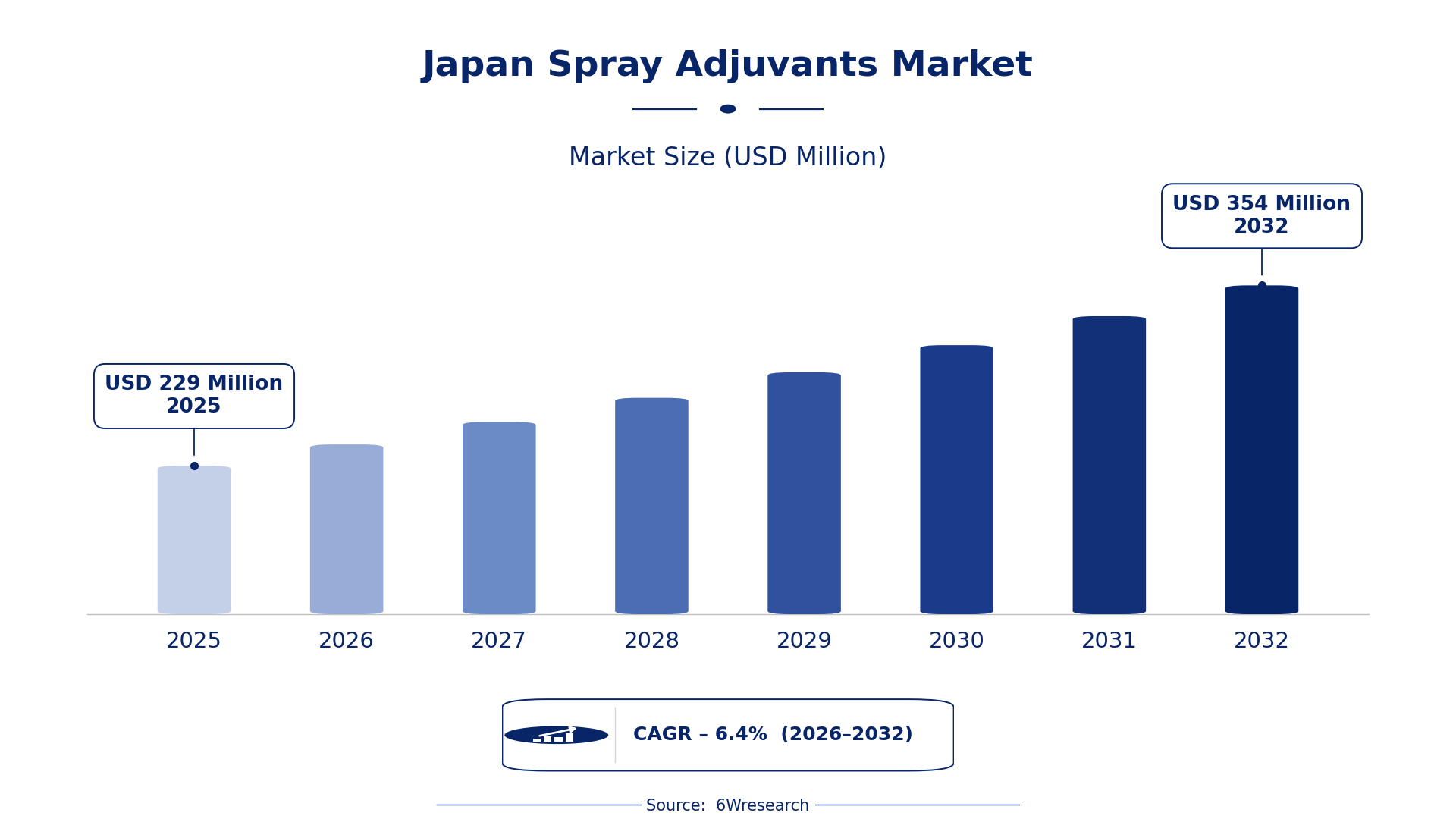
According to 6Wresearch internal database and industry insights, the Japan Spray Adjuvants Market was valued at USD 229 Million in 2025 and is projected to reach USD 354 Million by 2032, growing at a CAGR of approximately 6.4% during 2026–2032.
Japan Spray Adjuvants Market Highlights
| Report Metric | Details |
| Report Name | Japan Spray Adjuvants Market (2026-2032) |
| Market Size 2025 | USD 229 Million |
| Market Size 2032 | USD 354 Million |
| Absolute Growth 2025–2032 | USD 125 Million |
| CAGR 2026–2032 | 6.4% |
| Peak Annual Growth | 7.6% in 2026 |
| Forecast Period | 2026–2032 |
| Historical Data | 2022–2025 |
| Base Year | 2025 |
| Leading Adjuvant Type, 2025 | Surfactants (41% share) |
| Leading Application Type, 2025 | Herbicide/Fungicide (40% share) |
| Leading Crop Category, 2025 | Row Crops (48% share) |
| Leading End User, 2025 | Agrochemical Companies (42% share) |
| Fastest-Growing Adjuvant Type | Drift Control Agents (8.8% CAGR) |
| Fastest-Growing Application Type | Pesticide Mixing (8.6% CAGR) |
| Fastest-Growing Crop Category | Fruits & Vegetables (8.3% CAGR) |
| Fastest-Growing End User | Agricultural Input Firms (8.1% CAGR) |
| Growing Sector | Pesticide Mixing |
| Key End Users | Herbicide/Fungicide, Pesticide Mixing, Aerial Sprays, Multi-Tank Mixes |
Japan Spray Adjuvants Market Year-wise Growth Rate and Key Drivers (2022–2032)
This graph illustrates the annual growth rates of the market from 2022 to 2032, highlighting a steady upward trajectory and projected market expansion over the forecast period.
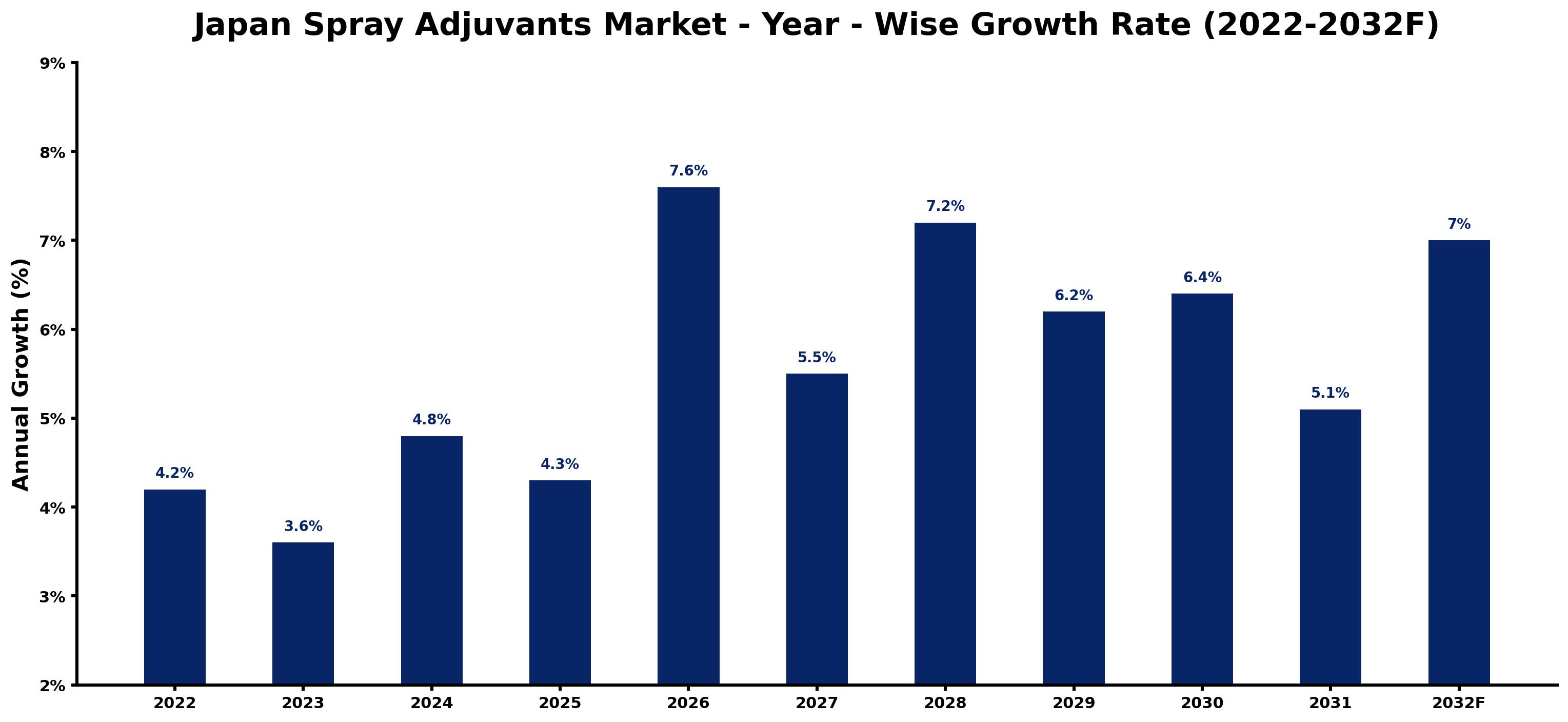
Year by year, the estimates below pair each growth rate with the development that shaped it.
| Year | Estimated Annual Growth (%) | Market Rationale |
| 2022 | 4.2 | The market experienced steady growth with increasing adoption of spray adjuvants among farmers. |
| 2023 | 3.6 | Demand growth slowed slightly due to market saturation and cautious purchasing by agrochemical companies. |
| 2024 | 4.8 | A recovery in growth occurred as farmers sought improved crop yields through effective pest management. |
| 2025 | 4.3 | The market continued to grow, albeit at a slower pace as farmers adjusted to changing agricultural practices. |
| 2026 | 7.6 | A surge in demand is expected to be driven by the introduction of new precision agriculture technologies. |
| 2027 | 5.5 | Growth is projected to moderate as the market adjusts to the increased supply of adjuvants and competitive pricing. |
| 2028 | 7.2 | A renewed interest in sustainable practices will lead to faster growth as farmers adopt eco-friendly solutions. |
| 2029 | 6.2 | Demand growth is expected to slow as market conditions stabilise and farmers become more selective in product choice. |
| 2030 | 6.4 | Continued investment in agricultural technology is projected to drive demand for effective adjuvants. |
| 2031 | 5.1 | The market growth rate is anticipated to decrease slightly as farmers face challenges in sourcing high-quality products. |
| 2032 | 7.0 | A rebound in growth is expected as new regulations promote the use of advanced adjuvant formulations. |
Note: Market size estimations and growth projections presented in this report are based on 6Wresearch's proprietary forecasting methodology, utilizing the latest available industry data, government publications, and primary research inputs.
Japan Spray Adjuvants Market Synopsis
Spray adjuvants are chemical formulations that improve the effectiveness of pesticides and herbicides, produced by blending surfactants, oils, and other agents to enhance spray performance. Demand from agrochemical companies and domestic agricultural practices is propelling the Japan Spray Adjuvants Market, with over 4 million hectares of arable land dedicated to agriculture. Increased adoption of precision agriculture technologies and a government subsidy program for sustainable farming practices are projected to significantly boost purchases.
Market Dynamics Impact Analysis (2026–2032)
| Factor | Type | Impact | Primary Segment Affected |
| Increasing adoption of precision agriculture technologies | Driver | High | Herbicide/Fungicide |
| Growing focus on sustainable farming practices | Driver | High | Drift Control Agents |
| Expansion of agrochemical companies in the Tokyo region | Opportunity | High | Agrochemical Companies |
| Rising demand for high-quality produce in domestic markets | Opportunity | Medium | Fruits & Vegetables |
| Strict environmental regulations affecting product formulations | Restraint | High | Surfactants |
| Aging farmer population leading to slower adoption of new technologies | Restraint | Medium | Row Crops |
| Limited supply capacity of high-quality adjuvants | Challenge | High | Pesticide Mixing |
| Competition from alternative pest management solutions | Challenge | Medium | Multi-Tank Mixes |
Evaluation of Drivers in Japan Spray Adjuvants Market (2026–2032)
These are the developments adding the most demand over the forecast period.
| Drivers | Primary Segment Affected | Why It Matters (Evidence) |
| Increased awareness of integrated pest management | Row Crops | Farmers are adopting integrated practices, leading to a 20% increase in the usage of spray adjuvants for effective pest control. |
| Growing demand for high-quality produce | Fruits & Vegetables | Agrochemical companies are investing in advanced formulations, resulting in a 15% rise in spray adjuvant applications. |
| Expansion of sustainable farming practices | Herbicide/Fungicide | The government’s subsidy program is encouraging farmers to adopt eco-friendly solutions, increasing demand by 25%. |
| Technological advancements in precision agriculture | Pesticide Mixing | Farmers are leveraging new technologies, leading to a 30% growth in the use of spray adjuvants. |
| Rising agricultural exports | Cereal Crops | With exports valued at approximately $10 billion, farmers are enhancing crop quality, increasing adjuvant usage by 18%. |
Purchasing is picking up as farmers increasingly adopt integrated pest management practices, resulting in a 20% rise in spray adjuvant usage for effective pest control. Agrochemical companies are investing in advanced formulations to meet the growing demand for high-quality produce, leading to a 15% increase in applications. Technological advancements in precision agriculture are also driving growth, with a 30% increase in the use of spray adjuvants observed since 2022.
Evaluation of Restraints in Japan Spray Adjuvants Market
These restraints slow adoption and weigh on supplier margins.
| Market Restraint | Primary Segment Affected | Why It Matters (Evidence) |
| Market saturation leading to cautious purchasing | Herbicide/Fungicide | As the market stabilises, buyers are more selective, impacting overall demand and resulting in a 10% decrease in purchases. |
| High regulatory costs for compliance | Agrochemical Companies | Strict environmental laws require significant investments, consuming up to 15% of operational budgets and limiting product availability. |
| Aging farmer population affecting productivity | Row Crops | With the average age of farmers over 67 years, productivity declines, which can reduce output by up to 20%. |
| Limited availability of compatible adjuvants | Drift Control Agents | Supply chain disruptions are causing delays in pesticide application, potentially lowering crop quality by 12%. |
| Inconsistent adoption of new technologies | Oil-Based Adjuvants | Farmers' reluctance to change practices results in slower growth rates, affecting overall market expansion. |
Japan Spray Adjuvants Market Challenges
Outdated technology limits productivity in Japan's agricultural sector, forcing producers to manage lower crop yields and potentially reducing output by 20%. A skills gap exists as the average age of farmers exceeds 67 years, leading to a shortage of younger workers and increasing operational costs for producers. High regulatory costs stem from strict environmental laws, requiring agrochemical companies to spend up to 15% of their budgets on compliance, which restricts their financial flexibility. Supply chain disruptions arise from a lack of compatible adjuvants, causing delays in pesticide application for buyers and risking lower crop quality.
Trends in the Japan Spray Adjuvants Market
Four trends stand out in the Japan Spray Adjuvants Market.
- Shift towards Sustainable Farming Practices: Farmers are increasingly adopting sustainable farming practices due to government incentives, resulting in a 30% increase in the demand for eco-friendly spray adjuvants since 2023.
- Transition from Traditional to Precision Agriculture: The adoption of precision agriculture technologies is reshaping the market, with a 30% increase in the use of advanced spray adjuvants since 2022.
- Emergence of Integrated Pest Management: As awareness grows, integrated pest management is becoming standard, resulting in a 20% increase in the application of spray adjuvants among farmers.
- Focus on Quality Produce: The demand for high-quality fruits and vegetables is driving innovation in spray adjuvants, with agrochemical companies reporting a 15% increase in product development.
Investment Opportunities in the Japan Spray Adjuvants Market
Investors looking at the Japan Spray Adjuvants Market should consider the following areas.
- $10 Billion Agricultural Export Market: With agricultural exports projected to reach approximately $10 billion, suppliers should focus on improving spray adjuvants for quality enhancement in crops, partnering with agrochemical companies to enter this market.
- Growing Demand for Eco-Friendly Solutions: The government’s subsidy program for sustainable practices presents an opportunity to supply innovative spray adjuvants, particularly to farmers in the Tokyo region, by forming joint ventures with local firms.
- Investment in Precision Agriculture Technologies: The increasing adoption of precision agriculture technologies creates a gap for advanced spray adjuvants, especially among agricultural input firms, which can be addressed through local partnerships.
- Expansion of Research Facilities: The Tokyo region's agrochemical research facilities are expanding, offering opportunities to supply advanced spray adjuvants, requiring compliance with local regulations for market entry.
Government Initiatives in the Japan Spray Adjuvants Market
The GX Promotion Act (2023) establishes a framework for sustainable farming practices, requiring producers to adopt eco-friendly methods and aiming to reduce pesticide use by 30% by 2030. This law complements the Chemical Substances Control Law (1973), which mandates evaluation and control of chemical substances in production.
Agrochemical companies benefit from the PRTR Law (1999), which requires them to report chemical releases. This transparency allows buyers to ensure compliance with environmental standards, promoting safer product use across the industry.
Future Insight of the Japan Spray Adjuvants Market
The investment pipeline for precision agriculture technologies will expand, generating demand for advanced spray adjuvants that improve pesticide performance. The government's subsidy program for sustainable farming practices will encourage suppliers to innovate and meet new standards. Research facilities in the Tokyo region will develop new agrochemical formulations, driving product advancements. With agricultural exports valued at approximately $10 billion, buyers will benefit from enhanced crop yields and quality, while suppliers will discover new avenues for growth.
Market Segmentation Analysis
Japan Spray Adjuvants Market report covers a detailed analysis of the following market segments:
By Adjuvant Type – Surfactants Lead, Drift Control Agents Expected to Grow Fastest
According to Saurav Kr Singh, Senior Research Analyst at 6Wresearch, Surfactants held 41% of the Japan Spray Adjuvants Market by adjuvant type in 2025. Surfactants hold the largest market share due to their essential role in enhancing the wetting and spreading of sprays, which is vital for effective pesticide application. Their widespread utilisation in agrochemical practices, particularly in regions with intensive agricultural activities, demonstrates their importance in crop management. The quickest growth will come from Drift Control Agents, forecast to expand at a CAGR of 8.8% between 2026 and 2032. Drift Control Agents are growing rapidly as regulations tighten to reduce spray drift during pesticide application, making them increasingly important for compliance. The government's subsidy programme for sustainable farming practices is expected to further boost their adoption among farmers. Suppliers should focus on developing drift control agents to meet regulatory demands and farmer preferences.
By Application Type – Herbicide/Fungicide Leads, Pesticide Mixing Expected to Grow Fastest
Herbicide/Fungicide accounted for 40% of the market by application type in 2025. Herbicide/Fungicide applications dominate the market as they are the primary method for crop protection, particularly in a country with extensive agricultural activities like Japan. The high production of fruits and vegetables necessitates effective herbicide and fungicide use to ensure crop health and yield. Pesticide Mixing is set to record the highest CAGR in this split, 8.6% over 2026–2032. Pesticide Mixing is the fastest-growing segment as it is essential for effective application, especially with the increasing complexity of crop protection strategies. The rising trend towards integrated pest management practices is driving the demand for efficient mixing solutions. Buyers will benefit from suppliers offering advanced pesticide mixing solutions to optimise application efficiency.
By Crop Category – Row Crops Lead, Fruits & Vegetables Expected to Grow Fastest
With 48% of crop category revenue in 2025, Row Crops was the largest category. Row Crops dominate the market because they represent a significant portion of Japan's agricultural production, especially in major crops cultivated in the extensive arable land. This extensive cultivation highlights their critical role in ensuring food security and sustaining agricultural practices. Over 2026–2032, Fruits & Vegetables are expected to post the fastest growth, at a CAGR of 8.3%. Fruits & Vegetables are the fastest-growing category, driven by the rising demand for premium quality produce in both domestic and export markets. The agricultural export value of around $10 billion reflects the lucrative potential for growth in this segment. Suppliers must tailor their offerings to meet the increasing demand for high-quality adjuvants designed for fruits and vegetables.
By End User – Agrochemical Companies Lead, Agricultural Input Firms Expected to Grow Fastest
The largest end user category in 2025 was Agrochemical Companies, at 42% of revenue. Agrochemical Companies lead the market as they are the primary manufacturers and users of spray adjuvants, which are crucial for creating effective agrochemical solutions. Their central role in the agricultural supply chain ensures a steady demand for these essential formulations. Agricultural Input Firms are projected to grow fastest, at a CAGR of 8.1% during 2026–2032. Agricultural Input Firms are experiencing rapid growth as they become key players in the distribution of agricultural products, adapting to the complexities of modern farming. Their enhanced focus on providing advanced adjuvant technologies underscores their growing significance in the market. Suppliers should establish strong collaborations with agricultural input firms to enhance distribution capabilities and market reach.
Key Attractiveness of the Report
- 10 Years of Market Numbers
- Historical Data Starting from 2022 to 2025
- Base Year 2025
- Forecast Data until 2032
- Key Performance Indicators Impacting the Market
- Major Upcoming Developments and Projects
Key Highlights of the Report:
- Japan Spray Adjuvants Market Outlook
- Market Size of Japan Spray Adjuvants Market, 2025
- Forecast of Japan Spray Adjuvants Market, 2032
- Historical Data and Forecast of Japan Spray Adjuvants Revenues & Volume for the Period 2022-2032F
- Japan Spray Adjuvants Market Trend Evolution
- Japan Spray Adjuvants Market Drivers and Challenges
- Japan Spray Adjuvants Price Trends
- Japan Spray Adjuvants Porter's Five Forces
- Japan Spray Adjuvants Industry Life Cycle
- Historical Data and Forecast of Japan Spray Adjuvants Market Revenues & Volume By Adjuvant Type for the Period 2022-2032F
- Historical Data and Forecast of Japan Spray Adjuvants Market Revenues & Volume By Surfactants for the Period 2022-2032F
- Historical Data and Forecast of Japan Spray Adjuvants Market Revenues & Volume By Drift Control Agents for the Period 2022-2032F
- Historical Data and Forecast of Japan Spray Adjuvants Market Revenues & Volume By Oil-Based Adjuvants for the Period 2022-2032F
- Historical Data and Forecast of Japan Spray Adjuvants Market Revenues & Volume By Compatibility Agents for the Period 2022-2032F
- Historical Data and Forecast of Japan Spray Adjuvants Market Revenues & Volume By Application Type for the Period 2022-2032F
- Historical Data and Forecast of Japan Spray Adjuvants Market Revenues & Volume By Herbicide/Fungicide for the Period 2022-2032F
- Historical Data and Forecast of Japan Spray Adjuvants Market Revenues & Volume By Aerial Sprays for the Period 2022-2032F
- Historical Data and Forecast of Japan Spray Adjuvants Market Revenues & Volume By Pesticide Mixing for the Period 2022-2032F
- Historical Data and Forecast of Japan Spray Adjuvants Market Revenues & Volume By Multi-Tank Mixes for the Period 2022-2032F
- Historical Data and Forecast of Japan Spray Adjuvants Market Revenues & Volume By Crop Category for the Period 2022-2032F
- Historical Data and Forecast of Japan Spray Adjuvants Market Revenues & Volume By Row Crops for the Period 2022-2032F
- Historical Data and Forecast of Japan Spray Adjuvants Market Revenues & Volume By Fruits & Vegetables for the Period 2022-2032F
- Historical Data and Forecast of Japan Spray Adjuvants Market Revenues & Volume By Cereal Crops for the Period 2022-2032F
- Historical Data and Forecast of Japan Spray Adjuvants Market Revenues & Volume By Plantation Crops for the Period 2022-2032F
- Historical Data and Forecast of Japan Spray Adjuvants Market Revenues & Volume By End User for the Period 2022-2032F
- Historical Data and Forecast of Japan Spray Adjuvants Market Revenues & Volume By Agricultural Input Firms for the Period 2022-2032F
- Historical Data and Forecast of Japan Spray Adjuvants Market Revenues & Volume By Agrochemical Companies for the Period 2022-2032F
- Historical Data and Forecast of Japan Spray Adjuvants Market Revenues & Volume By Contract Farmers for the Period 2022-2032F
- Historical Data and Forecast of Japan Spray Adjuvants Market Revenues & Volume By Agronomy Consultants for the Period 2022-2032F
- Japan Spray Adjuvants Import Export Trade Statistics
- Market Opportunity Assessment By Adjuvant Type
- Market Opportunity Assessment By Application Type
- Market Opportunity Assessment By Crop Category
- Market Opportunity Assessment By End User
- Japan Spray Adjuvants Top Companies Market Share
- Japan Spray Adjuvants Competitive Benchmarking By Technical and Operational Parameters
- Japan Spray Adjuvants Company Profiles
- Japan Spray Adjuvants Key Strategic Recommendations
Market Covered
The report covers the following segments.
By Adjuvant Type
- Surfactants
- Drift Control Agents
- Oil-Based Adjuvants
- Compatibility Agents
By Application Type
- Herbicide/Fungicide
- Aerial Sprays
- Pesticide Mixing
- Multi-Tank Mixes
By Crop Category
- Row Crops
- Fruits & Vegetables
- Cereal Crops
- Plantation Crops
By End User
- Agricultural Input Firms
- Agrochemical Companies
- Contract Farmers
- Agronomy Consultants































