Japan Starch Processing Enzymes Market Size & Growth Rate
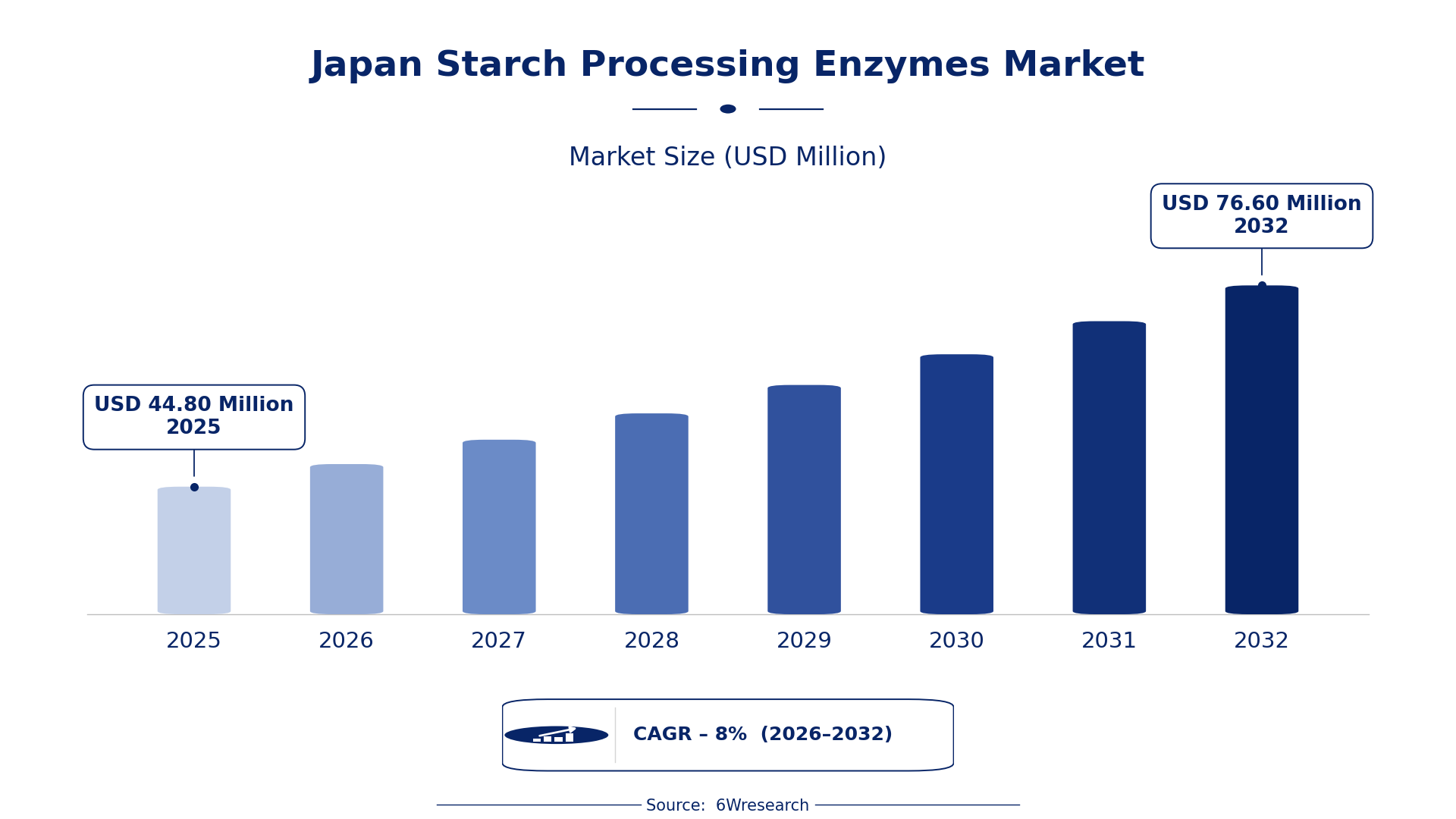
According to 6Wresearch internal database and industry insights, the Japan Starch Processing Enzymes Market was valued at USD 44.80 Million in 2025 and is projected to reach USD 76.60 Million by 2032, growing at a CAGR of approximately 8% during 2026–2032.
Japan Starch Processing Enzymes Market Highlights
| Report Metric | Details |
| Report Name | Japan Starch Processing Enzymes Market (2026-2032) |
| Market Size 2025 | USD 44.80 Million |
| Market Size 2032 | USD 76.60 Million |
| Absolute Growth 2025–2032 | USD 31.80 Million |
| CAGR 2026–2032 | 8% |
| Peak Annual Growth | 8.8% in 2027 |
| Forecast Period | 2026–2032 |
| Historical Data | 2022–2025 |
| Base Year | 2025 |
| Leading Enzyme Type, 2025 | Amylase (44% share) |
| Leading Function, 2025 | Starch Breakdown (37% share) |
| Leading Source, 2025 | Bacterial/Fungal (41% share) |
| Leading End User, 2025 | Food Processing Units (36% share) |
| Fastest-Growing Enzyme Type | Glucoamylase (11.3% CAGR) |
| Fastest-Growing Function | Glucose Conversion (10.5% CAGR) |
| Fastest-Growing Source | Microbial (11.6% CAGR) |
| Fastest-Growing End User | Bioethanol Plants (10.7% CAGR) |
| Growing Sector | Food Processing |
| Key End Users | Food Processing Units, Bioethanol Plants, Beverage Manufacturers, Sweetener Producers |
Japan Starch Processing Enzymes Market Year-wise Growth Rate and Key Drivers (2022–2032)
This graph illustrates the annual growth rates of the market from 2022 to 2032, highlighting a steady upward trajectory and projected market expansion over the forecast period.
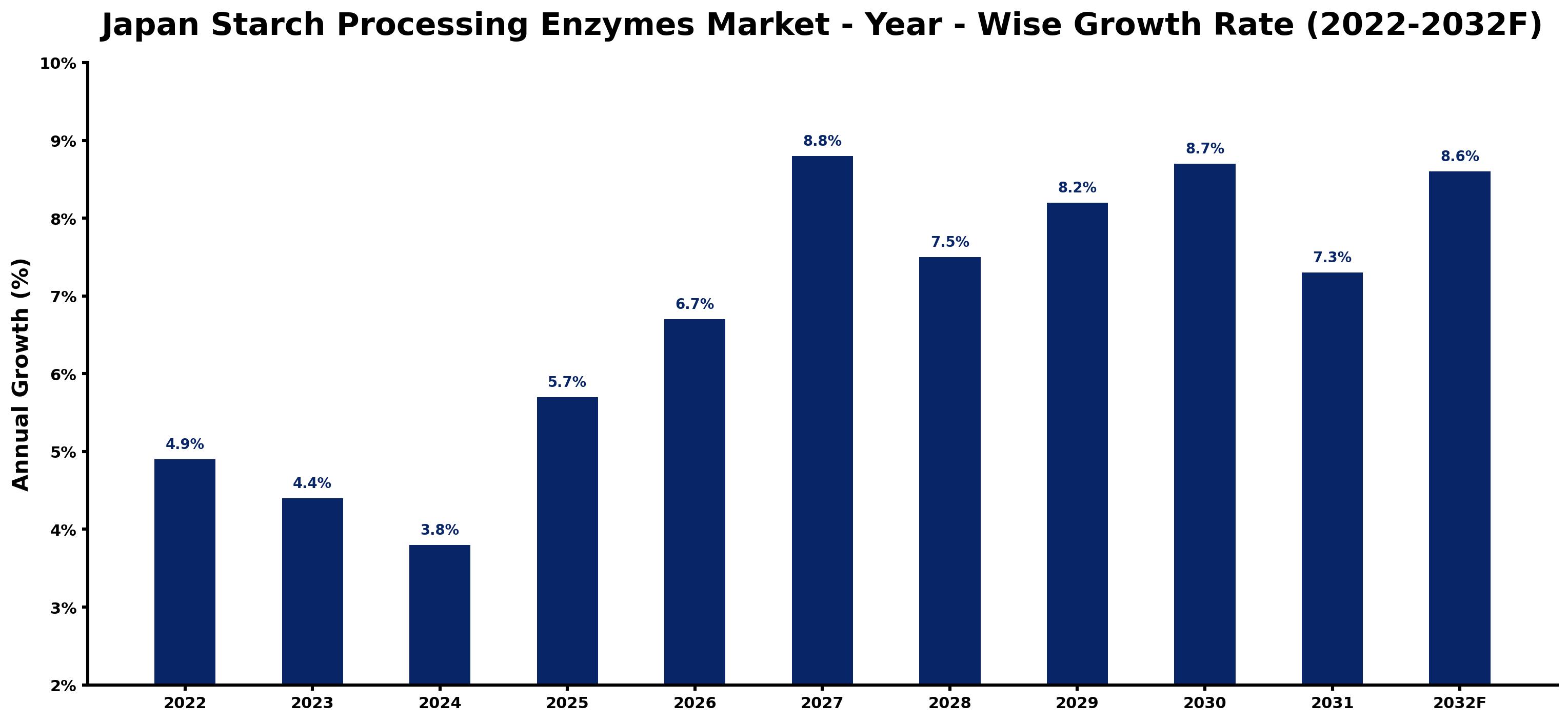
For each year, the table pairs the estimated growth rate with the leading influence on demand, showing how the drivers changed across the period.
| Year | Estimated Annual Growth (%) | Market Rationale |
| 2022 | 4.9 | The market showed steady growth due to stable demand from food processing industries. |
| 2023 | 4.4 | Growth slowed as manufacturers faced supply chain disruptions affecting enzyme availability. |
| 2024 | 3.8 | Demand continued to slow as market adjustments took place after previous growth peaks. |
| 2025 | 5.7 | Growth accelerated as food processing units increased enzyme adoption for efficiency. |
| 2026 | 6.7 | The market will see faster growth fueled by rising bioethanol production needs. |
| 2027 | 8.8 | Peak growth will occur as innovation in fermentation technology gains traction. |
| 2028 | 7.5 | Growth is projected to slow as the market stabilises after reaching peak demand. |
| 2029 | 8.2 | Demand will increase again as beverage manufacturers expand their product lines. |
| 2030 | 8.7 | Growth will continue as sweetener production increases in response to health trends. |
| 2031 | 7.3 | The market is projected to experience a slowdown as competition intensifies among enzyme producers. |
| 2032 | 8.6 | Growth is expected to pick up as bioethanol plants further adopt advanced enzyme solutions. |
Note: Market size estimations and growth projections presented in this report are based on 6Wresearch's proprietary forecasting methodology, utilizing the latest available industry data, government publications, and primary research inputs.
Japan Starch Processing Enzymes Market Synopsis
Starch processing enzymes are biocatalysts that convert starch into sugars and derivatives, produced through fermentation processes. These enzymes play a crucial role in food processing, bioethanol production, and sweetener manufacturing. The Japan Starch Processing Enzymes Market is growing due to strong demand from the food processing industry, valued at approximately 20 trillion JPY, and increasing investments in bioethanol production, which reached 1.5 million kiloliters in 2022. The beverage sector, with over 1,000 manufacturers, is also expanding its use of these enzymes, driven by health trends and innovation.
Market Dynamics Impact Analysis (2026–2032)
| Factor | Type | Impact | Primary Segment Affected |
| Rising demand for bioethanol production | Driver | High | Bioethanol Plants |
| Increased focus on fermentation technology | Driver | High | Food Processing Units |
| Expansion of the beverage sector | Opportunity | High | Beverage Manufacturers |
| Growing health consciousness among consumers | Opportunity | High | Sweetener Producers |
| Regulatory compliance costs for enzyme production | Restraint | Medium | Amylase |
| Competition from synthetic alternatives | Restraint | Medium | Amylase |
| Supply chain disruptions affecting ingredient availability | Challenge | High | Food Processing Units |
| High research and development costs for new applications | Challenge | Medium | Amylase |
Evaluation of Drivers in Japan Starch Processing Enzymes Market (2026–2032)
The table below links each growth driver to the segment it affects and the evidence for it.
| Drivers | Primary Segment Affected | Why It Matters (Evidence) |
| Increased bioethanol production | Bioethanol Plants | Japan's bioethanol production reached 1.5 million kiloliters in 2022, driving demand for starch processing enzymes. |
| Adoption of fermentation technologies | Food Processing Units | Japan has a high adoption rate of fermentation technologies, leading to increased enzyme usage in food production. |
| Health trends boosting sweetener demand | Sweetener Producers | The average consumption of sweeteners in Japan is about 10 kg per person annually, spurring enzyme demand. |
| Investment in beverage innovation | Beverage Manufacturers | Japan's beverage industry is projected to invest 500 billion JPY in innovation by 2025, increasing enzyme requirements. |
| Support from industry associations | Amylase | The Japan Enzyme Association promotes the development of enzyme technologies, driving market growth. |
Most of the extra volume comes from the growing bioethanol sector, which reached 1.5 million kiloliters in 2022 and drives demand for starch processing enzymes. The food processing industry, valued at approximately 20 trillion JPY, is increasingly adopting fermentation technologies that improve production efficiency. Sweetener consumption trends are influencing demand, with an average of 10 kg per person annually. The beverage sector is expected to invest 500 billion JPY in innovation by 2025, further boosting enzyme demand. Industry associations will continue to encourage growth in the market.
Evaluation of Restraints in Japan Starch Processing Enzymes Market
Several factors work against faster growth; the main ones are summarised below.
| Market Restraint | Primary Segment Affected | Why It Matters (Evidence) |
| High regulatory compliance costs | Amylase | The Food Sanitation Act requires stringent quality standards, increasing production costs for enzyme manufacturers. |
| Competition from synthetic enzyme alternatives | Amylase | Synthetic options are preferred for their cost-effectiveness, impacting market share of natural enzymes. |
| Supply chain disruptions | Food Processing Units | Challenges in sourcing raw materials have delayed enzyme production and affected food processing operations. |
| R&D costs for new enzyme applications | Amylase | High investment in research for new enzyme applications can limit smaller producers' market entry. |
| Market saturation in certain enzyme types | Amylase | The presence of established enzyme types like Amylase limits opportunities for new entrants. |
Japan Starch Processing Enzymes Market Challenges
Japan's regulatory framework under the Food Sanitation Act presents a hurdle, delaying enzyme approvals by up to six months, which hampers producers' market entry. Limited expertise in fermentation technology results in a skills gap, raising operational costs for suppliers by approximately 15% due to inefficiencies. Buyers face price increases as demand for high-quality starch processing enzymes grows, with costs potentially rising by 10% as the market expands. Supply chain disruptions from natural disasters can halt shipments, forcing manufacturers to cease production and incur revenue losses during critical periods.
Trends in the Japan Starch Processing Enzymes Market
Below are the shifts with the largest effect on the Japan Starch Processing Enzymes Market.
- Shift towards Sustainable Enzyme Production: In 2023, Japan initiated a program for sustainable enzyme production, aiming for eco-friendly practices. This shift aligns with increasing consumer demand for sustainable products, influencing manufacturers to invest in greener technologies.
- Growth of Health-Conscious Sweeteners: Sweetener producers are adapting to health trends, leading to a rise in demand for starch processing enzymes. The average sweetener consumption of 10 kg per person annually reflects this shift, prompting innovation in enzyme applications.
- Expansion of Bioethanol Production Facilities: Bioethanol plants are increasingly adopting enzymes to improve efficiency, with production reaching 1.5 million kiloliters in 2022. This trend indicates a growing market for starch processing enzymes in renewable energy sectors.
- Innovation in Beverage Manufacturing: The beverage sector in Japan, with over 1,000 manufacturers, is investing 500 billion JPY in innovation by 2025. This investment is driving the need for advanced starch processing enzymes to meet evolving consumer preferences.
Investment Opportunities in the Japan Starch Processing Enzymes Market
Several openings in the Japan Starch Processing Enzymes Market merit attention from investors.
- Food Processing Units Seeking Efficiency: Food processing units in Japan are looking to improve production efficiency, with the market valued at 20 trillion JPY. Investing in advanced starch processing enzymes is essential for meeting this demand.
- Bioethanol Plants Adopting Advanced Technologies: Bioethanol plants are increasingly adopting advanced enzymes to improve sugar conversion rates. With production reaching 1.5 million kiloliters, there is a significant opportunity for suppliers to enter this market.
- Beverage Manufacturers Innovating Product Lines: Beverage manufacturers are expanding their product lines to meet health trends, with expected investments of 500 billion JPY by 2025. Suppliers can partner with these manufacturers to provide tailored enzyme solutions.
- Sweetener Producers Adapting to Consumer Trends: Sweetener producers are responding to health trends, driving demand for starch processing enzymes. The average sweetener consumption of 10 kg per person annually indicates a need for innovative enzyme applications.
Government Initiatives in the Japan Starch Processing Enzymes Market
The Food Recycling Law, established in 2000, mandates food businesses to reduce waste and recycle it into feed and energy. This law encourages producers of starch processing enzymes to focus on sustainable practices, aligning with national objectives for reducing food waste. The Food Sanitation Act amendment in 2018 further raised safety standards for food utensils and packaging, indirectly impacting enzyme producers by increasing quality expectations.
The Japan Enzyme Association supports enzyme research through various funding initiatives. These bodies facilitate approvals for new enzyme applications, ensuring that producers can meet evolving market demands while adhering to stringent safety regulations.
Future Insight of the Japan Starch Processing Enzymes Market
A policy-driven shift towards sustainable enzyme production will drive advancements in fermentation technologies by 2032. The beverage industry is projected to invest 500 billion JPY in innovative processing methods, broadening product offerings for consumers. As bioethanol facilities adopt new enzymes, production efficiency could rise by 20%, benefiting both suppliers and buyers. The updated JIS standard will enhance quality assurance in enzyme production, building confidence among manufacturers and consumers.
Market Segmentation Analysis
Japan Starch Processing Enzymes Market report covers a detailed analysis of the following market segments:
By Enzyme Type – Amylase Leads, Glucoamylase Expected to Grow Fastest
According to Saurav Kr Singh, Senior Research Analyst at 6Wresearch, the largest enzyme type category in 2025 was Amylase, at 44% of revenue. Amylase holds the largest share due to its extensive use in starch breakdown processes across Japan's food processing industry. Its critical role in producing various staple food items reinforces its market dominance. Glucoamylase is set to record the highest CAGR in this split, 11.3% over 2026–2032. Glucoamylase is experiencing rapid growth as it is essential for converting starch into glucose, which is increasingly utilised in sweeteners. The rising health trends in Japan are significantly boosting the demand for glucose-based sweeteners, driving this segment forward. Suppliers must ensure the availability of glucoamylase to meet the growing demand in sweetener applications.
By Function – Starch Breakdown Leads, Glucose Conversion Expected to Grow Fastest
Starch Breakdown took 37% of function revenue in 2025, more than any other category. Starch Breakdown is the leading function as it is crucial for converting starch into fermentable sugars, a process that supports many food processing applications. This function is integral to the operations of numerous food processing units throughout Japan. Over 2026–2032, Glucose Conversion is expected to post the fastest growth, at a CAGR of 10.5%. Glucose Conversion is witnessing rapid growth due to its significance in sweetener production, which is becoming more popular among health-conscious consumers. The average sweetener consumption in Japan, at about 10 kg per person annually, indicates a robust market for glucose conversion. Buyers in the sweetener industry should prioritise sourcing enzymes that enhance glucose conversion efficiency.
By Source – Bacterial/Fungal Leads, Microbial Expected to Grow Fastest
In 2025, Bacterial/Fungal led the source split with a 41% share. Bacterial/Fungal sources dominate the market as they are reliable and widely used for enzyme production, ensuring a steady supply for Japan's food processing requirements. This reliability is essential for maintaining quality in enzyme applications across various sectors. Microbial is projected to grow fastest, at a CAGR of 11.6% during 2026–2032. Microbial sources are gaining traction due to their effectiveness in enzyme manufacturing, aligning with Japan's focus on fermentation technology. The increasing investments in R&D for new applications are expected to further accelerate this segment's growth. Suppliers should invest in microbial enzyme technologies to stay competitive in the market.
By End User – Food Processing Units Lead, Bioethanol Plants Expected to Grow Fastest
With 36% of end user revenue in 2025, Food Processing Units was the largest category. Food Processing Units are the primary consumers of starch processing enzymes, employing them extensively across a wide range of food products. Their significant role in Japan's food industry underscores the importance of these enzymes in meeting consumer demand. The quickest growth will come from Bioethanol Plants, forecast to expand at a CAGR of 10.7% between 2026 and 2032. Bioethanol Plants are experiencing the fastest growth as they increasingly adopt enzymes to improve sugar conversion efficiency in biofuel production. The Japanese government's support for biofuel initiatives through subsidies is likely to sustain this growth trajectory. Buyers in the bioethanol sector should seek partnerships with enzyme suppliers to enhance production efficiency.
Key Attractiveness of the Report
- 10 Years of Market Numbers
- Historical Data Starting from 2022 to 2025
- Base Year 2025
- Forecast Data until 2032
- Key Performance Indicators Impacting the Market
- Major Upcoming Developments and Projects
Key Highlights of the Report:
- Japan Starch Processing Enzymes Market Outlook
- Market Size of Japan Starch Processing Enzymes Market, 2025
- Forecast of Japan Starch Processing Enzymes Market, 2032
- Historical Data and Forecast of Japan Starch Processing Enzymes Revenues & Volume for the Period 2022-2032F
- Japan Starch Processing Enzymes Market Trend Evolution
- Japan Starch Processing Enzymes Market Drivers and Challenges
- Japan Starch Processing Enzymes Price Trends
- Japan Starch Processing Enzymes Porter's Five Forces
- Japan Starch Processing Enzymes Industry Life Cycle
- Historical Data and Forecast of Japan Starch Processing Enzymes Market Revenues & Volume By Enzyme Type for the Period 2022-2032F
- Historical Data and Forecast of Japan Starch Processing Enzymes Market Revenues & Volume By Amylase for the Period 2022-2032F
- Historical Data and Forecast of Japan Starch Processing Enzymes Market Revenues & Volume By Glucoamylase for the Period 2022-2032F
- Historical Data and Forecast of Japan Starch Processing Enzymes Market Revenues & Volume By Pullulanase for the Period 2022-2032F
- Historical Data and Forecast of Japan Starch Processing Enzymes Market Revenues & Volume By Alpha-glucosidase for the Period 2022-2032F
- Historical Data and Forecast of Japan Starch Processing Enzymes Market Revenues & Volume By Function for the Period 2022-2032F
- Historical Data and Forecast of Japan Starch Processing Enzymes Market Revenues & Volume By Starch Breakdown for the Period 2022-2032F
- Historical Data and Forecast of Japan Starch Processing Enzymes Market Revenues & Volume By Glucose Conversion for the Period 2022-2032F
- Historical Data and Forecast of Japan Starch Processing Enzymes Market Revenues & Volume By Debranching for the Period 2022-2032F
- Historical Data and Forecast of Japan Starch Processing Enzymes Market Revenues & Volume By Maltose Conversion for the Period 2022-2032F
- Historical Data and Forecast of Japan Starch Processing Enzymes Market Revenues & Volume By Source for the Period 2022-2032F
- Historical Data and Forecast of Japan Starch Processing Enzymes Market Revenues & Volume By Bacterial/Fungal for the Period 2022-2032F
- Historical Data and Forecast of Japan Starch Processing Enzymes Market Revenues & Volume By Microbial for the Period 2022-2032F
- Historical Data and Forecast of Japan Starch Processing Enzymes Market Revenues & Volume By Fungal/Yeast for the Period 2022-2032F
- Historical Data and Forecast of Japan Starch Processing Enzymes Market Revenues & Volume By Fermentation for the Period 2022-2032F
- Historical Data and Forecast of Japan Starch Processing Enzymes Market Revenues & Volume By End User for the Period 2022-2032F
- Historical Data and Forecast of Japan Starch Processing Enzymes Market Revenues & Volume By Food Processing Units for the Period 2022-2032F
- Historical Data and Forecast of Japan Starch Processing Enzymes Market Revenues & Volume By Bioethanol Plants for the Period 2022-2032F
- Historical Data and Forecast of Japan Starch Processing Enzymes Market Revenues & Volume By Beverage Manufacturers for the Period 2022-2032F
- Historical Data and Forecast of Japan Starch Processing Enzymes Market Revenues & Volume By Sweetener Producers for the Period 2022-2032F
- Japan Starch Processing Enzymes Import Export Trade Statistics
- Market Opportunity Assessment By Enzyme Type
- Market Opportunity Assessment By Function
- Market Opportunity Assessment By Source
- Market Opportunity Assessment By End User
- Japan Starch Processing Enzymes Top Companies Market Share
- Japan Starch Processing Enzymes Competitive Benchmarking By Technical and Operational Parameters
- Japan Starch Processing Enzymes Company Profiles
- Japan Starch Processing Enzymes Key Strategic Recommendations
Market Covered
Coverage by segment is as follows.
By Enzyme Type
- Amylase
- Glucoamylase
- Pullulanase
- Alpha-glucosidase
By Function
- Starch Breakdown
- Glucose Conversion
- Debranching
- Maltose Conversion
By Source
- Bacterial/Fungal
- Microbial
- Fungal/Yeast
- Fermentation
By End User
- Food Processing Units
- Bioethanol Plants
- Beverage Manufacturers
- Sweetener Producers































