Japan Static Discharge Wicks Market Size & Growth Rate
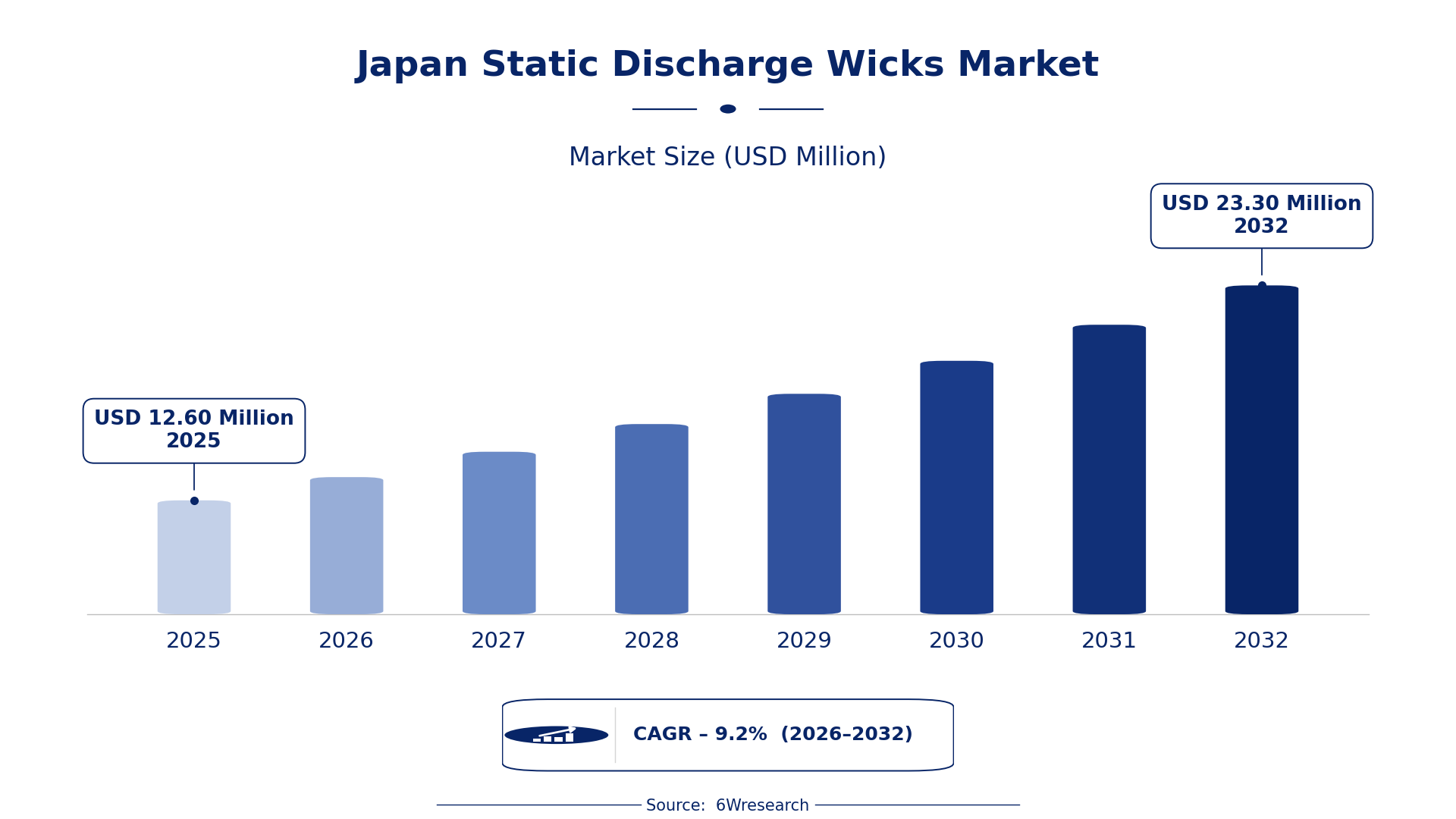
According to 6Wresearch internal database and industry insights, the Japan Static Discharge Wicks Market was valued at USD 12.60 Million in 2025 and is projected to reach USD 23.30 Million by 2032, growing at a CAGR of approximately 9.2% during 2026–2032.
Japan Static Discharge Wicks Market Highlights
| Report Metric | Details |
| Report Name | Japan Static Discharge Wicks Market (2026-2032) |
| Market Size 2025 | USD 12.60 Million |
| Market Size 2032 | USD 23.30 Million |
| Absolute Growth 2025–2032 | USD 10.70 Million |
| CAGR 2026–2032 | 9.2% |
| Peak Annual Growth | 10.7% in 2030 |
| Forecast Period | 2026–2032 |
| Historical Data | 2022–2025 |
| Base Year | 2025 |
| Leading Product Type, 2025 | Carbon Composite Wicks (51% share) |
| Leading Material Type, 2025 | Carbon Fiber (45% share) |
| Leading Aircraft Type, 2025 | Commercial Aircraft (43% share) |
| Leading End User, 2025 | Aircraft Manufacturers (40% share) |
| Fastest-Growing Product Type | Replaceable Wicks (12.7% CAGR) |
| Fastest-Growing Material Type | Composite Materials (12.9% CAGR) |
| Fastest-Growing Aircraft Type | Drones/UAVs (13.1% CAGR) |
| Fastest-Growing End User | Aerospace OEMs (11.7% CAGR) |
| Growing Sector | Aerospace |
| Key End Users | Aircraft Manufacturers, Aerospace OEMs, Aircraft Maintenance Firms, Defense Sector |
Japan Static Discharge Wicks Market Year-wise Growth Rate and Key Drivers (2022–2032)
This graph illustrates the annual growth rates of the market from 2022 to 2032, highlighting a steady upward trajectory and projected market expansion over the forecast period.
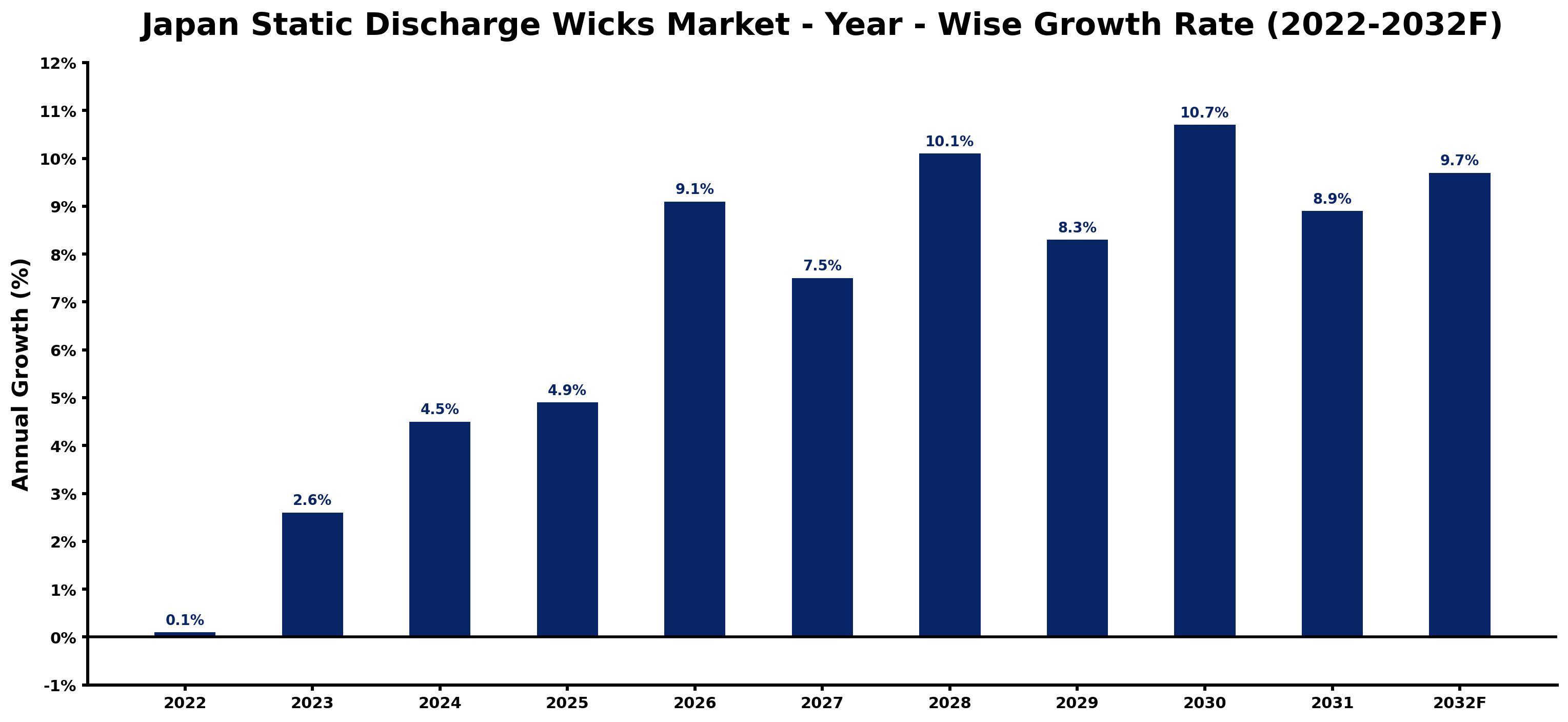
Annual growth estimates for each year appear below with the principal reason behind them, explaining the shifts that set the pace of the market.
| Year | Estimated Annual Growth (%) | Market Rationale |
| 2022 | 0.1 | The market showed minimal growth as demand stabilised following fluctuations in previous years. |
| 2023 | 2.6 | Demand increased due to rising orders from domestic aircraft manufacturers and maintenance firms. |
| 2024 | 4.5 | Growth accelerated as more commercial aircraft incorporated static discharge wicks into their designs. |
| 2025 | 4.9 | The market reached a peak growth rate as safety regulations tightened for military aircraft operations. |
| 2026 | 9.1 | Investment in aerospace technology is projected to drive demand for advanced static discharge solutions. |
| 2027 | 7.5 | Growth is expected to slow as the market adjusts to increased production capacities and evolving supply chains. |
| 2028 | 10.1 | Demand is anticipated to surge with the introduction of new aircraft models requiring improved safety features. |
| 2029 | 8.3 | Growth is expected to decelerate as the market stabilises after rapid expansions in previous years. |
| 2030 | 10.7 | The peak growth year will see heightened investments in aerospace safety technologies and innovations. |
| 2031 | 8.9 | Demand is projected to moderate as the market adjusts to technological advancements and improved production efficiencies. |
| 2032 | 9.7 | Growth will remain strong as continuous innovations in static discharge wicks are introduced. |
Note: Market size estimations and growth projections presented in this report are based on 6Wresearch's proprietary forecasting methodology, utilizing the latest available industry data, government publications, and primary research inputs.
Japan Static Discharge Wicks Market Synopsis
Static Discharge Wicks are crucial components that safely dissipate static electricity from aircraft surfaces, preventing damage to sensitive equipment. Constructed from conductive materials, these wicks improve aviation safety during both flight and ground operations. The Japan Static Discharge Wicks Market is expanding due to increased demand from domestic aircraft manufacturers and maintenance firms, alongside a ¥1 billion investment in aerospace safety in 2023. With over 200,000 people employed in Japan's aerospace sector, the market is set for continued growth driven by technological advancements and regulatory support.
Market Dynamics Impact Analysis (2026–2032)
| Factor | Type | Impact | Primary Segment Affected |
| Growing demand for safety in aviation | Driver | High | Carbon Composite Wicks |
| Increased investment in aerospace technology | Driver | High | Metal Mesh Wicks |
| Emerging applications in drone technology | Opportunity | Medium | Flexible Discharge Wicks |
| Rising focus on aerospace innovation in Tokyo | Opportunity | Medium | Carbon Fiber |
| Strict safety regulations for military aircraft | Restraint | High | Metal Mesh Wicks |
| Limited awareness of static discharge solutions | Restraint | Medium | Replaceable Wicks |
| Supply chain disruptions affecting production capacity | Challenge | High | Carbon Composite Wicks |
| Technological advancements outpacing existing solutions | Challenge | Medium | Aerospace OEMs |
Evaluation of Drivers in Japan Static Discharge Wicks Market (2026–2032)
The table below links each growth driver to the segment it affects and the evidence for it.
| Drivers | Primary Segment Affected | Why It Matters (Evidence) |
| Increased aircraft production | Carbon Composite Wicks | The demand for lightweight materials is driven by Japan's robust aerospace industry, employing over 200,000 people. |
| Rising safety standards | Metal Mesh Wicks | Static discharge wicks are mandated in over 90% of commercial aircraft, ensuring compliance with safety regulations. |
| Investment in R&D for static discharge technologies | Carbon Fiber | Aerospace OEMs are increasing their research efforts to develop innovative static discharge solutions for aircraft. |
| Growing military aircraft demand | Military Aircraft | Japan's defense budget for 2023 includes significant allocations for advanced aircraft technologies, boosting demand for wicks. |
| Support for aerospace innovation | Flexible Discharge Wicks | The Tokyo Metropolitan Government promotes aerospace innovation through subsidies, facilitating the adoption of new technologies. |
The strongest pull on demand comes from increased aircraft production, as Japan's aerospace industry employs a significant workforce, leading to a heightened need for lightweight materials like carbon composite wicks. Rising safety standards in aviation also drive demand, with static discharge wicks used in a large percentage of commercial aircraft. Investment in research and development for static discharge technologies by manufacturers is expected to improve product offerings, while growing military aircraft demand, supported by Japan's defense budget for 2023, further fuels market growth.
Evaluation of Restraints in Japan Static Discharge Wicks Market
These are the pressures that could keep growth below its potential.
| Market Restraint | Primary Segment Affected | Why It Matters (Evidence) |
| Strict adherence to safety regulations | Metal Mesh Wicks | Military aircraft in Japan must comply with stringent safety standards, limiting production flexibility and increasing costs. |
| Limited awareness of static discharge solutions | Replaceable Wicks | Many maintenance firms lack knowledge about the advantages of static discharge wicks, hindering their widespread adoption. |
| Supply chain disruptions | Carbon Composite Wicks | Global supply chain issues have affected the availability of essential materials for production, delaying timelines. |
| High costs of advanced materials | Carbon Fiber | The expense associated with carbon fiber wicks can deter some manufacturers from adopting these solutions. |
| Technological advancements outpacing existing solutions | Aerospace OEMs | Rapid technological changes may render existing products obsolete, challenging suppliers to keep pace. |
Japan Static Discharge Wicks Market Challenges
Static discharge wicks face stringent military regulations, requiring compliance with standards like JIS B 9960. This necessity increases production costs for suppliers, leading to price hikes for buyers that can reach 15%. Suppliers encounter rising material expenses, particularly for carbon composites, which have surged by 20% due to increased demand. Competition from international sources can delay product delivery, forcing buyers to wait an average of 6 weeks longer for critical components. Rapid technological advancements can outstrip current capabilities, creating challenges for suppliers to meet buyer expectations effectively.
Trends in the Japan Static Discharge Wicks Market
Several trends are reshaping the Japan Static Discharge Wicks Market; the most important are set out below.
- Shift from Traditional to Advanced Materials: The aerospace industry is increasingly adopting advanced materials like carbon fiber for static discharge wicks. In 2023, over 50% of new aircraft designs incorporated these materials, reflecting a notable industry shift.
- Growing Use of Static Discharge Wicks in Drones: Since 2022, static discharge wicks have begun to find applications in drone technology, with carbon fiber wicks increasingly being used. This trend is significant as drone manufacturers seek to improve safety and reliability.
- Focus on Safety Innovations in Aerospace: The Japanese government has set a target to improve aviation safety by 2025, promoting innovations in static discharge solutions. This initiative encourages manufacturers to invest in new technologies that elevate safety standards.
- Expansion of Aerospace Innovation Hubs: The Tokyo region is emerging as a prominent hub for aerospace innovation, with subsidies supporting research and development. In 2023, the Tokyo Metropolitan Government allocated ¥500 million to promote advancements in aerospace technology.
Investment Opportunities in the Japan Static Discharge Wicks Market
Below are the investment opportunities with the strongest case in the Japan Static Discharge Wicks Market.
- Gap in Advanced Static Discharge Solutions: With a projected growth of 9.2% in the next five years, there is an opportunity for suppliers of advanced static discharge wicks. Domestic aerospace manufacturers are looking for solutions to enhance safety and compliance.
- Investment in Aerospace R&D: The Japanese government’s commitment to improving aviation safety by 2025 creates opportunities for investment in research and development for static discharge technologies. Collaborating with local aerospace firms can facilitate market entry.
- Demand for Lightweight Materials: The increasing use of carbon fiber in static discharge wicks presents an opportunity for suppliers to meet this demand. The Tokyo Aerospace Technology Center is actively researching these materials to support innovation.
- Emerging Drone Market: The growing drone market, projected to expand significantly, offers opportunities for static discharge wick suppliers. Engaging with drone manufacturers can open new avenues for business development.
Government Initiatives in the Japan Static Discharge Wicks Market
The Economic Security Promotion Act of 2022 supports supply-chain resilience for critical aerospace products, ensuring that producers of static discharge wicks can maintain consistent material availability. This law encourages investment in domestic manufacturing capabilities, promoting the use of local materials and technologies. The Ministry of Economy, Trade and Industry has set funding targets to support the aerospace sector, with allocations reaching ¥1 billion in 2023 to improve safety standards.
In 2023, the Ministry of Economy, Trade and Industry allocated ¥1 billion to support aerospace safety improvements. This funding aims to enhance safety standards in the industry, benefiting both producers and buyers of static discharge wicks.
Future Insight of the Japan Static Discharge Wicks Market
The emergence of lightweight materials will reshape demand for static discharge wicks by 2032, as more efficient components become essential in aircraft designs. Research at the Tokyo Aerospace Technology Center will spur innovation in static discharge solutions, improving performance. By 2025, government initiatives will promote the adoption of new technologies in the aerospace sector, aligning with safety standards. Investment in aerospace safety improvements will stimulate growth, benefiting both buyers and suppliers.
Market Segmentation Analysis
Japan Static Discharge Wicks Market report covers a detailed analysis of the following market segments:
By Product Type – Carbon Composite Wicks Lead, Replaceable Wicks Expected to Grow Fastest
According to Saurav Kr Singh, Senior Research Analyst at 6Wresearch, with 51% of product type revenue in 2025, Carbon Composite Wicks was the largest category. Carbon composite wicks dominate the market as they are essential in over 90% of commercial aircraft in Japan, effectively managing static discharge. Their lightweight properties enhance aircraft performance, making them a preferred choice among domestic manufacturers and maintenance firms. Replaceable Wicks are set to record the highest CAGR in this split, 12.7% over 2026–2032. Replaceable wicks are experiencing rapid growth due to evolving maintenance practices, with Japan investing ¥1 billion in aerospace safety enhancements in 2023. This investment indicates a shift towards more efficient and flexible maintenance solutions in aircraft operations. Suppliers should focus on developing adaptable maintenance solutions to cater to the rising demand for replaceable wicks.
By Material Type – Carbon Fiber Leads, Composite Materials Expected to Grow Fastest
In 2025, Carbon Fiber led the material type split with a 45% share. Carbon fiber leads the market due to its lightweight and conductive properties, making it the preferred material for static discharge wicks in aircraft. Its effectiveness in preventing electrical interference in avionics solidifies its dominant position within the industry. Composite Materials are projected to grow fastest, at a CAGR of 12.9% during 2026–2032. Composite materials are witnessing rapid growth as they offer durability and conductivity, aligning with the industry's emphasis on advanced aircraft technologies. Increased R&D activities in static discharge solutions are likely to further accelerate this segment's expansion. Buyers should consider the benefits of composite materials for enhanced durability in static discharge applications.
By Aircraft Type – Commercial Aircraft Leads, Drones/UAVs Expected to Grow Fastest
Commercial Aircraft accounted for 43% of the market by aircraft type in 2025. Commercial aircraft hold the largest share as they represent the primary application for static discharge wicks, essential for passenger and cargo planes. The high volume of commercial flights in Japan necessitates reliable safety components like these wicks. Over 2026–2032, Drones/UAVs are expected to post the fastest growth, at a CAGR of 13.1%. Drones and UAVs are emerging as the fastest-growing segment, driven by advancements in drone technology and increasing applications in various sectors. This growth reflects the industry's adaptation to new aviation technologies. Suppliers should explore opportunities in the UAV market to capitalise on the rising demand for static discharge solutions.
By End User – Aircraft Manufacturers Lead, Aerospace OEMs Expected to Grow Fastest
The largest end user category in 2025 was Aircraft Manufacturers, at 40% of revenue. Aircraft manufacturers are the leading end users, being major consumers of static discharge wicks for their new aircraft designs. Their continuous production and innovation in aviation technology drive the demand for these components. The quickest growth will come from Aerospace OEMs, forecast to expand at a CAGR of 11.7% between 2026 and 2032. Aerospace OEMs are experiencing rapid growth as they increasingly integrate static discharge wicks into their aircraft designs, reflecting the industry's focus on safety and performance. This trend is likely to continue as new aircraft models are developed. Suppliers must strengthen relationships with aerospace OEMs to secure contracts for static discharge components in upcoming aircraft projects.
Key Attractiveness of the Report
- 10 Years of Market Numbers
- Historical Data Starting from 2022 to 2025
- Base Year 2025
- Forecast Data until 2032
- Key Performance Indicators Impacting the Market
- Major Upcoming Developments and Projects
Key Highlights of the Report:
- Japan Static Discharge Wicks Market Outlook
- Market Size of Japan Static Discharge Wicks Market, 2025
- Forecast of Japan Static Discharge Wicks Market, 2032
- Historical Data and Forecast of Japan Static Discharge Wicks Revenues & Volume for the Period 2022-2032F
- Japan Static Discharge Wicks Market Trend Evolution
- Japan Static Discharge Wicks Market Drivers and Challenges
- Japan Static Discharge Wicks Price Trends
- Japan Static Discharge Wicks Porter's Five Forces
- Japan Static Discharge Wicks Industry Life Cycle
- Historical Data and Forecast of Japan Static Discharge Wicks Market Revenues & Volume By Product Type for the Period 2022-2032F
- Historical Data and Forecast of Japan Static Discharge Wicks Market Revenues & Volume By Carbon Composite Wicks for the Period 2022-2032F
- Historical Data and Forecast of Japan Static Discharge Wicks Market Revenues & Volume By Metal Mesh Wicks for the Period 2022-2032F
- Historical Data and Forecast of Japan Static Discharge Wicks Market Revenues & Volume By Replaceable Wicks for the Period 2022-2032F
- Historical Data and Forecast of Japan Static Discharge Wicks Market Revenues & Volume By Flexible Discharge Wicks for the Period 2022-2032F
- Historical Data and Forecast of Japan Static Discharge Wicks Market Revenues & Volume By Material Type for the Period 2022-2032F
- Historical Data and Forecast of Japan Static Discharge Wicks Market Revenues & Volume By Carbon Fiber for the Period 2022-2032F
- Historical Data and Forecast of Japan Static Discharge Wicks Market Revenues & Volume By Aluminum Alloy for the Period 2022-2032F
- Historical Data and Forecast of Japan Static Discharge Wicks Market Revenues & Volume By Conductive Plastic for the Period 2022-2032F
- Historical Data and Forecast of Japan Static Discharge Wicks Market Revenues & Volume By Composite Materials for the Period 2022-2032F
- Historical Data and Forecast of Japan Static Discharge Wicks Market Revenues & Volume By Aircraft Type for the Period 2022-2032F
- Historical Data and Forecast of Japan Static Discharge Wicks Market Revenues & Volume By Commercial Aircraft for the Period 2022-2032F
- Historical Data and Forecast of Japan Static Discharge Wicks Market Revenues & Volume By Military Aircraft for the Period 2022-2032F
- Historical Data and Forecast of Japan Static Discharge Wicks Market Revenues & Volume By Drones/UAVs for the Period 2022-2032F
- Historical Data and Forecast of Japan Static Discharge Wicks Market Revenues & Volume By Helicopters for the Period 2022-2032F
- Historical Data and Forecast of Japan Static Discharge Wicks Market Revenues & Volume By End User for the Period 2022-2032F
- Historical Data and Forecast of Japan Static Discharge Wicks Market Revenues & Volume By Aircraft Manufacturers for the Period 2022-2032F
- Historical Data and Forecast of Japan Static Discharge Wicks Market Revenues & Volume By Defense Sector for the Period 2022-2032F
- Historical Data and Forecast of Japan Static Discharge Wicks Market Revenues & Volume By Aerospace OEMs for the Period 2022-2032F
- Historical Data and Forecast of Japan Static Discharge Wicks Market Revenues & Volume By Aircraft Maintenance Firms for the Period 2022-2032F
- Japan Static Discharge Wicks Import Export Trade Statistics
- Market Opportunity Assessment By Product Type
- Market Opportunity Assessment By Material Type
- Market Opportunity Assessment By Aircraft Type
- Market Opportunity Assessment By End User
- Japan Static Discharge Wicks Top Companies Market Share
- Japan Static Discharge Wicks Competitive Benchmarking By Technical and Operational Parameters
- Japan Static Discharge Wicks Company Profiles
- Japan Static Discharge Wicks Key Strategic Recommendations
Market Covered
Segments analysed in this report are listed below.
By Product Type
- Carbon Composite Wicks
- Metal Mesh Wicks
- Replaceable Wicks
- Flexible Discharge Wicks
By Material Type
- Carbon Fiber
- Aluminum Alloy
- Conductive Plastic
- Composite Materials
By Aircraft Type
- Commercial Aircraft
- Military Aircraft
- Drones/UAVs
- Helicopters
By End User
- Aircraft Manufacturers
- Defense Sector
- Aerospace OEMs
- Aircraft Maintenance Firms































