Japan Static Dissipative Additives Market Size & Growth Rate
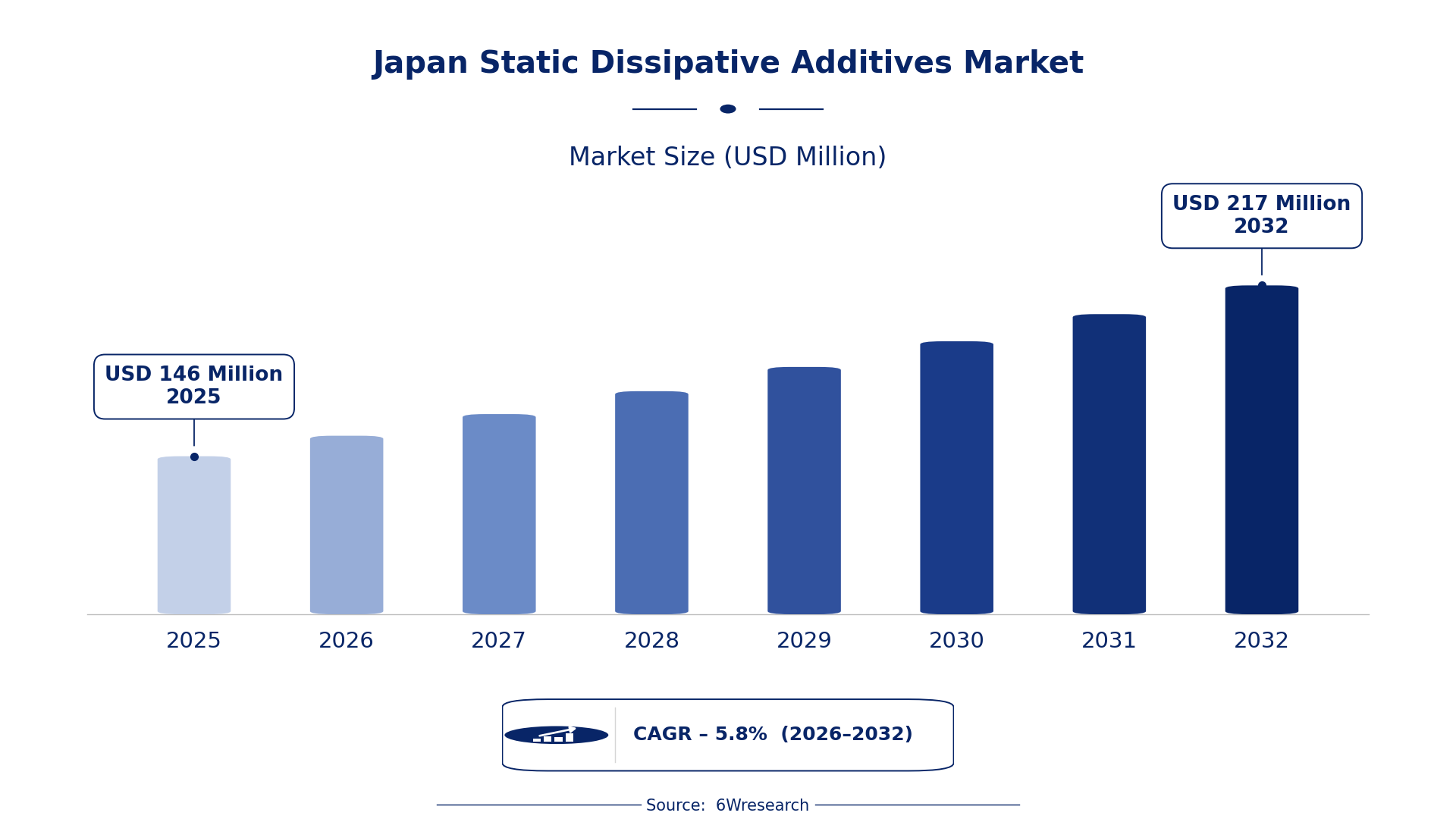
According to 6Wresearch internal database and industry insights, the Japan Static Dissipative Additives Market was valued at USD 146 Million in 2025 and is projected to reach USD 217 Million by 2032, growing at a CAGR of approximately 5.8% during 2026–2032.
Japan Static Dissipative Additives Market Highlights
| Report Metric | Details |
| Report Name | Japan Static Dissipative Additives Market (2026-2032) |
| Market Size 2025 | USD 146 Million |
| Market Size 2032 | USD 217 Million |
| Absolute Growth 2025–2032 | USD 71 Million |
| CAGR 2026–2032 | 5.8% |
| Peak Annual Growth | 6.7% in 2027 |
| Forecast Period | 2026–2032 |
| Historical Data | 2022–2025 |
| Base Year | 2025 |
| Leading Additive Type, 2025 | Polyethylene Glycol (50% share) |
| Leading Base Polymer, 2025 | Polyolefins (37% share) |
| Leading Form, 2025 | Pellet (45% share) |
| Leading End Use Industry, 2025 | Packaging Industry (44% share) |
| Fastest-Growing Additive Type | Carbon Black (8.0% CAGR) |
| Fastest-Growing Base Polymer | PVC (7.5% CAGR) |
| Fastest-Growing Form | Powder (8.4% CAGR) |
| Fastest-Growing End Use Industry | Electronics Components (7.3% CAGR) |
| Growing Sector | Electronics Components |
| Key End Users | Electronics manufacturers, automotive suppliers, packaging producers, industrial flooring companies |
Japan Static Dissipative Additives Market Year-wise Growth Rate and Key Drivers (2022–2032)
This graph illustrates the annual growth rates of the market from 2022 to 2032, highlighting a steady upward trajectory and projected market expansion over the forecast period.
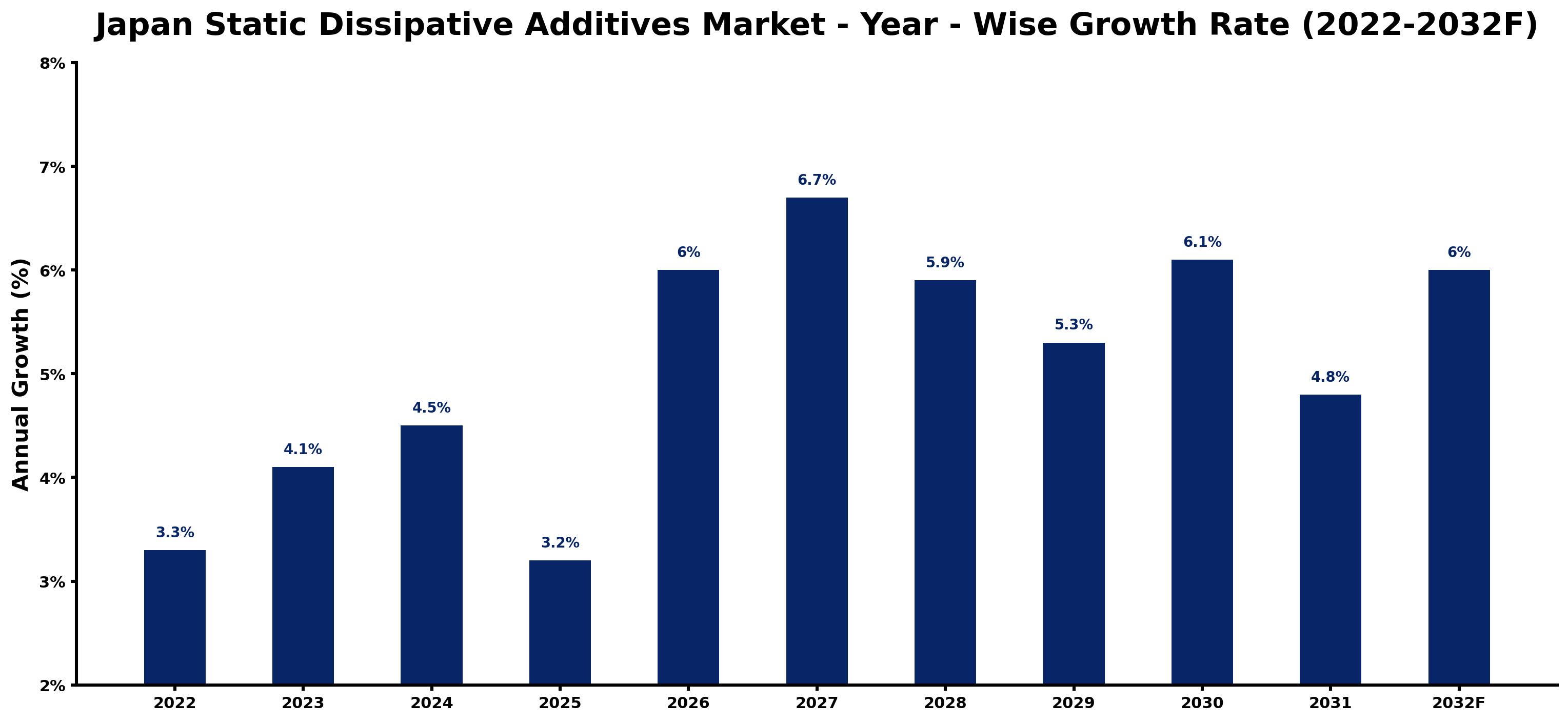
For each year, the table pairs the estimated growth rate with the leading influence on demand, showing how the drivers changed across the period.
| Year | Estimated Annual Growth (%) | Market Rationale |
| 2022 | 3.3 | The market showed steady activity, driven by existing demand in electronics and automotive sectors. |
| 2023 | 4.1 | Growth accelerated as manufacturers increased their use of static dissipative additives for safety. |
| 2024 | 4.5 | Demand continued to rise due to heightened safety standards in electronics manufacturing. |
| 2025 | 3.2 | Growth slowed as the market adjusted to previous peaks in demand from automotive and electronics. |
| 2026 | 6.0 | Renewed investments in advanced materials and technology are expected to boost the market. |
| 2027 | 6.7 | The electronics sector is set to ramp up production, boosting additive demand significantly. |
| 2028 | 5.9 | A slight slowdown is anticipated as the market stabilises after the peak growth year. |
| 2029 | 5.3 | Continued growth is expected, albeit at a reduced rate, as demand remains strong. |
| 2030 | 6.1 | Demand is projected to surge again, supported by new safety regulations in automotive interiors. |
| 2031 | 4.8 | A slowdown in growth is anticipated as the market adjusts to new supply circumstances. |
| 2032 | 6.0 | The market is expected to grow steadily as new applications emerge in packaging. |
Note: Market size estimations and growth projections presented in this report are based on 6Wresearch's proprietary forecasting methodology, utilizing the latest available industry data, government publications, and primary research inputs.
Japan Static Dissipative Additives Market Synopsis
Static dissipative additives mitigate static electricity in various applications, particularly in electronics, packaging, and automotive interiors. The Japan Static Dissipative Additives Market is growing due to rising demand from over 1,000 electronics manufacturers and the automotive sector, projected to account for 30% of additive usage by 2025. Investments in advanced materials, supported by standards like ISO 9001, are propelling further growth in Japan's market.
Market Dynamics Impact Analysis (2026–2032)
| Factor | Type | Impact | Primary Segment Affected |
| Rising demand from the electronics sector | Driver | High | Electronics Components |
| Increased adoption in automotive interiors | Driver | High | Automotive Interiors |
| Growing packaging industry requiring static control | Opportunity | High | Packaging Industry |
| Expansion of advanced materials initiatives | Opportunity | High | Conductive Polymer Blends |
| Compliance with safety regulations in manufacturing | Restraint | Medium | Automotive Interiors |
| Challenges in sourcing high-quality raw materials | Restraint | Medium | Conductive Polymer Blends |
| Cost pressures from raw material price fluctuations | Challenge | High | Electronics Components |
| Capacity constraints in production facilities | Challenge | Medium | Packaging Industry |
Evaluation of Drivers in Japan Static Dissipative Additives Market (2026–2032)
The factors lifting demand, and the evidence behind each, are summarised below.
| Drivers | Primary Segment Affected | Why It Matters (Evidence) |
| Increased production of consumer electronics | Electronics Components | The electronics sector, with over 1,000 manufacturers, drives demand for static dissipative additives to ensure product safety. |
| Growing safety regulations in automotive interiors | Automotive Interiors | Adoption of static dissipative additives in automotive interiors is driven by new safety regulations, expected to reach 30% by 2025. |
| Expansion of the packaging industry | Packaging Industry | The packaging industry, valued at over 10 trillion JPY, increasingly requires additives to prevent static-related incidents. |
| Rising use of conductive polymer blends | Conductive Polymer Blends | These blends are gaining traction in electronics due to their effectiveness in preventing static discharge, improving safety. |
| Increased investments in advanced materials | Conductive Polymer Blends | The Ministry of Economy, Trade and Industry's 2023 program promotes advanced materials, boosting additive demand. |
Much of the new demand originates from the electronics sector, which includes over 1,000 manufacturers needing static dissipative additives for safety. The automotive industry is expected to use a substantial portion of these additives by 2025, driven by stringent safety requirements. The packaging industry, valued at over 10 trillion JPY, increasingly utilises these materials to prevent static-related incidents. The rising popularity of conductive polymer blends in electronics results in higher purchases as they effectively prevent static discharge.
Evaluation of Restraints in Japan Static Dissipative Additives Market
These are the pressures that could keep growth below its potential.
| Market Restraint | Primary Segment Affected | Why It Matters (Evidence) |
| Compliance with stringent safety regulations | Automotive Interiors | Manufacturers must invest in compliance measures, increasing production costs and affecting pricing. |
| Sourcing high-quality raw materials | Conductive Polymer Blends | Quality issues can lead to production delays, impacting supply chains and delivery times. |
| Price volatility of raw materials | Electronics Components | Fluctuating costs strain budgets for manufacturers, resulting in reduced purchasing power. |
| Capacity limitations in production facilities | Packaging Industry | Limited production capacity can delay order fulfillment, affecting customer satisfaction. |
| Regulatory compliance costs | Automotive Interiors | Meeting safety standards requires investments in testing and certification, increasing operational expenses. |
Japan Static Dissipative Additives Market Challenges
Japan's electronics sector, with over 1,000 manufacturers, faces challenges due to outdated technology, causing delays in product launches by an average of six months for producers. Buyers encounter inflated costs stemming from limited availability of static dissipative additives, which can increase production expenses by 15% in the packaging industry. Distributors face supply chain disruptions from reliance on specific suppliers, leading to delivery delays of up to four weeks. Regulatory compliance, particularly with standards like ISO 9001, complicates operations, resulting in increased operational costs of approximately 10% for manufacturers.
Trends in the Japan Static Dissipative Additives Market
Several trends are reshaping the Japan Static Dissipative Additives Market; the most important are set out below.
- Shift towards Conductive Polymer Blends: Conductive Polymer Blends are becoming increasingly popular in Japan's electronics sector, with a notable rise in their adoption due to effectiveness in preventing static discharge. In 2023, the Ministry of Economy, Trade and Industry promoted advanced materials, further driving this trend.
- Increase in Automotive Safety Regulations: The automotive industry is experiencing a shift towards stricter safety regulations, resulting in increased adoption of static dissipative additives in interiors. By 2025, 30% of these additives are projected to be used in automotive applications, reflecting a change in industry standards.
- Growth of Static Dissipative Packaging Solutions: There is a growing trend in the packaging industry towards solutions that incorporate static dissipative additives. With the packaging industry valued at over 10 trillion JPY, manufacturers are investing in these materials to improve product safety and performance.
- Emergence of Advanced Material Initiatives: The Japanese government launched a program in 2023 to promote advanced materials, including static dissipative additives. This initiative aims to boost domestic manufacturing capabilities and is expected to impact the market positively.
Investment Opportunities in the Japan Static Dissipative Additives Market
The following opportunities in the Japan Static Dissipative Additives Market pair current demand with a clear way in.
- Electronics Manufacturers: Electronics manufacturers are increasingly seeking static dissipative additives to improve product safety and performance. With over 1,000 manufacturers in Japan, there is a clear opportunity for suppliers to meet this demand, especially with the projected growth in the sector.
- Partnerships with Automotive Suppliers: Now is an opportune moment for partnerships with automotive suppliers looking to comply with new safety regulations. By collaborating with local manufacturers, suppliers can enter the automotive market more effectively and tap into the projected usage of additives by 2025.
- Investment in Packaging Solutions: The packaging industry represents a key area for investment, as it increasingly requires static dissipative additives. With a market valued at over 10 trillion JPY, suppliers can focus on developing solutions to meet this growing demand.
- Expansion into Advanced Materials: The recent government initiative promotes advanced materials, creating opportunities for suppliers to innovate. Engaging with local partners can facilitate entry into this expanding market, particularly in electronics and packaging.
Government Initiatives in the Japan Static Dissipative Additives Market
The Chemical Substances Control Law mandates that manufacturers evaluate and control chemical substances used in static dissipative additives. Compliance with this law ensures that producers maintain safety and quality standards, which is essential for gaining market trust and meeting regulatory requirements.
The Semiconductor and Digital Industry Strategy, launched by the Ministry of Economy, Trade and Industry in June 2021, aims to secure domestic semiconductor manufacturing. This strategy includes funding for advanced materials, improving the capabilities of producers in the static dissipative additives market.
Future Insight of the Japan Static Dissipative Additives Market
The investment pipeline will expand as the government's programme to promote advanced materials drives demand for static dissipative additives. The automotive industry will increase its adoption of these materials, projected to use 30% by 2025. Testing standards such as JIS K 6301 will improve product reliability, benefiting both buyers and suppliers. As the market for static dissipative solutions grows, their integration into packaging will become standard, ensuring improved safety and performance.
Market Segmentation Analysis
Japan Static Dissipative Additives Market report covers a detailed analysis of the following market segments:
By Additive Type – Polyethylene Glycol Leads, Carbon Black Expected to Grow Fastest
According to Saurav Kr Singh, Senior Research Analyst at 6Wresearch, with 50% of additive type revenue in 2025, Polyethylene Glycol was the largest category. Polyethylene Glycol holds the largest share as it is widely used in formulations across various applications, particularly in electronics and automotive sectors. Its compatibility with numerous materials makes it a preferred choice among manufacturers in Japan. Carbon Black is set to record the highest CAGR in this split, 8.0% over 2026–2032. Carbon Black is experiencing rapid growth due to its effectiveness in enhancing conductivity in plastics, which is crucial for the electronics industry. The increasing demand for high-performance materials in electronic components is propelling its adoption. Suppliers should focus on developing formulations that incorporate Carbon Black to meet the rising demand in the electronics sector.
By Base Polymer – Polyolefins Lead, PVC Expected to Grow Fastest
The largest base polymer category in 2025 was Polyolefins, at 37% of revenue. Polyolefins dominate the market as they are extensively utilised as a base for static dissipative additives in various applications, particularly in packaging and automotive. Their versatility and cost-effectiveness have made them a staple choice among manufacturers in Japan. PVC is projected to grow fastest, at a CAGR of 7.5% during 2026–2032. PVC is gaining traction due to its widespread use in applications requiring static control, especially in the packaging and electronics sectors. The growing emphasis on safety and performance in these industries is driving its rapid adoption. Buyers should consider sourcing PVC-based additives to enhance static control in their products.
By Form – Pellet Leads, Powder Expected to Grow Fastest
In 2025, Pellet led the form split with a 45% share. Pellet form is the leading choice as it is the standard for processing in manufacturing, allowing for efficient handling and application in various industries. Its ease of use and compatibility with existing manufacturing processes make it highly preferred. The quickest growth will come from Powder, forecast to expand at a CAGR of 8.4% between 2026 and 2032. Powder form is seeing increased growth due to its specific applications in niche markets, particularly in electronics. As manufacturers seek tailored solutions for static control, the demand for powdered additives is on the rise. Suppliers may need to diversify their offerings to include powdered forms to cater to specialised applications.
By End Use Industry – Packaging Industry Leads, Electronics Components Expected to Grow Fastest
Packaging Industry took 44% of end use industry revenue in 2025, more than any other category. The Packaging Industry is the largest segment as it plays a critical role in preventing static in packaging materials, essential for protecting electronic components. With a market valued at over 10 trillion JPY, it represents a substantial opportunity for static dissipative additives. Over 2026–2032, Electronics Components are expected to post the fastest growth, at a CAGR of 7.3%. Electronics Components are witnessing the fastest growth due to the increasing demand for high-performance materials that ensure safety and reliability in electronic devices. The push for advanced materials in electronics is driving this segment's rapid expansion. Suppliers should prioritise the electronics sector to capitalise on the growing need for static control solutions.
Key Attractiveness of the Report
- 10 Years of Market Numbers
- Historical Data Starting from 2022 to 2025
- Base Year 2025
- Forecast Data until 2032
- Key Performance Indicators Impacting the Market
- Major Upcoming Developments and Projects
Key Highlights of the Report:
- Japan Static Dissipative Additives Market Outlook
- Market Size of Japan Static Dissipative Additives Market, 2025
- Forecast of Japan Static Dissipative Additives Market, 2032
- Historical Data and Forecast of Japan Static Dissipative Additives Revenues & Volume for the Period 2022-2032F
- Japan Static Dissipative Additives Market Trend Evolution
- Japan Static Dissipative Additives Market Drivers and Challenges
- Japan Static Dissipative Additives Price Trends
- Japan Static Dissipative Additives Porter's Five Forces
- Japan Static Dissipative Additives Industry Life Cycle
- Historical Data and Forecast of Japan Static Dissipative Additives Market Revenues & Volume By Additive Type for the Period 2022-2032F
- Historical Data and Forecast of Japan Static Dissipative Additives Market Revenues & Volume By Polyethylene Glycol for the Period 2022-2032F
- Historical Data and Forecast of Japan Static Dissipative Additives Market Revenues & Volume By Carbon Black for the Period 2022-2032F
- Historical Data and Forecast of Japan Static Dissipative Additives Market Revenues & Volume By Conductive Polymer Blends for the Period 2022-2032F
- Historical Data and Forecast of Japan Static Dissipative Additives Market Revenues & Volume By Quaternary Ammonium Compounds for the Period 2022-2032F
- Historical Data and Forecast of Japan Static Dissipative Additives Market Revenues & Volume By Base Polymer for the Period 2022-2032F
- Historical Data and Forecast of Japan Static Dissipative Additives Market Revenues & Volume By Polyolefins for the Period 2022-2032F
- Historical Data and Forecast of Japan Static Dissipative Additives Market Revenues & Volume By PVC for the Period 2022-2032F
- Historical Data and Forecast of Japan Static Dissipative Additives Market Revenues & Volume By PS/ABS for the Period 2022-2032F
- Historical Data and Forecast of Japan Static Dissipative Additives Market Revenues & Volume By TPU for the Period 2022-2032F
- Historical Data and Forecast of Japan Static Dissipative Additives Market Revenues & Volume By Form for the Period 2022-2032F
- Historical Data and Forecast of Japan Static Dissipative Additives Market Revenues & Volume By Pellet for the Period 2022-2032F
- Historical Data and Forecast of Japan Static Dissipative Additives Market Revenues & Volume By Powder for the Period 2022-2032F
- Historical Data and Forecast of Japan Static Dissipative Additives Market Revenues & Volume By Granules for the Period 2022-2032F
- Historical Data and Forecast of Japan Static Dissipative Additives Market Revenues & Volume By Liquid Additive for the Period 2022-2032F
- Historical Data and Forecast of Japan Static Dissipative Additives Market Revenues & Volume By End Use Industry for the Period 2022-2032F
- Historical Data and Forecast of Japan Static Dissipative Additives Market Revenues & Volume By Packaging Industry for the Period 2022-2032F
- Historical Data and Forecast of Japan Static Dissipative Additives Market Revenues & Volume By Electronics Components for the Period 2022-2032F
- Historical Data and Forecast of Japan Static Dissipative Additives Market Revenues & Volume By Automotive Interiors for the Period 2022-2032F
- Historical Data and Forecast of Japan Static Dissipative Additives Market Revenues & Volume By Industrial Flooring for the Period 2022-2032F
- Japan Static Dissipative Additives Import Export Trade Statistics
- Market Opportunity Assessment By Additive Type
- Market Opportunity Assessment By Base Polymer
- Market Opportunity Assessment By Form
- Market Opportunity Assessment By End Use Industry
- Japan Static Dissipative Additives Top Companies Market Share
- Japan Static Dissipative Additives Competitive Benchmarking By Technical and Operational Parameters
- Japan Static Dissipative Additives Company Profiles
- Japan Static Dissipative Additives Key Strategic Recommendations
Market Covered
The following segment groups are covered in the report.
By Additive Type
- Polyethylene Glycol
- Carbon Black
- Conductive Polymer Blends
- Quaternary Ammonium Compounds
By Base Polymer
- Polyolefins
- PVC
- PS/ABS
- TPU
By Form
- Pellet
- Powder
- Granules
- Liquid Additive
By End Use Industry
- Packaging Industry
- Electronics Components
- Automotive Interiors
- Industrial Flooring































