Japan Steel Ingots Market Size & Growth Rate
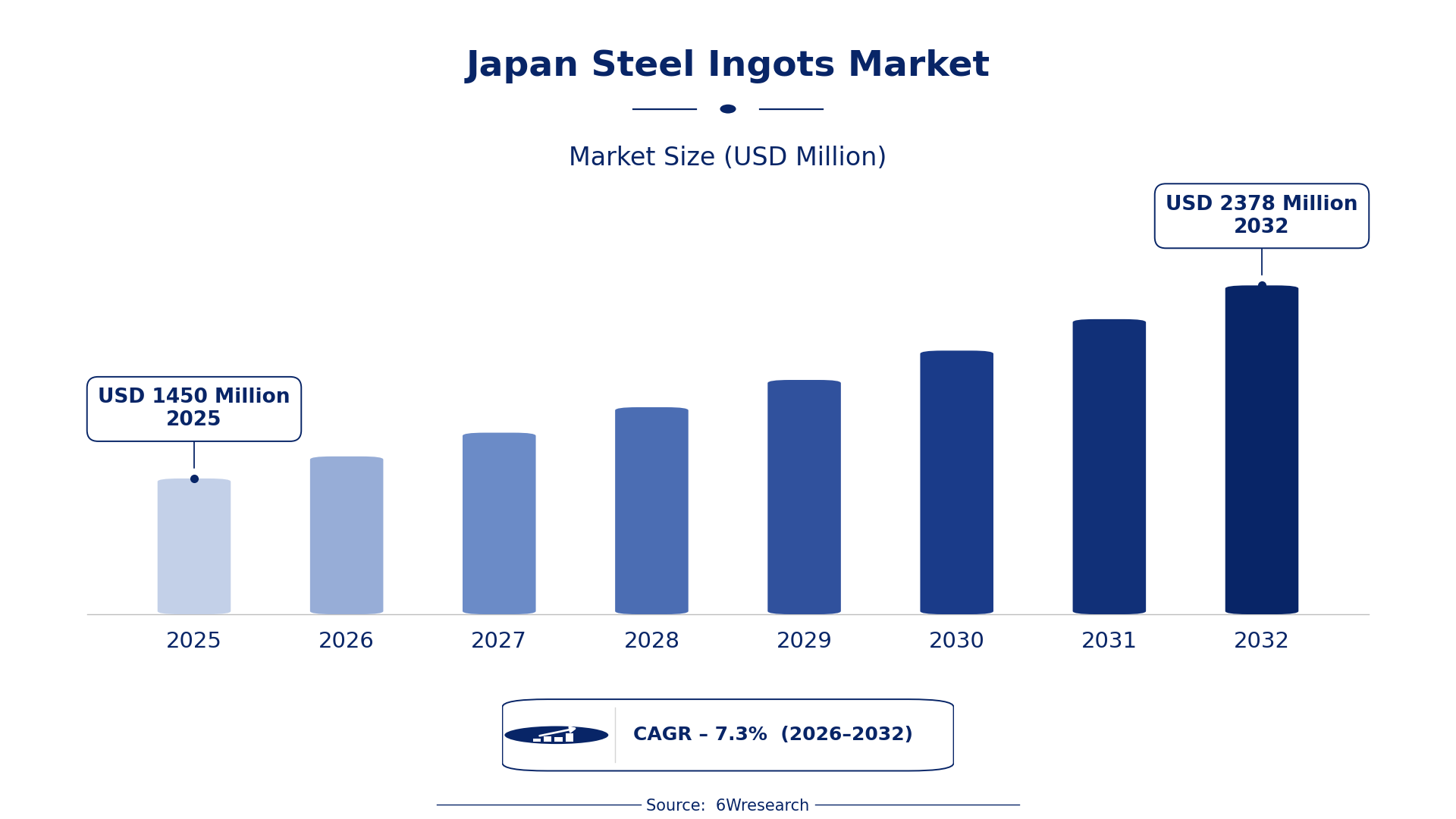
According to 6Wresearch internal database and industry insights, the Japan Steel Ingots Market was valued at USD 1,450 Million in 2025 and is projected to reach USD 2,378 Million by 2032, growing at a CAGR of approximately 7.3% during 2026–2032.
Japan Steel Ingots Market Highlights
| Report Metric | Details |
| Report Name | Japan Steel Ingots Market (2026-2032) |
| Market Size 2025 | USD 1,450 Million |
| Market Size 2032 | USD 2,378 Million |
| Absolute Growth 2025–2032 | USD 928 Million |
| CAGR 2026–2032 | 7.3% |
| Peak Annual Growth | 9.0% in 2032 |
| Forecast Period | 2026–2032 |
| Historical Data | 2022–2025 |
| Base Year | 2025 |
| Leading Material type, 2025 | Mild Steel (62% share) |
| Leading Application, 2025 | Construction (39% share) |
| Fastest-Growing Material type | Stainless Steel (9.9% CAGR) |
| Fastest-Growing Application | Energy (10.0% CAGR) |
| Growing Sector | Construction |
| Key End Users | Construction firms, automotive manufacturers, engineering companies |
Japan Steel Ingots Market Year-wise Growth Rate and Key Drivers (2022–2032)
This graph illustrates the annual growth rates of the market from 2022 to 2032, highlighting a steady upward trajectory and projected market expansion over the forecast period.
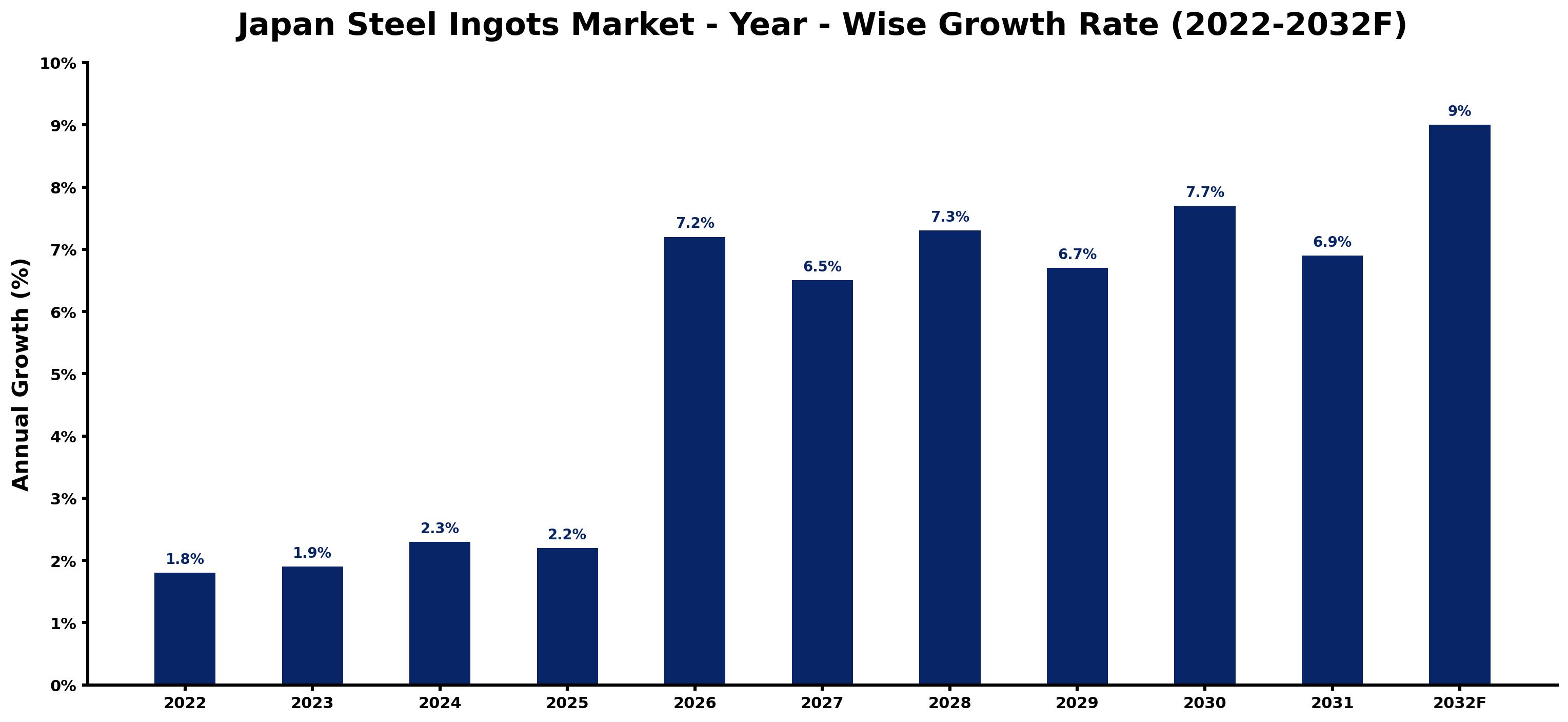
Below, each year's estimated growth is shown next to the factor that most influenced it.
| Year | Estimated Annual Growth (%) | Market Rationale |
| 2022 | 1.8 | The market showed stable growth, reflecting steady demand from construction and manufacturing sectors. |
| 2023 | 1.9 | Demand continued to rise as construction projects expanded across urban areas. |
| 2024 | 2.3 | Growth accelerated due to increased investments in infrastructure and residential developments. |
| 2025 | 2.2 | Growth slowed slightly as projects reached completion and demand stabilised. |
| 2026 | 7.2 | The market is expected to rebound strongly with renewed construction initiatives and urban development plans. |
| 2027 | 6.5 | Growth is projected to moderate as the market adjusts to higher production costs and competition. |
| 2028 | 7.3 | Demand is expected to surge again driven by government-backed infrastructure projects and private investments. |
| 2029 | 6.7 | Growth is projected to decelerate as the market faces capacity constraints and supply chain challenges. |
| 2030 | 7.7 | Demand will increase due to ongoing urbanisation and a focus on sustainable construction practices. |
| 2031 | 6.9 | Growth is expected to slow as market saturation begins to impact new project launches. |
| 2032 | 9.0 | The market is projected to peak with increased investments in green steel technologies and infrastructure. |
Note: Market size estimations and growth projections presented in this report are based on 6Wresearch's proprietary forecasting methodology, utilizing the latest available industry data, government publications, and primary research inputs.
Japan Steel Ingots Market Synopsis
Steel ingots are semi-finished products made from molten steel, cast into shapes for further processing. According to the Japan Steel Ingots Market, robust demand from the construction sector, which accounts for 40% of steel consumption, and the automotive industry, increasingly prioritising sustainable practices, is driving growth. Initiatives like the Green Growth Strategy are propelling investments in decarbonisation, leading to heightened purchases of steel ingots across various sectors, including engineering and manufacturing.
Market Dynamics Impact Analysis (2026–2032)
| Factor | Type | Impact | Primary Segment Affected |
| Rising infrastructure investments | Driver | High | Construction |
| Increased automotive production | Driver | High | Automotive |
| Growing demand for sustainable materials | Opportunity | High | Stainless Steel |
| Expansion of construction projects | Opportunity | High | Construction |
| High production costs | Restraint | Medium | Mild Steel |
| Supply chain disruptions | Restraint | Medium | Mild Steel |
| Competition from alternative materials | Challenge | High | Stainless Steel |
| Regulatory pressures on emissions | Challenge | High | Mild Steel |
Evaluation of Drivers in Japan Steel Ingots Market (2026–2032)
The table below links each growth driver to the segment it affects and the evidence for it.
| Drivers | Primary Segment Affected | Why It Matters (Evidence) |
| Increased Infrastructure Investment | Construction | The construction sector's demand for steel ingots is driven by ongoing infrastructure investments, which accounted for 40% of steel consumption in 2022. |
| Urbanisation Trends | Construction | Urbanisation in key regions boosts ingot purchases, as housing developments require substantial steel for structural components. |
| Sustainability Initiatives | Automotive | The automotive industry's reliance on steel, being the largest consumer, propels demand as manufacturers adopt sustainable production practices. |
| Decarbonisation Investments | Mild Steel | The GX Basic Policy's target of JPY 150 trillion in decarbonisation investments over the next decade encourages the use of high-quality steel grades. |
| Technological Advancements | Engineering | Technological advancements in manufacturing processes enhance efficiency, leading to increased production of steel ingots for engineering applications. |
Several shifts outside the market lift sales. The construction sector's demand for steel ingots is driven by ongoing infrastructure investments, which accounted for 40% of steel consumption in 2022. Urbanisation in key regions further boosts ingot purchases, as housing developments require substantial steel. The automotive industry's reliance on steel, being the largest consumer, also propels demand.
Evaluation of Restraints in Japan Steel Ingots Market
The main factors holding the market back are set out below.
| Market Restraint | Primary Segment Affected | Why It Matters (Evidence) |
| High production costs due to energy prices | Mild Steel | Increased energy costs have raised production expenses by approximately 15%, affecting pricing strategies for buyers. |
| Supply chain disruptions impacting delivery times | Mild Steel | Ongoing supply chain issues have delayed steel deliveries, causing project timelines for construction to extend by several weeks. |
| Competition from alternative materials like aluminium | Stainless Steel | Aluminium's lightweight properties appeal to automotive applications, challenging steel demand in that sector. |
| Regulatory pressures on carbon emissions | Mild Steel | Stricter emissions regulations require steel producers to invest in cleaner technologies, raising operational costs by about 10%. |
| Limited availability of raw materials | Mild Steel | Raw material shortages have constrained production capacity, impacting the supply of steel ingots and leading to increased prices. |
Japan Steel Ingots Market Challenges
Japan's steel ingot producers struggle with outdated technology, leading to inefficiencies that increase production costs by 20%, impacting profitability for manufacturers. High energy prices rank among the highest globally, adding 15% to operational expenses, which raises prices for buyers. Competition from countries with lower production costs forces local suppliers to lower prices, squeezing their margins and limiting their ability to invest in innovation. Stringent emissions regulations complicate operations, causing delays and increasing costs by 10% for producers, ultimately affecting their capacity to meet market demands.
Trends in the Japan Steel Ingots Market
Four trends stand out in the Japan Steel Ingots Market.
- Shift towards Sustainable Steel Production: Since 2023, Japan's steel industry has increasingly focused on sustainable practices, with the Green Growth Strategy aiming for net zero emissions by 2050. This initiative has prompted investments in eco-friendly technologies, with a projected JPY 150 trillion in funding.
- Transition from Mild Steel to Stainless Steel: In 2026, the demand for stainless steel surged, particularly in construction and automotive sectors. The adoption of grades like 304 and 316 reflects a growing preference for corrosion-resistant materials, with a projected CAGR of 9.9%.
- Emergence of Advanced Manufacturing Techniques: Beginning in 2025, advanced manufacturing techniques have gained traction in Japan's steel sector. These methods improve efficiency and reduce waste, aligning with sustainability goals, with investments expected to reach JPY 150 trillion.
- Prioritisation of Localised Supply Chains: Since 2024, there has been a notable shift towards localised supply chains in steel production. This change aims to mitigate supply chain disruptions and improve responsiveness to market demands, particularly in urban areas.
Investment Opportunities in the Japan Steel Ingots Market
The openings below show where demand in the Japan Steel Ingots Market is visible and how suppliers can enter.
- Construction Sector Expansion: The construction industry is experiencing growth, driven by urbanisation and infrastructure projects. With 40% of steel demand coming from this sector, suppliers can target construction firms for new contracts, especially in urban centres.
- Investment in Sustainable Steel Technologies: With Japan's commitment to carbon neutrality, there is a strong opportunity to invest in sustainable steel production technologies. The Japan Iron and Steel Federation promotes initiatives that align with these goals, with expected investments reaching JPY 150 trillion.
- Growing Demand for Stainless Steel: As the demand for stainless steel rises, suppliers can focus on providing high-quality grades for construction and automotive applications. The anticipated growth in this segment highlights its potential for suppliers looking to expand.
- Local Partnerships for Market Entry: To enter the Japanese market effectively, foreign suppliers should consider forming joint ventures with local manufacturers. This approach can facilitate access to distribution networks and regulatory compliance, improving market penetration.
Government Initiatives in the Japan Steel Ingots Market
The Hydrogen Society Promotion Act, enacted in 2024, impacts steel producers by supporting low-carbon hydrogen supply chains. This act provides price-gap support, encouraging the adoption of cleaner production methods in steel manufacturing, which is essential for meeting sustainability targets. The act aims to reduce carbon emissions by 2030, benefiting producers who invest in these technologies.
The Building Energy Efficiency Act, amended in 2022, requires all new buildings to comply with energy standards from April 2025. This regulation influences buyers in the construction sector, as they must ensure that steel products meet these enhanced energy efficiency requirements, promoting higher standards for materials used.
Future Insight of the Japan Steel Ingots Market
Investment in decarbonisation initiatives will reach JPY 150 trillion by 2032, creating a robust pipeline for new technologies in steel production. This transition towards net-zero emissions will open avenues for suppliers adopting sustainable practices. As the construction sector continues to drive steel demand, evolving building standards will require higher quality materials. The automotive industry's shift towards electric vehicles will also necessitate specialised steel grades, shaping future production strategies.
Market Segmentation Analysis
Japan Steel Ingots Market report covers a detailed analysis of the following market segments:
By Material type – Mild Steel Leads, Stainless Steel Expected to Grow Fastest
According to Ravi Bhandari, Research Head at 6Wresearch, in 2025, Mild Steel led the material type split with a 62% share. Mild steel holds the largest share due to its extensive use in construction and general engineering, which are vital for Japan's infrastructure needs. The construction sector's 40% contribution to steel demand underscores the reliance on mild steel for a variety of projects. Stainless Steel is set to record the highest CAGR in this split, 9.9% over 2026–2032. Stainless steel is witnessing rapid growth as industries increasingly require materials that can endure high-corrosion environments, particularly in sectors such as automotive and construction. This trend towards durability in applications is propelling its growth rate. Suppliers should focus on increasing stainless steel production to meet the growing demand for durable materials.
By Application – Construction Leads, Energy Expected to Grow Fastest
Construction took 39% of application revenue in 2025, more than any other category. The construction sector dominates steel ingot applications, driven by ongoing infrastructure development and urbanisation in Japan. Its leading share reflects the essential role of steel in structural components across numerous building projects. Over 2026–2032, Energy is expected to post the fastest growth, at a CAGR of 10.0%. The energy sector is poised for the fastest growth as investments in energy infrastructure rise alongside the shift towards sustainable energy solutions. This trend is likely to elevate the demand for steel in energy-related applications. Buyers in the energy sector must prepare for intensified competition for high-quality steel as demand continues to grow.
Key Attractiveness of the Report
- 10 Years of Market Numbers
- Historical Data Starting from 2022 to 2025
- Base Year 2025
- Forecast Data until 2032
- Key Performance Indicators Impacting the Market
- Major Upcoming Developments and Projects
Key Highlights of the Report:
- Japan Steel Ingots Market Outlook
- Market Size of Japan Steel Ingots Market, 2025
- Forecast of Japan Steel Ingots Market, 2032
- Historical Data and Forecast of Japan Steel Ingots Revenues & Volume for the Period 2022-2032
- Japan Steel Ingots Market Trend Evolution
- Japan Steel Ingots Market Drivers and Challenges
- Japan Steel Ingots Price Trends
- Japan Steel Ingots Porter's Five Forces
- Japan Steel Ingots Industry Life Cycle
- Historical Data and Forecast of Japan Steel Ingots Market Revenues & Volume By Material type for the Period 2022-2032
- Historical Data and Forecast of Japan Steel Ingots Market Revenues & Volume By Stainless Steel for the Period 2022-2032
- Historical Data and Forecast of Japan Steel Ingots Market Revenues & Volume By Mild Steel for the Period 2022-2032
- Historical Data and Forecast of Japan Steel Ingots Market Revenues & Volume By Application for the Period 2022-2032
- Historical Data and Forecast of Japan Steel Ingots Market Revenues & Volume By Construction for the Period 2022-2032
- Historical Data and Forecast of Japan Steel Ingots Market Revenues & Volume By Automotive for the Period 2022-2032
- Historical Data and Forecast of Japan Steel Ingots Market Revenues & Volume By Aerospace for the Period 2022-2032
- Historical Data and Forecast of Japan Steel Ingots Market Revenues & Volume By Energy for the Period 2022-2032
- Historical Data and Forecast of Japan Steel Ingots Market Revenues & Volume By Engineering for the Period 2022-2032
- Historical Data and Forecast of Japan Steel Ingots Market Revenues & Volume By Others for the Period 2022-2032
- Japan Steel Ingots Import Export Trade Statistics
- Market Opportunity Assessment By Material type
- Market Opportunity Assessment By Application
- Japan Steel Ingots Top Companies Market Share
- Japan Steel Ingots Competitive Benchmarking By Technical and Operational Parameters
- Japan Steel Ingots Company Profiles
- Japan Steel Ingots Key Strategic Recommendations
Market Covered
Coverage by segment is as follows.
By Material type
- Stainless Steel
- Mild Steel
By Application
- Construction
- Automotive
- Aerospace
- Energy
- Engineering
- Others































