Japan Steering Angle Sensor Market Size & Growth Rate
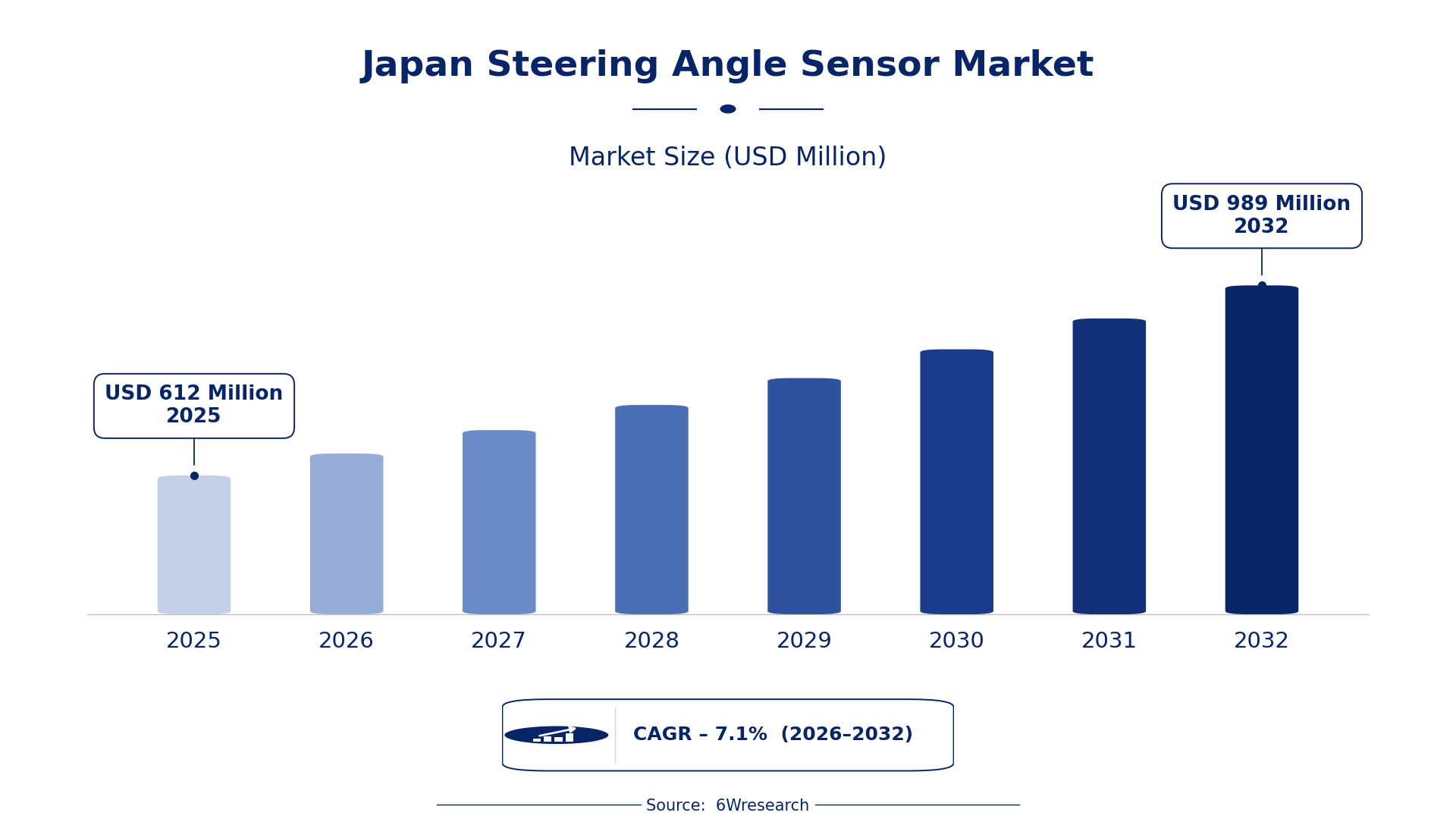
According to 6Wresearch internal database and industry insights, the Japan Steering Angle Sensor Market was valued at USD 612 Million in 2025 and is projected to reach USD 989 Million by 2032, growing at a CAGR of approximately 7.1% during 2026–2032.
Japan Steering Angle Sensor Market Highlights
| Report Metric | Details |
| Report Name | Japan Steering Angle Sensor Market (2026-2032) |
| Market Size 2025 | USD 612 Million |
| Market Size 2032 | USD 989 Million |
| Absolute Growth 2025–2032 | USD 377 Million |
| CAGR 2026–2032 | 7.1% |
| Peak Annual Growth | 8.0% in 2032 |
| Forecast Period | 2026–2032 |
| Historical Data | 2022–2025 |
| Base Year | 2025 |
| Leading Sensor Type, 2025 | Digital Angle Sensors (45% share) |
| Leading Interface Type, 2025 | CAN Bus (45% share) |
| Leading Vehicle Segment, 2025 | Passenger Vehicles (37% share) |
| Leading End User, 2025 | Automotive Electronics OEMs (37% share) |
| Fastest-Growing Sensor Type | Analog Angle Sensors (10.5% CAGR) |
| Fastest-Growing Interface Type | Analog Voltage Output (10.3% CAGR) |
| Fastest-Growing Vehicle Segment | Commercial Vehicles (9.6% CAGR) |
| Fastest-Growing End User | Tier 1 Suppliers (9.7% CAGR) |
| Growing Sector | automotive electronics |
| Key End Users | automotive electronics OEMs, Tier 1 suppliers, steering system integrators, advanced driver assistance |
Japan Steering Angle Sensor Market Year-wise Growth Rate and Key Drivers (2022–2032)
This graph illustrates the annual growth rates of the market from 2022 to 2032, highlighting a steady upward trajectory and projected market expansion over the forecast period.
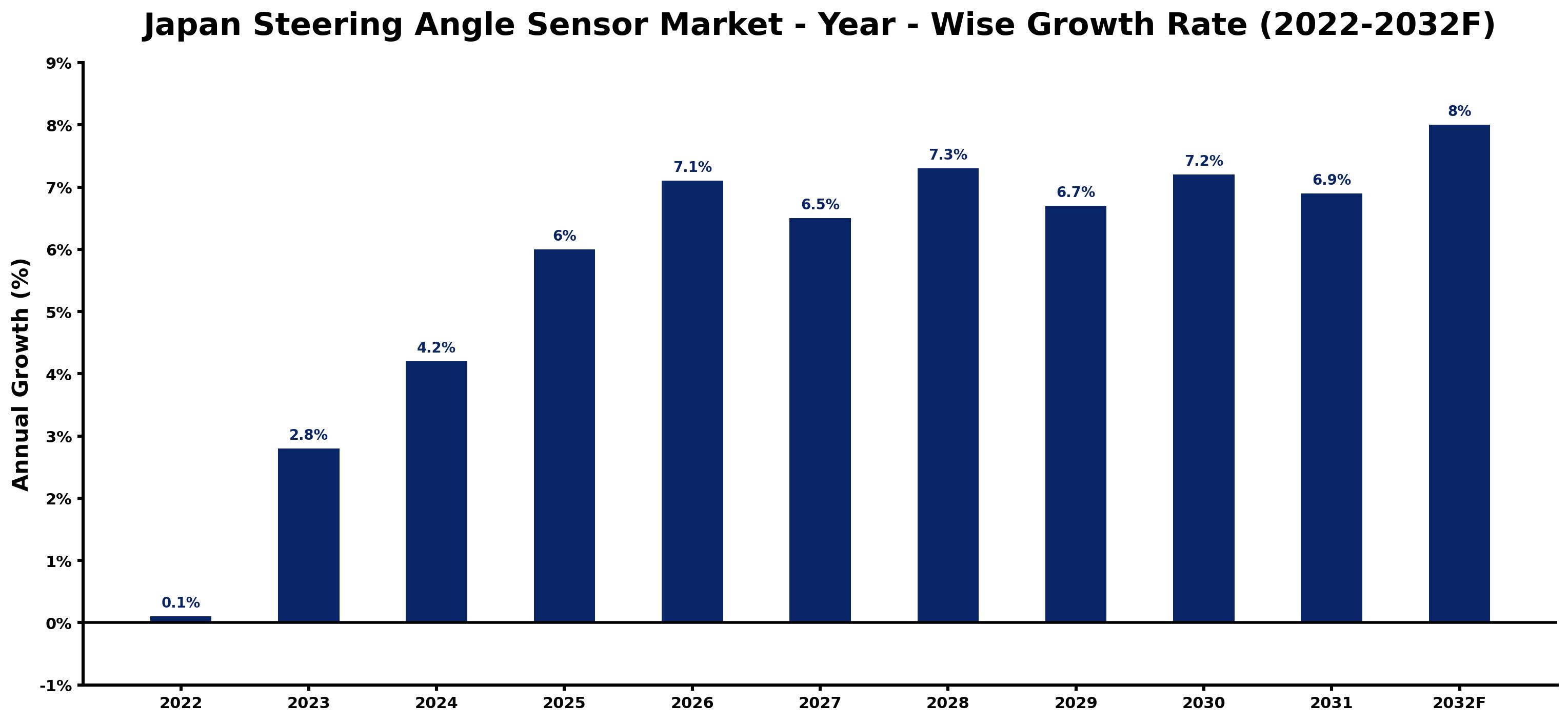
The table below sets out the estimated growth rate for each year and the main factor behind it.
| Year | Estimated Annual Growth (%) | Market Rationale |
| 2022 | 0.1 | The market experienced minimal growth due to initial recovery from economic impacts. |
| 2023 | 2.8 | Growth accelerated as automotive production increased, reflecting rising consumer demand. |
| 2024 | 4.2 | Continued growth was driven by advancements in vehicle safety technologies and ADAS integration. |
| 2025 | 6.0 | The market peaked with strong demand for digital angle sensors in passenger vehicles. |
| 2026 | 7.1 | Growth is expected to continue as manufacturers adopt advanced steering systems for improved safety. |
| 2027 | 6.5 | The growth rate is projected to slow slightly due to market saturation in certain vehicle segments. |
| 2028 | 7.3 | Demand is expected to increase again as new vehicle models incorporate advanced steering technologies. |
| 2029 | 6.7 | Growth is projected to slow as competition intensifies among sensor manufacturers and suppliers. |
| 2030 | 7.2 | The market is expected to rebound with new regulations mandating advanced driver assistance systems. |
| 2031 | 6.9 | Growth is projected to slow again as the market stabilises after a period of rapid expansion. |
| 2032 | 8.0 | The market is expected to peak with investments in autonomous vehicle technologies. |
Note: Market size estimations and growth projections presented in this report are based on 6Wresearch's proprietary forecasting methodology, utilizing the latest available industry data, government publications, and primary research inputs.
Japan Steering Angle Sensor Market Synopsis
Steering Angle Sensors are electronic devices that measure the steering wheel's angle, providing critical data to vehicle control systems. The Japan Steering Angle Sensor Market is expanding due to increased automotive production, which reached 8.3 million units in 2022, and the adoption of safety regulations mandating advanced driver assistance systems in new vehicles by 2025. The focus on developing autonomous vehicle technologies by 2030 further drives demand, attracting automotive electronics OEMs and Tier 1 suppliers.
Market Dynamics Impact Analysis (2026–2032)
| Factor | Type | Impact | Primary Segment Affected |
| Increased automotive production | Driver | High | Digital Angle Sensors |
| Adoption of advanced driver assistance systems | Driver | High | Magnetic Rotary Sensors |
| Growing demand for electric vehicles | Opportunity | High | Commercial Vehicles |
| Emergence of autonomous vehicles | Opportunity | High | Autonomous Vehicles |
| Competition among sensor manufacturers | Restraint | Medium | Analog Angle Sensors |
| Market saturation in passenger vehicles | Restraint | Medium | Passenger Vehicles |
| High development costs for new technologies | Challenge | High | Advanced Driver Assistance |
| Regulatory compliance requirements for safety standards | Challenge | High | Automotive Electronics OEMs |
Evaluation of Drivers in Japan Steering Angle Sensor Market (2026–2032)
The table below links each growth driver to the segment it affects and the evidence for it.
| Drivers | Primary Segment Affected | Why It Matters (Evidence) |
| Increased automotive production | Digital Angle Sensors | Japan's automotive production reached 8.3 million units in 2022, driving demand for precise steering measurements. |
| Integration of ADAS features | Magnetic Rotary Sensors | The mandate for ADAS in new vehicles by 2025 boosts the need for reliable steering angle sensors. |
| Rising electric vehicle adoption | Commercial Vehicles | The government's support for electric vehicle adoption by 2030 encourages demand for advanced steering technologies. |
| Development of autonomous vehicles | Autonomous Vehicles | Japan's focus on autonomous vehicle technologies by 2030 increases the need for accurate steering data. |
| Growing safety regulations | Advanced Driver Assistance | New regulations require improved safety features, leading to higher demand for steering angle sensors. |
Most of the extra volume comes from Japan's automotive production, which reached 8.3 million units in 2022, driving demand for steering angle sensors. The push for electric vehicle adoption by 2030 encourages manufacturers to invest in reliable steering technologies. The focus on developing autonomous vehicles further drives demand for accurate sensor data, as these vehicles require precise steering inputs for navigation and control.
Evaluation of Restraints in Japan Steering Angle Sensor Market
The key brakes on demand, and where they bite hardest, are shown below.
| Market Restraint | Primary Segment Affected | Why It Matters (Evidence) |
| Intense competition among sensor manufacturers | Analog Angle Sensors | Pricing pressures impact profit margins for manufacturers in this segment. |
| Market saturation in passenger vehicles | Passenger Vehicles | With over 4 million registered passenger vehicles in Japan, growth potential is limited as the market matures. |
| High development costs for new technologies | Advanced Driver Assistance | Investments in R&D for advanced sensors strain budgets, affecting smaller manufacturers' market entry. |
| Regulatory compliance requirements | Automotive Electronics OEMs | Compliance with standards like ISO 26262 increases operational costs for manufacturers. |
| Limited adoption of older sensor types | Analog Angle Sensors | As digital sensors dominate, demand for older analog types declines, affecting their market viability. |
Japan Steering Angle Sensor Market Challenges
Rising production costs for buyers stem from Japan's minimum wage of JPY 1,055 per hour, which pressures sensor prices. Local producers encounter intense competition, leading to profit margins shrinking by an estimated 15%, forcing suppliers to cut costs and risking sensor quality. A lack of skilled technicians in the automotive sector delays production timelines, impacting manufacturers who rely on timely sensor integration, with potential delays of up to three months. Stricter regulations, such as the JASO standard and ISO 26262, impose additional financial burdens on producers, slowing down product development and innovation.
Trends in the Japan Steering Angle Sensor Market
These developments are changing demand patterns in the Japan Steering Angle Sensor Market.
- Shift Towards Advanced Driver Assistance Systems: Automotive Electronics OEMs are increasingly integrating advanced driver assistance systems, driven by regulations mandating these features in new vehicles by 2025. This shift is reflected in the growing adoption of steering angle sensors, with the market expected to reach USD 612 million by 2025.
- Emergence of Electric Vehicles: The government's initiative to support electric vehicle adoption by 2030 is reshaping the automotive sector. This transition is increasing demand for steering angle sensors, particularly in commercial vehicles, which are projected to grow at a CAGR of 9.6%.
- Growth in Autonomous Vehicle Technologies: The focus on developing autonomous vehicles is driving innovation in steering angle sensors, essential for navigation and control. By 2030, Japan aims to lead in this sector, necessitating significant investments in sensor technology.
- Increased Safety Regulations: New safety regulations mandating advanced driver assistance systems are prompting manufacturers to enhance their sensor offerings. The Automotive Industry Association of Japan is promoting innovation, resulting in a projected market growth to USD 989 million by 2032.
Investment Opportunities in the Japan Steering Angle Sensor Market
Several openings in the Japan Steering Angle Sensor Market merit attention from investors.
- Timing for Investment in Digital Sensors: With the market for digital angle sensors expected to grow, now is the time for investment. Automotive electronics OEMs are seeking reliable suppliers, creating opportunities for partnerships and joint ventures.
- Gap in Advanced Driver Assistance Systems: The market gap for advanced driver assistance systems presents an opportunity, with expected growth driven by regulations. Suppliers can target automotive manufacturers in Tokyo and Aichi, regions known for their automotive production.
- Entry into Autonomous Vehicle Market: The push for autonomous vehicles creates a unique opportunity for sensor manufacturers. By collaborating with Tier 1 suppliers, companies can enter this rapidly expanding market, which is expected to grow significantly by 2030.
- Supply of High-Performance Sensors: The demand for high-performance steering angle sensors is increasing, especially in sports cars. Suppliers can focus on developing advanced technologies to meet the needs of this niche segment.
Government Initiatives in the Japan Steering Angle Sensor Market
The Semiconductor and Digital Industry Strategy, introduced in June 2021, strengthens Japan's semiconductor manufacturing capabilities, which are essential for producing steering angle sensors. This measure complements the Industrial Standardization Act, ensuring that manufacturers adhere to stringent quality standards for electronic components.
The Ministry of Land, Infrastructure, Transport and Tourism oversees the approval of automotive regulations and standards, ensuring compliance with safety measures. This agency funds initiatives aimed at improving vehicle technologies, promoting innovation in the automotive sector.
Future Insight of the Japan Steering Angle Sensor Market
By 2032, automotive manufacturers will experience a transition towards advanced steering angle sensors as the government promotes electric vehicle adoption, leading to a projected increase in sensor demand by 20%. Technological advancements will facilitate better integration with vehicle control systems, improving safety features. As Japan focuses on developing autonomous technologies, suppliers will need to innovate to meet emerging safety standards. Events like the Tokyo Motor Show will encourage collaboration among industry stakeholders, creating opportunities for rapid technological progress.
Market Segmentation Analysis
Japan Steering Angle Sensor Market report covers a detailed analysis of the following market segments:
By Sensor Type – Digital Angle Sensors Lead, Analog Angle Sensors Expected to Grow Fastest
According to Saurav Kr Singh, Senior Research Analyst at 6Wresearch, Digital Angle Sensors took 45% of sensor type revenue in 2025, more than any other category. Digital Angle Sensors hold the largest share because they are crucial for accurate angle measurement in modern vehicles, ensuring safety and stability. Their widespread use in advanced driver assistance systems reflects the robust automotive production in Japan, which reached 8.3 million units in 2022. The quickest growth will come from Analog Angle Sensors, forecast to expand at a CAGR of 10.5% between 2026 and 2032. The growth of Analog Angle Sensors is driven by the need to support older vehicle models, as many still depend on these sensors for functionality. With regulations evolving, the demand for retrofitting these vehicles is expected to rise significantly, maintaining the relevance of this sensor type. Suppliers should focus on developing solutions that cater to both modern and legacy vehicle models to maximise market opportunities.
By Interface Type – CAN Bus Leads, Analog Voltage Output Expected to Grow Fastest
With 45% of interface type revenue in 2025, CAN Bus was the largest category. The CAN Bus interface leads the market as it is the standard communication protocol in automotive electronics, ensuring reliable data transmission between components. Its widespread adoption across various vehicle models reinforces its dominant position. Analog Voltage Output is projected to grow fastest, at a CAGR of 10.3% during 2026–2032. Analog Voltage Output is experiencing rapid growth as older systems are being updated, necessitating compatibility with legacy technologies. This shift indicates a potential for increased demand as manufacturers seek to maintain older vehicle functionalities. Suppliers should consider offering solutions that bridge the gap between new technologies and existing systems to meet diverse customer needs.
By Vehicle Segment – Passenger Vehicles Lead, Commercial Vehicles Expected to Grow Fastest
Passenger Vehicles accounted for 37% of the market by vehicle segment in 2025. Passenger Vehicles dominate the market for steering angle sensors, with over 4 million registered vehicles in Japan relying on these sensors for enhanced safety features. Their critical role in everyday transportation ensures their continued prevalence in this segment. Commercial Vehicles are set to record the highest CAGR in this split, 9.6% over 2026–2032. Commercial Vehicles are experiencing the fastest growth due to increasing safety and navigation requirements, which heavily rely on steering angle sensors for operational efficiency. This trend is likely to continue as safety regulations become more stringent. Suppliers should tailor their offerings to meet the specific needs of both passenger and commercial vehicle markets.
By End User – Automotive Electronics OEMs Lead, Tier 1 Suppliers Expected to Grow Fastest
The largest end user category in 2025 was Automotive Electronics OEMs, at 37% of revenue. Automotive Electronics OEMs lead the market as they are the primary users of steering angle sensors, integrating them into various vehicle systems for improved safety and performance. Their essential role in the automotive supply chain reinforces their market position. Over 2026–2032, Tier 1 Suppliers are expected to post the fastest growth, at a CAGR of 9.7%. Tier 1 Suppliers are rapidly growing as they increasingly incorporate steering angle sensors into their systems to meet rising safety standards. This trend underscores the importance of these sensors in contemporary vehicle designs. Suppliers must strengthen partnerships with Tier 1 Suppliers to ensure their products are included in future vehicle architectures.
Key Attractiveness of the Report
- 10 Years of Market Numbers
- Historical Data Starting from 2022 to 2025
- Base Year 2025
- Forecast Data until 2032
- Key Performance Indicators Impacting the Market
- Major Upcoming Developments and Projects
Key Highlights of the Report:
- Japan Steering Angle Sensor Market Outlook
- Market Size of Japan Steering Angle Sensor Market, 2025
- Forecast of Japan Steering Angle Sensor Market, 2032
- Historical Data and Forecast of Japan Steering Angle Sensor Revenues & Volume for the Period 2022-2032F
- Japan Steering Angle Sensor Market Trend Evolution
- Japan Steering Angle Sensor Market Drivers and Challenges
- Japan Steering Angle Sensor Price Trends
- Japan Steering Angle Sensor Porter's Five Forces
- Japan Steering Angle Sensor Industry Life Cycle
- Historical Data and Forecast of Japan Steering Angle Sensor Market Revenues & Volume By Sensor Type for the Period 2022-2032F
- Historical Data and Forecast of Japan Steering Angle Sensor Market Revenues & Volume By Digital Angle Sensors for the Period 2022-2032F
- Historical Data and Forecast of Japan Steering Angle Sensor Market Revenues & Volume By Analog Angle Sensors for the Period 2022-2032F
- Historical Data and Forecast of Japan Steering Angle Sensor Market Revenues & Volume By Magnetic Rotary Sensors for the Period 2022-2032F
- Historical Data and Forecast of Japan Steering Angle Sensor Market Revenues & Volume By Optical Encoders for the Period 2022-2032F
- Historical Data and Forecast of Japan Steering Angle Sensor Market Revenues & Volume By Interface Type for the Period 2022-2032F
- Historical Data and Forecast of Japan Steering Angle Sensor Market Revenues & Volume By CAN Bus for the Period 2022-2032F
- Historical Data and Forecast of Japan Steering Angle Sensor Market Revenues & Volume By Analog Voltage Output for the Period 2022-2032F
- Historical Data and Forecast of Japan Steering Angle Sensor Market Revenues & Volume By LIN Protocol for the Period 2022-2032F
- Historical Data and Forecast of Japan Steering Angle Sensor Market Revenues & Volume By Wireless for the Period 2022-2032F
- Historical Data and Forecast of Japan Steering Angle Sensor Market Revenues & Volume By Vehicle Segment for the Period 2022-2032F
- Historical Data and Forecast of Japan Steering Angle Sensor Market Revenues & Volume By Passenger Vehicles for the Period 2022-2032F
- Historical Data and Forecast of Japan Steering Angle Sensor Market Revenues & Volume By Commercial Vehicles for the Period 2022-2032F
- Historical Data and Forecast of Japan Steering Angle Sensor Market Revenues & Volume By Sports Cars for the Period 2022-2032F
- Historical Data and Forecast of Japan Steering Angle Sensor Market Revenues & Volume By Autonomous Vehicles for the Period 2022-2032F
- Historical Data and Forecast of Japan Steering Angle Sensor Market Revenues & Volume By End User for the Period 2022-2032F
- Historical Data and Forecast of Japan Steering Angle Sensor Market Revenues & Volume By Automotive Electronics OEMs for the Period 2022-2032F
- Historical Data and Forecast of Japan Steering Angle Sensor Market Revenues & Volume By Tier 1 Suppliers for the Period 2022-2032F
- Historical Data and Forecast of Japan Steering Angle Sensor Market Revenues & Volume By Steering System Integrators for the Period 2022-2032F
- Historical Data and Forecast of Japan Steering Angle Sensor Market Revenues & Volume By Advanced Driver Assistance for the Period 2022-2032F
- Japan Steering Angle Sensor Import Export Trade Statistics
- Market Opportunity Assessment By Sensor Type
- Market Opportunity Assessment By Interface Type
- Market Opportunity Assessment By Vehicle Segment
- Market Opportunity Assessment By End User
- Japan Steering Angle Sensor Top Companies Market Share
- Japan Steering Angle Sensor Competitive Benchmarking By Technical and Operational Parameters
- Japan Steering Angle Sensor Company Profiles
- Japan Steering Angle Sensor Key Strategic Recommendations
Market Covered
This report examines the market across the segments below.
By Sensor Type
- Digital Angle Sensors
- Analog Angle Sensors
- Magnetic Rotary Sensors
- Optical Encoders
By Interface Type
- CAN Bus
- Analog Voltage Output
- LIN Protocol
- Wireless
By Vehicle Segment
- Passenger Vehicles
- Commercial Vehicles
- Sports Cars
- Autonomous Vehicles
By End User
- Automotive Electronics OEMs
- Tier 1 Suppliers
- Steering System Integrators
- Advanced Driver Assistance































