Japan Stem Cell Culture Market Size & Growth Rate
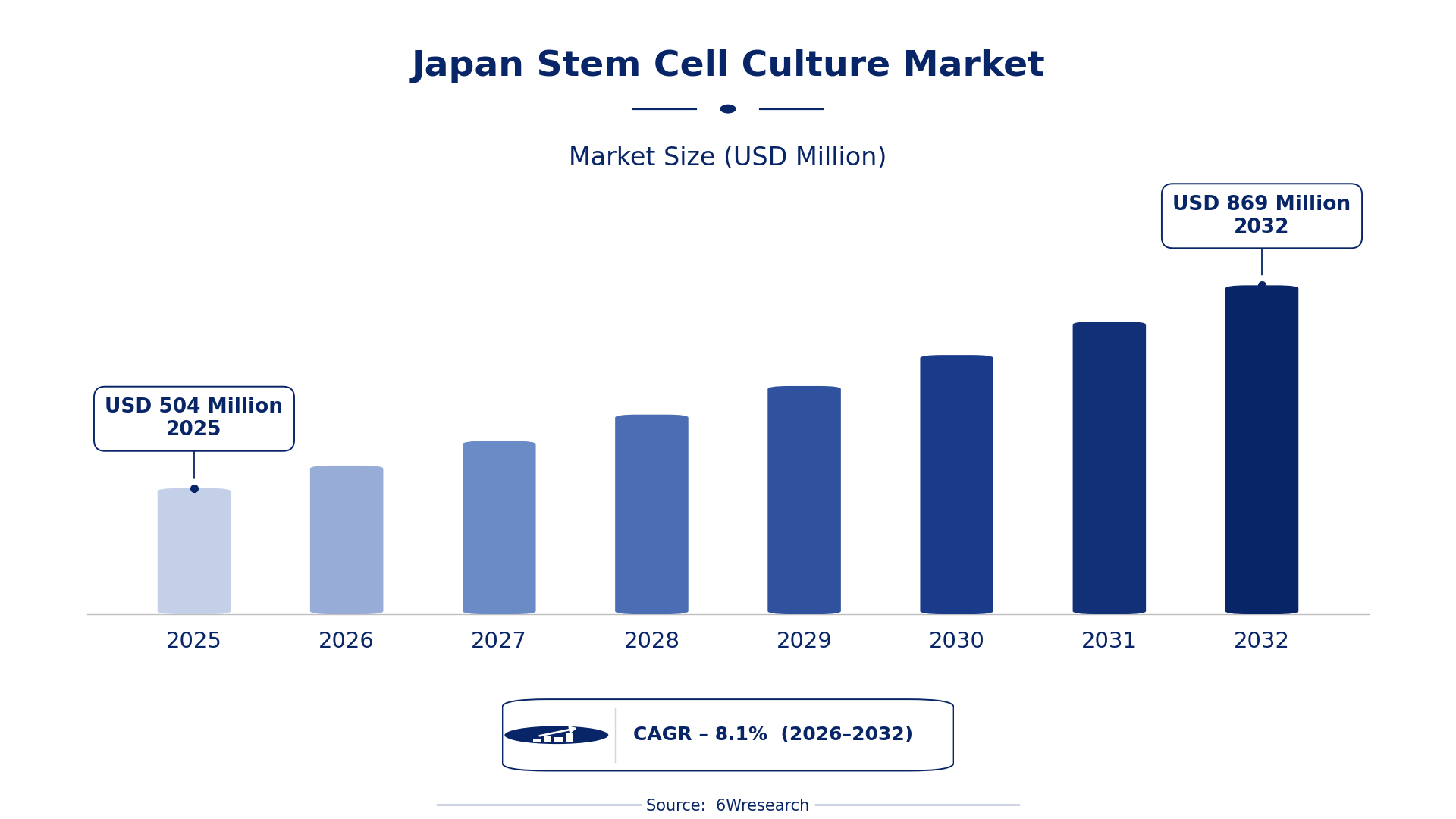
According to 6Wresearch internal database and industry insights, the Japan Stem Cell Culture Market was valued at USD 504 Million in 2025 and is projected to reach USD 869 Million by 2032, growing at a CAGR of approximately 8.1% during 2026–2032.
Japan Stem Cell Culture Market Highlights
| Report Metric | Details |
| Report Name | Japan Stem Cell Culture Market (2026-2032) |
| Market Size 2025 | USD 504 Million |
| Market Size 2032 | USD 869 Million |
| Absolute Growth 2025–2032 | USD 365 Million |
| CAGR 2026–2032 | 8.1% |
| Peak Annual Growth | 10.8% in 2026 |
| Forecast Period | 2026–2032 |
| Historical Data | 2022–2025 |
| Base Year | 2025 |
| Leading Cell Type, 2025 | Embryonic Stem Cells (41% share) |
| Leading Culture Medium Type, 2025 | Serum-Free Medium (37% share) |
| Leading Application Area, 2025 | Regenerative Medicine (51% share) |
| Leading End User, 2025 | Research Laboratories (42% share) |
| Fastest-Growing Cell Type | Adult Stem Cells (10.8% CAGR) |
| Fastest-Growing Culture Medium Type | Chemically Defined Media (10.9% CAGR) |
| Fastest-Growing Application Area | Cell Therapy (9.4% CAGR) |
| Fastest-Growing End User | Biotech Companies (10.4% CAGR) |
| Growing Sector | Regenerative Medicine |
| Key End Users | Research Laboratories, Biotech Companies, Hospitals & Clinics |
Japan Stem Cell Culture Market Year-wise Growth Rate and Key Drivers (2022–2032)
This graph illustrates the annual growth rates of the market from 2022 to 2032, highlighting a steady upward trajectory and projected market expansion over the forecast period.
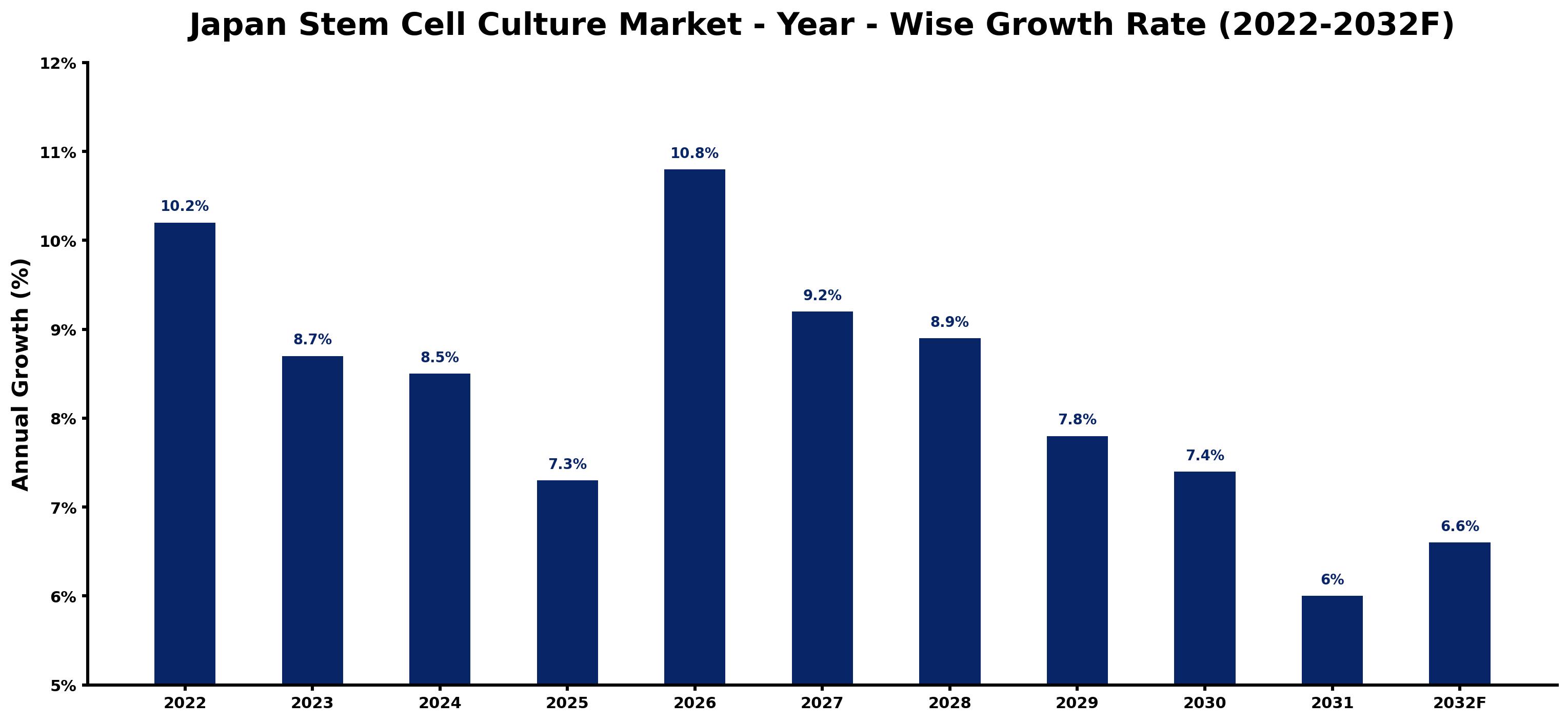
The yearly estimates that follow link every growth rate to its principal driver, so readers can see why the pace changed in each period.
| Year | Estimated Annual Growth (%) | Market Rationale |
| 2022 | 10.2 | The market experienced strong growth due to increased research activities and clinical trials. |
| 2023 | 8.7 | Growth slowed as the market adjusted to regulatory changes and funding allocations. |
| 2024 | 8.5 | The market continued to grow, driven by ongoing investments in regenerative medicine. |
| 2025 | 7.3 | Growth slowed further as the focus shifted towards optimizing existing technologies. |
| 2026 | 10.8 | Growth is expected to accelerate with renewed investments in stem cell research and development. |
| 2027 | 9.2 | Growth will slow again as market saturation begins to affect new investments. |
| 2028 | 8.9 | The market is projected to maintain growth due to rising demand for cell therapies. |
| 2029 | 7.8 | Growth is expected to continue slowing as competition intensifies among research laboratories. |
| 2030 | 7.4 | The market will experience a further slowdown as funding becomes more competitive. |
| 2031 | 6.0 | Growth is projected to decelerate as the market approaches maturity and consolidation occurs. |
| 2032 | 6.6 | Growth is expected to pick up again with new breakthroughs in stem cell applications. |
Note: Market size estimations and growth projections presented in this report are based on 6Wresearch's proprietary forecasting methodology, utilizing the latest available industry data, government publications, and primary research inputs.
Japan Stem Cell Culture Market Synopsis
Stem cell culture involves the growth and maintenance of stem cells in controlled environments, primarily using specialized culture media. Over 200 research laboratories in Japan drive demand for this market, supported by clinical applications in hospitals. Factors such as an aging population and increased funding for regenerative medicine are propelling growth. The government aims to double funding for regenerative medicine by 2025, stimulating further investment in this sector.
Market Dynamics Impact Analysis (2026–2032)
| Factor | Type | Impact | Primary Segment Affected |
| Growing demand for regenerative medicine applications | Driver | High | Regenerative Medicine |
| Increased clinical trials involving stem cells | Driver | High | Embryonic Stem Cells |
| Rising interest in cell therapies for chronic diseases | Opportunity | High | Cell Therapy |
| Expansion of research laboratories focusing on stem cell research | Opportunity | High | Research Laboratories |
| Regulatory complexities surrounding stem cell research | Restraint | Medium | Embryonic Stem Cells |
| Limited availability of funding for new projects | Restraint | Medium | Research Laboratories |
| High costs associated with advanced stem cell technologies | Challenge | High | Biotech Companies |
| Intense competition among research facilities | Challenge | Medium | Research Laboratories |
Evaluation of Drivers in Japan Stem Cell Culture Market (2026–2032)
Key forces behind demand, with the segment each one moves most, are listed below.
| Drivers | Primary Segment Affected | Why It Matters (Evidence) |
| Increased funding for regenerative medicine initiatives | Regenerative Medicine | The government allocated ¥5 billion for stem cell research in 2023, driving demand from research laboratories. |
| Growing number of clinical trials | Embryonic Stem Cells | The number of clinical trials involving stem cells reached 150 in 2023, increasing demand for culture media. |
| Rising interest in adult stem cell therapies | Adult Stem Cells | Adult stem cells are crucial for hematopoietic transplants, leading hospitals to invest more in stem cell culture. |
| Adoption of serum-free media for ethical reasons | Serum-Free Medium | Serum-free media is preferred for its ethical implications, driving its demand in research facilities. |
| Technological advancements in stem cell culture techniques | Induced Pluripotent Cells | Advancements in induced pluripotent stem cells have improved research capabilities, increasing purchases from biotech companies. |
A wider customer base explains much of the growth, as over 200 research laboratories in Japan are driving demand for stem cell culture. In 2023, the number of clinical trials involving stem cells reached 150, prompting hospitals to invest in advanced culture techniques. The preference for serum-free media is rising due to ethical considerations, leading to increased purchases in research facilities. Technological advancements have further improved capabilities, resulting in more investments from various sectors.
Evaluation of Restraints in Japan Stem Cell Culture Market
The following restraints limit how fast demand can grow.
| Market Restraint | Primary Segment Affected | Why It Matters (Evidence) |
| Regulatory complexities surrounding stem cell research | Embryonic Stem Cells | The Ministry of Health, Labour and Welfare oversees regulations, making compliance challenging for producers. |
| Limited availability of funding for new projects | Research Laboratories | Competition for government funding restricts financial resources for new stem cell projects. |
| High costs associated with advanced stem cell technologies | Biotech Companies | The expensive nature of stem cell technologies can deter investment from smaller firms. |
| Intense competition among research facilities | Research Laboratories | With many laboratories vying for funding, securing grants has become increasingly difficult. |
| Ethical concerns regarding stem cell sources | Embryonic Stem Cells | Public scrutiny over the use of embryonic stem cells can limit research opportunities. |
Japan Stem Cell Culture Market Challenges
High costs of specialized culture media burden research laboratories, as these expenses can consume up to 30% of their budgets, restricting their capacity to initiate new projects. Limited access to advanced technology in feeder-free culture systems can delay research timelines by several months for biotech companies. Stringent regulations from the Ministry of Health, Labour and Welfare can prolong approval processes for new products, causing significant delays in clinical trials for hospitals. Fierce competition among over 200 research laboratories for funding and resources can lead to potential shortages, hampering progress in innovative projects.
Trends in the Japan Stem Cell Culture Market
The trends below show where the Japan Stem Cell Culture Market is heading.
- Shift towards Serum-Free Media: In recent years, serum-free media has gained traction among research laboratories in Japan, with its usage increasing to 37% in 2025. This shift reflects a growing preference for ethical practices.
- Transition from Traditional to Advanced Culture Techniques: The move towards feeder-free cultures has become prominent in Japan's stem cell research. This change began in 2023, with feeder-free cultures gaining popularity due to their reproducibility and safety.
- Emergence of Cell Therapy as a Focus Area: Cell therapy is increasingly prioritised in Japan, with a projected CAGR of 9.4% from 2026 to 2032. This trend is driven by the growing number of biotech companies developing therapies for chronic diseases.
- Surge in Clinical Trials for Stem Cell Applications: The number of clinical trials involving stem cells has surged, reaching 150 in 2023. This increase indicates a strong focus on advancing stem cell applications in regenerative medicine.
Investment Opportunities in the Japan Stem Cell Culture Market
The following areas offer the clearest openings for investors and suppliers in the Japan Stem Cell Culture Market.
- Funding Gap for Stem Cell Projects: With the government aiming to double funding for regenerative medicine by 2025, there is a significant opportunity for research laboratories to secure grants. This funding boost, amounting to ¥5 billion, can help develop new therapies.
- Growing Demand for Regenerative Medicine: The aging Japanese population creates a pressing need for regenerative medicine applications. Hospitals and clinics are increasingly looking to adopt stem cell therapies, presenting an opportunity for suppliers to meet this demand.
- Expansion of Research Facilities in Key Regions: Tokyo and Osaka are key regions for stem cell research, with many facilities looking to enhance their capabilities. Suppliers can enter this market by partnering with local research institutions and offering advanced culture media.
- Development of Advanced Culture Techniques: The rise of chemically defined media presents an opportunity for suppliers to innovate. This segment is gaining traction among research laboratories seeking precise control in stem cell cultures.
Government Initiatives in the Japan Stem Cell Culture Market
The PRTR Law, enacted in 1999, mandates businesses to report releases of designated chemical substances, impacting stem cell culture producers by ensuring compliance with environmental standards. The PMD Act, renamed in 2014, regulates the approval and quality of pharmaceuticals and medical devices, directly affecting practices in stem cell culture.
In 2023, the Japanese government allocated ¥5 billion to fund stem cell research, administered by the Japan Agency for Medical Research and Development. This funding supports projects and improves the capabilities of research laboratories across the country.
Future Insight of the Japan Stem Cell Culture Market
By 2032, a significant policy shift will result in the government doubling funding for regenerative medicine, enhancing research capabilities and attracting increased investments. The implementation of ISO 9001 standards will elevate quality assurance in stem cell culture facilities, fostering greater confidence among buyers. Enhanced collaboration through the Japan Society for Regenerative Medicine will facilitate knowledge exchange and spur innovation. The aging population will escalate the demand for regenerative therapies, prompting hospitals to adopt more advanced applications, with clinical trials projected to reach 300.
Market Segmentation Analysis
Japan Stem Cell Culture Market report covers a detailed analysis of the following market segments:
By Cell Type – Embryonic Stem Cells Lead, Adult Stem Cells Expected to Grow Fastest
According to Saurav Kr Singh, Senior Research Analyst at 6Wresearch, with 41% of cell type revenue in 2025, Embryonic Stem Cells was the largest category. Embryonic stem cells maintain the largest share because they are integral to regenerative medicine and foundational research. Their extensive use in over 200 research laboratories in Japan highlights their importance in advancing scientific knowledge. The quickest growth will come from Adult Stem Cells, forecast to expand at a CAGR of 10.8% between 2026 and 2032. Adult stem cells are rapidly gaining traction as they are increasingly applied in therapies for blood disorders, supported by a growing number of clinical trials reaching 150 in 2023. This trend indicates that their adoption will continue to rise, further widening the gap with other cell types. Suppliers should prioritise the development of products tailored for adult stem cell therapies to meet the increasing demand.
By Culture Medium Type – Serum-Free Medium Leads, Chemically Defined Media Expected to Grow Fastest
In 2025, Serum-Free Medium led the culture medium type split with a 37% share. Serum-free media holds the largest share as it is essential for culturing various stem cell types, ensuring ethical practices in research. Its widespread use in over 200 research laboratories in Japan highlights its importance in advancing stem cell studies. Over 2026–2032, Chemically Defined Media is expected to post the fastest growth, at a CAGR of 10.9%. Chemically defined media is witnessing rapid growth due to its ability to provide precise control in stem cell cultures, which is increasingly sought after for both research and therapeutic applications. This demand aligns with the regulatory focus on standardisation in stem cell practices. Suppliers should prioritise the development of chemically defined media to meet the increasing demand for regulatory compliance.
By Application Area – Regenerative Medicine Leads, Cell Therapy Expected to Grow Fastest
The largest application area category in 2025 was Regenerative Medicine, at 51% of revenue. Regenerative medicine is the leading application area for stem cell cultures, driven by the Japanese government's focus on this field as part of its healthcare strategy. The aging population in Japan further fuels the demand for regenerative solutions. Cell Therapy is projected to grow fastest, at a CAGR of 9.4% during 2026–2032. Cell therapy is the fastest-growing area as biotech companies develop therapies for chronic diseases, reflecting a shift towards practical applications of stem cell research. The government’s commitment to doubling funding for regenerative medicine by 2025 supports this growth. Suppliers must align their strategies with the increasing focus on cell therapy to meet emerging market needs.
By End User – Research Laboratories Lead, Biotech Companies Expected to Grow Fastest
Research Laboratories accounted for 42% of the market by end user in 2025. Research laboratories lead the market as they are the primary users of stem cell cultures for diverse studies, with over 200 facilities dedicated to this research in Japan. Their critical role in advancing stem cell applications underscores their dominance in the sector. Biotech Companies are set to record the highest CAGR in this split, 10.4% over 2026–2032. Biotech companies are experiencing rapid growth as they focus on developing therapies based on stem cell research, evidenced by the rising number of clinical trials reaching 150 in 2023. This trend indicates a shift towards commercialisation that will likely enhance their market presence. Suppliers should consider forming alliances with biotech companies to leverage the increasing interest in stem cell-derived therapies.
Key Attractiveness of the Report
- 10 Years of Market Numbers
- Historical Data Starting from 2022 to 2025
- Base Year 2025
- Forecast Data until 2032
- Key Performance Indicators Impacting the Market
- Major Upcoming Developments and Projects
Key Highlights of the Report:
- Japan Stem Cell Culture Market Outlook
- Market Size of Japan Stem Cell Culture Market, 2025
- Forecast of Japan Stem Cell Culture Market, 2032
- Historical Data and Forecast of Japan Stem Cell Culture Revenues & Volume for the Period 2022-2032F
- Japan Stem Cell Culture Market Trend Evolution
- Japan Stem Cell Culture Market Drivers and Challenges
- Japan Stem Cell Culture Price Trends
- Japan Stem Cell Culture Porter's Five Forces
- Japan Stem Cell Culture Industry Life Cycle
- Historical Data and Forecast of Japan Stem Cell Culture Market Revenues & Volume By Cell Type for the Period 2022-2032F
- Historical Data and Forecast of Japan Stem Cell Culture Market Revenues & Volume By Embryonic Stem Cells for the Period 2022-2032F
- Historical Data and Forecast of Japan Stem Cell Culture Market Revenues & Volume By Adult Stem Cells for the Period 2022-2032F
- Historical Data and Forecast of Japan Stem Cell Culture Market Revenues & Volume By Induced Pluripotent Cells for the Period 2022-2032F
- Historical Data and Forecast of Japan Stem Cell Culture Market Revenues & Volume By Hematopoietic Stem Cells for the Period 2022-2032F
- Historical Data and Forecast of Japan Stem Cell Culture Market Revenues & Volume By Culture Medium Type for the Period 2022-2032F
- Historical Data and Forecast of Japan Stem Cell Culture Market Revenues & Volume By Serum-Free Medium for the Period 2022-2032F
- Historical Data and Forecast of Japan Stem Cell Culture Market Revenues & Volume By Chemically Defined Media for the Period 2022-2032F
- Historical Data and Forecast of Japan Stem Cell Culture Market Revenues & Volume By Feeder-Free Culture for the Period 2022-2032F
- Historical Data and Forecast of Japan Stem Cell Culture Market Revenues & Volume By Suspension Cultures for the Period 2022-2032F
- Historical Data and Forecast of Japan Stem Cell Culture Market Revenues & Volume By Application Area for the Period 2022-2032F
- Historical Data and Forecast of Japan Stem Cell Culture Market Revenues & Volume By Regenerative Medicine for the Period 2022-2032F
- Historical Data and Forecast of Japan Stem Cell Culture Market Revenues & Volume By Cell Therapy for the Period 2022-2032F
- Historical Data and Forecast of Japan Stem Cell Culture Market Revenues & Volume By Disease Modeling for the Period 2022-2032F
- Historical Data and Forecast of Japan Stem Cell Culture Market Revenues & Volume By Transplantation for the Period 2022-2032F
- Historical Data and Forecast of Japan Stem Cell Culture Market Revenues & Volume By End User for the Period 2022-2032F
- Historical Data and Forecast of Japan Stem Cell Culture Market Revenues & Volume By Research Laboratories for the Period 2022-2032F
- Historical Data and Forecast of Japan Stem Cell Culture Market Revenues & Volume By Biotech Companies for the Period 2022-2032F
- Historical Data and Forecast of Japan Stem Cell Culture Market Revenues & Volume By Pharma & Clinical Research for the Period 2022-2032F
- Historical Data and Forecast of Japan Stem Cell Culture Market Revenues & Volume By Hospitals & Clinics for the Period 2022-2032F
- Japan Stem Cell Culture Import Export Trade Statistics
- Market Opportunity Assessment By Cell Type
- Market Opportunity Assessment By Culture Medium Type
- Market Opportunity Assessment By Application Area
- Market Opportunity Assessment By End User
- Japan Stem Cell Culture Top Companies Market Share
- Japan Stem Cell Culture Competitive Benchmarking By Technical and Operational Parameters
- Japan Stem Cell Culture Company Profiles
- Japan Stem Cell Culture Key Strategic Recommendations
Market Covered
The report covers the following segments.
By Cell Type
- Embryonic Stem Cells
- Adult Stem Cells
- Induced Pluripotent Cells
- Hematopoietic Stem Cells
By Culture Medium Type
- Serum-Free Medium
- Chemically Defined Media
- Feeder-Free Culture
- Suspension Cultures
By Application Area
- Regenerative Medicine
- Cell Therapy
- Disease Modeling
- Transplantation
By End User
- Research Laboratories
- Biotech Companies
- Pharma & Clinical Research
- Hospitals & Clinics































