Japan Sterile Filling Systems Market Size & Growth Rate
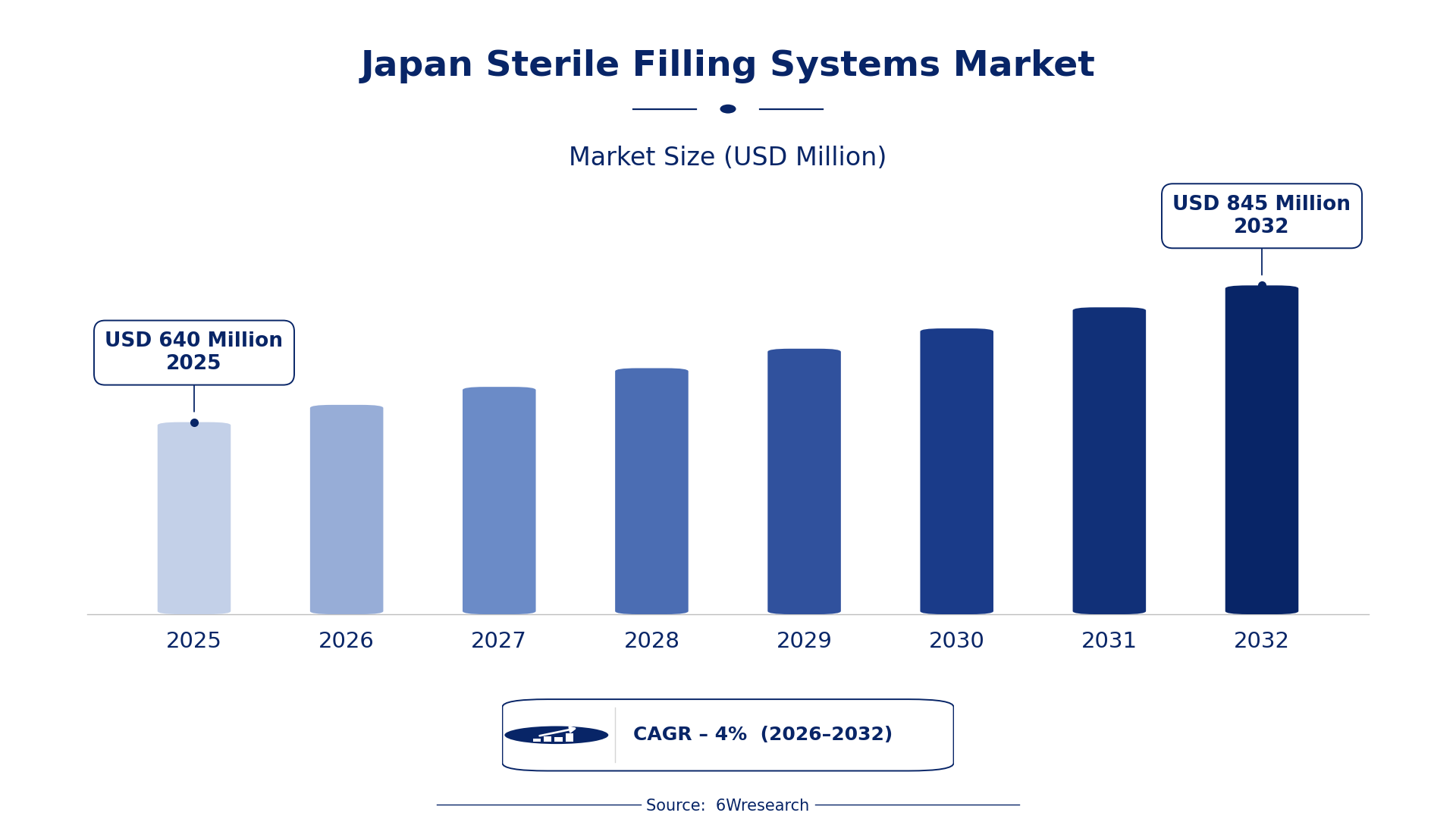
According to 6Wresearch internal database and industry insights, the Japan Sterile Filling Systems Market was valued at USD 640 Million in 2025 and is projected to reach USD 845 Million by 2032, growing at a CAGR of approximately 4% during 2026–2032.
Japan Sterile Filling Systems Market Highlights
| Report Metric | Details |
| Report Name | Japan Sterile Filling Systems Market (2026-2032) |
| Market Size 2025 | USD 640 Million |
| Market Size 2032 | USD 845 Million |
| Absolute Growth 2025–2032 | USD 205 Million |
| CAGR 2026–2032 | 4% |
| Peak Annual Growth | 4.8% in 2029 |
| Forecast Period | 2026–2032 |
| Historical Data | 2022–2025 |
| Base Year | 2025 |
| Leading Filling Type, 2025 | Aseptic Liquid Filling (41% share) |
| Leading Container Type, 2025 | Glass Vials (46% share) |
| Leading Operation Mode, 2025 | Fully Automatic (37% share) |
| Leading End User, 2025 | Biopharma Manufacturers (55% share) |
| Fastest-Growing Filling Type | Powder Filling Systems (5.5% CAGR) |
| Fastest-Growing Container Type | Ampoules (5.6% CAGR) |
| Fastest-Growing Operation Mode | Semi-Automatic (5.2% CAGR) |
| Fastest-Growing End User | Contract Manufacturing Orgs (5.1% CAGR) |
| Growing Sector | biopharmaceutical manufacturing |
| Key End Users | biopharma manufacturers, contract manufacturing organizations, vaccine producers, sterile drug producers |
Japan Sterile Filling Systems Market Year-wise Growth Rate and Key Drivers (2022–2032)
This graph illustrates the annual growth rates of the market from 2022 to 2032, highlighting a steady upward trajectory and projected market expansion over the forecast period.
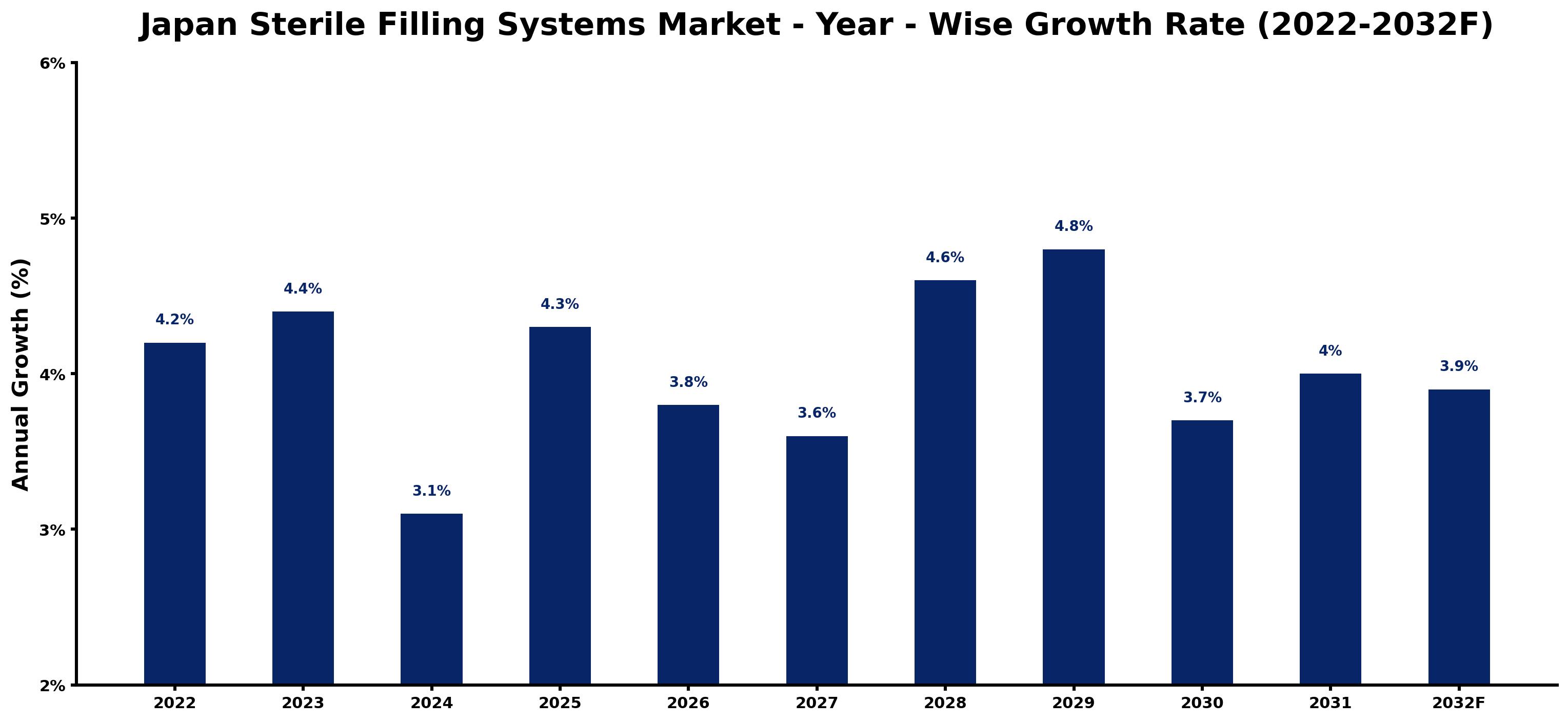
Below, each year's estimated growth is shown next to the factor that most influenced it.
| Year | Estimated Annual Growth (%) | Market Rationale |
| 2022 | 4.2 | The market showed strong performance, reflecting ongoing investments in biopharma manufacturing. |
| 2023 | 4.4 | Growth accelerated due to increased vaccine production and demand for sterile products. |
| 2024 | 3.1 | Growth slowed as market adjustments occurred after the previous year's surge. |
| 2025 | 4.3 | Demand rose again, driven by new biopharma projects and technological advancements. |
| 2026 | 3.8 | Growth is expected to moderate as manufacturers face challenges in scaling operations efficiently. |
| 2027 | 3.6 | The market will continue to grow, supported by steady investments in production capabilities. |
| 2028 | 4.6 | Growth is projected to pick up due to rising demand for vaccines and sterile drug production. |
| 2029 | 4.8 | The market is expected to peak, driven by advancements in filling technologies. |
| 2030 | 3.7 | Growth will slow as the market stabilises after reaching its peak performance. |
| 2031 | 4.0 | Demand is projected to increase again, supported by ongoing investments in biopharma technologies. |
| 2032 | 3.9 | Growth will moderate as the market adjusts to new production standards. |
Note: Market size estimations and growth projections presented in this report are based on 6Wresearch's proprietary forecasting methodology, utilizing the latest available industry data, government publications, and primary research inputs.
Japan Sterile Filling Systems Market Synopsis
Sterile filling systems are advanced technologies crucial for the pharmaceutical and biopharmaceutical industries, used to fill products like vaccines and injectable drugs into containers. The Japan Sterile Filling Systems Market is expanding, driven by a robust biopharmaceutical sector with over 200 manufacturers actively utilising these systems. The increasing focus on vaccine production and the government's support through the Healthcare Innovation Strategy are key factors propelling demand for these advanced filling technologies.
Market Dynamics Impact Analysis (2026–2032)
| Factor | Type | Impact | Primary Segment Affected |
| Growing biopharmaceutical sector drives demand for sterile filling systems. | Driver | High | Aseptic Liquid Filling |
| Increasing vaccine production necessitates advanced filling technologies. | Driver | High | Vaccine Producers |
| Investment in biopharma manufacturing technologies is expected to increase by 10% by 2025. | Opportunity | High | Biopharma Manufacturers |
| Rising demand for prefilled syringes as a delivery method for biologics. | Opportunity | Medium | Prefilled Syringes |
| High costs associated with compliance to stringent regulations. | Restraint | High | Sterile Drug Producers |
| Limited availability of skilled workforce for advanced filling systems. | Restraint | Medium | Contract Manufacturing Orgs |
| Investment in new technologies can be prohibitively expensive for smaller firms. | Challenge | High | Biopharma Manufacturers |
| Technological advancements require continuous training and adaptation. | Challenge | Medium | Vaccine Producers |
Evaluation of Drivers in Japan Sterile Filling Systems Market (2026–2032)
Below are the drivers that matter most for revenue growth, with supporting evidence.
| Drivers | Primary Segment Affected | Why It Matters (Evidence) |
| Increased investment in biopharma manufacturing technologies. | Biopharma Manufacturers | Japan's biopharmaceutical market was valued at approximately ¥1.5 trillion in 2022, leading to higher demand for sterile filling systems. |
| Growing focus on vaccine production. | Vaccine Producers | The number of vaccine doses administered in Japan reached 200 million in 2023, driving demand for efficient filling systems. |
| Adoption of ISO 13485 standards for quality management. | Sterile Drug Producers | Compliance with ISO 13485 ensures quality in medical devices, prompting manufacturers to upgrade filling systems. |
| Expansion of contract manufacturing organizations. | Contract Manufacturing Orgs | Over 200 biopharma manufacturers actively use sterile filling systems, increasing demand for contract services. |
| Technological advancements in filling processes. | Aseptic Liquid Filling | New guidelines approved in 2023 enhance sterile manufacturing processes, boosting demand for advanced filling systems. |
Several shifts outside the market lift sales. The biopharmaceutical sector, valued at approximately ¥1.5 trillion in 2022, is growing rapidly, leading to increased demand for sterile filling systems. The number of vaccine doses administered in Japan reached 200 million in 2023, prompting manufacturers to invest in efficient filling technologies. Compliance with ISO 13485 standards drives manufacturers to upgrade their systems, ensuring quality management. The rise of contract manufacturing organizations, with over 200 biopharma manufacturers, further fuels demand for these advanced technologies. New guidelines approved in 2023 are expected to improve sterile manufacturing processes, prompting investments in modern filling solutions.
Evaluation of Restraints in Japan Sterile Filling Systems Market
Several factors work against faster growth; the main ones are summarised below.
| Market Restraint | Primary Segment Affected | Why It Matters (Evidence) |
| High compliance costs for sterile filling systems. | Sterile Drug Producers | Compliance with stringent regulations can lead to financial burdens for manufacturers, with costs exceeding ¥100 million per unit. |
| Shortage of skilled workforce in biopharma manufacturing. | Contract Manufacturing Orgs | The limited availability of trained personnel can hinder operational efficiency and growth, impacting production timelines. |
| Initial investment costs for advanced filling technologies. | Biopharma Manufacturers | High upfront costs can deter smaller firms from adopting modern systems, limiting their competitiveness. |
| Complexity of regulatory compliance processes. | Vaccine Producers | Navigating regulatory frameworks can delay product launches and increase operational costs, affecting market responsiveness. |
| Market saturation in certain filling technologies. | Aseptic Liquid Filling | With many players in the market, competition can limit pricing power and profitability, constraining market growth. |
Japan Sterile Filling Systems Market Challenges
Producers face high costs for advanced sterile filling systems, with prices exceeding ¥100 million per unit, which reduces their profit margins. Competition among over 200 biopharma manufacturers intensifies pricing pressures, forcing some to limit investments in necessary technologies. Many producers struggle to integrate new manufacturing technologies, which can delay production timelines by up to six months, impacting their ability to meet demand. Regulatory compliance poses challenges, as the PMDA oversees approvals, potentially delaying new system implementations by several weeks, which obstructs timely product launches for manufacturers.
Trends in the Japan Sterile Filling Systems Market
Buyers and suppliers in the Japan Sterile Filling Systems Market are adjusting to the following trends.
- 200 Million Vaccine Doses Administered: In 2023, Japan administered 200 million vaccine doses, impacting the demand for sterile filling systems. This surge highlights the need for efficient production capabilities, prompting manufacturers to invest in advanced technologies.
- Shift Towards Prefilled Syringes: Biopharma manufacturers are increasingly adopting prefilled syringes for biologics, reflecting a growing trend in the market. The demand for these systems is projected to rise as they offer convenience and reduce contamination risks.
- Increase in Contract Manufacturing Organizations: The rise of contract manufacturing organizations is reshaping the sterile filling market. With over 200 biopharma manufacturers, these organizations are expanding their services to meet increasing demand for efficient filling solutions.
- 2023 Guidelines Improve Sterile Manufacturing: New guidelines approved in 2023 are improving sterile manufacturing processes in Japan. This regulatory update is expected to drive investments in advanced filling technologies, ensuring compliance and quality.
Investment Opportunities in the Japan Sterile Filling Systems Market
The following areas offer the clearest openings for investors and suppliers in the Japan Sterile Filling Systems Market.
- Investment in Aseptic Liquid Filling Technologies: With a projected increase in biopharma manufacturing technologies by 10% by 2025, there is an opportunity to supply advanced aseptic liquid filling systems. Collaborating with biopharma manufacturers in Tokyo can facilitate market entry.
- Supply of Prefilled Syringes: The rising demand for prefilled syringes presents an opportunity. Partnering with contract manufacturing organizations can help suppliers meet this growing need effectively.
- Expansion of Integrated Systems: Investing in integrated filling systems can cater to the evolving needs of biopharma manufacturers. Establishing joint ventures in Osaka can provide a strategic entry point into this market.
- Development of Semi-Automatic Systems: The increasing use of semi-automatic systems offers a niche opportunity. Focusing on smaller biopharma manufacturers in regional hubs can help suppliers tap into this growing segment.
Government Initiatives in the Japan Sterile Filling Systems Market
The guidelines approved in 2023 improve sterile manufacturing processes, adding to the existing framework established by the Clinical Trials Act of 2017. These guidelines ensure that manufacturers adhere to stringent quality standards, improving overall product safety and efficacy.
In 2023, the Ministry of Health allocated ¥10 billion to support medical research and development, overseen by the Pharmaceuticals and Medical Devices Agency. This funding aims to promote innovation in sterile filling technologies and improve regulatory compliance.
Future Insight of the Japan Sterile Filling Systems Market
New biopharma manufacturing facilities are set to emerge by 2032, driven by a 10% increase in investment in advanced sterile filling technologies by 2025, enhancing production capabilities for buyers. Updated guidelines for sterile manufacturing processes will streamline compliance, reducing time to market for new products. The population of Japan, approximately 125 million, will sustain a rising demand for pharmaceuticals, prompting suppliers to innovate and improve their offerings. Technological advancements in sterile filling systems will support the specific requirements of the biopharmaceutical sector.
Market Segmentation Analysis
Japan Sterile Filling Systems Market report covers a detailed analysis of the following market segments:
By Filling Type – Aseptic Liquid Filling Leads, Powder Filling Systems Expected to Grow Fastest
According to Saurav Kr Singh, Senior Research Analyst at 6Wresearch, with 41% of filling type revenue in 2025, Aseptic Liquid Filling was the largest category. Aseptic Liquid Filling is crucial for the sterile filling of liquid pharmaceuticals, particularly for vaccines and injectable drugs. Its dominance is reflected in the extensive installed base of over 1,000 units within Japan's biopharmaceutical sector. Powder Filling Systems are set to record the highest CAGR in this split, 5.5% over 2026–2032. Powder Filling Systems are experiencing significant growth due to the increasing demand for powdered drugs, especially in vaccine production. The administration of 200 million vaccine doses in 2023 underscores the urgent need for efficient filling solutions. Suppliers should invest in enhancing powder filling technologies to meet the rising demand in the biopharmaceutical sector.
By Container Type – Glass Vials Lead, Ampoules Expected to Grow Fastest
Glass Vials took 46% of container type revenue in 2025, more than any other category. Glass Vials are the leading container type due to their established role in storing and dispensing sterile products, particularly in the biopharmaceutical field. Their dominance is reflected in the operations of over 200 biopharma manufacturers in Japan. Over 2026–2032, Ampoules are expected to post the fastest growth, at a CAGR of 5.6%. Ampoules are experiencing swift growth as they are preferred for single-dose sterile products, offering convenience and safety. This trend is further supported by recent regulatory approvals for new sterile manufacturing processes. Manufacturers should explore opportunities to expand their ampoule production capabilities to meet the rising market demand.
By Operation Mode – Fully Automatic Leads, Semi-Automatic Expected to Grow Fastest
Fully Automatic held 37% of the Japan Sterile Filling Systems Market by operation mode in 2025. Fully Automatic systems are favoured for high-volume production, delivering the efficiency necessary to meet the demands of Japan's substantial biopharmaceutical market. Their widespread use is evident among major biopharma manufacturers who rely on these systems for optimal output. The quickest growth will come from Semi-Automatic, forecast to expand at a CAGR of 5.2% between 2026 and 2032. Semi-Automatic systems are gaining traction as they provide the flexibility needed for smaller batch sizes, enabling manufacturers to adapt quickly to market fluctuations. This adaptability is particularly important as investment in biopharma technologies is expected to rise by 10% by 2025. Suppliers should concentrate on developing semi-automatic solutions to cater to the needs of smaller production runs.
By End User – Biopharma Manufacturers Lead, Contract Manufacturing Orgs Expected to Grow Fastest
The largest end user category in 2025 was Biopharma Manufacturers, at 55% of revenue. Biopharma Manufacturers are the leading users of sterile filling systems, holding the largest share due to their extensive engagement in the production of vaccines and drugs. Their significant investments in advanced technologies highlight the essential role of these systems in maintaining product quality. Contract Manufacturing Orgs are projected to grow fastest, at a CAGR of 5.1% during 2026–2032. Contract Manufacturing Organizations are rapidly expanding as they offer vital services to biopharma companies, fulfilling their production requirements. The increasing trend towards outsourcing in the biopharmaceutical sector is a key driver of this growth. Suppliers should enhance partnerships with contract manufacturing organizations to broaden their market presence.
Key Attractiveness of the Report
- 10 Years of Market Numbers
- Historical Data Starting from 2022 to 2025
- Base Year 2025
- Forecast Data until 2032
- Key Performance Indicators Impacting the Market
- Major Upcoming Developments and Projects
Key Highlights of the Report:
- Japan Sterile Filling Systems Market Outlook
- Market Size of Japan Sterile Filling Systems Market, 2025
- Forecast of Japan Sterile Filling Systems Market, 2032
- Historical Data and Forecast of Japan Sterile Filling Systems Revenues & Volume for the Period 2022-2032F
- Japan Sterile Filling Systems Market Trend Evolution
- Japan Sterile Filling Systems Market Drivers and Challenges
- Japan Sterile Filling Systems Price Trends
- Japan Sterile Filling Systems Porter's Five Forces
- Japan Sterile Filling Systems Industry Life Cycle
- Historical Data and Forecast of Japan Sterile Filling Systems Market Revenues & Volume By Filling Type for the Period 2022-2032F
- Historical Data and Forecast of Japan Sterile Filling Systems Market Revenues & Volume By Aseptic Liquid Filling for the Period 2022-2032F
- Historical Data and Forecast of Japan Sterile Filling Systems Market Revenues & Volume By Powder Filling Systems for the Period 2022-2032F
- Historical Data and Forecast of Japan Sterile Filling Systems Market Revenues & Volume By Dual-Chamber Filling for the Period 2022-2032F
- Historical Data and Forecast of Japan Sterile Filling Systems Market Revenues & Volume By Blow-Fill-Seal Systems for the Period 2022-2032F
- Historical Data and Forecast of Japan Sterile Filling Systems Market Revenues & Volume By Container Type for the Period 2022-2032F
- Historical Data and Forecast of Japan Sterile Filling Systems Market Revenues & Volume By Glass Vials for the Period 2022-2032F
- Historical Data and Forecast of Japan Sterile Filling Systems Market Revenues & Volume By Ampoules for the Period 2022-2032F
- Historical Data and Forecast of Japan Sterile Filling Systems Market Revenues & Volume By Prefilled Syringes for the Period 2022-2032F
- Historical Data and Forecast of Japan Sterile Filling Systems Market Revenues & Volume By Plastic Bottles for the Period 2022-2032F
- Historical Data and Forecast of Japan Sterile Filling Systems Market Revenues & Volume By Operation Mode for the Period 2022-2032F
- Historical Data and Forecast of Japan Sterile Filling Systems Market Revenues & Volume By Fully Automatic for the Period 2022-2032F
- Historical Data and Forecast of Japan Sterile Filling Systems Market Revenues & Volume By Semi-Automatic for the Period 2022-2032F
- Historical Data and Forecast of Japan Sterile Filling Systems Market Revenues & Volume By Integrated System for the Period 2022-2032F
- Historical Data and Forecast of Japan Sterile Filling Systems Market Revenues & Volume By Compact Lines for the Period 2022-2032F
- Historical Data and Forecast of Japan Sterile Filling Systems Market Revenues & Volume By End User for the Period 2022-2032F
- Historical Data and Forecast of Japan Sterile Filling Systems Market Revenues & Volume By Biopharma Manufacturers for the Period 2022-2032F
- Historical Data and Forecast of Japan Sterile Filling Systems Market Revenues & Volume By Contract Manufacturing Orgs for the Period 2022-2032F
- Historical Data and Forecast of Japan Sterile Filling Systems Market Revenues & Volume By Vaccine Producers for the Period 2022-2032F
- Historical Data and Forecast of Japan Sterile Filling Systems Market Revenues & Volume By Sterile Drug Producers for the Period 2022-2032F
- Japan Sterile Filling Systems Import Export Trade Statistics
- Market Opportunity Assessment By Filling Type
- Market Opportunity Assessment By Container Type
- Market Opportunity Assessment By Operation Mode
- Market Opportunity Assessment By End User
- Japan Sterile Filling Systems Top Companies Market Share
- Japan Sterile Filling Systems Competitive Benchmarking By Technical and Operational Parameters
- Japan Sterile Filling Systems Company Profiles
- Japan Sterile Filling Systems Key Strategic Recommendations
Market Covered
The following segment groups are covered in the report.
By Filling Type
- Aseptic Liquid Filling
- Powder Filling Systems
- Dual-Chamber Filling
- Blow-Fill-Seal Systems
By Container Type
- Glass Vials
- Ampoules
- Prefilled Syringes
- Plastic Bottles
By Operation Mode
- Fully Automatic
- Semi-Automatic
- Integrated System
- Compact Lines
By End User
- Biopharma Manufacturers
- Contract Manufacturing Orgs
- Vaccine Producers
- Sterile Drug Producers































