Japan Sterile Manufacturing Market Size & Growth Rate
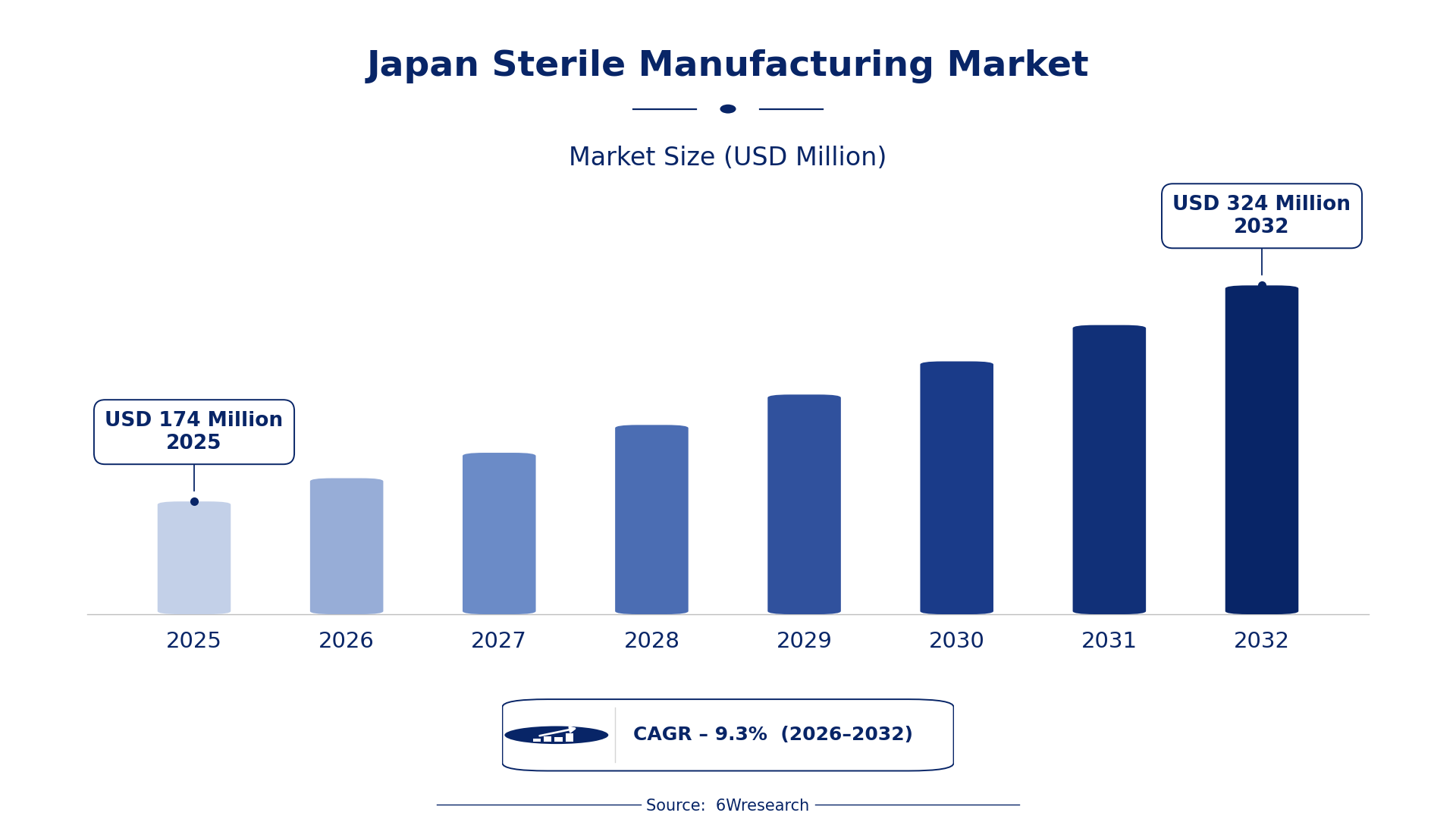
According to 6Wresearch internal database and industry insights, the Japan Sterile Manufacturing Market was valued at USD 174 Million in 2025 and is projected to reach USD 324 Million by 2032, growing at a CAGR of approximately 9.3% during 2026–2032.
Japan Sterile Manufacturing Market Highlights
| Report Metric | Details |
| Report Name | Japan Sterile Manufacturing Market (2026-2032) |
| Market Size 2025 | USD 174 Million |
| Market Size 2032 | USD 324 Million |
| Absolute Growth 2025–2032 | USD 150 Million |
| CAGR 2026–2032 | 9.3% |
| Peak Annual Growth | 10.1% in 2031 |
| Forecast Period | 2026–2032 |
| Historical Data | 2022–2025 |
| Base Year | 2025 |
| Leading Process Type, 2025 | Lyophilization (37% share) |
| Leading Production Scale, 2025 | Commercial (40% share) |
| Leading Drug Form Type, 2025 | Injectables (52% share) |
| Leading End User, 2025 | Pharmaceutical Companies (43% share) |
| Fastest-Growing Process Type | Terminal Sterilization (13.1% CAGR) |
| Fastest-Growing Production Scale | Clinical (12.9% CAGR) |
| Fastest-Growing Drug Form Type | IV Solutions (13.6% CAGR) |
| Fastest-Growing End User | Hospital Pharmacy Units (12.6% CAGR) |
| Growing Sector | Biologics |
| Key End Users | Pharmaceutical Companies, Hospital Pharmacy Units, Biotech Firms |
Japan Sterile Manufacturing Market Year-wise Growth Rate and Key Drivers (2022–2032)
This graph illustrates the annual growth rates of the market from 2022 to 2032, highlighting a steady upward trajectory and projected market expansion over the forecast period.
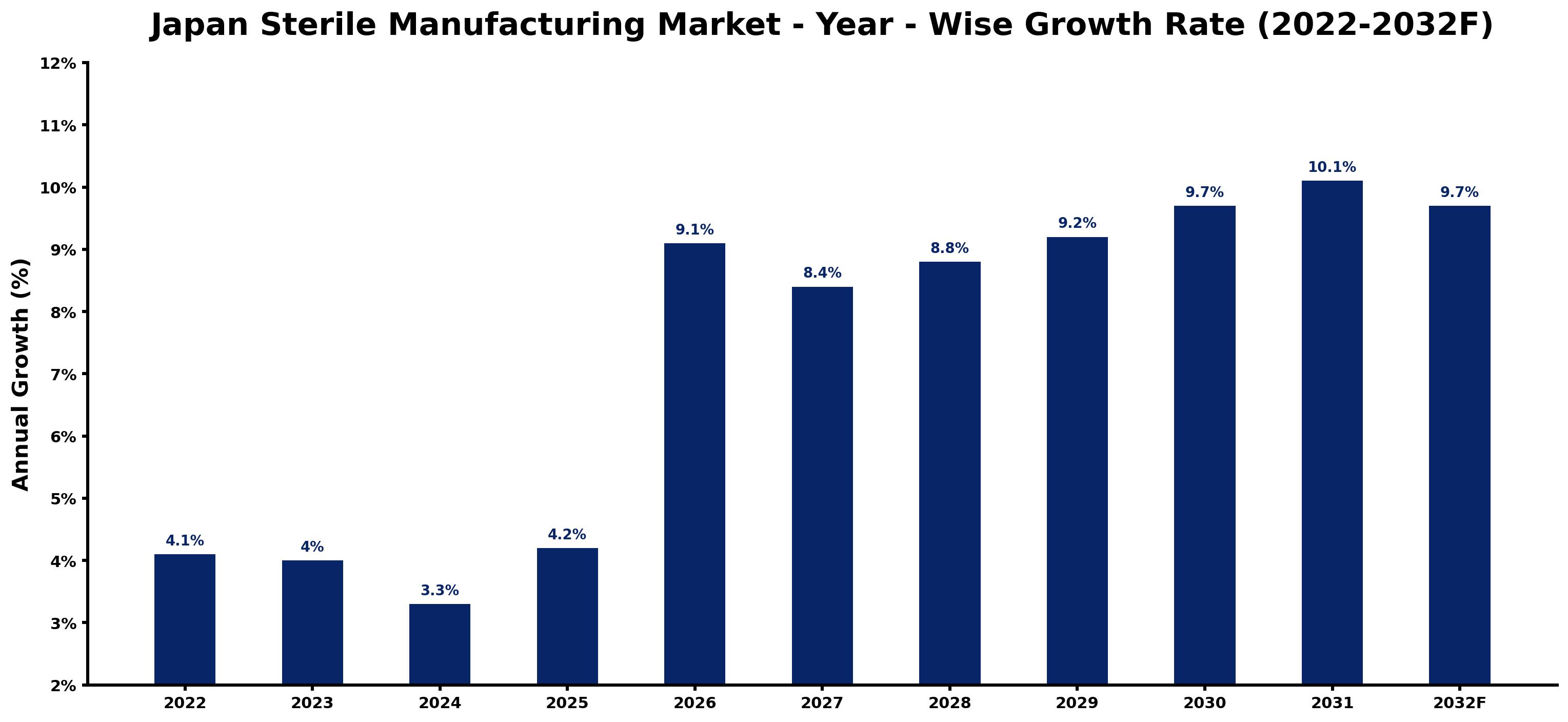
Year by year, the estimates below pair each growth rate with the development that shaped it.
| Year | Estimated Annual Growth (%) | Market Rationale |
| 2022 | 4.1 | The market experienced steady growth, supported by strong domestic demand for healthcare products. |
| 2023 | 4.0 | Growth slowed slightly as manufacturers adjusted to supply chain challenges and evolving regulations. |
| 2024 | 3.3 | Continued adjustments in production processes led to a further slowdown in growth rates. |
| 2025 | 4.2 | Growth accelerated as investments in sterile manufacturing facilities increased across the country. |
| 2026 | 9.1 | Demand is expected to surge with a focus on biopharmaceutical products and improved production capabilities. |
| 2027 | 8.4 | Growth is projected to slow as the market stabilises after rapid expansions in previous years. |
| 2028 | 8.8 | Increased adoption of aseptic techniques is expected to spur renewed interest in sterile manufacturing processes. |
| 2029 | 9.2 | The market is projected to see a rebound in growth as healthcare expenditure continues to rise. |
| 2030 | 9.7 | Investment in new technologies and processes will drive further growth in sterile manufacturing. |
| 2031 | 10.1 | The peak growth rate is expected as demand for injectables surges significantly. |
| 2032 | 9.7 | Growth is projected to slow slightly as the market begins to stabilise after several years of rapid expansion. |
Note: Market size estimations and growth projections presented in this report are based on 6Wresearch's proprietary forecasting methodology, utilizing the latest available industry data, government publications, and primary research inputs.
Japan Sterile Manufacturing Market Synopsis
Sterile manufacturing guarantees that products remain free from viable microorganisms, primarily through methods such as lyophilization and aseptic techniques. The Japan Sterile Manufacturing Market is growing, driven by a strong pharmaceutical sector and rising healthcare demands. The increasing requirement for injectables, IV solutions, and biologics is prompting investments in advanced manufacturing technologies. With over 1,000 pharmaceutical companies involved in sterile production, the market is expected to expand, supported by higher healthcare expenditure and advancements in biotech.
Market Dynamics Impact Analysis (2026–2032)
| Factor | Type | Impact | Primary Segment Affected |
| Investment in advanced manufacturing technologies is increasing. | Driver | High | Aseptic Manufacturing |
| Rising healthcare expenditure is driving demand for sterile products. | Driver | High | Injectables |
| The growing demand for biologics presents opportunities for manufacturers. | Opportunity | High | Biologics |
| The increasing need for IV solutions creates a significant market gap. | Opportunity | High | IV Solutions |
| Regulatory compliance can be complex and costly for manufacturers. | Restraint | High | Terminal Sterilization |
| Limited availability of skilled workforce can hinder production capabilities. | Restraint | Medium | Aseptic Manufacturing |
| Supply chain disruptions can delay production timelines. | Challenge | High | Commercial |
| Investment costs for new technologies can be prohibitive for smaller firms. | Challenge | Medium | Clinical |
Evaluation of Drivers in Japan Sterile Manufacturing Market (2026–2032)
The main growth drivers and the segments they affect most are set out below.
| Drivers | Primary Segment Affected | Why It Matters (Evidence) |
| Increased investment in sterile manufacturing facilities boosts capacity. | Commercial | Japan's healthcare expenditure reached ¥42 trillion in 2022, prompting more production capabilities. |
| Growing demand for injectables drives production volumes. | Injectables | Injectables account for 60% of the sterile manufacturing market, leading to higher output. |
| Rising interest in biologics encourages innovation in manufacturing processes. | Biologics | Biologics are growing at 15% annually, increasing the need for advanced production techniques. |
| Adoption of aseptic techniques improves product safety and efficacy. | Aseptic Manufacturing | ISO 13485 certification is critical for compliance, encouraging manufacturers to invest. |
| The expansion of hospital pharmacy units increases the demand for sterile products. | Hospital Pharmacy Units | The average hospital in Japan manages sterile products, driving consistent purchasing. |
Purchasing is picking up as healthcare expenditure in Japan reached ¥42 trillion in 2022, prompting increased investment in sterile manufacturing facilities. The demand for injectables, which account for 60% of the market, is driving production volumes. The expansion of hospital pharmacy units is increasing the demand for sterile products, creating consistent purchasing patterns. Facilities are also adopting more efficient sterilization technologies, improving compliance and reducing time-to-market for new therapies. With biologics growing at 15% annually, innovation in manufacturing processes is becoming essential to meet market needs.
Evaluation of Restraints in Japan Sterile Manufacturing Market
The table below lists the restraints and the evidence behind each.
| Market Restraint | Primary Segment Affected | Why It Matters (Evidence) |
| Complex regulatory compliance can hinder production timelines. | Terminal Sterilization | Compliance with Japanese regulations requires extensive documentation and testing, delaying market entry. |
| Limited skilled workforce affects production efficiency. | Aseptic Manufacturing | The shortage of trained personnel can lead to operational bottlenecks and increased costs. |
| Supply chain disruptions can impact material availability. | Commercial | Global supply chain issues have caused delays in sourcing essential materials for production. |
| High investment costs for new technologies can limit market participation. | Clinical | Smaller firms may struggle to afford the necessary upgrades, reducing competition. |
| Market saturation in certain segments can restrict growth opportunities. | IV Solutions | With many players in the IV solutions market, differentiation becomes challenging. |
Japan Sterile Manufacturing Market Challenges
Producers in Japan face a shortage of skilled professionals in sterile manufacturing, which can delay production timelines by up to 20%. Suppliers encounter rising costs as compliance with stringent regulations increases prices for sterile products by 15%. Hospitals struggle with adherence to ISO 13485 standards, necessitating investments in quality management systems that can reach ¥500 million annually, restricting their operational flexibility. Clinics must continuously upgrade sterilization technologies, which strains budgets and can postpone product launches by several months.
Trends in the Japan Sterile Manufacturing Market
These developments are changing demand patterns in the Japan Sterile Manufacturing Market.
- Shift towards Aseptic Manufacturing Techniques: Aseptic manufacturing techniques are increasingly adopted in Japan, particularly in the Tokyo region, where facilities are upgrading processes. This shift is essential for product safety, with aseptic techniques becoming vital for injectables.
- Increasing Use of Lyophilization for Biologics: Lyophilization is gaining popularity for biologics, particularly in the pharmaceutical sector. The average hospital in Japan has seen a rise in demand for lyophilized products, improving stability and shelf life.
- Growth of Single-Use Technology in Sterile Processes: Single-use technology is becoming more prevalent in sterile manufacturing, particularly in clinical settings. This trend is necessary for reducing contamination risks, with hospitals increasingly adopting these practices.
- Expansion of Hospital Pharmacy Units: Hospital pharmacy units are expanding their capabilities to handle sterile products, particularly in urban areas. With an estimated 10 million units of IV solutions required annually, this growth reflects the rising healthcare demands.
Investment Opportunities in the Japan Sterile Manufacturing Market
The following areas offer the clearest openings for investors and suppliers in the Japan Sterile Manufacturing Market.
- Investment in Biologics Production: Investment in biologics production is increasing, with the sector growing at 15% annually. Pharmaceutical companies are increasingly focusing on this area, creating opportunities for local partnerships to boost production capabilities.
- Supply of Aseptic Manufacturing Equipment: There is a growing need for aseptic manufacturing equipment, particularly in the Tokyo region. With ¥1 billion allocated for pharmaceutical innovation in 2023, suppliers can enter through local partnerships.
- Expansion of IV Solutions Production: The demand for IV solutions is substantial, with an estimated annual requirement of 10 million units. Suppliers can capitalize on this by establishing joint ventures with local manufacturers.
- Development of Single-Use Technologies: The market for single-use technologies is expanding, as there is a need to reduce contamination risks. Suppliers can enter this market by obtaining necessary certifications and collaborating with healthcare facilities.
Government Initiatives in the Japan Sterile Manufacturing Market
The Medical Care Act of 1948 establishes essential standards for hospitals and clinics, ensuring compliance in sterile manufacturing practices. The NHI drug price standard, revised regularly, influences reimbursement prices for sterile products, impacting manufacturers' pricing strategies and market access. In 2023, the government allocated ¥1 billion for pharmaceutical innovation, supporting research and development initiatives that improve sterile manufacturing capabilities.
The Pharmaceuticals and Medical Devices Agency oversees compliance with regulations, ensuring that sterile products meet safety standards. In 2023, the government allocated ¥1 billion for pharmaceutical innovation, supporting research and development initiatives that improve sterile manufacturing capabilities.
Future Insight of the Japan Sterile Manufacturing Market
Investment in sterile manufacturing is set to grow significantly, driven by government initiatives that allocate ¥1 billion for pharmaceutical innovation in 2023. As the population ages, the demand for advanced sterile products will increase, prompting suppliers to innovate. Facilities will implement more efficient sterilization processes to ensure compliance with evolving regulations. The annual demand for IV solutions is projected to rise to 12 million units, presenting new opportunities for both buyers and suppliers.
Market Segmentation Analysis
Japan Sterile Manufacturing Market report covers a detailed analysis of the following market segments:
By Process Type – Lyophilization Leads, Terminal Sterilization Expected to Grow Fastest
According to Saurav Kr Singh, Senior Research Analyst at 6Wresearch, Lyophilization held 37% of the Japan Sterile Manufacturing Market by process type in 2025. Lyophilization holds the largest share because it is widely used for long-term preservation of pharmaceuticals, ensuring their quality over time. This method is particularly significant for injectables, which are essential in the healthcare sector, especially in regions like Tokyo. Over 2026–2032, Terminal Sterilization is expected to post the fastest growth, at a CAGR of 13.1%. Terminal sterilization is experiencing rapid growth as it is vital for ensuring product safety and efficacy, particularly in compliance with Japanese regulations. The increasing focus on stringent drug safety standards is propelling this sub-segment's expansion. Suppliers must prioritise advancements in terminal sterilization to meet evolving regulatory expectations.
By Production Scale – Commercial Leads, Clinical Expected to Grow Fastest
In 2025, Commercial led the production scale split with a 40% share. The commercial scale dominates the market as it is the major scale for market-ready products, catering to the extensive pharmaceutical demand in Japan. This segment benefits from over 1,000 pharmaceutical companies operating in the country. The quickest growth will come from Clinical, forecast to expand at a CAGR of 12.9% between 2026 and 2032. Clinical production is growing quickly due to its importance in the trial phases of drug development, which are critical for bringing new therapies to market. The increasing number of clinical trials in Japan is a key driver for this growth. Buyers should consider investing in clinical scale capabilities to support ongoing drug development efforts.
By Drug Form Type – Injectables Lead, IV Solutions Expected to Grow Fastest
The largest drug form type category in 2025 was Injectables, at 52% of revenue. Injectables dominate the market as they are the primary form used in sterile manufacturing, essential for delivering various therapeutic solutions. Their substantial 60% market share reflects the strong demand for injectables in healthcare applications. IV Solutions are projected to grow fastest, at a CAGR of 13.6% during 2026–2032. IV solutions are experiencing the fastest growth, primarily due to their extensive usage in hospitals and clinics for patient treatment. The estimated annual demand of 10 million units for IV solutions highlights their increasing market significance. Suppliers should focus on ramping up IV solution production to meet the rising hospital demand.
By End User – Pharmaceutical Companies Lead, Hospital Pharmacy Units Expected to Grow Fastest
With 43% of end user revenue in 2025, Pharmaceutical Companies was the largest category. Pharmaceutical companies represent the largest end users of sterile manufacturing, utilising these processes to create a diverse array of healthcare products. Their considerable investment in sterile manufacturing capabilities, especially in the Tokyo region, reinforces their leading position in the market. Hospital Pharmacy Units are set to record the highest CAGR in this split, 12.6% over 2026–2032. Hospital pharmacy units are the fastest-growing end users as they increasingly rely on sterile products for patient care, driven by the rising healthcare demands in Japan. The ongoing development of healthcare facilities supports this upward trend. Suppliers must adapt their offerings to satisfy the growing requirements of hospital pharmacy units for sterile products.
Key Attractiveness of the Report
- 10 Years of Market Numbers
- Historical Data Starting from 2022 to 2025
- Base Year 2025
- Forecast Data until 2032
- Key Performance Indicators Impacting the Market
- Major Upcoming Developments and Projects
Key Highlights of the Report:
- Japan Sterile Manufacturing Market Outlook
- Market Size of Japan Sterile Manufacturing Market, 2025
- Forecast of Japan Sterile Manufacturing Market, 2032
- Historical Data and Forecast of Japan Sterile Manufacturing Revenues & Volume for the Period 2022-2032F
- Japan Sterile Manufacturing Market Trend Evolution
- Japan Sterile Manufacturing Market Drivers and Challenges
- Japan Sterile Manufacturing Price Trends
- Japan Sterile Manufacturing Porter's Five Forces
- Japan Sterile Manufacturing Industry Life Cycle
- Historical Data and Forecast of Japan Sterile Manufacturing Market Revenues & Volume By Process Type for the Period 2022-2032F
- Historical Data and Forecast of Japan Sterile Manufacturing Market Revenues & Volume By Lyophilization for the Period 2022-2032F
- Historical Data and Forecast of Japan Sterile Manufacturing Market Revenues & Volume By Terminal Sterilization for the Period 2022-2032F
- Historical Data and Forecast of Japan Sterile Manufacturing Market Revenues & Volume By Aseptic Manufacturing for the Period 2022-2032F
- Historical Data and Forecast of Japan Sterile Manufacturing Market Revenues & Volume By Single-Use Technology for the Period 2022-2032F
- Historical Data and Forecast of Japan Sterile Manufacturing Market Revenues & Volume By Production Scale for the Period 2022-2032F
- Historical Data and Forecast of Japan Sterile Manufacturing Market Revenues & Volume By Commercial for the Period 2022-2032F
- Historical Data and Forecast of Japan Sterile Manufacturing Market Revenues & Volume By Clinical for the Period 2022-2032F
- Historical Data and Forecast of Japan Sterile Manufacturing Market Revenues & Volume By R&D for the Period 2022-2032F
- Historical Data and Forecast of Japan Sterile Manufacturing Market Revenues & Volume By Pilot Scale for the Period 2022-2032F
- Historical Data and Forecast of Japan Sterile Manufacturing Market Revenues & Volume By Drug Form Type for the Period 2022-2032F
- Historical Data and Forecast of Japan Sterile Manufacturing Market Revenues & Volume By Injectables for the Period 2022-2032F
- Historical Data and Forecast of Japan Sterile Manufacturing Market Revenues & Volume By IV Solutions for the Period 2022-2032F
- Historical Data and Forecast of Japan Sterile Manufacturing Market Revenues & Volume By Biologics for the Period 2022-2032F
- Historical Data and Forecast of Japan Sterile Manufacturing Market Revenues & Volume By Ophthalmic Products for the Period 2022-2032F
- Historical Data and Forecast of Japan Sterile Manufacturing Market Revenues & Volume By End User for the Period 2022-2032F
- Historical Data and Forecast of Japan Sterile Manufacturing Market Revenues & Volume By Pharmaceutical Companies for the Period 2022-2032F
- Historical Data and Forecast of Japan Sterile Manufacturing Market Revenues & Volume By Hospital Pharmacy Units for the Period 2022-2032F
- Historical Data and Forecast of Japan Sterile Manufacturing Market Revenues & Volume By Biotech Firms for the Period 2022-2032F
- Historical Data and Forecast of Japan Sterile Manufacturing Market Revenues & Volume By Contract Development Orgs for the Period 2022-2032F
- Japan Sterile Manufacturing Import Export Trade Statistics
- Market Opportunity Assessment By Process Type
- Market Opportunity Assessment By Production Scale
- Market Opportunity Assessment By Drug Form Type
- Market Opportunity Assessment By End User
- Japan Sterile Manufacturing Top Companies Market Share
- Japan Sterile Manufacturing Competitive Benchmarking By Technical and Operational Parameters
- Japan Sterile Manufacturing Company Profiles
- Japan Sterile Manufacturing Key Strategic Recommendations
Market Covered
Segments analysed in this report are listed below.
By Process Type
- Lyophilization
- Terminal Sterilization
- Aseptic Manufacturing
- Single-Use Technology
By Production Scale
- Commercial
- Clinical
- R&D
- Pilot Scale
By Drug Form Type
- Injectables
- IV Solutions
- Biologics
- Ophthalmic Products
By End User
- Pharmaceutical Companies
- Hospital Pharmacy Units
- Biotech Firms
- Contract Development Orgs































