Japan Stock Trading Market Size & Growth Rate
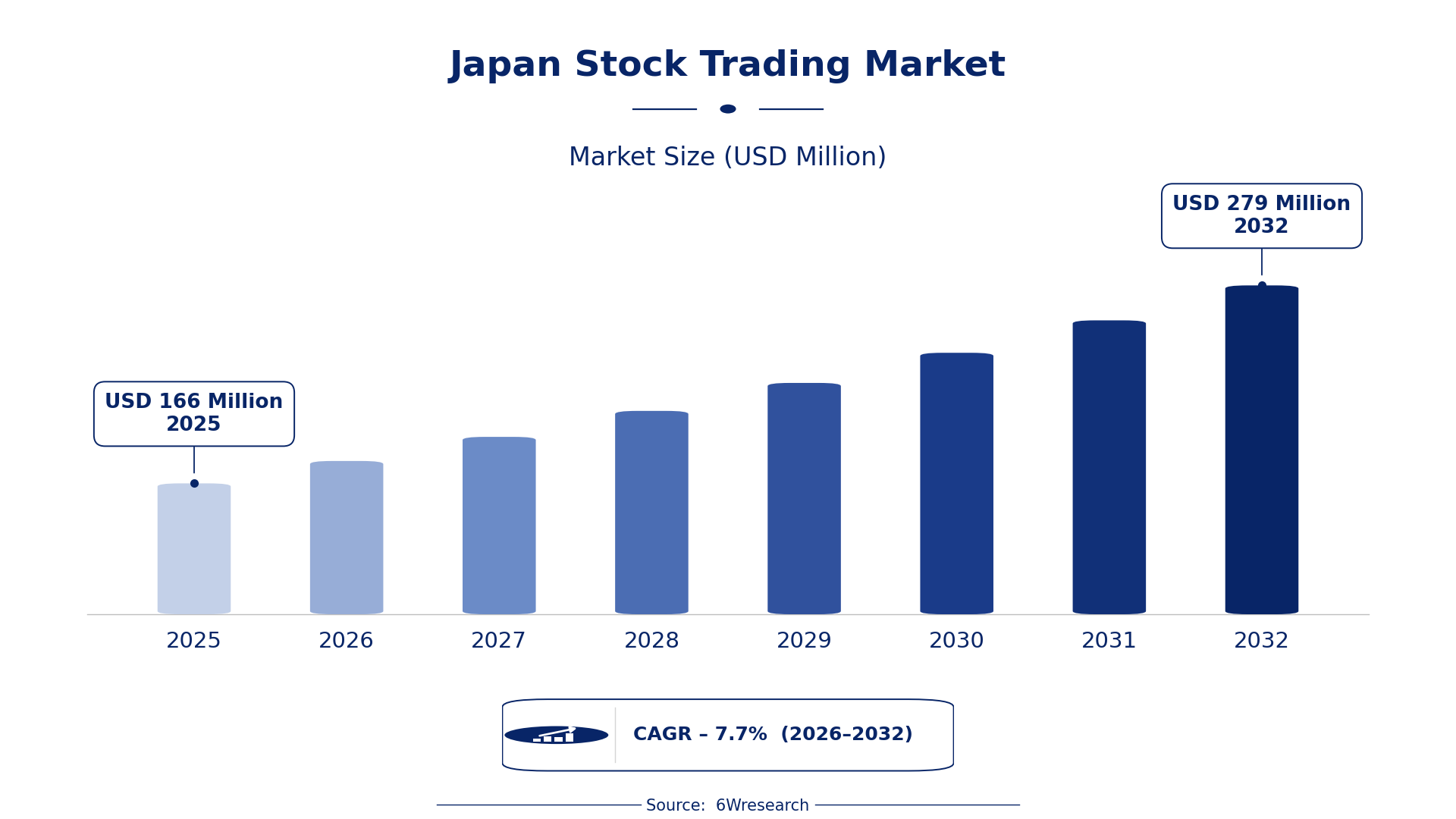
According to 6Wresearch internal database and industry insights, the Japan Stock Trading Market was valued at USD 166 Million in 2025 and is projected to reach USD 279 Million by 2032, growing at a CAGR of approximately 7.7% during 2026–2032.
Japan Stock Trading Market Highlights
| Report Metric | Details |
| Report Name | Japan Stock Trading Market (2026-2032) |
| Market Size 2025 | USD 166 Million |
| Market Size 2032 | USD 279 Million |
| Absolute Growth 2025–2032 | USD 113 Million |
| CAGR 2026–2032 | 7.7% |
| Peak Annual Growth | 8.7% in 2027 |
| Forecast Period | 2026–2032 |
| Historical Data | 2022–2025 |
| Base Year | 2025 |
| Leading Platform Type, 2025 | Online Trading Platforms (43% share) |
| Leading Asset Class, 2025 | Equities (39% share) |
| Leading Access Channel, 2025 | Web/Mobile (34% share) |
| Leading End User, 2025 | Individual Investors (47% share) |
| Fastest-Growing Platform Type | Robo-Advisors (10.9% CAGR) |
| Fastest-Growing Asset Class | ETFs (10.0% CAGR) |
| Fastest-Growing Access Channel | App-Based (10.1% CAGR) |
| Fastest-Growing End User | High-Net-Worth Clients (9.9% CAGR) |
| Growing Sector | investment management |
| Key End Users | individual investors, retail investors, institutional investors, high-net-worth clients |
Japan Stock Trading Market Year-wise Growth Rate and Key Drivers (2022–2032)
This graph illustrates the annual growth rates of the market from 2022 to 2032, highlighting a steady upward trajectory and projected market expansion over the forecast period.
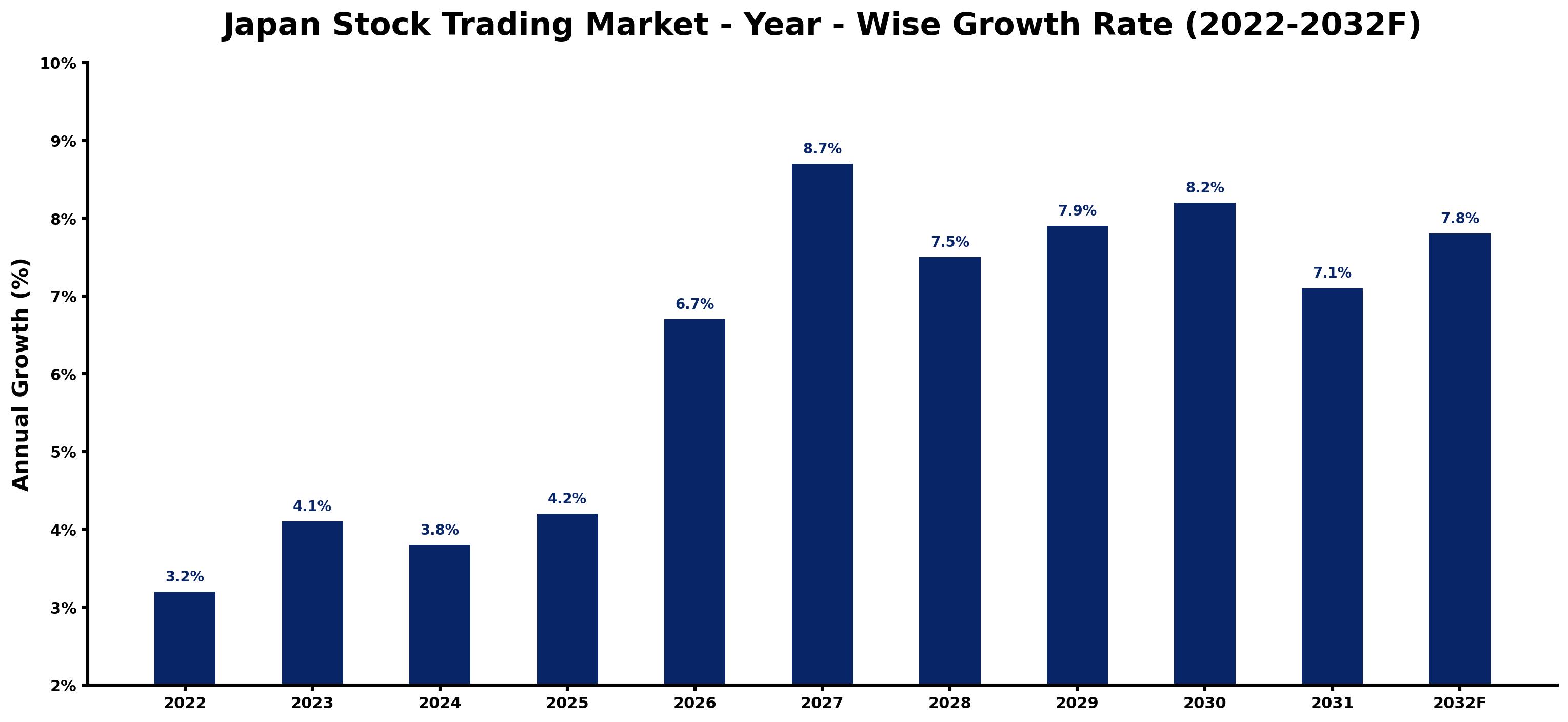
Each row of the following table gives one year's estimated growth and the event or demand shift that explains it.
| Year | Estimated Annual Growth (%) | Market Rationale |
| 2022 | 3.2 | The market showed steady activity with participation from individual investors. |
| 2023 | 4.1 | Trading volume increased due to heightened interest from retail investors amid market recovery. |
| 2024 | 3.8 | Growth slowed as investors became more cautious following market fluctuations. |
| 2025 | 4.2 | The market rebounded with renewed investor confidence and increased trading activities. |
| 2026 | 6.7 | Demand is expected to surge as digital trading platforms gain popularity among younger investors. |
| 2027 | 8.7 | The market is projected to peak with a surge in trading volume driven by strong economic conditions. |
| 2028 | 7.5 | Growth is anticipated to slow as market volatility prompts investors to reassess their strategies. |
| 2029 | 7.9 | Trading activity will rise as institutional investors seek to capitalize on market opportunities. |
| 2030 | 8.2 | Continued growth is expected to be supported by advancements in trading technology and platforms. |
| 2031 | 7.1 | Growth is projected to moderate as market conditions stabilise and investor sentiment becomes cautious. |
| 2032 | 7.8 | The market is set to expand further as digital securities gain traction among investors. |
Note: Market size estimations and growth projections presented in this report are based on 6Wresearch's proprietary forecasting methodology, utilizing the latest available industry data, government publications, and primary research inputs.
Japan Stock Trading Market Synopsis
The stock trading market in Japan encompasses the buying and selling of shares and securities through electronic platforms, primarily for investment and portfolio management. Individual investors, who made up around 60% of total trading volume in 2022, are driving market growth. The emergence of digital trading platforms and the increasing appeal of robo-advisors, managing over 1 trillion JPY in assets, are pivotal in this sector's expansion. As of 2023, Japan's average daily trading volume stands at approximately 2 trillion JPY, underscoring the market's vibrant character.
Market Dynamics Impact Analysis (2026–2032)
| Factor | Type | Impact | Primary Segment Affected |
| Increased participation from individual investors | Driver | High | Individual Investors |
| Growth of digital trading platforms | Driver | High | Online Trading Platforms |
| Expansion of robo-advisors for automated investment management | Opportunity | Medium | Robo-Advisors |
| Rising interest in diversified investment options like ETFs | Opportunity | Medium | ETFs |
| Regulatory scrutiny affecting trading practices | Restraint | High | Traditional Brokers |
| Market volatility impacting investor confidence | Restraint | Medium | Retail Investors |
| High operational costs for compliance with regulations | Challenge | High | Institutional Platforms |
| Technological barriers for older trading systems | Challenge | Medium | Traditional Brokers |
Evaluation of Drivers in Japan Stock Trading Market (2026–2032)
The table below links each growth driver to the segment it affects and the evidence for it.
| Drivers | Primary Segment Affected | Why It Matters (Evidence) |
| Increased trading volume from individual investors | Individual Investors | In 2022, individual investors accounted for about 60% of total trading volume, driving demand for trading services. |
| Popularity of online trading platforms | Online Trading Platforms | The average daily trading volume in Japan is approximately 2 trillion JPY, reflecting the shift to digital trading. |
| Growth of robo-advisors managing assets | Robo-Advisors | Robo-advisors in Japan manage over 1 trillion JPY in assets, attracting tech-savvy investors. |
| Rising demand for diversified investment options | ETFs | ETFs have gained popularity, with a growth rate of 10.0% projected for the coming years, boosting trading activity. |
| Institutional investment strategies | Institutional Platforms | Institutional investors are essential for large-scale trading, increasing market liquidity and stability. |
Most of the extra volume comes from individual investors, who accounted for about 60% of total trading in 2022. The average daily trading volume in Japan reached approximately 2 trillion JPY, reflecting a shift towards digital platforms. The growth of robo-advisors managing over 1 trillion JPY in assets attracts younger, tech-savvy participants, further driving demand. The rising interest in ETFs has led to increased trading activity as investors seek diversified portfolios. Institutional investors contribute significantly to liquidity, stabilising the market and encouraging further trading.
Evaluation of Restraints in Japan Stock Trading Market
These are the pressures that could keep growth below its potential.
| Market Restraint | Primary Segment Affected | Why It Matters (Evidence) |
| Regulatory scrutiny affecting trading practices | Traditional Brokers | Compliance with regulations imposed by the Financial Services Agency incurs significant costs, limiting operational flexibility. |
| Market volatility impacting investor confidence | Retail Investors | Fluctuating market conditions have made retail investors more cautious, reducing their trading frequency. |
| High operational costs for compliance with regulations | Institutional Platforms | Institutional platforms face substantial costs in adhering to regulatory standards, deterring new entrants. |
| Technological barriers for older trading systems | Traditional Brokers | Legacy systems struggle to integrate with modern trading technologies, hindering competitiveness. |
| Limited access to advanced trading tools for retail investors | Individual Investors | Many retail investors lack access to sophisticated trading tools, restricting their ability to compete effectively. |
Japan Stock Trading Market Challenges
In 2023, over 3,700 companies listed on the Tokyo Stock Exchange illustrate a crowded market that complicates buyers' decision-making. This complexity stems from inadequate market education, resulting in higher costs for individual investors who find it challenging to identify valuable opportunities. Technology adoption remains slow; while robo-advisors manage over 1 trillion JPY in assets, many investors lack awareness of these tools, leading to missed growth potential. Regulatory measures from the Financial Services Agency can delay the introduction of new trading technologies, raising operational costs for brokerage firms and hindering market progress.
Trends in the Japan Stock Trading Market
The shifts below are changing how Japan Stock Trading Market products are bought and supplied.
- Shift from Traditional Brokers to Online Trading Platforms: Since 2022, a clear shift towards online trading platforms has emerged as individual investors seek convenience and accessibility. Approximately 34% of trading activity now occurs through web and mobile channels, reflecting changing preferences.
- Emergence of Robo-Advisors in Investment Management: Robo-advisors have gained popularity in Japan, managing over 1 trillion JPY in assets as of 2023. This trend indicates a growing preference for automated investment solutions among younger investors.
- Increased Adoption of ETFs for Diversified Investments: The popularity of ETFs has surged, with a growth rate of 10.0% projected for the coming years. This trend is driven by investors looking for diversified portfolios without extensive research.
- Rise of App-Based Trading Among Younger Investors: Since 2023, app-based trading has gained traction, particularly among younger investors. This segment is expected to grow at a CAGR of 10.1%, reflecting a shift in trading habits.
Investment Opportunities in the Japan Stock Trading Market
Where to invest in the Japan Stock Trading Market: the main openings are set out below.
- Investment in Digital Trading Platforms: With the average daily trading volume at approximately 2 trillion JPY, there is a strong opportunity to invest in digital trading platforms. Individual investors are increasingly turning to these platforms for trading.
- Expansion of Robo-Advisory Services: As robo-advisors manage over 1 trillion JPY in assets, now is an ideal time to expand these services. Targeting younger investors in urban areas can yield substantial returns.
- Development of Advanced Trading Tools for Retail Investors: The demand for sophisticated trading tools is growing, presenting an opportunity to develop and supply these technologies. Individual investors are looking for ways to improve their trading capabilities.
- Partnerships with Financial Institutions for Compliance Solutions: Given the regulatory environment, forming partnerships with financial institutions to provide compliance solutions is timely. Institutional platforms require support to navigate complex regulations.
Government Initiatives in the Japan Stock Trading Market
The stock trading market in Japan is overseen by the Financial Services Agency, which ensures compliance with regulations to protect investors. The Act against Unjustifiable Premiums and Misleading Representations prohibits misleading advertising practices, promoting market transparency. The Digital Agency, established in September 2021, advocates for digital transformation within the financial sector, supporting the adoption of new trading technologies.
Individual investors benefit from the Japan Exchange Group's initiatives, which include annual investor education events designed to boost market participation. The Japan Securities Dealers Association offers guidelines for trading practices, ensuring that investors are well-informed and can make sound decisions.
Future Insight of the Japan Stock Trading Market
The Japan Financial Services Agency's recent programme to promote digital securities will drive a substantial shift in market operations, encouraging the adoption of advanced trading platforms. By 2032, initiatives from the Tokyo Stock Exchange will enhance market transparency and investor confidence. This transformation is likely to lead to an increase in average daily trading volume, potentially surpassing 2 trillion JPY. Heightened competition from foreign investors will compel suppliers to innovate, providing buyers with improved trading options and enhanced investment experiences.
Market Segmentation Analysis
Japan Stock Trading Market report covers a detailed analysis of the following market segments:
By Platform Type – Online Trading Platforms Lead, Robo-Advisors Expected to Grow Fastest
According to Saurav Kr Singh, Senior Research Analyst at 6Wresearch, with 43% of platform type revenue in 2025, Online Trading Platforms was the largest category. Online trading platforms dominate Japan's stock trading market as they are extensively utilised by individual and retail traders for direct transactions. Their popularity is underscored by the substantial trading volume attributed to these platforms, reflecting their critical role in investment activities. Robo-Advisors are set to record the highest CAGR in this split, 10.9% over 2026–2032. Robo-advisors are experiencing rapid growth due to the increasing demand for automated investment management, particularly among tech-savvy investors. In 2023, they manage over 1 trillion JPY in assets, indicating a strong shift towards automation in investment strategies. Suppliers should enhance their digital offerings to capture the increasing interest in automated investment solutions.
By Asset Class – Equities Lead, ETFs Expected to Grow Fastest
In 2025, Equities led the asset class split with a 39% share. Equities dominate the market as they are the primary asset class traded, attracting substantial participation from both domestic and foreign investors. With over 3,700 listed companies on the Tokyo Stock Exchange, equities provide ample opportunities for trading, solidifying their leading position. Over 2026–2032, ETFs are expected to post the fastest growth, at a CAGR of 10.0%. ETFs are experiencing the fastest growth due to their appeal for diversified investment options, attracting a wider range of investors. This trend is driven by a growing desire among investors to mitigate risk while still engaging in market movements. Buyers should consider diversifying their portfolios with ETFs to take advantage of the increasing trend towards diversified investments.
By Access Channel – Web/Mobile Leads, App-Based Expected to Grow Fastest
Web/Mobile accounted for 34% of the market by access channel in 2025. Web and mobile access channels lead the market as they serve as the primary means for individual traders to engage in stock trading. The convenience and flexibility offered by these platforms have made them the preferred choice for many investors, ensuring their dominant position. App-Based is projected to grow fastest, at a CAGR of 10.1% during 2026–2032. App-based access is rapidly gaining traction, especially among younger investors who prefer mobile solutions for trading. This trend reflects a broader movement towards mobile technology in financial services, enhancing user engagement and accessibility. Suppliers need to prioritise app development to address the rising demand for mobile trading solutions.
By End User – Individual Investors Lead, High-Net-Worth Clients Expected to Grow Fastest
Individual Investors took 47% of end user revenue in 2025, more than any other category. Individual investors constitute a significant portion of market participants, contributing heavily to trading volume. Their active participation in the stock market is essential for maintaining liquidity and overall market activity, highlighting their importance. The quickest growth will come from High-Net-Worth Clients, forecast to expand at a CAGR of 9.9% between 2026 and 2032. High-net-worth clients are the fastest-growing segment as they increasingly seek personalised investment services tailored to their financial objectives. This trend indicates a broader shift towards bespoke financial solutions within the investment landscape. Providers should tailor their services to meet the specific needs of high-net-worth clients to capitalise on this expanding market segment.
Key Attractiveness of the Report
- 10 Years of Market Numbers
- Historical Data Starting from 2022 to 2025
- Base Year 2025
- Forecast Data until 2032
- Key Performance Indicators Impacting the Market
- Major Upcoming Developments and Projects
Key Highlights of the Report:
- Japan Stock Trading Market Outlook
- Market Size of Japan Stock Trading Market, 2025
- Forecast of Japan Stock Trading Market, 2032
- Historical Data and Forecast of Japan Stock Trading Revenues & Volume for the Period 2022-2032F
- Japan Stock Trading Market Trend Evolution
- Japan Stock Trading Market Drivers and Challenges
- Japan Stock Trading Price Trends
- Japan Stock Trading Porter's Five Forces
- Japan Stock Trading Industry Life Cycle
- Historical Data and Forecast of Japan Stock Trading Market Revenues & Volume By Platform Type for the Period 2022-2032F
- Historical Data and Forecast of Japan Stock Trading Market Revenues & Volume By Online Trading Platforms for the Period 2022-2032F
- Historical Data and Forecast of Japan Stock Trading Market Revenues & Volume By Institutional Platforms for the Period 2022-2032F
- Historical Data and Forecast of Japan Stock Trading Market Revenues & Volume By Robo-Advisors for the Period 2022-2032F
- Historical Data and Forecast of Japan Stock Trading Market Revenues & Volume By Traditional Brokers for the Period 2022-2032F
- Historical Data and Forecast of Japan Stock Trading Market Revenues & Volume By Asset Class for the Period 2022-2032F
- Historical Data and Forecast of Japan Stock Trading Market Revenues & Volume By Equities for the Period 2022-2032F
- Historical Data and Forecast of Japan Stock Trading Market Revenues & Volume By Derivatives for the Period 2022-2032F
- Historical Data and Forecast of Japan Stock Trading Market Revenues & Volume By ETFs for the Period 2022-2032F
- Historical Data and Forecast of Japan Stock Trading Market Revenues & Volume By Bonds for the Period 2022-2032F
- Historical Data and Forecast of Japan Stock Trading Market Revenues & Volume By Access Channel for the Period 2022-2032F
- Historical Data and Forecast of Japan Stock Trading Market Revenues & Volume By Web/Mobile for the Period 2022-2032F
- Historical Data and Forecast of Japan Stock Trading Market Revenues & Volume By Direct Exchange Access for the Period 2022-2032F
- Historical Data and Forecast of Japan Stock Trading Market Revenues & Volume By App-Based for the Period 2022-2032F
- Historical Data and Forecast of Japan Stock Trading Market Revenues & Volume By Telephone/Physical for the Period 2022-2032F
- Historical Data and Forecast of Japan Stock Trading Market Revenues & Volume By End User for the Period 2022-2032F
- Historical Data and Forecast of Japan Stock Trading Market Revenues & Volume By Individual Investors for the Period 2022-2032F
- Historical Data and Forecast of Japan Stock Trading Market Revenues & Volume By Hedge Funds for the Period 2022-2032F
- Historical Data and Forecast of Japan Stock Trading Market Revenues & Volume By Retail Investors for the Period 2022-2032F
- Historical Data and Forecast of Japan Stock Trading Market Revenues & Volume By High-Net-Worth Clients for the Period 2022-2032F
- Japan Stock Trading Import Export Trade Statistics
- Market Opportunity Assessment By Platform Type
- Market Opportunity Assessment By Asset Class
- Market Opportunity Assessment By Access Channel
- Market Opportunity Assessment By End User
- Japan Stock Trading Top Companies Market Share
- Japan Stock Trading Competitive Benchmarking By Technical and Operational Parameters
- Japan Stock Trading Company Profiles
- Japan Stock Trading Key Strategic Recommendations
Market Covered
The following segment groups are covered in the report.
By Platform Type
- Online Trading Platforms
- Institutional Platforms
- Robo-Advisors
- Traditional Brokers
By Asset Class
- Equities
- Derivatives
- ETFs
- Bonds
By Access Channel
- Web/Mobile
- Direct Exchange Access
- App-Based
- Telephone/Physical
By End User
- Individual Investors
- Hedge Funds
- Retail Investors
- High-Net-Worth Clients































