Japan Strategic Weapons Market Size & Growth Rate
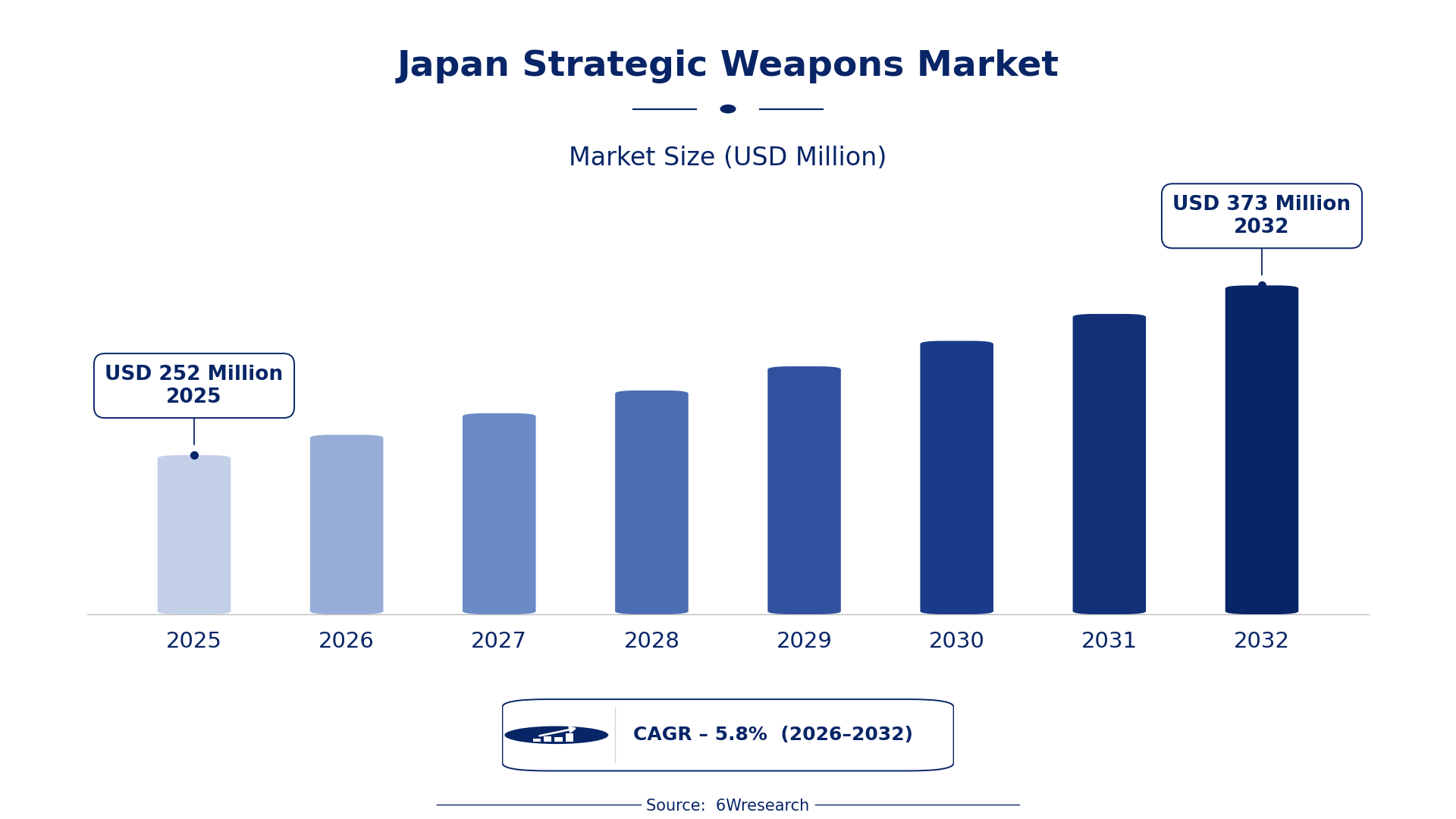
According to 6Wresearch internal database and industry insights, the Japan Strategic Weapons Market was valued at USD 252 Million in 2025 and is projected to reach USD 373 Million by 2032, growing at a CAGR of approximately 5.8% during 2026–2032.
Japan Strategic Weapons Market Highlights
| Report Metric | Details |
| Report Name | Japan Strategic Weapons Market (2026-2032) |
| Market Size 2025 | USD 252 Million |
| Market Size 2032 | USD 373 Million |
| Absolute Growth 2025–2032 | USD 121 Million |
| CAGR 2026–2032 | 5.8% |
| Peak Annual Growth | 7.1% in 2026 |
| Forecast Period | 2026–2032 |
| Historical Data | 2022–2025 |
| Base Year | 2025 |
| Leading Weapon Type, 2025 | Ballistic Missiles (51% share) |
| Leading Deployment Platform, 2025 | Land-Based (48% share) |
| Leading Guidance System, 2025 | Inertial/Nuclear (45% share) |
| Leading End User, 2025 | Defense Forces (36% share) |
| Fastest-Growing Weapon Type | Cruise Missiles (7.9% CAGR) |
| Fastest-Growing Deployment Platform | Airborne (8.0% CAGR) |
| Fastest-Growing Guidance System | GPS/Laser-Guided (8.5% CAGR) |
| Fastest-Growing End User | Military Contractors (7.2% CAGR) |
| Growing Sector | National Defense |
| Key End Users | Defense Forces, National Defense Agencies, Military Contractors |
Japan Strategic Weapons Market Year-wise Growth Rate and Key Drivers (2022–2032)
This graph illustrates the annual growth rates of the market from 2022 to 2032, highlighting a steady upward trajectory and projected market expansion over the forecast period.
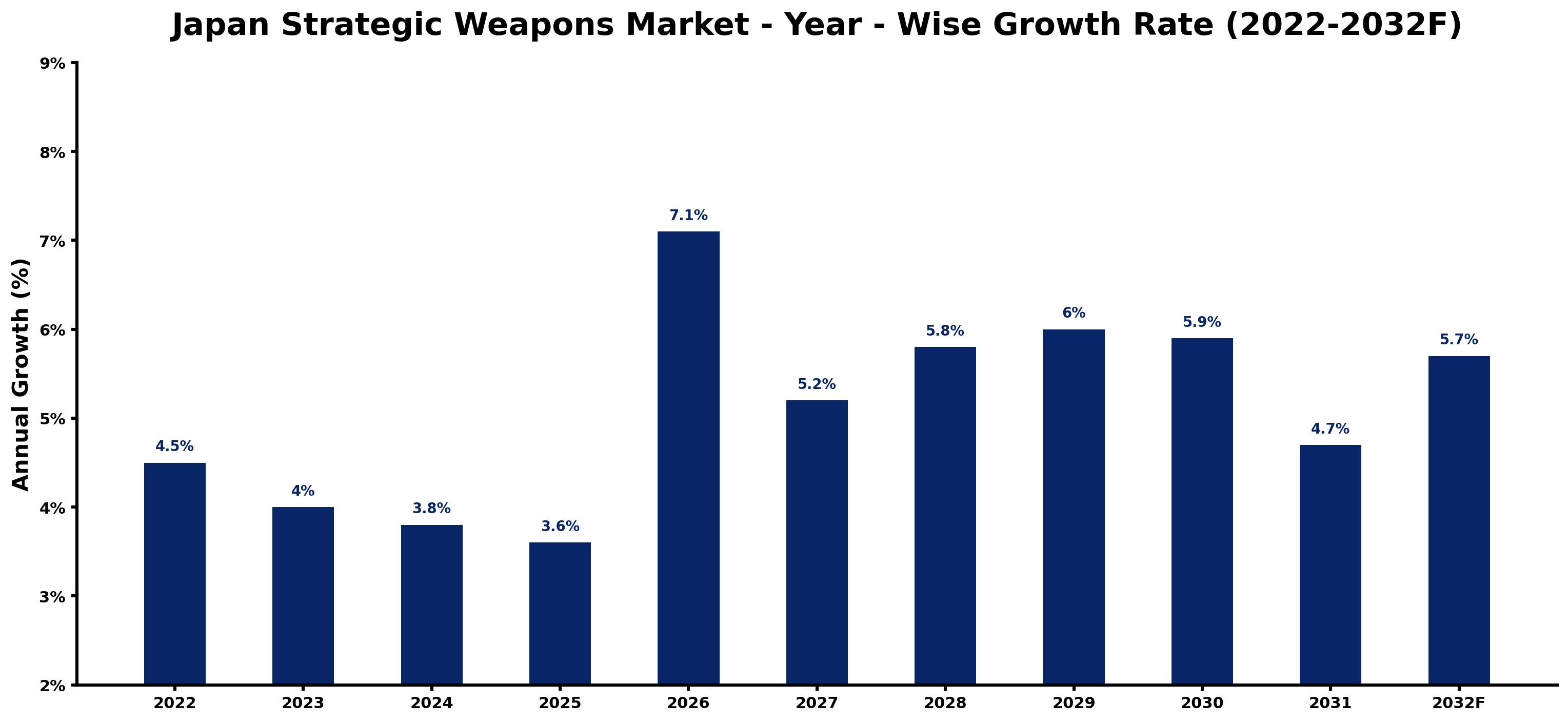
The following figures match every annual growth estimate with the main market development of that year, giving the reasoning behind each rise or slowdown.
| Year | Estimated Annual Growth (%) | Market Rationale |
| 2022 | 4.5 | Japan's defense policy emphasised deterrence capabilities in response to regional threats. |
| 2023 | 4.0 | The Ministry of Defense outlined a budget of approximately 5.4 trillion yen for strategic initiatives. |
| 2024 | 3.8 | Demand for advanced military technologies continued to rise amid regional tensions. |
| 2025 | 3.6 | The Self-Defense Forces aimed to improve missile defense systems by 2025. |
| 2026 | 7.1 | A significant increase in funding for hypersonic technology development is expected. |
| 2027 | 5.2 | Investment in missile systems will remain strong as international collaborations expand. |
| 2028 | 5.8 | Growing focus on indigenous defense capabilities is projected to drive demand. |
| 2029 | 6.0 | The introduction of new missile systems will further boost procurement activities. |
| 2030 | 5.9 | Increased military contracting in the Tokyo region will support market growth. |
| 2031 | 4.7 | Ongoing modernization efforts will sustain demand for strategic weapons. |
| 2032 | 5.7 | Japan is expected to significantly improve its strategic capabilities. |
Note: Market size estimations and growth projections presented in this report are based on 6Wresearch's proprietary forecasting methodology, utilizing the latest available industry data, government publications, and primary research inputs.
Japan Strategic Weapons Market Synopsis
Strategic weapons are advanced military technologies essential for national defense and deterrence, developed through extensive research and engineering. The Japan Strategic Weapons Market is expanding due to rising demand from national defense agencies and military contractors, driven by a focus on deterrence against regional threats and ongoing modernization efforts. The Ministry of Defense's budget of approximately 5.4 trillion yen in 2023 reflects this commitment, alongside collaborative efforts on missile defense systems, which are anticipated to further stimulate market growth.
Market Dynamics Impact Analysis (2026–2032)
| Factor | Type | Impact | Primary Segment Affected |
| Increased defense spending by the Ministry of Defense | Driver | High | Ballistic Missiles |
| Emerging hypersonic technologies | Driver | High | Hypersonic Weapons |
| Growing demand for precision strike capabilities | Opportunity | High | Cruise Missiles |
| Expansion of military contracting in Tokyo | Opportunity | Medium | Land-Based |
| International arms control agreements | Restraint | High | ICBMs |
| Rising costs of advanced military technologies | Restraint | Medium | Hypersonic Weapons |
| Competition for defense contracts | Challenge | High | Defense Forces |
| Technological integration challenges | Challenge | Medium | Military Contractors |
Evaluation of Drivers in Japan Strategic Weapons Market (2026–2032)
The main growth drivers and the segments they affect most are set out below.
| Drivers | Primary Segment Affected | Why It Matters (Evidence) |
| Increased funding for missile systems | Ballistic Missiles | The Ministry of Defense's budget of approximately 5.4 trillion yen supports procurement and development. |
| Focus on indigenous defense capabilities | Hypersonic Weapons | The GX Basic Policy aims for local production investment of approximately 150 trillion yen over 10 years. |
| Rising regional security threats | Cruise Missiles | Japan's defense policy emphasises deterrence, leading to increased purchases. |
| Collaborations on missile defense systems | Land-Based | International partnerships strengthen Japan's defense capabilities, resulting in greater demand. |
| Advancements in missile guidance technologies | Inertial/Nuclear | Improved accuracy and reliability drive procurement from national defense agencies. |
Several shifts outside the market lift sales. Japan's defense policy, emphasising deterrence against regional threats, has led to a budget of approximately 5.4 trillion yen in 2023, driving demand for ballistic missiles. The focus on indigenous capabilities is supported by the GX Basic Policy, which aims for substantial public-private investment over the next decade. Collaborations on missile defense systems with international partners are expected to increase demand for land-based systems. Advancements in missile guidance technologies improve accuracy, prompting national defense agencies to procure more inertial and nuclear systems.
Evaluation of Restraints in Japan Strategic Weapons Market
These are the pressures that could keep growth below its potential.
| Market Restraint | Primary Segment Affected | Why It Matters (Evidence) |
| Compliance with international arms control agreements | ICBMs | Japan's adherence to treaties limits the scope of missile development and procurement. |
| High costs associated with advanced military technologies | Hypersonic Weapons | Rising expenses can deter investment in new systems by defense contractors. |
| Limited domestic production capacity | Ballistic Missiles | Dependence on foreign technology can slow down development timelines. |
| Regulatory hurdles in defense procurement | Cruise Missiles | Complex approval processes can delay the acquisition of new systems. |
| Technological integration challenges | Defense Forces | Compatibility with existing systems can complicate new purchases. |
Japan Strategic Weapons Market Challenges
Japan's defence budget for 2023 is approximately 5.4 trillion yen, limiting the funds available for advanced technology development and delaying procurement for producers. A focus on indigenous capabilities creates intense competition among local firms, which can slow innovation and restrict options for buyers. Supply chain disruptions arise from reliance on international partners for missile defence systems, potentially causing shortages that hinder timely delivery for military contractors. Buyers face rising costs due to the emphasis on advanced weaponry, with procurement timelines extending by up to 18 months as a result of stringent compliance with international arms control agreements.
Trends in the Japan Strategic Weapons Market
Several trends are reshaping the Japan Strategic Weapons Market; the most important are set out below.
- Shift Towards Advanced Missile Systems: The National Defence Program Guidelines highlight advanced weaponry's importance in 2023, with a focus on ballistic and cruise missiles. This shift is reflected in the Ministry of Defence's budget allocation of approximately 5.4 trillion yen.
- Emergence of Hypersonic Technologies: Japan is investing in hypersonic technologies, with funding allocated for research and development in 2023. This investment aims to improve rapid response capabilities within the defence sector.
- Increased Military Contracting in Tokyo: The Tokyo region is becoming a hub for defence technology development, with military contracting on the rise. This trend is driven by the growing demand for advanced systems, stimulating procurement activities.
- Focus on Indigenous Defence Capabilities: The GX Basic Policy aims to boost local production by 2025, promoting self-sufficiency in defence. This strategy is expected to lead to increased investments in domestic defence technologies.
Investment Opportunities in the Japan Strategic Weapons Market
The openings below show where demand in the Japan Strategic Weapons Market is visible and how suppliers can enter.
- Investment in Hypersonic Technologies: With Japan allocating funds for hypersonic technology development in 2023, there is an opportunity for suppliers to engage with national defence agencies and military contractors, as demand for rapid response capabilities grows.
- Expansion of Land-Based Systems: The Tokyo region's growth in military contracting presents opportunities for suppliers of land-based missile systems, as demand is projected to rise in the coming years, driven by increased procurement activities.
- Development of Precision Strike Capabilities: The increasing focus on cruise missiles offers opportunities for investment in precision strike technologies, particularly for military contractors looking to improve their capabilities and meet rising demand.
- Collaboration on Missile Defence Systems: Ongoing international collaborations on missile defence systems create opportunities for joint ventures, particularly in the development of advanced technologies that enhance Japan's defence capabilities.
Government Initiatives in the Japan Strategic Weapons Market
The Industrial Standardization Act governs product standards, ensuring that all defence technologies meet rigorous testing and certification requirements. This act, along with the GX Basic Policy adopted in 2023, aims for substantial public-private investment in defence technologies over the next decade, improving Japan's defence industry capabilities.
In 2023, the Japan Defence Agency allocated approximately 5.4 trillion yen for strategic initiatives, focusing on missile systems and advanced technologies. The agency oversees research and development projects, ensuring compliance with international standards while promoting indigenous production capabilities.
Future Insight of the Japan Strategic Weapons Market
National defence agencies will see missile defence systems improved by 2025, as the government allocates funds for research and development of hypersonic technologies in 2023. Collaboration with international partners on missile defence will strengthen Japan's strategic position, ensuring timely access to advanced technologies. The Tokyo region will remain a hub for defence technology development, supporting innovation in military applications. These advancements will improve Japan's deterrence capabilities and operational readiness.
Market Segmentation Analysis
Japan Strategic Weapons Market report covers a detailed analysis of the following market segments:
By Weapon Type – Ballistic Missiles Lead, Cruise Missiles Expected to Grow Fastest
According to Saurav Kr Singh, Senior Research Analyst at 6Wresearch, in 2025, Ballistic Missiles led the weapon type split with a 51% share. Ballistic missiles are crucial for Japan's long-range strike capabilities, making them the top choice for the Self-Defense Forces. Their importance is highlighted by the National Defense Program Guidelines, which stress the need for advanced weaponry. Cruise Missiles are projected to grow fastest, at a CAGR of 7.9% during 2026–2032. Cruise missiles are rapidly gaining traction due to their precision strike capabilities, aligning with Japan's strategic focus on deterrence. The government's ongoing modernisation efforts for its arsenal are propelling this segment's growth. Suppliers should prioritise the development of cruise missile technologies to meet the increasing demand.
By Deployment Platform – Land-Based Leads, Airborne Expected to Grow Fastest
The largest deployment platform category in 2025 was Land-Based, at 48% of revenue. Land-based platforms serve as the primary deployment method for missiles, ensuring a robust response capability for Japan's Self-Defense Forces. This method aligns with the strategic defence plans outlined in the Ministry of Defense's annual budget. Over 2026–2032, Airborne is expected to post the fastest growth, at a CAGR of 8.0%. Airborne platforms are experiencing rapid growth as they offer flexible response options and enhance strategic operations. The rising need for adaptable deployment methods is driving this segment's expansion. Buyers will benefit from investing in versatile airborne deployment systems that enhance operational flexibility.
By Guidance System – Inertial/Nuclear Leads, GPS/Laser-Guided Expected to Grow Fastest
Inertial/Nuclear held 45% of the Japan Strategic Weapons Market by guidance system in 2025. Inertial/nuclear guidance systems are essential for missile guidance, providing reliable performance for Japan's strategic weapons. Their established use in current systems solidifies their leading position in the market. The quickest growth will come from GPS/Laser-Guided, forecast to expand at a CAGR of 8.5% between 2026 and 2032. GPS/laser-guided systems are advancing swiftly, significantly improving strike accuracy for modern military operations. The focus on precision in defence capabilities is accelerating this segment's growth. Suppliers must concentrate on developing GPS/laser-guided technologies to stay competitive in the market.
By End User – Defense Forces Lead, Military Contractors Expected to Grow Fastest
With 36% of end user revenue in 2025, Defense Forces was the largest category. Defense forces are the main users of strategic weapons, employing these systems directly for national security. Their continuous efforts to strengthen deterrence capabilities underscore their dominant position in the market. Military Contractors are set to record the highest CAGR in this split, 7.2% over 2026–2032. Military contractors are experiencing rapid growth as they support the development and production of advanced military technologies. The increasing collaboration with defense forces is significantly driving demand in this segment. Buyers should consider partnerships with military contractors to leverage their expertise in advanced weaponry development.
Key Attractiveness of the Report
- 10 Years of Market Numbers
- Historical Data Starting from 2022 to 2025
- Base Year 2025
- Forecast Data until 2032
- Key Performance Indicators Impacting the Market
- Major Upcoming Developments and Projects
Key Highlights of the Report:
- Japan Strategic Weapons Market Outlook
- Market Size of Japan Strategic Weapons Market, 2025
- Forecast of Japan Strategic Weapons Market, 2032
- Historical Data and Forecast of Japan Strategic Weapons Revenues & Volume for the Period 2022-2032F
- Japan Strategic Weapons Market Trend Evolution
- Japan Strategic Weapons Market Drivers and Challenges
- Japan Strategic Weapons Price Trends
- Japan Strategic Weapons Porter's Five Forces
- Japan Strategic Weapons Industry Life Cycle
- Historical Data and Forecast of Japan Strategic Weapons Market Revenues & Volume By Weapon Type for the Period 2022-2032F
- Historical Data and Forecast of Japan Strategic Weapons Market Revenues & Volume By Ballistic Missiles for the Period 2022-2032F
- Historical Data and Forecast of Japan Strategic Weapons Market Revenues & Volume By Cruise Missiles for the Period 2022-2032F
- Historical Data and Forecast of Japan Strategic Weapons Market Revenues & Volume By ICBMs for the Period 2022-2032F
- Historical Data and Forecast of Japan Strategic Weapons Market Revenues & Volume By Hypersonic Weapons for the Period 2022-2032F
- Historical Data and Forecast of Japan Strategic Weapons Market Revenues & Volume By Deployment Platform for the Period 2022-2032F
- Historical Data and Forecast of Japan Strategic Weapons Market Revenues & Volume By Land-Based for the Period 2022-2032F
- Historical Data and Forecast of Japan Strategic Weapons Market Revenues & Volume By Airborne for the Period 2022-2032F
- Historical Data and Forecast of Japan Strategic Weapons Market Revenues & Volume By Submarine-Launched for the Period 2022-2032F
- Historical Data and Forecast of Japan Strategic Weapons Market Revenues & Volume By Space-Enabled for the Period 2022-2032F
- Historical Data and Forecast of Japan Strategic Weapons Market Revenues & Volume By Guidance System for the Period 2022-2032F
- Historical Data and Forecast of Japan Strategic Weapons Market Revenues & Volume By Inertial/Nuclear for the Period 2022-2032F
- Historical Data and Forecast of Japan Strategic Weapons Market Revenues & Volume By GPS/Laser-Guided for the Period 2022-2032F
- Historical Data and Forecast of Japan Strategic Weapons Market Revenues & Volume By Satellite-Guided for the Period 2022-2032F
- Historical Data and Forecast of Japan Strategic Weapons Market Revenues & Volume By Advanced Navigation for the Period 2022-2032F
- Historical Data and Forecast of Japan Strategic Weapons Market Revenues & Volume By End User for the Period 2022-2032F
- Historical Data and Forecast of Japan Strategic Weapons Market Revenues & Volume By Defense Forces for the Period 2022-2032F
- Historical Data and Forecast of Japan Strategic Weapons Market Revenues & Volume By Military Contractors for the Period 2022-2032F
- Historical Data and Forecast of Japan Strategic Weapons Market Revenues & Volume By National Defense Agencies for the Period 2022-2032F
- Historical Data and Forecast of Japan Strategic Weapons Market Revenues & Volume By Strategic Defense Programs for the Period 2022-2032F
- Japan Strategic Weapons Import Export Trade Statistics
- Market Opportunity Assessment By Weapon Type
- Market Opportunity Assessment By Deployment Platform
- Market Opportunity Assessment By Guidance System
- Market Opportunity Assessment By End User
- Japan Strategic Weapons Top Companies Market Share
- Japan Strategic Weapons Competitive Benchmarking By Technical and Operational Parameters
- Japan Strategic Weapons Company Profiles
- Japan Strategic Weapons Key Strategic Recommendations
Market Covered
Segments analysed in this report are listed below.
By Weapon Type
- Ballistic Missiles
- Cruise Missiles
- ICBMs
- Hypersonic Weapons
By Deployment Platform
- Land-Based
- Airborne
- Submarine-Launched
- Space-Enabled
By Guidance System
- Inertial/Nuclear
- GPS/Laser-Guided
- Satellite-Guided
- Advanced Navigation
By End User
- Defense Forces
- Military Contractors
- National Defense Agencies
- Strategic Defense Programs































