Japan Stroke Market Size & Growth Rate
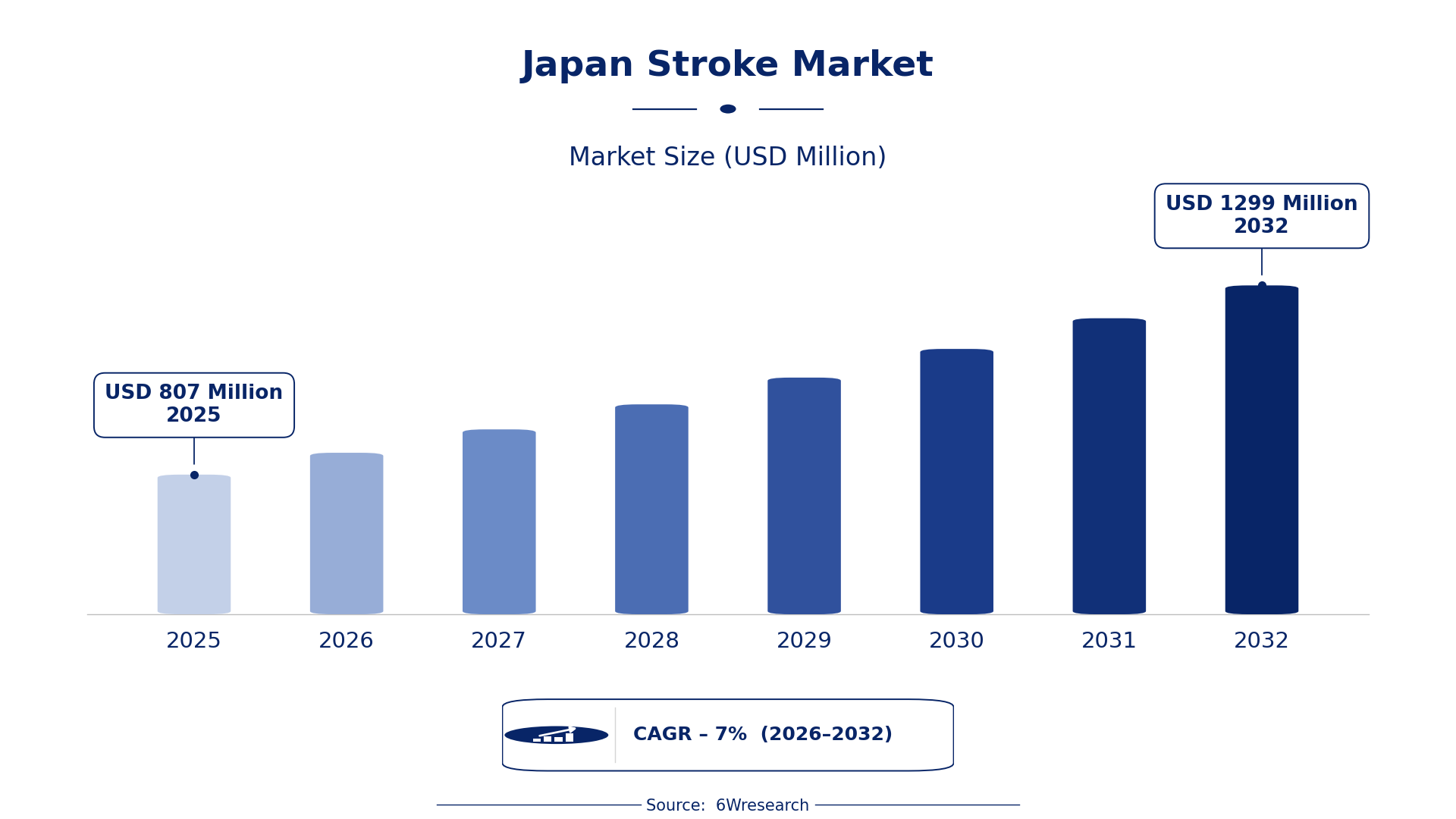
According to 6Wresearch internal database and industry insights, the Japan Stroke Market was valued at USD 807 Million in 2025 and is projected to reach USD 1,299 Million by 2032, growing at a CAGR of approximately 7% during 2026–2032.
Japan Stroke Market Highlights
| Report Metric | Details |
| Report Name | Japan Stroke Market (2026-2032) |
| Market Size 2025 | USD 807 Million |
| Market Size 2032 | USD 1,299 Million |
| Absolute Growth 2025–2032 | USD 492 Million |
| CAGR 2026–2032 | 7% |
| Peak Annual Growth | 8.3% in 2026 |
| Forecast Period | 2026–2032 |
| Historical Data | 2022–2025 |
| Base Year | 2025 |
| Leading Type, 2025 | Ischemic Stroke (48% share) |
| Leading Treatment, 2025 | Medication (53% share) |
| Leading Diagnosis, 2025 | Imaging Test (41% share) |
| Leading Gender, 2025 | Female (61% share) |
| Leading End User, 2025 | Hospitals & Clinics (42% share) |
| Fastest-Growing Type | Hemorrhagic Stroke (9.3% CAGR) |
| Fastest-Growing Treatment | Surgery (8.5% CAGR) |
| Fastest-Growing Diagnosis | Blood Test (8.8% CAGR) |
| Fastest-Growing Gender | Male (8.4% CAGR) |
| Fastest-Growing End User | Specialty Clinics (9.2% CAGR) |
| Growing Sector | Healthcare services for stroke management |
| Key End Users | Hospitals, Specialty Clinics, Rehabilitation Centres |
Japan Stroke Market Year-wise Growth Rate and Key Drivers (2022–2032)
This graph illustrates the annual growth rates of the market from 2022 to 2032, highlighting a steady upward trajectory and projected market expansion over the forecast period.
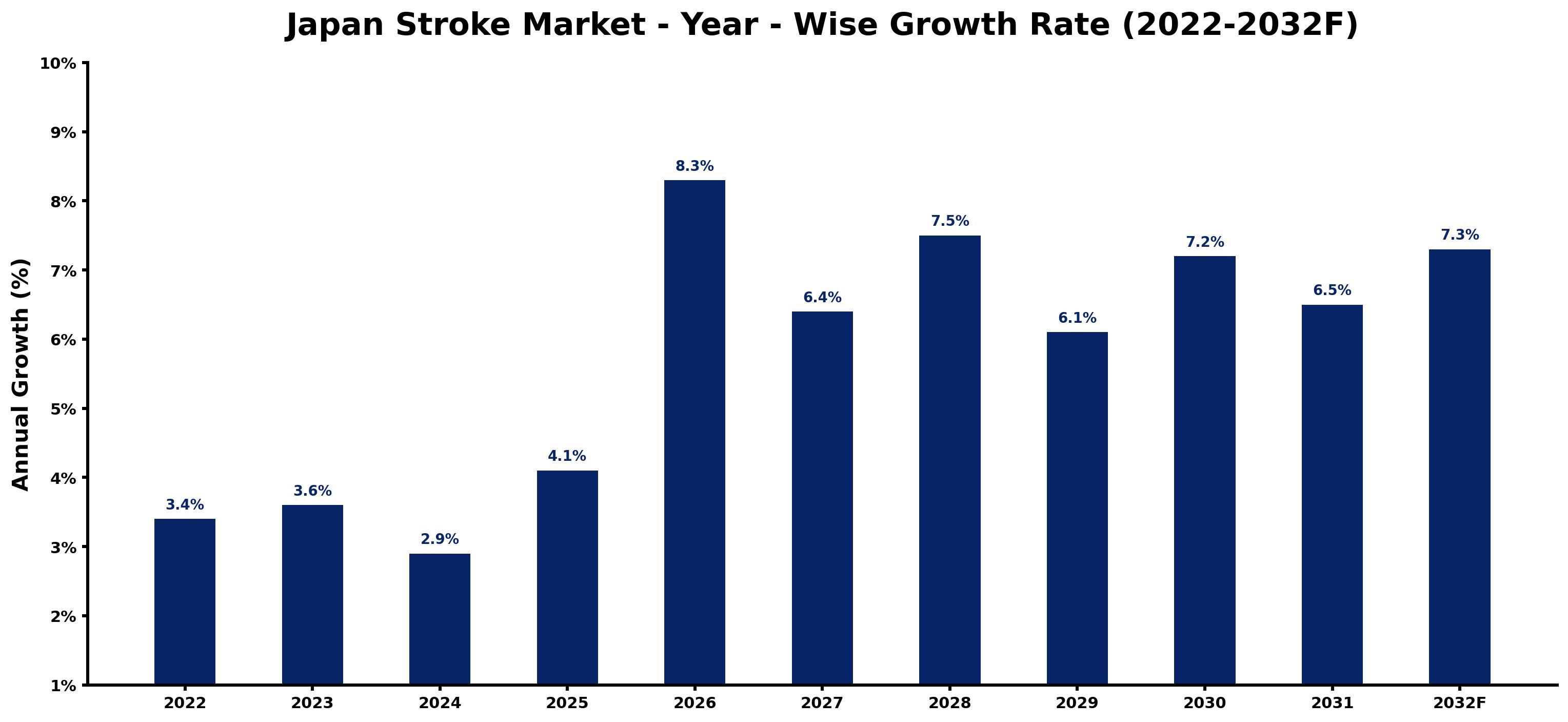
Year by year, the estimates below pair each growth rate with the development that shaped it.
| Year | Estimated Annual Growth (%) | Market Rationale |
| 2022 | 3.4 | The market experienced steady demand as hospitals managed existing stroke cases effectively. |
| 2023 | 3.6 | Growth accelerated due to increased awareness and improved treatment methodologies. |
| 2024 | 2.9 | The market saw a slowdown as new case rates stabilised amid ongoing treatment efforts. |
| 2025 | 4.1 | Demand rose as hospitals expanded their stroke care capabilities and treatment options. |
| 2026 | 8.3 | Surge in growth occurred due to the launch of new stroke management programmes. |
| 2027 | 6.4 | Growth slowed as the market adjusted to the rapid expansion of prior years. |
| 2028 | 7.5 | Demand increased again as specialty clinics focused on rehabilitation gained traction. |
| 2029 | 6.1 | The market experienced a slowdown as treatment standardisation took hold. |
| 2030 | 7.2 | Growth rebounded as advancements in imaging technology improved diagnosis speed. |
| 2031 | 6.5 | A slowdown occurred as the market stabilised after previous years of rapid growth. |
| 2032 | 7.3 | Demand is expected to rise with ongoing government initiatives targeting prevention. |
Note: Market size estimations and growth projections presented in this report are based on 6Wresearch's proprietary forecasting methodology, utilizing the latest available industry data, government publications, and primary research inputs.
Japan Stroke Market Synopsis
Stroke is a medical condition caused by interrupted blood flow to the brain, leading to cell death. The Japan Stroke Market is expanding due to the rising number of stroke patients, with over 1.2 million cases reported each year. The launch of a stroke prevention programme in 2023 targeting 1 million citizens further drives demand, alongside the increasing elderly population, which is particularly susceptible to stroke. The Tokyo region records the highest incidence of stroke cases, underscoring the urgent need for effective treatment and rehabilitation solutions.
Market Dynamics Impact Analysis (2026–2032)
| Factor | Type | Impact | Primary Segment Affected |
| Increasing incidence of stroke cases | Driver | High | Ischemic Stroke |
| Advancements in treatment technologies | Driver | High | Medication |
| Growing elderly population in Japan | Opportunity | High | Hospitals & Clinics |
| Rising awareness about stroke prevention | Opportunity | Medium | Specialty Clinics |
| Limited access to rehabilitation services | Restraint | High | Others Therapy |
| High costs associated with advanced imaging technologies | Restraint | Medium | Imaging Test |
| Shortage of trained healthcare professionals | Challenge | High | Surgery |
| Increased competition among healthcare providers | Challenge | Medium | Medication |
Evaluation of Drivers in Japan Stroke Market (2026–2032)
Demand rests on the following drivers, each shown with the segment it touches most.
| Drivers | Primary Segment Affected | Why It Matters (Evidence) |
| Rising number of stroke patients | Ischemic Stroke | Over 1.2 million stroke patients annually drive demand for immediate treatment options. |
| Improved medication efficacy | Medication | New medications improve treatment outcomes, encouraging hospitals to increase procurement. |
| Technological advancements in imaging | Imaging Test | Approximately 3,000 MRI machines in Japan improve diagnosis and treatment planning efficiency. |
| Government health initiatives | Specialty Clinics | The 2023 stroke prevention programme targets 1 million citizens, boosting clinic visits. |
| Focus on rehabilitation services | Others Therapy | Increased awareness of recovery needs prompts hospitals to invest in therapy options. |
What keeps demand rising is the increasing number of stroke patients, with over 1.2 million cases annually, prompting healthcare providers to improve treatment capabilities. Enhanced medication efficacy drives hospitals to procure new therapies, ensuring better patient outcomes. The installed base of around 3,000 MRI machines in Japan facilitates quicker diagnoses, prompting more imaging tests. The growing focus on rehabilitation services encourages hospitals to invest in therapy options, further elevating demand for comprehensive stroke care.
Evaluation of Restraints in Japan Stroke Market
Several factors work against faster growth; the main ones are summarised below.
| Market Restraint | Primary Segment Affected | Why It Matters (Evidence) |
| Limited access to rehabilitation services | Others Therapy | Many patients face challenges in accessing rehabilitation, which hinders their recovery efforts. |
| High costs of advanced imaging technologies | Imaging Test | The expense of MRI machines restricts their availability in smaller healthcare facilities. |
| Shortage of trained healthcare professionals | Surgery | The lack of specialists delays timely surgical interventions for severe cases. |
| Regulatory hurdles for new treatments | Medication | Stringent approval processes slow the introduction of new therapies. |
| Patient reluctance to seek immediate care | Ischemic Stroke | Some patients delay treatment, resulting in worse outcomes and increased healthcare costs. |
Japan Stroke Market Challenges
Inadequate imaging technology in some hospitals delays diagnosis by up to 48 hours, which can worsen patient outcomes and strain healthcare providers. Suppliers of medical imaging equipment struggle to meet demand, particularly in the Tokyo region, where 200,000 new cases arise annually. This supply gap can inflate costs for hospitals, forcing them to either invest in temporary solutions or pay higher prices for expedited deliveries. Increased competition among healthcare providers intensifies as they strive to improve management of stroke cases, leading some to reallocate resources from other critical services.
Trends in the Japan Stroke Market
The shifts below are changing how Japan Stroke Market products are bought and supplied.
- Launch of the Stroke Prevention Programme: In 2023, the Japanese government initiated a stroke prevention programme aimed at 1 million citizens, intending to reduce incidence rates. This initiative prompts healthcare providers to improve outreach and education efforts, increasing demand for preventive services.
- Shift towards Advanced Imaging Techniques: The healthcare sector is increasingly adopting advanced imaging techniques, which improve diagnosis accuracy. The installed base of about 3,000 MRI machines supports this trend, enabling hospitals to provide timely treatment for stroke patients.
- Focus on Rehabilitation Services: There is a growing emphasis on rehabilitation services for stroke patients, particularly in specialty clinics. This shift is driven by the recognition of the importance of recovery, leading to increased investments in therapy options.
- Increased Awareness of Stroke Risks: Public awareness campaigns about stroke risks have intensified in recent years, particularly in urban areas like Tokyo. This heightened awareness is reflected in the rising number of individuals seeking preventive care and treatment.
Investment Opportunities in the Japan Stroke Market
Where to invest in the Japan Stroke Market: the main openings are set out below.
- Hospitals seeking advanced rehabilitation solutions: With the increasing number of stroke patients, hospitals require advanced rehabilitation solutions to improve recovery rates. The 2023 stroke prevention programme highlights this need, creating opportunities for suppliers of rehabilitation technologies.
- Growing demand for new medications: As the market expands, there is an urgent need for new medications to treat stroke. The increasing number of stroke patients presents an opportunity for pharmaceutical companies to invest in research and development.
- Specialty clinics focusing on stroke care: Specialty clinics are emerging as key players in stroke care, particularly in rehabilitation. The rising elderly population creates a demand for tailored services, encouraging investments in clinic infrastructure.
- Investment in imaging technology: The demand for accurate diagnosis drives investment in advanced imaging technology. With a significant number of MRI machines in Japan, suppliers can enter the market by partnering with hospitals to upgrade their imaging capabilities.
Government Initiatives in the Japan Stroke Market
The GX Promotion Act, enacted in 2023, establishes a legal framework for stroke prevention initiatives. This act builds on the PMD Act of 2014, which regulates the approval and quality of medical devices, ensuring that new treatments meet stringent standards before reaching patients.
In 2023, the Japanese government allocated ¥10 billion for stroke research, administered by the Ministry of Health, Labour and Welfare. This funding supports projects aimed at improving stroke treatment and prevention, benefiting healthcare providers and patients alike.
Future Insight of the Japan Stroke Market
The government’s stroke prevention program will initiate a policy-driven shift by 2032, prompting hospitals to implement new rehabilitation standards like JIS Z 8122. Consequently, suppliers will need to innovate and deliver advanced treatment solutions to align with updated guidelines. An anticipated rise in stroke research funding to ¥20 billion will facilitate breakthroughs in treatment methodologies, positively impacting patient care. The integration of technology in management practices will improve rehabilitation therapies, ultimately enhancing patient outcomes.
Market Segmentation Analysis
Japan Stroke Market report covers a detailed analysis of the following market segments:
By Type – Ischemic Stroke Leads, Hemorrhagic Stroke Expected to Grow Fastest
According to Summon Dutta, Assistant Manager at 6Wresearch, Ischemic Stroke held 48% of the Japan Stroke Market by type in 2025. Ischemic stroke is the most common type of stroke in Japan, primarily due to lifestyle habits and the increasing elderly population. The Tokyo region, with its high stroke occurrence, exemplifies the urgent need for effective management strategies. The quickest growth will come from Hemorrhagic Stroke, forecast to expand at a CAGR of 9.3% between 2026 and 2032. The growth of the hemorrhagic stroke segment is propelled by rising public awareness and advancements in surgical methods. Recent government initiatives have highlighted the critical need for immediate medical responses, further accelerating this segment's growth. Suppliers should focus on developing targeted treatment solutions for ischemic stroke while also addressing the growing need for hemorrhagic stroke interventions.
By Treatment – Medication Leads, Surgery Expected to Grow Fastest
Medication accounted for 53% of the market by treatment in 2025. Medication plays a vital role in both the treatment and prevention of stroke, making it the most widely used approach in Japan's healthcare system. With over 1.2 million stroke patients annually, the reliance on medication is evident across hospitals and clinics. Surgery is projected to grow fastest, at a CAGR of 8.5% during 2026–2032. Surgery is increasingly recognised as essential for severe stroke cases, with advancements in techniques leading to better patient outcomes. The rising number of patients requiring surgical intervention is driving rapid growth in this segment. Healthcare providers must enhance surgical capabilities to meet the increasing demand for surgical treatments in stroke management.
By Diagnosis – Imaging Test Leads, Blood Test Expected to Grow Fastest
In 2025, Imaging Test led the diagnosis split with a 41% share. Imaging tests are critical for accurate diagnosis and treatment planning, establishing them as the primary diagnostic method in Japanese healthcare. The extensive installed base of MRI machines supports the high demand for these imaging procedures. Over 2026–2032, Blood Test is expected to post the fastest growth, at a CAGR of 8.8%. Blood tests are gaining prominence as a supplementary diagnostic tool, offering quick insights that aid in the overall diagnostic process. The growing emphasis on comprehensive diagnostic strategies is driving this segment's expansion. Diagnostic service providers should expand their offerings to include blood tests alongside imaging to align with evolving diagnostic needs.
By Gender – Female Leads, Male Expected to Grow Fastest
The largest gender category in 2025 was Female, at 61% of revenue. Females represent a larger demographic affected by stroke, particularly in the elderly population, which is growing in Japan. This demographic trend highlights the need for targeted interventions and care strategies for female stroke patients. Male is set to record the highest CAGR in this split, 8.4% over 2026–2032. The male demographic is increasingly being recognised for its vulnerability to stroke, prompting healthcare initiatives aimed at prevention and awareness. This shift in focus is contributing to the faster growth of male stroke cases. Healthcare strategies should consider gender-specific approaches to effectively address the needs of both male and female stroke patients.
By End User – Hospitals & Clinics Lead, Specialty Clinics Expected to Grow Fastest
Hospitals & Clinics took 42% of end user revenue in 2025, more than any other category. Hospitals and clinics serve as the primary care providers for stroke patients, underscoring their essential role in the healthcare landscape. The high volume of stroke cases necessitates robust infrastructure within these facilities to ensure effective patient management. The quickest growth will come from Specialty Clinics, forecast to expand at a CAGR of 9.2% between 2026 and 2032. Specialty clinics are becoming crucial centres for stroke rehabilitation, providing focused care that meets the specific needs of stroke survivors. The increasing emphasis on rehabilitation services is propelling the rapid growth of this segment. Suppliers should explore partnerships with specialty clinics to enhance rehabilitation services and improve patient outcomes.
Key Attractiveness of the Report
- 10 Years of Market Numbers
- Historical Data Starting from 2022 to 2025
- Base Year 2025
- Forecast Data until 2032
- Key Performance Indicators Impacting the Market
- Major Upcoming Developments and Projects
Key Highlights of the Report:
- Japan Stroke Market Outlook
- Market Size of Japan Stroke Market, 2025
- Forecast of Japan Stroke Market, 2032
- Historical Data and Forecast of Japan Stroke Revenues & Volume for the Period 2022-2032
- Japan Stroke Market Trend Evolution
- Japan Stroke Market Drivers and Challenges
- Japan Stroke Price Trends
- Japan Stroke Porter's Five Forces
- Japan Stroke Industry Life Cycle
- Historical Data and Forecast of Japan Stroke Market Revenues & Volume By Type for the Period 2022-2032
- Historical Data and Forecast of Japan Stroke Market Revenues & Volume By Ischemic Stroke for the Period 2022-2032
- Historical Data and Forecast of Japan Stroke Market Revenues & Volume By Hemorrhagic Stroke for the Period 2022-2032
- Historical Data and Forecast of Japan Stroke Market Revenues & Volume By Transient Ischemic Attack (TIA) for the Period 2022-2032
- Historical Data and Forecast of Japan Stroke Market Revenues & Volume By Treatment for the Period 2022-2032
- Historical Data and Forecast of Japan Stroke Market Revenues & Volume By Medication for the Period 2022-2032
- Historical Data and Forecast of Japan Stroke Market Revenues & Volume By Surgery for the Period 2022-2032
- Historical Data and Forecast of Japan Stroke Market Revenues & Volume By Others Therapy for the Period 2022-2032
- Historical Data and Forecast of Japan Stroke Market Revenues & Volume By Diagnosis for the Period 2022-2032
- Historical Data and Forecast of Japan Stroke Market Revenues & Volume By Imaging Test for the Period 2022-2032
- Historical Data and Forecast of Japan Stroke Market Revenues & Volume By Blood Test for the Period 2022-2032
- Historical Data and Forecast of Japan Stroke Market Revenues & Volume By Echocardiogram for the Period 2022-2032
- Historical Data and Forecast of Japan Stroke Market Revenues & Volume By Lumbar Puncture for the Period 2022-2032
- Historical Data and Forecast of Japan Stroke Market Revenues & Volume By Others for the Period 2022-2032
- Historical Data and Forecast of Japan Stroke Market Revenues & Volume By Gender for the Period 2022-2032
- Historical Data and Forecast of Japan Stroke Market Revenues & Volume By Female for the Period 2022-2032
- Historical Data and Forecast of Japan Stroke Market Revenues & Volume By Male for the Period 2022-2032
- Historical Data and Forecast of Japan Stroke Market Revenues & Volume By End User for the Period 2022-2032
- Historical Data and Forecast of Japan Stroke Market Revenues & Volume By Hospitals & Clinics for the Period 2022-2032
- Historical Data and Forecast of Japan Stroke Market Revenues & Volume By Specialty Clinics for the Period 2022-2032
- Historical Data and Forecast of Japan Stroke Market Revenues & Volume By Ambulatory Surgical Center for the Period 2022-2032
- Historical Data and Forecast of Japan Stroke Market Revenues & Volume By Homecare for the Period 2022-2032
- Historical Data and Forecast of Japan Stroke Market Revenues & Volume By Laboratories for the Period 2022-2032
- Historical Data and Forecast of Japan Stroke Market Revenues & Volume By Others for the Period 2022-2032
- Historical Data and Forecast of Japan Stroke Market Revenues & Volume By Distribution Channel for the Period 2022-2032
- Historical Data and Forecast of Japan Stroke Market Revenues & Volume By Direct for the Period 2022-2032
- Historical Data and Forecast of Japan Stroke Market Revenues & Volume By Retail for the Period 2022-2032
- Historical Data and Forecast of Japan Stroke Market Revenues & Volume By Online for the Period 2022-2032
- Japan Stroke Import Export Trade Statistics
- Market Opportunity Assessment By Type
- Market Opportunity Assessment By Treatment
- Market Opportunity Assessment By Diagnosis
- Market Opportunity Assessment By Gender
- Market Opportunity Assessment By End User
- Market Opportunity Assessment By Distribution Channel
- Japan Stroke Top Companies Market Share
- Japan Stroke Competitive Benchmarking By Technical and Operational Parameters
- Japan Stroke Company Profiles
- Japan Stroke Key Strategic Recommendations
Market Covered
The study includes the following segmentation.
By Type
- Ischemic Stroke
- Hemorrhagic Stroke
- Transient Ischemic Attack (TIA)
By Treatment
- Medication
- Surgery
- Others Therapy
By Diagnosis
- Imaging Test
- Blood Test
- Echocardiogram
- Lumbar Puncture
- Others
By Gender
- Female
- Male
By End User
- Hospitals & Clinics
- Specialty Clinics
- Ambulatory Surgical Center
- Homecare
- Laboratories
- Others































