Japan Stroke Treatment Devices Market Size & Growth Rate
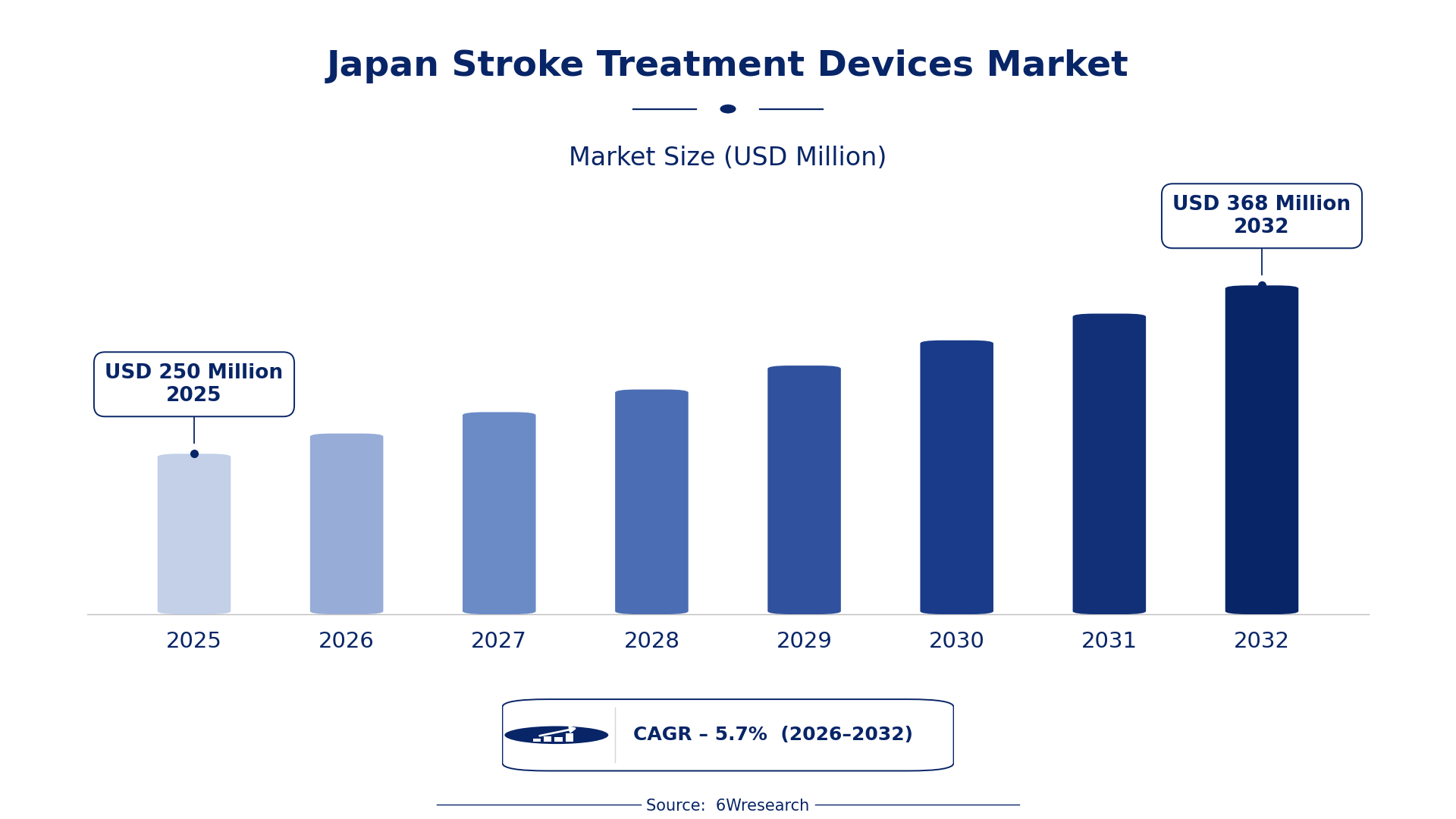
According to 6Wresearch internal database and industry insights, the Japan Stroke Treatment Devices Market was valued at USD 250 Million in 2025 and is projected to reach USD 368 Million by 2032, growing at a CAGR of approximately 5.7% during 2026–2032.
Japan Stroke Treatment Devices Market Highlights
| Report Metric | Details |
| Report Name | Japan Stroke Treatment Devices Market (2026-2032) |
| Market Size 2025 | USD 250 Million |
| Market Size 2032 | USD 368 Million |
| Absolute Growth 2025–2032 | USD 118 Million |
| CAGR 2026–2032 | 5.7% |
| Peak Annual Growth | 6.2% in 2031 |
| Forecast Period | 2026–2032 |
| Historical Data | 2022–2025 |
| Base Year | 2025 |
| Leading Device Type, 2025 | Stent Retrievers (47% share) |
| Leading Technology Type, 2025 | Mechanical (43% share) |
| Leading Application Stage, 2025 | Acute Stroke Intervention (51% share) |
| Leading End User, 2025 | Neurovascular Surgeons (50% share) |
| Fastest-Growing Device Type | Aspiration Catheters (8.0% CAGR) |
| Fastest-Growing Technology Type | Suction (8.4% CAGR) |
| Fastest-Growing Application Stage | Rehabilitation (7.6% CAGR) |
| Fastest-Growing End User | Rehab Clinics (7.3% CAGR) |
| Growing Sector | Rehabilitation |
| Key End Users | Acute Stroke Intervention, Clot Removal, Ischemic Stroke, Rehabilitation |
Japan Stroke Treatment Devices Market Year-wise Growth Rate and Key Drivers (2022–2032)
This graph illustrates the annual growth rates of the market from 2022 to 2032, highlighting a steady upward trajectory and projected market expansion over the forecast period.
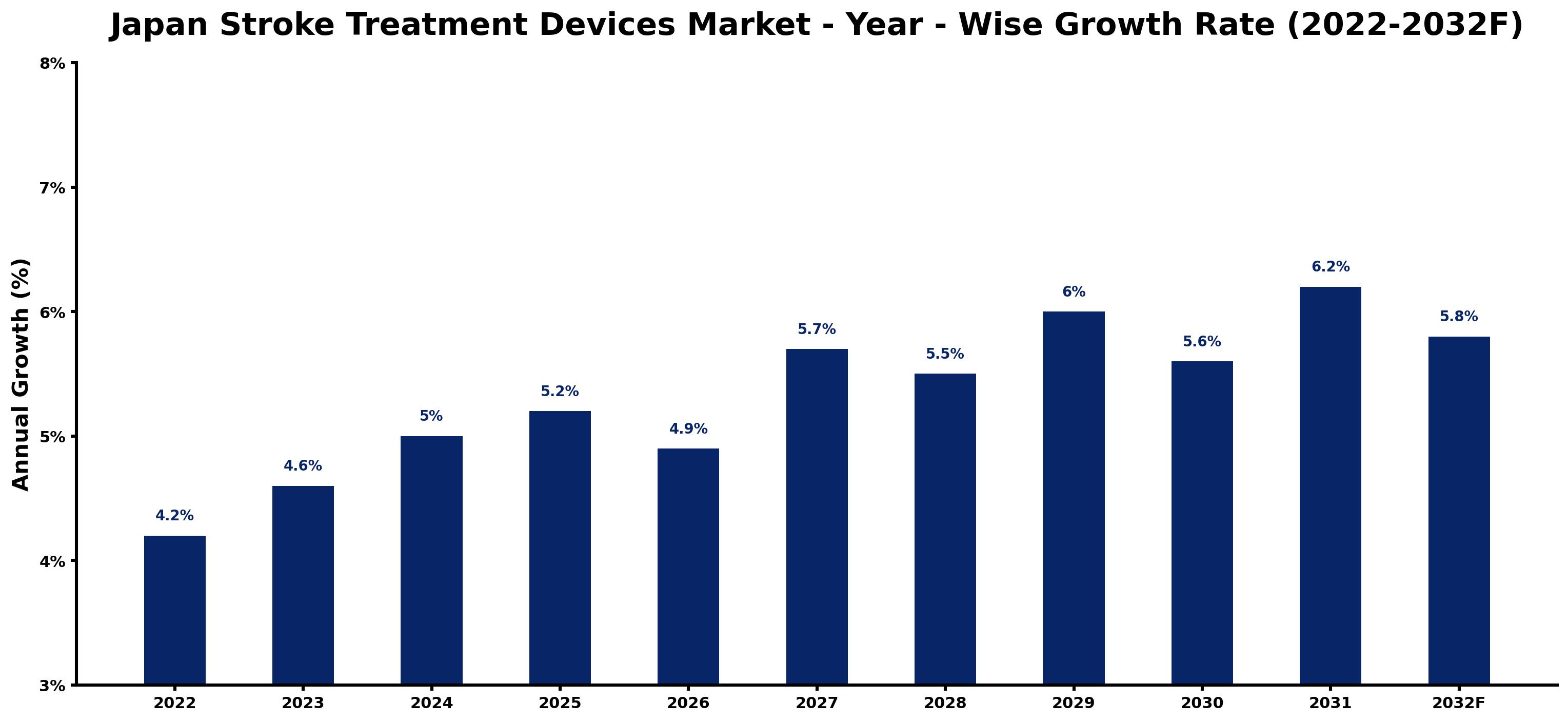
Each row of the following table gives one year's estimated growth and the event or demand shift that explains it.
| Year | Estimated Annual Growth (%) | Market Rationale |
| 2022 | 4.2 | The market showed steady growth as healthcare providers increased investments in stroke treatment technologies. |
| 2023 | 4.6 | Demand rose due to heightened awareness of stroke symptoms and improved treatment protocols. |
| 2024 | 5.0 | Healthcare facilities expanded their capabilities, leading to more procedures and device purchases. |
| 2025 | 5.2 | The introduction of advanced devices drove growth as hospitals upgraded their equipment. |
| 2026 | 4.9 | Growth slowed as market saturation began, but demand for new solutions is expected to remain strong. |
| 2027 | 5.7 | Increased aging population and stroke cases will boost demand for treatment devices. |
| 2028 | 5.5 | Growth is projected to slow slightly as competition intensifies among device manufacturers. |
| 2029 | 6.0 | Technological advancements will lead to a surge in demand for newer devices in hospitals. |
| 2030 | 5.6 | Demand is expected to remain strong as healthcare providers continue to invest in stroke care improvements. |
| 2031 | 6.2 | The market is projected to peak as hospitals adopt the latest technologies for stroke interventions. |
| 2032 | 5.8 | Demand growth is expected to slow as the market stabilises, but the aging population will continue to drive needs. |
Note: Market size estimations and growth projections presented in this report are based on 6Wresearch's proprietary forecasting methodology, utilizing the latest available industry data, government publications, and primary research inputs.
Japan Stroke Treatment Devices Market Synopsis
Stroke treatment devices are critical medical instruments designed to restore blood flow to the brain during acute interventions. The Japan Stroke Treatment Devices Market is growing due to an aging population, with 29.3% of residents aged 65 or older, and an increasing incidence of strokes, which rank as the third leading cause of death.
Market Dynamics Impact Analysis (2026–2032)
| Factor | Type | Impact | Primary Segment Affected |
| Aging population increasing stroke incidence | Driver | High | Ischemic Stroke |
| Government initiatives promoting advanced technologies | Driver | High | Acute Stroke Intervention |
| Growing need for advanced stroke care facilities | Opportunity | High | Stroke Care Units |
| Investment in research for innovative stroke therapies | Opportunity | Medium | Neurostimulators |
| Regulatory hurdles for new device approvals | Restraint | High | Stent Retrievers |
| High costs associated with advanced technologies | Restraint | Medium | Aspiration Catheters |
| Limited access to cutting-edge treatment options | Challenge | High | Neurovascular Surgeons |
| Increasing competition among device manufacturers | Challenge | Medium | Interventional Radiologists |
Evaluation of Drivers in Japan Stroke Treatment Devices Market (2026–2032)
The main growth drivers and the segments they affect most are set out below.
| Drivers | Primary Segment Affected | Why It Matters (Evidence) |
| Aging population increasing stroke incidence | Ischemic Stroke | With over 29.3% of Japan's population aged 65 or older, the demand for stroke treatment devices is rising. |
| Government promotion of advanced stroke technologies | Acute Stroke Intervention | The health ministry's initiatives encourage hospitals to invest in modern stroke treatment devices, leading to increased purchases. |
| Increased number of stroke care units | Stroke Care Units | Over 1,000 stroke care units in Japan improve patient access to treatment, boosting device demand. |
| Rising incidence of ischemic strokes | Stent Retrievers | With over 100,000 annual ischemic stroke cases, the need for effective treatment devices is critical. |
| Technological advancements in device design | Aspiration Catheters | Advancements in catheter technology are improving outcomes, prompting increased purchases by hospitals. |
Spending rises because the aging population in Japan drives demand for stroke treatment devices. The annual incidence of ischemic strokes exceeds 100,000 cases, prompting hospitals to invest in advanced technologies. Innovations in device design improve treatment efficacy, prompting increased purchases by healthcare providers. As hospitals upgrade their equipment, the market for acute stroke intervention devices expands.
Evaluation of Restraints in Japan Stroke Treatment Devices Market
These restraints slow adoption and weigh on supplier margins.
| Market Restraint | Primary Segment Affected | Why It Matters (Evidence) |
| Regulatory hurdles delaying device approvals | Stent Retrievers | The rigorous approval processes by the Pharmaceuticals and Medical Devices Agency can extend time to market for new devices. |
| High costs of advanced stroke treatment devices | Aspiration Catheters | The investment required for advanced devices can limit procurement by smaller healthcare facilities. |
| Limited access to training for medical staff | Neurovascular Surgeons | Insufficient training on new technologies can hinder effective use of advanced stroke treatment devices. |
| Competition leading to price pressure | Interventional Radiologists | As more manufacturers enter the market, pricing strategies may affect profitability for device suppliers. |
| Variability in hospital budgets for stroke care | Stroke Care Units | Budget constraints in some hospitals can limit the adoption of necessary treatment technologies. |
Japan Stroke Treatment Devices Market Challenges
In 2023, Japan's rigorous approval processes by the Pharmaceuticals and Medical Devices Agency delayed the introduction of new stroke treatment technologies, limiting hospitals' ability to offer the latest interventions. Supply chain disruptions have caused inconsistent access to essential devices, which can prolong patient recovery times and burden healthcare providers. The aging population, with over 100,000 annual ischemic stroke cases, has intensified the demand for neurovascular surgeons, yet the current workforce is inadequate, resulting in longer wait times for critical procedures. Many hospitals face budget constraints, with national medical care expenditure reaching JPY 46.7 trillion, restricting their ability to invest in necessary equipment.
Trends in the Japan Stroke Treatment Devices Market
The following changes are redrawing the Japan Stroke Treatment Devices Market.
- Shift from Traditional to Advanced Stroke Treatment: Japan is increasingly adopting advanced stroke treatment technologies, with hospitals utilising stent retrievers and aspiration catheters more frequently. In 2023, over 80% of thrombectomy procedures employed these devices, indicating a growing preference for effective interventions.
- Transition from Rehabilitation to Acute Treatment Focus: The focus in stroke care is shifting from rehabilitation to acute treatment, as shown by the rising adoption of acute stroke intervention devices. In 2023, acute stroke interventions comprised 51% of device usage in hospitals.
- Increased Awareness Campaigns for Stroke Symptoms: In 2023, the government initiated a campaign to raise awareness about stroke symptoms and treatment options. This initiative aims to improve early detection and intervention, which may lead to increased demand for stroke treatment devices.
- Emergence of New Rehabilitation Technologies: New rehabilitation technologies are emerging in Japan, particularly neurostimulators, which are gaining popularity in rehab clinics. The Japanese Association of Rehabilitation Medicine supports these advancements, promoting their adoption in post-stroke care.
Investment Opportunities in the Japan Stroke Treatment Devices Market
Below are the investment opportunities with the strongest case in the Japan Stroke Treatment Devices Market.
- Investment Gap in Advanced Devices: With the market projected to grow significantly, there exists a gap in advanced stroke treatment devices. Hospitals, especially in urban areas, need to invest in modern equipment to improve patient care.
- Expansion of Stroke Care Units: The growing number of stroke care units offers an opportunity for suppliers to provide advanced devices. Facilities in Tokyo and Osaka particularly require modern technologies to enhance treatment outcomes.
- Growing Demand from Neurovascular Surgeons: Neurovascular surgeons are seeking advanced devices to improve their procedures. Suppliers can enter this market by collaborating with hospitals to develop tailored solutions.
- Rising Focus on Rehabilitation Technologies: The demand for rehabilitation technologies is increasing as more stroke patients require post-treatment care. Suppliers can target rehab clinics with advanced neurostimulators to address this need.
Government Initiatives in the Japan Stroke Treatment Devices Market
The regulatory framework for stroke treatment devices in Japan is shaped by laws such as the PMD Act, which governs the approval and quality of medical devices. Established in 2004, the Pharmaceuticals and Medical Devices Agency (PMDA) oversees the safety and efficacy of these devices, ensuring compliance with national standards. Initiatives from the Health and Labor Ministry promote the use of advanced stroke technologies, further supporting market growth.
In 2023, the government allocated JPY 5 billion to improve stroke treatment facilities across Japan. The Japan Agency for Medical Research and Development (AMED) is responsible for funding medical research and development, ensuring that innovative technologies are developed and implemented effectively. This funding assists hospitals in acquiring the latest stroke treatment devices, thereby enhancing patient care.
Future Insight of the Japan Stroke Treatment Devices Market
By 2032, hospitals will experience improved access to advanced stroke treatment technologies as government funding for healthcare infrastructure increases. The integration of new techniques will improve recovery outcomes for patients. Public awareness campaigns will effectively educate people on stroke symptoms, leading to quicker emergency responses. As the aging population continues to grow, the healthcare system will adapt to meet the rising demand for effective interventions, ensuring better patient care throughout Japan.
Market Segmentation Analysis
Japan Stroke Treatment Devices Market report covers a detailed analysis of the following market segments:
By Device Type – Stent Retrievers Lead, Aspiration Catheters Expected to Grow Fastest
According to Saurav Kr Singh, Senior Research Analyst at 6Wresearch, Stent Retrievers took 47% of device type revenue in 2025, more than any other category. Stent retrievers hold the largest market share as they are crucial in mechanical thrombectomy procedures that effectively remove clots from stroke patients. Their essential role is underscored by their use in over 1,000 stroke care units across Japan, ensuring they are a staple in acute stroke treatment. Aspiration Catheters are projected to grow fastest, at a CAGR of 8.0% during 2026–2032. Aspiration catheters are experiencing rapid growth due to their efficiency in suctioning out clots during acute interventions, which is critical for improving patient outcomes. The annual estimate of over 100,000 ischemic stroke cases in Japan significantly propels the demand for these devices. Suppliers must focus on the distribution and training for aspiration catheters to meet the rising demand for effective stroke treatment solutions.
By Technology Type – Mechanical Leads, Suction Expected to Grow Fastest
The largest technology type category in 2025 was Mechanical, at 43% of revenue. Mechanical devices dominate the market as they are widely used for physically removing clots, making them essential in acute stroke interventions. Their established presence in hospitals ensures a strong installed base among healthcare providers. Over 2026–2032, Suction is expected to post the fastest growth, at a CAGR of 8.4%. Suction technology is gaining traction because it is critical for the functionality of aspiration catheters, which are becoming more popular in emergency stroke treatments. The government's investment in improving stroke treatment facilities supports this trend. Buyers may benefit from exploring advanced suction technologies to improve patient outcomes in stroke interventions.
By Application Stage – Acute Stroke Intervention Leads, Rehabilitation Expected to Grow Fastest
With 51% of application stage revenue in 2025, Acute Stroke Intervention was the largest category. Acute stroke intervention holds the largest share as it is focused on the immediate treatment of stroke patients, a necessity given that stroke is a leading cause of death in Japan. The high incidence of stroke cases underscores the urgent need for effective treatment options in this application stage. The quickest growth will come from Rehabilitation, forecast to expand at a CAGR of 7.6% between 2026 and 2032. Rehabilitation is growing swiftly as healthcare providers are increasingly recognising the importance of recovery following strokes, supported by advocacy from organisations promoting advanced rehabilitation technologies. The ageing population in Japan is further intensifying the demand for these rehabilitation services. Suppliers should consider expanding their product lines to include rehabilitation solutions to effectively cater to the increasing focus on post-stroke recovery.
By End User – Neurovascular Surgeons Lead, Rehab Clinics Expected to Grow Fastest
Neurovascular Surgeons accounted for 50% of the market by end user in 2025. Neurovascular surgeons are the primary users of stroke treatment devices, establishing their leading position in the market. Their expertise in managing acute stroke cases ensures a consistent demand for these vital devices in surgical settings. Rehab Clinics are set to record the highest CAGR in this split, 7.3% over 2026–2032. Rehabilitation clinics are increasingly adopting stroke treatment devices for post-stroke care, reflecting a growing focus on recovery processes. This trend is supported by advocacy from medical associations for advanced rehabilitation technologies. Suppliers should target rehabilitation clinics to expand their market presence and cater to the increasing demand for effective post-stroke care solutions.
Key Attractiveness of the Report
- 10 Years of Market Numbers
- Historical Data Starting from 2022 to 2025
- Base Year 2025
- Forecast Data until 2032
- Key Performance Indicators Impacting the Market
- Major Upcoming Developments and Projects
Key Highlights of the Report:
- Japan Stroke Treatment Devices Market Outlook
- Market Size of Japan Stroke Treatment Devices Market, 2025
- Forecast of Japan Stroke Treatment Devices Market, 2032
- Historical Data and Forecast of Japan Stroke Treatment Devices Revenues & Volume for the Period 2022-2032F
- Japan Stroke Treatment Devices Market Trend Evolution
- Japan Stroke Treatment Devices Market Drivers and Challenges
- Japan Stroke Treatment Devices Price Trends
- Japan Stroke Treatment Devices Porter's Five Forces
- Japan Stroke Treatment Devices Industry Life Cycle
- Historical Data and Forecast of Japan Stroke Treatment Devices Market Revenues & Volume By Device Type for the Period 2022-2032F
- Historical Data and Forecast of Japan Stroke Treatment Devices Market Revenues & Volume By Stent Retrievers for the Period 2022-2032F
- Historical Data and Forecast of Japan Stroke Treatment Devices Market Revenues & Volume By Embolic Protection for the Period 2022-2032F
- Historical Data and Forecast of Japan Stroke Treatment Devices Market Revenues & Volume By Aspiration Catheters for the Period 2022-2032F
- Historical Data and Forecast of Japan Stroke Treatment Devices Market Revenues & Volume By Neurostimulators for the Period 2022-2032F
- Historical Data and Forecast of Japan Stroke Treatment Devices Market Revenues & Volume By Technology Type for the Period 2022-2032F
- Historical Data and Forecast of Japan Stroke Treatment Devices Market Revenues & Volume By Mechanical for the Period 2022-2032F
- Historical Data and Forecast of Japan Stroke Treatment Devices Market Revenues & Volume By Filter-Based for the Period 2022-2032F
- Historical Data and Forecast of Japan Stroke Treatment Devices Market Revenues & Volume By Suction for the Period 2022-2032F
- Historical Data and Forecast of Japan Stroke Treatment Devices Market Revenues & Volume By Electrical for the Period 2022-2032F
- Historical Data and Forecast of Japan Stroke Treatment Devices Market Revenues & Volume By Application Stage for the Period 2022-2032F
- Historical Data and Forecast of Japan Stroke Treatment Devices Market Revenues & Volume By Acute Stroke Intervention for the Period 2022-2032F
- Historical Data and Forecast of Japan Stroke Treatment Devices Market Revenues & Volume By Clot Removal for the Period 2022-2032F
- Historical Data and Forecast of Japan Stroke Treatment Devices Market Revenues & Volume By Ischemic Stroke for the Period 2022-2032F
- Historical Data and Forecast of Japan Stroke Treatment Devices Market Revenues & Volume By Rehabilitation for the Period 2022-2032F
- Historical Data and Forecast of Japan Stroke Treatment Devices Market Revenues & Volume By End User for the Period 2022-2032F
- Historical Data and Forecast of Japan Stroke Treatment Devices Market Revenues & Volume By Neurovascular Surgeons for the Period 2022-2032F
- Historical Data and Forecast of Japan Stroke Treatment Devices Market Revenues & Volume By Stroke Care Units for the Period 2022-2032F
- Historical Data and Forecast of Japan Stroke Treatment Devices Market Revenues & Volume By Interventional Radiologists for the Period 2022-2032F
- Historical Data and Forecast of Japan Stroke Treatment Devices Market Revenues & Volume By Rehab Clinics for the Period 2022-2032F
- Japan Stroke Treatment Devices Import Export Trade Statistics
- Market Opportunity Assessment By Device Type
- Market Opportunity Assessment By Technology Type
- Market Opportunity Assessment By Application Stage
- Market Opportunity Assessment By End User
- Japan Stroke Treatment Devices Top Companies Market Share
- Japan Stroke Treatment Devices Competitive Benchmarking By Technical and Operational Parameters
- Japan Stroke Treatment Devices Company Profiles
- Japan Stroke Treatment Devices Key Strategic Recommendations
Market Covered
The following segment groups are covered in the report.
By Device Type
- Stent Retrievers
- Embolic Protection
- Aspiration Catheters
- Neurostimulators
By Technology Type
- Mechanical
- Filter-Based
- Suction
- Electrical
By Application Stage
- Acute Stroke Intervention
- Clot Removal
- Ischemic Stroke
- Rehabilitation
By End User
- Neurovascular Surgeons
- Stroke Care Units
- Interventional Radiologists
- Rehab Clinics































