Japan Structural Adhesives for Vehicles Market Size & Growth Rate
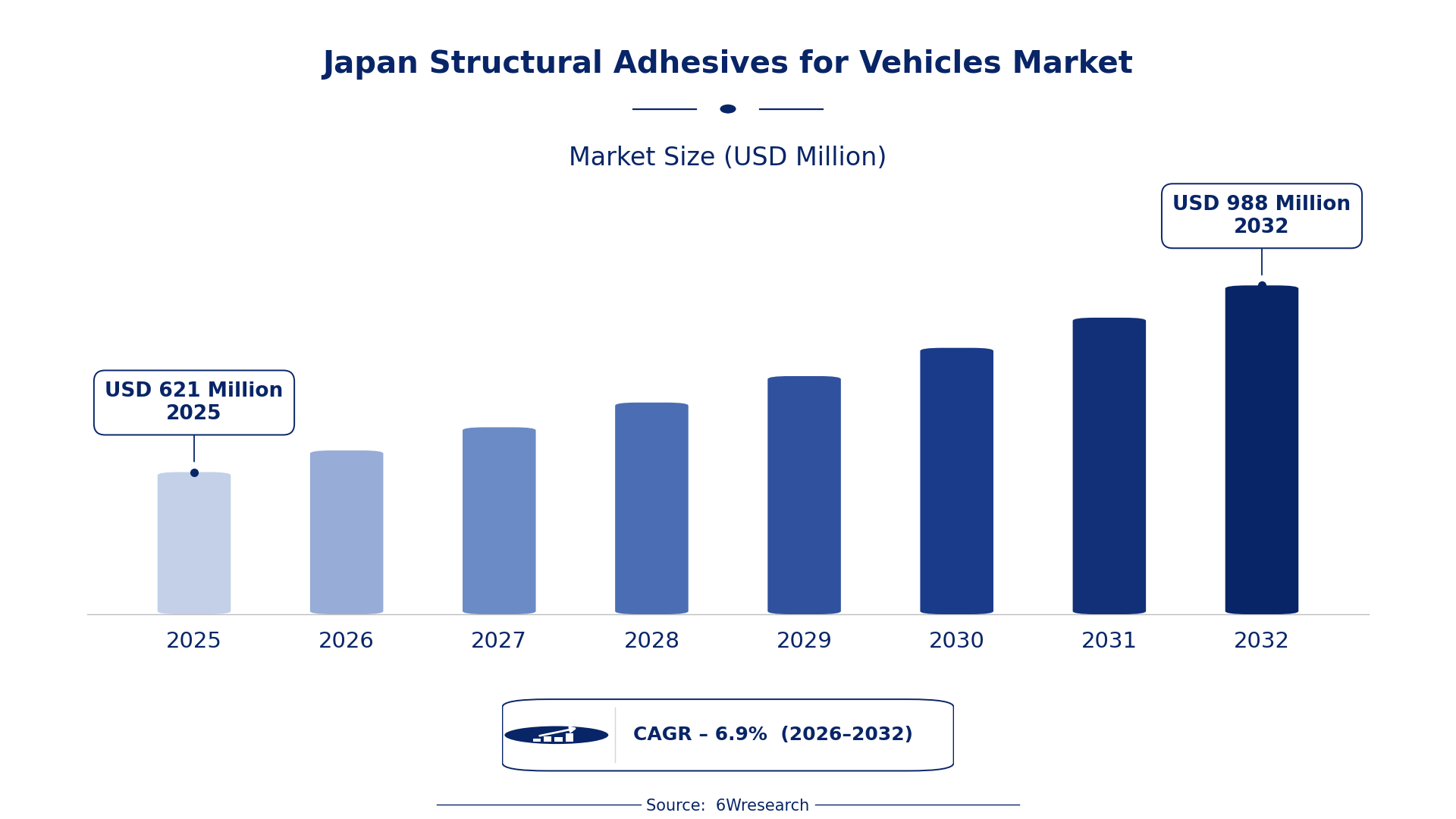
According to 6Wresearch internal database and industry insights, the Japan Structural Adhesives for Vehicles Market was valued at USD 621 Million in 2025 and is projected to reach USD 988 Million by 2032, growing at a CAGR of approximately 6.9% during 2026–2032.
Japan Structural Adhesives for Vehicles Market Highlights
| Report Metric | Details |
| Report Name | Japan Structural Adhesives for Vehicles Market (2026-2032) |
| Market Size 2025 | USD 621 Million |
| Market Size 2032 | USD 988 Million |
| Absolute Growth 2025–2032 | USD 367 Million |
| CAGR 2026–2032 | 6.9% |
| Peak Annual Growth | 7.3% in 2030 |
| Forecast Period | 2026–2032 |
| Historical Data | 2022–2025 |
| Base Year | 2025 |
| Leading Adhesive Type, 2025 | Epoxy Adhesives (51% share) |
| Leading Chemistry Base, 2025 | Two-Part Epoxy (43% share) |
| Leading Application Area, 2025 | Chassis Bonding (44% share) |
| Leading End User, 2025 | Vehicle OEMs (42% share) |
| Fastest-Growing Adhesive Type | Polyurethane Adhesives (9.6% CAGR) |
| Fastest-Growing Chemistry Base | One-Part Polyurethane (9.4% CAGR) |
| Fastest-Growing Application Area | Crash Structures (8.3% CAGR) |
| Fastest-Growing End User | Body Shops (9.2% CAGR) |
| Growing Sector | Crash Structures |
| Key End Users | Chassis Bonding, Crash Structures, Roof Panels, Doors & Interiors |
Japan Structural Adhesives for Vehicles Market Year-wise Growth Rate and Key Drivers (2022–2032)
This graph illustrates the annual growth rates of the market from 2022 to 2032, highlighting a steady upward trajectory and projected market expansion over the forecast period.
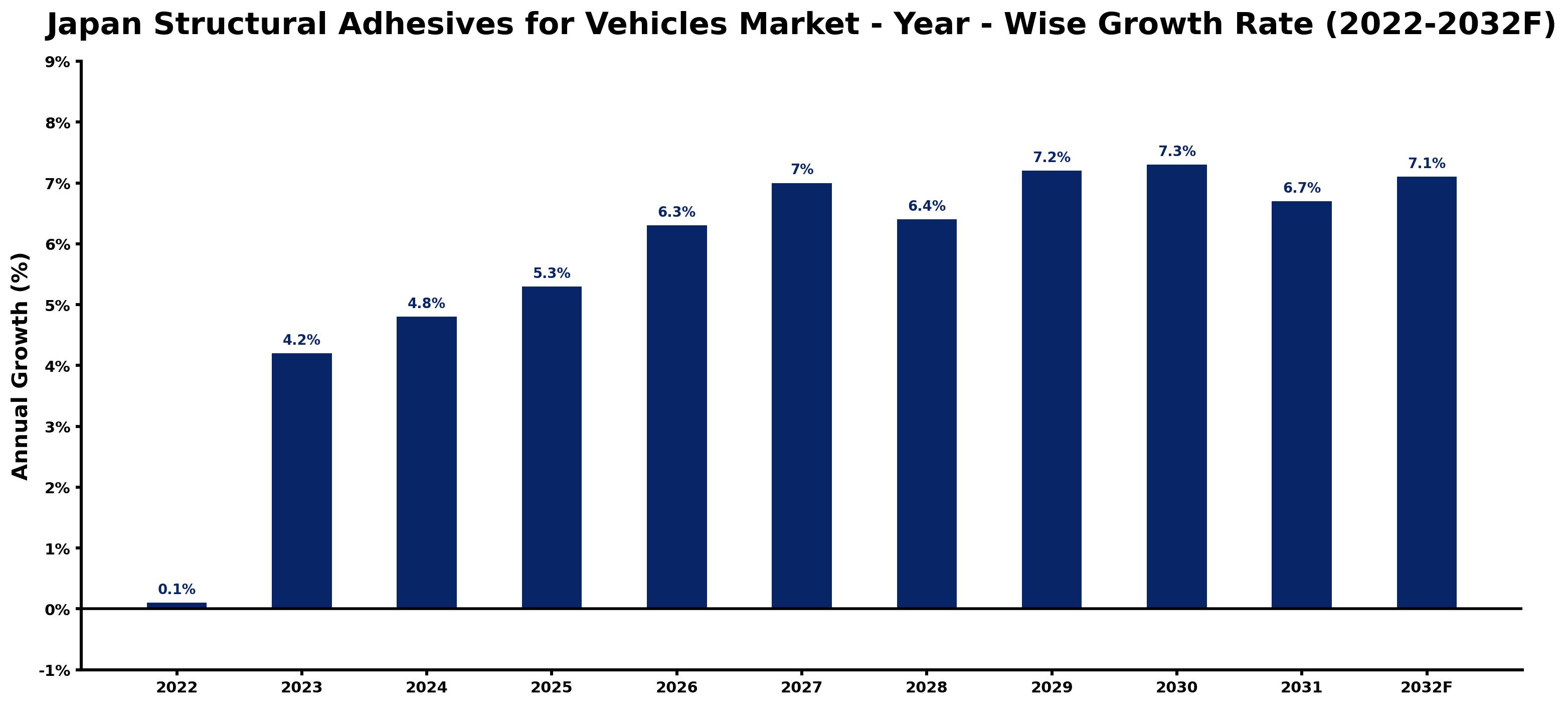
Year by year, the estimates below pair each growth rate with the development that shaped it.
| Year | Estimated Annual Growth (%) | Market Rationale |
| 2022 | 0.1 | The market showed minimal growth due to ongoing recovery from previous impacts. |
| 2023 | 4.2 | Increased automotive production contributed to a notable rise in demand for adhesives. |
| 2024 | 4.8 | Demand continued to grow as electric vehicle development gained traction. |
| 2025 | 5.3 | The introduction of new safety regulations spurred further demand for structural adhesives. |
| 2026 | 6.3 | Investment in lightweight vehicle technologies is expected to drive growth. |
| 2027 | 7.0 | The market benefits from rising production levels in the automotive sector. |
| 2028 | 6.4 | Growth slows slightly as the market adjusts to previous high rates of expansion. |
| 2029 | 7.2 | Continued focus on safety and performance boosts demand for adhesives. |
| 2030 | 7.3 | The market peaks as electric vehicle production accelerates. |
| 2031 | 6.7 | Growth moderates as the market stabilises after reaching peak levels. |
| 2032 | 7.1 | The demand remains strong due to ongoing innovations in vehicle design. |
Note: Market size estimations and growth projections presented in this report are based on 6Wresearch's proprietary forecasting methodology, utilizing the latest available industry data, government publications, and primary research inputs.
Japan Structural Adhesives for Vehicles Market Synopsis
Structural adhesives for vehicles are specialised bonding agents used in automotive manufacturing to join various components, ensuring structural integrity and reducing weight. The Japan Structural Adhesives for Vehicles Market is growing, driven by automotive production reaching 8.3 million units in 2022 and a projected 20% annual growth in the electric vehicle sector through 2025. Key factors include stringent safety regulations and government initiatives promoting lightweight technologies, both of which are increasing the demand for high-performance bonding solutions across various applications.
Market Dynamics Impact Analysis (2026–2032)
| Factor | Type | Impact | Primary Segment Affected |
| Rising automotive production levels | Driver | High | Epoxy Adhesives |
| Increased focus on electric vehicles | Driver | High | Polyurethane Adhesives |
| Growing demand for lightweight materials | Opportunity | High | Two-Part Epoxy |
| Expansion of body shops for repairs | Opportunity | Medium | Body Shops |
| High competition among adhesive manufacturers | Restraint | High | Acrylic Adhesives |
| Fluctuating raw material prices | Restraint | Medium | Rubber-Based Adhesives |
| Regulatory compliance costs for manufacturers | Challenge | High | Crash Structures |
| Technological advancements requiring new adhesive formulations | Challenge | Medium | Chassis Bonding |
Evaluation of Drivers in Japan Structural Adhesives for Vehicles Market (2026–2032)
The table below links each growth driver to the segment it affects and the evidence for it.
| Drivers | Primary Segment Affected | Why It Matters (Evidence) |
| Increased automotive production levels | Epoxy Adhesives | Japan's automotive production reached 8.3 million units in 2022, driving demand for high-strength adhesives. |
| Focus on electric vehicle development | Polyurethane Adhesives | The electric vehicle market is projected to grow 20% annually through 2025, increasing the need for flexible adhesives. |
| Safety regulations mandating stronger bonding solutions | Two-Part Epoxy | The demand for epoxy adhesives is rising due to stringent safety regulations in vehicle manufacturing. |
| Technological advancements in adhesive formulations | One-Part Polyurethane | Innovations in adhesive technology are improving application efficiency, leading to higher adoption rates. |
| Government initiatives promoting lightweight vehicle technologies | Crash Structures | The 2023 government program encourages the use of lightweight materials, boosting adhesive demand. |
Most of the extra volume comes from increased automotive production levels, which reached 8.3 million units in 2022, creating a greater need for high-strength bonding solutions. The electric vehicle sector is expanding rapidly, with projected annual growth of 20% through 2025, driving demand for flexible polyurethane adhesives. Advances in adhesive formulations are improving application efficiency, prompting higher adoption rates in manufacturing.
Evaluation of Restraints in Japan Structural Adhesives for Vehicles Market
The main factors holding the market back are set out below.
| Market Restraint | Primary Segment Affected | Why It Matters (Evidence) |
| High competition among adhesive manufacturers | Acrylic Adhesives | Intense competition pressures pricing and profit margins for manufacturers, affecting overall market stability. |
| Fluctuating raw material prices | Rubber-Based Adhesives | Volatility in raw material costs can lead to unpredictable pricing for end-users, impacting purchasing decisions. |
| Compliance costs for safety regulations | Crash Structures | Compliance with safety regulations incurs additional costs for manufacturers, which may deter investment. |
| Technological advancements requiring new adhesive formulations | Chassis Bonding | The need for constant innovation can strain resources and delay product development cycles. |
| Limited awareness of adhesive benefits among smaller manufacturers | Two-Part Epoxy | Smaller manufacturers may lack knowledge about the advantages of using advanced adhesives, hindering market penetration. |
Japan Structural Adhesives for Vehicles Market Challenges
Producers incur higher costs for structural adhesives, with some reporting price increases of up to 15% due to raw material shortages. Compliance with JIS K 6850 creates delays for manufacturers, extending production timelines by three weeks, which affects their ability to meet market demand. The rising need for epoxy adhesives, spurred by safety regulations, can elevate production costs for manufacturers by 20%, impacting their profit margins. Suppliers face intense competition from alternative bonding methods, compelling them to innovate rapidly or risk losing market share to more agile competitors.
Trends in the Japan Structural Adhesives for Vehicles Market
Several trends are reshaping the Japan Structural Adhesives for Vehicles Market; the most important are set out below.
- Launch of Green Growth Strategy: In December 2020, the Japanese government adopted the Green Growth Strategy, aiming for a 46% reduction in greenhouse gas emissions by 2030. This initiative is expected to boost demand for structural adhesives as manufacturers seek to comply with environmental standards.
- Shift towards Electric Vehicle Manufacturing: The automotive industry is increasingly focusing on electric vehicle production, which began gaining traction in 2023. This shift is driving the demand for high-performance adhesives that support lightweight designs and improved safety features.
- Increased Use of Epoxy Adhesives: The demand for epoxy adhesives in automotive applications is rising due to new safety regulations implemented in 2022. This trend is influencing manufacturers to adopt stronger bonding solutions for critical components.
- Expansion of Body Shops: The number of body shops specialising in automotive repairs and modifications is growing, with over 100 currently operating. This expansion is boosting the demand for various adhesives used in repair applications.
Investment Opportunities in the Japan Structural Adhesives for Vehicles Market
The following opportunities in the Japan Structural Adhesives for Vehicles Market pair current demand with a clear way in.
- Gap in Lightweight Adhesives: With the electric vehicle market projected to grow 20% annually through 2025, there is an opportunity to supply lightweight adhesives. Body shops are increasingly looking for solutions to meet this demand.
- Timing for Advanced Adhesives: The current focus on safety and environmental compliance creates a prime opportunity for suppliers of advanced adhesives. The Tokyo region, a hub for automotive manufacturing, is an ideal location for investment.
- Supply of High-Performance Adhesives: The demand for high-performance adhesives is rising due to safety regulations. Suppliers can target vehicle OEMs, who require reliable bonding solutions for critical applications.
- Investment in R&D for Adhesive Technologies: With the automotive sector contributing 20% of Japan's manufacturing output, there is a need for investment in R&D for adhesive technologies. Collaborating with research bodies can enhance product offerings.
Government Initiatives in the Japan Structural Adhesives for Vehicles Market
The Battery Industry Strategy, introduced by the Ministry of Economy, Trade and Industry in August 2022, aims to boost domestic battery manufacturing capacity to 150 GWh by 2030. This strategy supports the structural adhesives market by promoting lightweight vehicle technologies that require advanced bonding solutions.
The Ministry of Economy, Trade and Industry oversees the approval of funding for research and development in automotive adhesives. This includes initiatives aimed at improving adhesive performance and compliance with safety regulations, benefiting manufacturers and end-users alike.
Future Insight of the Japan Structural Adhesives for Vehicles Market
The introduction of advanced lightweight vehicle technology will drive demand for specialised structural adhesives, enhancing vehicle performance. By 2032, the electric vehicle sector will grow 20% annually, necessitating adhesives specifically designed for these applications. Innovations showcased at the Tokyo Motor Show will lead to new adhesive formulations that improve safety and durability. The government's commitment to reducing carbon emissions will push suppliers to focus on developing sustainable adhesive solutions that align with environmental goals.
Market Segmentation Analysis
Japan Structural Adhesives for Vehicles Market report covers a detailed analysis of the following market segments:
By Adhesive Type – Epoxy Adhesives Lead, Polyurethane Adhesives Expected to Grow Fastest
According to Saurav Kr Singh, Senior Research Analyst at 6Wresearch, in 2025, Epoxy Adhesives led the adhesive type split with a 51% share. Epoxy adhesives dominate the market due to their superior strength and durability, essential for critical joints in automotive manufacturing. Their widespread use in chassis bonding and crash structures underscores their importance in ensuring vehicle safety and performance. Polyurethane Adhesives are projected to grow fastest, at a CAGR of 9.6% during 2026–2032. The rapid growth of polyurethane adhesives is attributed to their flexibility and impact resistance, which are increasingly important for dynamic applications in modern vehicles. As the automotive industry shifts towards lightweight designs, the demand for these adhesives is expected to rise significantly. Suppliers should focus on developing advanced polyurethane formulations to meet the evolving needs of the automotive sector.
By Chemistry Base – Two-Part Epoxy Leads, One-Part Polyurethane Expected to Grow Fastest
The largest chemistry base category in 2025 was Two-Part Epoxy, at 43% of revenue. Two-part epoxy adhesives hold the largest market share because they provide excellent bonding capabilities, particularly for chassis and crash structures. Their reliability in critical applications makes them the preferred choice among manufacturers in Japan's automotive sector. One-Part Polyurethane is set to record the highest CAGR in this split, 9.4% over 2026–2032. One-part polyurethane adhesives are experiencing rapid growth due to their ease of application across various automotive components. This convenience aligns with the industry's emphasis on efficient manufacturing processes and lightweight vehicle technologies. Buyers should consider sourcing one-part polyurethane adhesives to enhance production efficiency and vehicle performance.
By Application Area – Chassis Bonding Leads, Crash Structures Expected to Grow Fastest
Chassis Bonding held 44% of the Japan Structural Adhesives for Vehicles Market by application area in 2025. Chassis bonding is the leading application area as it is crucial for maintaining vehicle structural integrity, a primary concern in automotive manufacturing. The high volume of vehicles produced in Japan necessitates robust bonding solutions for chassis components. The quickest growth will come from Crash Structures, forecast to expand at a CAGR of 8.3% between 2026 and 2032. The crash structures segment is growing quickly as safety regulations become stricter, requiring advanced bonding solutions to ensure compliance. This trend highlights the industry's commitment to enhancing vehicle safety and performance standards. Suppliers should invest in innovative solutions for crash structures to capitalise on the increasing regulatory demands in the automotive sector.
By End User – Vehicle OEMs Lead, Body Shops Expected to Grow Fastest
Vehicle OEMs took 42% of end user revenue in 2025, more than any other category. Vehicle OEMs represent the largest end user group, as they are the primary purchasers of structural adhesives for new vehicle production. The substantial automotive output in Japan ensures a steady demand for high-performance adhesives from this segment. Over 2026–2032, Body Shops are expected to post the fastest growth, at a CAGR of 9.2%. Body shops are the fastest-growing end user segment, driven by the increasing need for repair and modification services as vehicle lifespans extend. This growth indicates a rising trend in aftermarket services and repairs within the automotive industry. Suppliers must tailor their offerings to meet the unique needs of body shops to capture this expanding market segment.
Key Attractiveness of the Report
- 10 Years of Market Numbers
- Historical Data Starting from 2022 to 2025
- Base Year 2025
- Forecast Data until 2032
- Key Performance Indicators Impacting the Market
- Major Upcoming Developments and Projects
Key Highlights of the Report:
- Japan Structural Adhesives for Vehicles Market Outlook
- Market Size of Japan Structural Adhesives for Vehicles Market, 2025
- Forecast of Japan Structural Adhesives for Vehicles Market, 2032
- Historical Data and Forecast of Japan Structural Adhesives for Vehicles Revenues & Volume for the Period 2022-2032F
- Japan Structural Adhesives for Vehicles Market Trend Evolution
- Japan Structural Adhesives for Vehicles Market Drivers and Challenges
- Japan Structural Adhesives for Vehicles Price Trends
- Japan Structural Adhesives for Vehicles Porter's Five Forces
- Japan Structural Adhesives for Vehicles Industry Life Cycle
- Historical Data and Forecast of Japan Structural Adhesives for Vehicles Market Revenues & Volume By Adhesive Type for the Period 2022-2032F
- Historical Data and Forecast of Japan Structural Adhesives for Vehicles Market Revenues & Volume By Epoxy Adhesives for the Period 2022-2032F
- Historical Data and Forecast of Japan Structural Adhesives for Vehicles Market Revenues & Volume By Polyurethane Adhesives for the Period 2022-2032F
- Historical Data and Forecast of Japan Structural Adhesives for Vehicles Market Revenues & Volume By Acrylic Adhesives for the Period 2022-2032F
- Historical Data and Forecast of Japan Structural Adhesives for Vehicles Market Revenues & Volume By Rubber-Based Adhesives for the Period 2022-2032F
- Historical Data and Forecast of Japan Structural Adhesives for Vehicles Market Revenues & Volume By Chemistry Base for the Period 2022-2032F
- Historical Data and Forecast of Japan Structural Adhesives for Vehicles Market Revenues & Volume By Two-Part Epoxy for the Period 2022-2032F
- Historical Data and Forecast of Japan Structural Adhesives for Vehicles Market Revenues & Volume By One-Part Polyurethane for the Period 2022-2032F
- Historical Data and Forecast of Japan Structural Adhesives for Vehicles Market Revenues & Volume By Methacrylate Base for the Period 2022-2032F
- Historical Data and Forecast of Japan Structural Adhesives for Vehicles Market Revenues & Volume By Synthetic Rubber for the Period 2022-2032F
- Historical Data and Forecast of Japan Structural Adhesives for Vehicles Market Revenues & Volume By Application Area for the Period 2022-2032F
- Historical Data and Forecast of Japan Structural Adhesives for Vehicles Market Revenues & Volume By Chassis Bonding for the Period 2022-2032F
- Historical Data and Forecast of Japan Structural Adhesives for Vehicles Market Revenues & Volume By Crash Structures for the Period 2022-2032F
- Historical Data and Forecast of Japan Structural Adhesives for Vehicles Market Revenues & Volume By Roof Panels for the Period 2022-2032F
- Historical Data and Forecast of Japan Structural Adhesives for Vehicles Market Revenues & Volume By Doors & Interiors for the Period 2022-2032F
- Historical Data and Forecast of Japan Structural Adhesives for Vehicles Market Revenues & Volume By End User for the Period 2022-2032F
- Historical Data and Forecast of Japan Structural Adhesives for Vehicles Market Revenues & Volume By Vehicle OEMs for the Period 2022-2032F
- Historical Data and Forecast of Japan Structural Adhesives for Vehicles Market Revenues & Volume By Body Shops for the Period 2022-2032F
- Historical Data and Forecast of Japan Structural Adhesives for Vehicles Market Revenues & Volume By Electric Vehicle Makers for the Period 2022-2032F
- Historical Data and Forecast of Japan Structural Adhesives for Vehicles Market Revenues & Volume By Auto Parts Manufacturers for the Period 2022-2032F
- Japan Structural Adhesives for Vehicles Import Export Trade Statistics
- Market Opportunity Assessment By Adhesive Type
- Market Opportunity Assessment By Chemistry Base
- Market Opportunity Assessment By Application Area
- Market Opportunity Assessment By End User
- Japan Structural Adhesives for Vehicles Top Companies Market Share
- Japan Structural Adhesives for Vehicles Competitive Benchmarking By Technical and Operational Parameters
- Japan Structural Adhesives for Vehicles Company Profiles
- Japan Structural Adhesives for Vehicles Key Strategic Recommendations
Market Covered
Segments analysed in this report are listed below.
By Adhesive Type
- Epoxy Adhesives
- Polyurethane Adhesives
- Acrylic Adhesives
- Rubber-Based Adhesives
By Chemistry Base
- Two-Part Epoxy
- One-Part Polyurethane
- Methacrylate Base
- Synthetic Rubber
By Application Area
- Chassis Bonding
- Crash Structures
- Roof Panels
- Doors & Interiors
By End User
- Vehicle OEMs
- Body Shops
- Electric Vehicle Makers
- Auto Parts Manufacturers































