Japan Structural Aerospace Components Market Size & Growth Rate
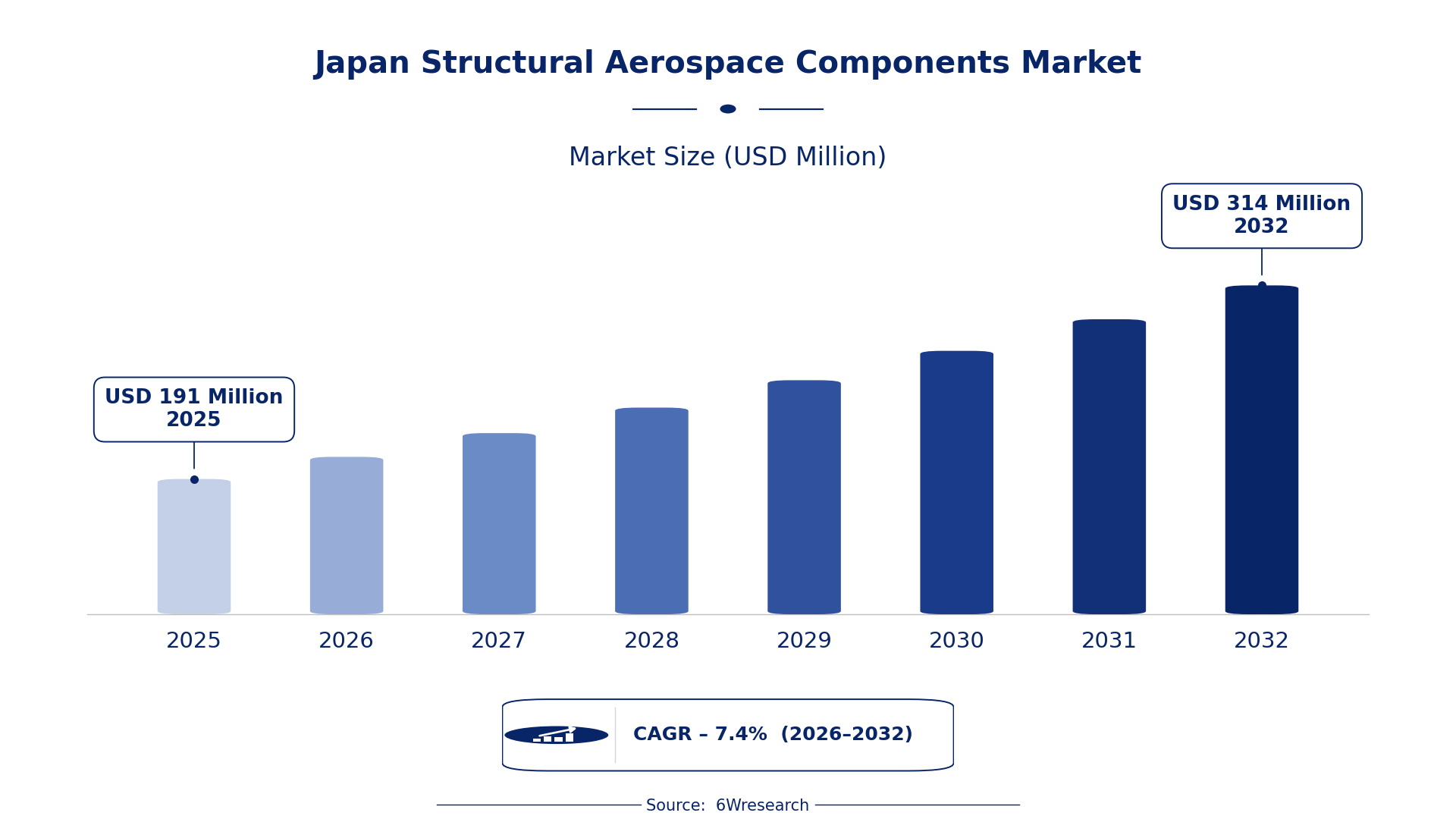
According to 6Wresearch internal database and industry insights, the Japan Structural Aerospace Components Market was valued at USD 191 Million in 2025 and is projected to reach USD 314 Million by 2032, growing at a CAGR of approximately 7.4% during 2026–2032.
Japan Structural Aerospace Components Market Highlights
| Report Metric | Details |
| Report Name | Japan Structural Aerospace Components Market (2026-2032) |
| Market Size 2025 | USD 191 Million |
| Market Size 2032 | USD 314 Million |
| Absolute Growth 2025–2032 | USD 123 Million |
| CAGR 2026–2032 | 7.4% |
| Peak Annual Growth | 8.4% in 2028 |
| Forecast Period | 2026–2032 |
| Historical Data | 2022–2025 |
| Base Year | 2025 |
| Leading Component Type, 2025 | Wing Structures (38% share) |
| Leading Material Type, 2025 | Aluminum Alloys (37% share) |
| Leading Aircraft Type, 2025 | Commercial Aircraft (36% share) |
| Leading End User, 2025 | Aerospace OEMs (49% share) |
| Fastest-Growing Component Type | Fuselage Sections (9.8% CAGR) |
| Fastest-Growing Material Type | Titanium/Composite (10.5% CAGR) |
| Fastest-Growing Aircraft Type | Military Jets (9.9% CAGR) |
| Fastest-Growing End User | Defense Contractors (9.1% CAGR) |
| Growing Sector | Aerospace manufacturing |
| Key End Users | Aerospace OEMs, Defense Contractors, Drone Manufacturers |
Japan Structural Aerospace Components Market Year-wise Growth Rate and Key Drivers (2022–2032)
This graph illustrates the annual growth rates of the market from 2022 to 2032, highlighting a steady upward trajectory and projected market expansion over the forecast period.
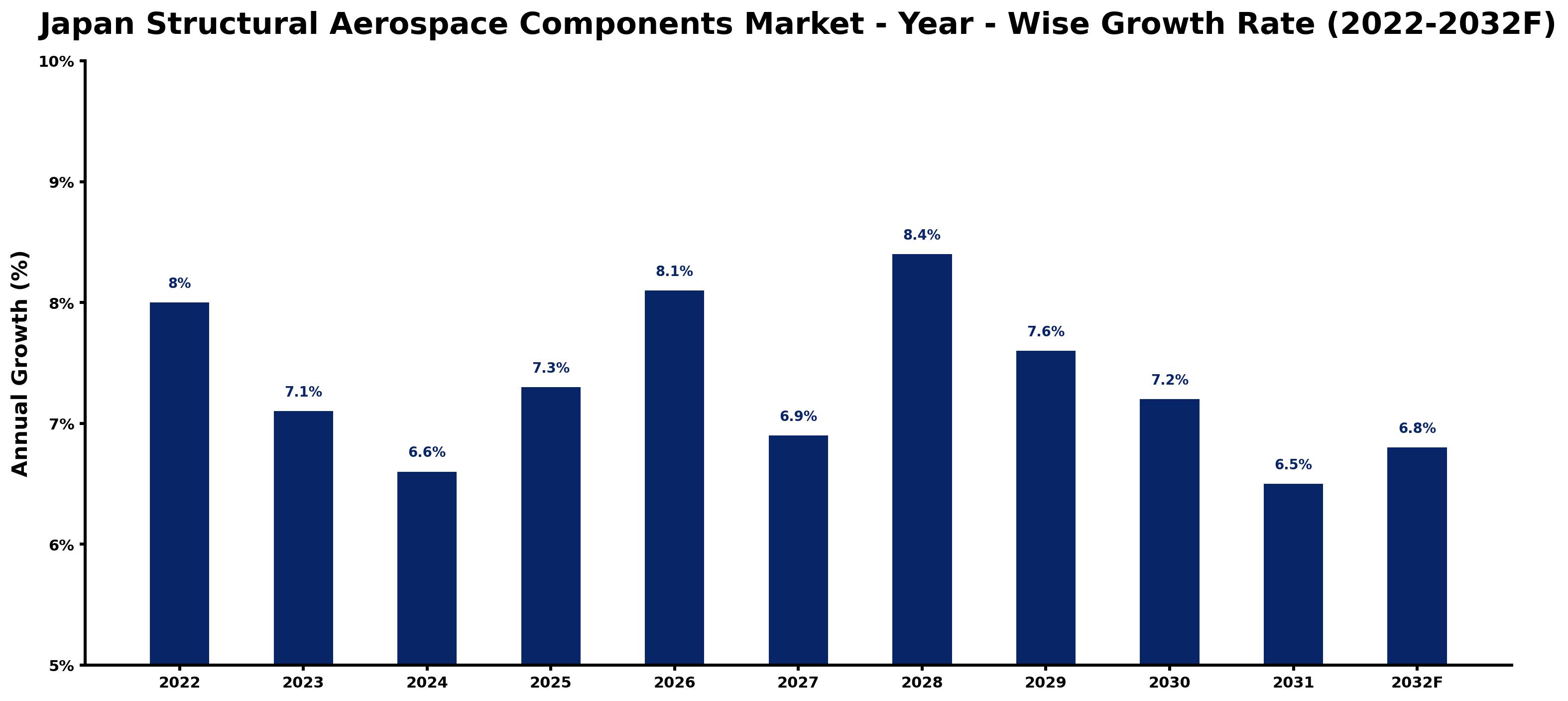
Year by year, the estimates below pair each growth rate with the development that shaped it.
| Year | Estimated Annual Growth (%) | Market Rationale |
| 2022 | 8.0 | The market experienced strong demand due to increased aerospace production activities. |
| 2023 | 7.1 | Growth slowed as manufacturers adjusted to supply chain challenges and fluctuating material costs. |
| 2024 | 6.6 | The market continued to grow, albeit at a slower pace, driven by ongoing defence spending. |
| 2025 | 7.3 | Demand increased as domestic aircraft production initiatives gained momentum, boosting orders. |
| 2026 | 8.1 | Growth is expected to accelerate with rising investments in advanced aerospace technologies and materials. |
| 2027 | 6.9 | A slight slowdown is projected as the market stabilises after previous rapid growth phases. |
| 2028 | 8.4 | A peak in demand is anticipated due to heightened interest in military jets and defence contracts. |
| 2029 | 7.6 | Growth is projected to slow as manufacturers face challenges in sourcing high-quality materials. |
| 2030 | 7.2 | Demand is expected to continue slowing as the market adjusts to new production standards. |
| 2031 | 6.5 | The market growth rate is projected to decrease further due to increased competition and pricing pressures. |
| 2032 | 6.8 | Growth is expected to pick up again as new aerospace projects and innovations are launched. |
Note: Market size estimations and growth projections presented in this report are based on 6Wresearch's proprietary forecasting methodology, utilizing the latest available industry data, government publications, and primary research inputs.
Japan Structural Aerospace Components Market Synopsis
Structural aerospace components are fundamental for aircraft construction, employing advanced materials such as aluminium alloys and carbon fibre. These components improve performance and integrity, catering to both commercial and military needs. The Japan Structural Aerospace Components Market is growing, spurred by a government initiative to increase domestic aircraft production by 20% by 2025. Rising defence expenditure and technological progress are driving demand in the sector, with aerospace exports reaching around $5 billion in 2022.
Market Dynamics Impact Analysis (2026–2032)
| Factor | Type | Impact | Primary Segment Affected |
| Increased domestic aircraft production initiatives | Driver | High | Fuselage Sections |
| Growing defence spending on military aircraft | Driver | High | Wing Structures |
| Rising demand for lightweight materials in aerospace | Opportunity | High | Carbon Fiber |
| Expansion of aerospace startups in the Tokyo region | Opportunity | Medium | Aluminum Alloys |
| Challenges in sourcing high-quality materials | Restraint | High | High-Strength Alloys |
| Fluctuating costs of raw materials affecting production | Restraint | Medium | Titanium/Composite |
| High production costs for advanced components | Challenge | High | Tail Assemblies |
| Intense competition among domestic manufacturers | Challenge | Medium | Bulkheads |
Evaluation of Drivers in Japan Structural Aerospace Components Market (2026–2032)
Demand rests on the following drivers, each shown with the segment it touches most.
| Drivers | Primary Segment Affected | Why It Matters (Evidence) |
| Increased domestic aircraft production | Fuselage Sections | Japan's government aims to boost production by 20% by 2025, resulting in more orders. |
| Growing defence spending | Wing Structures | The Japanese Defence Agency is investing approximately $300 million in military aircraft development, stimulating demand. |
| Technological advancements in materials | Carbon Fiber | Carbon fiber components improve fuel efficiency, prompting more purchases from aerospace manufacturers. |
| Expansion of aerospace manufacturing hubs | Aluminum Alloys | The Tokyo region's aerospace sector employs over 50,000 people, driving demand for structural components. |
| Rising exports of aerospace products | High-Strength Alloys | Japan's aerospace exports reached approximately $5 billion in 2022, increasing production needs. |
Advancements in carbon fiber technology improve fuel efficiency, leading to increased purchases from manufacturers. The Tokyo region's aerospace hubs are expanding, further stimulating demand for aluminum alloys. Japan's aerospace exports, valued at approximately $5 billion in 2022, are anticipated to rise, increasing the need for high-strength alloys in production.
Evaluation of Restraints in Japan Structural Aerospace Components Market
The main factors holding the market back are set out below.
| Market Restraint | Primary Segment Affected | Why It Matters (Evidence) |
| Challenges in sourcing high-quality materials | High-Strength Alloys | Manufacturers face difficulties in obtaining high-quality materials, which delays production timelines. |
| Fluctuating costs of raw materials | Titanium/Composite | Rising costs affect pricing strategies, reducing profit margins for producers. |
| High production costs for advanced components | Tail Assemblies | The complexity of manufacturing processes increases costs, limiting market entry for new players. |
| Intense competition among domestic manufacturers | Bulkheads | Increased competition pressures prices, affecting profitability for existing manufacturers. |
| Regulatory compliance costs | Fuselage Sections | Compliance with ISO 9001 standards incurs additional costs for manufacturers, impacting pricing. |
Japan Structural Aerospace Components Market Challenges
Technical malfunctions in advanced robotics used in the fuselage section manufacturing process have caused production delays, raising operational costs for manufacturers by up to 15% this year. Compliance with ISO 9001 standards imposes extra costs, extending project timelines by an average of three months for suppliers. Rising prices of aluminium alloys, which constitute 70% of structural components, have increased input costs by around 10%, straining buyers' budgets. A shortage of skilled precision engineers affects over 50,000 aerospace employees, resulting in a 20% productivity decline for some producers as they struggle to adapt to new technologies.
Trends in the Japan Structural Aerospace Components Market
Buyers and suppliers in the Japan Structural Aerospace Components Market are adjusting to the following trends.
- Shift in Aerospace Manufacturing to Advanced Materials: The Tokyo region is experiencing a shift towards advanced materials in aerospace manufacturing, with carbon fibre components increasingly used to improve fuel efficiency. Approximately 70% of structural components now utilise aluminium alloys, reflecting this trend.
- Growing Focus on Military Aircraft Production: Defence contractors are prioritising military aircraft production, driven by increased government spending. The Japanese Defence Agency's investment in next-generation military aircraft development is projected to double UAV production by 2030.
- Rise of Aerospace Startups in Tokyo: The Tokyo Metropolitan Government has launched a programme to support aerospace startups, aiming to stimulate innovation in the sector. This initiative is expected to attract significant investment, enhancing local manufacturing capabilities.
- Increased Adoption of Robotics in Manufacturing: The fuselage section manufacturing process is increasingly adopting advanced robotics and automation, improving efficiency. This shift is evident in the growing number of facilities implementing these technologies.
Investment Opportunities in the Japan Structural Aerospace Components Market
The following opportunities in the Japan Structural Aerospace Components Market pair current demand with a clear way in.
- Expansion of Aerospace Manufacturing Hubs in Nagoya: The Nagoya region is seeing a surge in aerospace component manufacturers, with a projected growth rate of 9.8% for fuselage sections. Investing in local partnerships can facilitate entry into this growing market.
- Rising Demand for Carbon Fiber Components: Aerospace manufacturers are increasingly seeking carbon fibre components to improve fuel efficiency. With carbon fibre usage rising, suppliers can benefit from this trend by establishing local production facilities.
- Investment in UAV Production Facilities: The Japanese government aims to double UAV production by 2030, creating opportunities for manufacturers. Collaborating with local defence contractors can enhance market access.
- Support for Aerospace Startups in Tokyo: The Tokyo Metropolitan Government's programme to support startups presents an opportunity for investors. With a growing focus on innovation, entering through partnerships can yield significant returns.
Government Initiatives in the Japan Structural Aerospace Components Market
The Economic Security Promotion Act of 2022 supports supply-chain resilience for critical aerospace products. This law mandates that manufacturers strengthen their supply chains and invest in local production capabilities, ensuring a stable supply of structural components. The Act aims to enhance domestic production by 20% by 2025, benefiting over 50,000 workers in the aerospace sector.
In 2022, the Japan Aerospace Exploration Agency (JAXA) allocated approximately $300 million to support research and development in aerospace technologies. This funding promotes innovation and development, benefiting manufacturers of structural aerospace components.
Future Insight of the Japan Structural Aerospace Components Market
The development of advanced manufacturing facilities will revolutionise production processes, particularly through automation in assembly lines. Support for aerospace startups in Tokyo will drive innovation and lead to the emergence of new product lines. Increased defence spending will boost demand for structural components in military applications, while the target to double UAV production by 2030 will open new market avenues. Japan's aerospace exports are anticipated to rise as domestic aircraft production increases by 20% by 2025, reflecting a significant shift in the industry.
Market Segmentation Analysis
Japan Structural Aerospace Components Market report covers a detailed analysis of the following market segments:
By Component Type – Wing Structures Lead, Fuselage Sections Expected to Grow Fastest
According to Saurav Kr Singh, Senior Research Analyst at 6Wresearch, Wing Structures held 38% of the Japan Structural Aerospace Components Market by component type in 2025. Wing structures play a crucial role in aircraft performance, making them indispensable in both commercial and military aviation. The Tokyo region's robust aerospace manufacturing capabilities ensure a steady supply and installed base for these components. The quickest growth will come from Fuselage Sections, forecast to expand at a CAGR of 9.8% between 2026 and 2032. Fuselage sections are witnessing rapid growth due to their essential function in aircraft structure, with advanced robotics and automation significantly improving production efficiency. The increasing focus on lightweight designs is further propelling the expansion of this segment. Suppliers should prioritise advancements in fuselage section manufacturing to capture emerging opportunities in the aerospace market.
By Material Type – Aluminum Alloys Lead, Titanium/Composite Expected to Grow Fastest
The largest material type category in 2025 was Aluminum Alloys, at 37% of revenue. Aluminum alloys are extensively used for lightweight structures, accounting for approximately 70% of structural components in aircraft. Their widespread adoption is facilitated by established manufacturing processes and availability within Japan's aerospace sector. Over 2026–2032, Titanium/Composite is expected to post the fastest growth, at a CAGR of 10.5%. Titanium and composite materials are gaining traction due to their superior strength-to-weight ratio, which is critical for enhancing aircraft performance. The push for more fuel-efficient aircraft is accelerating the adoption of these advanced materials. Buyers should consider incorporating titanium and composite materials to improve aircraft efficiency and adhere to regulatory standards.
By Aircraft Type – Commercial Aircraft Leads, Military Jets Expected to Grow Fastest
In 2025, Commercial Aircraft led the aircraft type split with a 36% share. Commercial aircraft represent a major segment of aerospace production, supported by Japan's strong export market and domestic demand. The government's target to increase aircraft production by 20% by 2025 reinforces the leading position of this segment. Military Jets are projected to grow fastest, at a CAGR of 9.9% during 2026–2032. Military jets are experiencing robust growth as national defense spending rises, reflecting a strategic focus on enhancing military capabilities. This trend is further bolstered by investments in next-generation military aircraft development. Suppliers should align their strategies with the growing demand for military jets to capitalise on increasing defence budgets.
By End User – Aerospace OEMs Lead, Defense Contractors Expected to Grow Fastest
Aerospace OEMs took 49% of end user revenue in 2025, more than any other category. Aerospace OEMs are the primary manufacturers of aircraft, driving demand for structural components across various aircraft types. Their established relationships and high production volumes ensure a consistent need for quality components in the market. Defense Contractors are set to record the highest CAGR in this split, 9.1% over 2026–2032. Defense contractors are rapidly expanding their roles in military aircraft production, propelled by government contracts and heightened defence initiatives. This growth is expected to continue as the emphasis on national security intensifies. Suppliers must enhance their offerings to meet the specific needs of defense contractors in the evolving aerospace environment.
Key Attractiveness of the Report
- 10 Years of Market Numbers
- Historical Data Starting from 2022 to 2025
- Base Year 2025
- Forecast Data until 2032
- Key Performance Indicators Impacting the Market
- Major Upcoming Developments and Projects
Key Highlights of the Report:
- Japan Structural Aerospace Components Market Outlook
- Market Size of Japan Structural Aerospace Components Market, 2025
- Forecast of Japan Structural Aerospace Components Market, 2032
- Historical Data and Forecast of Japan Structural Aerospace Components Revenues & Volume for the Period 2022-2032F
- Japan Structural Aerospace Components Market Trend Evolution
- Japan Structural Aerospace Components Market Drivers and Challenges
- Japan Structural Aerospace Components Price Trends
- Japan Structural Aerospace Components Porter's Five Forces
- Japan Structural Aerospace Components Industry Life Cycle
- Historical Data and Forecast of Japan Structural Aerospace Components Market Revenues & Volume By Component Type for the Period 2022-2032F
- Historical Data and Forecast of Japan Structural Aerospace Components Market Revenues & Volume By Wing Structures for the Period 2022-2032F
- Historical Data and Forecast of Japan Structural Aerospace Components Market Revenues & Volume By Fuselage Sections for the Period 2022-2032F
- Historical Data and Forecast of Japan Structural Aerospace Components Market Revenues & Volume By Tail Assemblies for the Period 2022-2032F
- Historical Data and Forecast of Japan Structural Aerospace Components Market Revenues & Volume By Bulkheads for the Period 2022-2032F
- Historical Data and Forecast of Japan Structural Aerospace Components Market Revenues & Volume By Material Type for the Period 2022-2032F
- Historical Data and Forecast of Japan Structural Aerospace Components Market Revenues & Volume By Aluminum Alloys for the Period 2022-2032F
- Historical Data and Forecast of Japan Structural Aerospace Components Market Revenues & Volume By Titanium/Composite for the Period 2022-2032F
- Historical Data and Forecast of Japan Structural Aerospace Components Market Revenues & Volume By Carbon Fiber for the Period 2022-2032F
- Historical Data and Forecast of Japan Structural Aerospace Components Market Revenues & Volume By High-Strength Alloys for the Period 2022-2032F
- Historical Data and Forecast of Japan Structural Aerospace Components Market Revenues & Volume By Aircraft Type for the Period 2022-2032F
- Historical Data and Forecast of Japan Structural Aerospace Components Market Revenues & Volume By Commercial Aircraft for the Period 2022-2032F
- Historical Data and Forecast of Japan Structural Aerospace Components Market Revenues & Volume By Military Jets for the Period 2022-2032F
- Historical Data and Forecast of Japan Structural Aerospace Components Market Revenues & Volume By UAVs for the Period 2022-2032F
- Historical Data and Forecast of Japan Structural Aerospace Components Market Revenues & Volume By Helicopters for the Period 2022-2032F
- Historical Data and Forecast of Japan Structural Aerospace Components Market Revenues & Volume By End User for the Period 2022-2032F
- Historical Data and Forecast of Japan Structural Aerospace Components Market Revenues & Volume By Aerospace OEMs for the Period 2022-2032F
- Historical Data and Forecast of Japan Structural Aerospace Components Market Revenues & Volume By Defense Contractors for the Period 2022-2032F
- Historical Data and Forecast of Japan Structural Aerospace Components Market Revenues & Volume By Drone Manufacturers for the Period 2022-2032F
- Historical Data and Forecast of Japan Structural Aerospace Components Market Revenues & Volume By Helicopter OEMs for the Period 2022-2032F
- Japan Structural Aerospace Components Import Export Trade Statistics
- Market Opportunity Assessment By Component Type
- Market Opportunity Assessment By Material Type
- Market Opportunity Assessment By Aircraft Type
- Market Opportunity Assessment By End User
- Japan Structural Aerospace Components Top Companies Market Share
- Japan Structural Aerospace Components Competitive Benchmarking By Technical and Operational Parameters
- Japan Structural Aerospace Components Company Profiles
- Japan Structural Aerospace Components Key Strategic Recommendations
Market Covered
The following segment groups are covered in the report.
By Component Type
- Wing Structures
- Fuselage Sections
- Tail Assemblies
- Bulkheads
By Material Type
- Aluminum Alloys
- Titanium/Composite
- Carbon Fiber
- High-Strength Alloys
By Aircraft Type
- Commercial Aircraft
- Military Jets
- UAVs
- Helicopters
By End User
- Aerospace OEMs
- Defense Contractors
- Drone Manufacturers
- Helicopter OEMs































