Japan Structural Aircraft Fasteners Market Size & Growth Rate
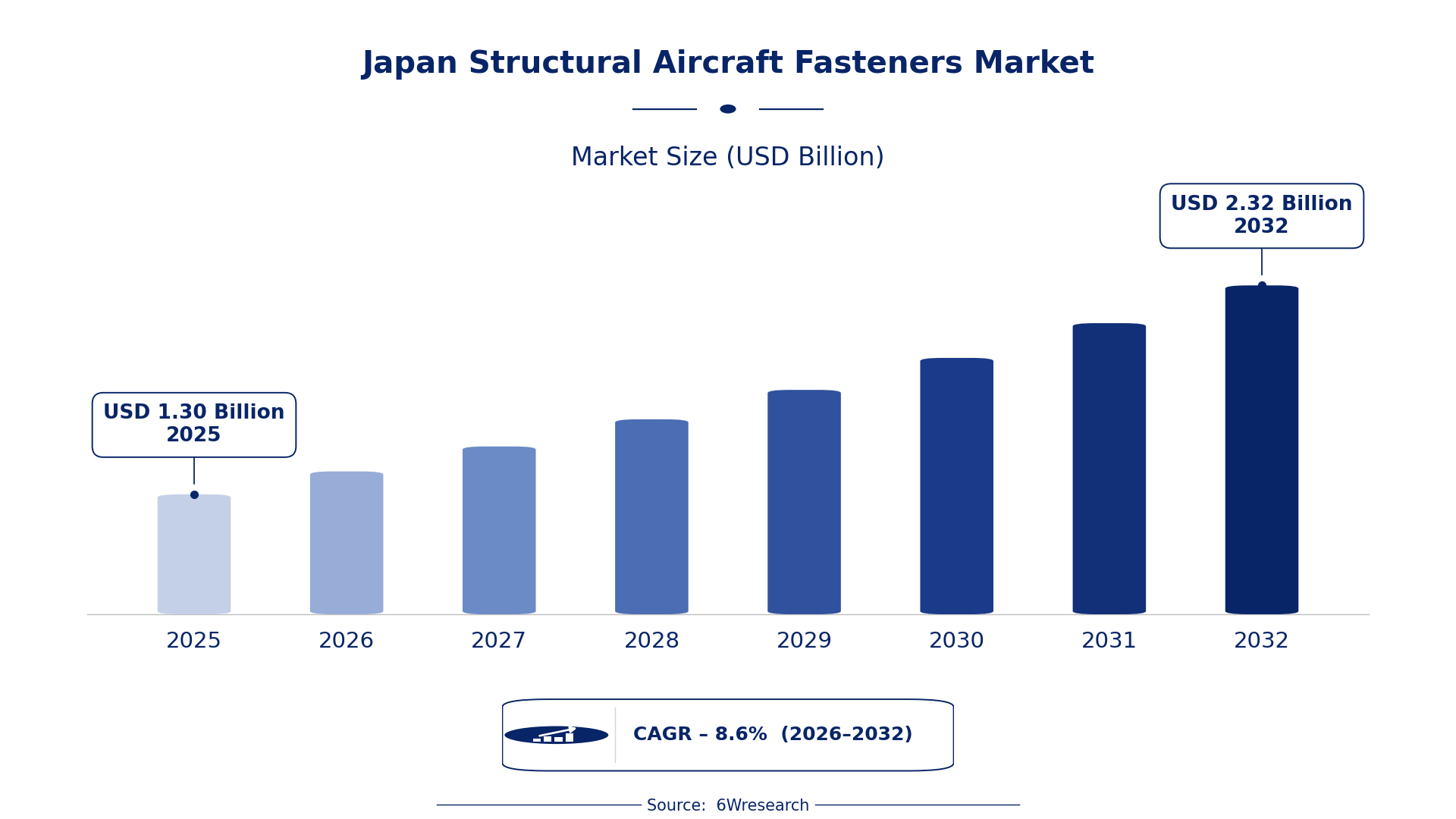
According to 6Wresearch internal database and industry insights, the Japan Structural Aircraft Fasteners Market was valued at USD 1.30 billion in 2025 and is projected to reach USD 2.32 billion by 2032, growing at a CAGR of approximately 8.6% during 2026–2032.
Japan Structural Aircraft Fasteners Market Highlights
| Report Metric | Details |
| Report Name | Japan Structural Aircraft Fasteners Market |
| Market Size 2025 | USD 1.30 billion |
| Market Size 2032 | USD 2.32 billion |
| Absolute Growth 2025–2032 | USD 1.02 billion |
| CAGR 2026–2032 | 8.6% |
| Peak Annual Growth | 10.2% in 2030 |
| Forecast Period | 2026–2032 |
| Historical Data | 2022–2025 |
| Base Year | 2025 |
| Leading Fastener Type, 2025 | Bolts & Screws (43% share) |
| Leading Material Type, 2025 | Aluminum (36% share) |
| Leading Aircraft Zone, 2025 | Wing & Fuselage (37% share) |
| Leading End User, 2025 | OEM Aircraft Assemblers (45% share) |
| Fastest-Growing Fastener Type | Lockbolts (10.7% CAGR) |
| Fastest-Growing Material Type | High-Performance Alloy (10.7% CAGR) |
| Fastest-Growing Aircraft Zone | Cabin Structure (9.9% CAGR) |
| Fastest-Growing End User | MRO Facilities (9.9% CAGR) |
| Growing Sector | Aerospace Manufacturing |
| Key End Users | OEM Aircraft Assemblers, MRO Facilities, Aerospace Tier-1 Suppliers |
Japan Structural Aircraft Fasteners Market Year-wise Growth Rate and Key Drivers (2022–2032)
This graph illustrates the annual growth rates of the market from 2022 to 2032, highlighting a steady upward trajectory and projected market expansion over the forecast period.
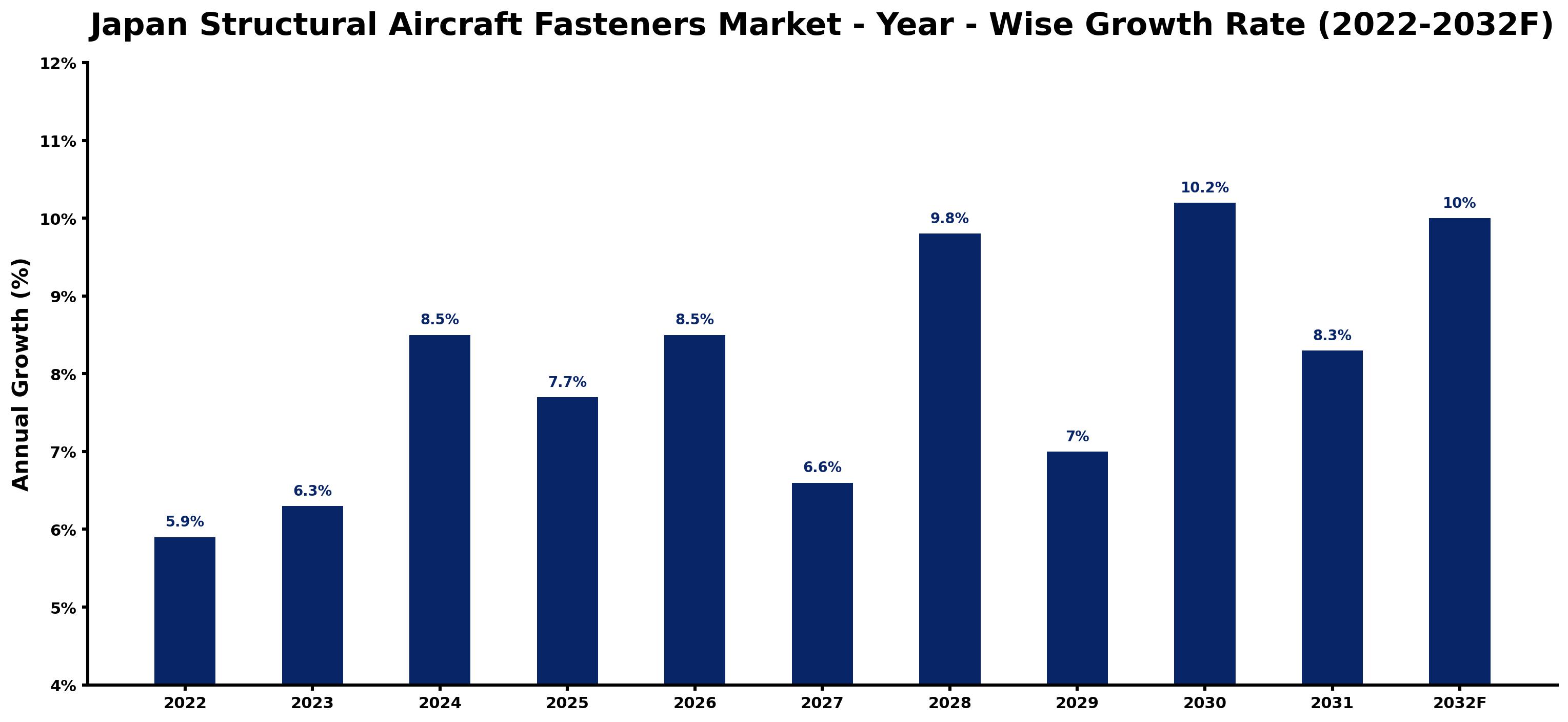
Each row of the following table gives one year's estimated growth and the event or demand shift that explains it.
| Year | Estimated Annual Growth (%) | Market Rationale |
| 2022 | 5.9 | The market experienced steady growth due to ongoing production in the aerospace sector. |
| 2023 | 6.3 | Growth accelerated as domestic aircraft manufacturers increased output to meet rising demand. |
| 2024 | 8.5 | Demand surged with Japan producing over 100 commercial aircraft, boosting fastener requirements. |
| 2025 | 7.7 | Growth slowed as production stabilised, yet demand remained strong from OEM assemblers. |
| 2026 | 8.5 | The market rebounded as investment in aerospace innovation gained momentum. |
| 2027 | 6.6 | Growth decelerated as manufacturers adjusted to supply chain dynamics. |
| 2028 | 9.8 | Demand picked up due to advancements in high-performance alloy fasteners. |
| 2029 | 7.0 | Growth slowed again as market conditions normalised after rapid expansion. |
| 2030 | 10.2 | The market peaked with significant investments in advanced manufacturing technologies. |
| 2031 | 8.3 | Growth decelerated as the market adjusted to previous peaks in demand. |
| 2032 | 10.0 | The market is expected to grow as aerospace exports continue to rise. |
Note: Market size estimations and growth projections presented in this report are based on 6Wresearch's proprietary forecasting methodology, utilizing the latest available industry data, government publications, and primary research inputs.
Japan Structural Aircraft Fasteners Market Synopsis
Structural Aircraft Fasteners in Japan are crucial components in aircraft assembly and maintenance. Crafted from high-strength materials such as titanium and aluminium, these fasteners secure aircraft structures and ensure flight safety. The Japan Structural Aircraft Fasteners Market is expanding due to strong demand from domestic manufacturers and maintenance facilities. In 2023, Japan's aerospace exports reached 1.2 trillion yen, underscoring the industry's robustness. The Tokyo region continues to be a central hub for aircraft manufacturing, prompting further investments in fastener technology and production capabilities.
Market Dynamics Impact Analysis (2026–2032)
| Factor | Type | Impact | Primary Segment Affected |
| Increasing production of commercial aircraft | Driver | High | Rivets |
| Growing demand for high-performance alloys | Driver | High | High-Performance Alloy |
| Expansion of MRO facilities | Opportunity | Medium | MRO Facilities |
| Investment in advanced manufacturing technologies | Opportunity | Medium | Aircraft Assembly Plants |
| Regulatory compliance costs | Restraint | High | Bolts & Screws |
| Supply chain disruptions affecting availability | Restraint | High | Lockbolts |
| Skilled labour shortages in aerospace manufacturing | Challenge | High | OEM Aircraft Assemblers |
| High material costs impacting production | Challenge | Medium | Titanium |
Evaluation of Drivers in Japan Structural Aircraft Fasteners Market (2026–2032)
Key forces behind demand, with the segment each one moves most, are listed below.
| Drivers | Primary Segment Affected | Why It Matters (Evidence) |
| Increased production of commercial aircraft | Rivets | In 2022, Japan produced over 100 commercial aircraft, driving demand for rivets in assembly. |
| Growing adoption of high-performance alloys | High-Performance Alloy | The aerospace sector's shift towards high-performance alloys is projected to grow at a CAGR of 10.7% from 2026 to 2032. |
| Expansion of MRO facilities | MRO Facilities | The growth of MRO facilities is linked to Japan's aerospace exports reaching 1.2 trillion yen in 2023. |
| Investment in advanced manufacturing technologies | Aircraft Assembly Plants | Japan has invested heavily in advanced technologies, improving production capabilities for fasteners. |
| Regulatory compliance with ISO 9001 standards | Bolts & Screws | Adoption of ISO 9001 in the aerospace sector ensures quality, increasing demand for bolts and screws. |
Market growth for Structural Aircraft Fasteners in Japan is underpinned by increased production of commercial aircraft and a growing focus on high-performance alloys. In 2022, Japan produced over 100 commercial aircraft, which boosted demand for rivets used in assembly. The aerospace sector is shifting towards high-performance alloys, projected to grow at a CAGR of 10.7% from 2026 to 2032. The expansion of MRO facilities is notable, with aerospace exports reaching 1.2 trillion yen in 2023, prompting further demand for fasteners. Investments in advanced manufacturing technologies have improved production capabilities, driving up the need for structural fasteners.
Evaluation of Restraints in Japan Structural Aircraft Fasteners Market
The table below lists the restraints and the evidence behind each.
| Market Restraint | Primary Segment Affected | Why It Matters (Evidence) |
| High compliance costs associated with regulations | Bolts & Screws | Compliance with standards like ISO 9001 increases operational costs for manufacturers. |
| Supply chain disruptions affecting availability | Lockbolts | Recent supply chain issues have limited the availability of critical fasteners, impacting production. |
| Skilled labour shortages in aerospace manufacturing | OEM Aircraft Assemblers | A shortage of skilled workers hampers production efficiency and increases lead times. |
| High material costs impacting production | Titanium | Rising titanium prices have led to increased production costs for fasteners, affecting pricing strategies. |
| Market volatility due to global economic conditions | Rivets | Economic fluctuations can impact demand stability for rivets in the aerospace sector. |
Japan Structural Aircraft Fasteners Market Challenges
Producers in the Japan Structural Aircraft Fasteners market encounter technological limitations that hinder the adoption of advanced manufacturing methods, resulting in delayed product launches and lost revenue opportunities. Importers face a skills shortage in the aerospace sector, which leads to production delays and increased costs for distributors, ultimately raising prices for buyers. Competition among domestic aircraft manufacturers intensifies, driving prices down and squeezing margins, which can compromise the quality of fasteners sourced. High demand from maintenance, repair, and overhaul facilities can create supply chain bottlenecks, causing lead times to extend, which affects buyers needing urgent replacements.
Trends in the Japan Structural Aircraft Fasteners Market
Several trends are reshaping the Japan Structural Aircraft Fasteners Market; the most important are set out below.
- Shift towards High-Performance Alloys: Japan's aerospace sector is increasingly embracing high-performance alloys for structural fasteners, with a projected CAGR of 10.7% from 2026 to 2032. This shift stems from the demand for lightweight and durable materials in aircraft construction.
- Expansion of MRO Facilities in Tokyo: The Tokyo region is witnessing a notable expansion of MRO facilities, improving support for the growing fleet of commercial aircraft. In 2023, Japan's aerospace exports reached 1.2 trillion yen, driving further investments in maintenance capabilities.
- Increased Demand from OEM Aircraft Assemblers: OEM aircraft assemblers are seeing heightened demand for structural fasteners, with a projected market share of 45% in 2025. This growth correlates with Japan's aircraft production and assembly activities.
- Adoption of ISO 9001 Standards: The aerospace sector in Japan is increasingly adopting ISO 9001 standards to ensure quality and safety in fastener production. This trend supports the industry's commitment to maintaining high-quality manufacturing practices.
Investment Opportunities in the Japan Structural Aircraft Fasteners Market
The following opportunities in the Japan Structural Aircraft Fasteners Market pair current demand with a clear way in.
- Investment in High-Performance Alloys: There is a growing opportunity to supply high-performance alloy fasteners, projected to grow at a CAGR of 10.7% from 2026 to 2032. OEM aircraft assemblers are key buyers, and local partnerships can facilitate market entry.
- Expansion of MRO Facilities: The expansion of MRO facilities in the Tokyo region presents an opportunity to supply fasteners for maintenance operations. With aerospace exports reaching 1.2 trillion yen in 2023, entering this market can be advantageous.
- Supply of Lightweight Aluminum Fasteners: The demand for lightweight aluminum fasteners is rising, driven by the need for fuel-efficient aircraft. Aerospace Tier-1 suppliers are significant buyers, and establishing local production can enhance competitiveness.
- Development of Advanced Fastening Technologies: Investment in advanced fastening technologies is crucial as the market evolves. The 2023 Aerospace Technology Conference highlighted innovations, indicating strong demand for suppliers who can meet these new standards.
Government Initiatives in the Japan Structural Aircraft Fasteners Market
The Chemical Substances Control Law (1973) mandates the evaluation and control of chemical substances used in manufacturing. This law ensures that structural aircraft fasteners meet safety and environmental standards, impacting production processes. Additionally, the Economic Security Promotion Act (2022) supports supply-chain resilience for critical aerospace materials, encouraging local production and innovation in fastener technology. This act aims to enhance the competitiveness of Japan's aerospace industry in the global market. The GX Basic Policy adopted in 2023 aims for about JPY 150 trillion in public-private decarbonisation investment over ten years, supporting initiatives that promote sustainability in aircraft manufacturing.
The Japan Aerospace Exploration Agency oversees the implementation of various funding programs that promote technological advancements in aerospace, ensuring that buyers have access to the latest innovations in fastener technology. The agency's initiatives help producers improve their manufacturing processes and meet evolving market demands. These measures collectively strengthen the supply chain and improve the overall quality of aerospace components.
Future Insight of the Japan Structural Aircraft Fasteners Market
The Japan Structural Aircraft Fasteners market will undergo notable changes by 2032 as advancements in manufacturing technologies and increased government support drive growth. The Tokyo region will solidify its role as a manufacturing hub, attracting investments in innovative fastener technologies. Funding programs from the Ministry of Economy, Trade and Industry will enhance the capabilities of suppliers to meet the evolving demands of buyers. Collaborations between industry associations and research institutions will lead to improvements in quality assurance, creating a more efficient supply chain for the aerospace sector.
Market Segmentation Analysis
Each segment group is reviewed below, with the leader by share and the fastest grower by CAGR.
By Fastener Type – Bolts & Screws Dominated, Lockbolts Expected to Grow Fastest
According to Summon Dutta, Assistant Manager at 6Wresearch, Bolts & Screws held a 43% share of the Japan Structural Aircraft Fasteners Market by fastener type in 2025. Bolts and screws dominate the Japan Structural Aircraft Fasteners Market due to their critical role in various aircraft assemblies, ensuring the structural integrity of aircraft. The reliance of aircraft manufacturing facilities in the Tokyo region on these fasteners underscores their importance in production processes. Over 2026–2032, Lockbolts are expected to post the fastest growth, at a CAGR of 10.7%. Lockbolts are rapidly gaining traction because they provide high-strength fastening solutions in critical aircraft areas, particularly where stress is a concern. The production of over 100 commercial aircraft in 2022 has significantly driven the demand for these robust fasteners. Suppliers should enhance their lockbolt offerings to align with the growing needs of the aerospace sector.
By Material Type – Aluminum Dominated, High-Performance Alloy Expected to Grow Fastest
Aluminum took a 36% share of material type in 2025, more than any other category. Aluminum holds the largest market share in the Japan Structural Aircraft Fasteners Market owing to its lightweight properties, making it a preferred choice for aircraft applications. This material's widespread adoption by domestic aircraft manufacturers solidifies its dominant position in the market. The quickest growth will come from High-Performance Alloy, forecast to expand at a CAGR of 10.7% between 2026 and 2032. High-performance alloys are experiencing the fastest growth as they are increasingly utilised in demanding aerospace applications, driven by advancements in manufacturing technologies. The push for more efficient aircraft designs is propelling the demand for these advanced materials. Buyers should consider sourcing high-performance alloy fasteners to enhance aircraft performance and reduce weight.
By Aircraft Zone – Wing & Fuselage Dominated, Cabin Structure Expected to Grow Fastest
The largest aircraft zone category in 2025 was Wing & Fuselage, with a 37% share of total revenue. The wing and fuselage segment commands the largest share in the market as these major structural areas necessitate robust fasteners to maintain aircraft integrity. Their critical role in ensuring safety during flight further cements their dominance in the market. Cabin Structure is projected to grow fastest, at a CAGR of 9.9% during 2026–2032. Cabin structures are witnessing the fastest growth due to an increased focus on passenger safety and comfort, which necessitates secure fastenings. The rising passenger traffic in Japan's aviation sector is driving the demand for enhanced cabin safety features. Suppliers should prioritise the development of fasteners specifically designed for cabin structures to capitalise on this growing segment.
By End User – OEM Aircraft Assemblers Dominated, MRO Facilities Expected to Grow Fastest
In 2025, OEM Aircraft Assemblers led the end user split with a 45% share. OEM aircraft assemblers represent the largest share of the market as they directly utilise fasteners in aircraft production, ensuring quality and safety. The robust domestic aerospace industry in Japan significantly bolsters this segment's prominence. MRO Facilities are set to record the highest CAGR in this split, 9.9% over 2026–2032. MRO facilities are experiencing rapid growth as they require fasteners for aircraft maintenance and repairs, particularly with the increasing number of aircraft in operation. The heightened emphasis on aircraft safety and maintenance is propelling this segment's expansion. Suppliers must strengthen partnerships with MRO facilities to capture the rising demand for fasteners in maintenance operations.
Key Attractiveness of the Report
- 10 Years of Market Numbers
- Historical Data Starting from 2022 to 2025
- Base Year 2025
- Forecast Data until 2032
- Key Performance Indicators Impacting the Market
- Major Upcoming Developments and Projects
Key Highlights of the Report:
- Japan Structural Aircraft Fasteners Market Outlook
- Market Size of Japan Structural Aircraft Fasteners Market, 2025
- Forecast of Japan Structural Aircraft Fasteners Market, 2032
- Historical Data and Forecast of Japan Structural Aircraft Fasteners Revenues & Volume for the Period 2022 - 2032F
- Japan Structural Aircraft Fasteners Market Trend Evolution
- Japan Structural Aircraft Fasteners Market Drivers and Challenges
- Japan Structural Aircraft Fasteners Price Trends
- Japan Structural Aircraft Fasteners Porter's Five Forces
- Japan Structural Aircraft Fasteners Industry Life Cycle
- Historical Data and Forecast of Japan Structural Aircraft Fasteners Market Revenues & Volume By Fastener Type for the Period 2022 - 2032F
- Historical Data and Forecast of Japan Structural Aircraft Fasteners Market Revenues & Volume By Rivets for the Period 2022 - 2032F
- Historical Data and Forecast of Japan Structural Aircraft Fasteners Market Revenues & Volume By Bolts & Screws for the Period 2022 - 2032F
- Historical Data and Forecast of Japan Structural Aircraft Fasteners Market Revenues & Volume By Pins for the Period 2022 - 2032F
- Historical Data and Forecast of Japan Structural Aircraft Fasteners Market Revenues & Volume By Lockbolts for the Period 2022 - 2032F
- Historical Data and Forecast of Japan Structural Aircraft Fasteners Market Revenues & Volume By Material Type for the Period 2022 - 2032F
- Historical Data and Forecast of Japan Structural Aircraft Fasteners Market Revenues & Volume By Titanium for the Period 2022 - 2032F
- Historical Data and Forecast of Japan Structural Aircraft Fasteners Market Revenues & Volume By Stainless Steel for the Period 2022 - 2032F
- Historical Data and Forecast of Japan Structural Aircraft Fasteners Market Revenues & Volume By High-Performance Alloy for the Period 2022 - 2032F
- Historical Data and Forecast of Japan Structural Aircraft Fasteners Market Revenues & Volume By Aluminum for the Period 2022 - 2032F
- Historical Data and Forecast of Japan Structural Aircraft Fasteners Market Revenues & Volume By Aircraft Zone for the Period 2022 - 2032F
- Historical Data and Forecast of Japan Structural Aircraft Fasteners Market Revenues & Volume By Wing & Fuselage for the Period 2022 - 2032F
- Historical Data and Forecast of Japan Structural Aircraft Fasteners Market Revenues & Volume By Engine Mounts for the Period 2022 - 2032F
- Historical Data and Forecast of Japan Structural Aircraft Fasteners Market Revenues & Volume By Landing Gear for the Period 2022 - 2032F
- Historical Data and Forecast of Japan Structural Aircraft Fasteners Market Revenues & Volume By Cabin Structure for the Period 2022 - 2032F
- Historical Data and Forecast of Japan Structural Aircraft Fasteners Market Revenues & Volume By End User for the Period 2022 - 2032F
- Historical Data and Forecast of Japan Structural Aircraft Fasteners Market Revenues & Volume By Aircraft Assembly Plants for the Period 2022 - 2032F
- Historical Data and Forecast of Japan Structural Aircraft Fasteners Market Revenues & Volume By Aerospace Tier-1 Suppliers for the Period 2022 - 2032F
- Historical Data and Forecast of Japan Structural Aircraft Fasteners Market Revenues & Volume By MRO Facilities for the Period 2022 - 2032F
- Historical Data and Forecast of Japan Structural Aircraft Fasteners Market Revenues & Volume By OEM Aircraft Assemblers for the Period 2022 - 2032F
- Japan Structural Aircraft Fasteners Import Export Trade Statistics
- Market Opportunity Assessment By Fastener Type
- Market Opportunity Assessment By Material Type
- Market Opportunity Assessment By Aircraft Zone
- Market Opportunity Assessment By End User
- Japan Structural Aircraft Fasteners Top Companies Market Share
- Japan Structural Aircraft Fasteners Competitive Benchmarking By Technical and Operational Parameters
- Japan Structural Aircraft Fasteners Company Profiles
- Japan Structural Aircraft Fasteners Key Strategic Recommendations
Market Covered
Segments analysed in this report are listed below.
By Fastener Type
- Rivets
- Bolts & Screws
- Pins
- Lockbolts
By Material Type
- Titanium
- Stainless Steel
- High-Performance Alloy
- Aluminum
By Aircraft Zone
- Wing & Fuselage
- Engine Mounts
- Landing Gear
- Cabin Structure
By End User
- Aircraft Assembly Plants
- Aerospace Tier-1 Suppliers
- MRO Facilities
- OEM Aircraft Assemblers































