Japan Structural Alloy Market Size & Growth Rate
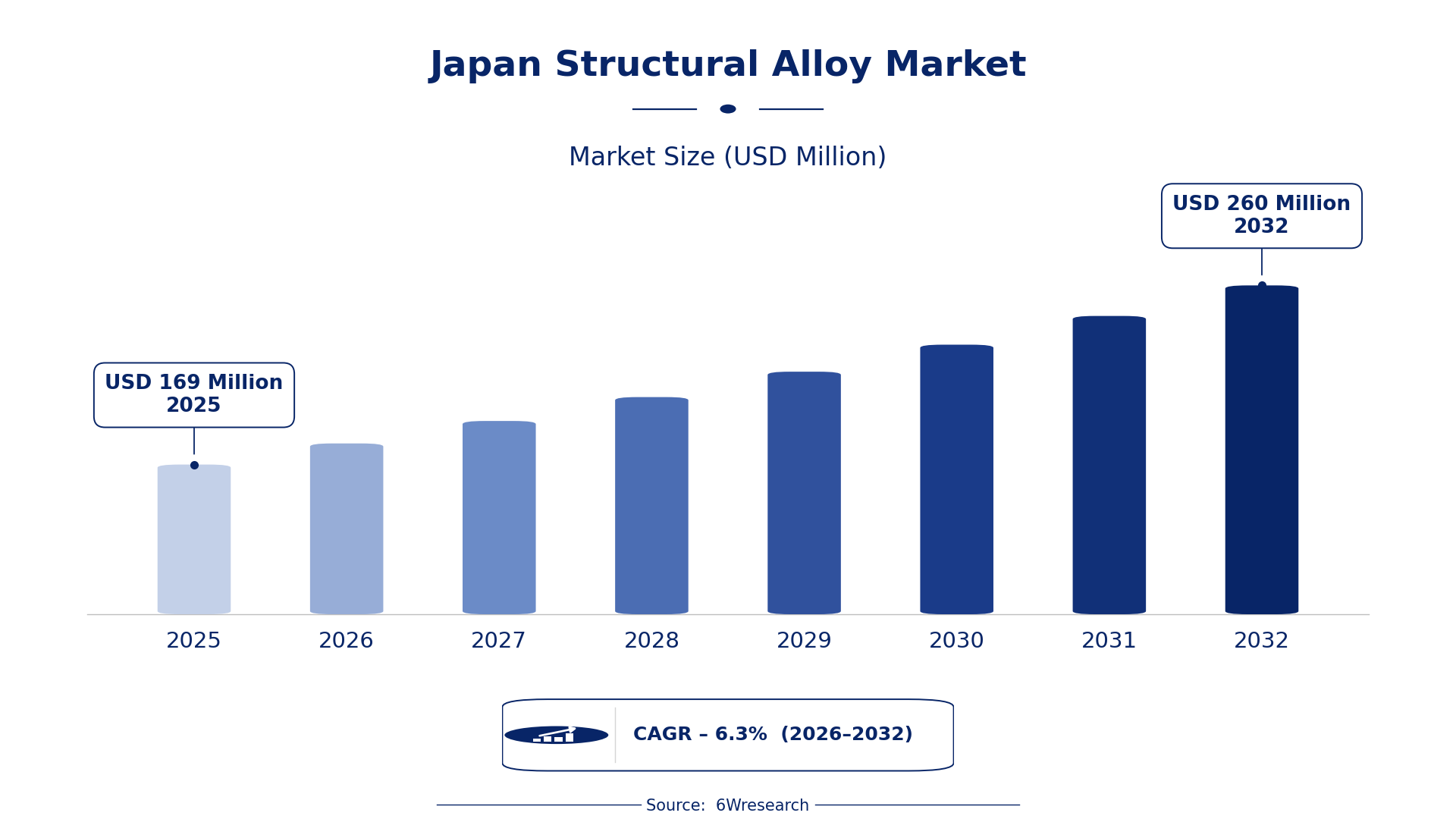
According to 6Wresearch internal database and industry insights, the Japan Structural Alloy Market was valued at USD 169 Million in 2025 and is projected to reach USD 260 Million by 2032, growing at a CAGR of approximately 6.3% during 2026–2032.
Japan Structural Alloy Market Highlights
| Report Metric | Details |
| Report Name | Japan Structural Alloy Market (2026-2032) |
| Market Size 2025 | USD 169 Million |
| Market Size 2032 | USD 260 Million |
| Absolute Growth 2025–2032 | USD 91 Million |
| CAGR 2026–2032 | 6.3% |
| Peak Annual Growth | 7.6% in 2032 |
| Forecast Period | 2026–2032 |
| Historical Data | 2022–2025 |
| Base Year | 2025 |
| Leading Alloy Type, 2025 | Aluminum Alloys (46% share) |
| Leading Base Material, 2025 | Aluminum (46% share) |
| Leading Application Area, 2025 | Aerospace Panels (44% share) |
| Leading End User, 2025 | Aircraft Manufacturers (41% share) |
| Fastest-Growing Alloy Type | Titanium Alloys (8.9% CAGR) |
| Fastest-Growing Base Material | Titanium (9.0% CAGR) |
| Fastest-Growing Application Area | Medical Implants (7.6% CAGR) |
| Fastest-Growing End User | Biomedical Firms (8.4% CAGR) |
| Growing Sector | Aerospace and Automotive |
| Key End Users | Aerospace Manufacturers, Automotive OEMs, Biomedical Firms, Infrastructure Contractors |
Japan Structural Alloy Market Year-wise Growth Rate and Key Drivers (2022–2032)
This graph illustrates the annual growth rates of the market from 2022 to 2032, highlighting a steady upward trajectory and projected market expansion over the forecast period.
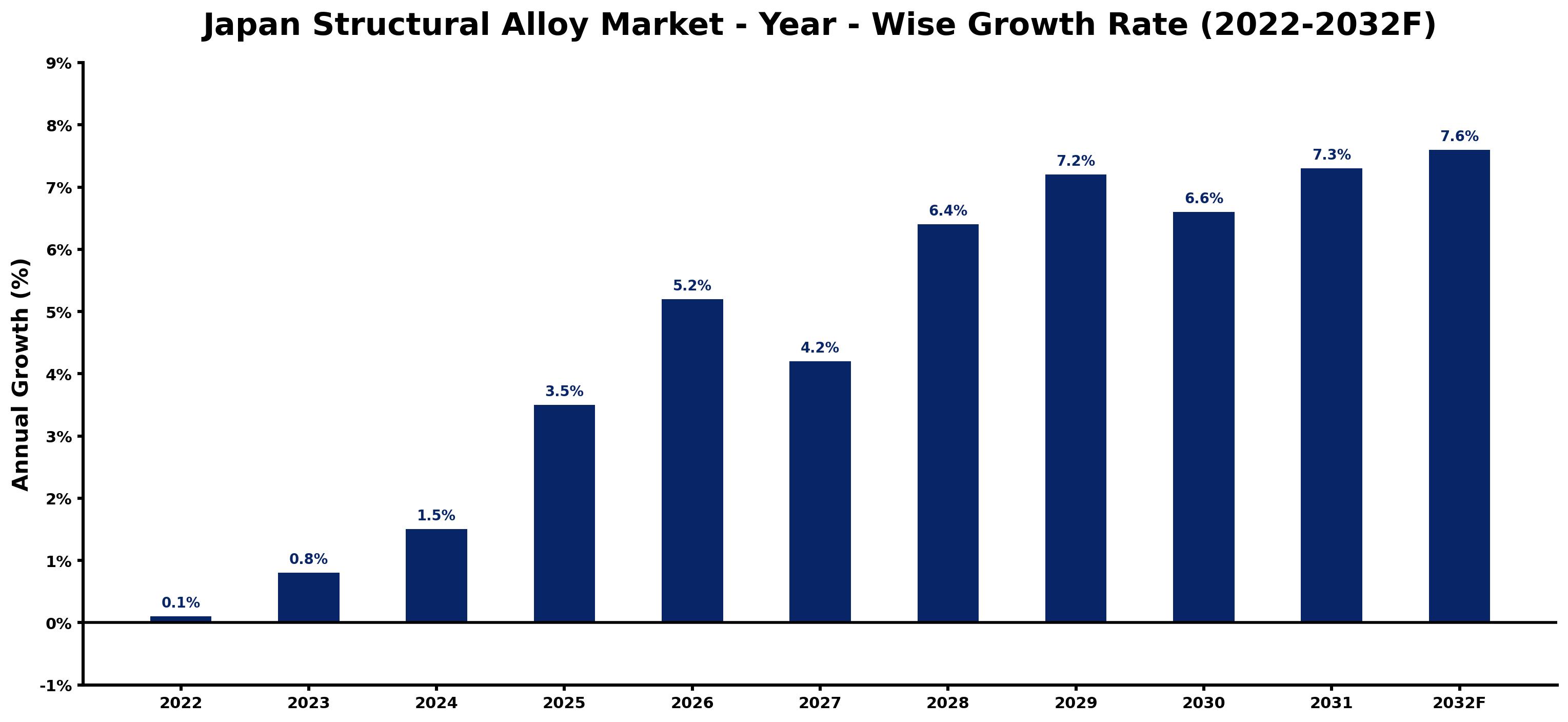
The yearly estimates that follow link every growth rate to its principal driver, so readers can see why the pace changed in each period.
| Year | Estimated Annual Growth (%) | Market Rationale |
| 2022 | 0.1 | The market showed minimal growth due to economic uncertainties affecting demand. |
| 2023 | 0.8 | Growth accelerated as manufacturers increased production to meet rising vehicle demand. |
| 2024 | 1.5 | Continued expansion occurred as the aerospace sector sought advanced materials for new aircraft. |
| 2025 | 3.5 | The market experienced a boost from increased construction activities and infrastructure projects. |
| 2026 | 5.2 | Growth is expected to continue as demand from the automotive sector for lightweight materials increases. |
| 2027 | 4.2 | The rate is projected to slow as supply chain challenges begin to impact production schedules. |
| 2028 | 6.4 | Demand is expected to surge again as advancements in technology lead to new applications in aerospace. |
| 2029 | 7.2 | The market is projected to maintain momentum with strong growth in the medical implants sector. |
| 2030 | 6.6 | Growth is expected to slow slightly as market saturation begins in some application areas. |
| 2031 | 7.3 | The market is projected to rebound with renewed interest in sustainable materials and practices. |
| 2032 | 7.6 | The peak growth is expected to be driven by high demand from the aerospace and automotive industries. |
Note: Market size estimations and growth projections presented in this report are based on 6Wresearch's proprietary forecasting methodology, utilizing the latest available industry data, government publications, and primary research inputs.
Japan Structural Alloy Market Synopsis
Structural alloys are advanced materials known for their high strength-to-weight ratios, produced through various metallurgical processes. They find primary applications in aerospace components, automotive parts, and construction. The Japan Structural Alloy Market is expanding due to increasing domestic demand from the aerospace sector, valued at approximately 2 trillion yen, and the automotive industry, which produced about 8 million vehicles in 2022. Key regions like Tokyo and Aichi are central to manufacturing activities, supported by a focus on lightweight materials and stringent quality standards such as ISO 9001.
Market Dynamics Impact Analysis (2026–2032)
| Factor | Type | Impact | Primary Segment Affected |
| Growing demand from the aerospace sector for lightweight materials. | Driver | High | Aluminum Alloys |
| Increased automotive production necessitating high-performance materials. | Driver | High | Titanium Alloys |
| Emerging opportunities in medical implants due to an aging population. | Opportunity | High | Medical Implants |
| Expansion of construction projects requiring structural integrity and lightweight materials. | Opportunity | High | Construction Supports |
| Supply chain disruptions affecting timely material availability. | Restraint | High | Steel Alloys |
| High production costs limiting competitiveness in global markets. | Restraint | Medium | Aluminum Alloys |
| Rising energy costs impacting manufacturing operations. | Challenge | High | Titanium Alloys |
| Compliance with stringent environmental regulations increasing operational costs. | Challenge | Medium | Steel Alloys |
Evaluation of Drivers in Japan Structural Alloy Market (2026–2032)
These are the developments adding the most demand over the forecast period.
| Drivers | Primary Segment Affected | Why It Matters (Evidence) |
| Increased production of aluminum alloys for lightweight automotive components. | Aluminum Alloys | Japan produces over 1 million tons of aluminum alloys annually, driving demand from vehicle OEMs. |
| Growing aerospace sector requiring advanced titanium alloys for aircraft. | Titanium Alloys | The aerospace sector's value of approximately 2 trillion yen boosts demand for high-performance materials. |
| Expansion of medical implant applications requiring titanium and other alloys. | Medical Implants | The installed base of over 2 million medical implants in Japan drives demand for specialized alloys. |
| Rising construction activities necessitating durable steel alloys. | Steel Alloys | The construction industry in Japan is projected to grow by 3% annually, increasing demand for structural materials. |
| Technological advancements in alloy production processes improving efficiency. | Aluminum Alloys | ISO 9001 standards adoption improves quality, encouraging manufacturers to invest in advanced production technologies. |
Purchasing is picking up as Japan's aerospace sector, valued at approximately 2 trillion yen, drives demand for lightweight materials. The country's automotive industry, producing about 8 million vehicles in 2022, is increasingly adopting aluminum alloys for vehicle components. The installed base of over 2 million medical implants creates a steady demand for titanium alloys. Construction activities are projected to grow by 3% annually, increasing the need for steel alloys. Advances in production processes are improving efficiency, leading to heightened purchasing from manufacturers seeking high-quality materials.
Evaluation of Restraints in Japan Structural Alloy Market
The table below lists the restraints and the evidence behind each.
| Market Restraint | Primary Segment Affected | Why It Matters (Evidence) |
| Supply chain disruptions affecting the availability of raw materials. | Steel Alloys | These disruptions have caused delays in project timelines, impacting infrastructure contractors' operations. |
| High production costs limiting competitiveness in the global market. | Aluminum Alloys | Increased costs have made it challenging for local manufacturers to compete internationally. |
| Regulatory compliance costs increasing operational expenses. | Titanium Alloys | Compliance with JIS standards requires investment in testing and certification, raising costs for producers. |
| Limited availability of skilled labour impacting production capacity. | Medical Implants | The shortage of skilled workers affects the ability of biomedical firms to meet rising demand. |
| Market saturation in certain application areas leading to slower growth. | Aerospace Panels | As the market matures, growth rates are stabilising, impacting purchasing decisions. |
Japan Structural Alloy Market Challenges
A shortage of skilled metallurgy professionals hampers production efficiency, leading to delays for manufacturers in fulfilling orders. Domestic producers struggle against foreign competition, which pressures them to lower prices and reduces profit margins for suppliers. Buyers face extended lead times due to erratic raw material availability, delaying essential projects in the construction and automotive sectors. Rapid technological advancements in alloy production compel traditional manufacturers to innovate, risking obsolescence and market share loss for producers if they fail to adapt.
Trends in the Japan Structural Alloy Market
These developments are changing demand patterns in the Japan Structural Alloy Market.
- Launch of Lightweight Materials Initiative: Japan's 2023 programme to improve lightweight materials in automotive applications is transforming production methods. This initiative aims to increase aluminum alloy usage by 15%.
- Shift Towards Sustainable Alloy Production: Manufacturers are increasingly adopting sustainable practices in alloy production, focusing on recycling and reduced emissions. This trend aligns with the Green Growth Strategy, targeting carbon neutrality by 2050.
- Increased Adoption of JIS Standards: The widespread adoption of JIS standards in the structural alloy industry is enhancing quality assurance. Approximately 70% of manufacturers are now certified, leading to improved product reliability.
- Growth in Medical Implant Applications: The medical implant sector is expanding rapidly, with an installed base of over 2 million units. This growth is driving demand for titanium alloys, particularly in biomedical firms.
Investment Opportunities in the Japan Structural Alloy Market
The openings below show where demand in the Japan Structural Alloy Market is visible and how suppliers can enter.
- Aerospace Manufacturers Seeking Advanced Alloys: Aerospace manufacturers are increasingly looking for high-performance alloys to improve aircraft efficiency. With the sector valued at approximately 2 trillion yen, suppliers can focus on high-quality materials.
- Investment in Lightweight Automotive Components: The automotive sector is prioritising lightweight materials, presenting opportunities for suppliers of aluminum and titanium alloys. The recent programme to enhance lightweight materials in vehicles supports this trend.
- Construction Sector Expansion: With the construction industry projected to grow by 3% annually, there is a significant opportunity for suppliers of structural alloys. Infrastructure contractors are actively seeking durable and lightweight materials.
- Biomedical Firms Expanding Implant Production: Biomedical firms are increasing production of medical implants, creating demand for titanium alloys. Suppliers can enter this market by focusing on quality and compliance with industry standards.
Government Initiatives in the Japan Structural Alloy Market
The Economic Security Promotion Act of 2022 impacts buyers of structural alloys by supporting supply-chain resilience for critical materials. This act encourages local production and reduces dependency on imports, ensuring a steady supply for manufacturers in the aerospace and automotive sectors.
In 2023, Japan allocated 10 billion yen to support lightweight materials through the Ministry of Economy, Trade and Industry. This funding supports research and development in advanced materials, benefiting buyers in the automotive and aerospace industries.
Future Insight of the Japan Structural Alloy Market
By 2032, buyers in the construction sector will demand more structural alloys, driven by increased infrastructure projects. The automotive industry will pivot towards lightweight materials due to a government programme promoting vehicle efficiency. Suppliers must align with JIS standards to meet the evolving needs of healthcare providers, particularly as the medical sector expands. Japan's production of over 1 million tons of aluminum alloys annually will necessitate continuous innovation to cater to specific industry requirements.
Market Segmentation Analysis
Japan Structural Alloy Market report covers a detailed analysis of the following market segments:
By Alloy Type – Aluminum Alloys Lead, Titanium Alloys Expected to Grow Fastest
According to Saurav Kr Singh, Senior Research Analyst at 6Wresearch, with 46% of alloy type revenue in 2025, Aluminum Alloys was the largest category. Aluminum alloys dominate the market due to their widespread use in lightweight structures, particularly in the aerospace sector valued at approximately 2 trillion yen. The concentration of manufacturing facilities in regions like Tokyo and Aichi reinforces their strong market presence. The quickest growth will come from Titanium Alloys, forecast to expand at a CAGR of 8.9% between 2026 and 2032. Titanium alloys are experiencing rapid growth, driven by their essential role in aerospace and medical applications, with increased investments in advanced materials research. The recent programme launched in 2023 to enhance lightweight materials in automotive underscores the rising interest in titanium's capabilities. Suppliers should focus on developing titanium alloys to cater to the growing demand in aerospace and medical sectors.
By Base Material – Aluminum Leads, Titanium Expected to Grow Fastest
Aluminum held 46% of the Japan Structural Alloy Market by base material in 2025. Aluminum is the primary base material, extensively utilised across various applications, especially in the automotive and aerospace industries, which produced approximately 8 million vehicles in 2022. The robust annual production of over 1 million tons of aluminum alloys further solidifies its leading position in the market. Titanium is projected to grow fastest, at a CAGR of 9.0% during 2026–2032. Titanium is rapidly gaining traction as a preferred base material for high-performance applications, particularly in aerospace and biomedical sectors. The increasing focus on lightweight materials in these industries is likely to accelerate titanium's adoption further. Buyers should consider incorporating titanium into their material choices to improve performance in critical applications.
By Application Area – Aerospace Panels Lead, Medical Implants Expected to Grow Fastest
The largest application area category in 2025 was Aerospace Panels, at 44% of revenue. Aerospace panels represent the leading application area, crucial for aircraft manufacturing where structural alloys play a vital role in ensuring safety and operational efficiency. The steady demand from aircraft manufacturers secures a strong position for this segment in the market. Over 2026–2032, Medical Implants are expected to post the fastest growth, at a CAGR of 7.6%. Medical implants are the fastest-growing application area, increasingly employing advanced materials for biomedical uses. The existing installed base of over 2 million medical implants in Japan reflects a robust and expanding market for this segment. Suppliers should target the medical implants segment to leverage the increasing demand for advanced materials in healthcare.
By End User – Aircraft Manufacturers Lead, Biomedical Firms Expected to Grow Fastest
In 2025, Aircraft Manufacturers led the end user split with a 41% share. Aircraft manufacturers are the predominant end users of structural alloys, necessitating high-strength materials for aircraft component production. Their substantial consumption ensures a steady demand for both aluminum and titanium alloys in the market. Biomedical Firms are set to record the highest CAGR in this split, 8.4% over 2026–2032. Biomedical firms represent the fastest-growing end user segment, primarily due to the rising utilisation of titanium and other alloys for medical implants. This growth is propelled by an increasing number of medical procedures and advancements in biomedical technology. Suppliers must adapt their strategies to cater to the specific requirements of biomedical firms to seize growth opportunities in this sector.
Key Attractiveness of the Report
- 10 Years of Market Numbers
- Historical Data Starting from 2022 to 2025
- Base Year 2025
- Forecast Data until 2032
- Key Performance Indicators Impacting the Market
- Major Upcoming Developments and Projects
Key Highlights of the Report:
- Japan Structural Alloy Market Outlook
- Market Size of Japan Structural Alloy Market, 2025
- Forecast of Japan Structural Alloy Market, 2032
- Historical Data and Forecast of Japan Structural Alloy Revenues & Volume for the Period 2022-2032F
- Japan Structural Alloy Market Trend Evolution
- Japan Structural Alloy Market Drivers and Challenges
- Japan Structural Alloy Price Trends
- Japan Structural Alloy Porter's Five Forces
- Japan Structural Alloy Industry Life Cycle
- Historical Data and Forecast of Japan Structural Alloy Market Revenues & Volume By Alloy Type for the Period 2022-2032F
- Historical Data and Forecast of Japan Structural Alloy Market Revenues & Volume By Aluminum Alloys for the Period 2022-2032F
- Historical Data and Forecast of Japan Structural Alloy Market Revenues & Volume By Titanium Alloys for the Period 2022-2032F
- Historical Data and Forecast of Japan Structural Alloy Market Revenues & Volume By Magnesium Alloys for the Period 2022-2032F
- Historical Data and Forecast of Japan Structural Alloy Market Revenues & Volume By Steel Alloys for the Period 2022-2032F
- Historical Data and Forecast of Japan Structural Alloy Market Revenues & Volume By Base Material for the Period 2022-2032F
- Historical Data and Forecast of Japan Structural Alloy Market Revenues & Volume By Aluminum for the Period 2022-2032F
- Historical Data and Forecast of Japan Structural Alloy Market Revenues & Volume By Titanium for the Period 2022-2032F
- Historical Data and Forecast of Japan Structural Alloy Market Revenues & Volume By Magnesium for the Period 2022-2032F
- Historical Data and Forecast of Japan Structural Alloy Market Revenues & Volume By Carbon Steel for the Period 2022-2032F
- Historical Data and Forecast of Japan Structural Alloy Market Revenues & Volume By Application Area for the Period 2022-2032F
- Historical Data and Forecast of Japan Structural Alloy Market Revenues & Volume By Aerospace Panels for the Period 2022-2032F
- Historical Data and Forecast of Japan Structural Alloy Market Revenues & Volume By Medical Implants for the Period 2022-2032F
- Historical Data and Forecast of Japan Structural Alloy Market Revenues & Volume By Automotive Frames for the Period 2022-2032F
- Historical Data and Forecast of Japan Structural Alloy Market Revenues & Volume By Construction Supports for the Period 2022-2032F
- Historical Data and Forecast of Japan Structural Alloy Market Revenues & Volume By End User for the Period 2022-2032F
- Historical Data and Forecast of Japan Structural Alloy Market Revenues & Volume By Aircraft Manufacturers for the Period 2022-2032F
- Historical Data and Forecast of Japan Structural Alloy Market Revenues & Volume By Biomedical Firms for the Period 2022-2032F
- Historical Data and Forecast of Japan Structural Alloy Market Revenues & Volume By Vehicle OEMs for the Period 2022-2032F
- Historical Data and Forecast of Japan Structural Alloy Market Revenues & Volume By Infrastructure Contractors for the Period 2022-2032F
- Japan Structural Alloy Import Export Trade Statistics
- Market Opportunity Assessment By Alloy Type
- Market Opportunity Assessment By Base Material
- Market Opportunity Assessment By Application Area
- Market Opportunity Assessment By End User
- Japan Structural Alloy Top Companies Market Share
- Japan Structural Alloy Competitive Benchmarking By Technical and Operational Parameters
- Japan Structural Alloy Company Profiles
- Japan Structural Alloy Key Strategic Recommendations
Market Covered
Coverage by segment is as follows.
By Alloy Type
- Aluminum Alloys
- Titanium Alloys
- Magnesium Alloys
- Steel Alloys
By Base Material
- Aluminum
- Titanium
- Magnesium
- Carbon Steel
By Application Area
- Aerospace Panels
- Medical Implants
- Automotive Frames
- Construction Supports
By End User
- Aircraft Manufacturers
- Biomedical Firms
- Vehicle OEMs
- Infrastructure Contractors































