Japan Structural Body Component Market Size & Growth Rate
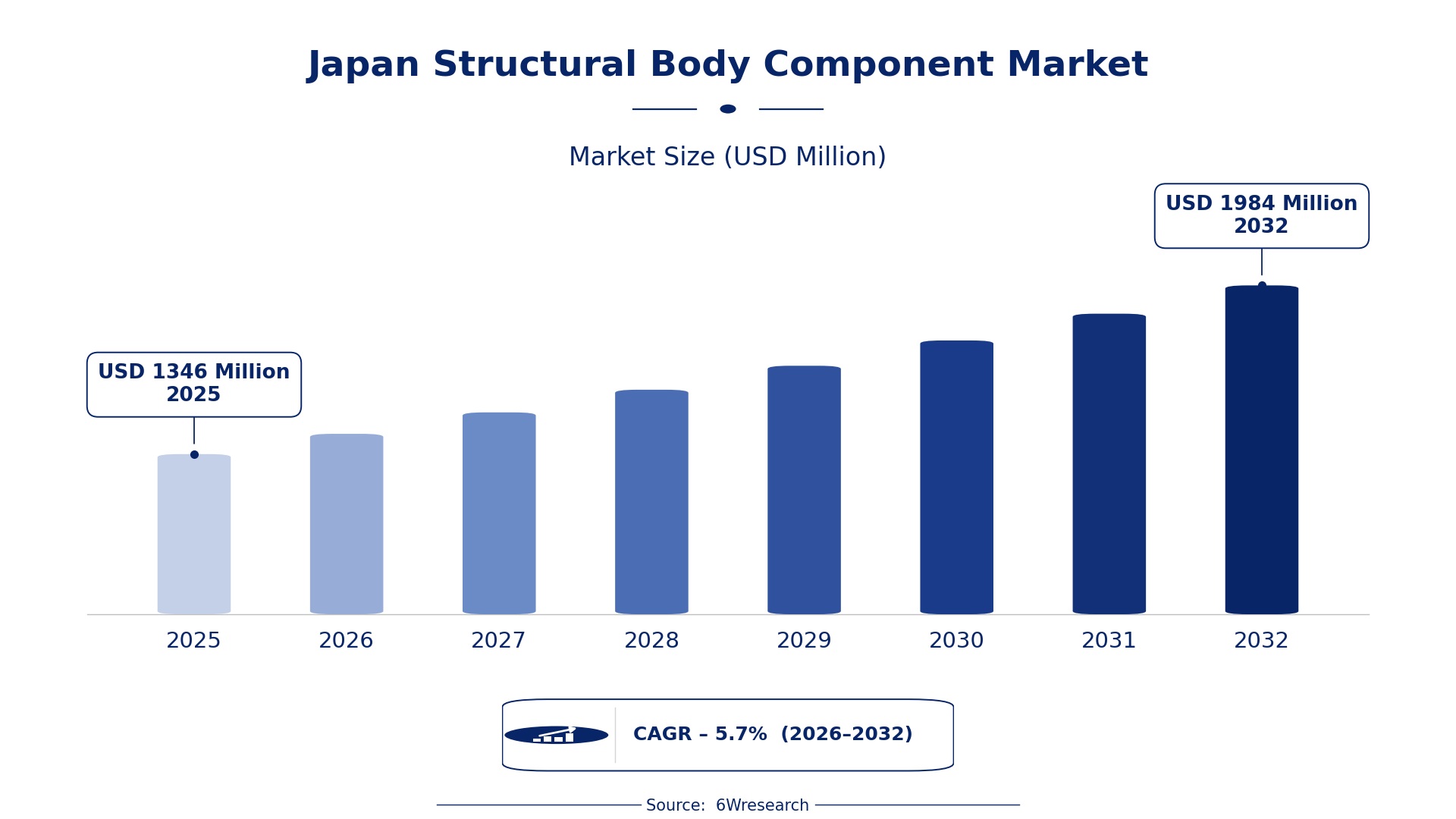
According to 6Wresearch internal database and industry insights, the Japan Structural Body Component Market was valued at USD 1,346 Million in 2025 and is projected to reach USD 1,984 Million by 2032, growing at a CAGR of approximately 5.7% during 2026–2032.
Japan Structural Body Component Market Highlights
| Report Metric | Details |
| Report Name | Japan Structural Body Component Market (2026-2032) |
| Market Size 2025 | USD 1,346 Million |
| Market Size 2032 | USD 1,984 Million |
| Absolute Growth 2025–2032 | USD 638 Million |
| CAGR 2026–2032 | 5.7% |
| Peak Annual Growth | 6.5% in 2028 |
| Forecast Period | 2026–2032 |
| Historical Data | 2022–2025 |
| Base Year | 2025 |
| Leading Component Type, 2025 | Front End Structures (38% share) |
| Leading Position, 2025 | Front (40% share) |
| Leading Manufacturing Process, 2025 | Press Forming (47% share) |
| Leading End User, 2025 | Passenger Car Manufacturers (38% share) |
| Fastest-Growing Component Type | Side Impact Beams (7.9% CAGR) |
| Fastest-Growing Position | Side (7.4% CAGR) |
| Fastest-Growing Manufacturing Process | Hot Stamping (8.0% CAGR) |
| Fastest-Growing End User | Electric Vehicle Makers (7.7% CAGR) |
| Growing Sector | Electric Vehicle Makers |
| Key End Users | Passenger Car Manufacturers, Automotive OEMs, Electric Vehicle Makers, Safety System Providers |
Japan Structural Body Component Market Year-wise Growth Rate and Key Drivers (2022–2032)
This graph illustrates the annual growth rates of the market from 2022 to 2032, highlighting a steady upward trajectory and projected market expansion over the forecast period.
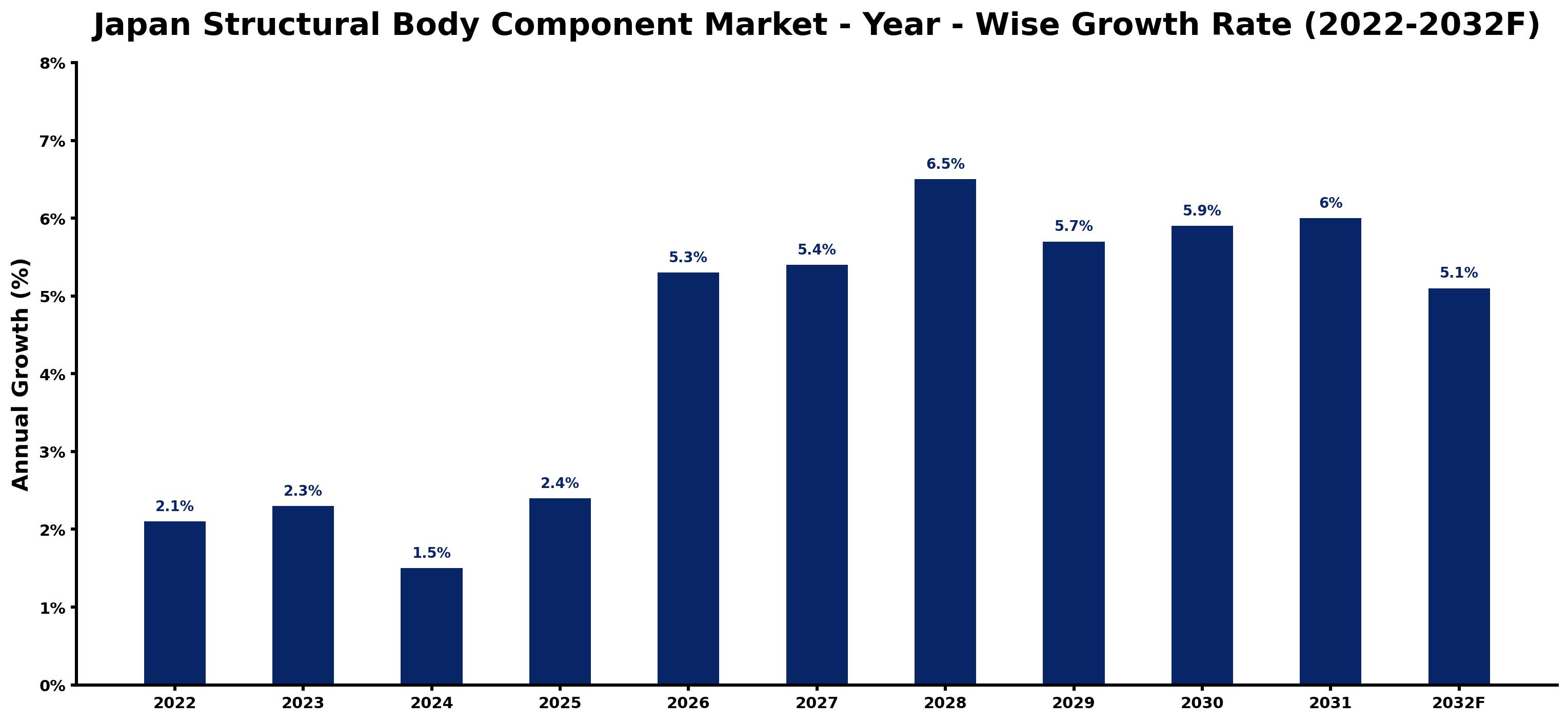
Each row of the following table gives one year's estimated growth and the event or demand shift that explains it.
| Year | Estimated Annual Growth (%) | Market Rationale |
| 2022 | 2.1 | The market exhibited stable growth with moderate activity in structural body components. |
| 2023 | 2.3 | Demand increased due to rising production rates among automotive manufacturers. |
| 2024 | 1.5 | Growth slowed as supply chain disruptions affected component availability. |
| 2025 | 2.4 | Production ramped up, driven by new vehicle launches and increased consumer demand. |
| 2026 | 5.3 | Investment in manufacturing capacity surged, leading to increased demand. |
| 2027 | 5.4 | Continued investment in technology enhanced production efficiency and output. |
| 2028 | 6.5 | Peak growth is expected as demand from electric vehicle makers surges. |
| 2029 | 5.7 | Growth is projected to slow slightly as the market adjusts to increased supply capabilities. |
| 2030 | 5.9 | Demand will rise again as new standards for safety and efficiency are adopted. |
| 2031 | 6.0 | The market will continue to expand with rising investments in advanced manufacturing. |
| 2032 | 5.1 | Growth is expected to moderate as the market stabilises after rapid expansion. |
Note: Market size estimations and growth projections presented in this report are based on 6Wresearch's proprietary forecasting methodology, utilizing the latest available industry data, government publications, and primary research inputs.
Japan Structural Body Component Market Synopsis
Structural body components are crucial elements in vehicle manufacturing, encompassing front end structures and side impact beams. The Japan Structural Body Component Market is growing as passenger car manufacturers increase production rates and invest in battery manufacturing capacity. The Battery Industry Strategy aims for 150 GWh of domestic battery manufacturing capacity by 2030, which drives demand for components that support electric vehicle production and supports overall market growth.
Market Dynamics Impact Analysis (2026–2032)
| Factor | Type | Impact | Primary Segment Affected |
| Increased production rates in the automotive sector | Driver | High | Front End Structures |
| Growing demand for electric vehicles | Driver | High | Side Impact Beams |
| Rising consumer preference for safety features | Opportunity | High | Roof Rails |
| Expansion of domestic battery manufacturing | Opportunity | High | Rear Cross Members |
| Supply chain disruptions affecting component availability | Restraint | High | Front End Structures |
| High raw material costs impacting production | Restraint | High | Side Impact Beams |
| Competition from international manufacturers | Challenge | Medium | Roof Rails |
| Technological advancements requiring significant investment | Challenge | Medium | Rear Cross Members |
Evaluation of Drivers in Japan Structural Body Component Market (2026–2032)
Below are the drivers that matter most for revenue growth, with supporting evidence.
| Drivers | Primary Segment Affected | Why It Matters (Evidence) |
| Increased production rates among automotive manufacturers | Front End Structures | This leads to higher demand for structural components as vehicle output rises, with passenger car production reaching 8 million units in 2022. |
| Growing adoption of electric vehicles | Side Impact Beams | Electric vehicle makers are investing heavily in safety features, increasing demand for advanced body components. |
| Rising consumer preference for safety features | Roof Rails | Safety regulations are becoming stricter, prompting manufacturers to improve vehicle safety with better components. |
| Expansion of domestic battery manufacturing | Rear Cross Members | The Battery Industry Strategy aims for 150 GWh capacity by 2030, driving demand for components in electric vehicles. |
| Technological advancements in manufacturing processes | Hot Stamping | Innovations in manufacturing are improving efficiency, prompting increased production of advanced structural components. |
Much of the new demand stems from heightened production rates in the automotive sector, with passenger car production reaching 8 million units in 2022. This increase in output is driving the need for structural components, particularly front end structures, which are vital for vehicle safety and performance. The rising adoption of electric vehicles creates a market for side impact beams, as manufacturers invest in advanced safety features. The expansion of domestic battery manufacturing capacity, targeting 150 GWh by 2030, fuels demand for components that support electric vehicle production.
Evaluation of Restraints in Japan Structural Body Component Market
Several factors work against faster growth; the main ones are summarised below.
| Market Restraint | Primary Segment Affected | Why It Matters (Evidence) |
| Supply chain disruptions affecting component availability | Front End Structures | These disruptions have led to delays in production schedules, impacting the ability of manufacturers to meet demand. |
| High raw material costs impacting production | Side Impact Beams | Rising prices for essential materials have squeezed profit margins and increased costs for manufacturers. |
| Regulatory compliance costs for safety standards | Roof Rails | Manufacturers face increased expenses to meet stringent safety regulations, affecting pricing strategies. |
| Limited skilled workforce in advanced manufacturing | Rear Cross Members | A shortage of skilled workers in the manufacturing sector hampers production capabilities and efficiency. |
| Competition from international manufacturers | Hot Stamping | Local producers face pressure from foreign companies offering lower prices and advanced technologies. |
Japan Structural Body Component Market Challenges
Complex material regulations create compliance challenges, resulting in production delays for manufacturers who must secure multiple approvals. Limited domestic supplier options lead to supply chain disruptions, extending lead times for producers needing critical components. Rising raw material prices can inflate project costs by 15%, forcing buyers to adjust budgets and potentially delaying project timelines. Increased competition compels suppliers to lower prices, which may compromise the quality of components and negatively impact operational efficiency for buyers.
Trends in the Japan Structural Body Component Market
Buyers and suppliers in the Japan Structural Body Component Market are adjusting to the following trends.
- Shift towards Advanced Manufacturing Techniques: The adoption of hot stamping has increased among automotive manufacturers, with production rates rising by 20% since 2021. This shift improves component strength and reduces weight, appealing to electric vehicle makers.
- Growth in Electric Vehicle Production: The rise in electric vehicle production is evident in regions like Nagoya, where output has increased by 30% since 2020. This trend drives demand for structural components tailored to EV specifications.
- Emphasis on Safety Standards: Since 2022, the implementation of stricter safety standards has led to a notable increase in demand for side impact beams. Manufacturers are adapting their production lines to meet these new regulations.
- Expansion of Domestic Battery Manufacturing: The Battery Industry Strategy initiated in 2022 aims for substantial growth in capacity by 2030, increasing demand for structural components in electric vehicles.
Investment Opportunities in the Japan Structural Body Component Market
The opportunities below stand out in the Japan Structural Body Component Market for new entrants and existing suppliers.
- Passenger Car Manufacturers seeking advanced components: With production expected to reach 9 million units by 2025, there is a growing need for high-quality structural components. Collaborating with local manufacturers can help suppliers tap into this expanding market.
- Electric Vehicle Makers investing in safety features: The push for enhanced safety in electric vehicles creates a demand for advanced body components. Suppliers can enter this market by partnering with automotive manufacturers focused on innovation.
- Regional automotive hubs expanding production capacity: Regions like Aichi are investing heavily in automotive manufacturing, with production expected to grow by 25% by 2026. Suppliers should consider establishing local partnerships to meet this demand.
- New safety regulations driving component upgrades: As safety standards evolve, manufacturers are looking for innovative solutions. Suppliers can seize opportunities by developing compliant products that meet the latest regulations.
Government Initiatives in the Japan Structural Body Component Market
The Electrical Appliance and Material Safety Act regulates the safety of electrical appliances and materials in Japan, ensuring that structural body components meet safety standards. Compliance with these regulations is crucial for manufacturers to maintain market access and consumer trust. The act mandates rigorous testing and certification processes, impacting production timelines and costs.
The Battery Industry Strategy aims for substantial growth in domestic battery manufacturing capacity by 2030, creating opportunities for structural body component suppliers to engage with electric vehicle manufacturers and expand their market presence. This strategy encourages collaboration between battery producers and automotive manufacturers, promoting innovation in component design and production.
Future Insight of the Japan Structural Body Component Market
By 2032, clinics will see improved production efficiency through the adoption of robotics in manufacturing processes. Enhanced recycling programmes will enable suppliers to minimise waste and reduce costs. New quality standards will ensure greater reliability and safety in components, boosting buyer confidence. The market will shift towards smart manufacturing facilities, allowing suppliers to adapt swiftly to changing demands.
Market Segmentation Analysis
Japan Structural Body Component Market report covers a detailed analysis of the following market segments:
By Component Type – Front End Structures Lead, Side Impact Beams Expected to Grow Fastest
According to Saurav Kr Singh, Senior Research Analyst at 6Wresearch, the largest component type category in 2025 was Front End Structures, at 38% of revenue. Front End Structures dominate the market due to their critical role in vehicle safety and design, with a substantial presence in passenger vehicles. Their importance is underscored by compliance with Japan's rigorous safety standards, which necessitate robust front-end designs. Side Impact Beams are projected to grow fastest, at a CAGR of 7.9% during 2026–2032. Side Impact Beams are experiencing rapid growth as manufacturers increasingly focus on passenger safety, with demand surging in recent years. This trend is driven by stricter regulatory frameworks and a rising consumer emphasis on advanced safety features. Suppliers should prioritise the development of innovative side impact beam solutions to align with the growing market demand.
By Position – Front Leads, Side Expected to Grow Fastest
Front held 40% of the Japan Structural Body Component Market by position in 2025. The Front position leads the market as it is essential for vehicle safety and design, with most vehicles featuring advanced front-end structures. This segment is crucial for meeting crash test standards and fulfilling consumer safety expectations. The quickest growth will come from Side, forecast to expand at a CAGR of 7.4% between 2026 and 2032. The Side position is witnessing swift growth due to the heightened emphasis on side-impact safety, evidenced by a marked increase in side airbag installations in new vehicle models. This trend reflects a broader industry commitment to comprehensive safety measures. Buyers need to prioritise side safety features when selecting components to ensure alignment with evolving safety regulations.
By Manufacturing Process – Press Forming Leads, Hot Stamping Expected to Grow Fastest
Press Forming accounted for 47% of the market by manufacturing process in 2025. Press Forming is the leading process due to its efficiency and ability to produce complex shapes required for structural components, widely used in the production of front end structures. Its established presence in the market ensures a steady supply chain. Over 2026–2032, Hot Stamping is expected to post the fastest growth, at a CAGR of 8.0%. Hot Stamping is rapidly gaining traction as it allows for the production of lightweight yet strong components, with a projected growth rate of 20% in the next five years. This process is particularly advantageous in the manufacturing of side impact beams. Manufacturers should invest in hot stamping capabilities to stay competitive in the evolving market.
By End User – Passenger Car Manufacturers Lead, Electric Vehicle Makers Expected to Grow Fastest
With 38% of end user revenue in 2025, Passenger Car Manufacturers was the largest category. Passenger Car Manufacturers hold the largest share as they represent the majority of vehicle production in Japan, focusing on structural components that enhance safety and performance. Their high production volumes ensure a consistent demand for body components. Electric Vehicle Makers are set to record the highest CAGR in this split, 7.7% over 2026–2032. Electric Vehicle Makers are the fastest-growing segment, reflecting the industry's shift towards electric mobility with a notable rise in production rates. This transition creates a demand for lightweight and efficient structural components tailored for electric vehicles. Suppliers should customise their offerings to address the specific needs of electric vehicle manufacturers to capitalise on this growth opportunity.
Key Attractiveness of the Report
- 10 Years of Market Numbers
- Historical Data Starting from 2022 to 2025
- Base Year 2025
- Forecast Data until 2032
- Key Performance Indicators Impacting the Market
- Major Upcoming Developments and Projects
Key Highlights of the Report:
- Japan Structural Body Component Market Outlook
- Market Size of Japan Structural Body Component Market, 2025
- Forecast of Japan Structural Body Component Market, 2032
- Historical Data and Forecast of Japan Structural Body Component Revenues & Volume for the Period 2022-2032F
- Japan Structural Body Component Market Trend Evolution
- Japan Structural Body Component Market Drivers and Challenges
- Japan Structural Body Component Price Trends
- Japan Structural Body Component Porter's Five Forces
- Japan Structural Body Component Industry Life Cycle
- Historical Data and Forecast of Japan Structural Body Component Market Revenues & Volume By Component Type for the Period 2022-2032F
- Historical Data and Forecast of Japan Structural Body Component Market Revenues & Volume By Front End Structures for the Period 2022-2032F
- Historical Data and Forecast of Japan Structural Body Component Market Revenues & Volume By Side Impact Beams for the Period 2022-2032F
- Historical Data and Forecast of Japan Structural Body Component Market Revenues & Volume By Roof Rails for the Period 2022-2032F
- Historical Data and Forecast of Japan Structural Body Component Market Revenues & Volume By Rear Cross Members for the Period 2022-2032F
- Historical Data and Forecast of Japan Structural Body Component Market Revenues & Volume By Position for the Period 2022-2032F
- Historical Data and Forecast of Japan Structural Body Component Market Revenues & Volume By Front for the Period 2022-2032F
- Historical Data and Forecast of Japan Structural Body Component Market Revenues & Volume By Side for the Period 2022-2032F
- Historical Data and Forecast of Japan Structural Body Component Market Revenues & Volume By Top for the Period 2022-2032F
- Historical Data and Forecast of Japan Structural Body Component Market Revenues & Volume By Rear for the Period 2022-2032F
- Historical Data and Forecast of Japan Structural Body Component Market Revenues & Volume By Manufacturing Process for the Period 2022-2032F
- Historical Data and Forecast of Japan Structural Body Component Market Revenues & Volume By Press Forming for the Period 2022-2032F
- Historical Data and Forecast of Japan Structural Body Component Market Revenues & Volume By Laser Welding for the Period 2022-2032F
- Historical Data and Forecast of Japan Structural Body Component Market Revenues & Volume By Hot Stamping for the Period 2022-2032F
- Historical Data and Forecast of Japan Structural Body Component Market Revenues & Volume By Die Casting for the Period 2022-2032F
- Historical Data and Forecast of Japan Structural Body Component Market Revenues & Volume By End User for the Period 2022-2032F
- Historical Data and Forecast of Japan Structural Body Component Market Revenues & Volume By Passenger Car Manufacturers for the Period 2022-2032F
- Historical Data and Forecast of Japan Structural Body Component Market Revenues & Volume By Safety System Providers for the Period 2022-2032F
- Historical Data and Forecast of Japan Structural Body Component Market Revenues & Volume By Automotive OEMs for the Period 2022-2032F
- Historical Data and Forecast of Japan Structural Body Component Market Revenues & Volume By Electric Vehicle Makers for the Period 2022-2032F
- Japan Structural Body Component Import Export Trade Statistics
- Market Opportunity Assessment By Component Type
- Market Opportunity Assessment By Position
- Market Opportunity Assessment By Manufacturing Process
- Market Opportunity Assessment By End User
- Japan Structural Body Component Top Companies Market Share
- Japan Structural Body Component Competitive Benchmarking By Technical and Operational Parameters
- Japan Structural Body Component Company Profiles
- Japan Structural Body Component Key Strategic Recommendations
Market Covered
Segments analysed in this report are listed below.
By Component Type
- Front End Structures
- Side Impact Beams
- Roof Rails
- Rear Cross Members
By Position
- Front
- Side
- Top
- Rear
By Manufacturing Process
- Press Forming
- Laser Welding
- Hot Stamping
- Die Casting
By End User
- Passenger Car Manufacturers
- Safety System Providers
- Automotive OEMs
- Electric Vehicle Makers































