Japan Structural Bonding Materials Market Size & Growth Rate
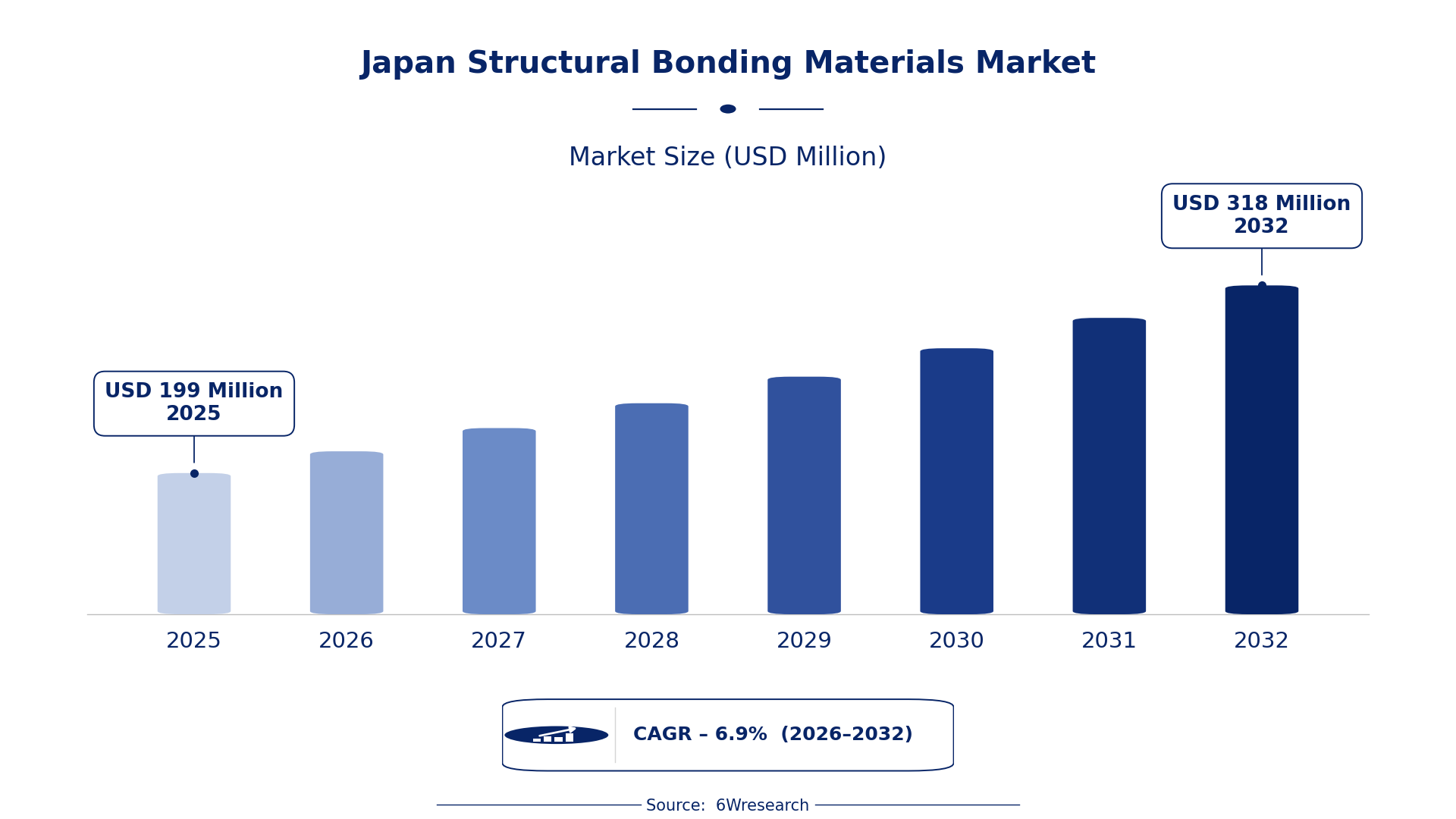
According to 6Wresearch internal database and industry insights, the Japan Structural Bonding Materials Market was valued at USD 199 Million in 2025 and is projected to reach USD 318 Million by 2032, growing at a CAGR of approximately 6.9% during 2026–2032.
Japan Structural Bonding Materials Market Highlights
| Report Metric | Details |
| Report Name | Japan Structural Bonding Materials Market (2026-2032) |
| Market Size 2025 | USD 199 Million |
| Market Size 2032 | USD 318 Million |
| Absolute Growth 2025–2032 | USD 119 Million |
| CAGR 2026–2032 | 6.9% |
| Peak Annual Growth | 7.9% in 2032 |
| Forecast Period | 2026–2032 |
| Historical Data | 2022–2025 |
| Base Year | 2025 |
| Leading Material Type, 2025 | Epoxy Resins (39% share) |
| Leading Chemical Base, 2025 | Thermosetting Polymer (44% share) |
| Leading Bonding Application, 2025 | Aerospace Structures (42% share) |
| Leading End User, 2025 | Aviation OEMs (39% share) |
| Fastest-Growing Material Type | Acrylics (9.7% CAGR) |
| Fastest-Growing Chemical Base | Solvent-Free (9.1% CAGR) |
| Fastest-Growing Bonding Application | Automotive Panels (9.3% CAGR) |
| Fastest-Growing End User | Body Assembly Units (9.0% CAGR) |
| Growing Sector | Aerospace |
| Key End Users | Aviation OEMs, Automotive Manufacturers, Construction Firms |
Japan Structural Bonding Materials Market Year-wise Growth Rate and Key Drivers (2022–2032)
This graph illustrates the annual growth rates of the market from 2022 to 2032, highlighting a steady upward trajectory and projected market expansion over the forecast period.
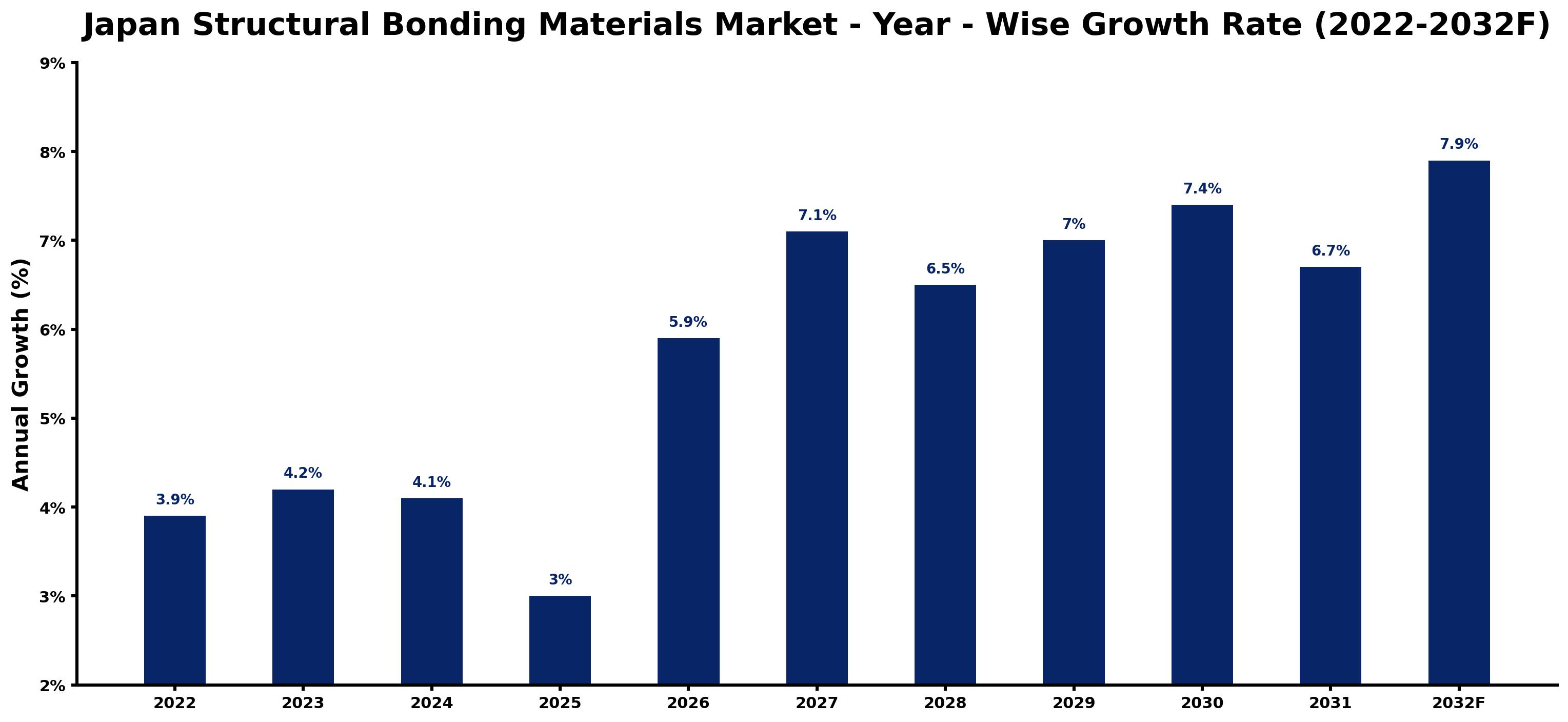
Year by year, the estimates below pair each growth rate with the development that shaped it.
| Year | Estimated Annual Growth (%) | Market Rationale |
| 2022 | 3.9 | The market experienced steady growth due to ongoing infrastructure projects. |
| 2023 | 4.2 | Demand increased as the automotive sector ramped up production following recovery efforts. |
| 2024 | 4.1 | Growth slowed slightly as manufacturers adjusted to market conditions. |
| 2025 | 3.0 | A decrease in growth occurred amid stabilisation in the construction sector. |
| 2026 | 5.9 | Demand rises as new eco-friendly bonding materials gain traction in projects. |
| 2027 | 7.1 | The aerospace sector's expansion drives a rise in bonding material requirements. |
| 2028 | 6.5 | Growth slows as the market adjusts to increased supply capacity. |
| 2029 | 7.0 | Demand accelerates with new automotive models requiring advanced bonding solutions. |
| 2030 | 7.4 | A surge in construction projects boosts the need for structural adhesives. |
| 2031 | 6.7 | Growth moderates as the market begins to stabilise after rapid expansion. |
| 2032 | 7.9 | Demand peaks as the market adapts to evolving industry standards. |
Note: Market size estimations and growth projections presented in this report are based on 6Wresearch's proprietary forecasting methodology, utilizing the latest available industry data, government publications, and primary research inputs.
Japan Structural Bonding Materials Market Synopsis
Structural bonding materials are advanced adhesives primarily composed of polymers, essential in construction and manufacturing. Their applications span aerospace, automotive, and construction industries. The Japan Structural Bonding Materials Market is growing due to rising demand from domestic manufacturers, investments in decarbonisation, and ongoing infrastructure projects. With the aerospace sector projected to require over 1,000 tons of structural bonding materials by 2025, and the automotive industry producing approximately 8.3 million vehicles in 2022, the market is set for sustained growth.
Market Dynamics Impact Analysis (2026–2032)
| Factor | Type | Impact | Primary Segment Affected |
| Increasing demand from the aerospace sector for lightweight bonding solutions | Driver | High | Aerospace Structures |
| Growing investments in eco-friendly bonding materials due to regulations | Driver | High | Solvent-Free |
| Rising demand for polyurethane adhesives due to their versatility | Opportunity | High | Polyurethanes |
| Expansion of the automotive industry in key regions like Tokyo and Aichi | Opportunity | High | Automotive Panels |
| Environmental regulations limiting traditional adhesive use | Restraint | Medium | Epoxy Resins |
| Market saturation in certain bonding applications constraining growth | Restraint | Medium | Acrylics |
| Supply chain disruptions affecting material availability | Challenge | High | Polyurethanes |
| Technological advancements outpacing current production capabilities | Challenge | Medium | Thermosetting Polymer |
Evaluation of Drivers in Japan Structural Bonding Materials Market (2026–2032)
The main growth drivers and the segments they affect most are set out below.
| Drivers | Primary Segment Affected | Why It Matters (Evidence) |
| Demand from the aerospace sector | Aerospace Structures | The aerospace sector's growth, requiring over 1,000 tons of bonding materials by 2025, drives increased purchases. |
| Investment in eco-friendly bonding materials | Solvent-Free | Japan's GX Basic Policy targets JPY 150 trillion for decarbonisation, boosting demand for sustainable materials. |
| Automotive production levels | Automotive Panels | The automotive industry produced approximately 8.3 million vehicles in 2022, increasing demand for bonding solutions. |
| Infrastructure projects in construction | Prefab Construction | The construction sector is projected to see a 5% increase in structural adhesive use by 2025, driving demand. |
| Technological advancements in bonding applications | Polyurethanes | The versatility of polyurethane adhesives is likely to lead to market growth. |
The strongest pull on demand comes from the aerospace sector, projected to require over 1,000 tons of structural bonding materials by 2025. Investment in eco-friendly bonding materials is rising, driven by Japan's commitment to decarbonisation, targeting JPY 150 trillion over ten years. The automotive industry produced approximately 8.3 million vehicles in 2022, increasing the need for bonding solutions. Infrastructure projects are expected to boost the construction sector's use of structural adhesives by 5% by 2025. Technological advancements in bonding applications, particularly for polyurethane adhesives, are also contributing to market growth.
Evaluation of Restraints in Japan Structural Bonding Materials Market
The table below lists the restraints and the evidence behind each.
| Market Restraint | Primary Segment Affected | Why It Matters (Evidence) |
| Environmental regulations limiting traditional adhesive use | Epoxy Resins | Regulations restrict the use of certain adhesives, impacting production capabilities and material choices. |
| Market saturation in specific bonding applications | Acrylics | Saturation in the market for acrylic adhesives limits growth opportunities for manufacturers. |
| Supply chain disruptions affecting material availability | Polyurethanes | Supply chain issues have led to delays and increased costs for polyurethane adhesive procurement. |
| Increased competition among manufacturers | Thermosetting Polymer | Rising competition pressures prices and profit margins, affecting overall market conditions. |
| Limited awareness of advanced bonding technologies | Solvent-Free | Many potential users remain unaware of the benefits of solvent-free adhesives, hindering market penetration. |
Japan Structural Bonding Materials Market Challenges
Producers of structural bonding materials encounter intense competition from international suppliers, which can reduce profit margins by up to 15% for local manufacturers. Compliance with evolving regulations on eco-friendly materials raises production costs by approximately 10% for smaller firms, straining their financial resources. Many local producers lag in adopting new bonding technologies, resulting in product launch delays averaging six months, hindering market responsiveness. Supply chain disruptions, intensified by recent global events, can lead to material shortages, causing project delays of up to three months for construction firms that depend on timely deliveries.
Trends in the Japan Structural Bonding Materials Market
Four trends stand out in the Japan Structural Bonding Materials Market.
- Shift towards Eco-Friendly Bonding Materials: The trend towards eco-friendly bonding materials began in 2023, driven by government initiatives. The Ministry of Land, Infrastructure, Transport and Tourism promotes advanced bonding materials, aiming for a 46% reduction in greenhouse gas emissions by 2030.
- Transition from Traditional to Advanced Adhesives: The transition started in 2022, as industries adopt advanced adhesives for better performance. The aerospace sector's demand for lightweight bonding solutions is projected to require over 1,000 tons by 2025.
- Emergence of Polyurethane Adhesives: Polyurethane adhesives are gaining prominence, particularly in the automotive sector. The market for these adhesives is anticipated to grow due to their versatility in applications.
- Focus on Prefabricated Construction: Prefabricated construction is increasingly prioritised, especially in urban areas. The construction sector is projected to see a 5% increase in structural adhesive use by 2025, reflecting this trend.
Investment Opportunities in the Japan Structural Bonding Materials Market
Several openings in the Japan Structural Bonding Materials Market merit attention from investors.
- Supply of Eco-Friendly Bonding Materials: With Japan's target of JPY 150 trillion for decarbonisation, there is an opportunity to supply eco-friendly bonding materials. Construction firms are increasingly seeking sustainable solutions.
- Investment in Polyurethane Adhesives: The market for polyurethane adhesives is set to grow due to their versatility. Automotive manufacturers are looking for effective bonding solutions to enhance vehicle performance.
- Expansion in Aerospace Bonding Applications: The aerospace sector is rapidly expanding, creating opportunities for suppliers of structural bonding materials. Companies can enter this market by collaborating with aviation OEMs.
- Development of Advanced Adhesive Technologies: The shift towards advanced adhesives presents opportunities for investment in R&D. Manufacturers focusing on effective bonding solutions will benefit from growing demand.
Government Initiatives in the Japan Structural Bonding Materials Market
The Green Growth Strategy Through Achieving Carbon Neutrality in 2050, updated in 2021, builds on earlier regulations such as the Chemical Substances Control Law of 1973. This strategy aims to identify growth sectors, including advanced bonding materials, promoting investments in eco-friendly solutions and compliance with environmental standards.
The PRTR Law requires businesses to report chemical substance releases, ensuring that construction firms understand the environmental impact of the bonding materials they use, encouraging the adoption of safer alternatives.
Future Insight of the Japan Structural Bonding Materials Market
Japan's ambitious decarbonisation goals will drive a shift towards advanced adhesive technologies, prompting suppliers to innovate. By 2032, the anticipated investment in decarbonisation initiatives will enhance production capabilities significantly. The aerospace sector's requirement for over 1,200 tons of structural bonding materials by 2025 will further stimulate market growth. As the construction sector increases its use of structural adhesives by 5% by 2025, buyers will experience improved product offerings that meet new standards.
Market Segmentation Analysis
Japan Structural Bonding Materials Market report covers a detailed analysis of the following market segments:
By Material Type – Epoxy Resins Lead, Acrylics Expected to Grow Fastest
According to Saurav Kr Singh, Senior Research Analyst at 6Wresearch, in 2025, Epoxy Resins led the material type split with a 39% share. Epoxy resins dominate the market due to their extensive application in creating strong and durable bonds, particularly in aerospace and automotive sectors. Their established use in Japan's manufacturing, along with compliance to standards like JIS K 6850, reinforces their leading position. Acrylics are projected to grow fastest, at a CAGR of 9.7% during 2026–2032. Acrylics are rapidly gaining popularity, driven by their versatility and the increasing emphasis on eco-friendly materials. The government's initiatives to promote advanced bonding materials in construction are likely to accelerate their adoption. Suppliers should prioritise the development of acrylic formulations to cater to the growing demand across various industries.
By Chemical Base – Thermosetting Polymer Leads, Solvent-Free Expected to Grow Fastest
Thermosetting Polymer accounted for 44% of the market by chemical base in 2025. Thermosetting polymers dominate the market as they are essential for high-performance bonding applications, particularly in demanding environments like aerospace and automotive. Their ability to withstand extreme conditions makes them a preferred choice among manufacturers. Solvent-Free is set to record the highest CAGR in this split, 9.1% over 2026–2032. Solvent-free options are rapidly gaining popularity due to stringent environmental regulations, prompting manufacturers to seek sustainable alternatives. This trend is expected to accelerate as companies aim to comply with Japan's decarbonisation targets. Buyers will increasingly prioritise solvent-free solutions to align with environmental standards and regulations.
By Bonding Application – Aerospace Structures Lead, Automotive Panels Expected to Grow Fastest
Aerospace Structures held 42% of the Japan Structural Bonding Materials Market by bonding application in 2025. Aerospace structures command the largest share as they necessitate lightweight and durable bonding solutions crucial for safety and performance in aviation. The projected requirement of over 1,000 tons of structural bonding materials by 2025 highlights the importance of this application. The quickest growth will come from Automotive Panels, forecast to expand at a CAGR of 9.3% between 2026 and 2032. Automotive panels represent the fastest-growing application, propelled by the automotive industry's output of approximately 8.3 million vehicles in 2022. Ongoing investments in innovative vehicle designs are likely to further accelerate this segment's expansion. Suppliers should focus on developing bonding solutions tailored for automotive applications to capture the growing market potential.
By End User – Aviation OEMs Lead, Body Assembly Units Expected to Grow Fastest
The largest end user category in 2025 was Aviation OEMs, at 39% of revenue. Aviation OEMs dominate the market as key users of bonding materials in aircraft manufacturing, where adherence to safety and performance standards is paramount. Their significant investments in advanced materials ensure a steady demand for high-quality bonding solutions. Over 2026–2032, Body Assembly Units are expected to post the fastest growth, at a CAGR of 9.0%. Body assembly units are witnessing rapid growth due to their vital role in automotive manufacturing, especially with the increasing complexity of vehicle designs. The anticipated rise in vehicle production is expected to further boost this segment's demand. Suppliers must tailor their offerings to meet the specific needs of body assembly units to take advantage of this growth opportunity.
Key Attractiveness of the Report
- 10 Years of Market Numbers
- Historical Data Starting from 2022 to 2025
- Base Year 2025
- Forecast Data until 2032
- Key Performance Indicators Impacting the Market
- Major Upcoming Developments and Projects
Key Highlights of the Report:
- Japan Structural Bonding Materials Market Outlook
- Market Size of Japan Structural Bonding Materials Market, 2025
- Forecast of Japan Structural Bonding Materials Market, 2032
- Historical Data and Forecast of Japan Structural Bonding Materials Revenues & Volume for the Period 2022-2032F
- Japan Structural Bonding Materials Market Trend Evolution
- Japan Structural Bonding Materials Market Drivers and Challenges
- Japan Structural Bonding Materials Price Trends
- Japan Structural Bonding Materials Porter's Five Forces
- Japan Structural Bonding Materials Industry Life Cycle
- Historical Data and Forecast of Japan Structural Bonding Materials Market Revenues & Volume By Material Type for the Period 2022-2032F
- Historical Data and Forecast of Japan Structural Bonding Materials Market Revenues & Volume By Epoxy Resins for the Period 2022-2032F
- Historical Data and Forecast of Japan Structural Bonding Materials Market Revenues & Volume By Acrylics for the Period 2022-2032F
- Historical Data and Forecast of Japan Structural Bonding Materials Market Revenues & Volume By Polyurethanes for the Period 2022-2032F
- Historical Data and Forecast of Japan Structural Bonding Materials Market Revenues & Volume By Silicone-Based for the Period 2022-2032F
- Historical Data and Forecast of Japan Structural Bonding Materials Market Revenues & Volume By Chemical Base for the Period 2022-2032F
- Historical Data and Forecast of Japan Structural Bonding Materials Market Revenues & Volume By Thermosetting Polymer for the Period 2022-2032F
- Historical Data and Forecast of Japan Structural Bonding Materials Market Revenues & Volume By Solvent-Free for the Period 2022-2032F
- Historical Data and Forecast of Japan Structural Bonding Materials Market Revenues & Volume By Flexible Bonding for the Period 2022-2032F
- Historical Data and Forecast of Japan Structural Bonding Materials Market Revenues & Volume By Weatherproofing for the Period 2022-2032F
- Historical Data and Forecast of Japan Structural Bonding Materials Market Revenues & Volume By Bonding Application for the Period 2022-2032F
- Historical Data and Forecast of Japan Structural Bonding Materials Market Revenues & Volume By Aerospace Structures for the Period 2022-2032F
- Historical Data and Forecast of Japan Structural Bonding Materials Market Revenues & Volume By Automotive Panels for the Period 2022-2032F
- Historical Data and Forecast of Japan Structural Bonding Materials Market Revenues & Volume By Rail Vehicle Bonding for the Period 2022-2032F
- Historical Data and Forecast of Japan Structural Bonding Materials Market Revenues & Volume By Prefab Construction for the Period 2022-2032F
- Historical Data and Forecast of Japan Structural Bonding Materials Market Revenues & Volume By End User for the Period 2022-2032F
- Historical Data and Forecast of Japan Structural Bonding Materials Market Revenues & Volume By Aviation OEMs for the Period 2022-2032F
- Historical Data and Forecast of Japan Structural Bonding Materials Market Revenues & Volume By Body Assembly Units for the Period 2022-2032F
- Historical Data and Forecast of Japan Structural Bonding Materials Market Revenues & Volume By Rolling Stock Manufacturers for the Period 2022-2032F
- Historical Data and Forecast of Japan Structural Bonding Materials Market Revenues & Volume By Building Component Firms for the Period 2022-2032F
- Japan Structural Bonding Materials Import Export Trade Statistics
- Market Opportunity Assessment By Material Type
- Market Opportunity Assessment By Chemical Base
- Market Opportunity Assessment By Bonding Application
- Market Opportunity Assessment By End User
- Japan Structural Bonding Materials Top Companies Market Share
- Japan Structural Bonding Materials Competitive Benchmarking By Technical and Operational Parameters
- Japan Structural Bonding Materials Company Profiles
- Japan Structural Bonding Materials Key Strategic Recommendations
Market Covered
The following segment groups are covered in the report.
By Material Type
- Epoxy Resins
- Acrylics
- Polyurethanes
- Silicone-Based
By Chemical Base
- Thermosetting Polymer
- Solvent-Free
- Flexible Bonding
- Weatherproofing
By Bonding Application
- Aerospace Structures
- Automotive Panels
- Rail Vehicle Bonding
- Prefab Construction
By End User
- Aviation OEMs
- Body Assembly Units
- Rolling Stock Manufacturers
- Building Component Firms































