Japan Structural Composites Market Size & Growth Rate
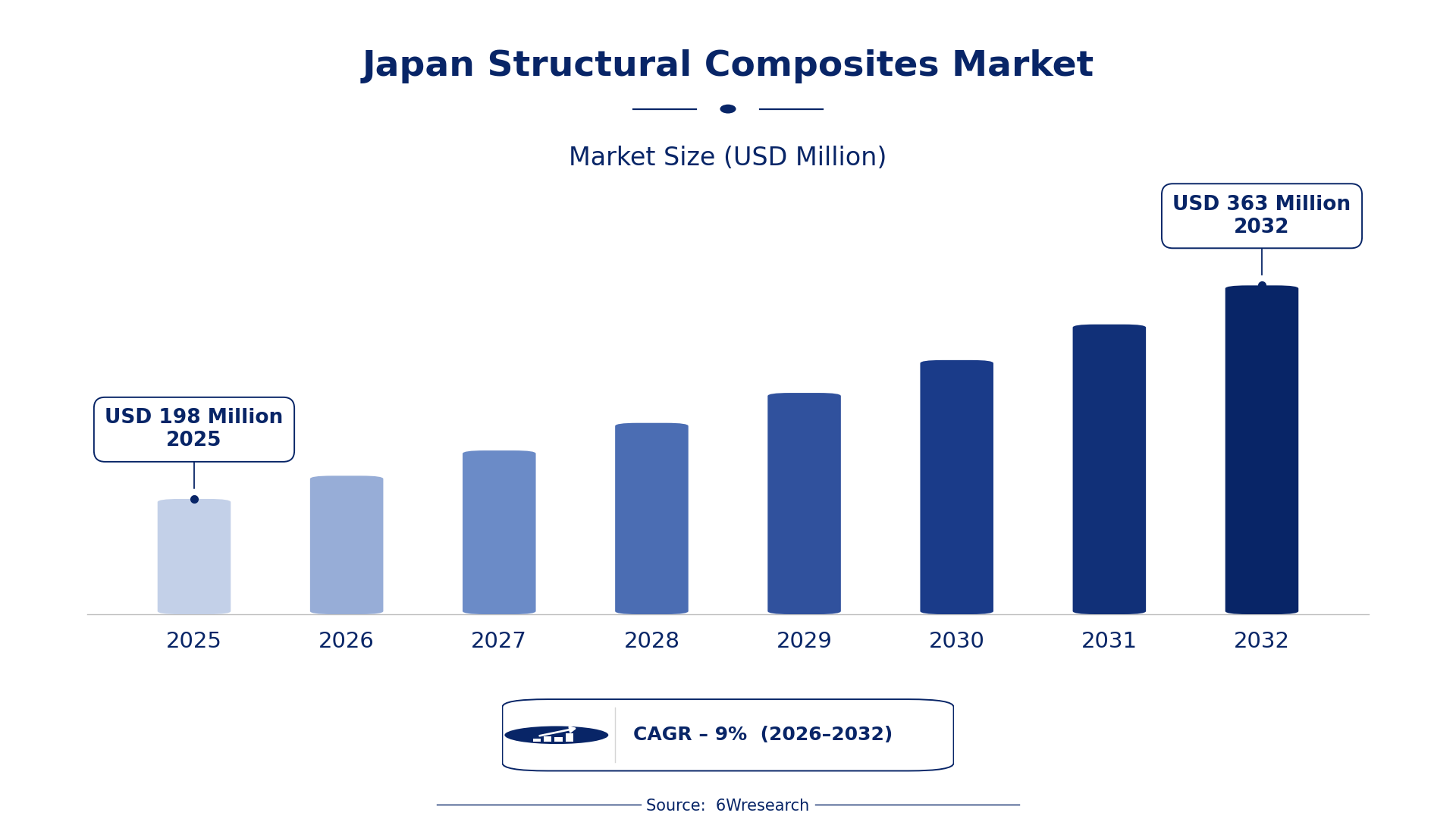
According to 6Wresearch internal database and industry insights, the Japan Structural Composites Market was valued at USD 198 Million in 2025 and is projected to reach USD 363 Million by 2032, growing at a CAGR of approximately 9% during 2026–2032.
Japan Structural Composites Market Highlights
| Report Metric | Details |
| Report Name | Japan Structural Composites Market (2026-2032) |
| Market Size 2025 | USD 198 Million |
| Market Size 2032 | USD 363 Million |
| Absolute Growth 2025–2032 | USD 165 Million |
| CAGR 2026–2032 | 9% |
| Peak Annual Growth | 10.6% in 2032 |
| Forecast Period | 2026–2032 |
| Historical Data | 2022–2025 |
| Base Year | 2025 |
| Leading Composite Type, 2025 | Carbon Fiber Composites (49% share) |
| Leading Fiber Type, 2025 | Carbon (39% share) |
| Leading Matrix Material, 2025 | Epoxy Resin (47% share) |
| Leading End User, 2025 | Aerospace Industry (48% share) |
| Fastest-Growing Composite Type | Glass Fiber Composites (12.4% CAGR) |
| Fastest-Growing Fiber Type | E-Glass (13.3% CAGR) |
| Fastest-Growing Matrix Material | Thermoplastic (12.7% CAGR) |
| Fastest-Growing End User | Automotive Suppliers (11.7% CAGR) |
| Growing Sector | Aerospace Industry |
| Key End Users | Aerospace Industry, Automotive Suppliers, Ballistic Protection Firms, Sports Equipment Makers |
Japan Structural Composites Market Year-wise Growth Rate and Key Drivers (2022–2032)
This graph illustrates the annual growth rates of the market from 2022 to 2032, highlighting a steady upward trajectory and projected market expansion over the forecast period.
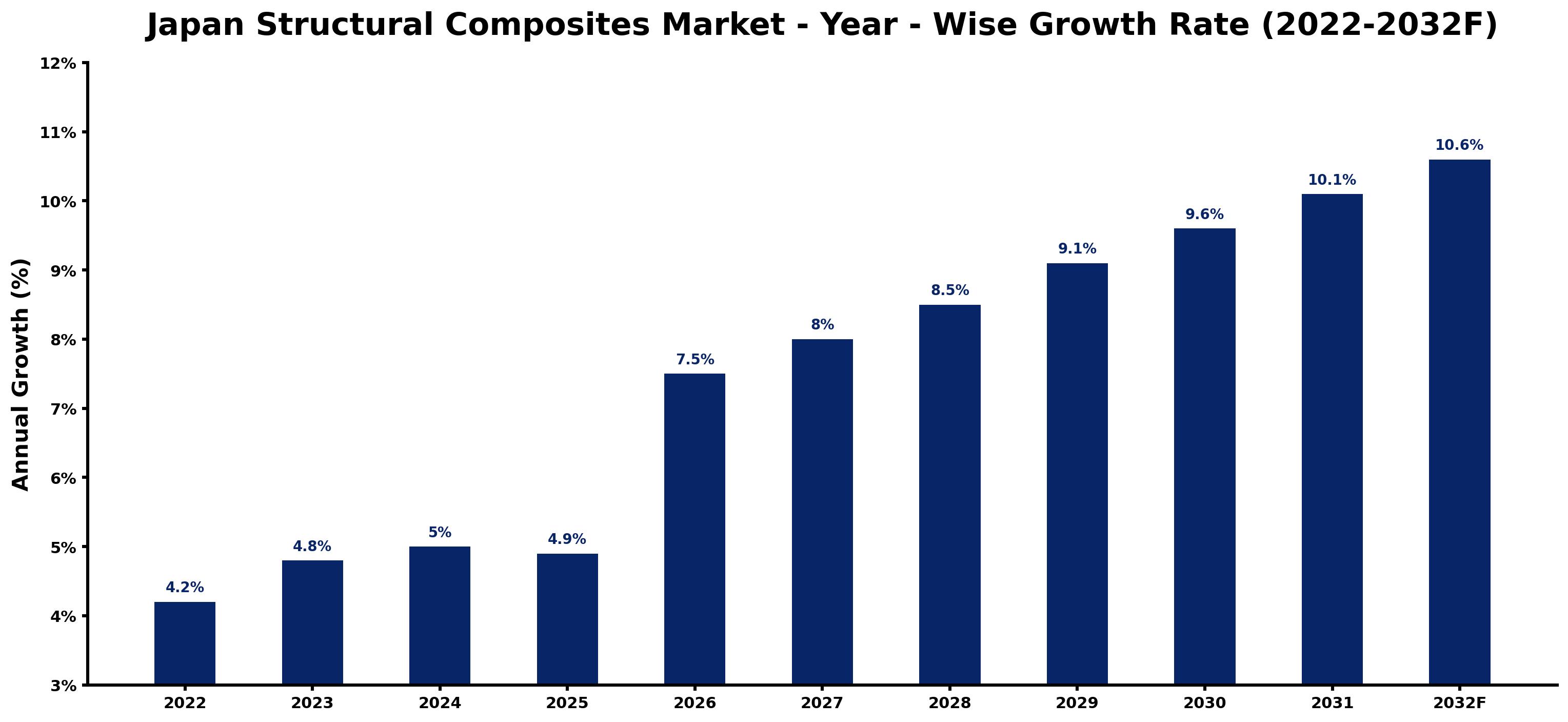
The table below sets out the estimated growth rate for each year and the main factor behind it.
| Year | Estimated Annual Growth (%) | Market Rationale |
| 2022 | 4.2 | The market was characterised by steady demand from the aerospace sector. |
| 2023 | 4.8 | Growth accelerated as automotive manufacturers increased investments in lightweight materials. |
| 2024 | 5.0 | Demand continued to rise, driven by advancements in composite manufacturing techniques. |
| 2025 | 4.9 | Growth slowed slightly as the market adjusted to production capacities. |
| 2026 | 7.5 | Demand surged as new projects in aerospace and automotive emerged. |
| 2027 | 8.0 | The automotive sector's push for weight reduction boosted composite use. |
| 2028 | 8.5 | Increased adoption of thermoplastic composites contributed to higher growth rates. |
| 2029 | 9.1 | Demand from the automotive industry continued to expand, increasing market potential. |
| 2030 | 9.6 | Technological advancements in composite processing are expected to improve production efficiency. |
| 2031 | 10.1 | The aerospace sector's ongoing projects will further propel market growth. |
| 2032 | 10.6 | The market will peak as investments in advanced materials reach new heights. |
Note: Market size estimations and growth projections presented in this report are based on 6Wresearch's proprietary forecasting methodology, utilizing the latest available industry data, government publications, and primary research inputs.
Japan Structural Composites Market Synopsis
Structural composites are advanced materials that combine fibres and matrix materials, providing high strength-to-weight ratios. They are produced through methods such as resin infusion and filament winding, and are primarily utilised in aerospace components, automotive parts, and protective gear. The Japan Structural Composites Market is growing due to investments from the aerospace and automotive sectors, with the automotive industry targeting a 20% reduction in vehicle weight by 2025, which is driving demand for lightweight materials and new solutions.
Market Dynamics Impact Analysis (2026–2032)
| Factor | Type | Impact | Primary Segment Affected |
| Increased demand for lightweight materials in the automotive sector. | Driver | High | Glass Fiber Composites |
| Technological advancements in composite manufacturing processes. | Driver | High | Carbon Fiber Composites |
| Growing interest in sustainable materials and recyclability. | Opportunity | Medium | Thermoplastic |
| Expansion of aerospace projects requiring advanced materials. | Opportunity | High | Carbon Fiber Composites |
| High production costs of advanced composites limit accessibility. | Restraint | High | Carbon Fiber Composites |
| Limited awareness of composite benefits among smaller manufacturers. | Restraint | Medium | Glass Fiber Composites |
| Challenges in meeting stringent quality standards for composites. | Challenge | High | Epoxy Resin |
| Competition from alternative materials in automotive applications. | Challenge | Medium | Glass Fiber Composites |
Evaluation of Drivers in Japan Structural Composites Market (2026–2032)
Below are the drivers that matter most for revenue growth, with supporting evidence.
| Drivers | Primary Segment Affected | Why It Matters (Evidence) |
| Increased investment in lightweight materials by automotive manufacturers. | Glass Fiber Composites | The automotive sector aims to reduce vehicle weight by 20% by 2025, driving demand for composites. |
| Rising production of aircraft components using carbon fiber. | Carbon Fiber Composites | Japan's aerospace sector is a major consumer of carbon fiber composites, focusing on aircraft manufacturing with significant output. |
| Technological advancements in thermoplastic composites. | Thermoplastic | The growing use of thermoplastic composites is driven by their recyclability and processing advantages, appealing to environmentally conscious sectors. |
| Expansion of the Composite Materials Association of Japan's initiatives. | Epoxy Resin | The association promotes the use of composites across various industries, increasing awareness and demand for advanced materials. |
| Increasing funding for ballistic protection development in the defense sector. | Aramid Composites | In 2023, Japan's defense sector allocated funds for developing aramid composites for ballistic protection, enhancing safety measures. |
Spending rises because the automotive industry is heavily investing in lightweight materials, with plans to reduce vehicle weight by 20% by 2025. In 2022, Japan produced approximately 1.5 million tons of composite materials, reflecting strong demand from sectors like aerospace. The push for weight reduction in vehicles leads to increased purchases of composites. Funding for ballistic protection development in the defense sector is driving demand for aramid composites, creating opportunities for suppliers in the market.
Evaluation of Restraints in Japan Structural Composites Market
These restraints slow adoption and weigh on supplier margins.
| Market Restraint | Primary Segment Affected | Why It Matters (Evidence) |
| High production costs hinder widespread adoption of carbon fiber composites. | Carbon Fiber Composites | The cost of carbon fiber production remains high, limiting its use to premium applications. |
| Limited awareness of composite benefits restricts market growth. | Glass Fiber Composites | Many smaller manufacturers are unaware of the advantages of using composites over traditional materials. |
| Challenges in meeting stringent quality standards for composites. | Epoxy Resin | Producers must adhere to JIS standards, complicating production processes and increasing costs. |
| Competition from alternative materials in automotive applications. | Glass Fiber Composites | The automotive sector often opts for cheaper alternatives, affecting composite demand. |
| Slow adoption of new technologies by traditional manufacturers. | Thermoplastic | Many established manufacturers are hesitant to invest in new processing techniques, limiting growth. |
Japan Structural Composites Market Challenges
Japan produced around 1.5 million tons of composite materials in 2022, but stringent JIS regulations can delay product approvals for producers, leading to missed deadlines for aerospace contracts. The slow adoption of automation technologies in composite production hampers efficiency, resulting in lead times extending by up to 30% for automotive buyers. Rising raw material costs, particularly for specialty fibres, can increase production expenses by 15%, forcing automotive manufacturers to reassess their material choices. A shortage of skilled technicians in composite processing limits innovation, making it challenging for producers to keep pace with industry advancements.
Trends in the Japan Structural Composites Market
The following changes are redrawing the Japan Structural Composites Market.
- Shift in Aerospace Manufacturing to Advanced Composites: The Tokyo Metropolitan area is seeing a shift towards advanced composites in aerospace manufacturing, particularly carbon fibre. In 2022, the aerospace sector consumed a substantial portion of carbon fibre composites, improving performance and efficiency.
- Growing Adoption of Thermoplastic Composites: In 2023, the use of thermoplastic composites is rising due to their recyclability. Japan's automotive industry is exploring these materials to meet sustainability goals, with production expected to increase significantly in the coming years.
- Expansion of Composite Standards under JIS: Japan has established standards for composites under JIS to ensure quality and safety. This initiative is expected to build market confidence, with many manufacturers aligning their products to these standards, improving overall industry standards.
- Increase in Defense Sector Investment in Composites: Japan's defence sector is investing in aramid composites for ballistic protection. In 2023, funding was allocated for this purpose, indicating a growing market for advanced protective materials and technologies.
Investment Opportunities in the Japan Structural Composites Market
Where to invest in the Japan Structural Composites Market: the main openings are set out below.
- Entry through Joint Ventures in Automotive: Now is the time for joint ventures with automotive suppliers, as the sector aims to reduce vehicle weight by 20% by 2025. Collaborating with automotive manufacturers can provide access to new projects and enhance market presence.
- Focus on Sustainable Materials in Construction: With a growing emphasis on sustainability, there is an opportunity to supply thermoplastic composites to construction firms. The demand for recyclable materials is increasing, presenting a market gap that can be filled by innovative suppliers.
- Partnerships with Aerospace Manufacturers: Aerospace manufacturers are seeking advanced materials for lightweight components. Forming partnerships can facilitate entry into this high-demand sector, especially in the Tokyo Metropolitan area, where innovation is key.
- Investment in R&D for Composite Innovations: Investment in research and development for new composite materials is critical now. The Composite Materials Association of Japan is actively promoting innovations, creating opportunities for suppliers to meet evolving market needs.
Government Initiatives in the Japan Structural Composites Market
The Plastic Resource Circulation Act, enacted in 2021, promotes the reduction, reuse, and recycling of plastics, which indirectly benefits structural composites by encouraging the use of recyclable materials. This law complements existing regulations by setting clear guidelines for sustainable practices in the industry, supporting manufacturers in adopting greener technologies.
In 2022, the Ministry of Economy, Trade and Industry allocated funds to support initiatives aimed at promoting advanced materials in manufacturing. This funding is intended to improve the capacity of local manufacturers to adopt new composite technologies and enhance competitiveness in the market.
Future Insight of the Japan Structural Composites Market
The adoption of advanced manufacturing technologies will reshape demand by 2032, driven by the need for improved efficiency. The automotive sector aims to reduce vehicle weight by 20% by 2025, which will increase the use of lightweight materials. Japan's defence sector plans to allocate more funds for developing aramid composites for ballistic protection, enhancing safety measures. Initiatives from the Ministry of Economy, Trade and Industry will facilitate the integration of advanced materials, creating new opportunities across multiple industries.
Market Segmentation Analysis
Japan Structural Composites Market report covers a detailed analysis of the following market segments:
By Composite Type – Carbon Fiber Composites Lead, Glass Fiber Composites Expected to Grow Fastest
According to Saurav Kr Singh, Senior Research Analyst at 6Wresearch, with 49% of composite type revenue in 2025, Carbon Fiber Composites was the largest category. Carbon fiber composites dominate the market due to their indispensable role in aerospace manufacturing, particularly for lightweight aircraft components. The Japanese aerospace sector's reliance on these materials ensures a robust demand, especially in regions like the Tokyo Metropolitan area. Over 2026–2032, Glass Fiber Composites are expected to post the fastest growth, at a CAGR of 12.4%. Glass fiber composites are rapidly gaining traction as the automotive industry invests heavily in lightweight materials to achieve a 20% weight reduction by 2025. This focus on efficiency and cost-effectiveness is driving their increased adoption in vehicle manufacturing. Suppliers should focus on developing glass fiber composites to align with the automotive industry's shift towards lightweight materials.
By Fiber Type – Carbon Leads, E-Glass Expected to Grow Fastest
Carbon held 39% of the Japan Structural Composites Market by fiber type in 2025. Carbon is the predominant fiber type, crucial for high-strength applications in both aerospace and automotive sectors. Its unique properties make it essential for manufacturers who prioritise performance and reliability in their products. E-Glass is projected to grow fastest, at a CAGR of 13.3% during 2026–2032. E-Glass is witnessing the fastest growth due to its widespread use in construction and automotive sectors for insulation and reinforcement. The rising demand for economical materials is propelling its increased adoption across various applications. Buyers should consider sourcing E-Glass to meet the growing demand for cost-effective composite solutions in construction and automotive industries.
By Matrix Material – Epoxy Resin Leads, Thermoplastic Expected to Grow Fastest
Epoxy Resin accounted for 47% of the market by matrix material in 2025. Epoxy resin is the leading matrix material, widely used in various composite applications due to its excellent adhesion and mechanical properties. Its versatility makes it a staple in both aerospace and automotive sectors. Thermoplastic is set to record the highest CAGR in this split, 12.7% over 2026–2032. Thermoplastic materials are growing rapidly as they offer recyclability and ease of processing, appealing to manufacturers focused on sustainability. The shift towards environmentally friendly materials is driving this trend in multiple applications. Suppliers need to invest in thermoplastic technologies to meet the increasing demand for sustainable composite solutions.
By End User – Aerospace Industry Leads, Automotive Suppliers Expected to Grow Fastest
Aerospace Industry took 48% of end user revenue in 2025, more than any other category. The aerospace industry is the largest end user of structural composites, utilising them for lightweight components that enhance aircraft performance. This sector's strong dependence on advanced materials guarantees a steady demand for composites. The quickest growth will come from Automotive Suppliers, forecast to expand at a CAGR of 11.7% between 2026 and 2032. Automotive suppliers are experiencing the fastest growth as they increasingly adopt lightweight and fuel-efficient vehicle parts to comply with regulatory standards. This trend reflects the automotive industry's commitment to innovation and efficiency in manufacturing. Buyers in the automotive sector should seek partnerships with suppliers that specialise in lightweight composite materials to maintain a competitive advantage.
Key Attractiveness of the Report
- 10 Years of Market Numbers
- Historical Data Starting from 2022 to 2025
- Base Year 2025
- Forecast Data until 2032
- Key Performance Indicators Impacting the Market
- Major Upcoming Developments and Projects
Key Highlights of the Report:
- Japan Structural Composites Market Outlook
- Market Size of Japan Structural Composites Market, 2025
- Forecast of Japan Structural Composites Market, 2032
- Historical Data and Forecast of Japan Structural Composites Revenues & Volume for the Period 2022-2032F
- Japan Structural Composites Market Trend Evolution
- Japan Structural Composites Market Drivers and Challenges
- Japan Structural Composites Price Trends
- Japan Structural Composites Porter's Five Forces
- Japan Structural Composites Industry Life Cycle
- Historical Data and Forecast of Japan Structural Composites Market Revenues & Volume By Composite Type for the Period 2022-2032F
- Historical Data and Forecast of Japan Structural Composites Market Revenues & Volume By Carbon Fiber Composites for the Period 2022-2032F
- Historical Data and Forecast of Japan Structural Composites Market Revenues & Volume By Glass Fiber Composites for the Period 2022-2032F
- Historical Data and Forecast of Japan Structural Composites Market Revenues & Volume By Aramid Composites for the Period 2022-2032F
- Historical Data and Forecast of Japan Structural Composites Market Revenues & Volume By Hybrid Composites for the Period 2022-2032F
- Historical Data and Forecast of Japan Structural Composites Market Revenues & Volume By Fiber Type for the Period 2022-2032F
- Historical Data and Forecast of Japan Structural Composites Market Revenues & Volume By Carbon for the Period 2022-2032F
- Historical Data and Forecast of Japan Structural Composites Market Revenues & Volume By E-Glass for the Period 2022-2032F
- Historical Data and Forecast of Japan Structural Composites Market Revenues & Volume By Kevlar for the Period 2022-2032F
- Historical Data and Forecast of Japan Structural Composites Market Revenues & Volume By Mixed Fiber for the Period 2022-2032F
- Historical Data and Forecast of Japan Structural Composites Market Revenues & Volume By Matrix Material for the Period 2022-2032F
- Historical Data and Forecast of Japan Structural Composites Market Revenues & Volume By Epoxy Resin for the Period 2022-2032F
- Historical Data and Forecast of Japan Structural Composites Market Revenues & Volume By Polyester for the Period 2022-2032F
- Historical Data and Forecast of Japan Structural Composites Market Revenues & Volume By Thermoplastic for the Period 2022-2032F
- Historical Data and Forecast of Japan Structural Composites Market Revenues & Volume By Vinyl Ester for the Period 2022-2032F
- Historical Data and Forecast of Japan Structural Composites Market Revenues & Volume By End User for the Period 2022-2032F
- Historical Data and Forecast of Japan Structural Composites Market Revenues & Volume By Aerospace Industry for the Period 2022-2032F
- Historical Data and Forecast of Japan Structural Composites Market Revenues & Volume By Automotive Suppliers for the Period 2022-2032F
- Historical Data and Forecast of Japan Structural Composites Market Revenues & Volume By Ballistic Protection Firms for the Period 2022-2032F
- Historical Data and Forecast of Japan Structural Composites Market Revenues & Volume By Sports Equipment Makers for the Period 2022-2032F
- Japan Structural Composites Import Export Trade Statistics
- Market Opportunity Assessment By Composite Type
- Market Opportunity Assessment By Fiber Type
- Market Opportunity Assessment By Matrix Material
- Market Opportunity Assessment By End User
- Japan Structural Composites Top Companies Market Share
- Japan Structural Composites Competitive Benchmarking By Technical and Operational Parameters
- Japan Structural Composites Company Profiles
- Japan Structural Composites Key Strategic Recommendations
Market Covered
Segments analysed in this report are listed below.
By Composite Type
- Carbon Fiber Composites
- Glass Fiber Composites
- Aramid Composites
- Hybrid Composites
By Fiber Type
- Carbon
- E-Glass
- Kevlar
- Mixed Fiber
By Matrix Material
- Epoxy Resin
- Polyester
- Thermoplastic
- Vinyl Ester
By End User
- Aerospace Industry
- Automotive Suppliers
- Ballistic Protection Firms
- Sports Equipment Makers































