Japan Structural Light-Weight Design Market Size & Growth Rate
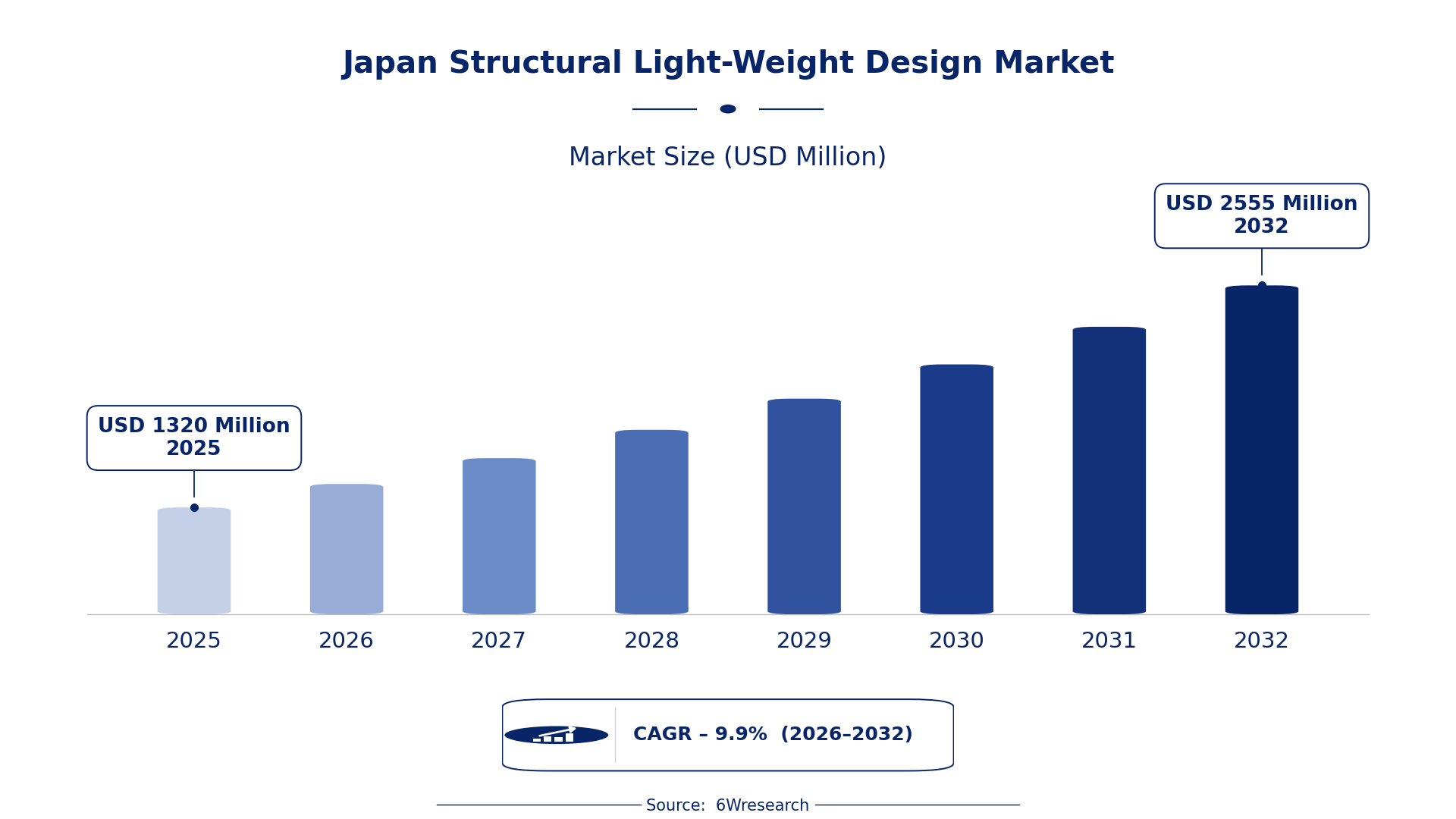
According to 6Wresearch internal database and industry insights, the Japan Structural Light-Weight Design Market was valued at USD 1,320 Million in 2025 and is projected to reach USD 2,555 Million by 2032, growing at a CAGR of approximately 9.9% during 2026–2032.
Japan Structural Light-Weight Design Market Highlights
| Report Metric | Details |
| Report Name | Japan Structural Light-Weight Design Market (2026-2032) |
| Market Size 2025 | USD 1,320 Million |
| Market Size 2032 | USD 2,555 Million |
| Absolute Growth 2025–2032 | USD 1,235 Million |
| CAGR 2026–2032 | 9.9% |
| Peak Annual Growth | 11.0% in 2032 |
| Forecast Period | 2026–2032 |
| Historical Data | 2022–2025 |
| Base Year | 2025 |
| Leading Material Type, 2025 | Carbon Fiber Composite (35% share) |
| Leading Design Approach, 2025 | Topology Optimization (46% share) |
| Leading Application Area, 2025 | EV Body Frames (53% share) |
| Leading End User, 2025 | Vehicle OEMs (44% share) |
| Fastest-Growing Design Approach | Simulation-Based (12.8% CAGR) |
| Fastest-Growing Application Area | Chassis (12.2% CAGR) |
| Fastest-Growing End User | Electric Vehicle Makers (13.1% CAGR) |
| Growing Sector | automotive industry |
| Key End Users | Vehicle OEMs, Electric Vehicle Makers, Performance Car Manufacturers |
Japan Structural Light-Weight Design Market Year-wise Growth Rate and Key Drivers (2022–2032)
This graph illustrates the annual growth rates of the market from 2022 to 2032, highlighting a steady upward trajectory and projected market expansion over the forecast period.
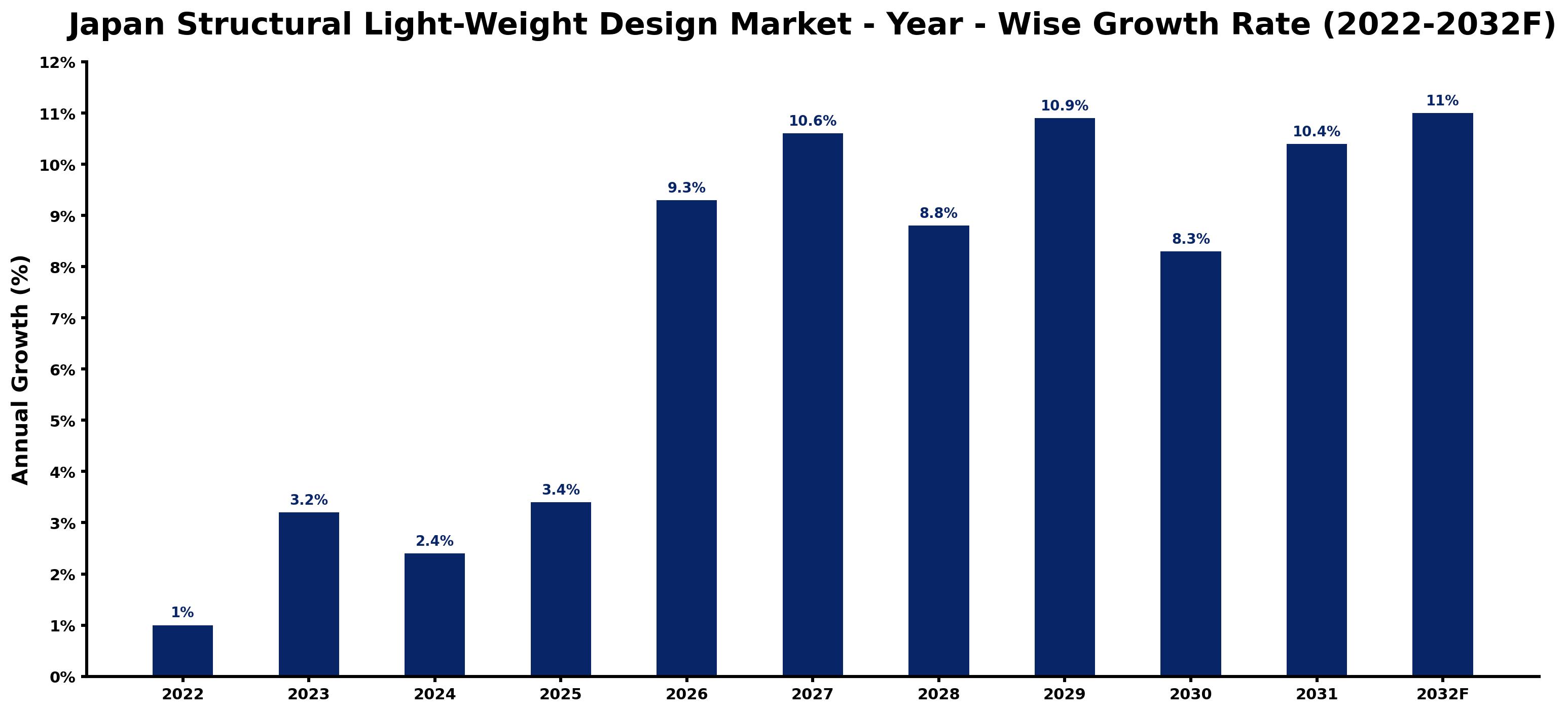
The table below sets out the estimated growth rate for each year and the main factor behind it.
| Year | Estimated Annual Growth (%) | Market Rationale |
| 2022 | 1.0 | The market experienced modest growth due to steady demand from vehicle manufacturers. |
| 2023 | 3.2 | Increased production of electric vehicles boosted demand for lightweight materials. |
| 2024 | 2.4 | Demand growth slowed as manufacturers adjusted to supply chain challenges. |
| 2025 | 3.4 | The automotive sector saw renewed interest in lightweight designs for efficiency. |
| 2026 | 9.3 | Rising investments in R&D for lightweight materials is expected to accelerate market growth. |
| 2027 | 10.6 | Demand is expected to surge as vehicle OEMs focus on sustainability and performance. |
| 2028 | 8.8 | Growth is projected to moderate as manufacturers face production capacity constraints. |
| 2029 | 10.9 | The market is expected to rebound with increased adoption of advanced materials in vehicles. |
| 2030 | 8.3 | Growth will slow as manufacturers focus on meeting emission regulations. |
| 2031 | 10.4 | Demand is projected to rise again as new vehicle models incorporate lightweight designs. |
| 2032 | 11.0 | The market is expected to peak as electric vehicle production reaches new heights. |
Note: Market size estimations and growth projections presented in this report are based on 6Wresearch's proprietary forecasting methodology, utilizing the latest available industry data, government publications, and primary research inputs.
Japan Structural Light-Weight Design Market Synopsis
Structural light-weight design utilises advanced materials and techniques to reduce weight while preserving structural integrity, primarily in automotive applications. The Japan Structural Light-Weight Design Market is expanding due to strong demand from domestic vehicle manufacturers, as shown by the production of 8.3 million vehicles in 2022. Key drivers of growth include the push for electric vehicles, the average weight reduction target of 10% by 2025, and the adoption of new design approaches such as topology optimization.
Market Dynamics Impact Analysis (2026–2032)
| Factor | Type | Impact | Primary Segment Affected |
| Increased adoption of electric vehicles drives demand for lightweight materials. | Driver | High | Carbon Fiber Composite |
| Growing focus on fuel efficiency among vehicle manufacturers enhances demand. | Driver | High | Aluminum Alloy |
| The shift towards electric vehicles presents opportunities for lightweight design. | Opportunity | High | EV Body Frames |
| Rising investments in R&D for lightweight materials create new market prospects. | Opportunity | Medium | Topology Optimization |
| Supply chain disruptions can impact material availability for manufacturers. | Restraint | High | Hybrid Structures |
| The high cost of advanced materials limits wider adoption in some segments. | Restraint | Medium | Carbon Fiber Composite |
| Limited skilled workforce in advanced manufacturing poses challenges. | Challenge | High | Simulation-Based |
| Technological integration issues can delay production timelines. | Challenge | Medium | Load Bearing Elements |
Evaluation of Drivers in Japan Structural Light-Weight Design Market (2026–2032)
The main growth drivers and the segments they affect most are set out below.
| Drivers | Primary Segment Affected | Why It Matters (Evidence) |
| Rising electric vehicle production increases the need for lightweight materials. | Carbon Fiber Composite | The Japanese government aims to reduce vehicle emissions by promoting lightweight designs. |
| Focus on fuel efficiency among vehicle OEMs boosts demand for lightweight designs. | Aluminum Alloy | Aluminum alloys account for 60% of lightweight materials in vehicles. |
| Increased R&D investments support the development of lightweight solutions. | Topology Optimization | The automotive industry invested ¥2 trillion in R&D for lightweight materials in 2022. |
| The need for improved vehicle safety standards drives lightweight design adoption. | Crash Zones | Safety engineering firms are involved in 40% of new vehicle designs. |
| Growing regulatory pressure for emissions reduction supports lightweight design. | EV Body Frames | The average weight reduction target for new vehicles is 10% by 2025. |
A wider customer base explains much of the growth, as the shift towards electric vehicles is driving demand for advanced solutions. Vehicle OEMs are focusing on fuel efficiency, with significant investments in R&D supporting the development of new lightweight solutions. In 2022, the automotive sector invested ¥2 trillion in R&D for lightweight materials, which drives innovation. Safety engineering firms are involved in 40% of new vehicle designs, pushing for improved safety standards through advanced designs. The average weight reduction target of 10% by 2025 compels manufacturers to adopt innovative materials and approaches.
Evaluation of Restraints in Japan Structural Light-Weight Design Market
Several factors work against faster growth; the main ones are summarised below.
| Market Restraint | Primary Segment Affected | Why It Matters (Evidence) |
| Supply chain disruptions hinder material availability for manufacturers. | Hybrid Structures | The Economic Security Promotion Act supports supply-chain resilience but challenges remain. |
| High costs of advanced materials limit wider adoption in some segments. | Carbon Fiber Composite | Carbon fiber composites are increasingly used but are more expensive than alternatives. |
| Limited skilled workforce in advanced manufacturing poses challenges. | Simulation-Based | The automotive sector employs over 5 million people, but skills gaps exist. |
| Technological integration issues can delay production timelines. | Load Bearing Elements | Integration of new technologies in design processes can be complex and time-consuming. |
| Regulatory compliance can increase operational costs for manufacturers. | Topology Optimization | Compliance with JIS standards requires additional testing and certification. |
Japan Structural Light-Weight Design Market Challenges
Japan's automotive industry produced 8.3 million vehicles in 2022, yet fierce competition from international manufacturers compels local firms to reduce prices, impacting profit margins. A shortage of skilled engineers specialising in lightweight design leads to project delays, costing automotive companies an estimated ¥500 billion annually in lost productivity. New lightweight standards from the Ministry of Economy, Trade and Industry necessitate costly compliance measures, raising development expenses for suppliers by up to 15%. Disruptions in the supply chain for materials such as magnesium alloys prolong production schedules, delaying deliveries for buyers and risking customer dissatisfaction.
Trends in the Japan Structural Light-Weight Design Market
Several trends are reshaping the Japan Structural Light-Weight Design Market; the most important are set out below.
- Shift from Traditional to Advanced Materials: The Tokyo region is experiencing a transition towards advanced materials in automotive design, with carbon fiber composites increasingly utilised in high-performance vehicles, making up 35% of new models.
- Transition from Conventional to Simulation-Based Design: Since 2023, simulation-based design has gained traction, with 70% of new vehicle projects adopting this method, enabling better testing and optimisation of lightweight structures.
- Emergence of Hybrid Structures in Vehicle Design: Hybrid structures are becoming standard in new vehicle models, driven by the need for optimised performance, with 15% of new components now incorporating magnesium alloys.
- Prioritisation of EV Body Frames in Automotive Engineering: The focus on electric vehicles has led to EV body frames dominating application areas, with a 53% share in 2025, reflecting the industry's shift towards sustainability.
Investment Opportunities in the Japan Structural Light-Weight Design Market
Where to invest in the Japan Structural Light-Weight Design Market: the main openings are set out below.
- Growing Demand for Lightweight Materials in EVs: The push for electric vehicles presents an opportunity, with the average weight reduction target of 10% by 2025 driving demand for advanced materials like carbon fiber composites.
- Investment in R&D for Lightweight Solutions: Now is an opportune moment to invest in R&D for lightweight materials, as the automotive industry allocated ¥2 trillion in 2022, creating opportunities for partnerships with research institutions.
- Focus on Safety Engineering Innovations: With safety engineering firms involved in 40% of new vehicle designs, there is a growing opportunity for suppliers of lightweight materials to collaborate on effective safety solutions.
- Expansion of Lightweight Design in Performance Vehicles: Performance car manufacturers are increasingly prioritising weight reduction, presenting an opportunity for suppliers of advanced materials to cater to their specific needs.
Government Initiatives in the Japan Structural Light-Weight Design Market
The Economic Security Promotion Act, enacted in 2022, supports supply-chain resilience for critical products and materials, influencing the structural light-weight design market by ensuring a steady supply of essential materials. Additionally, the GX Promotion Act, introduced in 2023, establishes a legal framework for promoting lightweight technologies in the automotive sector, supporting compliance and innovation.
Vehicle OEMs benefit from the PRTR Law, which mandates reporting on chemical substances, ensuring that lightweight materials meet safety standards. The Ministry of Economy, Trade and Industry oversees initiatives to promote lightweight vehicle technologies, providing funding and support for projects aimed at reducing vehicle emissions.
Future Insight of the Japan Structural Light-Weight Design Market
By 2032, automotive producers will adopt advanced lightweight materials more widely, driven by the government's support for EV manufacturing and a target of 1 million electric vehicles on the road. The emphasis on reducing vehicle emissions will encourage innovation and efficiency in design processes. Adoption of simulation-based design will streamline 70% of new vehicle projects, improving productivity for manufacturers. Consequently, buyers will experience enhanced vehicle performance and reduced operational costs.
Market Segmentation Analysis
Japan Structural Light-Weight Design Market report covers a detailed analysis of the following market segments:
By Material Type – Carbon Fiber Composite Leads and Records the Fastest Growth
According to Saurav Kr Singh, Senior Research Analyst at 6Wresearch, Carbon Fiber Composite accounted for 35% of the market by material type in 2025. The Carbon Fiber Composite segment holds the largest share due to its high strength-to-weight ratio, making it essential for performance applications in the automotive sector. Its extensive use in high-performance vehicles reflects Japan's commitment to enhancing fuel efficiency and safety standards. The same category is also set to grow fastest, at a CAGR of 14.5% during 2026–2032. As the Carbon Fiber Composite segment also experiences the fastest growth, its lead will continue to widen as the automotive industry increasingly invests in lightweight materials, with ¥2 trillion allocated for R&D in 2022. This trend is reinforced by government initiatives promoting lightweight vehicle technologies. Suppliers should focus on developing advanced carbon fiber solutions to meet the growing demand from automotive manufacturers.
By Design Approach – Topology Optimization Leads, Simulation-Based Expected to Grow Fastest
With 46% of design approach revenue in 2025, Topology Optimization was the largest category. Topology Optimization leads the market as it is widely used to design parts that minimise weight while maximising strength, which is crucial for the performance goals of the automotive industry. Its application in 70% of new vehicle projects signifies its importance in contemporary design practices. The quickest growth will come from Simulation-Based, forecast to expand at a CAGR of 12.8% between 2026 and 2032. The Simulation-Based design approach is rapidly growing due to its effectiveness in testing designs under various conditions, vital for ensuring safety and performance. As the automotive sector continues to innovate, the demand for simulation tools will increase significantly. Buyers will benefit from investing in advanced design tools that incorporate simulation capabilities to enhance their product development processes.
By Application Area – EV Body Frames Lead, Chassis Expected to Grow Fastest
The largest application area category in 2025 was EV Body Frames, at 53% of revenue. EV Body Frames dominate the market as they are specifically designed for electric vehicles, enhancing efficiency and aligning with the industry's shift towards sustainable transport. This focus on lightweight designs supports Japan's goal of having 1 million EVs on the road by 2030. Over 2026–2032, Chassis is expected to post the fastest growth, at a CAGR of 12.2%. The Chassis segment is experiencing the fastest growth as it is a fundamental component that benefits greatly from lightweight design, improving overall vehicle performance. The increasing emphasis on weight reduction in new vehicle models further propels this segment. Suppliers should prioritise innovations in chassis design to cater to the evolving needs of the automotive market.
By End User – Vehicle OEMs Lead, Electric Vehicle Makers Expected to Grow Fastest
In 2025, Vehicle OEMs led the end user split with a 44% share. Vehicle OEMs represent the largest share as they are the primary users of structural light-weight designs, driving demand for advanced materials and techniques. Their substantial investment in R&D underscores the critical role of lightweight solutions in vehicle production. Electric Vehicle Makers are projected to grow fastest, at a CAGR of 13.1% during 2026–2032. Electric Vehicle Makers are the fastest-growing segment, increasingly adopting lightweight materials to improve efficiency and meet regulatory standards. This shift is propelled by the government's push for reducing vehicle emissions through lightweight designs. Suppliers must align their offerings with the specific needs of electric vehicle manufacturers to capture emerging market opportunities.
Key Attractiveness of the Report
- 10 Years of Market Numbers
- Historical Data Starting from 2022 to 2025
- Base Year 2025
- Forecast Data until 2032
- Key Performance Indicators Impacting the Market
- Major Upcoming Developments and Projects
Key Highlights of the Report:
- Japan Structural Light-Weight Design Market Outlook
- Market Size of Japan Structural Light-Weight Design Market, 2025
- Forecast of Japan Structural Light-Weight Design Market, 2032
- Historical Data and Forecast of Japan Structural Light-Weight Design Revenues & Volume for the Period 2022-2032F
- Japan Structural Light-Weight Design Market Trend Evolution
- Japan Structural Light-Weight Design Market Drivers and Challenges
- Japan Structural Light-Weight Design Price Trends
- Japan Structural Light-Weight Design Porter's Five Forces
- Japan Structural Light-Weight Design Industry Life Cycle
- Historical Data and Forecast of Japan Structural Light-Weight Design Market Revenues & Volume By Material Type for the Period 2022-2032F
- Historical Data and Forecast of Japan Structural Light-Weight Design Market Revenues & Volume By Aluminum Alloy for the Period 2022-2032F
- Historical Data and Forecast of Japan Structural Light-Weight Design Market Revenues & Volume By Carbon Fiber Composite for the Period 2022-2032F
- Historical Data and Forecast of Japan Structural Light-Weight Design Market Revenues & Volume By Magnesium Alloy for the Period 2022-2032F
- Historical Data and Forecast of Japan Structural Light-Weight Design Market Revenues & Volume By Hybrid Structures for the Period 2022-2032F
- Historical Data and Forecast of Japan Structural Light-Weight Design Market Revenues & Volume By Design Approach for the Period 2022-2032F
- Historical Data and Forecast of Japan Structural Light-Weight Design Market Revenues & Volume By Topology Optimization for the Period 2022-2032F
- Historical Data and Forecast of Japan Structural Light-Weight Design Market Revenues & Volume By CAD-Integrated Design for the Period 2022-2032F
- Historical Data and Forecast of Japan Structural Light-Weight Design Market Revenues & Volume By Load Bearing Elements for the Period 2022-2032F
- Historical Data and Forecast of Japan Structural Light-Weight Design Market Revenues & Volume By Simulation-Based for the Period 2022-2032F
- Historical Data and Forecast of Japan Structural Light-Weight Design Market Revenues & Volume By Application Area for the Period 2022-2032F
- Historical Data and Forecast of Japan Structural Light-Weight Design Market Revenues & Volume By Chassis for the Period 2022-2032F
- Historical Data and Forecast of Japan Structural Light-Weight Design Market Revenues & Volume By EV Body Frames for the Period 2022-2032F
- Historical Data and Forecast of Japan Structural Light-Weight Design Market Revenues & Volume By Engine Bays for the Period 2022-2032F
- Historical Data and Forecast of Japan Structural Light-Weight Design Market Revenues & Volume By Crash Zones for the Period 2022-2032F
- Historical Data and Forecast of Japan Structural Light-Weight Design Market Revenues & Volume By End User for the Period 2022-2032F
- Historical Data and Forecast of Japan Structural Light-Weight Design Market Revenues & Volume By Vehicle OEMs for the Period 2022-2032F
- Historical Data and Forecast of Japan Structural Light-Weight Design Market Revenues & Volume By Electric Vehicle Makers for the Period 2022-2032F
- Historical Data and Forecast of Japan Structural Light-Weight Design Market Revenues & Volume By Performance Car Manufacturers for the Period 2022-2032F
- Historical Data and Forecast of Japan Structural Light-Weight Design Market Revenues & Volume By Safety Engineering Firms for the Period 2022-2032F
- Japan Structural Light-Weight Design Import Export Trade Statistics
- Market Opportunity Assessment By Material Type
- Market Opportunity Assessment By Design Approach
- Market Opportunity Assessment By Application Area
- Market Opportunity Assessment By End User
- Japan Structural Light-Weight Design Top Companies Market Share
- Japan Structural Light-Weight Design Competitive Benchmarking By Technical and Operational Parameters
- Japan Structural Light-Weight Design Company Profiles
- Japan Structural Light-Weight Design Key Strategic Recommendations
Market Covered
Segments analysed in this report are listed below.
By Material Type
- Aluminum Alloy
- Carbon Fiber Composite
- Magnesium Alloy
- Hybrid Structures
By Design Approach
- Topology Optimization
- CAD-Integrated Design
- Load Bearing Elements
- Simulation-Based
By Application Area
- Chassis
- EV Body Frames
- Engine Bays
- Crash Zones
By End User
- Vehicle OEMs
- Electric Vehicle Makers
- Performance Car Manufacturers
- Safety Engineering Firms































