Japan Structural Metal Market Size & Growth Rate
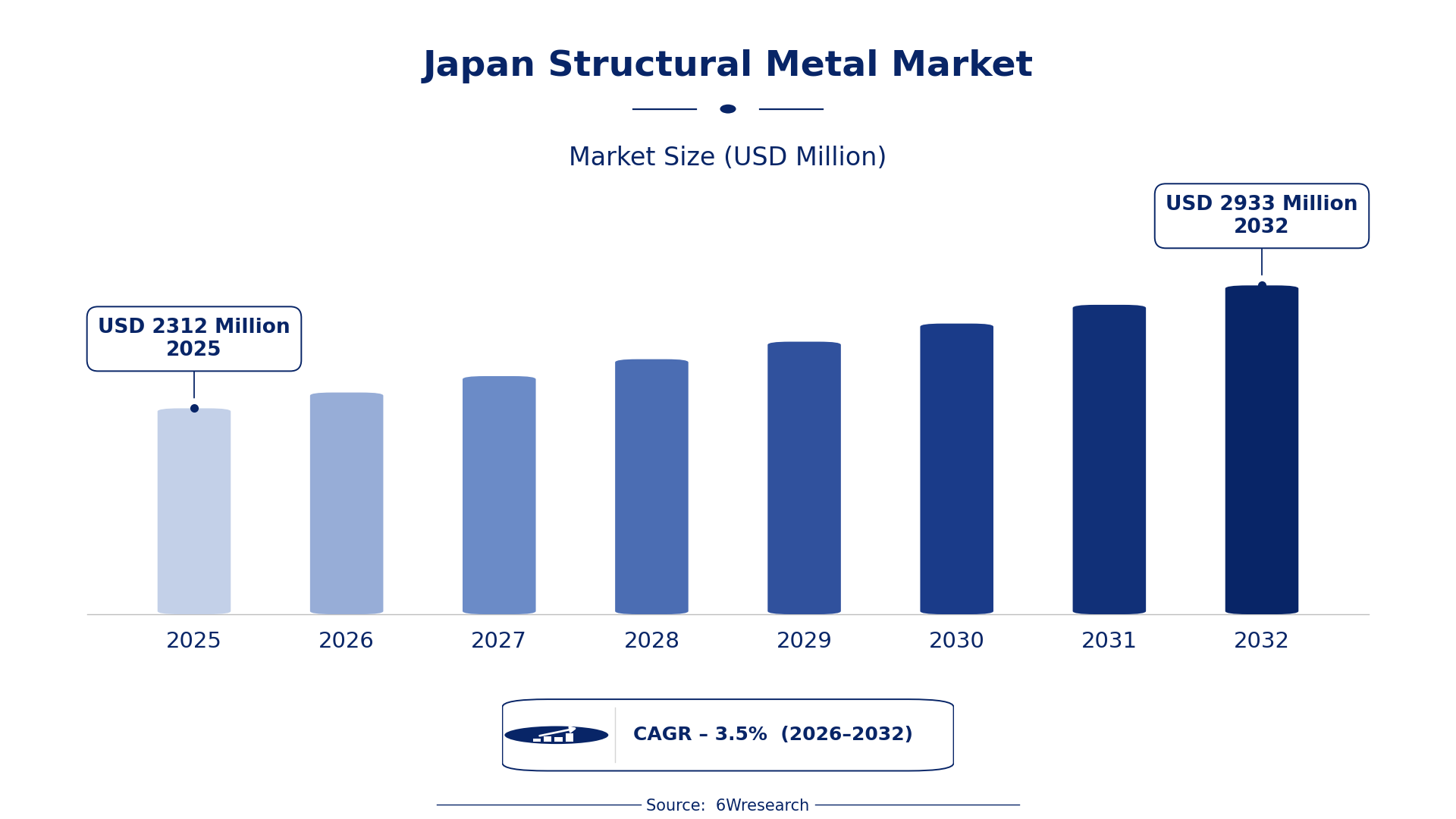
According to 6Wresearch internal database and industry insights, the Japan Structural Metal Market was valued at USD 2,312 Million in 2025 and is projected to reach USD 2,933 Million by 2032, growing at a CAGR of approximately 3.5% during 2026–2032.
Japan Structural Metal Market Highlights
| Report Metric | Details |
| Report Name | Japan Structural Metal Market (2026-2032) |
| Market Size 2025 | USD 2,312 Million |
| Market Size 2032 | USD 2,933 Million |
| Absolute Growth 2025–2032 | USD 621 Million |
| CAGR 2026–2032 | 3.5% |
| Peak Annual Growth | 4.8% in 2028 |
| Forecast Period | 2026–2032 |
| Historical Data | 2022–2025 |
| Base Year | 2025 |
| Leading Metal Type, 2025 | Structural Steel (53% share) |
| Leading Product Form, 2025 | I-Beams (50% share) |
| Leading Application Area, 2025 | Building Frameworks (37% share) |
| Leading End User, 2025 | Construction Firms (44% share) |
| Fastest-Growing Metal Type | Aluminum (4.8% CAGR) |
| Fastest-Growing Product Form | Channels & Angles (4.9% CAGR) |
| Fastest-Growing Application Area | Bridges (4.5% CAGR) |
| Fastest-Growing End User | Infrastructure Developers (4.6% CAGR) |
| Growing Sector | Construction |
| Key End Users | Construction Firms, Infrastructure Developers, Engineering Contractors, Civil Engineers |
Japan Structural Metal Market Year-wise Growth Rate and Key Drivers (2022–2032)
This graph illustrates the annual growth rates of the market from 2022 to 2032, highlighting a steady upward trajectory and projected market expansion over the forecast period.
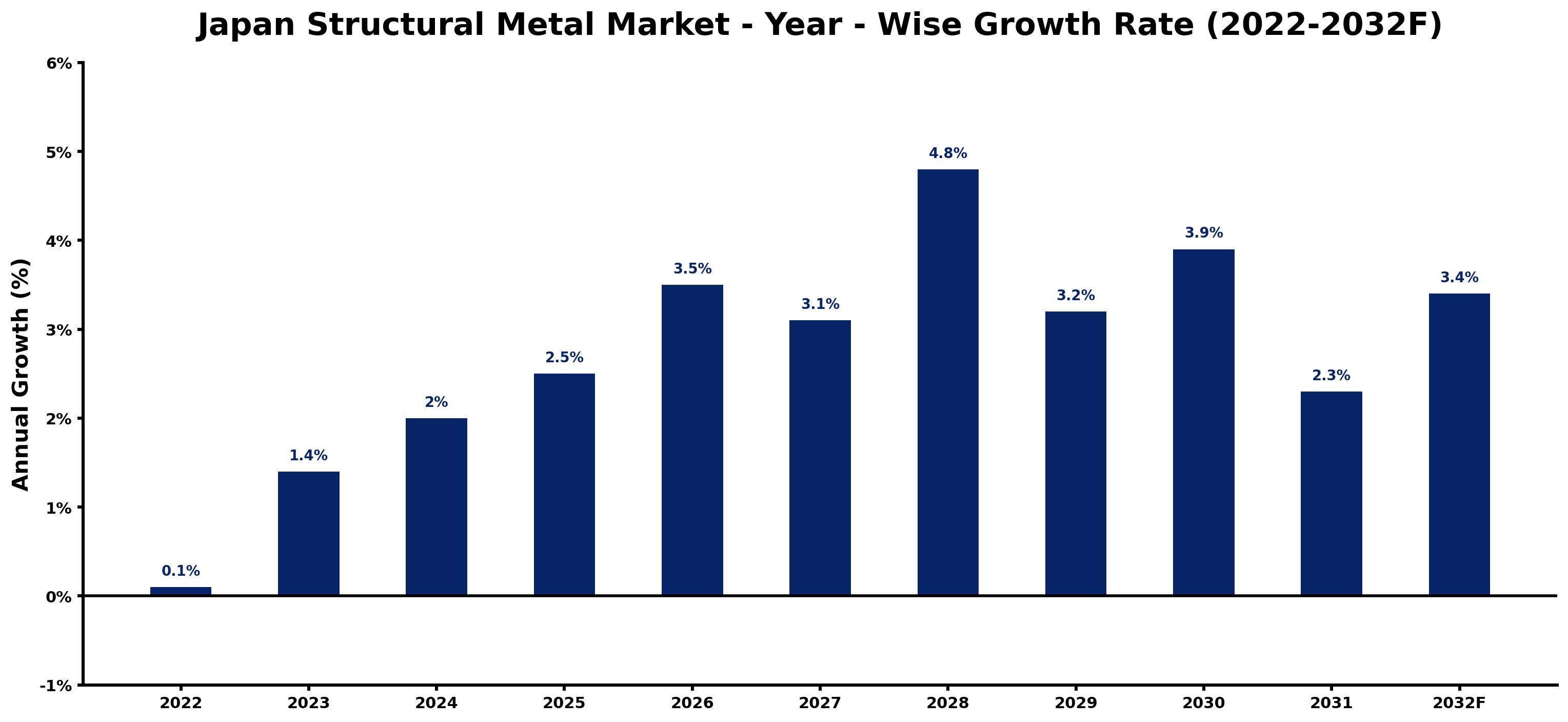
The following figures match every annual growth estimate with the main market development of that year, giving the reasoning behind each rise or slowdown.
| Year | Estimated Annual Growth (%) | Market Rationale |
| 2022 | 0.1 | The market experienced minimal growth as construction activity was limited due to economic uncertainties. |
| 2023 | 1.4 | Demand rose due to increased infrastructure investments in urban areas, particularly in the Tokyo metropolitan region. |
| 2024 | 2.0 | Growth continued as more construction projects were initiated, supported by public works funding. |
| 2025 | 2.5 | The market saw growth driven by the completion of major infrastructure projects and rising material needs. |
| 2026 | 3.5 | Demand is expected to rise as the government allocates substantial funds for infrastructure development. |
| 2027 | 3.1 | Growth is projected to slow slightly as the market adjusts to previous high levels of construction activity. |
| 2028 | 4.8 | The market is expected to peak as new construction initiatives and infrastructure upgrades drive demand. |
| 2029 | 3.2 | Demand growth is projected to slow as the market stabilises after the peak in 2028. |
| 2030 | 3.9 | Growth is expected to accelerate again as new regulations promote sustainable construction practices. |
| 2031 | 2.3 | The market is projected to see slower growth as demand normalises after previous peaks in construction. |
| 2032 | 3.4 | Demand is expected to rise steadily as investment in infrastructure continues to be a priority. |
Note: Market size estimations and growth projections presented in this report are based on 6Wresearch's proprietary forecasting methodology, utilizing the latest available industry data, government publications, and primary research inputs.
Japan Structural Metal Market Synopsis
Structural metal consists of materials like steel and aluminum, primarily used in construction frameworks, bridges, and industrial platforms. The Japan Structural Metal Market is driven by ongoing infrastructure projects and a strong construction sector, particularly in the Tokyo metropolitan area. The government has allocated JPY 1 trillion for infrastructure development in 2023, stimulating demand for structural metal. As sustainability becomes a priority, the market is expected to grow due to increased investments in eco-friendly materials and practices.
Market Dynamics Impact Analysis (2026–2032)
| Factor | Type | Impact | Primary Segment Affected |
| Increasing infrastructure investment in urban areas | Driver | High | Building Frameworks |
| Growing demand for lightweight materials in construction | Driver | High | Aluminum |
| Rising public and private sector funding for construction projects | Opportunity | High | Construction Firms |
| Shift towards sustainable construction practices | Opportunity | Medium | Infrastructure Developers |
| High production costs for raw materials | Restraint | High | Structural Steel |
| Strict regulations on construction standards | Restraint | Medium | Stainless Steel |
| Supply chain disruptions affecting material availability | Challenge | High | Rebar |
| Competition from alternative materials in construction | Challenge | Medium | I-Beams |
Evaluation of Drivers in Japan Structural Metal Market (2026–2032)
These are the developments adding the most demand over the forecast period.
| Drivers | Primary Segment Affected | Why It Matters (Evidence) |
| Increased urbanisation leading to more construction projects | Building Frameworks | In the Tokyo metropolitan area, over 70% of new commercial buildings utilise structural metal. |
| Growing preference for lightweight materials | Aluminum | The usage of aluminum in building frameworks has risen due to its corrosion resistance and lightweight properties. |
| Government funding for infrastructure development | Construction Firms | In 2023, the government allocated ¥1 trillion for infrastructure projects, boosting demand for structural metal. |
| Rising demand for concrete reinforcement in new constructions | Rebar | Concrete reinforcement bars are essential for over 80% of new construction projects. |
| Increased focus on sustainability in construction | Infrastructure Developers | Japan targets a 46% reduction in greenhouse gas emissions by 2030, promoting sustainable materials. |
Behind the steady rise in orders sits increased urbanisation, particularly in the Tokyo metropolitan area, where over 70% of new commercial buildings utilise structural metal. The shift towards lightweight materials has led to a rise in aluminum usage, reflecting a broader trend towards sustainability. Concrete reinforcement bars are essential for over 80% of new construction projects, further driving demand for structural metal.
Evaluation of Restraints in Japan Structural Metal Market
These restraints slow adoption and weigh on supplier margins.
| Market Restraint | Primary Segment Affected | Why It Matters (Evidence) |
| High production costs for raw materials affecting pricing | Structural Steel | The rising costs of steel production have led to increased prices for structural steel, impacting buyers. |
| Strict regulations on construction standards impacting timelines | Stainless Steel | Japan's stringent regulations on structural integrity can delay project timelines for construction firms. |
| Supply chain disruptions affecting material availability | Rebar | Recent supply chain issues have resulted in shortages of rebar, impacting construction schedules. |
| Competition from alternative materials in construction | I-Beams | The rise in popularity of alternative materials has reduced demand for traditional I-beams. |
| Limited recycling capabilities for structural metal | Aluminum | The recycling process for aluminum is not as advanced, affecting its availability in the market. |
Japan Structural Metal Market Challenges
Construction projects in the Tokyo metropolitan area face delays due to outdated technology, resulting in increased costs for buyers. Average project completion times have risen by 20%, leading to higher expenses that strain budgets. Suppliers contend with rising production costs from fluctuating raw material prices, which have driven input costs for structural metal up by 15%. Stringent regulations on structural integrity, influenced by seismic activity, impose compliance costs reaching ¥500 million per project, impacting both suppliers and buyers. A shortage of skilled labour in the construction sector hampers productivity, costing firms approximately ¥300 billion annually in lost output.
Trends in the Japan Structural Metal Market
The shifts below are changing how Japan Structural Metal Market products are bought and supplied.
- Shift towards Sustainable Construction Materials: The Ministry of Land, Infrastructure, Transport and Tourism promotes sustainable practices, influencing the adoption of eco-friendly materials. In 2023, Japan allocated ¥1 trillion for infrastructure, driving demand for structural metal.
- Transition from Steel to Aluminium in Building Frameworks: Aluminium is increasingly favoured for building frameworks due to its lightweight and corrosion-resistant properties. In recent years, its usage has surged, with a notable increase in projects across urban areas.
- Emergence of Advanced Construction Techniques: Construction firms are adopting advanced techniques that require high-quality structural materials. This trend is particularly evident in the Tokyo metropolitan area, where over 70% of new projects utilise innovative frameworks.
- Increase in Prefabricated Construction Solutions: Prefabricated construction methods are gaining traction, with structural metal playing a key role. In 2023, the demand for prefabricated solutions rose by 15%, reflecting changing buyer preferences.
Investment Opportunities in the Japan Structural Metal Market
The opportunities below stand out in the Japan Structural Metal Market for new entrants and existing suppliers.
- Gap in Sustainable Material Supply: With Japan targeting a 46% reduction in emissions by 2030, there is an opportunity to supply eco-friendly structural metal. Infrastructure developers are increasingly seeking sustainable materials.
- Investment in Infrastructure Development: The government allocated ¥1 trillion in 2023 for infrastructure projects, creating a demand for structural metal. Suppliers can enter this market by partnering with local construction firms.
- Timing for Lightweight Materials: As construction firms seek to reduce overall building weight, the demand for aluminium is set to rise. This trend is particularly relevant in urban areas where space is limited.
- Focus on Urban Infrastructure Projects: Urbanisation is driving construction, particularly in the Tokyo metropolitan area, creating a growing need for structural metal. Suppliers can target this hub for strategic partnerships.
Government Initiatives in the Japan Structural Metal Market
The Economic Security Promotion Act of 2022 supports supply-chain resilience for critical materials, including structural metal. This law mandates that businesses ensure a stable supply of essential materials, promoting local production and reducing dependency on imports. Furthermore, the PRTR Law requires businesses to report chemical releases, ensuring environmental compliance in metal production.
The Japan Iron and Steel Federation oversees approvals for infrastructure projects, ensuring compliance with safety and quality standards. This agency allocates funding for sustainable construction initiatives, further encouraging the use of high-quality structural materials in new developments.
Future Insight of the Japan Structural Metal Market
By 2032, advancements in smart building technology will reshape demand for structural metal, driven by Japan's JPY 150 trillion investment in decarbonisation. Enhanced construction practices will improve efficiency and minimise waste, benefiting buyers and suppliers alike. Infrastructure development will thrive, supported by government initiatives that ensure sustained demand for structural metal. New guidelines from the Japan Society of Civil Engineers will influence design standards, impacting material choices and construction methods.
Market Segmentation Analysis
Japan Structural Metal Market report covers a detailed analysis of the following market segments:
By Metal Type – Structural Steel Leads, Aluminum Expected to Grow Fastest
According to Saurav Kr Singh, Senior Research Analyst at 6Wresearch, in 2025, Structural Steel led the metal type split with a 53% share. Structural steel is the cornerstone of construction and infrastructure projects in Japan, with a production volume of 7.5 million tons in 2022. Its critical application in over 70% of new commercial building projects underscores its indispensable role in fulfilling national construction objectives. The quickest growth will come from Aluminum, forecast to expand at a CAGR of 4.8% between 2026 and 2032. Aluminum's increasing adoption is attributed to its lightweight and corrosion-resistant properties, making it ideal for a variety of applications. The notable rise in aluminium use for bridges highlights its expanding market relevance and adaptability. Suppliers should prioritise advancements in aluminium technology to cater to growing demand, while buyers may benefit from considering lightweight materials for enhanced project efficiency.
By Product Form – I-Beams Lead, Channels & Angles Expected to Grow Fastest
I-Beams held 50% of the Japan Structural Metal Market by product form in 2025. I-beams are essential for providing structural support in buildings and bridges, making them a staple in the construction sector. Their critical role is highlighted by their widespread application in major construction projects across Japan. Channels & Angles are set to record the highest CAGR in this split, 4.9% over 2026–2032. Channels and angles are experiencing rapid growth as they are increasingly used for framing and support structures in construction. This trend is driven by the ongoing infrastructure development initiatives, which require versatile support solutions. Suppliers must ensure a steady supply of channels and angles to meet the rising demand, while buyers should consider these forms for their construction projects.
By Application Area – Building Frameworks Lead, Bridges Expected to Grow Fastest
Building Frameworks accounted for 37% of the market by application area in 2025. Building frameworks represent the primary application for structural metal in construction, reflecting strong demand in this sector. The ongoing construction surge in the Tokyo metropolitan area emphasises the importance of this application in addressing urban development challenges. Bridges are projected to grow fastest, at a CAGR of 4.5% during 2026–2032. Bridges are witnessing the fastest growth due to their essential role in infrastructure development and connectivity, bolstered by significant government investment in public works. The recent allocation of ¥1 trillion for infrastructure projects further propels this demand. Suppliers should concentrate on providing solutions tailored for bridge construction to align with infrastructure needs, while buyers may need to prepare for an increase in bridge-related projects.
By End User – Construction Firms Lead, Infrastructure Developers Expected to Grow Fastest
Construction Firms took 44% of end user revenue in 2025, more than any other category. Construction firms are the predominant consumers of structural metal, utilising it extensively for various projects across Japan. Their workforce of over 5 million workers illustrates the scale of their operations and the heightened demand for structural materials. Over 2026–2032, Infrastructure Developers are expected to post the fastest growth, at a CAGR of 4.6%. Infrastructure developers are rapidly increasing their use of structural metal, particularly for public works and development projects. This trend is driven by government initiatives aimed at enhancing national infrastructure, leading to further demand. Suppliers should focus on meeting the specific needs of infrastructure developers, while buyers may need to collaborate closely with these entities to seize project opportunities.
Key Attractiveness of the Report
- 10 Years of Market Numbers
- Historical Data Starting from 2022 to 2025
- Base Year 2025
- Forecast Data until 2032
- Key Performance Indicators Impacting the Market
- Major Upcoming Developments and Projects
Key Highlights of the Report:
- Japan Structural Metal Market Outlook
- Market Size of Japan Structural Metal Market, 2025
- Forecast of Japan Structural Metal Market, 2032
- Historical Data and Forecast of Japan Structural Metal Revenues & Volume for the Period 2022-2032F
- Japan Structural Metal Market Trend Evolution
- Japan Structural Metal Market Drivers and Challenges
- Japan Structural Metal Price Trends
- Japan Structural Metal Porter's Five Forces
- Japan Structural Metal Industry Life Cycle
- Historical Data and Forecast of Japan Structural Metal Market Revenues & Volume By Metal Type for the Period 2022-2032F
- Historical Data and Forecast of Japan Structural Metal Market Revenues & Volume By Structural Steel for the Period 2022-2032F
- Historical Data and Forecast of Japan Structural Metal Market Revenues & Volume By Aluminum for the Period 2022-2032F
- Historical Data and Forecast of Japan Structural Metal Market Revenues & Volume By Stainless Steel for the Period 2022-2032F
- Historical Data and Forecast of Japan Structural Metal Market Revenues & Volume By Rebar for the Period 2022-2032F
- Historical Data and Forecast of Japan Structural Metal Market Revenues & Volume By Product Form for the Period 2022-2032F
- Historical Data and Forecast of Japan Structural Metal Market Revenues & Volume By I-Beams for the Period 2022-2032F
- Historical Data and Forecast of Japan Structural Metal Market Revenues & Volume By Channels & Angles for the Period 2022-2032F
- Historical Data and Forecast of Japan Structural Metal Market Revenues & Volume By Plates for the Period 2022-2032F
- Historical Data and Forecast of Japan Structural Metal Market Revenues & Volume By Rods for the Period 2022-2032F
- Historical Data and Forecast of Japan Structural Metal Market Revenues & Volume By Application Area for the Period 2022-2032F
- Historical Data and Forecast of Japan Structural Metal Market Revenues & Volume By Building Frameworks for the Period 2022-2032F
- Historical Data and Forecast of Japan Structural Metal Market Revenues & Volume By Bridges for the Period 2022-2032F
- Historical Data and Forecast of Japan Structural Metal Market Revenues & Volume By Industrial Platforms for the Period 2022-2032F
- Historical Data and Forecast of Japan Structural Metal Market Revenues & Volume By Concrete Reinforcement for the Period 2022-2032F
- Historical Data and Forecast of Japan Structural Metal Market Revenues & Volume By End User for the Period 2022-2032F
- Historical Data and Forecast of Japan Structural Metal Market Revenues & Volume By Construction Firms for the Period 2022-2032F
- Historical Data and Forecast of Japan Structural Metal Market Revenues & Volume By Infrastructure Developers for the Period 2022-2032F
- Historical Data and Forecast of Japan Structural Metal Market Revenues & Volume By Engineering Contractors for the Period 2022-2032F
- Historical Data and Forecast of Japan Structural Metal Market Revenues & Volume By Civil Engineers for the Period 2022-2032F
- Japan Structural Metal Import Export Trade Statistics
- Market Opportunity Assessment By Metal Type
- Market Opportunity Assessment By Product Form
- Market Opportunity Assessment By Application Area
- Market Opportunity Assessment By End User
- Japan Structural Metal Top Companies Market Share
- Japan Structural Metal Competitive Benchmarking By Technical and Operational Parameters
- Japan Structural Metal Company Profiles
- Japan Structural Metal Key Strategic Recommendations
Market Covered
The study includes the following segmentation.
By Metal Type
- Structural Steel
- Aluminum
- Stainless Steel
- Rebar
By Product Form
- I-Beams
- Channels & Angles
- Plates
- Rods
By Application Area
- Building Frameworks
- Bridges
- Industrial Platforms
- Concrete Reinforcement
By End User
- Construction Firms
- Infrastructure Developers
- Engineering Contractors
- Civil Engineers































