Japan Structural Stamp Components Market Size & Growth Rate
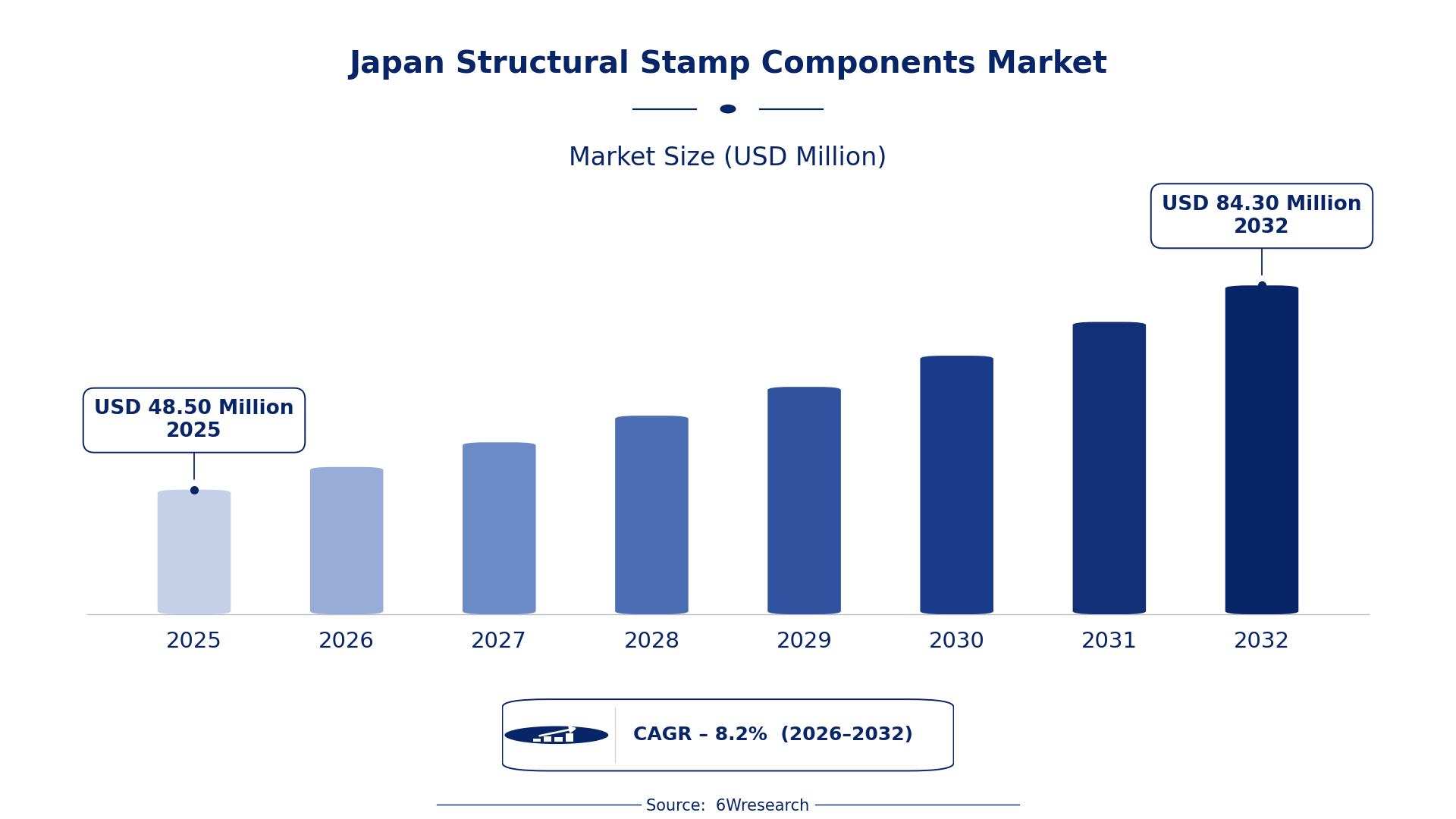
According to 6Wresearch internal database and industry insights, the Japan Structural Stamp Components Market was valued at USD 48.50 Million in 2025 and is projected to reach USD 84.30 Million by 2032, growing at a CAGR of approximately 8.2% during 2026–2032.
Japan Structural Stamp Components Market Highlights
| Report Metric | Details |
| Report Name | Japan Structural Stamp Components Market (2026-2032) |
| Market Size 2025 | USD 48.50 Million |
| Market Size 2032 | USD 84.30 Million |
| Absolute Growth 2025–2032 | USD 35.80 Million |
| CAGR 2026–2032 | 8.2% |
| Peak Annual Growth | 9.1% in 2028 |
| Forecast Period | 2026–2032 |
| Historical Data | 2022–2025 |
| Base Year | 2025 |
| Leading Component Type, 2025 | Floor Panels (47% share) |
| Leading Metal Type, 2025 | Aluminum Alloy (50% share) |
| Leading Manufacturing Method, 2025 | Deep Drawing (36% share) |
| Leading End User, 2025 | Car Body Shops (46% share) |
| Fastest-Growing Component Type | Door Frames (11.3% CAGR) |
| Fastest-Growing Metal Type | Cold-Rolled Steel (11.7% CAGR) |
| Fastest-Growing Manufacturing Method | Progressive Die (11.8% CAGR) |
| Fastest-Growing End User | Vehicle OEMs (10.4% CAGR) |
| Growing Sector | automotive manufacturing |
| Key End Users | automotive manufacturers, construction firms, vehicle OEMs, auto part suppliers |
Japan Structural Stamp Components Market Year-wise Growth Rate and Key Drivers (2022–2032)
This graph illustrates the annual growth rates of the market from 2022 to 2032, highlighting a steady upward trajectory and projected market expansion over the forecast period.
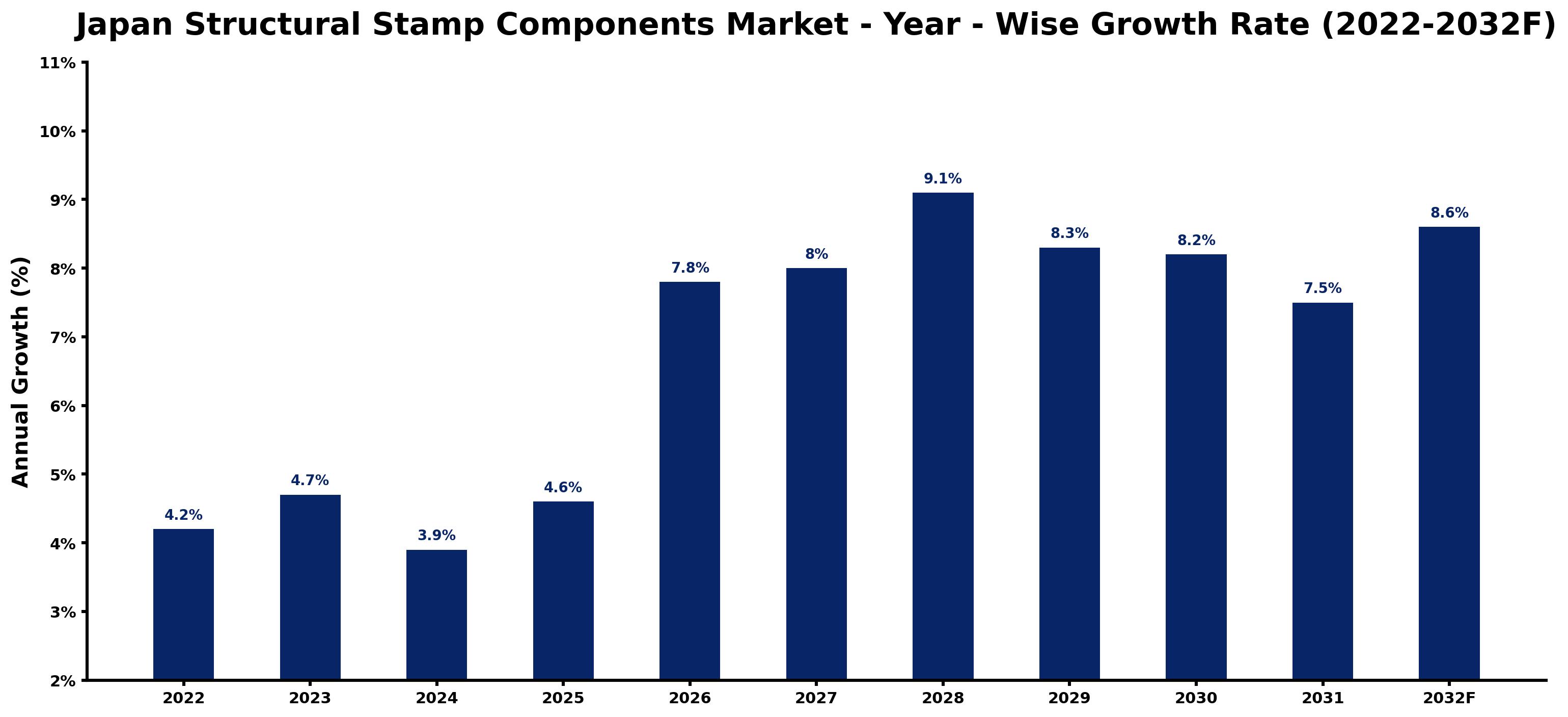
Annual growth estimates for each year appear below with the principal reason behind them, explaining the shifts that set the pace of the market.
| Year | Estimated Annual Growth (%) | Market Rationale |
| 2022 | 4.2 | The market exhibited steady growth as automotive production levels remained stable, driving demand for structural components. |
| 2023 | 4.7 | Demand surged due to increased automotive production, with manufacturers ramping up output to meet rising orders. |
| 2024 | 3.9 | Growth slowed as supply chain challenges emerged, affecting the timely delivery of raw materials for production. |
| 2025 | 4.6 | Demand accelerated again as vehicle OEMs expanded operations, leading to increased orders for structural components. |
| 2026 | 7.8 | The market is expected to grow as investments in advanced manufacturing technologies enhance production capabilities. |
| 2027 | 8.0 | Demand will rise further as the shift towards lightweight materials continues, particularly in the electric vehicle segment. |
| 2028 | 9.1 | The peak growth year will be driven by heightened automotive production and the introduction of new industry standards. |
| 2029 | 8.3 | Growth will moderate as market saturation begins to set in, but demand for innovative designs will persist. |
| 2030 | 8.2 | The market will continue to grow, supported by ongoing investments in local production facilities and automation. |
| 2031 | 7.5 | Growth will slow as the market stabilises, but demand for high-quality components will remain strong. |
| 2032 | 8.6 | The market is expected to grow rapidly as new industry standards drive quality improvements and operational efficiencies. |
Note: Market size estimations and growth projections presented in this report are based on 6Wresearch's proprietary forecasting methodology, utilizing the latest available industry data, government publications, and primary research inputs.
Japan Structural Stamp Components Market Synopsis
Structural Stamp Components play a critical role in automotive and construction applications by providing essential strength and stability. The Japan Structural Stamp Components Market is expanding, driven by rising automotive production levels, projected to reach USD 84.30 Million by 2032. Factors such as increased investments in advanced manufacturing technologies and a growing preference for lightweight materials are propelling this market forward, indicating a robust future for suppliers and buyers alike.
Market Dynamics Impact Analysis (2026–2032)
| Factor | Type | Impact | Primary Segment Affected |
| Increased automotive production drives demand for structural components. | Driver | High | Floor Panels |
| Growing demand for lightweight materials enhances market opportunities. | Driver | High | Door Frames |
| Investment in manufacturing facilities presents significant growth potential. | Opportunity | High | Crossmembers |
| Rising demand for energy-efficient vehicles creates new market avenues. | Opportunity | High | Roof Rails |
| Supply chain disruptions can hinder production capabilities. | Restraint | High | Floor Panels |
| High competition may lead to price pressures in the market. | Restraint | Medium | Door Frames |
| Technological advancements require continuous investment from producers. | Challenge | High | Crossmembers |
| Regulatory compliance can increase operational costs for manufacturers. | Challenge | Medium | Roof Rails |
Evaluation of Drivers in Japan Structural Stamp Components Market (2026–2032)
The factors lifting demand, and the evidence behind each, are summarised below.
| Drivers | Primary Segment Affected | Why It Matters (Evidence) |
| Rising automotive production levels. | Floor Panels | In 2025, Japan's automotive production is expected to reach 9 million units, increasing demand for structural components. |
| Growing preference for lightweight materials. | Door Frames | The shift towards electric vehicles is driving demand for lighter components, with a projected growth of 11.3% for Door Frames. |
| Expansion of vehicle OEMs in Japan. | Roof Rails | The automotive sector's growth is resulting in increased orders for structural components. |
| Rising consumer demand for energy-efficient vehicles. | Crossmembers | The push for fuel-efficient cars is driving demand for lightweight structural components. |
| Technological advancements in manufacturing processes. | Floor Panels | Investments in automation and advanced manufacturing techniques are improving production efficiency. |
Buyers are expanding capacity as Japan's automotive production is anticipated to hit 9 million units by 2025, heightening the demand for structural components. The move towards lightweight materials is accelerating, with demand for Door Frames expected to surge due to the rise of electric vehicles. The expansion of vehicle OEMs is generating greater orders for structural components, while consumer trends favouring energy-efficient vehicles are increasing the need for lighter materials. Technological advancements in manufacturing processes are further improving production efficiency, creating a positive outlook for the market.
Evaluation of Restraints in Japan Structural Stamp Components Market
Several factors work against faster growth; the main ones are summarised below.
| Market Restraint | Primary Segment Affected | Why It Matters (Evidence) |
| Supply chain disruptions affecting material availability. | Floor Panels | In 2022, supply chain issues led to delays in material sourcing, impacting production timelines. |
| Intense competition leading to price pressures. | Door Frames | The increasing number of manufacturers has resulted in aggressive pricing strategies, affecting profit margins. |
| Regulatory compliance costs for manufacturers. | Crossmembers | Compliance with safety and environmental regulations can increase operational costs by approximately 15%. |
| Technological investment requirements for production. | Roof Rails | Manufacturers must invest heavily in new technologies to remain competitive, impacting cash flow. |
| Fluctuations in raw material prices affecting profitability. | Floor Panels | In 2023, rising steel prices increased production costs by approximately 10%. |
Japan Structural Stamp Components Market Challenges
Producers face intricate regulations that complicate adherence to local safety standards, resulting in product launch delays and increased costs for manufacturers. Importers experience supply chain disruptions that can prolong lead times by 30%, leading to stock shortages for distributors. A shortage of skilled workers hinders production efficiency, causing operational delays that can increase costs by 15% for producers. Buyers contend with fluctuating raw material prices, which can inflate project budgets by 20%, impacting the feasibility of their projects.
Trends in the Japan Structural Stamp Components Market
The shifts below are changing how Japan Structural Stamp Components Market products are bought and supplied.
- Shift from Steel to Aluminum Alloys: In 2023, the trend towards Aluminium Alloys for structural components gained traction, capturing a 50% market share. This shift is driven by the demand for lighter materials in automotive production.
- Transition from Traditional to Advanced Manufacturing Methods: Beginning in 2026, manufacturers are increasingly adopting advanced methods like Progressive Die, projected to grow at 11.8%. This transition enhances efficiency and production capabilities.
- Emergence of New Manufacturing Standards: The introduction of new manufacturing standards in 2025 is transforming production processes. These standards aim to minimise environmental impact, encouraging manufacturers to adopt sustainable practices.
- Prioritisation of Lightweight Components in Automotive Design: As of 2024, the automotive industry is focusing on lightweight components, with a notable shift towards structural components like Roof Rails, enhancing vehicle efficiency.
Investment Opportunities in the Japan Structural Stamp Components Market
Below are the investment opportunities with the strongest case in the Japan Structural Stamp Components Market.
- Growing demand for energy-efficient vehicles creates investment opportunities.: With the automotive sector prioritising fuel efficiency, a 20% increase in demand for lightweight components is projected by 2025. Manufacturers can seize this trend by investing in new materials.
- Partnerships with local manufacturers can facilitate market entry.: Now presents an ideal opportunity for foreign companies to collaborate with Japanese manufacturers to access the expanding market. Partnerships can aid in navigating regulatory challenges and local preferences.
- Investment in advanced manufacturing technologies is crucial.: With a projected 11.8% growth in Progressive Die methods, suppliers should explore investments in these technologies to meet rising demand. Vehicle OEMs are actively seeking partners for new solutions.
- Expansion of automotive production facilities presents opportunities.: As Japan's automotive production is poised to increase, there is a substantial opportunity for suppliers to provide structural components. Engaging with vehicle OEMs can ease entry into this growing market.
Government Initiatives in the Japan Structural Stamp Components Market
The Chemical Substances Control Law (1973) requires manufacturers to evaluate and manage chemical substances used in production. This law ensures that structural components comply with safety and environmental standards, influencing production processes. The PRTR Law (1999) further mandates businesses to report on chemical substances, promoting transparency and accountability in manufacturing practices.
The Ministry of the Environment (MoE) supervises the implementation of the PRTR Law, ensuring compliance among manufacturers. Additionally, the Economic Security Promotion Act (2022) supports supply-chain resilience for critical products, providing funding for initiatives that strengthen production capabilities in the structural components sector.
Future Insight of the Japan Structural Stamp Components Market
Investment in advanced manufacturing technologies will spur demand for high-quality structural stamp components. By 2032, the introduction of new industry standards will elevate product quality and reliability, benefiting both buyers and suppliers. The growth of local production facilities will strengthen supply chain resilience. Increased automation in production processes will lower operational costs, allowing suppliers to provide more competitive pricing.
Market Segmentation Analysis
Japan Structural Stamp Components Market report covers a detailed analysis of the following market segments:
By Component Type – Floor Panels Lead, Door Frames Expected to Grow Fastest
According to Saurav Kr Singh, Senior Research Analyst at 6Wresearch, Floor Panels held 47% of the Japan Structural Stamp Components Market by component type in 2025. Floor panels are widely used in both residential and commercial construction, providing essential structural support and durability. Their critical role in projects such as high-rise buildings and extensive housing developments solidifies their leading market position. Door Frames are set to record the highest CAGR in this split, 11.3% over 2026–2032. The surge in the use of door frames is propelled by a growing focus on design and functionality in modern architecture. This trend is particularly evident in urban residential developments, where door frames significantly enhance the overall aesthetic. Suppliers should prioritise door frame production to meet the rising demand in the construction industry.
By Metal Type – Aluminum Alloy Leads, Cold-Rolled Steel Expected to Grow Fastest
Aluminum Alloy took 50% of metal type revenue in 2025, more than any other category. Aluminum alloy is preferred in structural applications due to its lightweight characteristics and corrosion resistance, making it ideal for diverse construction requirements. Its widespread use in sectors like automotive and aerospace strengthens its leading market share. Over 2026–2032, Cold-Rolled Steel is expected to post the fastest growth, at a CAGR of 11.7%. The increasing preference for cold-rolled steel is largely due to its cost-effectiveness and versatility across various sectors. This trend is notably significant in the construction industry, where builders are looking for budget-friendly materials for structural needs. Buyers should consider sourcing cold-rolled steel to benefit from its growing popularity and cost efficiencies.
By Manufacturing Method – Deep Drawing Leads, Progressive Die Expected to Grow Fastest
Deep Drawing accounted for 36% of the market by manufacturing method in 2025. Deep drawing is the dominant method due to its efficiency in producing complex shapes with minimal waste. Its widespread use in automotive parts manufacturing highlights its importance in the industry. The quickest growth will come from Progressive Die, forecast to expand at a CAGR of 11.8% between 2026 and 2032. The increasing adoption of progressive die methods is fuelled by the need for higher precision and lower production costs. This method is becoming essential in high-volume production scenarios, particularly in the automotive field. Manufacturers should invest in progressive die technology to stay competitive and meet precision demands.
By End User – Car Body Shops Lead, Vehicle OEMs Expected to Grow Fastest
With 46% of end user revenue in 2025, Car Body Shops was the largest category. Car body shops represent the largest user group due to their critical role in vehicle assembly and repair. Their reliance on structural components for safety and performance ensures a strong market presence. Vehicle OEMs are projected to grow fastest, at a CAGR of 10.4% during 2026–2032. Vehicle OEMs are experiencing rapid growth as they expand production capabilities to meet rising consumer demand. This trend is particularly strong in the electric vehicle segment, which is gaining momentum in the market. Suppliers must align their offerings with the needs of vehicle OEMs to capture emerging opportunities.
Key Attractiveness of the Report
- 10 Years of Market Numbers
- Historical Data Starting from 2022 to 2025
- Base Year 2025
- Forecast Data until 2032
- Key Performance Indicators Impacting the Market
- Major Upcoming Developments and Projects
Key Highlights of the Report:
- Japan Structural Stamp Components Market Outlook
- Market Size of Japan Structural Stamp Components Market, 2025
- Forecast of Japan Structural Stamp Components Market, 2032
- Historical Data and Forecast of Japan Structural Stamp Components Revenues & Volume for the Period 2022-2032F
- Japan Structural Stamp Components Market Trend Evolution
- Japan Structural Stamp Components Market Drivers and Challenges
- Japan Structural Stamp Components Price Trends
- Japan Structural Stamp Components Porter's Five Forces
- Japan Structural Stamp Components Industry Life Cycle
- Historical Data and Forecast of Japan Structural Stamp Components Market Revenues & Volume By Component Type for the Period 2022-2032F
- Historical Data and Forecast of Japan Structural Stamp Components Market Revenues & Volume By Floor Panels for the Period 2022-2032F
- Historical Data and Forecast of Japan Structural Stamp Components Market Revenues & Volume By Door Frames for the Period 2022-2032F
- Historical Data and Forecast of Japan Structural Stamp Components Market Revenues & Volume By Crossmembers for the Period 2022-2032F
- Historical Data and Forecast of Japan Structural Stamp Components Market Revenues & Volume By Roof Rails for the Period 2022-2032F
- Historical Data and Forecast of Japan Structural Stamp Components Market Revenues & Volume By Metal Type for the Period 2022-2032F
- Historical Data and Forecast of Japan Structural Stamp Components Market Revenues & Volume By Aluminum Alloy for the Period 2022-2032F
- Historical Data and Forecast of Japan Structural Stamp Components Market Revenues & Volume By Cold-Rolled Steel for the Period 2022-2032F
- Historical Data and Forecast of Japan Structural Stamp Components Market Revenues & Volume By Galvanized Steel for the Period 2022-2032F
- Historical Data and Forecast of Japan Structural Stamp Components Market Revenues & Volume By AHSS for the Period 2022-2032F
- Historical Data and Forecast of Japan Structural Stamp Components Market Revenues & Volume By Manufacturing Method for the Period 2022-2032F
- Historical Data and Forecast of Japan Structural Stamp Components Market Revenues & Volume By Deep Drawing for the Period 2022-2032F
- Historical Data and Forecast of Japan Structural Stamp Components Market Revenues & Volume By Progressive Die for the Period 2022-2032F
- Historical Data and Forecast of Japan Structural Stamp Components Market Revenues & Volume By Press Stamping for the Period 2022-2032F
- Historical Data and Forecast of Japan Structural Stamp Components Market Revenues & Volume By Transfer Die for the Period 2022-2032F
- Historical Data and Forecast of Japan Structural Stamp Components Market Revenues & Volume By End User for the Period 2022-2032F
- Historical Data and Forecast of Japan Structural Stamp Components Market Revenues & Volume By Car Body Shops for the Period 2022-2032F
- Historical Data and Forecast of Japan Structural Stamp Components Market Revenues & Volume By Vehicle OEMs for the Period 2022-2032F
- Historical Data and Forecast of Japan Structural Stamp Components Market Revenues & Volume By Auto Part Suppliers for the Period 2022-2032F
- Historical Data and Forecast of Japan Structural Stamp Components Market Revenues & Volume By Crash Structure Engineers for the Period 2022-2032F
- Japan Structural Stamp Components Import Export Trade Statistics
- Market Opportunity Assessment By Component Type
- Market Opportunity Assessment By Metal Type
- Market Opportunity Assessment By Manufacturing Method
- Market Opportunity Assessment By End User
- Japan Structural Stamp Components Top Companies Market Share
- Japan Structural Stamp Components Competitive Benchmarking By Technical and Operational Parameters
- Japan Structural Stamp Components Company Profiles
- Japan Structural Stamp Components Key Strategic Recommendations
Market Covered
The study includes the following segmentation.
By Component Type
- Floor Panels
- Door Frames
- Crossmembers
- Roof Rails
By Metal Type
- Aluminum Alloy
- Cold-Rolled Steel
- Galvanized Steel
- AHSS
By Manufacturing Method
- Deep Drawing
- Progressive Die
- Press Stamping
- Transfer Die
By End User
- Car Body Shops
- Vehicle OEMs
- Auto Part Suppliers
- Crash Structure Engineers































