Japan Subsea Robotics Market Size & Growth Rate
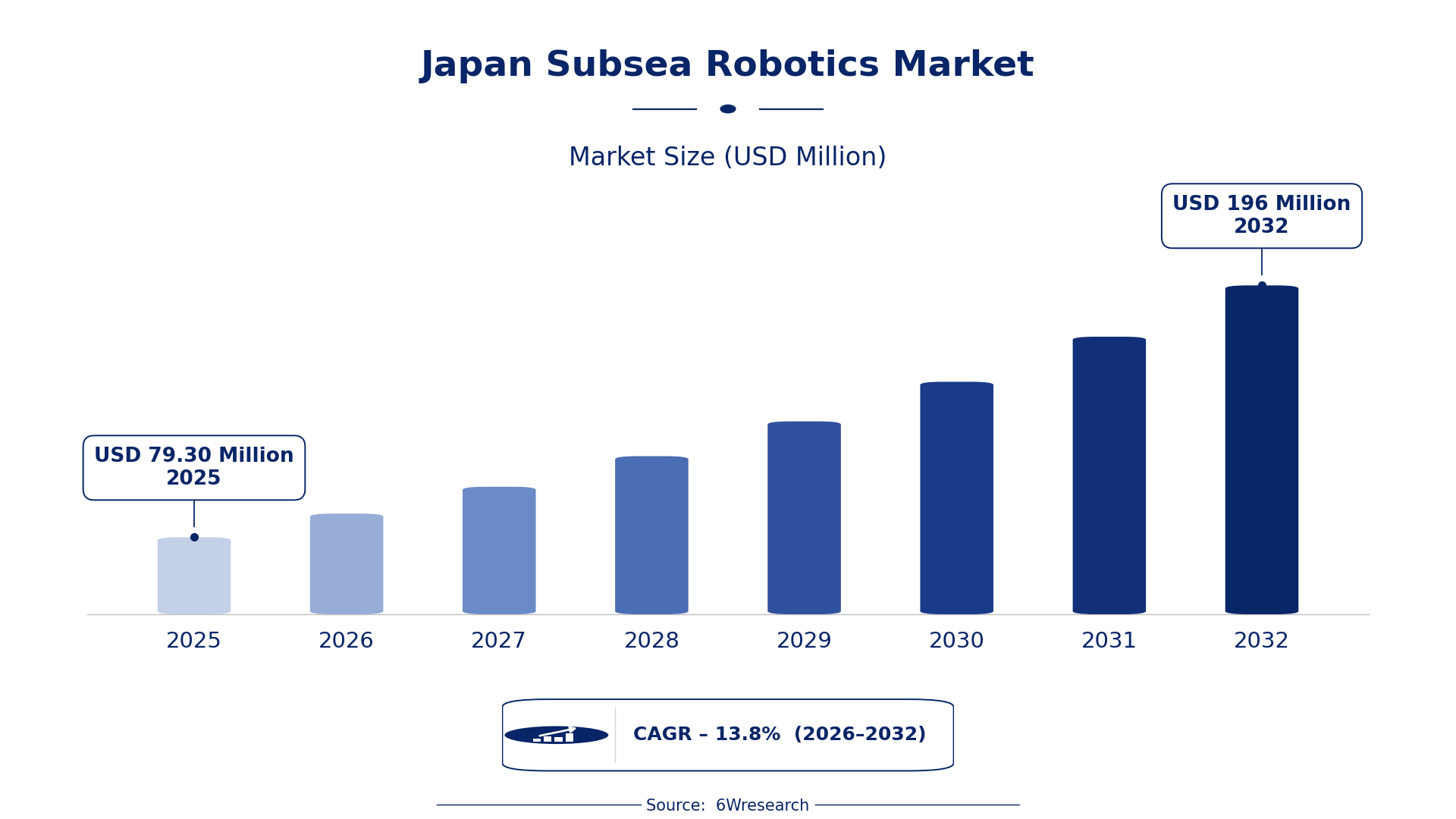
According to 6Wresearch internal database and industry insights, the Japan Subsea Robotics Market was valued at USD 79.30 Million in 2025 and is projected to reach USD 196 Million by 2032, growing at a CAGR of approximately 13.8% during 2026–2032.
Japan Subsea Robotics Market Highlights
| Report Metric | Details |
| Report Name | Japan Subsea Robotics Market (2026-2032) |
| Market Size 2025 | USD 79.30 Million |
| Market Size 2032 | USD 196 Million |
| Absolute Growth 2025–2032 | USD 116.70 Million |
| CAGR 2026–2032 | 13.8% |
| Peak Annual Growth | 15.3% in 2032 |
| Forecast Period | 2026–2032 |
| Historical Data | 2022–2025 |
| Base Year | 2025 |
| Leading Robot Type, 2025 | ROVs (Remotely Operated) (47% share) |
| Leading Control Type, 2025 | Tethered (51% share) |
| Leading Operation Depth, 2025 | Deep-Sea (41% share) |
| Leading End User, 2025 | Offshore Drilling Firms (45% share) |
| Fastest-Growing Robot Type | AUVs (Autonomous) (20.2% CAGR) |
| Fastest-Growing Control Type | AI Navigation (20.0% CAGR) |
| Fastest-Growing Operation Depth | Midwater (18.1% CAGR) |
| Fastest-Growing End User | Oceanography Institutes (18.0% CAGR) |
| Growing Sector | Oceanography Institutes |
| Key End Users | Offshore Drilling Firms, Energy Companies, Oceanography Institutes, Pipeline Maintenance Teams |
Japan Subsea Robotics Market Year-wise Growth Rate and Key Drivers (2022–2032)
This graph illustrates the annual growth rates of the market from 2022 to 2032, highlighting a steady upward trajectory and projected market expansion over the forecast period.
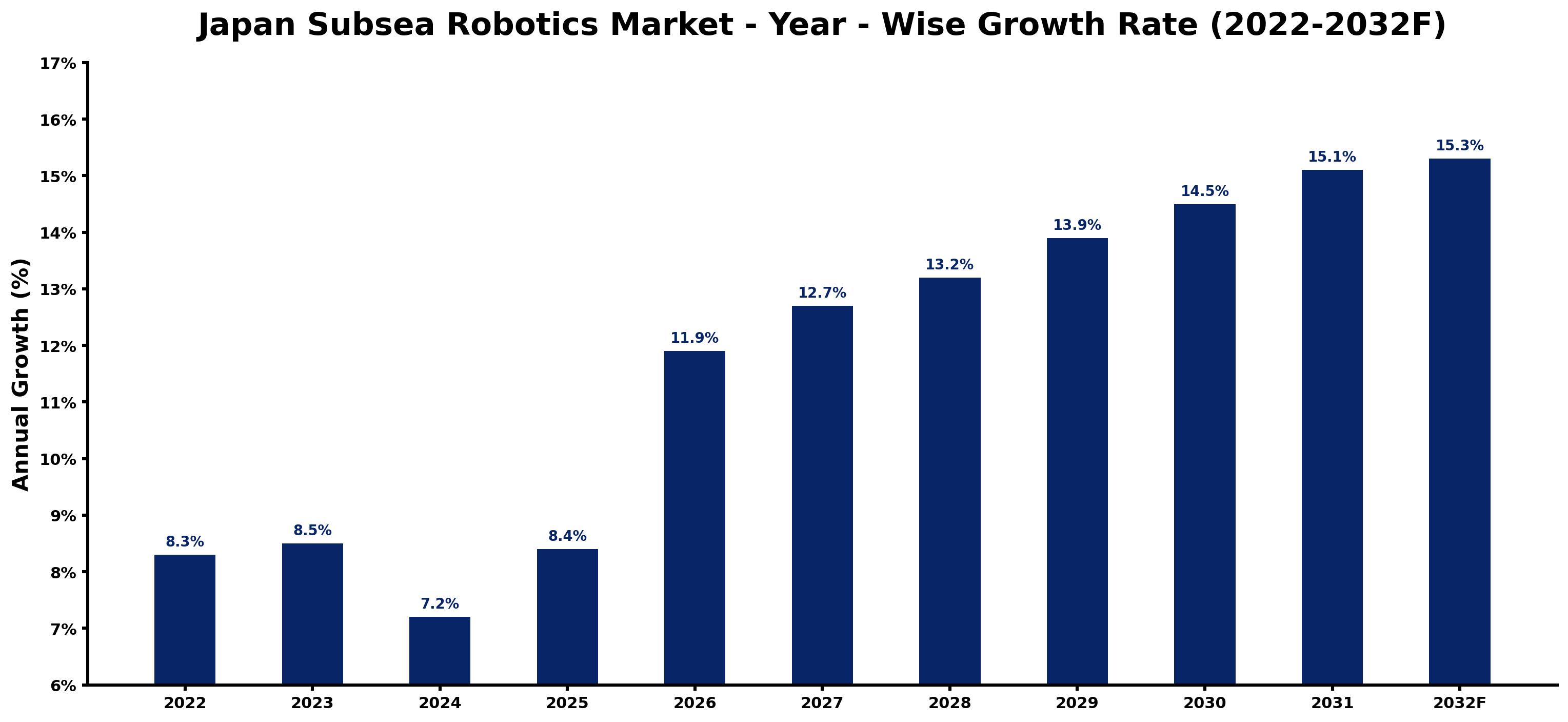
Below, each year's estimated growth is shown next to the factor that most influenced it.
| Year | Estimated Annual Growth (%) | Market Rationale |
| 2022 | 8.3 | The market experienced steady growth, driven by increased offshore drilling activities. |
| 2023 | 8.5 | Growth accelerated due to heightened investments in marine technology and environmental monitoring. |
| 2024 | 7.2 | A slowdown occurred as companies adjusted to market saturation and economic conditions. |
| 2025 | 8.4 | Demand surged again as new projects in oceanographic research gained momentum. |
| 2026 | 11.9 | The market is expected to grow faster due to rising offshore energy exploration activities. |
| 2027 | 12.7 | Continued investment in advanced robotics technology will further boost demand. |
| 2028 | 13.2 | The growth rate is projected to increase as environmental monitoring becomes a priority. |
| 2029 | 13.9 | Demand will rise as more offshore drilling firms adopt advanced subsea technologies. |
| 2030 | 14.5 | The market is projected to grow as the use of autonomous vehicles expands significantly. |
| 2031 | 15.1 | Growth will continue with increasing investments in marine research and technology. |
| 2032 | 15.3 | The peak growth year will be driven by extensive offshore projects and technological advancements. |
Note: Market size estimations and growth projections presented in this report are based on 6Wresearch's proprietary forecasting methodology, utilizing the latest available industry data, government publications, and primary research inputs.
Japan Subsea Robotics Market Synopsis
Subsea robotics encompasses technology for underwater exploration and operations, primarily involving remotely operated vehicles (ROVs) and autonomous underwater vehicles (AUVs). The Japan Subsea Robotics Market is experiencing growth due to strong demand from offshore drilling firms and oceanography institutes, supported by over 50 offshore platforms in the Nankai Trough region. The government has allocated substantial funding for oceanographic research, while advancements in AI navigation are improving operational capabilities and attracting further investments in this sector.
Market Dynamics Impact Analysis (2026–2032)
| Factor | Type | Impact | Primary Segment Affected |
| Growing offshore drilling activities in the Nankai Trough region | Driver | High | ROVs (Remotely Operated) |
| Increased funding for oceanographic research | Driver | High | AUVs (Autonomous) |
| Rising demand for environmental monitoring solutions | Opportunity | High | AUVs (Autonomous) |
| Expansion of subsea robotics applications in energy sectors | Opportunity | Medium | ROVs (Remotely Operated) |
| High initial investment costs for advanced robotics | Restraint | High | ROVs (Remotely Operated) |
| Limited awareness among potential buyers about technology benefits | Restraint | Medium | AUVs (Autonomous) |
| Competition from alternative technologies in underwater operations | Challenge | High | Hybrid Vehicles |
| Regulatory compliance requirements for subsea operations | Challenge | Medium | Inspection Drones |
Evaluation of Drivers in Japan Subsea Robotics Market (2026–2032)
These are the developments adding the most demand over the forecast period.
| Drivers | Primary Segment Affected | Why It Matters (Evidence) |
| Increased offshore drilling activities | ROVs (Remotely Operated) | This surge is driven by over 50 platforms in the Nankai Trough, leading to higher demand for inspection and maintenance. |
| Growing funding for oceanographic research | AUVs (Autonomous) | With 5 billion JPY allocated in 2023, research institutions are purchasing more AUVs for data collection. |
| Technological advancements in AI navigation | AUVs (Autonomous) | These innovations improve operational capabilities, prompting energy companies to invest in new AUV systems. |
| Rising environmental monitoring needs | AUVs (Autonomous) | Initiatives for biodiversity assessments are increasing the demand for AUVs in marine studies. |
| Expansion of subsea robotics in energy sectors | ROVs (Remotely Operated) | The oil and gas sector employs around 30,000 people, driving demand for ROVs in maintenance operations. |
What keeps demand rising is the increased focus on subsea robotics, which has evolved significantly over the past five years. In 2023, funding for oceanographic research reached 5 billion JPY, prompting research institutions to acquire more AUVs for data collection. Technological advancements in navigation systems are improving operational capabilities, leading energy firms to invest in new AUV systems. The oil and gas sector's workforce supports the need for ROVs in maintenance operations, creating a thriving market for subsea robotics. Additionally, the rising emphasis on environmental monitoring is driving demand for AUVs in marine biodiversity assessments.
Evaluation of Restraints in Japan Subsea Robotics Market
The key brakes on demand, and where they bite hardest, are shown below.
| Market Restraint | Primary Segment Affected | Why It Matters (Evidence) |
| Shortage of skilled professionals | ROVs (Remotely Operated) | Limited educational programmes in marine technology delay project timelines for offshore operators. |
| High production costs | AUVs (Autonomous) | Advanced materials and technologies can inflate project budgets by up to 20% for suppliers. |
| Stringent regulations | ROVs (Remotely Operated) | Compliance with standards like JIS B 8420 can lead to potential project delays of several months. |
| Supply chain disruptions | AUVs (Autonomous) | Reliance on specific components causes delays in delivery times for buyers in the oil and gas sector. |
| Market saturation | ROVs (Remotely Operated) | As the market matures, new entrants face challenges in gaining market share. |
Japan Subsea Robotics Market Challenges
A considerable obstacle in the subsea robotics market is the shortage of skilled professionals. This issue arises from Japan's limited educational focus on marine technology, resulting in project delays for research institutions and offshore operators. High production costs stem from the use of advanced materials and technologies, inflating project budgets by around 20% for suppliers. Compliance with established standards, such as JIS B 8420, complicates operations, potentially delaying projects by several months for producers. Supply chain disruptions occur due to reliance on specific components, leading to extended delivery times for buyers in the oil and gas sector.
Trends in the Japan Subsea Robotics Market
Several trends are reshaping the Japan Subsea Robotics Market; the most important are set out below.
- Shift from Manual to Autonomous Operations: Since 2023, the industry has seen a move towards greater autonomy in subsea robotics. This shift is evident in the increased use of AUVs for environmental monitoring, with 1 billion JPY allocated for research.
- Increased Focus on Environmental Monitoring: The Ministry of the Environment initiated a program in 2023 to monitor marine biodiversity using AUVs. This has led to a surge in demand for advanced robotic systems in environmental studies.
- Growing Adoption of AI Navigation: In 2025, advancements in AI navigation technology are transforming subsea operations. Energy companies are investing in these systems to improve the efficiency of underwater inspections.
- Expansion of Offshore Drilling Projects: The number of offshore drilling platforms in Japan has increased, particularly in the Nankai Trough. This growth is driving demand for ROVs, which are essential for inspection and maintenance.
Investment Opportunities in the Japan Subsea Robotics Market
Investors looking at the Japan Subsea Robotics Market should consider the following areas.
- Offshore Drilling Firms Seeking Advanced Solutions: With over 50 platforms in the Nankai Trough, there is a growing demand for advanced subsea robotics. Suppliers can partner with local firms to meet these needs.
- Investment in Oceanographic Research: The allocation of 5 billion JPY for oceanographic research in 2023 highlights a gap for AUV suppliers. Collaborating with research institutions can facilitate market entry.
- Environmental Monitoring Initiatives: The Ministry of the Environment's biodiversity program creates a need for AUVs. Suppliers can enter this market through local partnerships and certifications.
- Technological Development in Shizuoka Prefecture: Shizuoka Prefecture is emerging as a hub for subsea robotics technology. Investing in local facilities can provide access to a growing market.
Government Initiatives in the Japan Subsea Robotics Market
The New Robot Strategy (2015) aims to expand robot use in various sectors, including subsea robotics. This strategy builds on previous regulations by promoting innovation and investment in robotics technology, improving the overall framework for subsea operations. The government has set a target to increase the use of autonomous vehicles in marine environments by 30% by 2030, which will further support the subsea robotics sector.
Funding for oceanographic research reached 5 billion JPY in 2023, administered by the Japan Agency for Marine-Earth Science and Technology. This funding supports the development and use of subsea robotics in environmental monitoring and research, providing crucial resources for advancing technology in this field.
Future Insight of the Japan Subsea Robotics Market
Investment in oceanographic research is projected to reach 6 billion JPY by 2024, creating demand for subsea robotics. This investment will prompt suppliers to innovate and develop advanced solutions. The government's initiative to increase the use of autonomous vehicles in marine environments by 30% by 2030 will open new avenues for buyers. As Tokyo Bay becomes a central hub for environmental monitoring, the demand for ROVs and AUVs will grow, driving collaboration among stakeholders to advance technology.
Market Segmentation Analysis
Japan Subsea Robotics Market report covers a detailed analysis of the following market segments:
By Robot Type – ROVs (Remotely Operated) Leads, AUVs (Autonomous) Expected to Grow Fastest
According to Prakhar Dixit, Senior Research Analyst at 6Wresearch, ROVs (Remotely Operated) held 47% of the Japan Subsea Robotics Market by robot type in 2025. ROVs hold the largest share as they are extensively used for underwater inspections and operations, particularly in Japan's offshore drilling sector. With an installed base of around 200 units, they play a crucial role in maintenance activities across numerous platforms. Over 2026–2032, AUVs (Autonomous) is expected to post the fastest growth, at a CAGR of 20.2%. AUVs are experiencing rapid growth due to their increasing application in autonomous data collection for oceanography, supported by projects funded by the Japan Agency for Marine-Earth Science and Technology. Their efficiency in data gathering positions them well for future demand. Suppliers should focus on enhancing AUV capabilities to meet the growing needs of research institutions.
By Control Type – Tethered Leads, AI Navigation Expected to Grow Fastest
The largest control type category in 2025 was Tethered, at 51% of revenue. Tethered systems dominate the market due to their essential role in real-time control and data transmission during underwater operations. This is particularly crucial for tasks requiring immediate feedback, such as inspections and maintenance. AI Navigation is set to record the highest CAGR in this split, 20.0% over 2026–2032. AI Navigation is growing swiftly as it enables autonomous operations in complex underwater environments, allowing for greater flexibility and efficiency in data collection. This technology is becoming increasingly vital as marine exploration demands evolve. Buyers will benefit from investing in AI Navigation systems to enhance operational capabilities.
By Operation Depth – Deep-Sea Leads, Midwater Expected to Grow Fastest
In 2025, Deep-Sea led the operation depth split with a 41% share. Deep-Sea operations lead the market as they are critical for exploration and resource extraction in Japan's rich marine environments. This depth is essential for accessing valuable resources and conducting significant research. Midwater is projected to grow fastest, at a CAGR of 18.1% during 2026–2032. Midwater applications are rapidly expanding, driven by their importance in research and monitoring activities in midwater environments, which are gaining attention for biodiversity studies. This growth reflects a broader interest in understanding marine ecosystems. Suppliers should consider developing solutions tailored for midwater applications to capture emerging opportunities.
By End User – Offshore Drilling Firms Lead, Oceanography Institutes Expected to Grow Fastest
Offshore Drilling Firms accounted for 45% of the market by end user in 2025. Offshore Drilling Firms represent the largest user group, as they rely heavily on subsea robotics for drilling and maintenance operations in Japan's offshore fields. Their significant investment in technology ensures a steady demand for ROVs and AUVs. The quickest growth will come from Oceanography Institutes, forecast to expand at a CAGR of 18.0% between 2026 and 2032. Oceanography Institutes are the fastest-growing segment, driven by increased funding for research and data collection initiatives, such as the 1 billion JPY allocated by the Ministry of Education. Their focus on marine science is propelling demand for advanced subsea robotics. Suppliers should engage with oceanography institutes to align their offerings with research needs.
Key Attractiveness of the Report
- 10 Years of Market Numbers
- Historical Data Starting from 2022 to 2025
- Base Year 2025
- Forecast Data until 2032
- Key Performance Indicators Impacting the Market
- Major Upcoming Developments and Projects
Key Highlights of the Report:
- Japan Subsea Robotics Market Outlook
- Market Size of Japan Subsea Robotics Market, 2025
- Forecast of Japan Subsea Robotics Market, 2032
- Historical Data and Forecast of Japan Subsea Robotics Revenues & Volume for the Period 2022-2032F
- Japan Subsea Robotics Market Trend Evolution
- Japan Subsea Robotics Market Drivers and Challenges
- Japan Subsea Robotics Price Trends
- Japan Subsea Robotics Porter's Five Forces
- Japan Subsea Robotics Industry Life Cycle
- Historical Data and Forecast of Japan Subsea Robotics Market Revenues & Volume By Robot Type for the Period 2022-2032F
- Historical Data and Forecast of Japan Subsea Robotics Market Revenues & Volume By ROVs (Remotely Operated) for the Period 2022-2032F
- Historical Data and Forecast of Japan Subsea Robotics Market Revenues & Volume By AUVs (Autonomous) for the Period 2022-2032F
- Historical Data and Forecast of Japan Subsea Robotics Market Revenues & Volume By Hybrid Vehicles for the Period 2022-2032F
- Historical Data and Forecast of Japan Subsea Robotics Market Revenues & Volume By Inspection Drones for the Period 2022-2032F
- Historical Data and Forecast of Japan Subsea Robotics Market Revenues & Volume By Control Type for the Period 2022-2032F
- Historical Data and Forecast of Japan Subsea Robotics Market Revenues & Volume By Tethered for the Period 2022-2032F
- Historical Data and Forecast of Japan Subsea Robotics Market Revenues & Volume By AI Navigation for the Period 2022-2032F
- Historical Data and Forecast of Japan Subsea Robotics Market Revenues & Volume By Manual + Autonomous for the Period 2022-2032F
- Historical Data and Forecast of Japan Subsea Robotics Market Revenues & Volume By Remote Monitoring for the Period 2022-2032F
- Historical Data and Forecast of Japan Subsea Robotics Market Revenues & Volume By Operation Depth for the Period 2022-2032F
- Historical Data and Forecast of Japan Subsea Robotics Market Revenues & Volume By Deep-Sea for the Period 2022-2032F
- Historical Data and Forecast of Japan Subsea Robotics Market Revenues & Volume By Midwater for the Period 2022-2032F
- Historical Data and Forecast of Japan Subsea Robotics Market Revenues & Volume By Variable Depth for the Period 2022-2032F
- Historical Data and Forecast of Japan Subsea Robotics Market Revenues & Volume By Shallow for the Period 2022-2032F
- Historical Data and Forecast of Japan Subsea Robotics Market Revenues & Volume By End User for the Period 2022-2032F
- Historical Data and Forecast of Japan Subsea Robotics Market Revenues & Volume By Offshore Drilling Firms for the Period 2022-2032F
- Historical Data and Forecast of Japan Subsea Robotics Market Revenues & Volume By Oceanography Institutes for the Period 2022-2032F
- Historical Data and Forecast of Japan Subsea Robotics Market Revenues & Volume By Energy Companies for the Period 2022-2032F
- Historical Data and Forecast of Japan Subsea Robotics Market Revenues & Volume By Pipeline Maintenance Teams for the Period 2022-2032F
- Japan Subsea Robotics Import Export Trade Statistics
- Market Opportunity Assessment By Robot Type
- Market Opportunity Assessment By Control Type
- Market Opportunity Assessment By Operation Depth
- Market Opportunity Assessment By End User
- Japan Subsea Robotics Top Companies Market Share
- Japan Subsea Robotics Competitive Benchmarking By Technical and Operational Parameters
- Japan Subsea Robotics Company Profiles
- Japan Subsea Robotics Key Strategic Recommendations
Market Covered
The study includes the following segmentation.
By Robot Type
- ROVs (Remotely Operated)
- AUVs (Autonomous)
- Hybrid Vehicles
- Inspection Drones
By Control Type
- Tethered
- AI Navigation
- Manual + Autonomous
- Remote Monitoring
By Operation Depth
- Deep-Sea
- Midwater
- Variable Depth
- Shallow
By End User
- Offshore Drilling Firms
- Oceanography Institutes
- Energy Companies
- Pipeline Maintenance Teams































