Japan Sulfide Reagent Market Size & Growth Rate
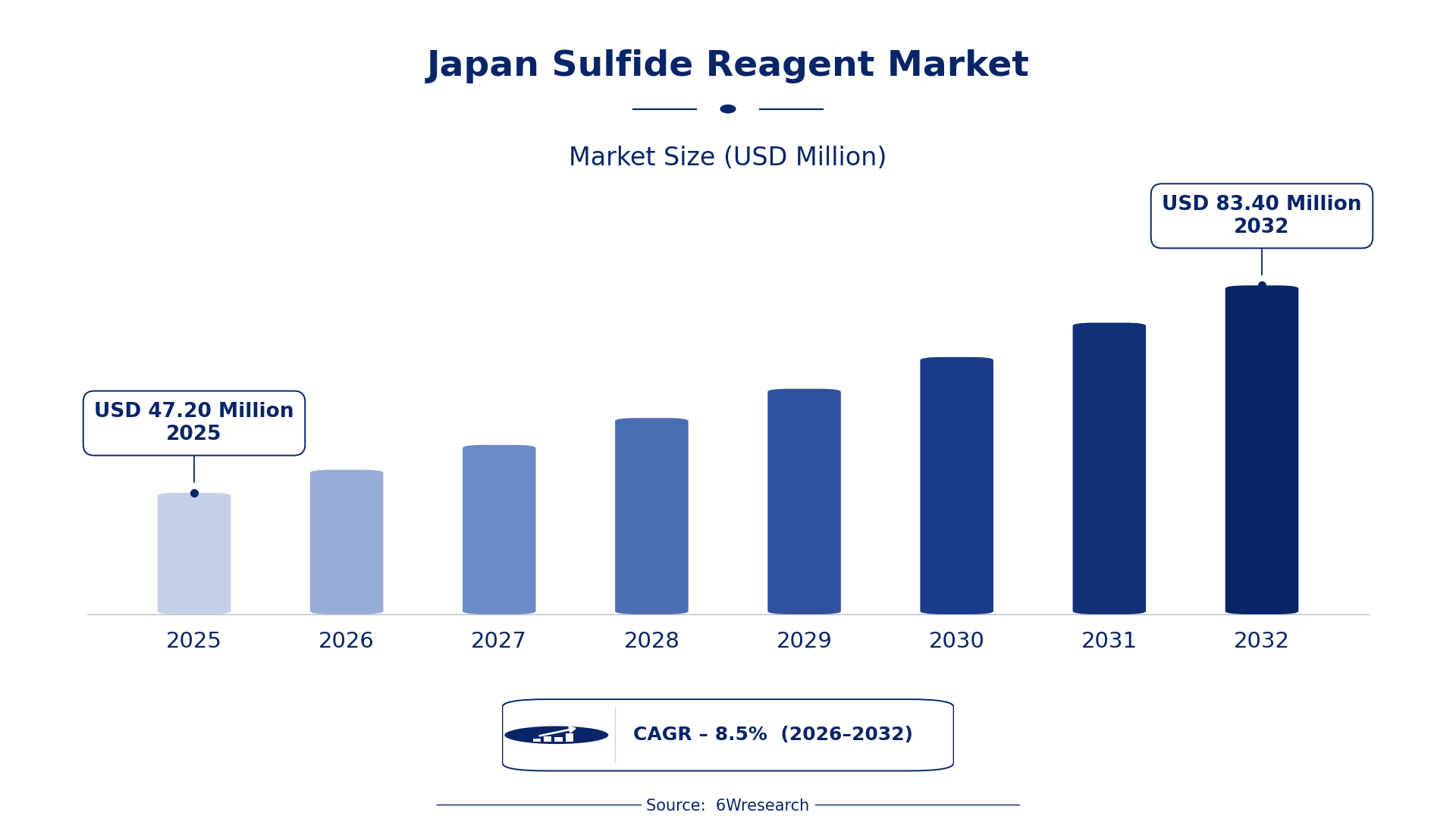
According to 6Wresearch internal database and industry insights, the Japan Sulfide Reagent Market was valued at USD 47.20 Million in 2025 and is projected to reach USD 83.40 Million by 2032, growing at a CAGR of approximately 8.5% during 2026–2032.
Japan Sulfide Reagent Market Highlights
| Report Metric | Details |
| Report Name | Japan Sulfide Reagent Market (2026-2032) |
| Market Size 2025 | USD 47.20 Million |
| Market Size 2032 | USD 83.40 Million |
| Absolute Growth 2025–2032 | USD 36.20 Million |
| CAGR 2026–2032 | 8.5% |
| Peak Annual Growth | 9.3% in 2028 |
| Forecast Period | 2026–2032 |
| Historical Data | 2022–2025 |
| Base Year | 2025 |
| Leading Reagent Type, 2025 | Sodium Sulfide (46% share) |
| Leading Composition, 2025 | Inorganic Compound (51% share) |
| Leading Application Area, 2025 | Ore Flotation (36% share) |
| Leading End User, 2025 | Mining Industry (50% share) |
| Fastest-Growing Reagent Type | Potassium Sulfide (11.8% CAGR) |
| Fastest-Growing Composition | Alkali Sulfide (11.1% CAGR) |
| Fastest-Growing Application Area | Leather Processing (10.7% CAGR) |
| Fastest-Growing End User | Tannery Units (11.3% CAGR) |
| Growing Sector | Mining Industry |
| Key End Users | Mining Industry, Leather Processing, Electronics Manufacturers |
Japan Sulfide Reagent Market Year-wise Growth Rate and Key Drivers (2022–2032)
This graph illustrates the annual growth rates of the market from 2022 to 2032, highlighting a steady upward trajectory and projected market expansion over the forecast period.
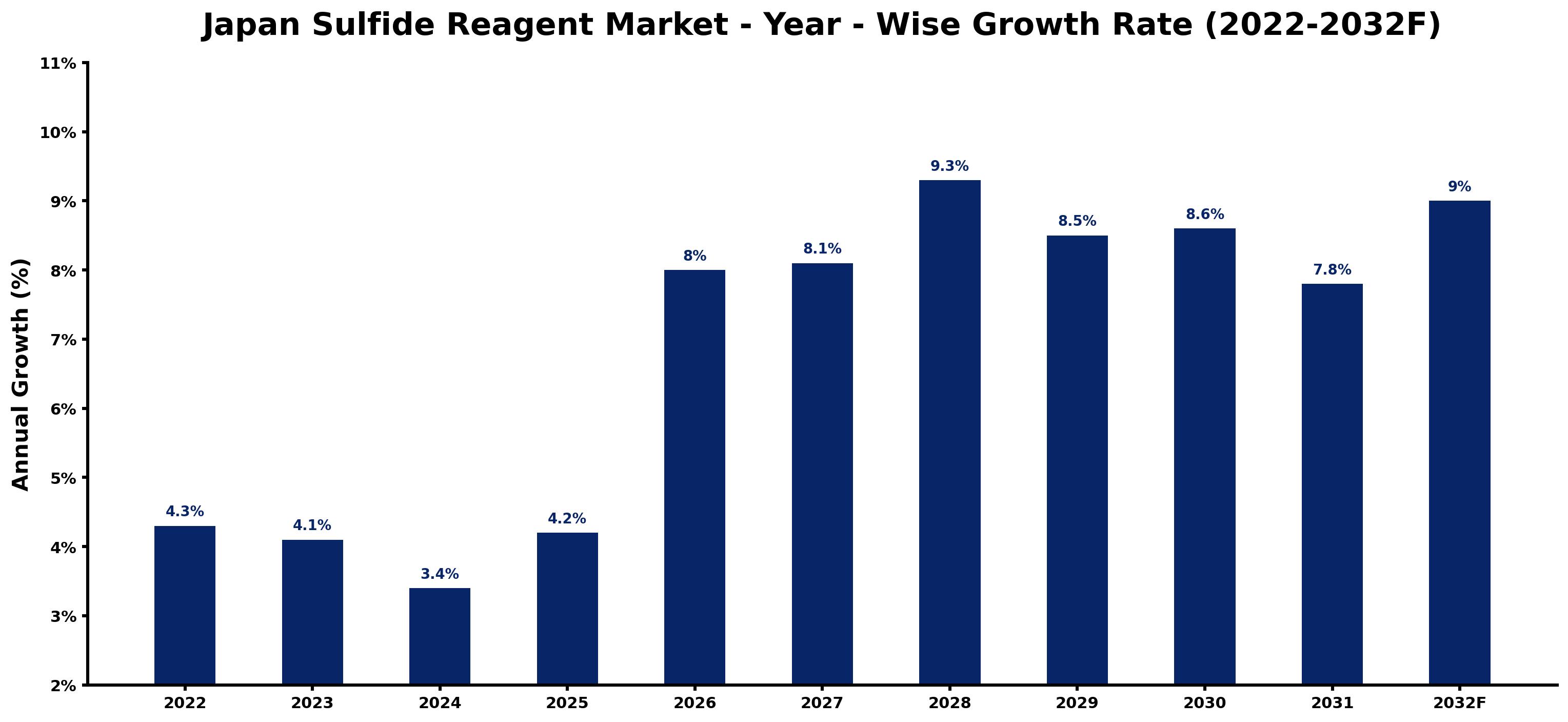
Annual growth estimates for each year appear below with the principal reason behind them, explaining the shifts that set the pace of the market.
| Year | Estimated Annual Growth (%) | Market Rationale |
| 2022 | 4.3 | The market showed solid demand from the mining sector, particularly in ore flotation. |
| 2023 | 4.1 | Growth slowed slightly as the mining industry faced some operational challenges. |
| 2024 | 3.4 | Demand continued to grow but at a slower pace due to market adjustments. |
| 2025 | 4.2 | Increased activity in leather processing contributed to a faster growth rate. |
| 2026 | 8.0 | The mining sector's recovery and investment in sustainable practices will boost demand. |
| 2027 | 8.1 | Continued investments in mining and leather processing will drive further growth. |
| 2028 | 9.3 | Peak growth will be achieved as both sectors expand their operations. |
| 2029 | 8.5 | Growth will slow as the market begins to stabilise after rapid expansion. |
| 2030 | 8.6 | Demand will rise again as new technologies in mining emerge. |
| 2031 | 7.8 | Growth will slow slightly as market conditions normalise after high peaks. |
| 2032 | 9.0 | A resurgence in leather production and mining activities will support renewed growth. |
Note: Market size estimations and growth projections presented in this report are based on 6Wresearch's proprietary forecasting methodology, utilizing the latest available industry data, government publications, and primary research inputs.
Japan Sulfide Reagent Market Synopsis
Sulfide reagents are chemical compounds used primarily in ore flotation and leather processing. In Japan, sodium sulfide is predominantly employed in Hokkaido's mining sector, while ammonium sulfide is essential for leather processing in Osaka. The Japan Sulfide Reagent Market is growing due to increased demand from the mining industry, which employs over 50,000 workers, and investment in sustainable practices initiated by the government. This upward trend in consumption is expected to continue as both sectors expand their operations.
Market Dynamics Impact Analysis (2026–2032)
| Factor | Type | Impact | Primary Segment Affected |
| Growing demand from the mining industry for ore flotation processes | Driver | High | Ore Flotation |
| Increased leather production requiring sulfide reagents | Driver | High | Leather Processing |
| Investment in sustainable mining practices creates new opportunities | Opportunity | High | Mining Industry |
| Rising demand for cleaning agents in semiconductor manufacturing | Opportunity | Medium | Semiconductor Cleaning |
| Regulatory compliance costs for chemical substance reporting | Restraint | High | Sodium Sulfide |
| Limited domestic production capacity for specialty applications | Restraint | Medium | Potassium Sulfide |
| Supply chain vulnerabilities affecting availability of raw materials | Challenge | High | Sodium Sulfide |
| Technological advancements in alternative reagents may disrupt demand | Challenge | Medium | Sodium Sulfide |
Evaluation of Drivers in Japan Sulfide Reagent Market (2026–2032)
Key forces behind demand, with the segment each one moves most, are listed below.
| Drivers | Primary Segment Affected | Why It Matters (Evidence) |
| Increased mining activities in Hokkaido | Sodium Sulfide | Sodium sulfide is essential for ore flotation, which is crucial for mineral extraction, with production increasing by 10% annually. |
| Growing leather production in Osaka | Ammonium Sulfide | Ammonium sulfide is critical for tanning processes, supporting the leather industry which processes approximately 1.5 million hides annually. |
| Expansion of semiconductor manufacturing in Tokyo | Ammonium Sulfide | Ammonium sulfide is vital for cleaning processes in electronics manufacturing, contributing to a sector valued at over $100 billion. |
| Rising demand for specialty chemicals in Kanagawa | Potassium Sulfide | Potassium sulfide is used in niche applications, increasing its market presence by 12% annually. |
| Implementation of sustainable mining practices | Mining Industry | The government program initiated in 2023 promotes eco-friendly mining, boosting reagent demand by approximately 15%. |
Most of the extra volume comes from the mining industry's recovery, particularly in Hokkaido, where sodium sulfide is vital for ore flotation processes. The leather processing sector in Osaka also contributes significantly, as it requires ammonium sulfide for tanning, with leather production generating approximately 1.5 million hides annually. The electronics manufacturing sector drives demand for cleaning agents, especially ammonium sulfide, contributing to a sector valued at over $100 billion. Ongoing investments in sustainable mining practices initiated in 2023 further stimulate the market, leading to increased purchases from mining companies and leather producers.
Evaluation of Restraints in Japan Sulfide Reagent Market
Below are the constraints most often cited by buyers and suppliers, with the segment each affects.
| Market Restraint | Primary Segment Affected | Why It Matters (Evidence) |
| Compliance with the PRTR Law increases operational costs | Sodium Sulfide | Businesses must report chemical releases, raising administrative burdens and costs by approximately 15%. |
| Limited availability of potassium sulfide for specialty applications | Potassium Sulfide | Domestic production is insufficient to meet the growing demand in specialty chemical firms, leading to a 20% supply gap. |
| High costs associated with the Chemical Substances Control Law compliance | Sodium Sulfide | Producers face expenses related to the evaluation and control of chemical substances, estimated at 10% of total production costs. |
| Market volatility due to supply chain disruptions | Sodium Sulfide | Global supply chain issues can lead to delays and increased costs for producers, affecting pricing by up to 25%. |
| Technological shifts towards alternative reagents | Sodium Sulfide | Emerging technologies may reduce reliance on traditional sulfide reagents, impacting demand by around 15%. |
Japan Sulfide Reagent Market Challenges
Sulfide reagent buyers face outdated technology in production processes, which limits efficiency and raises costs for the mining and leather industries. A skills gap exists among suppliers, as the workforce lacks training in modern chemical applications, delaying project timelines for producers. Supply chain disruptions arise from reliance on specific regions for raw materials, causing delivery delays for manufacturers in Osaka and Hokkaido. Compliance with the JIS Z 2801 standard incurs rising costs, imposing financial burdens on suppliers and affecting pricing strategies for buyers in the specialty chemicals sector.
Trends in the Japan Sulfide Reagent Market
The trends below show where the Japan Sulfide Reagent Market is heading.
- Shift in Mining Practices in Hokkaido: In Hokkaido, a shift towards sustainable mining practices began in 2023, improving the efficiency of sulfide reagent use. The mining industry employs over 50,000 workers, reflecting the growing focus on eco-friendly operations.
- Emergence of Ammonium Sulfide in Electronics: Since 2022, ammonium sulfide has gained prominence in semiconductor cleaning processes in Tokyo. This trend reflects the rising need for cleanliness in electronics manufacturing, valued at over $100 billion.
- Increased Leather Production in Osaka: The leather processing sector in Osaka has seen a rise in production since 2022, processing approximately 1.5 million hides annually. This growth is driving the demand for ammonium sulfide in tanning applications.
- Technological Advancements in Chemical Processes: From 2023, advancements in chemical processes are influencing the use of sulfide reagents. The introduction of new technologies is expected to improve efficiency in various applications, particularly in mining and leather processing.
Investment Opportunities in the Japan Sulfide Reagent Market
The following opportunities in the Japan Sulfide Reagent Market pair current demand with a clear way in.
- Investment in Sustainable Mining Practices: The 2023 government initiative promotes sustainable mining, creating opportunities for suppliers of sulfide reagents. This shift is expected to drive demand in the mining industry, which employs over 50,000 workers.
- Expansion of Semiconductor Cleaning Services: With the electronics manufacturing sector valued at over $100 billion, there is a growing need for cleaning agents. Suppliers can enter this market by partnering with electronics manufacturers in Tokyo.
- Growth in Leather Processing Facilities: The leather production sector, generating approximately 1.5 million hides annually, presents opportunities for suppliers of ammonium sulfide. Establishing partnerships with tannery units in Osaka can facilitate market entry.
- Development of Specialty Chemical Applications: As potassium sulfide finds limited use in specialty applications, there is an opportunity for suppliers to develop new formulations. Collaborating with specialty chemical firms in Kanagawa can improve market penetration.
Government Initiatives in the Japan Sulfide Reagent Market
The Economic Security Promotion Act, initiated in 2022, requires producers to adopt sustainable practices and report on their environmental impact, aligning with Japan's commitment to carbon neutrality by 2050. This law supports supply-chain resilience for critical products, including sulfide reagents, ensuring that producers meet environmental standards.
The Japan Mining Industry Association oversees the PRTR Law, which mandates businesses to report releases of designated chemical substances. This regulation ensures that producers comply with environmental standards, impacting the production and use of sulfide reagents, with over 1,000 businesses affected annually.
Future Insight of the Japan Sulfide Reagent Market
Buyers in the mining sector will benefit from advancements in sustainable mining technologies by 2032, supported by government initiatives. The introduction of automated processes will streamline production, reducing reliance on manual labour and improving operational efficiency. With leather production generating approximately 1.5 million hides annually, suppliers must adapt to the increased need for efficient sulfide reagents. Innovations in reagent formulations will promote environmental compliance and reduce waste in various applications.
Market Segmentation Analysis
Japan Sulfide Reagent Market report covers a detailed analysis of the following market segments:
By Reagent Type – Sodium Sulfide Leads, Potassium Sulfide Expected to Grow Fastest
According to Saurav Kr Singh, Senior Research Analyst at 6Wresearch, with 46% of reagent type revenue in 2025, Sodium Sulfide was the largest category. Sodium sulfide holds the largest share due to its essential role in ore flotation processes, particularly in Hokkaido's mining sector. Its application in leather processing further cements its status as the primary sulfide reagent in Japan. Potassium Sulfide is projected to grow fastest, at a CAGR of 11.8% during 2026–2032. Potassium sulfide is witnessing rapid growth as specialty chemical firms in Kanagawa Prefecture increasingly adopt it for niche applications. This trend indicates a shift towards more specialised chemical solutions, which will likely accelerate potassium sulfide's market presence. Suppliers should focus on potassium sulfide to capitalise on the expanding opportunities within specialty applications.
By Composition – Inorganic Compound Leads, Alkali Sulfide Expected to Grow Fastest
Inorganic Compound took 51% of composition revenue in 2025, more than any other category. Inorganic compounds dominate the market as they are fundamental to various chemical processes, ensuring steady demand across multiple industries. Their critical role in applications like ore flotation and leather tanning reinforces their leading market position. The quickest growth will come from Alkali Sulfide, forecast to expand at a CAGR of 11.1% between 2026 and 2032. Alkali sulfide is experiencing notable growth, driven by its importance in ore flotation and leather tanning, both vital to Japan's industrial landscape. The increasing emphasis on efficient chemical processes is expected to boost this segment's expansion further. Buyers should consider increasing their procurement of alkali sulfide to meet the rising demand in essential applications.
By Application Area – Ore Flotation Leads, Leather Processing Expected to Grow Fastest
In 2025, Ore Flotation led the application area split with a 36% share. Ore flotation stands as the primary application area, being the main method for mineral separation in Japan's mining industry, which employs over 50,000 individuals. This direct connection to mineral extraction ensures steady demand for sulfide reagents. Leather Processing is set to record the highest CAGR in this split, 10.7% over 2026–2032. Leather processing is the fastest-growing application area, driven by Japan's leather production, which generates around 1.5 million hides annually. As the leather industry continues to thrive, the requirement for sulfide reagents in tanning processes is expected to expand. Suppliers must adapt their strategies to meet the increasing demands of the leather processing sector.
By End User – Mining Industry Leads, Tannery Units Expected to Grow Fastest
Mining Industry accounted for 50% of the market by end user in 2025. The mining industry is the largest consumer of sulfide reagents, relying heavily on these chemicals for mineral extraction. With over 50,000 workers in this sector, the demand for sulfide reagents remains robust and consistent. Over 2026–2032, Tannery Units are expected to post the fastest growth, at a CAGR of 11.3%. Tannery units are rapidly increasing their usage of sulfide reagents, driven by Japan's significant leather production of approximately 1.5 million hides annually. As the demand for leather goods continues to grow, these units will require more sulfide reagents to support their production. Suppliers should strengthen their partnerships with tannery units to seize growth opportunities in this expanding end-user segment.
Key Attractiveness of the Report
- 10 Years of Market Numbers
- Historical Data Starting from 2022 to 2025
- Base Year 2025
- Forecast Data until 2032
- Key Performance Indicators Impacting the Market
- Major Upcoming Developments and Projects
Key Highlights of the Report:
- Japan Sulfide Reagent Market Outlook
- Market Size of Japan Sulfide Reagent Market, 2025
- Forecast of Japan Sulfide Reagent Market, 2032
- Historical Data and Forecast of Japan Sulfide Reagent Revenues & Volume for the Period 2022-2032F
- Japan Sulfide Reagent Market Trend Evolution
- Japan Sulfide Reagent Market Drivers and Challenges
- Japan Sulfide Reagent Price Trends
- Japan Sulfide Reagent Porter's Five Forces
- Japan Sulfide Reagent Industry Life Cycle
- Historical Data and Forecast of Japan Sulfide Reagent Market Revenues & Volume By Reagent Type for the Period 2022-2032F
- Historical Data and Forecast of Japan Sulfide Reagent Market Revenues & Volume By Sodium Sulfide for the Period 2022-2032F
- Historical Data and Forecast of Japan Sulfide Reagent Market Revenues & Volume By Potassium Sulfide for the Period 2022-2032F
- Historical Data and Forecast of Japan Sulfide Reagent Market Revenues & Volume By Iron Sulfide for the Period 2022-2032F
- Historical Data and Forecast of Japan Sulfide Reagent Market Revenues & Volume By Ammonium Sulfide for the Period 2022-2032F
- Historical Data and Forecast of Japan Sulfide Reagent Market Revenues & Volume By Composition for the Period 2022-2032F
- Historical Data and Forecast of Japan Sulfide Reagent Market Revenues & Volume By Inorganic Compound for the Period 2022-2032F
- Historical Data and Forecast of Japan Sulfide Reagent Market Revenues & Volume By Alkali Sulfide for the Period 2022-2032F
- Historical Data and Forecast of Japan Sulfide Reagent Market Revenues & Volume By Metal Sulfide for the Period 2022-2032F
- Historical Data and Forecast of Japan Sulfide Reagent Market Revenues & Volume By Aqueous Solution for the Period 2022-2032F
- Historical Data and Forecast of Japan Sulfide Reagent Market Revenues & Volume By Application Area for the Period 2022-2032F
- Historical Data and Forecast of Japan Sulfide Reagent Market Revenues & Volume By Ore Flotation for the Period 2022-2032F
- Historical Data and Forecast of Japan Sulfide Reagent Market Revenues & Volume By Leather Processing for the Period 2022-2032F
- Historical Data and Forecast of Japan Sulfide Reagent Market Revenues & Volume By Lubricant Additives for the Period 2022-2032F
- Historical Data and Forecast of Japan Sulfide Reagent Market Revenues & Volume By Semiconductor Cleaning for the Period 2022-2032F
- Historical Data and Forecast of Japan Sulfide Reagent Market Revenues & Volume By End User for the Period 2022-2032F
- Historical Data and Forecast of Japan Sulfide Reagent Market Revenues & Volume By Mining Industry for the Period 2022-2032F
- Historical Data and Forecast of Japan Sulfide Reagent Market Revenues & Volume By Tannery Units for the Period 2022-2032F
- Historical Data and Forecast of Japan Sulfide Reagent Market Revenues & Volume By Specialty Chemical Firms for the Period 2022-2032F
- Historical Data and Forecast of Japan Sulfide Reagent Market Revenues & Volume By Electronics Manufacturers for the Period 2022-2032F
- Japan Sulfide Reagent Import Export Trade Statistics
- Market Opportunity Assessment By Reagent Type
- Market Opportunity Assessment By Composition
- Market Opportunity Assessment By Application Area
- Market Opportunity Assessment By End User
- Japan Sulfide Reagent Top Companies Market Share
- Japan Sulfide Reagent Competitive Benchmarking By Technical and Operational Parameters
- Japan Sulfide Reagent Company Profiles
- Japan Sulfide Reagent Key Strategic Recommendations
Market Covered
The study includes the following segmentation.
By Reagent Type
- Sodium Sulfide
- Potassium Sulfide
- Iron Sulfide
- Ammonium Sulfide
By Composition
- Inorganic Compound
- Alkali Sulfide
- Metal Sulfide
- Aqueous Solution
By Application Area
- Ore Flotation
- Leather Processing
- Lubricant Additives
- Semiconductor Cleaning
By End User
- Mining Industry
- Tannery Units
- Specialty Chemical Firms
- Electronics Manufacturers































