Japan Sulfur Compounds Market Size & Growth Rate
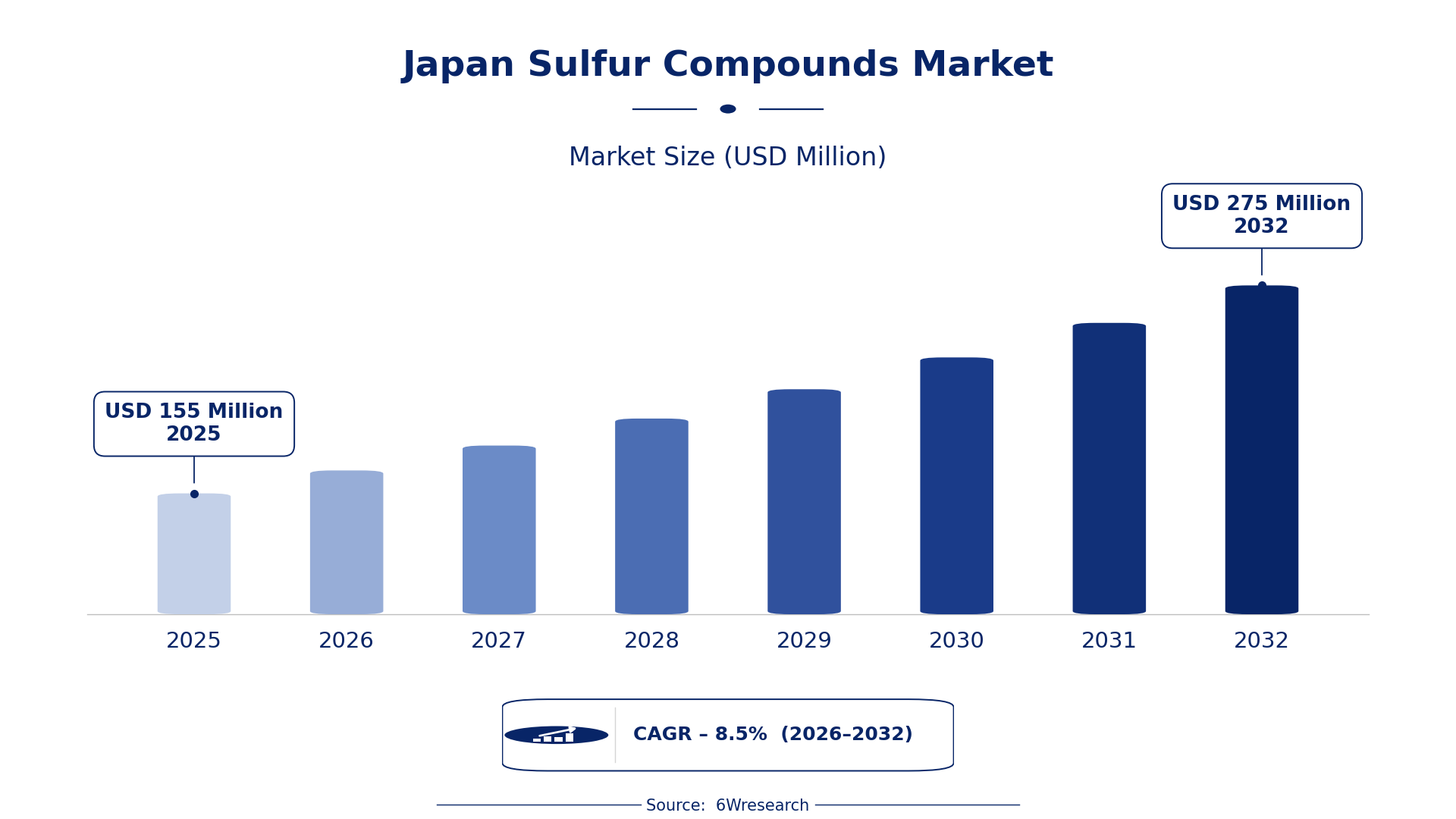
According to 6Wresearch internal database and industry insights, the Japan Sulfur Compounds Market was valued at USD 155 Million in 2025 and is projected to reach USD 275 Million by 2032, growing at a CAGR of approximately 8.5% during 2026–2032.
Japan Sulfur Compounds Market Highlights
| Report Metric | Details |
| Report Name | Japan Sulfur Compounds Market (2026-2032) |
| Market Size 2025 | USD 155 Million |
| Market Size 2032 | USD 275 Million |
| Absolute Growth 2025–2032 | USD 120 Million |
| CAGR 2026–2032 | 8.5% |
| Peak Annual Growth | 10.3% in 2026 |
| Forecast Period | 2026–2032 |
| Historical Data | 2022–2025 |
| Base Year | 2025 |
| Leading Compound Type, 2025 | Elemental Sulfur (50% share) |
| Leading Form Type, 2025 | Gas (67% share) |
| Leading Application Area, 2025 | Fertilizer Manufacturing (48% share) |
| Leading End User, 2025 | Food Industry (40% share) |
| Fastest-Growing Compound Type | Sulfur Dioxide (12.0% CAGR) |
| Fastest-Growing Application Area | Chemical Synthesis (10.2% CAGR) |
| Fastest-Growing End User | Agrochemical Companies (10.6% CAGR) |
| Growing Sector | agrochemical sector |
| Key End Users | food industry, agrochemical companies, industrial chemical makers |
Japan Sulfur Compounds Market Year-wise Growth Rate and Key Drivers (2022–2032)
This graph illustrates the annual growth rates of the market from 2022 to 2032, highlighting a steady upward trajectory and projected market expansion over the forecast period.
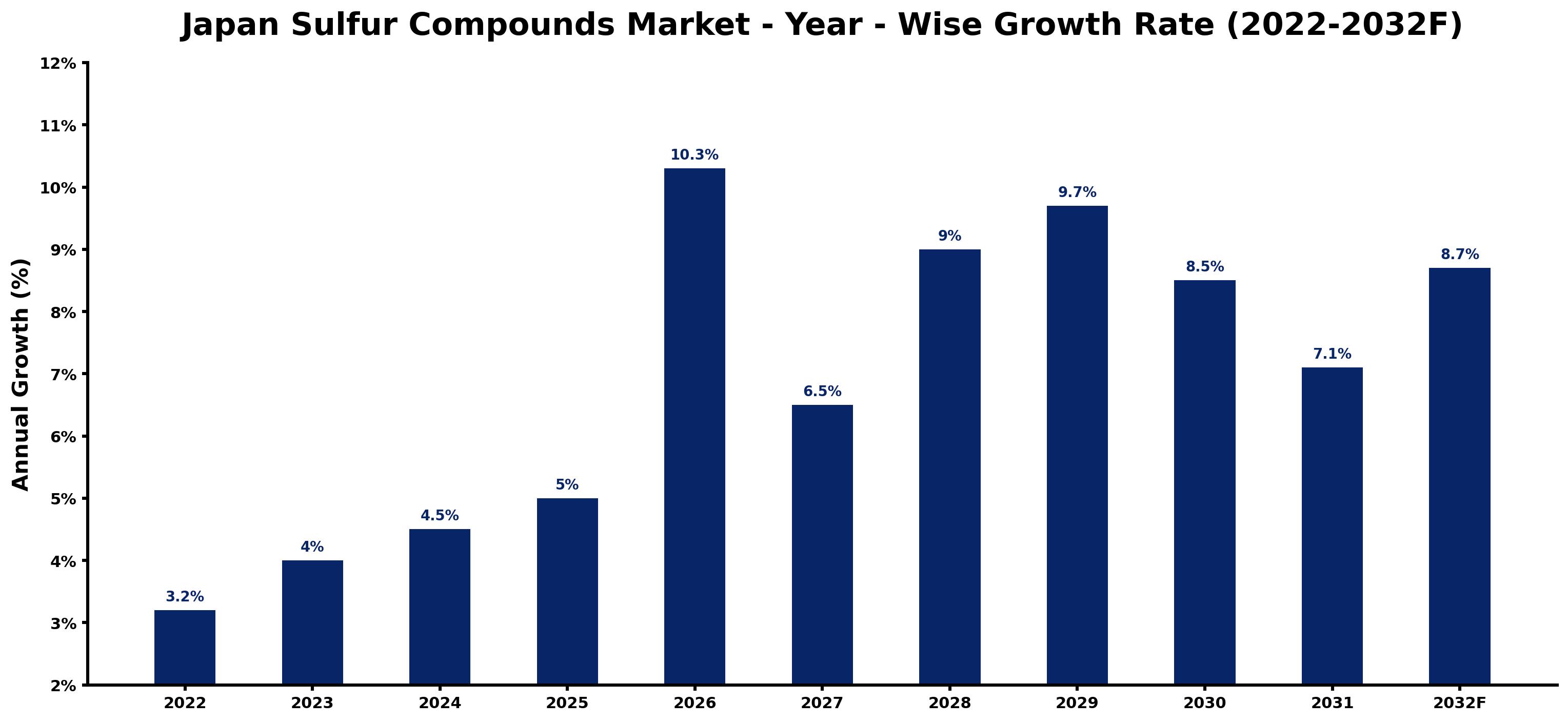
The yearly estimates that follow link every growth rate to its principal driver, so readers can see why the pace changed in each period.
| Year | Estimated Annual Growth (%) | Market Rationale |
| 2022 | 3.2 | The market experienced steady growth, driven by consistent demand from the food industry. |
| 2023 | 4.0 | Growth accelerated as food preservation needs increased amid rising consumer awareness. |
| 2024 | 4.5 | Demand continued to rise, supported by advancements in agricultural practices. |
| 2025 | 5.0 | The market peaked due to heightened activity in fertilizer manufacturing and food preservation. |
| 2026 | 10.3 | Growth surged as the chemical synthesis sector expanded its use of sulfur compounds. |
| 2027 | 6.5 | Demand growth slowed slightly as the market adjusted after the peak year. |
| 2028 | 9.0 | Purchasing increased again due to rising agrochemical needs in agriculture. |
| 2029 | 9.7 | Growth continued to strengthen, driven by the expanding food industry. |
| 2030 | 8.5 | The market will see a slowdown as growth stabilises after several strong years. |
| 2031 | 7.1 | Demand growth will decelerate further as market conditions begin to normalise. |
| 2032 | 8.7 | The market is expected to grow again, driven by innovations in sulfur applications. |
Note: Market size estimations and growth projections presented in this report are based on 6Wresearch's proprietary forecasting methodology, utilizing the latest available industry data, government publications, and primary research inputs.
Japan Sulfur Compounds Market Synopsis
Sulfur compounds are chemical substances containing sulfur, produced mainly through industrial processes. They are used in food preservation, electrical insulation, chemical synthesis, and fertilizer manufacturing. The Japan Sulfur Compounds Market is growing, largely driven by the food industry valued at over 100 billion USD, which relies heavily on sulfur dioxide for preservation. The agrochemical sector, one of the largest in Asia, is increasingly using sulfur compounds, further driving market demand.
Market Dynamics Impact Analysis (2026–2032)
| Factor | Type | Impact | Primary Segment Affected |
| Increasing demand for food preservation drives the use of sulfur dioxide. | Driver | High | Food Preservation |
| The growth of the agrochemical sector boosts the need for elemental sulfur. | Driver | High | Agrochemical Companies |
| The shift towards sustainable fertilizer practices creates opportunities for sulfur compounds. | Opportunity | High | Fertilizer Manufacturing |
| Innovative applications of sulfur compounds in chemical synthesis present new market avenues. | Opportunity | Medium | Chemical Synthesis |
| Strict regulations on sulfur emissions may limit production capabilities. | Restraint | High | Elemental Sulfur |
| High production costs of sulfur compounds can affect pricing strategies. | Restraint | Medium | Gas |
| Transitioning to greener technologies in power utilities poses challenges for sulfur hexafluoride usage. | Challenge | High | Electrical Insulation |
| The need for compliance with stringent food safety regulations can complicate operations. | Challenge | Medium | Food Industry |
Evaluation of Drivers in Japan Sulfur Compounds Market (2026–2032)
The main growth drivers and the segments they affect most are set out below.
| Drivers | Primary Segment Affected | Why It Matters (Evidence) |
| Rising food preservation needs drive sulfur dioxide usage. | Sulfur Dioxide | Over 60% of food preservation applications in Japan utilise sulfur dioxide, increasing purchases from food industry players. |
| Growing agrochemical sector boosts elemental sulfur demand. | Elemental Sulfur | Japan's agrochemical market is projected to grow by 3% annually, increasing purchases for pesticide formulations. |
| Expansion of chemical synthesis sector increases sulfur compound consumption. | Chemical Synthesis | The chemical industry in Japan is one of the largest globally, driving demand for sulfur compounds as key inputs. |
| Investment in sustainable fertilizer practices increases sulfur compound usage. | Fertilizer Manufacturing | Government subsidies for sustainable practices support the fertilizer manufacturing industry, increasing sulfur compound demand. |
| High-voltage applications in power utilities rely on sulfur hexafluoride. | Sulfur Hexafluoride | The electrical insulation market in Japan is projected to reach 5 billion USD by 2025, boosting purchases. |
Purchasing is picking up as Japan's agrochemical sector, one of the largest in Asia, is projected to grow by 3% annually. This growth raises the demand for elemental sulfur used in pesticide formulations. Over 60% of food preservation applications use sulfur dioxide, prompting food industry players to increase their purchases. The chemical industry, a global leader, fuels demand for sulfur compounds as key inputs in various processes. Investment in sustainable practices in fertilizer manufacturing is raising the need for sulfur compounds.
Evaluation of Restraints in Japan Sulfur Compounds Market
Below are the constraints most often cited by buyers and suppliers, with the segment each affects.
| Market Restraint | Primary Segment Affected | Why It Matters (Evidence) |
| Strict regulations on sulfur emissions limit production capabilities. | Elemental Sulfur | Japan has stringent regulations on sulfur emissions, governed by the Ministry of the Environment, impacting production levels. |
| High production costs of sulfur compounds can affect pricing strategies. | Gas | The costs associated with producing sulfur compounds can lead to higher prices, limiting buyer access. |
| Transitioning to greener technologies in power utilities reduces sulfur hexafluoride usage. | Sulfur Hexafluoride | Japan's electrical utilities are moving towards greener technologies, impacting the demand for sulfur hexafluoride. |
| Compliance with stringent food safety regulations complicates operations. | Food Industry | The Food Sanitation Act amendment mandates HACCP-based hygiene management, increasing operational costs for food businesses. |
| Market adjustments post-peak growth may slow demand. | Chemical Synthesis | After reaching a peak, the market is stabilising, leading to slower growth rates in chemical synthesis. |
Japan Sulfur Compounds Market Challenges
Japan's strict sulfur emission regulations impose high compliance costs on buyers in the food preservation sector, leading to potential shortages and disruptions in their operations. Producers face intensified competition from alternative preservatives, forcing them to reduce prices, which can erode profit margins and limit their ability to invest in quality improvements. Regulatory changes regarding sustainable practices in fertilizer manufacturing increase operational costs for producers, resulting in higher prices for buyers and a potential decline in demand. Rising costs associated with compliance measures can delay production timelines, impacting the timely delivery of sulfur compounds to various sectors.
Trends in the Japan Sulfur Compounds Market
The following changes are redrawing the Japan Sulfur Compounds Market.
- Shift to Sustainable Fertilizer Practices: In 2023, Japan's Ministry of Agriculture launched a program to promote sustainable fertilizer use, aiming to reduce environmental impact. This initiative encourages agrochemical companies to adopt sulfur compounds in their formulations, with the fertilizer manufacturing industry receiving government support.
- Transition to New Uses of Sulfur: Japan is increasingly exploring new applications of sulfur in agriculture, supported by research investments. The government has invested significantly in research for new sulfur uses, increasing demand in the agrochemical sector.
- Emerging Focus on Food Safety Standards: The Food Sanitation Act amendment in 2018 made HACCP-based hygiene management mandatory for food businesses. This shift has increased the need for sulfur dioxide in food preservation, as it is listed as an essential food additive.
- Growth in Electrical Insulation Market: The electrical insulation market in Japan is projected to reach 5 billion USD by 2025. This growth is driven by the increasing demand for high-voltage applications, particularly in power utilities.
Investment Opportunities in the Japan Sulfur Compounds Market
The following areas offer the clearest openings for investors and suppliers in the Japan Sulfur Compounds Market.
- Supply of Elemental Sulfur: The demand for elemental sulfur is rising due to the growing agrochemical sector, projected to grow by 3% annually. Agrochemical companies in Japan are looking for reliable suppliers to meet their needs.
- Investment in Fertilizer Manufacturing: With Japan's fertilizer manufacturing industry supported by government subsidies, there is an opportunity to supply sulfur compounds. Collaborating with local agrochemical companies can facilitate market entry.
- Expansion in Chemical Synthesis Applications: The chemical synthesis sector is expected to grow, creating opportunities for sulfur compound suppliers. Investing in research and development can provide practical solutions for industrial chemical makers.
- Growth in Food Preservation Needs: The food industry, valued at over 100 billion USD, presents a lucrative opportunity for sulfur dioxide suppliers. Establishing partnerships with food manufacturers can enhance market presence.
Government Initiatives in the Japan Sulfur Compounds Market
The Food Sanitation Act amendment made HACCP-based hygiene management mandatory, improving food safety protocols for businesses. This law requires food producers to implement stringent hygiene measures, increasing the need for sulfur dioxide as an essential food additive.
In 2023, Japan's Ministry of Agriculture launched a program promoting sustainable fertilizer use, with funding of approximately 10 million USD. The Ministry of Agriculture oversees this initiative, which supports the adoption of sulfur compounds in fertilizer manufacturing.
Future Insight of the Japan Sulfur Compounds Market
Innovative agricultural technologies will transform the demand for sulfur compounds by 2032, particularly in sustainable fertilizer applications. The Ministry of Agriculture's initiative will encourage the adoption of effective sulfur-based solutions, enhancing crop yields for farmers. The chemical synthesis sector will expand, with sulfur compounds being key inputs for new products. As Japan's agrochemical market grows annually, suppliers will need to adapt to evolving standards like ISO 14001 to ensure they meet buyer expectations.
Market Segmentation Analysis
Japan Sulfur Compounds Market report covers a detailed analysis of the following market segments:
By Compound Type – Elemental Sulfur Leads, Sulfur Dioxide Expected to Grow Fastest
According to Saurav Kr Singh, Senior Research Analyst at 6Wresearch, the largest compound type category in 2025 was Elemental Sulfur, at 50% of revenue. Elemental sulfur holds the largest share due to its essential function in fertilizer manufacturing, which is critical for Japan's agricultural sector. The agrochemical industry, one of the largest in Asia, significantly relies on this compound to meet domestic food production needs. Sulfur Dioxide is projected to grow fastest, at a CAGR of 12.0% during 2026–2032. Sulfur dioxide is experiencing rapid growth as it is a key component in over 60% of food preservation applications, which is vital given the food industry's valuation exceeding 100 billion USD. This trend is likely to continue as food safety regulations evolve and demand for preserved food increases. This indicates that suppliers should focus on enhancing their sulfur dioxide products to meet the rising needs of the food preservation market.
By Form Type – Gas Lead and Record the Fastest Growth
Gas took 67% of form type revenue in 2025, more than any other category. Gas is the leading form type as it is widely used in applications such as food preservation and electrical insulation, making it essential for various industries. The versatility of gas in these critical areas ensures its dominance in the market. Its lead should widen, with a projected CAGR of 9.6% during 2026–2032, the highest in this split. Gas is also the fastest-growing form type, as its applications in food preservation and electrical insulation are expanding. This dual role reinforces its position, allowing it to capture a larger market share over time. Buyers should prioritise sourcing gas forms of sulfur compounds to align with industry trends and applications.
By Application Area – Fertilizer Manufacturing Leads, Chemical Synthesis Expected to Grow Fastest
With 48% of application area revenue in 2025, Fertilizer Manufacturing was the largest category. Fertilizer manufacturing leads the market as it extensively uses sulfur compounds, which are vital for improving agricultural yields in Japan. The persistent demand for effective fertilizers to ensure food security reinforces the importance of this application area. The quickest growth will come from Chemical Synthesis, forecast to expand at a CAGR of 10.2% between 2026 and 2032. Chemical synthesis is the fastest-growing segment, primarily due to its crucial role in producing various chemicals and intermediates that are increasingly in demand. The overall growth of Japan's chemical industry is a significant contributor to this rapid expansion. This suggests that suppliers should target the chemical synthesis sector to capitalise on its swift growth.
By End User – Food Industry Leads, Agrochemical Companies Expected to Grow Fastest
Food Industry held 40% of the Japan Sulfur Compounds Market by end user in 2025. The food industry is the primary end user of sulfur compounds, largely for food preservation, reflecting Japan's high demand for safe food products. With a population of around 125 million, the food industry's consumption remains a critical driver. Agrochemical Companies are set to record the highest CAGR in this split, 10.6% over 2026–2032. Agrochemical companies represent the fastest-growing end user group, as they increasingly depend on elemental sulfur for pesticide formulations. The agrochemical market's projected annual growth of 3% highlights the rising demand for sulfur-based solutions. Suppliers should strategically target agrochemical companies to tap into the growth potential within this sector.
Key Attractiveness of the Report
- 10 Years of Market Numbers
- Historical Data Starting from 2022 to 2025
- Base Year 2025
- Forecast Data until 2032
- Key Performance Indicators Impacting the Market
- Major Upcoming Developments and Projects
Key Highlights of the Report:
- Japan Sulfur Compounds Market Outlook
- Market Size of Japan Sulfur Compounds Market, 2025
- Forecast of Japan Sulfur Compounds Market, 2032
- Historical Data and Forecast of Japan Sulfur Compounds Revenues & Volume for the Period 2022-2032F
- Japan Sulfur Compounds Market Trend Evolution
- Japan Sulfur Compounds Market Drivers and Challenges
- Japan Sulfur Compounds Price Trends
- Japan Sulfur Compounds Porter's Five Forces
- Japan Sulfur Compounds Industry Life Cycle
- Historical Data and Forecast of Japan Sulfur Compounds Market Revenues & Volume By Compound Type for the Period 2022-2032F
- Historical Data and Forecast of Japan Sulfur Compounds Market Revenues & Volume By Sulfur Dioxide for the Period 2022-2032F
- Historical Data and Forecast of Japan Sulfur Compounds Market Revenues & Volume By Sulfur Hexafluoride for the Period 2022-2032F
- Historical Data and Forecast of Japan Sulfur Compounds Market Revenues & Volume By Hydrogen Sulfide for the Period 2022-2032F
- Historical Data and Forecast of Japan Sulfur Compounds Market Revenues & Volume By Elemental Sulfur for the Period 2022-2032F
- Historical Data and Forecast of Japan Sulfur Compounds Market Revenues & Volume By Form Type for the Period 2022-2032F
- Historical Data and Forecast of Japan Sulfur Compounds Market Revenues & Volume By Gas for the Period 2022-2032F
- Historical Data and Forecast of Japan Sulfur Compounds Market Revenues & Volume By Gas for the Period 2022-2032F
- Historical Data and Forecast of Japan Sulfur Compounds Market Revenues & Volume By Gas for the Period 2022-2032F
- Historical Data and Forecast of Japan Sulfur Compounds Market Revenues & Volume By Solid for the Period 2022-2032F
- Historical Data and Forecast of Japan Sulfur Compounds Market Revenues & Volume By Application Area for the Period 2022-2032F
- Historical Data and Forecast of Japan Sulfur Compounds Market Revenues & Volume By Food Preservation for the Period 2022-2032F
- Historical Data and Forecast of Japan Sulfur Compounds Market Revenues & Volume By Electrical Insulation for the Period 2022-2032F
- Historical Data and Forecast of Japan Sulfur Compounds Market Revenues & Volume By Chemical Synthesis for the Period 2022-2032F
- Historical Data and Forecast of Japan Sulfur Compounds Market Revenues & Volume By Fertilizer Manufacturing for the Period 2022-2032F
- Historical Data and Forecast of Japan Sulfur Compounds Market Revenues & Volume By End User for the Period 2022-2032F
- Historical Data and Forecast of Japan Sulfur Compounds Market Revenues & Volume By Food Industry for the Period 2022-2032F
- Historical Data and Forecast of Japan Sulfur Compounds Market Revenues & Volume By Power Utilities for the Period 2022-2032F
- Historical Data and Forecast of Japan Sulfur Compounds Market Revenues & Volume By Industrial Chemical Makers for the Period 2022-2032F
- Historical Data and Forecast of Japan Sulfur Compounds Market Revenues & Volume By Agrochemical Companies for the Period 2022-2032F
- Japan Sulfur Compounds Import Export Trade Statistics
- Market Opportunity Assessment By Compound Type
- Market Opportunity Assessment By Form Type
- Market Opportunity Assessment By Application Area
- Market Opportunity Assessment By End User
- Japan Sulfur Compounds Top Companies Market Share
- Japan Sulfur Compounds Competitive Benchmarking By Technical and Operational Parameters
- Japan Sulfur Compounds Company Profiles
- Japan Sulfur Compounds Key Strategic Recommendations
Market Covered
The following segment groups are covered in the report.
By Compound Type
- Sulfur Dioxide
- Sulfur Hexafluoride
- Hydrogen Sulfide
- Elemental Sulfur
By Form Type
- Gas
- Solid
By Application Area
- Food Preservation
- Electrical Insulation
- Chemical Synthesis
- Fertilizer Manufacturing
By End User
- Food Industry
- Power Utilities
- Industrial Chemical Makers
- Agrochemical Companies































