Japan Sunscreen Ingredient Market Size & Growth Rate
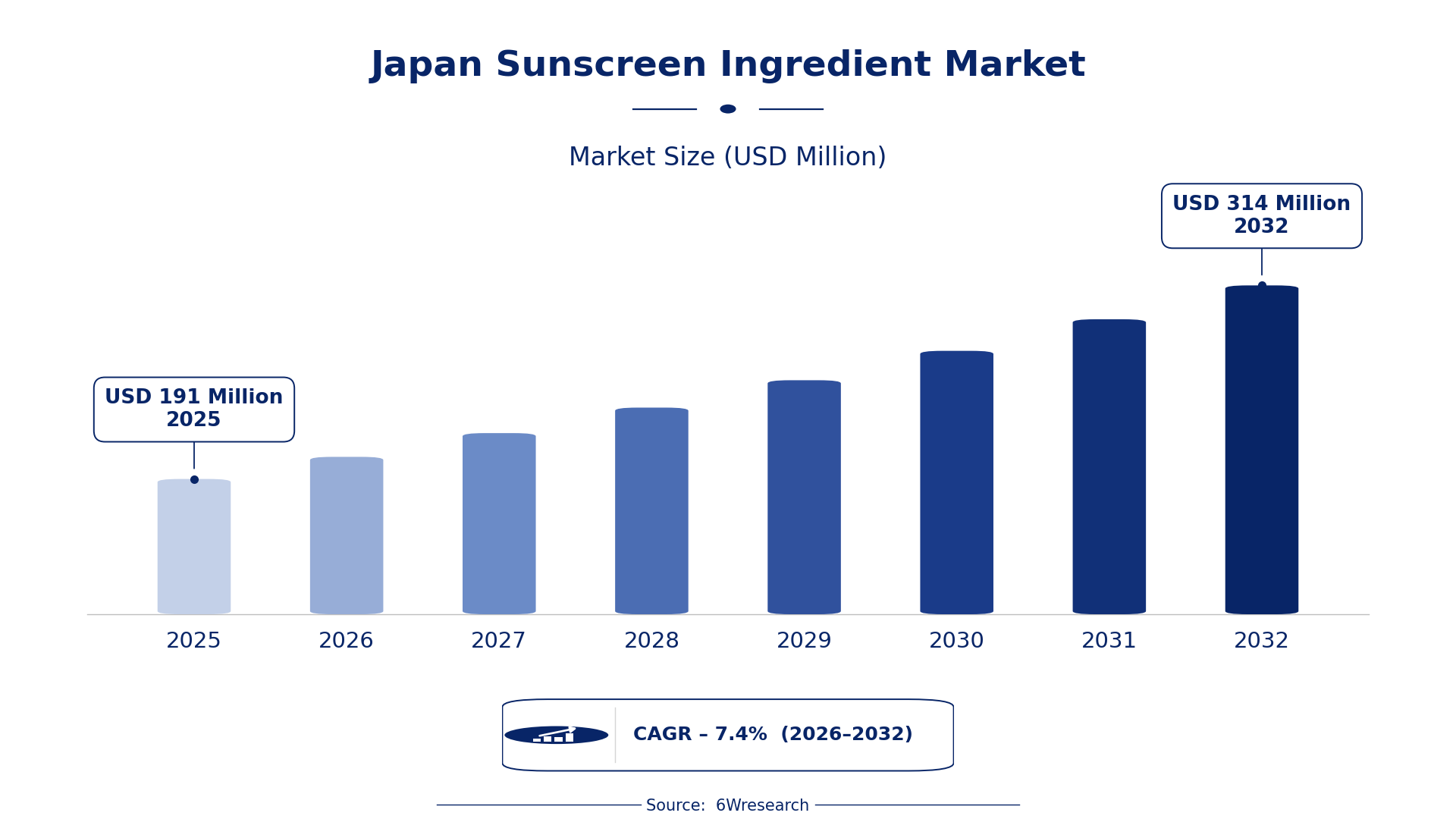
According to 6Wresearch internal database and industry insights, the Japan Sunscreen Ingredient Market was valued at USD 191 Million in 2025 and is projected to reach USD 314 Million by 2032, growing at a CAGR of approximately 7.4% during 2026–2032.
Japan Sunscreen Ingredient Market Highlights
| Report Metric | Details |
| Report Name | Japan Sunscreen Ingredient Market (2026-2032) |
| Market Size 2025 | USD 191 Million |
| Market Size 2032 | USD 314 Million |
| Absolute Growth 2025–2032 | USD 123 Million |
| CAGR 2026–2032 | 7.4% |
| Peak Annual Growth | 8.3% in 2028 |
| Forecast Period | 2026–2032 |
| Historical Data | 2022–2025 |
| Base Year | 2025 |
| Leading Ingredient Type, 2025 | Zinc Oxide (40% share) |
| Leading Source Type, 2025 | Mineral (57% share) |
| Leading Function, 2025 | Physical Block (33% share) |
| Leading End User, 2025 | Sunscreen Manufacturers (48% share) |
| Fastest-Growing Ingredient Type | Avobenzone (10.1% CAGR) |
| Fastest-Growing Function | Broad-Spectrum Filter (9.4% CAGR) |
| Fastest-Growing End User | Sun Care Product Developers (9.3% CAGR) |
| Growing Sector | Cosmetic Industry |
| Key End Users | Sunscreen Manufacturers, Cosmetic Industry, Natural Skincare Brands, Sun Care Product Developers |
Japan Sunscreen Ingredient Market Year-wise Growth Rate and Key Drivers (2022–2032)
This graph illustrates the annual growth rates of the market from 2022 to 2032, highlighting a steady upward trajectory and projected market expansion over the forecast period.
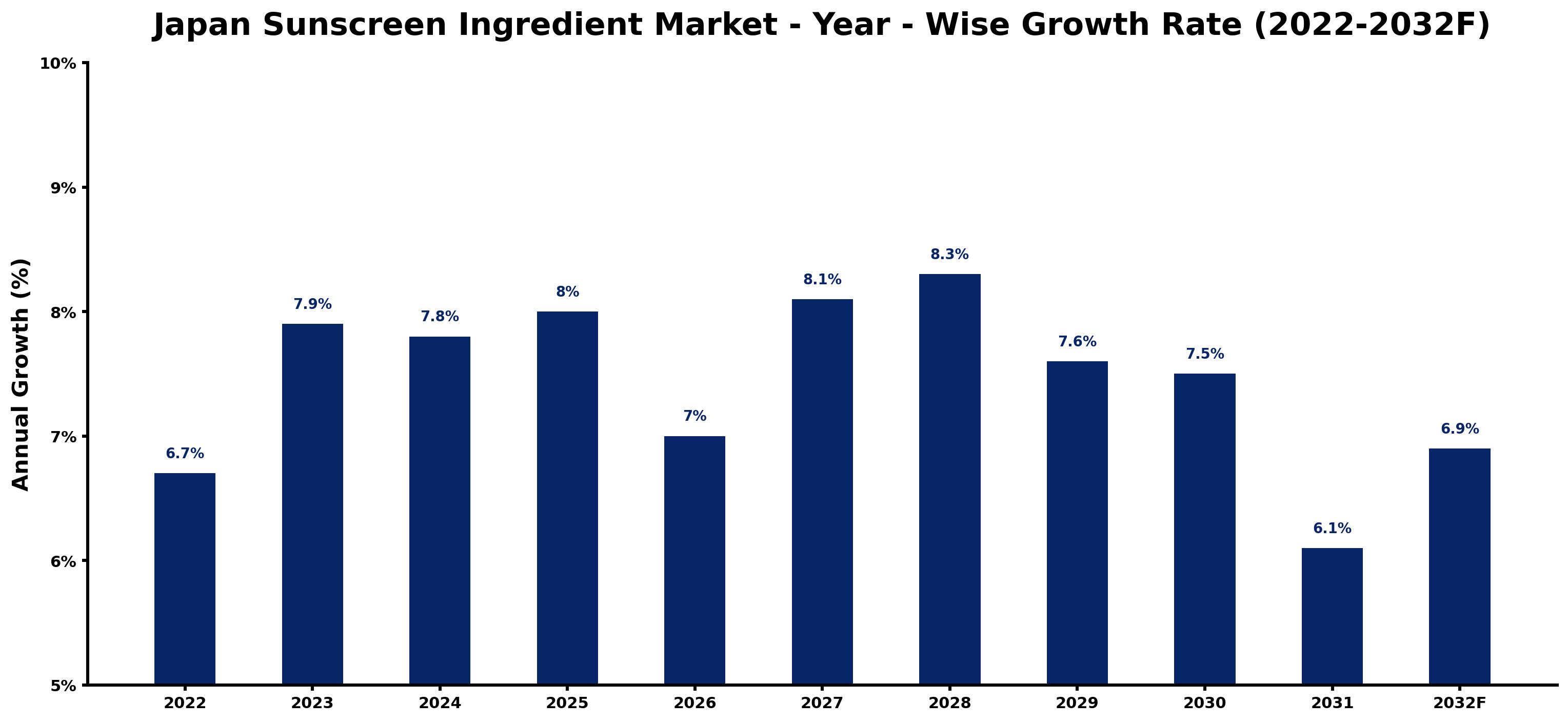
The yearly estimates that follow link every growth rate to its principal driver, so readers can see why the pace changed in each period.
| Year | Estimated Annual Growth (%) | Market Rationale |
| 2022 | 6.7 | The market showed steady growth as consumer awareness of UV protection increased in urban areas. |
| 2023 | 7.9 | Demand rose due to heightened interest in skin health and safety among consumers in Japan. |
| 2024 | 7.8 | Growth slowed slightly as the market adjusted to previous high demand levels. |
| 2025 | 8.0 | A surge in product launches contributed to faster growth, driven by innovation in formulations. |
| 2026 | 7.0 | Demand growth slowed as market saturation began to impact new product introductions. |
| 2027 | 8.1 | Increased consumer focus on natural ingredients boosted demand for mineral-based products. |
| 2028 | 8.3 | The market peaked as broad-spectrum protection became a priority for consumers. |
| 2029 | 7.6 | Growth decelerated as competition intensified among sunscreen manufacturers. |
| 2030 | 7.5 | Demand continued to slow as consumers became more selective in their purchases. |
| 2031 | 6.1 | The market faced slower growth as new entrants increased competition and options. |
| 2032 | 6.9 | A renewed focus on UV protection will lead to a slight uptick in growth. |
Note: Market size estimations and growth projections presented in this report are based on 6Wresearch's proprietary forecasting methodology, utilizing the latest available industry data, government publications, and primary research inputs.
Japan Sunscreen Ingredient Market Synopsis
Sunscreen ingredients, including chemical and mineral compounds, protect the skin from harmful UV radiation. They are formulated through chemical synthesis or natural extraction processes and are primarily used in sunscreen products, cosmetics, and skincare formulations. The Japan Sunscreen Ingredient Market is expanding due to rising consumer awareness of UV protection, with the cosmetic industry employing over 100,000 people. The increasing demand for organic formulations is further driving growth, as evidenced by a notable rise in product launches by natural skincare brands in 2023.
Market Dynamics Impact Analysis (2026–2032)
| Factor | Type | Impact | Primary Segment Affected |
| Rising consumer awareness of UV protection | Driver | High | Sunscreen Manufacturers |
| Increased product innovation in formulations | Driver | High | Natural Skincare Brands |
| Growing interest in natural ingredients | Opportunity | High | Natural Skincare Brands |
| Expansion of public health campaigns promoting UV protection | Opportunity | Medium | Cosmetic Industry |
| Market saturation limiting new product introductions | Restraint | High | Sunscreen Manufacturers |
| Regulatory compliance costs for new formulations | Restraint | Medium | Sunscreen Manufacturers |
| Intense competition among manufacturers | Challenge | High | Sunscreen Manufacturers |
| Supply chain disruptions affecting ingredient availability | Challenge | Medium | Sunscreen Manufacturers |
Evaluation of Drivers in Japan Sunscreen Ingredient Market (2026–2032)
Demand rests on the following drivers, each shown with the segment it touches most.
| Drivers | Primary Segment Affected | Why It Matters (Evidence) |
| Increased consumer focus on skin health | Sunscreen Manufacturers | Consumer awareness of UV protection has risen, leading to higher purchases of sunscreen products, with the market valued at approximately 200 billion yen. |
| Growing demand for natural formulations | Natural Skincare Brands | Natural skincare brands have seen a 15% increase in product launches in 2023, reflecting consumer preference for mineral ingredients. |
| Public health campaigns promoting UV protection | Cosmetic Industry | The Japanese government promotes UV protection through campaigns, encouraging consumers to seek effective sunscreen products. |
| Rising popularity of broad-spectrum protection | Sunscreen Manufacturers | Avobenzone's recognition for broad-spectrum UV protection capabilities has led to increased incorporation in formulations. |
| Technological advancements in formulation | Sunscreen Manufacturers | ISO 24443 standards for sunscreen testing have spurred innovation in product development and safety. |
What keeps demand rising is the increased focus on skin health among consumers, leading to higher purchases of sunscreen products valued at approximately 200 billion yen. A 15% increase in product launches in 2023 reflects consumer preference for mineral ingredients. Campaigns promoting UV protection have encouraged consumers to seek effective sunscreen products. Advancements in formulation technology, supported by ISO standards, have driven innovation in product development and safety, further boosting demand.
Evaluation of Restraints in Japan Sunscreen Ingredient Market
These are the pressures that could keep growth below its potential.
| Market Restraint | Primary Segment Affected | Why It Matters (Evidence) |
| Market saturation limiting new product introductions | Sunscreen Manufacturers | As the market matures, fewer new products are launched, impacting growth potential and consumer choice. |
| Regulatory compliance costs for new formulations | Sunscreen Manufacturers | Manufacturers face costs to comply with JIS standards for safety and efficacy, affecting profitability. |
| Intense competition among manufacturers | Sunscreen Manufacturers | The presence of numerous brands leads to price wars, reducing margins for producers. |
| Supply chain disruptions affecting ingredient availability | Sunscreen Manufacturers | Disruptions in the supply chain can delay production schedules and impact product availability. |
| Consumer preferences shifting towards multifunctional products | Sunscreen Manufacturers | As consumers seek products that offer multiple benefits, traditional sunscreen formulations may struggle to compete. |
Japan Sunscreen Ingredient Market Challenges
Limited availability of sunscreen ingredients disrupts production schedules, particularly as local demand for cosmetic products grows. Logistical inefficiencies in distribution networks can cause delays of up to six weeks for producers, hindering their ability to fulfil orders. Intense competition among manufacturers results in aggressive pricing strategies, which can reduce profit margins for suppliers, especially in urban markets. Compliance with JIS standards introduces regulatory complexities, leading to product launch delays of approximately three months for new entrants, ultimately restricting market access for new formulations.
Trends in the Japan Sunscreen Ingredient Market
The shifts below are changing how Japan Sunscreen Ingredient Market products are bought and supplied.
- Shift towards Natural Ingredients: Natural skincare brands are increasingly incorporating mineral ingredients into their products, reflecting consumer demand for safer options. In 2023, there was a notable increase in product launches in this sector, indicating a shift in consumer preferences.
- Growing Demand for Broad-Spectrum Protection: There is a trend towards broad-spectrum protection in sunscreen formulations, with Avobenzone gaining popularity for its effectiveness. This shift began in 2022, as consumers became more aware of the need for effective UV protection.
- Increased Regulatory Scrutiny: The Japanese government has implemented stricter regulations on sunscreen ingredients, particularly concerning safety and efficacy. In 2022, the Ministry of Health, Labour and Welfare reinforced compliance with JIS standards, impacting product development.
- Expansion of Public Health Campaigns: Public health campaigns promoting UV protection have gained momentum, particularly in urban areas. The government has actively encouraged awareness, leading to increased consumer engagement and demand for sunscreen products.
Investment Opportunities in the Japan Sunscreen Ingredient Market
Several openings in the Japan Sunscreen Ingredient Market merit attention from investors.
- Timing for Natural Product Launches: With a notable increase in product launches by natural skincare brands in 2023, now is an ideal time to invest in mineral-based sunscreen ingredients. Collaborating with natural skincare brands can facilitate market entry.
- Gap in Multifunctional Products: As consumer preferences shift towards multifunctional products, there is an opportunity for innovation. The cosmetic industry is seeking new formulations that combine sun protection with skincare benefits.
- Entry through Regulatory Compliance: Navigating JIS standards for safety and efficacy can facilitate market entry for new products. Partnering with established manufacturers can ease the certification process and accelerate product launches.
- Investment in Broad-Spectrum Ingredients: The growing demand for broad-spectrum protection presents an opportunity to invest in ingredients like Avobenzone. Targeting sunscreen manufacturers focused on innovative formulations can yield substantial returns.
Government Initiatives in the Japan Sunscreen Ingredient Market
The Economic Security Promotion Act of 2022 supports supply-chain resilience for critical products, including sunscreen ingredients. This measure encourages manufacturers to invest in local sourcing and production, ensuring stability in the supply chain and availability for consumers. The act aims to strengthen domestic production capabilities and reduce dependency on imports, fostering a more resilient market environment.
The Ministry of Health, Labour and Welfare oversees cosmetic regulations, including compliance with JIS standards for sunscreen products. This agency ensures that manufacturers meet safety and efficacy requirements, providing consumers with reliable sun protection options. The ministry conducts regular assessments and approvals, contributing to the overall safety of cosmetic products in the market.
Future Insight of the Japan Sunscreen Ingredient Market
By 2032, policy-driven shifts will prompt suppliers to adopt advanced testing methods and improve product formulations. Public health initiatives will elevate consumer awareness, increasing demand for compliant products. The introduction of rigorous safety protocols will ensure greater efficacy, benefiting buyers seeking reliable options. The market will likely see a rise in product launches, with over 100,000 professionals in the cosmetic sector contributing to developments that align with consumer preferences.
Market Segmentation Analysis
Japan Sunscreen Ingredient Market report covers a detailed analysis of the following market segments:
By Ingredient Type – Zinc Oxide Leads, Avobenzone Expected to Grow Fastest
According to Saurav Kr Singh, Senior Research Analyst at 6Wresearch, Zinc Oxide held 40% of the Japan Sunscreen Ingredient Market by ingredient type in 2025. Zinc oxide holds the largest share due to its effectiveness as a physical block against UV rays, making it a fundamental component in numerous sunscreen formulations. Its widespread use is evident in the increasing demand from health-conscious consumers prioritising safe skincare options. Avobenzone is set to record the highest CAGR in this split, 10.1% over 2026–2032. Avobenzone is experiencing rapid growth as it provides broad-spectrum UV protection, which is becoming essential in modern sunscreen products. This ingredient's unique attributes are driving its incorporation into new formulations tailored to consumer preferences. Suppliers should focus on enhancing their avobenzone offerings to meet the rising demand for advanced UV protection.
By Source Type – Mineral Leads and Records the Fastest Growth
The largest source type category in 2025 was Mineral, at 57% of revenue. Mineral ingredients dominate the market as they are favoured in natural and organic formulations, aligning with consumer preferences for safer skincare options. The rising number of mineral-based sunscreens reflects this shift towards health-conscious products. Its lead should widen, with a projected CAGR of 9.1% during 2026–2032, the highest in this split. The mineral segment is also the fastest-growing, driven by increasing consumer interest in natural skincare solutions. This trend is expected to persist as awareness of the importance of UV protection continues to rise among urban populations. Buyers should prioritise sourcing mineral ingredients to align with market trends and consumer preferences.
By Function – Physical Block Leads, Broad-Spectrum Filter Expected to Grow Fastest
In 2025, Physical Block led the function split with a 33% share. The physical block function is crucial for effective UV protection, making it the preferred choice among manufacturers. Its proven efficacy in safeguarding skin health has led to its widespread adoption in sunscreen products across the market. Broad-Spectrum Filter is projected to grow fastest, at a CAGR of 9.4% during 2026–2032. Broad-spectrum filters are increasingly sought after as they offer comprehensive UV protection, which consumers are demanding more than ever. As awareness of UV exposure risks rises, this segment's growth is expected to accelerate significantly. Suppliers should expand their product lines to include broad-spectrum filters to capture emerging market opportunities.
By End User – Sunscreen Manufacturers Lead, Sun Care Product Developers Expected to Grow Fastest
Sunscreen Manufacturers took 48% of end user revenue in 2025, more than any other category. Sunscreen manufacturers are the primary consumers of these ingredients, driving demand through their extensive product offerings. Their established presence in the market ensures a consistent need for effective sunscreen components that comply with regulatory standards. Over 2026–2032, Sun Care Product Developers are expected to post the fastest growth, at a CAGR of 9.3%. Sun care product developers are the fastest-growing group, concentrating on creating innovative sun protection solutions that address evolving consumer needs. Their agility in adapting to market trends positions them for continued growth in the sector. Suppliers must engage with sun care product developers to stay ahead of industry trends and secure valuable partnerships.
Key Attractiveness of the Report
- 10 Years of Market Numbers
- Historical Data Starting from 2022 to 2025
- Base Year 2025
- Forecast Data until 2032
- Key Performance Indicators Impacting the Market
- Major Upcoming Developments and Projects
Key Highlights of the Report:
- Japan Sunscreen Ingredient Market Outlook
- Market Size of Japan Sunscreen Ingredient Market, 2025
- Forecast of Japan Sunscreen Ingredient Market, 2032
- Historical Data and Forecast of Japan Sunscreen Ingredient Revenues & Volume for the Period 2022-2032F
- Japan Sunscreen Ingredient Market Trend Evolution
- Japan Sunscreen Ingredient Market Drivers and Challenges
- Japan Sunscreen Ingredient Price Trends
- Japan Sunscreen Ingredient Porter's Five Forces
- Japan Sunscreen Ingredient Industry Life Cycle
- Historical Data and Forecast of Japan Sunscreen Ingredient Market Revenues & Volume By Ingredient Type for the Period 2022-2032F
- Historical Data and Forecast of Japan Sunscreen Ingredient Market Revenues & Volume By Zinc Oxide for the Period 2022-2032F
- Historical Data and Forecast of Japan Sunscreen Ingredient Market Revenues & Volume By Octinoxate for the Period 2022-2032F
- Historical Data and Forecast of Japan Sunscreen Ingredient Market Revenues & Volume By Titanium Dioxide for the Period 2022-2032F
- Historical Data and Forecast of Japan Sunscreen Ingredient Market Revenues & Volume By Avobenzone for the Period 2022-2032F
- Historical Data and Forecast of Japan Sunscreen Ingredient Market Revenues & Volume By Source Type for the Period 2022-2032F
- Historical Data and Forecast of Japan Sunscreen Ingredient Market Revenues & Volume By Mineral for the Period 2022-2032F
- Historical Data and Forecast of Japan Sunscreen Ingredient Market Revenues & Volume By Chemical for the Period 2022-2032F
- Historical Data and Forecast of Japan Sunscreen Ingredient Market Revenues & Volume By Mineral for the Period 2022-2032F
- Historical Data and Forecast of Japan Sunscreen Ingredient Market Revenues & Volume By Chemical for the Period 2022-2032F
- Historical Data and Forecast of Japan Sunscreen Ingredient Market Revenues & Volume By Function for the Period 2022-2032F
- Historical Data and Forecast of Japan Sunscreen Ingredient Market Revenues & Volume By Physical Block for the Period 2022-2032F
- Historical Data and Forecast of Japan Sunscreen Ingredient Market Revenues & Volume By UV-B Filter for the Period 2022-2032F
- Historical Data and Forecast of Japan Sunscreen Ingredient Market Revenues & Volume By Broad-Spectrum Filter for the Period 2022-2032F
- Historical Data and Forecast of Japan Sunscreen Ingredient Market Revenues & Volume By UV-A Filter for the Period 2022-2032F
- Historical Data and Forecast of Japan Sunscreen Ingredient Market Revenues & Volume By End User for the Period 2022-2032F
- Historical Data and Forecast of Japan Sunscreen Ingredient Market Revenues & Volume By Sunscreen Manufacturers for the Period 2022-2032F
- Historical Data and Forecast of Japan Sunscreen Ingredient Market Revenues & Volume By Cosmetic Industry for the Period 2022-2032F
- Historical Data and Forecast of Japan Sunscreen Ingredient Market Revenues & Volume By Natural Skincare Brands for the Period 2022-2032F
- Historical Data and Forecast of Japan Sunscreen Ingredient Market Revenues & Volume By Sun Care Product Developers for the Period 2022-2032F
- Japan Sunscreen Ingredient Import Export Trade Statistics
- Market Opportunity Assessment By Ingredient Type
- Market Opportunity Assessment By Source Type
- Market Opportunity Assessment By Function
- Market Opportunity Assessment By End User
- Japan Sunscreen Ingredient Top Companies Market Share
- Japan Sunscreen Ingredient Competitive Benchmarking By Technical and Operational Parameters
- Japan Sunscreen Ingredient Company Profiles
- Japan Sunscreen Ingredient Key Strategic Recommendations
Market Covered
Segments analysed in this report are listed below.
By Ingredient Type
- Zinc Oxide
- Octinoxate
- Titanium Dioxide
- Avobenzone
By Source Type
- Mineral
- Chemical
By Function
- Physical Block
- UV-B Filter
- Broad-Spectrum Filter
- UV-A Filter
By End User
- Sunscreen Manufacturers
- Cosmetic Industry
- Natural Skincare Brands
- Sun Care Product Developers































