Japan Supersonic Tank Market Size & Growth Rate
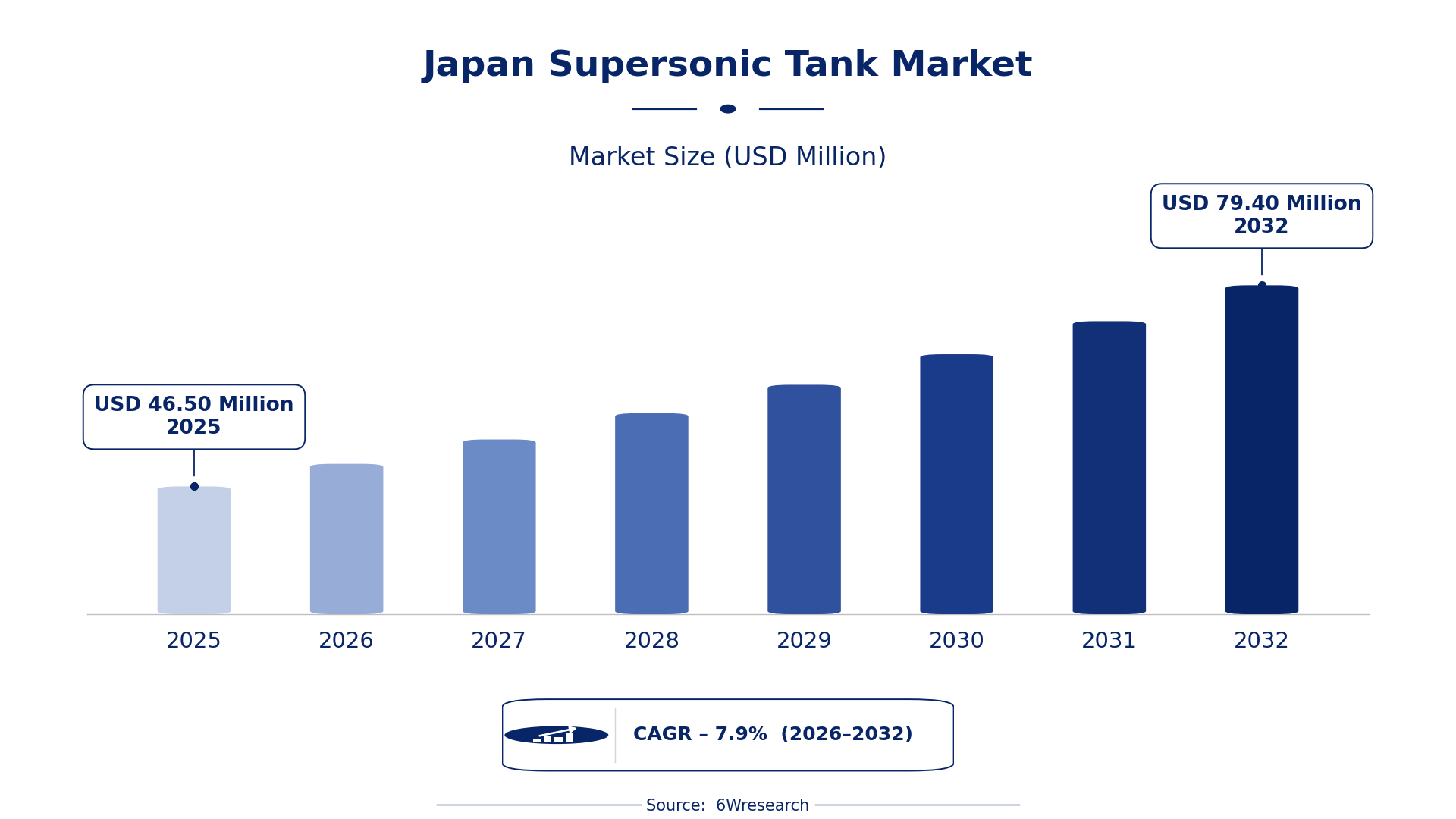
According to 6Wresearch internal database and industry insights, the Japan Supersonic Tank Market was valued at USD 46.50 Million in 2025 and is projected to reach USD 79.40 Million by 2032, growing at a CAGR of approximately 7.9% during 2026–2032.
Japan Supersonic Tank Market Highlights
| Report Metric | Details |
| Report Name | Japan Supersonic Tank Market (2026-2032) |
| Market Size 2025 | USD 46.50 Million |
| Market Size 2032 | USD 79.40 Million |
| Absolute Growth 2025–2032 | USD 32.90 Million |
| CAGR 2026–2032 | 7.9% |
| Peak Annual Growth | 9.5% in 2032 |
| Forecast Period | 2026–2032 |
| Historical Data | 2022–2025 |
| Base Year | 2025 |
| Leading Tank Type, 2025 | Supersonic Fuel Tanks (38% share) |
| Leading Application Domain, 2025 | Military Aircraft (52% share) |
| Leading Integration Platform, 2025 | Jet Fighter Aircraft (33% share) |
| Leading End User, 2025 | Defense Forces (35% share) |
| Fastest-Growing Tank Type | Drop Tanks (11.2% CAGR) |
| Fastest-Growing Application Domain | Detachable Storage (10.7% CAGR) |
| Fastest-Growing Integration Platform | Strike Aircraft (11.6% CAGR) |
| Fastest-Growing End User | Air Force Contractors (10.5% CAGR) |
| Growing Sector | Detachable Storage |
| Key End Users | Military Aircraft, Detachable Storage, Aerodynamic Integration, High-Speed Systems |
Japan Supersonic Tank Market Year-wise Growth Rate and Key Drivers (2022–2032)
This graph illustrates the annual growth rates of the market from 2022 to 2032, highlighting a steady upward trajectory and projected market expansion over the forecast period.
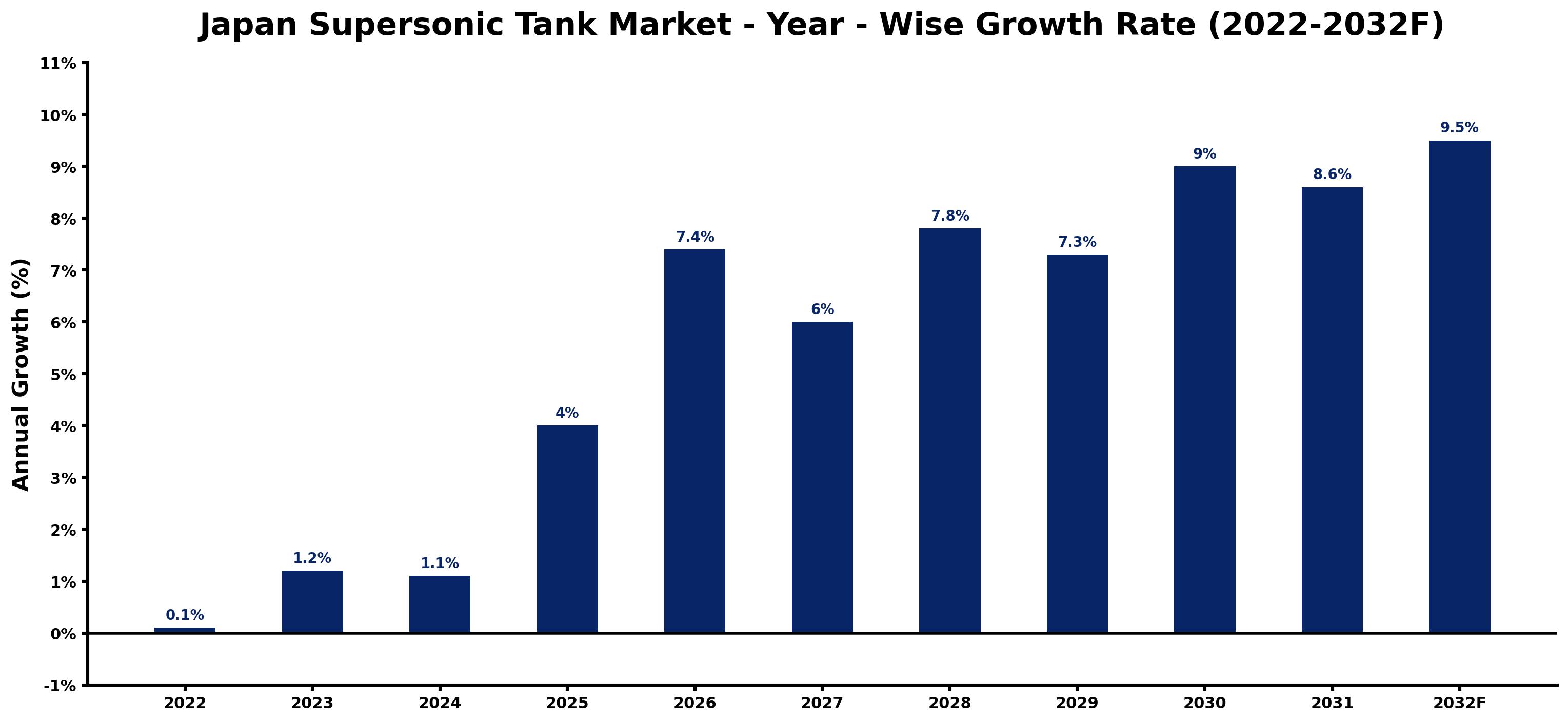
The yearly estimates that follow link every growth rate to its principal driver, so readers can see why the pace changed in each period.
| Year | Estimated Annual Growth (%) | Market Rationale |
| 2022 | 0.1 | The market showed minimal growth due to limited military spending and project delays. |
| 2023 | 1.2 | Demand increased as Japan's defense budget rose, reflecting heightened military priorities. |
| 2024 | 1.1 | Growth slowed as some defense projects faced implementation challenges and resource allocation issues. |
| 2025 | 4.0 | A rise in defense spending led to accelerated procurement of advanced fuel systems. |
| 2026 | 7.4 | Demand is expected to surge as military aircraft modernization programs gain traction and funding. |
| 2027 | 6.0 | Growth is projected to slow as the market adjusts to the previous year's rapid expansion. |
| 2028 | 7.8 | Increased investment in aerospace technology is expected to spur further demand for supersonic tanks. |
| 2029 | 7.3 | Market growth is anticipated to decelerate slightly as defense budgets stabilise after previous increases. |
| 2030 | 9.0 | A renewed focus on military capabilities will drive strong demand for fuel systems. |
| 2031 | 8.6 | Growth is projected to moderate as the market prepares for the upcoming peak in defense spending. |
| 2032 | 9.5 | Demand is expected to peak as Japan's strategic initiatives for defense technology reach fruition. |
Note: Market size estimations and growth projections presented in this report are based on 6Wresearch's proprietary forecasting methodology, utilizing the latest available industry data, government publications, and primary research inputs.
Japan Supersonic Tank Market Synopsis
Supersonic tanks are advanced fuel storage systems designed for military aircraft, utilising composite materials for optimal performance. The Japan Supersonic Tank Market is growing due to increased defense spending and modernization initiatives. The Japan Air Self-Defense Force operates over 300 aircraft, creating a need for advanced fuel systems. Demand is further driven by ongoing technological advancements and a focus on operational capabilities.
Market Dynamics Impact Analysis (2026–2032)
| Factor | Type | Impact | Primary Segment Affected |
| Increased defense spending | Driver | High | Supersonic Fuel Tanks |
| Modernization of military aircraft | Driver | High | Military Aircraft |
| Growing need for operational readiness | Opportunity | High | Jet Fighter Aircraft |
| Investment in aerospace technology | Opportunity | Medium | Advanced Jets |
| Regulatory compliance costs | Restraint | High | Conformal Tanks |
| Supply chain disruptions | Restraint | Medium | Drop Tanks |
| Competition from alternative fuel systems | Challenge | High | High-Speed Systems |
| Technological integration challenges | Challenge | Medium | Aerodynamic Integration |
Evaluation of Drivers in Japan Supersonic Tank Market (2026–2032)
The table below links each growth driver to the segment it affects and the evidence for it.
| Drivers | Primary Segment Affected | Why It Matters (Evidence) |
| Increased defense budget allocations | Supersonic Fuel Tanks | Japan's defense budget for 2023 is approximately 6.8 trillion JPY, driving demand for advanced fuel systems. |
| Modernization of existing aircraft fleets | Military Aircraft | The Japan Air Self-Defense Force operates over 300 aircraft, necessitating upgrades to fuel systems for operational readiness. |
| Focus on operational capabilities | Jet Fighter Aircraft | The Ministry of Defense has initiated programs for aircraft capability enhancement by 2025, boosting demand for fuel systems. |
| Technological advancements in aerospace | Advanced Jets | Japan's aerospace sector is fostering innovation in fuel systems, supported by a workforce of around 80,000 skilled professionals. |
| Collaboration with international defense organizations | Conformal Tanks | Japan collaborates with international organizations for technology sharing, facilitating the development of advanced fuel systems. |
Purchasing is picking up as Japan increases its defense budget, projected at approximately 6.8 trillion JPY for 2023. Demand is rising due to the need for advanced fuel systems in over 300 operational aircraft. Investment in aerospace technology is promoting innovation in fuel systems, while collaboration with international organizations supports growth in supersonic tanks. These factors are driving a significant increase in procurement activities across the sector.
Evaluation of Restraints in Japan Supersonic Tank Market
Several factors work against faster growth; the main ones are summarised below.
| Market Restraint | Primary Segment Affected | Why It Matters (Evidence) |
| High production costs due to advanced materials | Supersonic Fuel Tanks | The need for advanced composite materials inflates prices, straining military budgets. |
| Sourcing delays for materials | Drop Tanks | Limited domestic availability of materials impacts timely delivery for military applications. |
| Shortage of skilled aerospace engineers | Jet Fighter Aircraft | A workforce of approximately 80,000 can hinder production capabilities and lead to project delays. |
| Stringent compliance with JIS standards | Military Aircraft | Extensive testing requirements prolong timelines and increase costs for manufacturers. |
| Dependence on international collaborations | Strike Aircraft | Collaboration with foreign entities can complicate technology transfer and integration processes. |
Japan Supersonic Tank Market Challenges
Rising production costs for supersonic tanks arise from the need for advanced composite materials, inflating prices by 15% and straining budgets for military buyers. Limited domestic availability of these materials leads to sourcing delays, impacting timely delivery for over 300 aircraft. A shortage of skilled workers in aerospace engineering, with approximately 80,000 employed, can hinder production capabilities, resulting in project delays for manufacturers. Stringent adherence to JIS standards requires extensive testing, which can prolong timelines and increase costs for suppliers, ultimately affecting the operational readiness of Japan's defense forces.
Trends in the Japan Supersonic Tank Market
These developments are changing demand patterns in the Japan Supersonic Tank Market.
- Shift towards Advanced Fuel Systems: Since 2023, Japan has been focusing on advanced fuel systems for military aircraft, with a budget allocation of 200 billion JPY for defense technology advancements. This shift indicates a growing demand for efficient solutions in the aerospace sector.
- Integration of Sustainable Technologies: In 2024, Japan's defense sector began integrating sustainable fuel technologies into military aircraft. This transition aligns with the government's goal to improve defense capabilities by 2030, promoting eco-friendly practices in aerospace.
- Focus on Aerodynamic Efficiency: Beginning in 2025, Japan's aerospace engineering programs have prioritised aerodynamic integration in aircraft design. This focus is evident in ongoing research conducted by the Japan Aerospace Exploration Agency on advanced fuel systems.
- Increased Collaboration in Defense R&D: From 2023, Japan has seen a rise in collaboration among defense R&D organisations, enhancing innovation in supersonic tank technology. This collaboration is crucial for meeting the demands of modern military operations.
Investment Opportunities in the Japan Supersonic Tank Market
The following areas offer the clearest openings for investors and suppliers in the Japan Supersonic Tank Market.
- Supply of Advanced Fuel Systems: With Japan's defense budget projected to reach 6.8 trillion JPY, there is an opportunity for suppliers of advanced fuel systems. Collaborating with defense contractors in the Tokyo region can facilitate market entry.
- Investment in Research and Development: The allocation of 200 billion JPY for defense technology advancements creates opportunities for R&D firms. Engaging with defense R&D organisations can lead to new solutions in supersonic tank technology.
- Expansion into Sustainable Fuel Technologies: As Japan invests in sustainable fuel technologies, suppliers can capitalise on this trend. Partnering with aerospace firms focused on eco-friendly practices will be essential for market penetration.
- Development of Aerodynamic Integration Solutions: The focus on aerodynamic efficiency presents opportunities for companies developing integrated fuel systems. Collaborating with the Japan Aerospace Exploration Agency can enhance product offerings.
Government Initiatives in the Japan Supersonic Tank Market
The Industrial Standardization Act governs JIS product and test standards, ensuring that supersonic tanks meet safety and reliability requirements. Compliance with these standards is essential for manufacturers to maintain market access and consumer trust, impacting production timelines and costs. The GX Basic Policy aims at about JPY 150 trillion of public-private decarbonisation investment over 10 years, which supports advancements in sustainable technologies for military applications.
The Defense Technology Agency oversees the integration of new technologies into military aircraft, funding projects that support the acquisition of advanced fuel systems. This support aids defense forces in aligning with national defense strategies while ensuring operational readiness.
Future Insight of the Japan Supersonic Tank Market
A programme for next-generation military aircraft will launch by 2032, increasing demand for advanced fuel systems. The focus on sustainable fuel technologies will transform production processes, aligning with global environmental standards. Collaboration among aerospace firms will intensify as they seek efficient storage solutions. The Tokyo region will continue to be a key hub for aerospace technology development, allowing suppliers to leverage local expertise and resources.
Market Segmentation Analysis
Japan Supersonic Tank Market report covers a detailed analysis of the following market segments:
By Tank Type – Supersonic Fuel Tanks Lead, Drop Tanks Expected to Grow Fastest
According to Saurav Kr Singh, Senior Research Analyst at 6Wresearch, the largest tank type category in 2025 was Supersonic Fuel Tanks, at 38% of revenue. Supersonic fuel tanks hold the largest share due to their critical function in military aircraft, enhancing both performance and operational range. The Japan Air Self-Defense Force, which operates over 300 aircraft, relies on these tanks for optimal fuel efficiency. Over 2026–2032, Drop Tanks are expected to post the fastest growth, at a CAGR of 11.2%. Drop tanks are experiencing rapid growth as they are increasingly used to extend flight range during missions. This trend is supported by Japan's 2023 defense budget allocation of 200 billion JPY for advancements in technology, which encourages the adoption of these systems. Suppliers should focus on developing and promoting drop tanks to capitalise on this growing demand.
By Application Domain – Military Aircraft Leads, Detachable Storage Expected to Grow Fastest
With 52% of application domain revenue in 2025, Military Aircraft was the largest category. Military aircraft represent the largest application domain for supersonic tanks, being essential for the operational readiness of Japan's defense forces. The Ministry of Defense's initiatives to enhance aircraft capabilities by 2025 further solidify this segment's dominance. The quickest growth will come from Detachable Storage, forecast to expand at a CAGR of 10.7% between 2026 and 2032. Detachable storage is the fastest-growing application domain, increasingly employed for specific missions requiring flexible fuel solutions. This growth is driven by Japan's strategic goal to enhance its defense capabilities by 2030, necessitating adaptable fuel systems. Buyers should consider investing in detachable storage solutions to meet evolving mission requirements.
By Integration Platform – Jet Fighter Aircraft Leads, Strike Aircraft Expected to Grow Fastest
Jet Fighter Aircraft accounted for 33% of the market by integration platform in 2025. Jet fighter aircraft are the leading integration platform, as they are the primary users of supersonic tanks essential for high-performance operations. The integration of advanced fuel systems into these aircraft is vital for maintaining Japan's military readiness. Strike Aircraft is set to record the highest CAGR in this split, 11.6% over 2026–2032. Strike aircraft represent the fastest-growing platform, requiring extended operational capabilities for various missions. The emphasis on enhancing strike aircraft aligns with Japan's increased defense spending and commitment to modernising its military. Suppliers must prioritise the development of fuel systems specifically for strike aircraft to align with market trends.
By End User – Defense Forces Lead, Air Force Contractors Expected to Grow Fastest
In 2025, Defense Forces led the end user split with a 35% share. Defense forces are the principal end user of supersonic tanks, being the main consumers of this critical technology for military operations. The government's substantial investment in defense technology advancements reinforces this segment's leading position. Air Force Contractors are projected to grow fastest, at a CAGR of 10.5% during 2026–2032. Air force contractors are the fastest-growing end user group, crucial in supporting the development and manufacturing of advanced fuel systems. This growth is propelled by increasing collaboration between the government and contractors to enhance military capabilities. Suppliers should engage with air force contractors to expand their market reach and ensure alignment with military needs.
Key Attractiveness of the Report
- 10 Years of Market Numbers
- Historical Data Starting from 2022 to 2025
- Base Year 2025
- Forecast Data until 2032
- Key Performance Indicators Impacting the Market
- Major Upcoming Developments and Projects
Key Highlights of the Report:
- Japan Supersonic Tank Market Outlook
- Market Size of Japan Supersonic Tank Market, 2025
- Forecast of Japan Supersonic Tank Market, 2032
- Historical Data and Forecast of Japan Supersonic Tank Revenues & Volume for the Period 2022-2032F
- Japan Supersonic Tank Market Trend Evolution
- Japan Supersonic Tank Market Drivers and Challenges
- Japan Supersonic Tank Price Trends
- Japan Supersonic Tank Porter's Five Forces
- Japan Supersonic Tank Industry Life Cycle
- Historical Data and Forecast of Japan Supersonic Tank Market Revenues & Volume By Tank Type for the Period 2022-2032F
- Historical Data and Forecast of Japan Supersonic Tank Market Revenues & Volume By Supersonic Fuel Tanks for the Period 2022-2032F
- Historical Data and Forecast of Japan Supersonic Tank Market Revenues & Volume By Drop Tanks for the Period 2022-2032F
- Historical Data and Forecast of Japan Supersonic Tank Market Revenues & Volume By Conformal Tanks for the Period 2022-2032F
- Historical Data and Forecast of Japan Supersonic Tank Market Revenues & Volume By High-Pressure Tanks for the Period 2022-2032F
- Historical Data and Forecast of Japan Supersonic Tank Market Revenues & Volume By Application Domain for the Period 2022-2032F
- Historical Data and Forecast of Japan Supersonic Tank Market Revenues & Volume By Military Aircraft for the Period 2022-2032F
- Historical Data and Forecast of Japan Supersonic Tank Market Revenues & Volume By Detachable Storage for the Period 2022-2032F
- Historical Data and Forecast of Japan Supersonic Tank Market Revenues & Volume By Aerodynamic Integration for the Period 2022-2032F
- Historical Data and Forecast of Japan Supersonic Tank Market Revenues & Volume By High-Speed Systems for the Period 2022-2032F
- Historical Data and Forecast of Japan Supersonic Tank Market Revenues & Volume By Integration Platform for the Period 2022-2032F
- Historical Data and Forecast of Japan Supersonic Tank Market Revenues & Volume By Jet Fighter Aircraft for the Period 2022-2032F
- Historical Data and Forecast of Japan Supersonic Tank Market Revenues & Volume By Strike Aircraft for the Period 2022-2032F
- Historical Data and Forecast of Japan Supersonic Tank Market Revenues & Volume By Advanced Jets for the Period 2022-2032F
- Historical Data and Forecast of Japan Supersonic Tank Market Revenues & Volume By Experimental Aircraft for the Period 2022-2032F
- Historical Data and Forecast of Japan Supersonic Tank Market Revenues & Volume By End User for the Period 2022-2032F
- Historical Data and Forecast of Japan Supersonic Tank Market Revenues & Volume By Defense Forces for the Period 2022-2032F
- Historical Data and Forecast of Japan Supersonic Tank Market Revenues & Volume By Air Force Contractors for the Period 2022-2032F
- Historical Data and Forecast of Japan Supersonic Tank Market Revenues & Volume By Tactical Aerospace Firms for the Period 2022-2032F
- Historical Data and Forecast of Japan Supersonic Tank Market Revenues & Volume By Defense R&D Organizations for the Period 2022-2032F
- Japan Supersonic Tank Import Export Trade Statistics
- Market Opportunity Assessment By Tank Type
- Market Opportunity Assessment By Application Domain
- Market Opportunity Assessment By Integration Platform
- Market Opportunity Assessment By End User
- Japan Supersonic Tank Top Companies Market Share
- Japan Supersonic Tank Competitive Benchmarking By Technical and Operational Parameters
- Japan Supersonic Tank Company Profiles
- Japan Supersonic Tank Key Strategic Recommendations
Market Covered
Coverage by segment is as follows.
By Tank Type
- Supersonic Fuel Tanks
- Drop Tanks
- Conformal Tanks
- High-Pressure Tanks
By Application Domain
- Military Aircraft
- Detachable Storage
- Aerodynamic Integration
- High-Speed Systems
By Integration Platform
- Jet Fighter Aircraft
- Strike Aircraft
- Advanced Jets
- Experimental Aircraft
By End User
- Defense Forces
- Air Force Contractors
- Tactical Aerospace Firms
- Defense R&D Organizations































