Japan Sushi Restaurants Market Size & Growth Rate
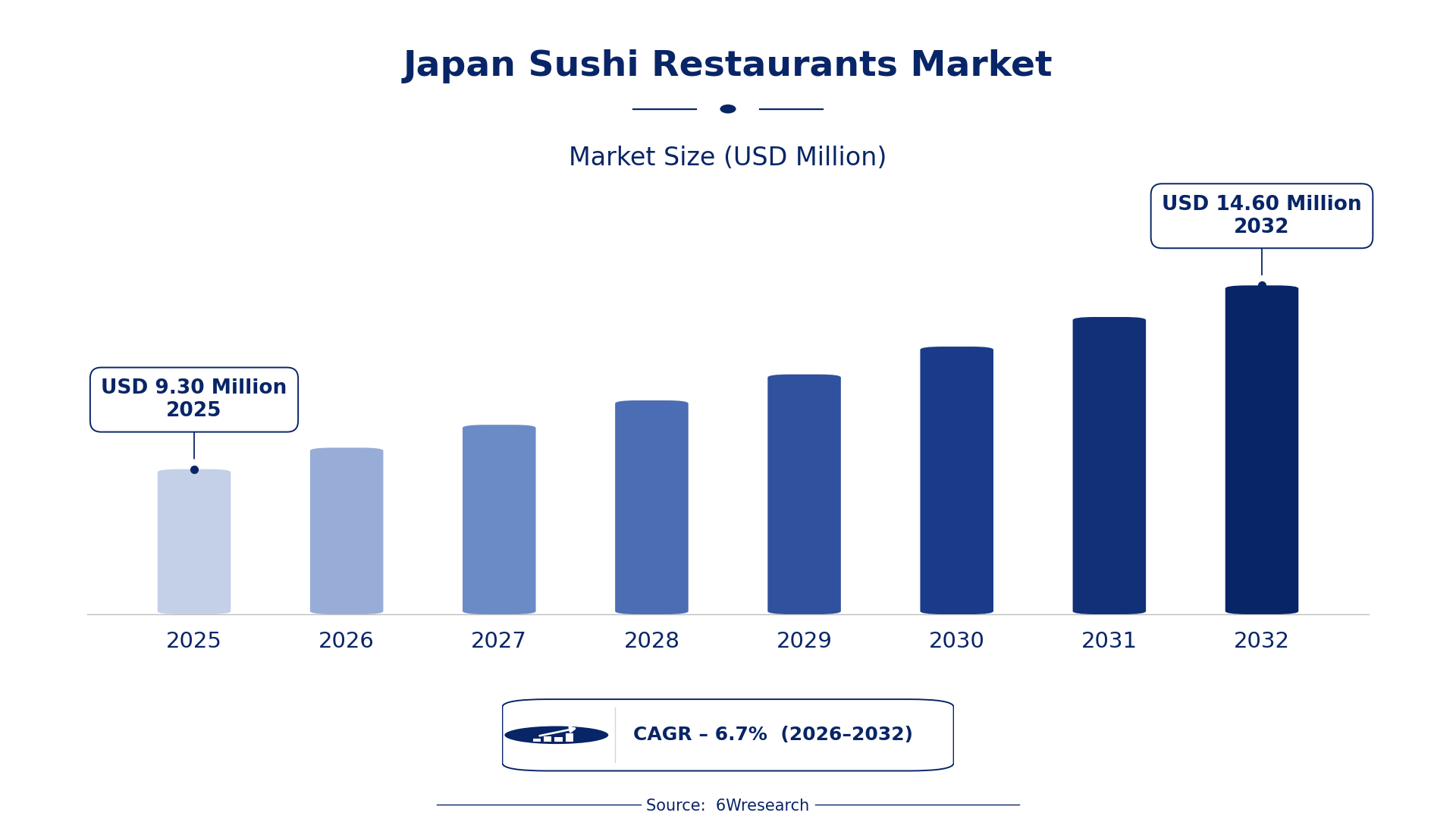
According to 6Wresearch internal database and industry insights, the Japan Sushi Restaurants Market was valued at USD 9.30 Million in 2025 and is projected to reach USD 14.60 Million by 2032, growing at a CAGR of approximately 6.7% during 2026–2032.
Japan Sushi Restaurants Market Highlights
| Report Metric | Details |
| Report Name | Japan Sushi Restaurants Market (2026-2032) |
| Market Size 2025 | USD 9.30 Million |
| Market Size 2032 | USD 14.60 Million |
| Absolute Growth 2025–2032 | USD 5.30 Million |
| CAGR 2026–2032 | 6.7% |
| Peak Annual Growth | 7.6% in 2027 |
| Forecast Period | 2026–2032 |
| Historical Data | 2022–2025 |
| Base Year | 2025 |
| Leading Type, 2025 | Traditional Sushi Restaurant (55% share) |
| Leading Application, 2025 | Dine-in (67% share) |
| Fastest-Growing Type | Conveyor Belt Sushi Restaurant (8.8% CAGR) |
| Fastest-Growing Application | Takeout (8.4% CAGR) |
| Growing Sector | Takeout |
| Key End Users | Dine-in, Takeout |
Japan Sushi Restaurants Market Year-wise Growth Rate and Key Drivers (2022–2032)
This graph illustrates the annual growth rates of the market from 2022 to 2032, highlighting a steady upward trajectory and projected market expansion over the forecast period.
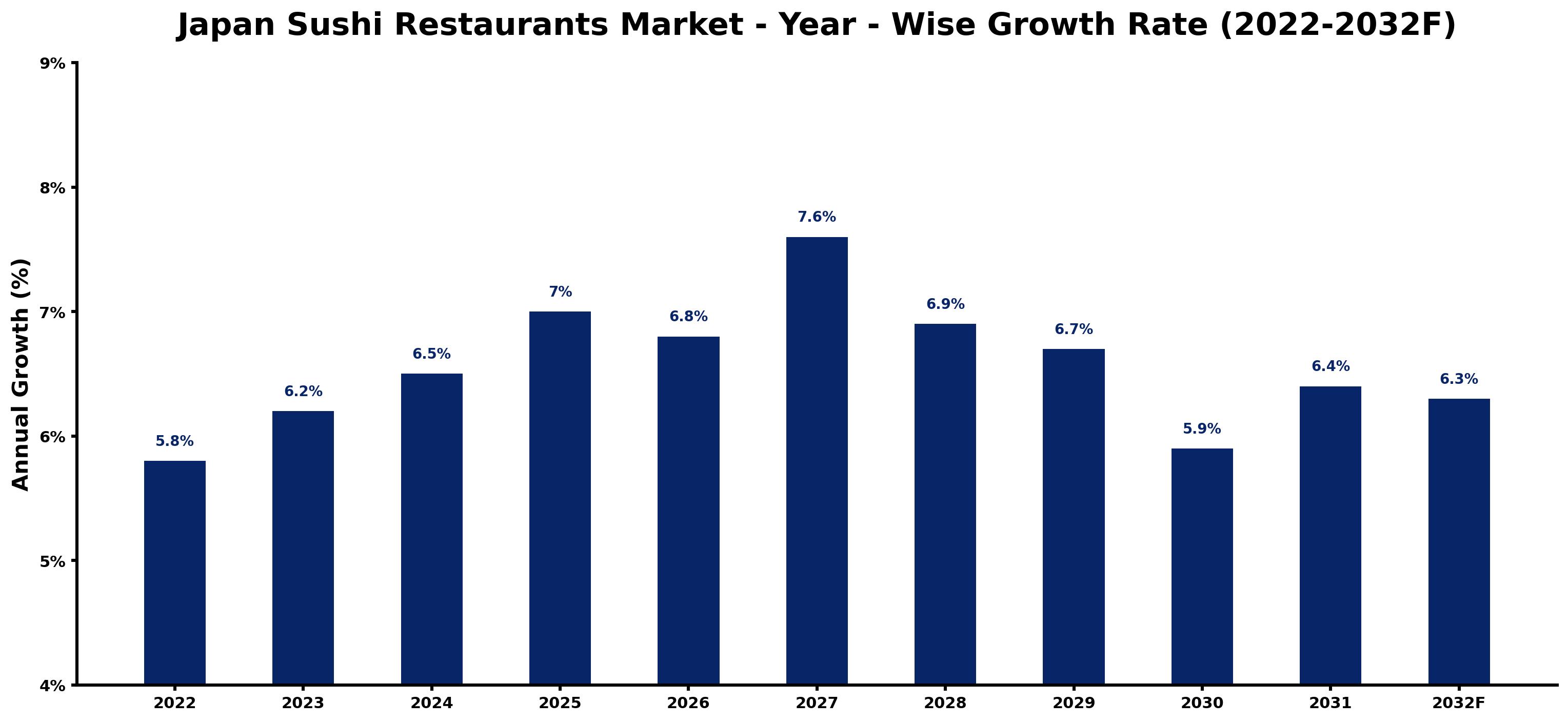
Below, each year's estimated growth is shown next to the factor that most influenced it.
| Year | Estimated Annual Growth (%) | Market Rationale |
| 2022 | 5.8 | The market experienced steady demand from local consumers and tourists. |
| 2023 | 6.2 | A rise in sushi restaurant openings across major cities supported growth. |
| 2024 | 6.5 | Increased interest in culinary tourism contributed to higher sushi consumption. |
| 2025 | 7.0 | The market reached a historical peak due to a surge in domestic dining. |
| 2026 | 6.8 | Growth is expected to slow as the market stabilises after rapid expansion. |
| 2027 | 7.6 | A renewed interest in traditional sushi experiences will drive demand higher again. |
| 2028 | 6.9 | Growth is projected to moderate as the market adjusts to changing consumer preferences. |
| 2029 | 6.7 | Demand will remain strong, but growth rates are expected to slow slightly. |
| 2030 | 5.9 | The market is projected to experience a further slowdown as competition intensifies. |
| 2031 | 6.4 | Growth is expected to pick up again as culinary tourism initiatives gain traction. |
| 2032 | 6.3 | The market will stabilise with consistent demand from both locals and tourists. |
Note: Market size estimations and growth projections presented in this report are based on 6Wresearch's proprietary forecasting methodology, utilizing the latest available industry data, government publications, and primary research inputs.
Japan Sushi Restaurants Market Synopsis
Sushi restaurants in Japan serve a traditional dish made with vinegared rice and various ingredients, including seafood and vegetables. The Japan Sushi Restaurants Market is thriving, driven by domestic consumers and international tourists seeking authentic dining experiences. With over 3,000 sushi establishments in Tokyo alone, the industry is projected to grow steadily, supported by culinary tourism and sustainable seafood sourcing standards. Sushi consumption in Japan reaches approximately 2.5 million tons annually, highlighting its cultural significance and demand.
Market Dynamics Impact Analysis (2026–2032)
| Factor | Type | Impact | Primary Segment Affected |
| Rising culinary tourism in Japan | Driver | High | Traditional Sushi Restaurant |
| Increasing interest in authentic dining experiences | Driver | High | Traditional Sushi Restaurant |
| Growing demand for casual dining options | Opportunity | Medium | Conveyor Belt Sushi Restaurant |
| Expansion of sushi offerings in urban areas | Opportunity | Medium | Dine-in |
| High operational costs due to rising wages | Restraint | High | Traditional Sushi Restaurant |
| Competition from international cuisines | Restraint | Medium | Conveyor Belt Sushi Restaurant |
| Shortage of skilled sushi chefs | Challenge | High | Traditional Sushi Restaurant |
| Fluctuations in seafood supply due to climate change | Challenge | Medium | Conveyor Belt Sushi Restaurant |
Evaluation of Drivers in Japan Sushi Restaurants Market (2026–2032)
These are the developments adding the most demand over the forecast period.
| Drivers | Primary Segment Affected | Why It Matters (Evidence) |
| Increase in sushi restaurant openings | Traditional Sushi Restaurant | In 2022, Japan saw a 10% increase in sushi restaurant openings compared to 2021, attracting more diners. |
| Rise in culinary tourism | Traditional Sushi Restaurant | In 2022, Japan welcomed over 31 million international tourists, increasing demand for authentic dining experiences. |
| Popularity of casual dining formats | Conveyor Belt Sushi Restaurant | Osaka's conveyor belt sushi locations, with over 1,000 establishments, cater to a growing demand for quick dining. |
| Focus on sustainable seafood sourcing | Traditional Sushi Restaurant | The Ministry of Agriculture, Forestry and Fisheries promotes standards that appeal to environmentally conscious consumers. |
| Training of new chefs | Traditional Sushi Restaurant | The Tokyo Sushi Academy trains over 200 chefs annually, ensuring a steady supply of skilled professionals. |
Much of the new demand traces back to the rise in culinary tourism, with international visitors seeking authentic sushi experiences. In 2022, Japan saw a 10% increase in sushi restaurant openings compared to the previous year, leading to more dining options. The average price of sushi in traditional restaurants is around 3,000 JPY, appealing to both locals and tourists. Osaka's conveyor belt sushi locations, with over 1,000 establishments, cater to a growing preference for casual dining formats.
Evaluation of Restraints in Japan Sushi Restaurants Market
Below are the constraints most often cited by buyers and suppliers, with the segment each affects.
| Market Restraint | Primary Segment Affected | Why It Matters (Evidence) |
| Skills shortage in the sushi chef workforce | Traditional Sushi Restaurant | The average age of sushi chefs is around 30 years old, leading to fewer young chefs entering the industry. |
| Intense competition among restaurants | Traditional Sushi Restaurant | Over 3,000 sushi restaurants in Tokyo drive down prices, affecting profit margins for producers. |
| Rising costs for consumers | Traditional Sushi Restaurant | The average price of sushi in traditional restaurants is around 3,000 JPY per person, deterring some customers. |
| Supply chain disruptions due to sourcing standards | Traditional Sushi Restaurant | Stringent sustainable seafood sourcing standards can increase operational costs for distributors. |
| Limited takeout options | Takeout | Takeout is available but not the main focus, limiting market expansion in that segment. |
Japan Sushi Restaurants Market Challenges
Japan's sushi restaurants face a skills shortage, with the average age of sushi chefs around 30 years, which delays restaurant openings for producers. Stringent sustainable seafood sourcing standards from the Ministry of Agriculture, Forestry and Fisheries disrupt supply chains, raising operational costs for distributors. Intense competition among over 3,000 establishments in Tokyo drives down prices, forcing buyers to pay more for quality dishes while squeezing profit margins for producers. Rising operational costs mean buyers encounter an average price of around 3,000 JPY per person, deterring some customers from dining out.
Trends in the Japan Sushi Restaurants Market
Four trends stand out in the Japan Sushi Restaurants Market.
- Shift from Traditional to Conveyor Belt Sushi: In 2022, the popularity of conveyor belt sushi surged, with over 1,000 locations in Osaka catering to casual diners. This shift reflects changing consumer preferences for quick dining experiences, impacting traditional sushi establishments.
- Emergence of Sustainable Sushi Practices: Since 2023, sushi restaurants have increasingly adopted sustainable seafood sourcing practices, driven by consumer demand for environmentally friendly dining options. This trend aligns with the Ministry of Agriculture, Forestry and Fisheries' standards.
- Growth of Culinary Tourism: The culinary tourism sector has expanded since 2022, with over 31 million international visitors seeking authentic sushi experiences. This trend boosts demand for sushi restaurants across Japan.
- Increased Focus on Chef Training: The Tokyo Sushi Academy has ramped up its training programs since 2022, producing over 200 skilled chefs annually. This focus on education ensures a steady supply of talent for the sushi restaurant industry.
Investment Opportunities in the Japan Sushi Restaurants Market
The following areas offer the clearest openings for investors and suppliers in the Japan Sushi Restaurants Market.
- Rising Demand for Takeout Options: With a 10% increase in sushi restaurant openings in 2022, there is an opportunity to expand takeout services. Targeting busy professionals in urban areas can attract new customers.
- Investment in Sustainable Practices: Now is the time to invest in sustainable seafood sourcing, as consumers increasingly prefer environmentally friendly options. Restaurants can improve their appeal by adopting these practices.
- Expansion of Culinary Tourism Initiatives: The Japanese government is promoting culinary tourism, creating opportunities for sushi restaurants to attract international visitors. Collaborating with local tourism boards can enhance visibility.
- Development of Unique Dining Experiences: As culinary tourism grows, there is an opportunity to create unique dining experiences that cater to tourists. Partnering with local chefs can offer authentic cultural experiences.
Government Initiatives in the Japan Sushi Restaurants Market
The GX Basic Policy, adopted in 2023, aims for about JPY 150 trillion in public-private decarbonisation investment over 10 years, impacting sushi restaurants by promoting sustainable practices. This policy builds on previous standards, emphasising the focus on environmental responsibility in the industry.
The Consumer Affairs Agency oversees the implementation of food safety and sustainable sourcing standards. This agency funds training programs for chefs and approves certifications that ensure quality and sustainability in sushi restaurants.
Future Insight of the Japan Sushi Restaurants Market
By 2032, buyers will increasingly demand unique culinary experiences, driven by government-supported culinary tourism initiatives. Technology will enhance operations, with sushi restaurants adopting advanced reservation systems to improve customer management. The Tokyo Sushi Academy will train new chefs, ensuring a steady influx of skilled professionals. As sushi consumption reaches approximately 2.5 million tons annually, suppliers will need to diversify their offerings to meet changing consumer preferences.
Market Segmentation Analysis
Japan Sushi Restaurants Market report covers a detailed analysis of the following market segments:
By Type – Traditional Sushi Restaurant Leads, Conveyor Belt Sushi Restaurant Expected to Grow Fastest
According to Summon Dutta, Assistant Manager at 6Wresearch, Traditional Sushi Restaurant held 55% of the Japan Sushi Restaurants Market by type in 2025. Traditional sushi restaurants dominate the market due to their emphasis on high-quality, artisanal sushi, which resonates with both locals and tourists seeking authentic culinary experiences. The extensive network of over 3,000 sushi restaurants in Tokyo illustrates the strong preference for traditional dining among consumers. Conveyor Belt Sushi Restaurant is projected to grow fastest, at a CAGR of 8.8% during 2026–2032. The conveyor belt sushi restaurant segment is growing quickly, primarily because of its casual dining appeal and convenience for customers. With over 1,000 locations in Osaka, this format effectively caters to busy diners looking for quick meal options, reinforcing its rapid expansion. Suppliers should consider strategies to align with the increasing demand for casual dining formats.
By Application – Dine-in Leads, Takeout Expected to Grow Fastest
With 67% of application revenue in 2025, Dine-in was the largest category. Dine-in services are the primary model as they provide an immersive experience that attracts both local patrons and international visitors. This model is particularly prominent in traditional sushi establishments, where the atmosphere enhances the overall dining experience. Takeout is set to record the highest CAGR in this split, 8.4% over 2026–2032. Takeout services are witnessing swift growth, fuelled by rising consumer demand for convenience. The 10% increase in sushi restaurant openings in 2022 highlights a shift towards more accessible dining options for consumers. Buyers can anticipate a wider variety of takeout options as restaurants adapt to evolving consumer preferences.
Key Attractiveness of the Report
- 10 Years of Market Numbers
- Historical Data Starting from 2022 to 2025
- Base Year 2025
- Forecast Data until 2032
- Key Performance Indicators Impacting the Market
- Major Upcoming Developments and Projects
Key Highlights of the Report:
- Japan Sushi Restaurants Market Outlook
- Market Size of Japan Sushi Restaurants Market, 2025
- Forecast of Japan Sushi Restaurants Market, 2032
- Historical Data and Forecast of Japan Sushi Restaurants Revenues & Volume for the Period 2022-2032
- Japan Sushi Restaurants Market Trend Evolution
- Japan Sushi Restaurants Market Drivers and Challenges
- Japan Sushi Restaurants Price Trends
- Japan Sushi Restaurants Porter's Five Forces
- Japan Sushi Restaurants Industry Life Cycle
- Historical Data and Forecast of Japan Sushi Restaurants Market Revenues & Volume By Type for the Period 2022-2032
- Historical Data and Forecast of Japan Sushi Restaurants Market Revenues & Volume By Traditional Sushi Restaurant for the Period 2022-2032
- Historical Data and Forecast of Japan Sushi Restaurants Market Revenues & Volume By Conveyor Belt Sushi Restaurant for the Period 2022-2032
- Historical Data and Forecast of Japan Sushi Restaurants Market Revenues & Volume By Application for the Period 2022-2032
- Historical Data and Forecast of Japan Sushi Restaurants Market Revenues & Volume By Dine-in for the Period 2022-2032
- Historical Data and Forecast of Japan Sushi Restaurants Market Revenues & Volume By Takeout for the Period 2022-2032
- Japan Sushi Restaurants Import Export Trade Statistics
- Market Opportunity Assessment By Type
- Market Opportunity Assessment By Application
- Japan Sushi Restaurants Top Companies Market Share
- Japan Sushi Restaurants Competitive Benchmarking By Technical and Operational Parameters
- Japan Sushi Restaurants Company Profiles
- Japan Sushi Restaurants Key Strategic Recommendations
Market Covered
The report covers the following segments.
By Type
- Traditional Sushi Restaurant
- Conveyor Belt Sushi Restaurant
By Application
- Dine-in
- Takeout































