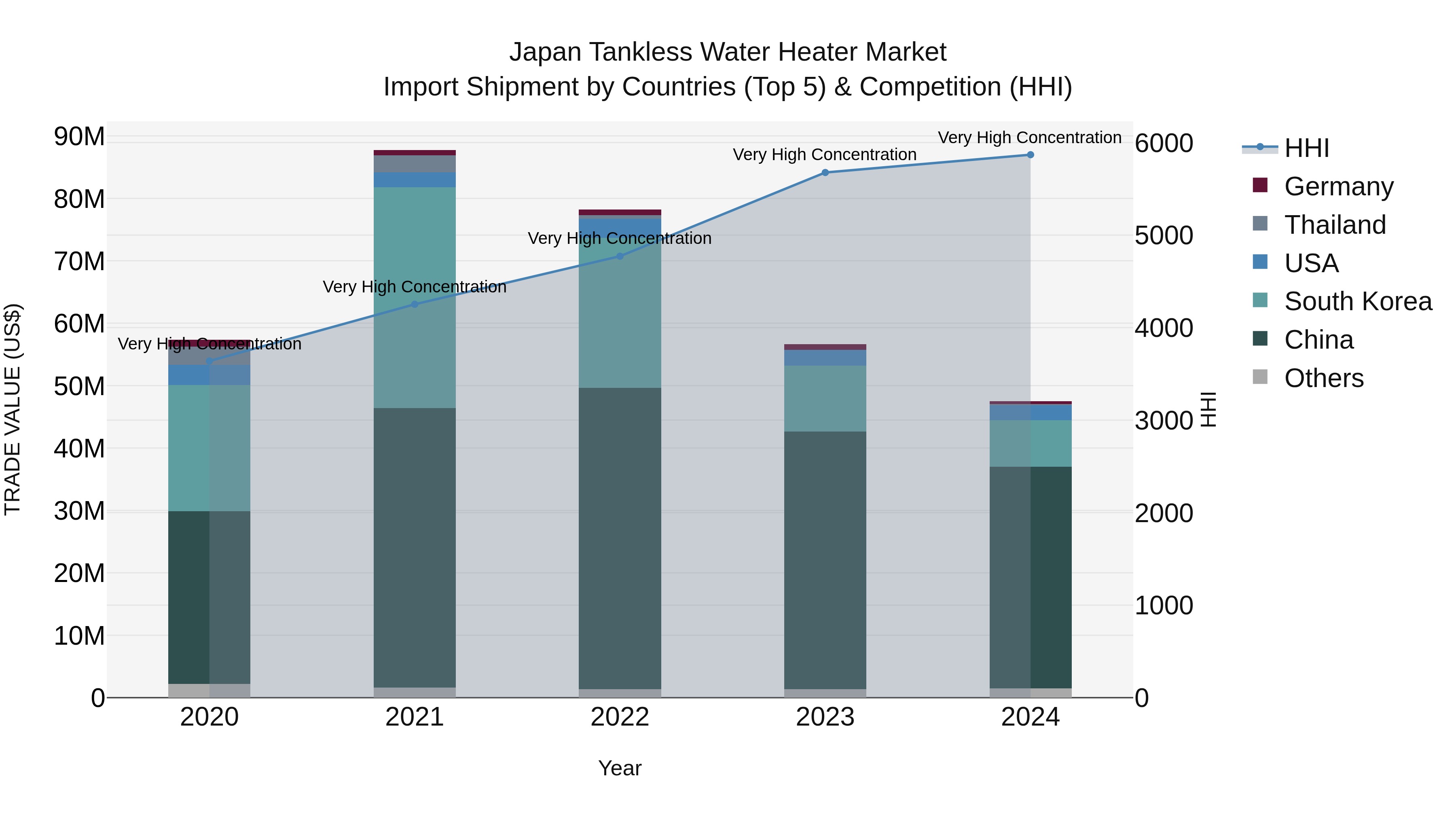
Japan Tankless Water Heater Market Import Shipment by Countries (Top 5) & Competition (HHI)
Despite a decline in the CAGR and growth rate in 2024, Japan continued to import tankless water heaters primarily from China, South Korea, USA, Metropolitan France, and Germany. The high Herfindahl-Hirschman Index (HHI) indicates a concentrated market, with these top exporting countries dominating the industry. The negative growth rates suggest a challenging market environment, possibly influenced by factors such as economic conditions or shifting consumer preferences. Monitoring these trends will be crucial for stakeholders in the tankless water heater import market in Japan.
Japan Tankless Water Heater Market Overview
The Japan tankless water heater market is experiencing steady growth driven by factors such as increasing awareness about energy efficiency, government initiatives promoting eco-friendly appliances, and the growing demand for compact and space-saving home appliances. Consumers in Japan are increasingly opting for tankless water heaters due to their energy-saving benefits, on-demand hot water supply, and longer lifespan compared to traditional tank-based models. Key players in the market are focusing on technological advancements, such as smart home integration and energy-saving features, to cater to the evolving consumer preferences. The market is also witnessing a shift towards electric tankless water heaters due to their ease of installation and lower maintenance requirements. Overall, the Japan tankless water heater market is poised for continued growth in the coming years.
Japan Tankless Water Heater Market Trends and Opportunities
The Japan Tankless Water Heater Market is experiencing growth due to increasing demand for energy-efficient and space-saving water heating solutions. Consumers are increasingly opting for tankless water heaters over traditional storage tank models for their on-demand hot water supply and long-term cost savings. In particular, the adoption of smart technology in tankless water heaters is a key trend, offering features such as remote control, energy monitoring, and eco-friendly operation. Additionally, the government`s focus on promoting energy efficiency and sustainability further boosts the market. Opportunities lie in targeting residential and commercial sectors with innovative and eco-friendly tankless water heater solutions, as well as expanding distribution channels to reach a wider customer base in urban and rural areas across Japan.
Japan Tankless Water Heater Market Challenges
In the Japan Tankless Water Heater Market, challenges arise due to consumer preferences for traditional storage water heaters, which are perceived as more reliable and familiar. Additionally, the initial cost of tankless water heaters is higher than traditional models, leading to hesitation among price-conscious consumers. Infrastructure constraints, such as limited availability of natural gas for gas-powered tankless water heaters, also pose a challenge in the market. Furthermore, the need for specialized installation and maintenance services for tankless water heaters adds complexity for both consumers and suppliers. Market players must address these challenges by educating consumers on the long-term cost savings, energy efficiency, and convenience offered by tankless water heaters, while also investing in infrastructure development and service capabilities to enhance market penetration.
Japan Tankless Water Heater Market Drivers
The Japan Tankless Water Heater Market is primarily driven by the growing demand for energy-efficient and space-saving heating solutions in residential and commercial buildings. Tankless water heaters offer benefits such as on-demand hot water, lower energy consumption, reduced maintenance costs, and longer product lifespan compared to traditional storage water heaters. Rising awareness about environmental sustainability and the need to reduce carbon emissions are also fueling the adoption of tankless water heaters in Japan. Additionally, government initiatives promoting energy efficiency and the construction of new residential and commercial buildings further propel market growth. The convenience of instant hot water, along with the compact size of tankless water heaters, makes them a popular choice among consumers in Japan seeking modern and efficient heating solutions.
Japan Tankless Water Heater Market Government Policies
In Japan, government policies related to the tankless water heater market focus on promoting energy efficiency and reducing carbon emissions. The government offers subsidies and tax incentives to encourage the adoption of energy-efficient tankless water heaters, which are known for their lower energy consumption compared to traditional storage water heaters. Additionally, there are regulations in place that set energy efficiency standards for water heaters to ensure that only efficient models are sold in the market. The government also supports research and development efforts to improve the technology and performance of tankless water heaters, further driving their adoption in residential and commercial buildings. Overall, these policies aim to reduce energy consumption, lower carbon emissions, and promote sustainable practices in the heating sector.
Japan Tankless Water Heater Market Future Outlook
The Japan Tankless Water Heater Market is poised for significant growth in the coming years due to various factors such as increasing awareness about energy efficiency, rising demand for space-saving home appliances, and a shift towards sustainable living practices. The market is expected to witness a surge in demand as consumers look for more efficient and cost-effective water heating solutions. Technological advancements in tankless water heaters, such as improved energy efficiency and smart features, are also likely to drive market growth. Additionally, government initiatives promoting the adoption of eco-friendly appliances are expected to further propel the market forward. Overall, the future outlook for the Japan Tankless Water Heater Market appears promising, with manufacturers focusing on innovation and sustainability to meet the evolving consumer needs.
Key Highlights of the Report:
- Japan Tankless Water Heater Market Outlook
- Market Size of Japan Tankless Water Heater Market, 2024
- Forecast of Japan Tankless Water Heater Market, 2031
- Historical Data and Forecast of Japan Tankless Water Heater Revenues & Volume for the Period 2021- 2031
- Japan Tankless Water Heater Market Trend Evolution
- Japan Tankless Water Heater Market Drivers and Challenges
- Japan Tankless Water Heater Price Trends
- Japan Tankless Water Heater Porter's Five Forces
- Japan Tankless Water Heater Industry Life Cycle
- Historical Data and Forecast of Japan Tankless Water Heater Market Revenues & Volume By Type for the Period 2021- 2031
- Historical Data and Forecast of Japan Tankless Water Heater Market Revenues & Volume By Whole-House for the Period 2021- 2031
- Historical Data and Forecast of Japan Tankless Water Heater Market Revenues & Volume By Point-of-Use for the Period 2021- 2031
- Historical Data and Forecast of Japan Tankless Water Heater Market Revenues & Volume By Application for the Period 2021- 2031
- Historical Data and Forecast of Japan Tankless Water Heater Market Revenues & Volume By Residential for the Period 2021- 2031
- Historical Data and Forecast of Japan Tankless Water Heater Market Revenues & Volume By Commercial for the Period 2021- 2031
- Japan Tankless Water Heater Import Export Trade Statistics
- Market Opportunity Assessment By Type
- Market Opportunity Assessment By Application
- Japan Tankless Water Heater Top Companies Market Share
- Japan Tankless Water Heater Competitive Benchmarking By Technical and Operational Parameters
- Japan Tankless Water Heater Company Profiles
- Japan Tankless Water Heater Key Strategic Recommendations






































