Japan Technical And Vocational Education Market Size & Growth Rate
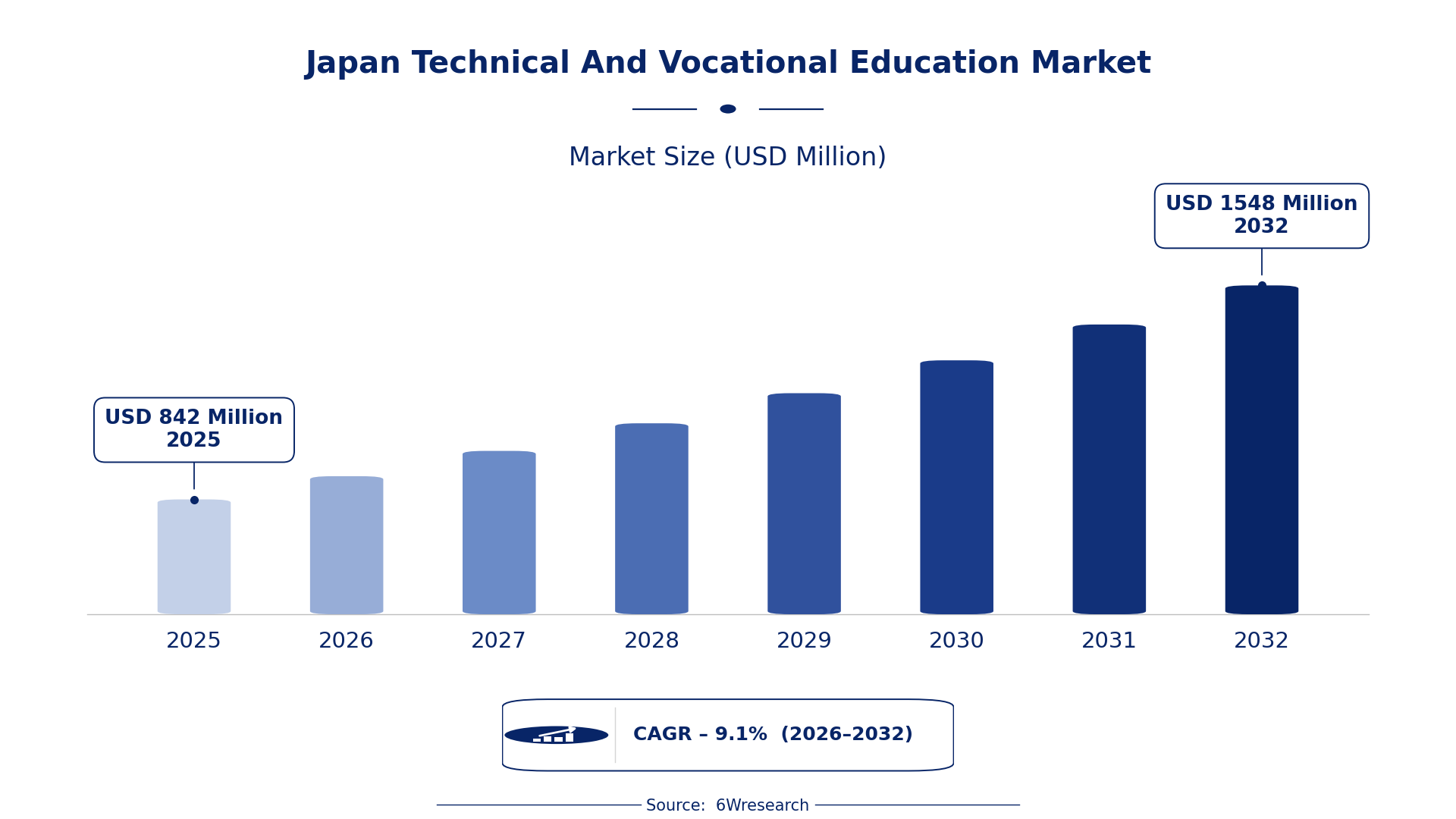
According to 6Wresearch internal database and industry insights, the Japan Technical And Vocational Education Market was valued at USD 842 Million in 2025 and is projected to reach USD 1,548 Million by 2032, growing at a CAGR of approximately 9.1% during 2026–2032.
Japan Technical And Vocational Education Market Highlights
| Report Metric | Details |
| Report Name | Japan Technical And Vocational Education Market (2026-2032) |
| Market Size 2025 | USD 842 Million |
| Market Size 2032 | USD 1,548 Million |
| Absolute Growth 2025–2032 | USD 706 Million |
| CAGR 2026–2032 | 9.1% |
| Peak Annual Growth | 10.0% in 2026 |
| Forecast Period | 2026–2032 |
| Historical Data | 2022–2025 |
| Base Year | 2025 |
| Leading Type, 2025 | STEM Technical and Vocational Education (56% share) |
| Leading Application, 2025 | Corporates (67% share) |
| Fastest-Growing Type | Non-STEM Technical and Vocational Education (12.5% CAGR) |
| Fastest-Growing Application | Individual Customers (11.5% CAGR) |
| Growing Sector | Individual Customers |
| Key End Users | Corporates, Individual Customers |
Japan Technical And Vocational Education Market Year-wise Growth Rate and Key Drivers (2022–2032)
This graph illustrates the annual growth rates of the market from 2022 to 2032, highlighting a steady upward trajectory and projected market expansion over the forecast period.
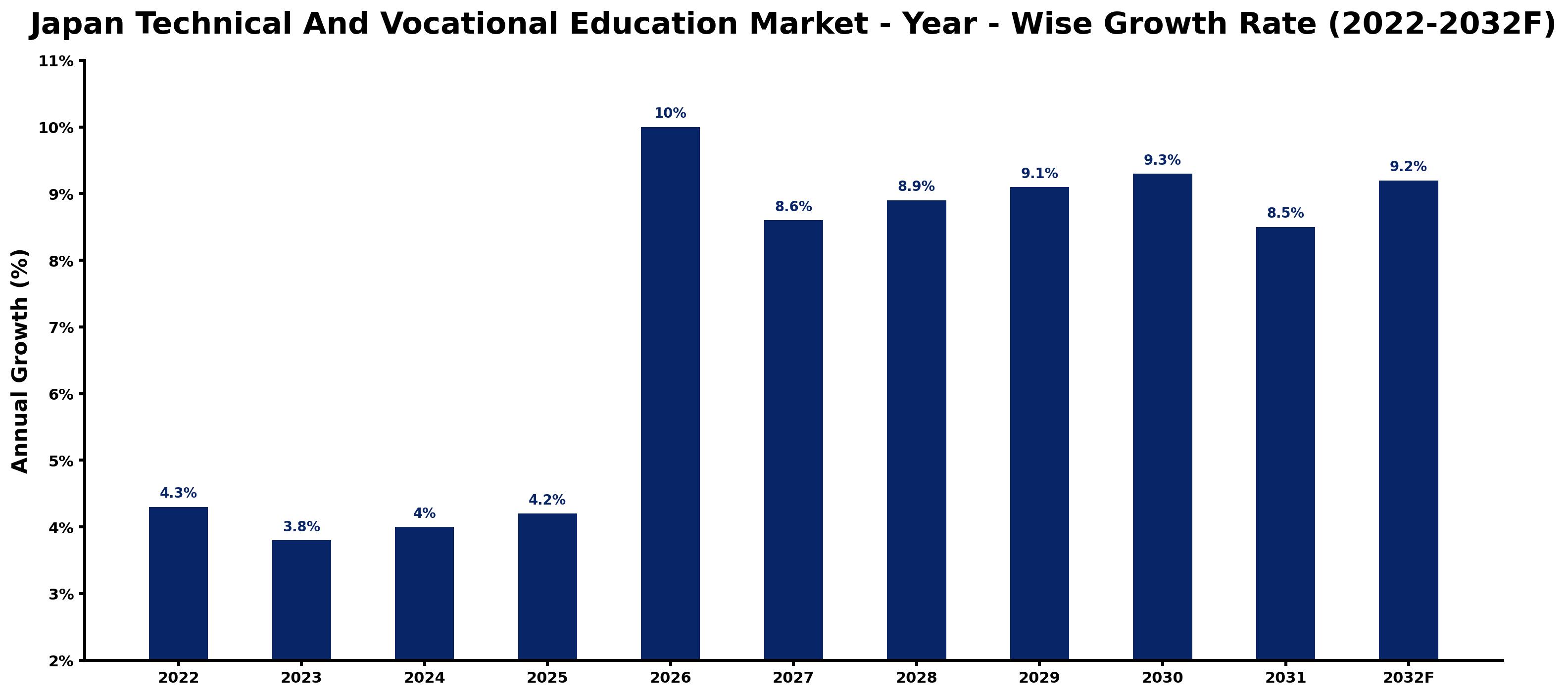
Below, each year's estimated growth is shown next to the factor that most influenced it.
| Year | Estimated Annual Growth (%) | Market Rationale |
| 2022 | 4.3 | The market showed steady growth as vocational training became increasingly recognised for its role in employability. |
| 2023 | 3.8 | Enrollment rates decreased slightly amid economic uncertainties, leading to slower growth. |
| 2024 | 4.0 | A rebound occurred as individuals sought vocational training for career advancement opportunities. |
| 2025 | 4.2 | Increased corporate partnerships for workforce development contributed to sustained interest in vocational programs. |
| 2026 | 10.0 | A surge in demand for skilled labor is expected to drive the market to its peak growth rate. |
| 2027 | 8.6 | Growth will slow as the market begins to stabilise after the peak demand year. |
| 2028 | 8.9 | The market is projected to pick up pace again as digital skills training becomes a priority for many institutions. |
| 2029 | 9.1 | Demand will continue to rise as more individuals recognise the value of vocational education. |
| 2030 | 9.3 | The market is expected to maintain its upward trend, driven by ongoing corporate investments in training. |
| 2031 | 8.5 | Growth will moderate as the market adjusts to the previous year's high demand. |
| 2032 | 9.2 | A renewed focus on vocational training for emerging industries will spur further growth. |
Note: Market size estimations and growth projections presented in this report are based on 6Wresearch's proprietary forecasting methodology, utilizing the latest available industry data, government publications, and primary research inputs.
Japan Technical And Vocational Education Market Synopsis
Technical and Vocational Education Market in Japan encompasses training programs designed to equip individuals with practical skills for various trades. In 2022, approximately 1.2 million students enrolled in vocational training programs, reflecting strong demand from domestic users and corporate partnerships. The government's aim to increase enrollment by 20% by 2025 and the establishment of the National Institute for Vocational Education and Training in 2019 are key factors driving this growth, improving the quality of vocational education.
Market Dynamics Impact Analysis (2026–2032)
| Factor | Type | Impact | Primary Segment Affected |
| Growing corporate investments in workforce development | Driver | High | Corporates |
| Rising individual interest in skill acquisition for career advancement | Driver | High | Individual Customers |
| Increasing demand for skilled labor in technology-driven industries | Opportunity | High | STEM Technical and Vocational Education |
| Expansion of vocational training programs to meet industry needs | Opportunity | High | Non-STEM Technical and Vocational Education |
| Limited awareness of vocational education benefits among potential students | Restraint | Medium | Non-STEM Technical and Vocational Education |
| Competition from traditional higher education pathways | Restraint | Medium | STEM Technical and Vocational Education |
| Rising costs of vocational training programs | Challenge | High | Corporates |
| Compliance with evolving educational standards | Challenge | Medium | Individual Customers |
Evaluation of Drivers in Japan Technical And Vocational Education Market (2026–2032)
Below are the drivers that matter most for revenue growth, with supporting evidence.
| Drivers | Primary Segment Affected | Why It Matters (Evidence) |
| Corporate partnerships invest in training programs | Corporates | This investment leads to enhanced skill development, with over 70% of vocational graduates finding employment within six months. |
| Government initiatives improve digital skills training | STEM Technical and Vocational Education | Such initiatives attract younger students, contributing to a 20% increase in vocational training enrollment by 2025. |
| Vocational schools offer diverse programs | Non-STEM Technical and Vocational Education | This diversity meets industry needs, driving more individuals to pursue vocational training. |
| The National Institute for Vocational Education and Training enhances education quality | STEM Technical and Vocational Education | By ensuring standards align with market requirements, it increases student enrollment. |
| JIS standards applied in curricula | Non-STEM Technical and Vocational Education | These standards ensure quality education, making vocational training more attractive to potential students. |
A wider customer base explains much of the growth, as corporate partnerships increasingly invest in training programs, with over 70% of vocational graduates finding employment within six months. The average age of vocational students is 19, indicating a young demographic eager for skills. Government initiatives, such as the 2023 program improving digital skills, further support demand. Japan's vocational schools offer diverse programs that cater to industry needs, while the Ministry of Education ensures standards align with market requirements. This alignment encourages more individuals to pursue vocational training, ultimately increasing enrollment numbers.
Evaluation of Restraints in Japan Technical And Vocational Education Market
Below are the constraints most often cited by buyers and suppliers, with the segment each affects.
| Market Restraint | Primary Segment Affected | Why It Matters (Evidence) |
| Limited awareness of vocational education benefits | Non-STEM Technical and Vocational Education | Many potential students remain unaware of the advantages of vocational training, affecting enrollment rates. |
| Competition from traditional higher education pathways | STEM Technical and Vocational Education | As more students opt for university degrees, vocational programs struggle to attract attention. |
| High costs associated with vocational training programs | Corporates | Rising tuition fees can deter companies from investing in employee training initiatives. |
| Compliance with educational standards | Individual Customers | Changes in regulations can create challenges for institutions in maintaining accreditation. |
| Economic uncertainties affecting training budgets | Non-STEM Technical and Vocational Education | Companies may reduce training budgets during economic downturns, impacting enrollment. |
Japan Technical And Vocational Education Market Challenges
High technology integration costs burden vocational schools, leading to outdated training methods that hinder student preparedness. Many institutions struggle to secure funding for necessary upgrades, resulting in a workforce ill-equipped for industry demands. Employers report that 30% of vocational graduates lack essential skills, delaying their hiring processes and increasing operational costs. Regulatory standards from the Ministry of Education can stall curriculum updates, costing employers an average of three months in onboarding new hires as they seek to bridge the skills gap.
Trends in the Japan Technical And Vocational Education Market
The following changes are redrawing the Japan Technical And Vocational Education Market.
- Shift towards Digital Skills Training: Vocational education is increasingly prioritising digital skills, with the government launching a program in 2023 to improve these skills. This shift prepares students for the evolving job market, reflecting the growing need for tech-savvy workers.
- Increased Enrollment in Vocational Schools: In 2022, approximately 1.2 million students enrolled in vocational training programs, showcasing a growing interest in practical skills. This trend is likely to continue as more individuals seek career advancement through vocational education.
- Focus on Industry-Specific Training: Vocational education is shifting to address specific industry needs, with numerous vocational schools in Japan offering tailored programs. This change ensures that graduates possess the skills required by employers, improving employability.
- Rising Corporate Investments in Training: Corporates are investing more in vocational education to develop skilled labour, as evidenced by the high employment rate of graduates within six months. This trend indicates a strong commitment to workforce development.
Investment Opportunities in the Japan Technical And Vocational Education Market
Where to invest in the Japan Technical And Vocational Education Market: the main openings are set out below.
- Corporates seeking skilled labor: Corporates in Japan are increasingly investing in vocational training, aiming to improve workforce capabilities. The government aims to increase enrollment by 20% by 2025, presenting an opportunity for training providers.
- Vocational training institutions in Osaka: Osaka is a major hub for vocational education, with significant demand for skilled labour. The government’s investment in vocational programs highlights the need for training providers to expand their offerings.
- Growing demand for STEM education: The STEM Technical and Vocational Education segment is projected to grow, driven by the need for skilled workers in technology-driven industries. Training providers can capitalise on this trend by developing relevant programs.
- Individual customers pursuing career advancement: Individuals are increasingly seeking vocational training for career advancement, focusing on practical skills. Training providers can enter this market by offering tailored programs that meet specific industry demands.
Government Initiatives in the Japan Technical And Vocational Education Market
The Act on Japanese Industrial Standards governs vocational education, ensuring that training programs meet specific quality requirements. This law impacts buyers by mandating that vocational institutions adhere to established standards, ensuring that students receive quality education.
The Consumer Affairs Agency oversees the implementation of regulations that prohibit misleading advertising in vocational education. This regulation ensures that buyers receive accurate information about training programs, protecting their interests.
Future Insight of the Japan Technical And Vocational Education Market
The launch of digital skills training programmes will transform vocational education by 2032. With the government targeting a 20% increase in enrollment by 2025, institutions will attract more students with relevant skills. Vocational schools will align their curricula with JIS standards to meet industry requirements. As the Technical and Vocational Education Development Program allocates ¥5 billion for 2023, this investment will improve training quality and better prepare graduates for the workforce.
Market Segmentation Analysis
Japan Technical And Vocational Education Market report covers a detailed analysis of the following market segments:
By Type – STEM Technical and Vocational Education Leads, Non-STEM Technical and Vocational Education Expected to Grow Fastest
According to Dhaval Chaurasia, Assistant Manager at 6Wresearch, STEM Technical and Vocational Education took 56% of type revenue in 2025, more than any other category. STEM Technical and Vocational Education holds the largest share due to its critical role in equipping students with skills for technology-driven industries. The high enrolment numbers from urban centres like Tokyo and Osaka highlight its importance in meeting the demands of modern workplaces. The quickest growth will come from Non-STEM Technical and Vocational Education, forecast to expand at a CAGR of 12.5% between 2026 and 2032. Non-STEM Technical and Vocational Education is growing rapidly as it caters to a diverse range of trades and services, with government initiatives aiming for a 20% increase in enrolment by 2025. This segment's expansion is driven by the increasing need for skilled labour in various sectors, ensuring continued growth. Suppliers should focus on developing diverse training programs to address the growing demand across both STEM and non-STEM vocational education.
By Application – Corporates Lead, Individual Customers Expected to Grow Fastest
With 67% of application revenue in 2025, Corporates was the largest category. Corporates dominate the market as they invest significantly in vocational training to develop a skilled workforce, essential for staying competitive in Japan's evolving job landscape. This trend is evident as companies recognise the value of vocational education in fulfilling industry skill requirements. Individual Customers are set to record the highest CAGR in this split, 11.5% over 2026–2032. Individual Customers represent the fastest-growing segment, motivated by a rising interest in acquiring skills that improve career opportunities, reflecting a shift towards continuous learning. The government's initiatives to enhance digital skills in vocational training further stimulate this growth, attracting more individuals to vocational programs. Suppliers need to tailor their offerings to meet the distinct requirements of both corporate clients and individual learners to capitalise on this expanding market.
Key Attractiveness of the Report
- 10 Years of Market Numbers
- Historical Data Starting from 2022 to 2025
- Base Year 2025
- Forecast Data until 2032
- Key Performance Indicators Impacting the Market
- Major Upcoming Developments and Projects
Key Highlights of the Report:
- Japan Technical And Vocational Education Market Outlook
- Market Size of Japan Technical And Vocational Education Market, 2025
- Forecast of Japan Technical And Vocational Education Market, 2032
- Historical Data and Forecast of Japan Technical And Vocational Education Revenues & Volume for the Period 2022-2032
- Japan Technical And Vocational Education Market Trend Evolution
- Japan Technical And Vocational Education Market Drivers and Challenges
- Japan Technical And Vocational Education Price Trends
- Japan Technical And Vocational Education Porter's Five Forces
- Japan Technical And Vocational Education Industry Life Cycle
- Historical Data and Forecast of Japan Technical And Vocational Education Market Revenues & Volume By Type for the Period 2022-2032
- Historical Data and Forecast of Japan Technical And Vocational Education Market Revenues & Volume By STEM Technical and Vocational Education for the Period 2022-2032
- Historical Data and Forecast of Japan Technical And Vocational Education Market Revenues & Volume By Non-STEM Technical and Vocational Education for the Period 2022-2032
- Historical Data and Forecast of Japan Technical And Vocational Education Market Revenues & Volume By Application for the Period 2022-2032
- Historical Data and Forecast of Japan Technical And Vocational Education Market Revenues & Volume By Corporates for the Period 2022-2032
- Historical Data and Forecast of Japan Technical And Vocational Education Market Revenues & Volume By Individual Customers for the Period 2022-2032
- Japan Technical And Vocational Education Import Export Trade Statistics
- Market Opportunity Assessment By Type
- Market Opportunity Assessment By Application
- Japan Technical And Vocational Education Top Companies Market Share
- Japan Technical And Vocational Education Competitive Benchmarking By Technical and Operational Parameters
- Japan Technical And Vocational Education Company Profiles
- Japan Technical And Vocational Education Key Strategic Recommendations
Market Covered
This report examines the market across the segments below.
By Type
- STEM Technical and Vocational Education
- Non-STEM Technical and Vocational Education
By Application
- Corporates
- Individual Customers































