Japan Temporary Power Market Size & Growth Rate
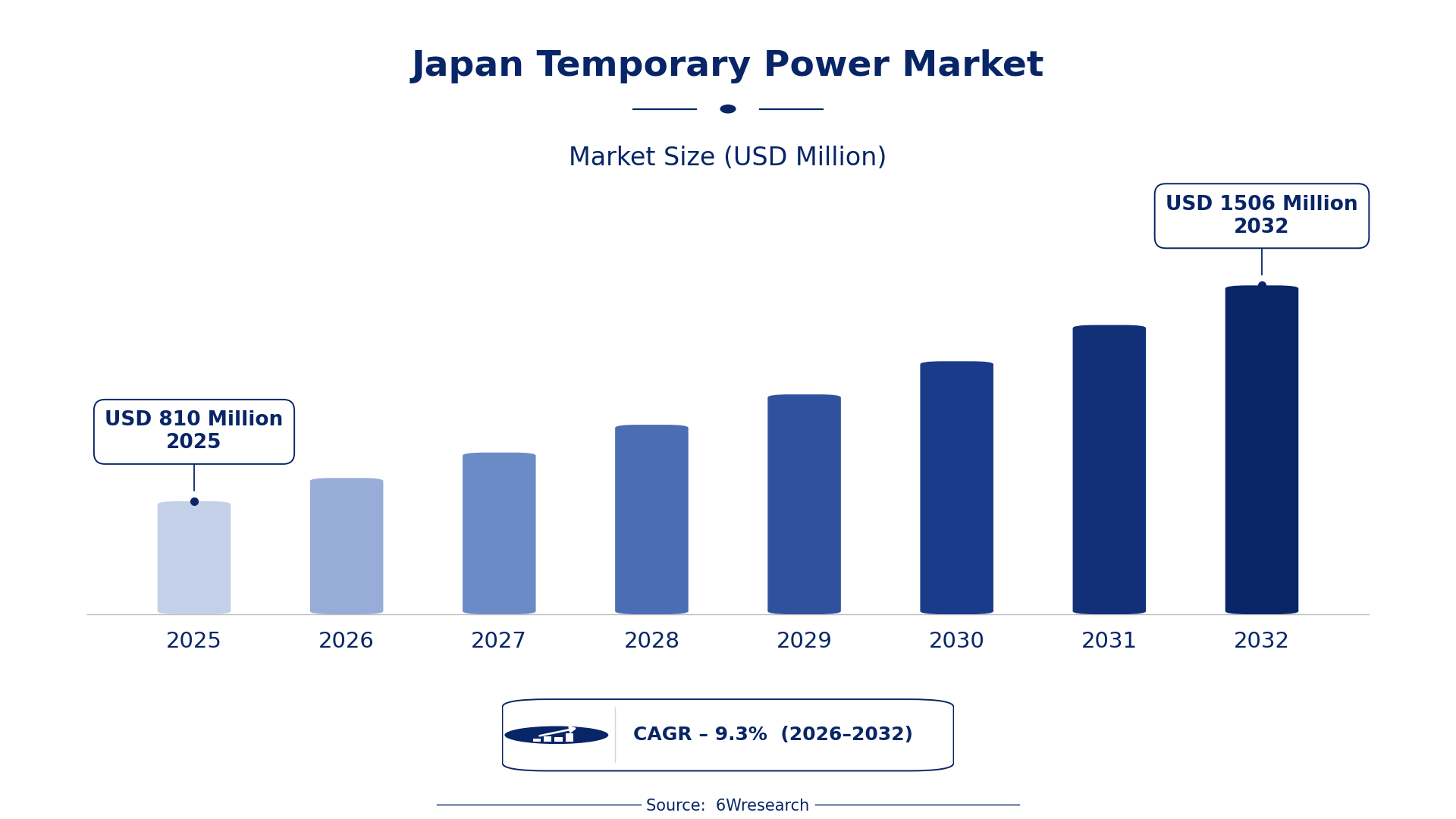
According to 6Wresearch internal database and industry insights, the Japan Temporary Power Market was valued at USD 810 Million in 2025 and is projected to reach USD 1,506 Million by 2032, growing at a CAGR of approximately 9.3% during 2026–2032.
Japan Temporary Power Market Highlights
| Report Metric | Details |
| Report Name | Japan Temporary Power Market (2026-2032) |
| Market Size 2025 | USD 810 Million |
| Market Size 2032 | USD 1,506 Million |
| Absolute Growth 2025–2032 | USD 696 Million |
| CAGR 2026–2032 | 9.3% |
| Peak Annual Growth | 10.7% in 2026 |
| Forecast Period | 2026–2032 |
| Historical Data | 2022–2025 |
| Base Year | 2025 |
| Leading Generator Rating, 2025 | Less than 80 kW (45% share) |
| Leading End Use, 2025 | Construction (50% share) |
| Leading Fuel Type, 2025 | Diesel (51% share) |
| Fastest-Growing Generator Rating | 81-280kW (11.3% CAGR) |
| Fastest-Growing End Use | Events (12.2% CAGR) |
| Fastest-Growing Fuel Type | Gas (12.4% CAGR) |
| Growing Sector | Construction |
| Key End Users | Event organisers, construction companies, utility providers, disaster recovery agencies |
Japan Temporary Power Market Year-wise Growth Rate and Key Drivers (2022–2032)
This graph illustrates the annual growth rates of the market from 2022 to 2032, highlighting a steady upward trajectory and projected market expansion over the forecast period.
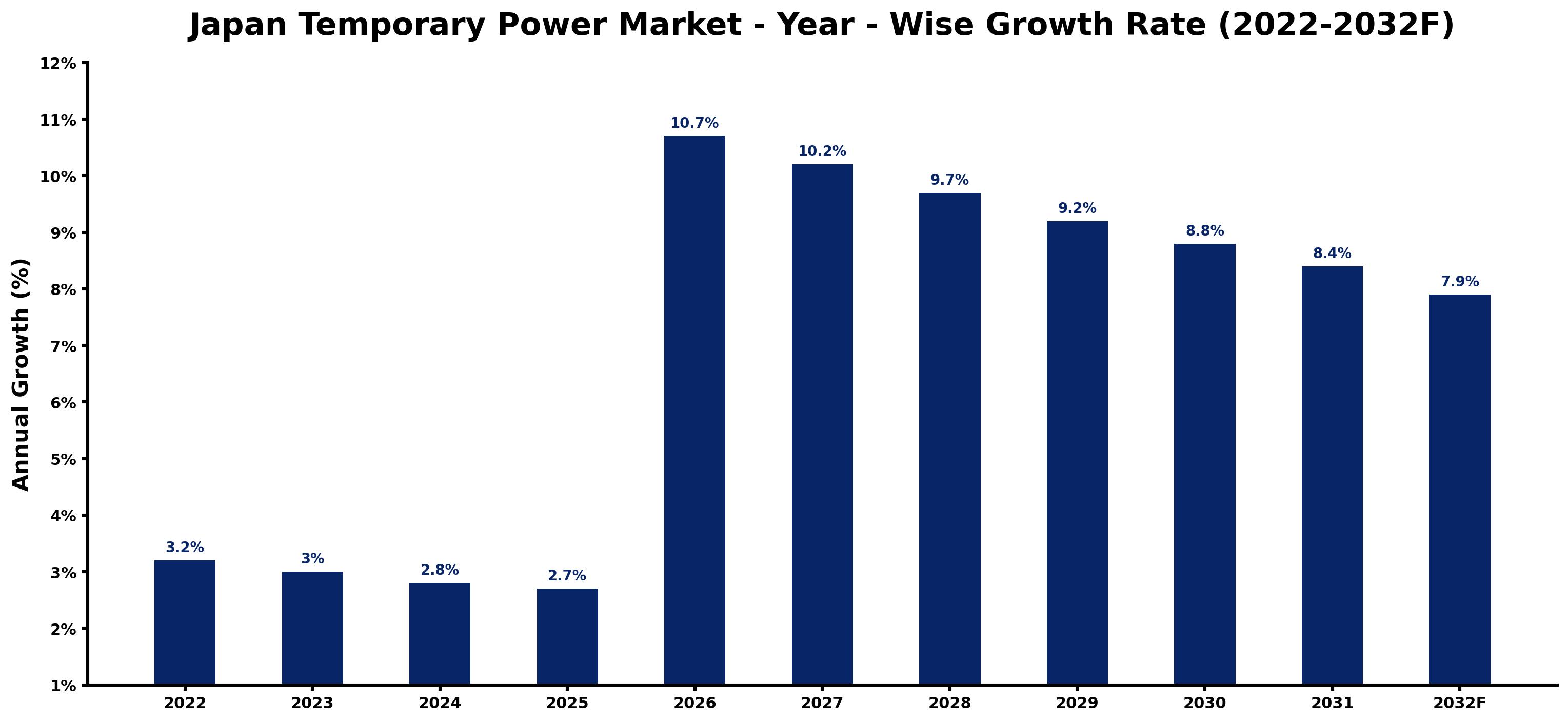
Year by year, the estimates below pair each growth rate with the development that shaped it.
| Year | Estimated Annual Growth (%) | Market Rationale |
| 2022 | 3.2 | The market experienced steady growth supported by numerous events requiring temporary power solutions. |
| 2023 | 3.0 | Demand growth slowed slightly as the construction industry faced challenges in project timelines. |
| 2024 | 2.8 | Continued slow growth reflected ongoing recovery efforts in the events sector. |
| 2025 | 2.7 | The market maintained slow growth with a focus on energy efficiency in temporary power applications. |
| 2026 | 10.7 | Demand surged as major events and construction projects ramped up, increasing temporary power needs. |
| 2027 | 10.2 | Growth slowed slightly as the market adjusted to increased supply and demand. |
| 2028 | 9.7 | Demand continued to decrease gradually as the market stabilised after the previous surge. |
| 2029 | 9.2 | The market experienced a further slowdown as new projects faced delays and cancellations. |
| 2030 | 8.8 | Growth slowed as the focus shifted towards sustainable energy solutions in temporary power. |
| 2031 | 8.4 | Market growth continued to slow as competition increased among temporary power providers. |
| 2032 | 7.9 | Demand growth stabilised as the market adapted to new energy policies and practices. |
Note: Market size estimations and growth projections presented in this report are based on 6Wresearch's proprietary forecasting methodology, utilizing the latest available industry data, government publications, and primary research inputs.
Japan Temporary Power Market Synopsis
Temporary power refers to the provision of electricity through portable generators, primarily used during emergencies or for temporary applications such as events and construction. The Japan Temporary Power Market is driven by over 1,000 annual events and a construction industry valued at approximately ¥60 trillion, creating strong demand for these solutions. Key regions like Tokyo and Osaka are central to this growth, with substantial investments in disaster preparedness and decarbonisation initiatives, including JPY 150 trillion targeted for public and private investments over the next decade.
Market Dynamics Impact Analysis (2026–2032)
| Factor | Type | Impact | Primary Segment Affected |
| Increasing number of events requiring temporary power solutions | Driver | High | Events |
| Significant investments in construction projects | Driver | High | Construction |
| Growing demand for sustainable energy solutions | Opportunity | High | Utilities |
| Emerging technologies in generator efficiency | Opportunity | Medium | Less than 80 kW |
| High competition among temporary power providers | Restraint | High | Less than 80 kW |
| Regulatory challenges in energy efficiency compliance | Restraint | Medium | Less than 80 kW |
| Dependence on diesel fuel for generators | Challenge | High | Diesel |
| Limited availability of skilled technicians for maintenance | Challenge | Medium | Less than 80 kW |
Evaluation of Drivers in Japan Temporary Power Market (2026–2032)
The following drivers explain most of the expected growth.
| Drivers | Primary Segment Affected | Why It Matters (Evidence) |
| Rising number of events | Events | Over 1,000 annual events in Japan drive demand for temporary power solutions. |
| Investment in construction projects | Construction | The construction industry valued at approximately ¥60 trillion creates a strong demand for temporary power. |
| Government initiatives for disaster preparedness | Utilities | In 2023, the government allocated ¥10 billion for disaster preparedness, boosting temporary power needs. |
| Focus on energy efficiency | Less than 80 kW | The Act on the Rational Use of Energy obliges large energy users to improve energy efficiency. |
| Investment in clean energy solutions | Utilities | Japan targets a 46% cut in greenhouse-gas emissions by 2030, influencing temporary power adoption. |
The strongest pull on demand comes from the increasing number of events requiring temporary power solutions, with over 1,000 events annually driving purchases. The construction industry, valued at approximately ¥60 trillion, also boosts demand as projects ramp up. The commitment to reducing greenhouse-gas emissions by 46% by 2030 encourages investments in cleaner temporary power solutions.
Evaluation of Restraints in Japan Temporary Power Market
The main factors holding the market back are set out below.
| Market Restraint | Primary Segment Affected | Why It Matters (Evidence) |
| High competition among providers | Less than 80 kW | Increased competition leads to price pressure, affecting profitability for temporary power suppliers. |
| Regulatory compliance costs | Less than 80 kW | Compliance with energy efficiency regulations can increase operational costs for providers. |
| Dependence on diesel fuel | Diesel | Reliance on diesel limits flexibility and increases vulnerability to fuel price fluctuations. |
| Limited availability of skilled technicians | Less than 80 kW | A shortage of qualified technicians for maintenance can delay service delivery and increase costs. |
| Market saturation in urban areas | Less than 80 kW | High density in urban areas like Tokyo increases competition, limiting growth opportunities. |
Japan Temporary Power Market Challenges
While over 1,000 annual events in Japan create strong demand for temporary power solutions, outdated generator technology can inflate operational costs by as much as 20% for event organisers. A shortage of skilled workers delays the deployment of these solutions, pushing project timelines back and raising expenses for construction firms by around ¥5 billion each year. Compliance with ISO 8528 standards complicates operations, requiring suppliers to dedicate additional resources that can prolong project delivery. Supply chain disruptions, especially for specialised generators, may result in delays of up to three months, forcing contractors to incur extra costs that affect their profitability.
Trends in the Japan Temporary Power Market
Below are the shifts with the largest effect on the Japan Temporary Power Market.
- Shift Towards Sustainable Energy Solutions: Japan is increasingly adopting sustainable energy solutions in temporary power applications, influenced by government initiatives. The GX Basic Policy aims for JPY 150 trillion in decarbonisation investments, impacting the market.
- Transition from Diesel to Gas Generators: There is a notable shift from diesel to gas generators in temporary power applications, as gas usage grows. This trend is supported by a projected 12.4% CAGR for gas generators, reflecting changing preferences.
- Increase in Event-Based Power Requirements: Tokyo is experiencing a surge in event-based power requirements, with over 1,000 events annually. This trend has led to increased investments in temporary power solutions, supporting market growth.
- Focus on Energy Efficiency in Temporary Power: The Act on the Rational Use of Energy is driving a focus on energy efficiency in temporary power. Compliance is expected to influence purchasing decisions, impacting generator types.
Investment Opportunities in the Japan Temporary Power Market
Below are the investment opportunities with the strongest case in the Japan Temporary Power Market.
- Supply of Gas Generators: There is a growing opportunity to supply gas generators as demand transitions from diesel. The construction sector, employing approximately 5.5 million workers, is increasingly pursuing cleaner energy solutions.
- Investment in Disaster Preparedness Solutions: With the government allocating ¥10 billion for disaster preparedness, opportunities arise to invest in temporary power solutions. Utility companies are particularly keen on enhancing their backup power capabilities.
- Expansion of Temporary Power for Events: The rise in events highlights a gap in temporary power supply, with over 1,000 events annually. Event organisers in urban centres like Tokyo are seeking dependable power solutions.
- Development of Energy-Efficient Generators: The market presents opportunities for developing energy-efficient generators in response to regulatory demands. Manufacturers can focus on the construction and utility sectors to meet compliance needs.
Government Initiatives in the Japan Temporary Power Market
The GX Promotion Act, adopted in 2023, strengthens the legal framework for decarbonisation efforts by promoting clean energy solutions. This act complements the Act on the Rational Use of Energy, which requires large energy users to improve efficiency, ensuring that temporary power solutions align with national sustainability goals.
Utility companies are utilising government funding under the disaster preparedness scheme to improve their temporary power capabilities. The allocation of ¥10 billion in 2023 supports investments in backup power systems, enabling utilities to meet increased demand during emergencies.
Future Insight of the Japan Temporary Power Market
Japan's GX Basic Policy will drive transformations in the temporary power market by 2032, urging suppliers to adopt cleaner technologies. The government's allocation of ¥150 trillion for decarbonisation will facilitate the development of advanced temporary power solutions. Urbanisation in cities like Tokyo will heighten demand for efficient power systems at various events and construction sites. Government initiatives promoting clean energy will further encourage innovation and the adoption of sustainable practices in temporary power applications.
Market Segmentation Analysis
Japan Temporary Power Market report covers a detailed analysis of the following market segments:
By Generator Rating – Less than 80 kW Leads, 81-280kW Expected to Grow Fastest
According to Shubham Deep, Research Manager at 6Wresearch, Less than 80 kW held 45% of the Japan Temporary Power Market by generator rating in 2025. The less than 80 kW segment holds the largest share due to its widespread use for small events and temporary applications, making it accessible to various users. With over 1,000 annual events in Japan, there is a consistent demand for portable power solutions within this capacity. Over 2026–2032, 81-280kW is expected to post the fastest growth, at a CAGR of 11.3%. The 81-280 kW segment is experiencing rapid growth as it caters to medium-sized events and construction sites, where demand is significantly increasing. The construction industry's valuation of approximately ¥60 trillion indicates a strong need for generators in this power range, which will likely expand further. Suppliers should prioritise their product development towards the 81-280 kW range to meet the rising demand from construction and medium-sized events.
By End Use – Construction Leads, Events Expected to Grow Fastest
Construction took 50% of end use revenue in 2025, more than any other category. The construction sector leads the market as it is essential for powering tools and machinery on-site, with around 5.5 million workers contributing to this demand. The substantial value of the construction industry ensures a continuous need for temporary power solutions. Events are set to record the highest CAGR in this split, 12.2% over 2026–2032. The events sector is growing at the fastest rate as it frequently requires temporary power for concerts, festivals, and exhibitions, significantly boosting the demand for portable generators. The high frequency of annual events in Japan further supports this upward trend. Suppliers should refine their marketing strategies towards the events sector to leverage the increasing demand for temporary power solutions.
By Fuel Type – Diesel Leads, Gas Expected to Grow Fastest
Diesel accounted for 51% of the market by fuel type in 2025. Diesel is the primary fuel type for generators, establishing its leadership in the market due to its reliability and efficiency for temporary applications. The installed base of over 300,000 units predominantly utilises diesel, reinforcing its strong market position. Gas are projected to grow fastest, at a CAGR of 12.4% during 2026–2032. Gas is experiencing the fastest growth as it is increasingly adopted for specific applications, driven by government initiatives that promote clean energy solutions. This transition aligns with Japan's decarbonisation targets and the rising demand for environmentally friendly options. Suppliers should consider expanding their fuel offerings to include gas solutions, aligning with the market's shift towards cleaner energy sources.
Key Attractiveness of the Report
- 10 Years of Market Numbers
- Historical Data Starting from 2022 to 2025
- Base Year 2025
- Forecast Data until 2032
- Key Performance Indicators Impacting the Market
- Major Upcoming Developments and Projects
Key Highlights of the Report:
- Japan Temporary Power Market Outlook
- Market Size of Japan Temporary Power Market, 2025
- Forecast of Japan Temporary Power Market, 2032
- Historical Data and Forecast of Japan Temporary Power Revenues & Volume for the Period 2022-2032
- Japan Temporary Power Market Trend Evolution
- Japan Temporary Power Market Drivers and Challenges
- Japan Temporary Power Price Trends
- Japan Temporary Power Porter's Five Forces
- Japan Temporary Power Industry Life Cycle
- Historical Data and Forecast of Japan Temporary Power Market Revenues & Volume By Generator Rating for the Period 2022-2032
- Historical Data and Forecast of Japan Temporary Power Market Revenues & Volume By Less than 80 kW for the Period 2022-2032
- Historical Data and Forecast of Japan Temporary Power Market Revenues & Volume By 81-280kW for the Period 2022-2032
- Historical Data and Forecast of Japan Temporary Power Market Revenues & Volume By 281-600 kW for the Period 2022-2032
- Historical Data and Forecast of Japan Temporary Power Market Revenues & Volume By End Use for the Period 2022-2032
- Historical Data and Forecast of Japan Temporary Power Market Revenues & Volume By Events for the Period 2022-2032
- Historical Data and Forecast of Japan Temporary Power Market Revenues & Volume By Utilities for the Period 2022-2032
- Historical Data and Forecast of Japan Temporary Power Market Revenues & Volume By Oil & Gas for the Period 2022-2032
- Historical Data and Forecast of Japan Temporary Power Market Revenues & Volume By Construction for the Period 2022-2032
- Historical Data and Forecast of Japan Temporary Power Market Revenues & Volume By Mining for the Period 2022-2032
- Historical Data and Forecast of Japan Temporary Power Market Revenues & Volume By Manufacturing for the Period 2022-2032
- Historical Data and Forecast of Japan Temporary Power Market Revenues & Volume By Shipping for the Period 2022-2032
- Historical Data and Forecast of Japan Temporary Power Market Revenues & Volume By Fuel Type for the Period 2022-2032
- Historical Data and Forecast of Japan Temporary Power Market Revenues & Volume By Diesel for the Period 2022-2032
- Historical Data and Forecast of Japan Temporary Power Market Revenues & Volume By Gas for the Period 2022-2032
- Historical Data and Forecast of Japan Temporary Power Market Revenues & Volume By Others Duel Fuel & HFO for the Period 2022-2032
- Japan Temporary Power Import Export Trade Statistics
- Market Opportunity Assessment By Generator Rating
- Market Opportunity Assessment By End Use
- Market Opportunity Assessment By Fuel Type
- Japan Temporary Power Top Companies Market Share
- Japan Temporary Power Competitive Benchmarking By Technical and Operational Parameters
- Japan Temporary Power Company Profiles
- Japan Temporary Power Key Strategic Recommendations
Market Covered
The following segment groups are covered in the report.
By Generator Rating
- Less than 80 kW
- 81-280kW
- 281-600 kW
By End Use
- Events
- Utilities
- Oil & Gas
- Construction
- Mining
- Manufacturing
- Shipping
By Fuel Type
- Diesel
- Gas
- Others Duel Fuel & HFO































