Japan Textile Waste Management Market Size & Growth Rate
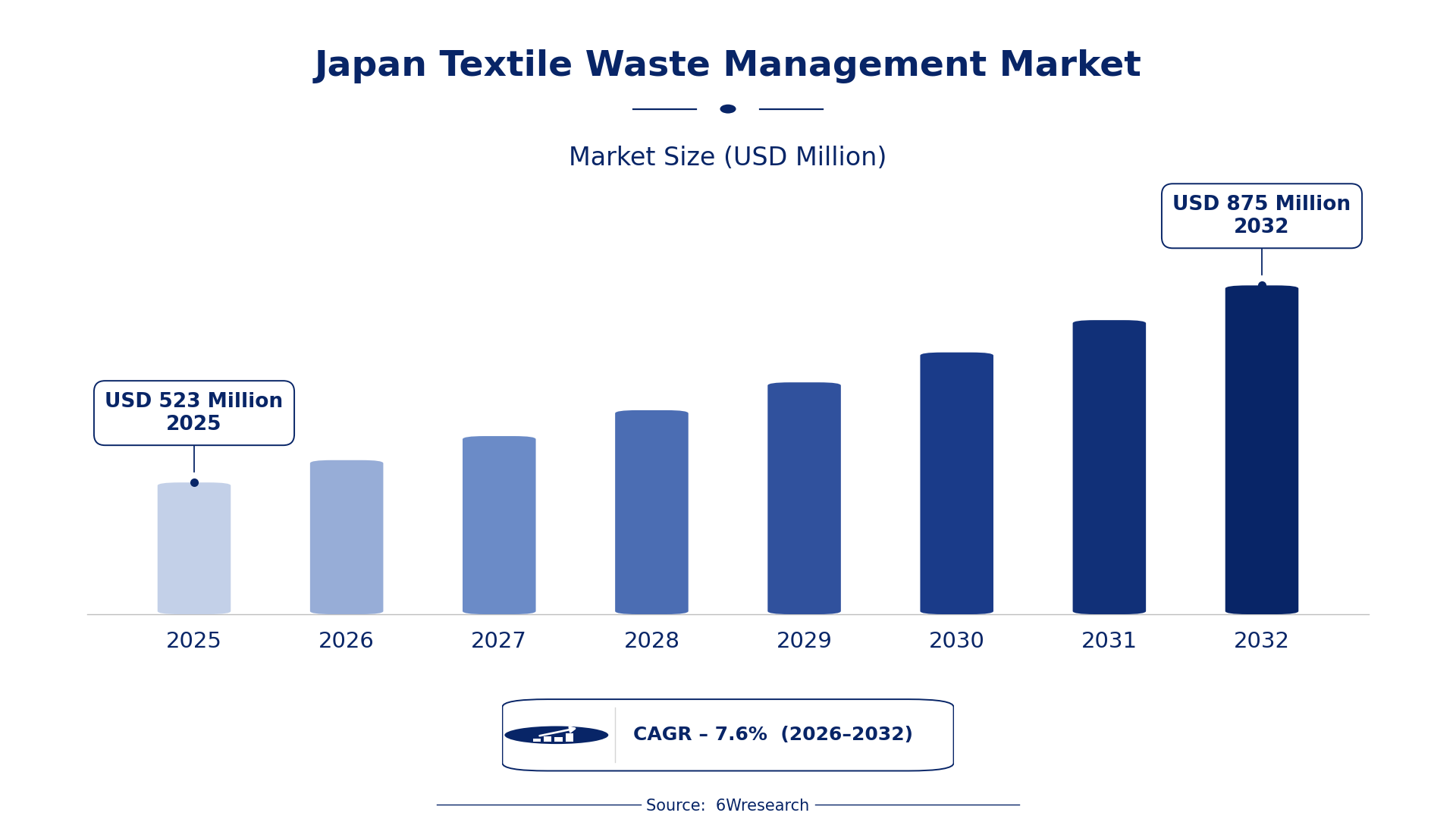
According to 6Wresearch internal database and industry insights, the Japan Textile Waste Management Market was valued at USD 523 Million in 2025 and is projected to reach USD 875 Million by 2032, growing at a CAGR of approximately 7.6% during 2026–2032.
Japan Textile Waste Management Market Highlights
| Report Metric | Details |
| Report Name | Japan Textile Waste Management Market (2026-2032) |
| Market Size 2025 | USD 523 Million |
| Market Size 2032 | USD 875 Million |
| Absolute Growth 2025–2032 | USD 352 Million |
| CAGR 2026–2032 | 7.6% |
| Peak Annual Growth | 8.4% in 2028 |
| Forecast Period | 2026–2032 |
| Historical Data | 2022–2025 |
| Base Year | 2025 |
| Leading Type, 2025 | Source Reduction Solutions (53% share) |
| Leading Application, 2025 | Water Purifier (61% share) |
| Fastest-Growing Type | Landfills Solutions (10.9% CAGR) |
| Fastest-Growing Application | Wastewater Treatment Equipment (9.7% CAGR) |
| Growing Sector | Textile Recycling |
| Key End Users | Textile manufacturers, recycling facilities, local governments, environmental agencies |
Japan Textile Waste Management Market Year-wise Growth Rate and Key Drivers (2022–2032)
This graph illustrates the annual growth rates of the market from 2022 to 2032, highlighting a steady upward trajectory and projected market expansion over the forecast period.
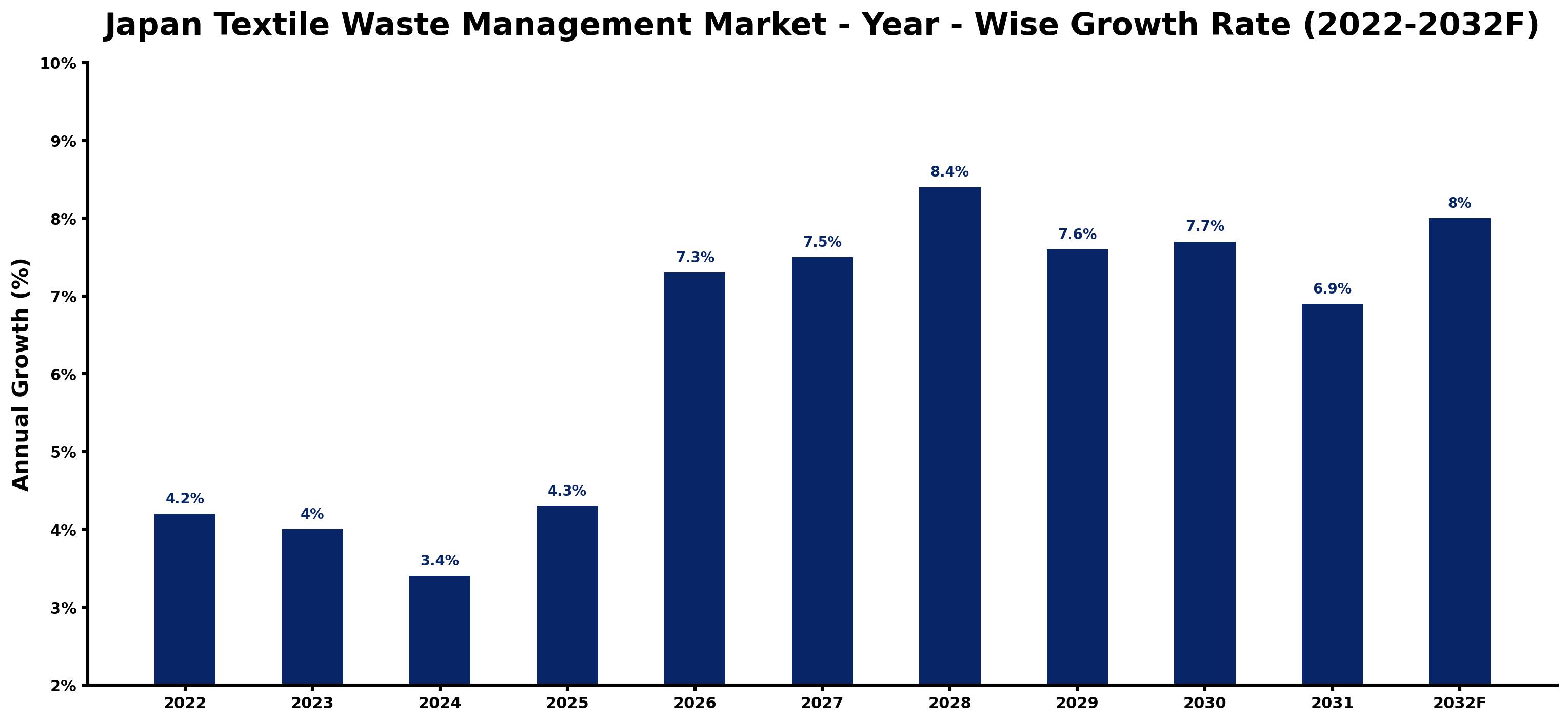
For each year, the table pairs the estimated growth rate with the leading influence on demand, showing how the drivers changed across the period.
| Year | Estimated Annual Growth (%) | Market Rationale |
| 2022 | 4.2 | The market experienced steady growth with ongoing recycling initiatives and public awareness. |
| 2023 | 4.0 | Demand growth slowed as the market adjusted to new regulations and consumer habits. |
| 2024 | 3.4 | The market continued to grow, albeit at a slower pace, as recycling rates remained low. |
| 2025 | 4.3 | Growth accelerated due to increased investments in recycling technologies and facilities. |
| 2026 | 7.3 | Expansion is anticipated as innovative recycling initiatives gain traction across various regions. |
| 2027 | 7.5 | Demand is projected to rise further with the implementation of more effective waste management practices. |
| 2028 | 8.4 | The market is expected to peak with heightened recycling efforts and government support for sustainability. |
| 2029 | 7.6 | Growth is projected to slow slightly as the market begins to stabilise after peak performance. |
| 2030 | 7.7 | Demand will increase again as public awareness of textile waste continues to rise. |
| 2031 | 6.9 | The market is expected to experience a slowdown as recycling rates remain below targets. |
| 2032 | 8.0 | Growth is projected to resume with new initiatives aimed at achieving higher recycling rates. |
Note: Market size estimations and growth projections presented in this report are based on 6Wresearch's proprietary forecasting methodology, utilizing the latest available industry data, government publications, and primary research inputs.
Japan Textile Waste Management Market Synopsis
Textile waste management involves reducing, recycling, and disposing of textile waste materials through methods such as sorting and shredding. The Japan Textile Waste Management Market is growing due to rising environmental awareness and government initiatives promoting recycling. Japan generates approximately 2.5 million tons of textile waste annually, with the Tokyo region accounting for 30% of this total. The government aims to achieve a 50% recycling rate for textile waste by 2030, which drives demand for effective waste management solutions and practices.
Market Dynamics Impact Analysis (2026–2032)
| Factor | Type | Impact | Primary Segment Affected |
| Rising environmental awareness among consumers | Driver | High | Recycling Solutions |
| Government initiatives promoting recycling | Driver | High | Source Reduction Solutions |
| Growing demand for sustainable practices | Opportunity | High | Recycling Solutions |
| Investment in advanced recycling technologies | Opportunity | High | Wastewater Treatment Equipment |
| Low recycling rates for textiles | Restraint | High | Recycling Solutions |
| Limited public awareness of textile waste management | Restraint | Medium | Source Reduction Solutions |
| Inadequate infrastructure for waste processing | Challenge | High | Recycling Solutions |
| High costs associated with recycling technologies | Challenge | Medium | Wastewater Treatment Equipment |
Evaluation of Drivers in Japan Textile Waste Management Market (2026–2032)
The factors lifting demand, and the evidence behind each, are summarised below.
| Drivers | Primary Segment Affected | Why It Matters (Evidence) |
| Increased public awareness of textile waste issues | Recycling Solutions | This awareness drives consumers to seek out recycling options, resulting in higher demand for recycling services. |
| Government support for recycling initiatives | Source Reduction Solutions | Funding from the Circular Economy Promotion Law enhances investments in waste management facilities, encouraging better practices. |
| Rising consumer preference for sustainable products | Recycling Solutions | Consumers are increasingly choosing brands that prioritise sustainable practices, boosting demand for recycled materials. |
| Technological advancements in recycling processes | Wastewater Treatment Equipment | New technologies improve efficiency and effectiveness in recycling, attracting investment and increasing capacity. |
| Collaboration between stakeholders in the textile industry | Recycling Solutions | Partnerships among manufacturers, recyclers, and government bodies improve resource recovery and reduce waste. |
Most of the extra volume comes from increased public awareness of textile waste issues, which has led to a demand rise for recycling services. Approximately 2.5 million tons of textile waste are generated annually in Japan, prompting consumers to seek sustainable disposal methods. New technologies improve efficiency, attracting further investment and increasing capacity. Partnerships among stakeholders in the textile industry improve resource recovery, making recycling more viable and appealing to consumers.
Evaluation of Restraints in Japan Textile Waste Management Market
Several factors work against faster growth; the main ones are summarised below.
| Market Restraint | Primary Segment Affected | Why It Matters (Evidence) |
| Low recycling rates for textiles hinder effective waste management | Recycling Solutions | With recycling rates remaining below 20%, the volume of textile waste continues to overwhelm existing systems. |
| Limited public awareness of textile waste management practices | Source Reduction Solutions | Many consumers lack knowledge about proper disposal methods, resulting in increased landfill use. |
| Inadequate infrastructure for processing textile waste | Recycling Solutions | The current infrastructure cannot handle the volume of textile waste generated, causing inefficiencies. |
| High costs associated with implementing recycling technologies | Wastewater Treatment Equipment | The initial investment required for advanced recycling technologies can deter potential adopters. |
| Strict regulations on waste disposal complicate compliance | Source Reduction Solutions | Regulatory requirements can be challenging for smaller facilities to meet, limiting their operational capacity. |
Japan Textile Waste Management Market Challenges
Japan generates approximately 2.5 million tons of textile waste annually, which creates a pressing need for skilled workers in waste management. The shortage of trained personnel limits processing efficiency, resulting in increased operational costs for producers. Intense competition among textile waste management facilities leads to higher service prices, directly impacting buyers who seek cost-effective solutions. Strict regulations from Kyoto Prefecture impose additional compliance costs on producers, which can drive up service prices and restrict affordable options for buyers.
Trends in the Japan Textile Waste Management Market
The trends below show where the Japan Textile Waste Management Market is heading.
- Shift from Landfill Disposal to Recycling Initiatives: Since 2023, the focus has shifted towards recycling initiatives in Japan, driven by the Eco Town program. This program promotes sustainable practices, aiming to reduce landfill waste, with over 80% of textile waste previously sent to landfills.
- Emergence of Advanced Recycling Technologies: In 2023, new recycling technologies began to gain traction, particularly in the Tokyo region. These advancements are expected to improve recycling rates, which currently remain below 20%, by increasing processing efficiency.
- Increased Collaboration Among Industry Stakeholders: The textile industry is experiencing a rise in collaborations among manufacturers and recyclers, particularly in Kyoto Prefecture. This trend aims to improve resource recovery and streamline waste management processes.
- Growing Consumer Demand for Sustainable Practices: Consumer demand for sustainable practices has surged since 2022, prompting brands to adopt eco-friendly methods. This shift is reflected in the increasing interest in recycling solutions and sustainable textile products.
Investment Opportunities in the Japan Textile Waste Management Market
Below are the investment opportunities with the strongest case in the Japan Textile Waste Management Market.
- Investment in Recycling Facilities: With Japan generating 2.5 million tons of textile waste annually, there is a gap in recycling capacity. Investing in recycling facilities can meet this demand, particularly in urban areas like Tokyo.
- Supply of Advanced Wastewater Treatment Equipment: The need for effective wastewater treatment is critical, especially in textile processing facilities. Supplying advanced equipment can cater to the growing demand for sustainable waste management solutions.
- Partnerships with Local Governments: Local governments are seeking partnerships to improve recycling initiatives. Collaborating with municipalities can facilitate entry into the market and align with sustainability goals.
- Development of Eco-Friendly Textile Products: As consumer demand for sustainable practices rises, there is an opportunity to develop eco-friendly textile products. Targeting environmentally conscious consumers can drive sales and brand loyalty.
Government Initiatives in the Japan Textile Waste Management Market
The Waste Management and Public Cleansing Act regulates the treatment and disposal of textile waste, ensuring compliance with environmental standards. This law mandates proper management practices, compelling producers to invest in recycling technologies to meet regulatory requirements. In 2023, the government allocated ¥5 billion for textile recycling initiatives, supporting sustainable practices in the industry.
The Eco Town program, overseen by the Ministry of the Environment, promotes recycling across various regions. This initiative provides funding and resources to local governments, encouraging them to establish effective recycling systems. As a result, municipalities are better equipped to manage textile waste and promote sustainable practices among citizens.
Future Insight of the Japan Textile Waste Management Market
Clinics will experience notable changes in textile waste management by 2032 as new initiatives reshape the market. The 'Eco Town' program will strengthen local recycling capabilities, allowing suppliers to offer more sustainable solutions. Facilities adopting ISO 14001 standards will improve operational efficiency, reducing costs for buyers. The government's target of a 50% recycling rate for textile waste by 2030, supported by a ¥5 billion allocation for recycling initiatives, will stimulate investment in advanced technologies and create a more competitive market.
Market Segmentation Analysis
Japan Textile Waste Management Market report covers a detailed analysis of the following market segments:
By Type – Source Reduction Solutions Lead, Landfills Solutions Expected to Grow Fastest
According to Shubham Padhi, Research Analyst at 6Wresearch, Source Reduction Solutions took 53% of type revenue in 2025, more than any other category. Source Reduction Solutions hold the largest share as they focus on minimising waste at the source, crucial for managing the 2.5 million tons of textile waste generated annually. This approach is aligned with the government's target of achieving a 50% recycling rate by 2030, making it a priority for stakeholders. The quickest growth will come from Landfills Solutions, forecast to expand at a CAGR of 10.9% between 2026 and 2032. Landfills Solutions are experiencing rapid growth due to increasing environmental regulations, particularly in regions like Kyoto Prefecture where strict disposal rules are enforced. This trend indicates a shift towards more sustainable waste management practices, which are likely to become more prevalent in the future. Suppliers must adapt to regulatory changes and develop solutions that prioritise waste minimisation to remain competitive.
By Application – Water Purifier Leads, Wastewater Treatment Equipment Expected to Grow Fastest
The largest application category in 2025 was Water Purifier, at 61% of revenue. Water Purifier is the leading segment as it ensures the quality of water used in textile processing, essential for maintaining industry standards and meeting regulatory requirements. Although it holds a minor share, its importance is underscored by the need for compliance in a market focused on environmental sustainability. Wastewater Treatment Equipment is projected to grow fastest, at a CAGR of 9.7% during 2026–2032. Wastewater Treatment Equipment is witnessing rapid growth as it is vital for managing effluents from textile processing, driven by increased regulatory demands aimed at reducing pollution. The implementation of the Circular Economy Promotion Law in 2022 has intensified the focus on effective wastewater management solutions. Buyers should invest in advanced wastewater treatment technologies to comply with regulations and enhance operational efficiency.
Key Attractiveness of the Report
- 10 Years of Market Numbers
- Historical Data Starting from 2022 to 2025
- Base Year 2025
- Forecast Data until 2032
- Key Performance Indicators Impacting the Market
- Major Upcoming Developments and Projects
Key Highlights of the Report:
- Japan Textile Waste Management Market Outlook
- Market Size of Japan Textile Waste Management Market, 2025
- Forecast of Japan Textile Waste Management Market, 2032
- Historical Data and Forecast of Japan Textile Waste Management Revenues & Volume for the Period 2022-2032
- Japan Textile Waste Management Market Trend Evolution
- Japan Textile Waste Management Market Drivers and Challenges
- Japan Textile Waste Management Price Trends
- Japan Textile Waste Management Porter's Five Forces
- Japan Textile Waste Management Industry Life Cycle
- Historical Data and Forecast of Japan Textile Waste Management Market Revenues & Volume By Type for the Period 2022-2032
- Historical Data and Forecast of Japan Textile Waste Management Market Revenues & Volume By Source Reduction Solutions for the Period 2022-2032
- Historical Data and Forecast of Japan Textile Waste Management Market Revenues & Volume By Landfills Solutions for the Period 2022-2032
- Historical Data and Forecast of Japan Textile Waste Management Market Revenues & Volume By Recycling Solutions for the Period 2022-2032
- Historical Data and Forecast of Japan Textile Waste Management Market Revenues & Volume By Incineration Solutions for the Period 2022-2032
- Historical Data and Forecast of Japan Textile Waste Management Market Revenues & Volume By Application for the Period 2022-2032
- Historical Data and Forecast of Japan Textile Waste Management Market Revenues & Volume By Water Purifier for the Period 2022-2032
- Historical Data and Forecast of Japan Textile Waste Management Market Revenues & Volume By Wastewater Treatment Equipment for the Period 2022-2032
- Japan Textile Waste Management Import Export Trade Statistics
- Market Opportunity Assessment By Type
- Market Opportunity Assessment By Application
- Japan Textile Waste Management Top Companies Market Share
- Japan Textile Waste Management Competitive Benchmarking By Technical and Operational Parameters
- Japan Textile Waste Management Company Profiles
- Japan Textile Waste Management Key Strategic Recommendations
Market Covered
The report covers the following segments.
By Type
- Source Reduction Solutions
- Landfills Solutions
- Recycling Solutions
- Incineration Solutions
By Application
- Water Purifier
- Wastewater Treatment Equipment































