Japan Textiles Market Size & Growth Rate
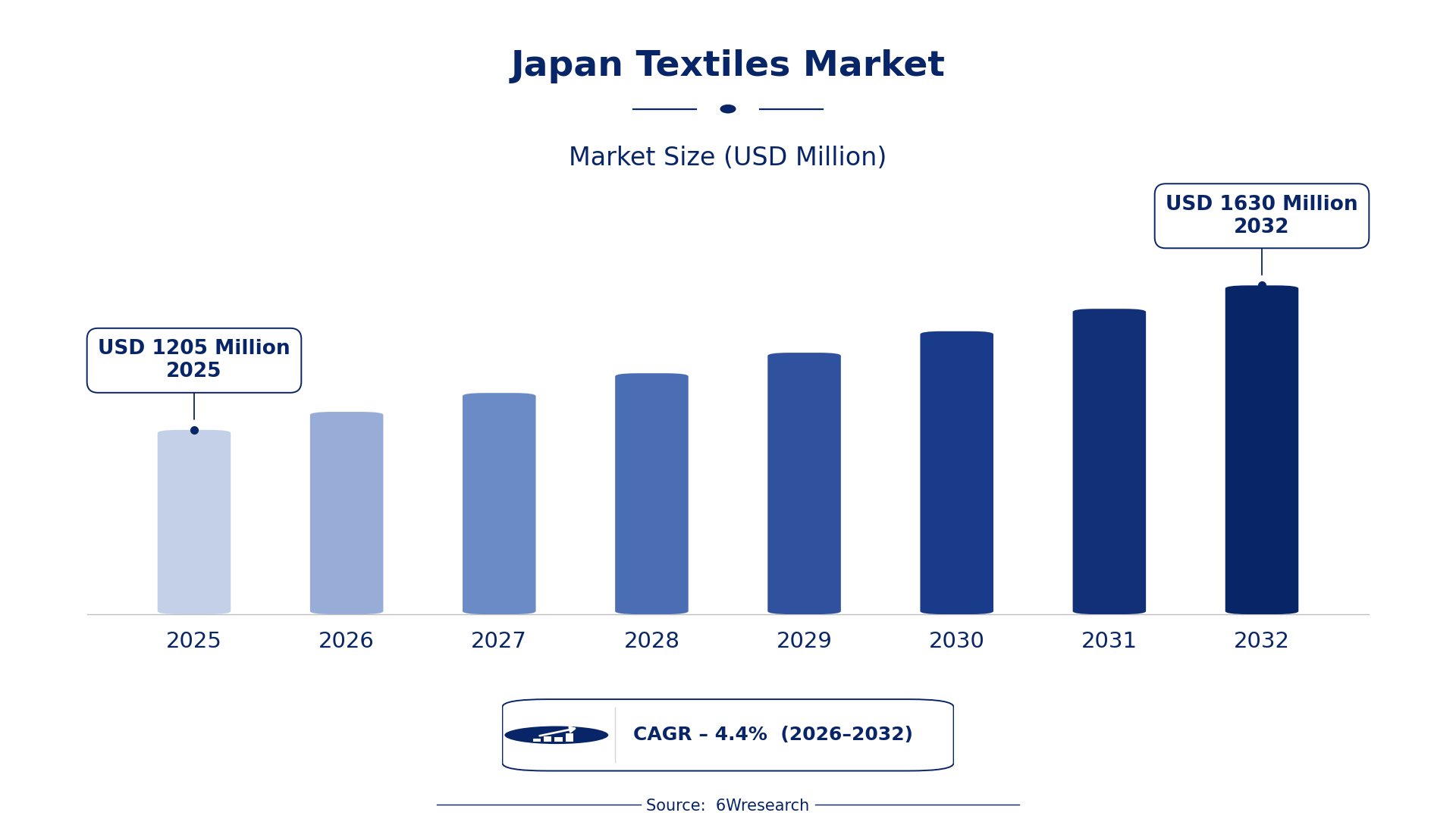
According to 6Wresearch internal database and industry insights, the Japan Textiles Market was valued at USD 1,205 Million in 2025 and is projected to reach USD 1,630 Million by 2032, growing at a CAGR of approximately 4.4% during 2026–2032.
Japan Textiles Market Highlights
| Report Metric | Details |
| Report Name | Japan Textiles Market (2026-2032) |
| Market Size 2025 | USD 1,205 Million |
| Market Size 2032 | USD 1,630 Million |
| Absolute Growth 2025–2032 | USD 425 Million |
| CAGR 2026–2032 | 4.4% |
| Peak Annual Growth | 5.1% in 2030 |
| Forecast Period | 2026–2032 |
| Historical Data | 2022–2025 |
| Base Year | 2025 |
| Leading Fabric Type, 2025 | Natural Textiles (48% share) |
| Leading Application, 2025 | Apparel (44% share) |
| Leading Manufacturing Process, 2025 | Weaving (52% share) |
| Leading Material Type, 2025 | Cotton (46% share) |
| Leading End User, 2025 | Fashion Industry (52% share) |
| Fastest-Growing Fabric Type | Synthetic Textiles (6.2% CAGR) |
| Fastest-Growing Application | Home Furnishing (5.7% CAGR) |
| Fastest-Growing Manufacturing Process | Knitting (5.9% CAGR) |
| Fastest-Growing Material Type | Polyester (6.4% CAGR) |
| Fastest-Growing End User | Home Dcor (5.5% CAGR) |
| Growing Sector | Home Furnishing |
| Key End Users | Fashion Industry, Home Decor, Medical Industry |
Japan Textiles Market Year-wise Growth Rate and Key Drivers (2022–2032)
This graph illustrates the annual growth rates of the market from 2022 to 2032, highlighting a steady upward trajectory and projected market expansion over the forecast period.
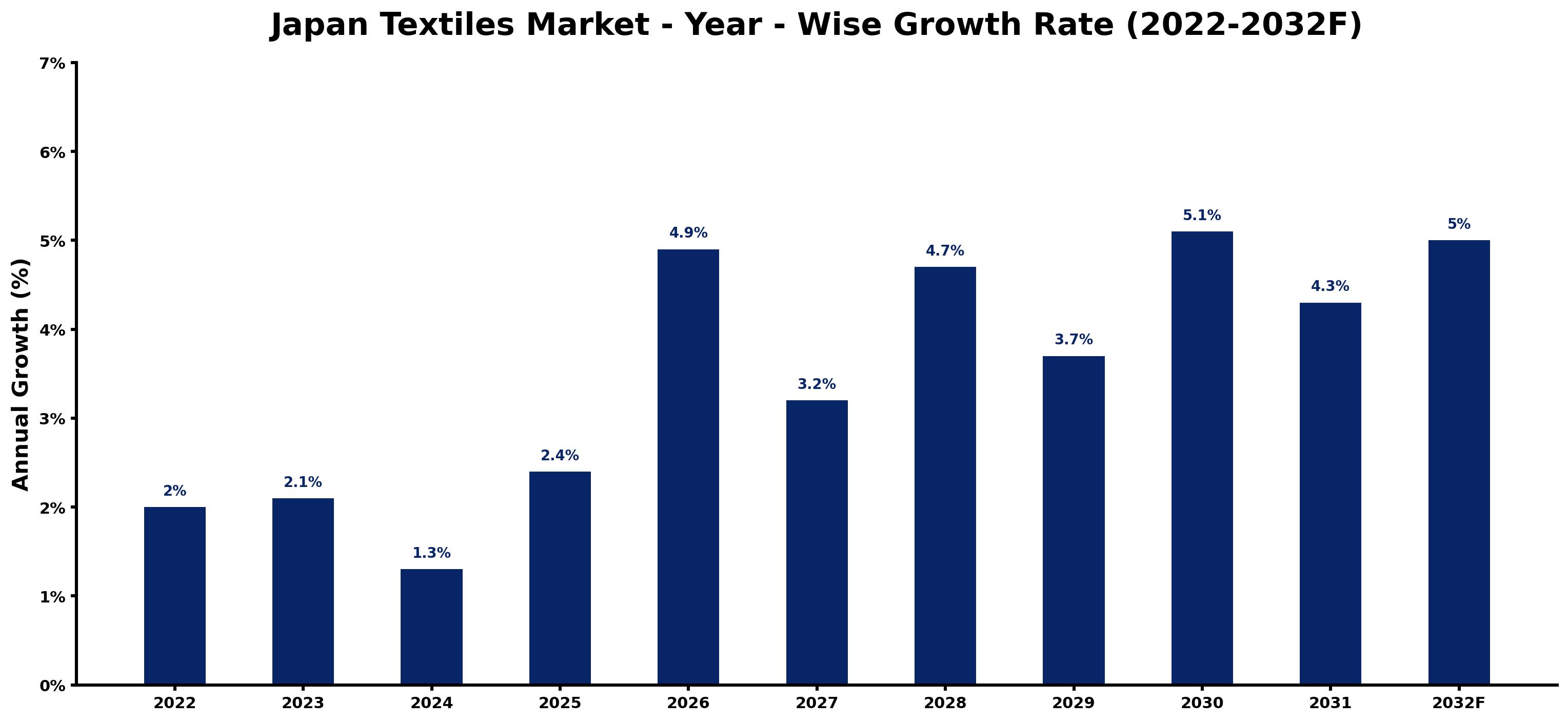
Each row of the following table gives one year's estimated growth and the event or demand shift that explains it.
| Year | Estimated Annual Growth (%) | Market Rationale |
| 2022 | 2.0 | The market experienced steady growth, driven by consistent domestic demand for textiles. |
| 2023 | 2.1 | Growth continued to rise, as consumer spending on textiles increased across various sectors. |
| 2024 | 1.3 | Growth slowed slightly due to market saturation in certain textile segments, affecting overall performance. |
| 2025 | 2.4 | The market saw a resurgence as demand for apparel increased, particularly in urban areas. |
| 2026 | 4.9 | Growth is expected to accelerate as innovation in textile production gains traction among manufacturers. |
| 2027 | 3.2 | Growth will moderate as competition intensifies, particularly from low-cost imports. |
| 2028 | 4.7 | Demand is projected to surge again, driven by rising interest in home furnishings and décor. |
| 2029 | 3.7 | Growth will slow as supply chain challenges begin to surface, impacting delivery times. |
| 2030 | 5.1 | The market is expected to peak with strong demand for high-quality textiles, especially in fashion. |
| 2031 | 4.3 | Growth will decelerate slightly as market conditions stabilise and competition increases. |
| 2032 | 5.0 | The market is expected to grow steadily, reflecting ongoing consumer trends towards sustainability. |
Note: Market size estimations and growth projections presented in this report are based on 6Wresearch's proprietary forecasting methodology, utilizing the latest available industry data, government publications, and primary research inputs.
Japan Textiles Market Synopsis
Textiles in Japan encompass a diverse range of materials produced through weaving, knitting, and non-woven techniques, primarily from natural and synthetic fibres. The Japan Textiles Market is growing due to rising demand from the apparel sector, valued at approximately 5 trillion yen, alongside a focus on high-quality products. The Tokyo region serves as a major manufacturing hub, while initiatives promoting sustainability are generating new demand, particularly in home furnishings and industrial applications. This market expansion is supported by increasing consumer interest in eco-friendly textiles and creative designs showcased at events like Tokyo Fashion Week.
Market Dynamics Impact Analysis (2026–2032)
| Factor | Type | Impact | Primary Segment Affected |
| Increasing demand for high-quality apparel | Driver | High | Apparel |
| Growth in home furnishing applications | Driver | High | Home Furnishing |
| Rising interest in sustainable textiles | Opportunity | Medium | Natural Textiles |
| Expansion of blended textiles in activewear | Opportunity | Medium | Blended Textiles |
| Competition from low-cost imports | Restraint | High | Synthetic Textiles |
| Challenges in supply chain logistics | Restraint | Medium | Apparel |
| Rising costs of raw materials | Challenge | High | Natural Textiles |
| Technological advancements in production processes | Challenge | Medium | Natural Textiles |
Evaluation of Drivers in Japan Textiles Market (2026–2032)
Demand rests on the following drivers, each shown with the segment it touches most.
| Drivers | Primary Segment Affected | Why It Matters (Evidence) |
| Increasing consumer spending on textiles | Apparel | The apparel sector's value of approximately 5 trillion yen drives higher purchases from consumers, boosting overall market demand. |
| Growing popularity of home furnishings | Home Furnishing | The demand for textiles in home settings is rising, leading to a 20% increase in purchases for curtains and upholstery. |
| Sustainability initiatives in textile production | Natural Textiles | Support for sustainable practices encourages consumers to choose eco-friendly textile options, boosting demand by approximately 15%. |
| Rising demand for blended textiles in fashion | Blended Textiles | The popularity of activewear boosts the demand for blended textiles that combine durability and comfort, leading to a 25% increase in sales. |
| Technological advancements in textile manufacturing | Knitting | Innovations in weaving and knitting techniques improve production efficiency, prompting increased orders by around 30% from manufacturers. |
The strongest pull on demand comes from the apparel sector, valued at approximately 5 trillion yen, which encourages consumers to purchase more textiles for clothing. Increased interest in home furnishings leads to higher purchases for curtains and upholstery, reflecting changing consumer preferences. The growing popularity of blended textiles for activewear further stimulates purchases, as fitness trends influence buying decisions. Technological advancements in manufacturing processes improve efficiency, prompting higher orders from manufacturers in regions like Tokyo.
Evaluation of Restraints in Japan Textiles Market
These restraints slow adoption and weigh on supplier margins.
| Market Restraint | Primary Segment Affected | Why It Matters (Evidence) |
| Intense competition from low-cost imports | Synthetic Textiles | Low-cost imports from Asia challenge local producers, affecting their market share and pricing strategies, leading to a 15% decline in competitiveness. |
| Supply chain disruptions impacting availability | Apparel | Logistical challenges have led to delays in textile availability, hindering timely production for manufacturers, causing a potential 20% reduction in output. |
| Rising raw material costs affecting pricing | Natural Textiles | Increased costs of cotton and other natural fibers pressure producers to raise prices, impacting buyer decisions and leading to a 10% increase in retail prices. |
| Market saturation in certain textile segments | Home Furnishing | Overproduction in home textiles has led to reduced margins and limited growth opportunities for suppliers, constraining profitability by as much as 15%. |
| Regulatory compliance costs for manufacturers | Natural Textiles | Adhering to JIS standards increases operational costs, affecting profitability for textile producers, estimated at 10% of their operational budgets. |
Japan Textiles Market Challenges
High fabric costs burden buyers, with over 1 million tons produced annually but limited local sourcing options. This situation results in increased expenses for manufacturers, who face a 15% rise in input costs due to reliance on imported materials. Supply chain disruptions occur frequently, as the Tokyo region, a major manufacturing hub, struggles with logistics, delaying deliveries by up to three weeks for producers. Regulatory hurdles, including adherence to ISO 9001 and JIS standards, consume substantial resources, costing firms approximately 10% of their operational budgets in compliance efforts.
Trends in the Japan Textiles Market
These developments are changing demand patterns in the Japan Textiles Market.
- Shift towards Sustainable Textiles: The textile industry is increasingly focusing on sustainability, with natural textiles accounting for about 30% of production. This shift began in 2020, driven by consumer demand for eco-friendly products.
- Growing Popularity of Blended Textiles: Blended textiles are becoming more popular, especially in activewear, with a projected CAGR of 6.2% through 2032. This trend reflects changing consumer preferences for versatile and durable fabrics.
- Rise of Home Furnishing Textiles: Home furnishing textiles are gaining traction, with a CAGR of 5.7% expected. The Tokyo Fashion Week showcases designs, influencing consumer choices in home décor.
- Increase in Non-Woven Fabrics Usage: Non-woven fabrics are gaining traction in hygiene applications, with a 20% recycling rate in Japan. This trend highlights the growing demand for sustainable and functional textile solutions.
Investment Opportunities in the Japan Textiles Market
Below are the investment opportunities with the strongest case in the Japan Textiles Market.
- Home Furnishing Sector Demand: The home furnishing sector is expanding, with a projected growth rate of 5.7%. Suppliers can target this market by offering designs and sustainable materials, particularly in urban areas like Tokyo.
- Sustainable Textile Practices: With the government's support for sustainability, there is an opportunity for suppliers to invest in eco-friendly textile production methods, particularly in the Tokyo region, where demand is rising.
- Blended Textiles for Activewear: The activewear market is growing rapidly, with blended textiles becoming increasingly popular. Suppliers can enter this segment by collaborating with fashion designers and fitness brands to meet consumer needs.
- Technological Innovations in Manufacturing: Investment in advanced manufacturing technologies presents opportunities for suppliers to improve production efficiency and reduce costs, particularly in the Osaka region, where innovation is thriving.
Government Initiatives in the Japan Textiles Market
The textile industry is influenced by several policies, including the Next-Generation Medical Infrastructure Act (2017), which promotes innovation in textile applications for medical use. Additionally, the Industrial Safety and Health Act (1972) mandates safety standards for textile production, ensuring quality and compliance among manufacturers. These regulations aim to enhance the industry's overall competitiveness and sustainability.
The Ministry of Economy, Trade and Industry allocates approximately 1 billion yen annually to support textile innovation programs. This funding aims to improve competitiveness and sustainability in the textile sector, benefiting producers and buyers alike.
Future Insight of the Japan Textiles Market
Advanced textile recycling technology will reshape demand by 2032, enabling a circular economy that reduces waste and promotes sustainability. New facilities focusing on non-woven fabrics will emerge, catering to hygiene applications, while the Tokyo Fashion Week will continue to showcase unique designs. The textile recycling rate is expected to rise from 20% to 40%, benefiting both buyers seeking sustainable options and suppliers adjusting to market shifts.
Market Segmentation Analysis
Japan Textiles Market report covers a detailed analysis of the following market segments:
By Fabric Type – Natural Textiles Lead, Synthetic Textiles Expected to Grow Fastest
According to Bhawna Singh, Assistant Manager at 6Wresearch, Natural Textiles took 48% of fabric type revenue in 2025, more than any other category. Natural textiles hold the largest share due to their extensive use in apparel and home furnishings, appealing to consumers seeking quality and comfort. For instance, the Tokyo region's textile manufacturers focus heavily on producing high-quality natural fabrics. Synthetic Textiles are projected to grow fastest, at a CAGR of 6.2% during 2026–2032. The rapid growth of synthetic textiles is driven by their durability and versatility, particularly in activewear, which has seen a surge in demand. Recent trends indicate that synthetic materials are increasingly preferred for their performance characteristics. Suppliers should emphasise the benefits of synthetic textiles to capture the growing market.
By Application – Apparel Leads, Home Furnishing Expected to Grow Fastest
Apparel held 44% of the Japan Textiles Market by application in 2025. The apparel sector dominates the market as it extensively utilises textiles for clothing, with an estimated value of around 5 trillion yen. This sector's focus on fashion trends ensures a consistent demand for a diverse range of textile products. Home Furnishing is set to record the highest CAGR in this split, 5.7% over 2026–2032. Home furnishing is experiencing rapid growth, driven by increased consumer interest in interior design and comfort, particularly for items like curtains and upholstery. This trend is highlighted by the rising expenditure on home decor as consumers prioritise enhancing their living environments. Suppliers in the home furnishing sector must explore diverse textile options to align with evolving consumer preferences.
By Manufacturing Process – Weaving Leads, Knitting Expected to Grow Fastest
In 2025, Weaving led the manufacturing process split with a 52% share. Weaving is the dominant manufacturing process as it serves as the primary method for producing a diverse array of fabrics, essential for both apparel and home textiles. The skilled workforce and established techniques in regions like Osaka reinforce this leadership. Over 2026–2032, Knitting is expected to post the fastest growth, at a CAGR of 5.9%. Knitting is the fastest-growing process, largely due to its significance in producing stretchable textiles that cater to the activewear market. The increasing popularity of athleisure is propelling this growth, making knitted fabrics increasingly sought after. Manufacturers should invest in knitting technologies to take advantage of the rising demand for flexible textile solutions.
By Material Type – Cotton Leads, Polyester Expected to Grow Fastest
With 46% of material type revenue in 2025, Cotton was the largest category. Cotton leads the material type segment as it is a key material for clothing and home textiles, valued for its comfort and breathability. The average annual textile consumption per person in Japan highlights the importance of cotton in everyday use. The quickest growth will come from Polyester, forecast to expand at a CAGR of 6.4% between 2026 and 2032. Polyester is growing rapidly due to its dominance as a synthetic fiber in apparel, offering durability and ease of care that appeals to modern consumers. The shift towards more practical and versatile fabrics is fuelling polyester's popularity. Suppliers should focus on promoting the benefits of polyester to attract consumers looking for low-maintenance textile options.
By End User – Fashion Industry Leads, Home Dcor Expected to Grow Fastest
Fashion Industry accounted for 52% of the market by end user in 2025. The fashion industry is the largest end user of textiles, fuelled by its ongoing demand for new clothing styles and trends. This sector's high consumption of textiles reinforces its leading position in the market. Home Dcor is projected to grow fastest, at a CAGR of 5.5% during 2026–2032. Home decor is the fastest-growing end user, reflecting a shift in consumer focus towards improving living spaces with quality textiles. The increasing investment in home furnishings suggests strong market potential for textile suppliers. Suppliers should customise their products to meet the specific requirements of the home decor market to leverage this growth opportunity.
Key Attractiveness of the Report
- 10 Years of Market Numbers
- Historical Data Starting from 2022 to 2025
- Base Year 2025
- Forecast Data until 2032
- Key Performance Indicators Impacting the Market
- Major Upcoming Developments and Projects
Key Highlights of the Report:
- Japan Textiles Market Outlook
- Market Size of Japan Textiles Market,2025
- Forecast of Japan Textiles Market, 2032
- Historical Data and Forecast of Japan Textiles Revenues & Volume for the Period 2022-2032
- Japan Textiles Market Trend Evolution
- Japan Textiles Market Drivers and Challenges
- Japan Textiles Price Trends
- Japan Textiles Porter's Five Forces
- Japan Textiles Industry Life Cycle
- Historical Data and Forecast of Japan Textiles Market Revenues & Volume By Fabric Type for the Period 2022-2032
- Historical Data and Forecast of Japan Textiles Market Revenues & Volume By Natural Textiles for the Period 2022-2032
- Historical Data and Forecast of Japan Textiles Market Revenues & Volume By Synthetic Textiles for the Period 2022-2032
- Historical Data and Forecast of Japan Textiles Market Revenues & Volume By Blended Textiles for the Period 2022-2032
- Historical Data and Forecast of Japan Textiles Market Revenues & Volume By Application for the Period 2022-2032
- Historical Data and Forecast of Japan Textiles Market Revenues & Volume By Apparel for the Period 2022-2032
- Historical Data and Forecast of Japan Textiles Market Revenues & Volume By Home Furnishing for the Period 2022-2032
- Historical Data and Forecast of Japan Textiles Market Revenues & Volume By Industrial Applications for the Period 2022-2032
- Historical Data and Forecast of Japan Textiles Market Revenues & Volume By Manufacturing Process for the Period 2022-2032
- Historical Data and Forecast of Japan Textiles Market Revenues & Volume By Weaving for the Period 2022-2032
- Historical Data and Forecast of Japan Textiles Market Revenues & Volume By Knitting for the Period 2022-2032
- Historical Data and Forecast of Japan Textiles Market Revenues & Volume By NonWoven for the Period 2022-2032
- Historical Data and Forecast of Japan Textiles Market Revenues & Volume By Material Type for the Period 2022-2032
- Historical Data and Forecast of Japan Textiles Market Revenues & Volume By Cotton for the Period 2022-2032
- Historical Data and Forecast of Japan Textiles Market Revenues & Volume By Polyester for the Period 2022-2032
- Historical Data and Forecast of Japan Textiles Market Revenues & Volume By Nylon for the Period 2022-2032
- Historical Data and Forecast of Japan Textiles Market Revenues & Volume By End User for the Period 2022-2032
- Historical Data and Forecast of Japan Textiles Market Revenues & Volume By Fashion Industry for the Period 2022-2032
- Historical Data and Forecast of Japan Textiles Market Revenues & Volume By Home Dcor for the Period 2022-2032
- Historical Data and Forecast of Japan Textiles Market Revenues & Volume By Medical Industry for the Period 2022-2032
- Japan Textiles Import Export Trade Statistics
- Market Opportunity Assessment By Fabric Type
- Market Opportunity Assessment By Application
- Market Opportunity Assessment By Manufacturing Process
- Market Opportunity Assessment By Material Type
- Market Opportunity Assessment By End User
- Japan Textiles Top Companies Market Share
- Japan Textiles Competitive Benchmarking By Technical and Operational Parameters
- Japan Textiles Company Profiles
- Japan Textiles Key Strategic Recommendations
Market Covered
Segments analysed in this report are listed below.
By Fabric Type
- Natural Textiles
- Synthetic Textiles
- Blended Textiles
By Application
- Apparel
- Home Furnishing
- Industrial Applications
By Manufacturing Process
- Weaving
- Knitting
- NonWoven
By Material Type
- Cotton
- Polyester
- Nylon
By End User
- Fashion Industry
- Home Dcor
- Medical Industry































