Japan Time Tracking Software Market Size & Growth Rate
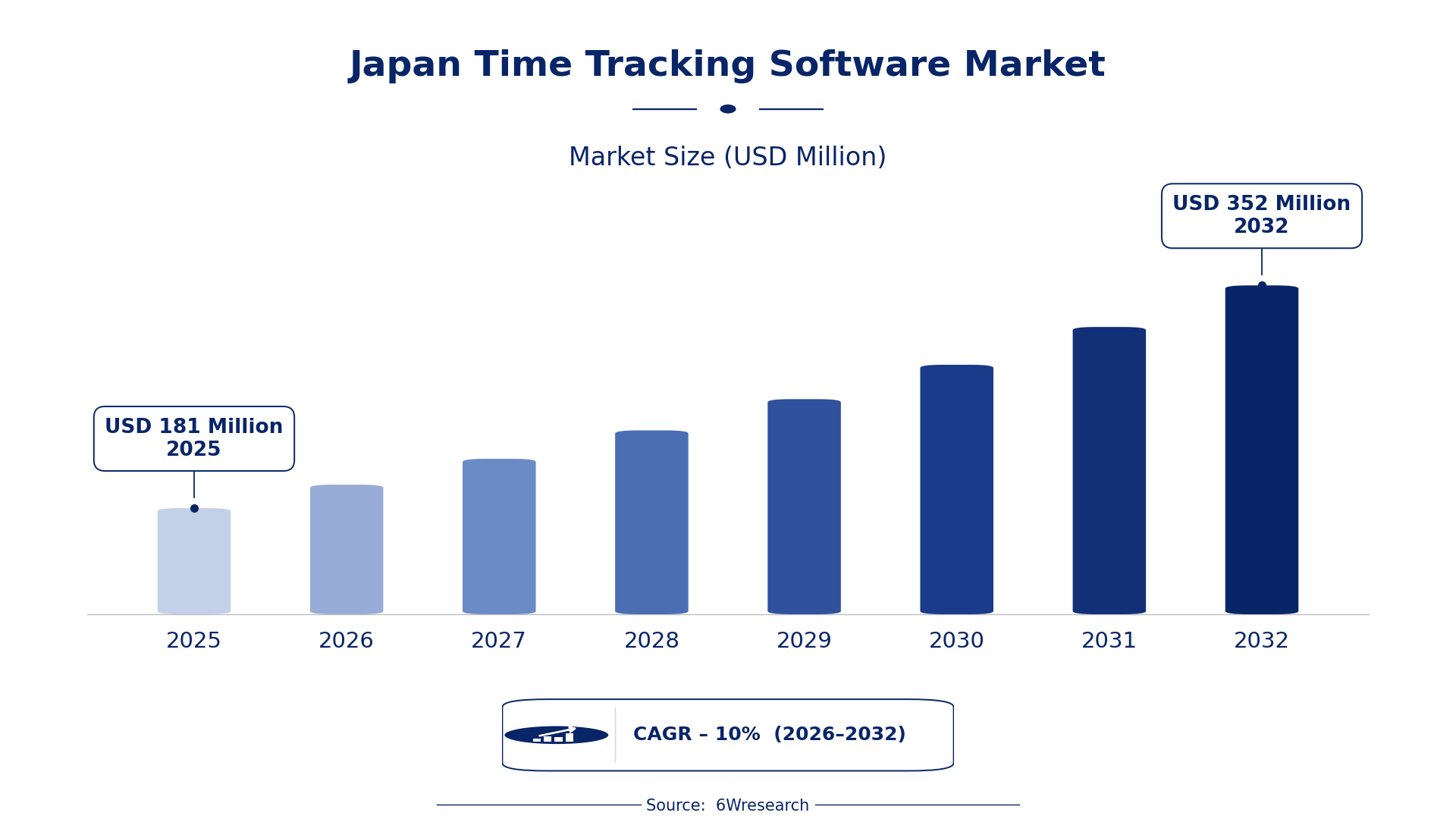
According to 6Wresearch internal database and industry insights, the Japan Time Tracking Software Market was valued at USD 181 Million in 2025 and is projected to reach USD 352 Million by 2032, growing at a CAGR of approximately 10% during 2026–2032.
Japan Time Tracking Software Market Highlights
| Report Metric | Details |
| Report Name | Japan Time Tracking Software Market (2026-2032) |
| Market Size 2025 | USD 181 Million |
| Market Size 2032 | USD 352 Million |
| Absolute Growth 2025–2032 | USD 171 Million |
| CAGR 2026–2032 | 10% |
| Peak Annual Growth | 11.3% in 2026 |
| Forecast Period | 2026–2032 |
| Historical Data | 2022–2025 |
| Base Year | 2025 |
| Leading Type, 2025 | Timesheet (55% share) |
| Leading Application, 2025 | Large Enterprises (64% share) |
| Fastest-Growing Type | Time tracking/Recording (13.2% CAGR) |
| Fastest-Growing Application | Small and Medium-Sized Enterprises (12.6% CAGR) |
| Growing Sector | Corporate sector |
| Key End Users | Large Enterprises, Small and Medium-Sized Enterprises, IT industry, Manufacturing sector |
Japan Time Tracking Software Market Year-wise Growth Rate and Key Drivers (2022–2032)
This graph illustrates the annual growth rates of the market from 2022 to 2032, highlighting a steady upward trajectory and projected market expansion over the forecast period.
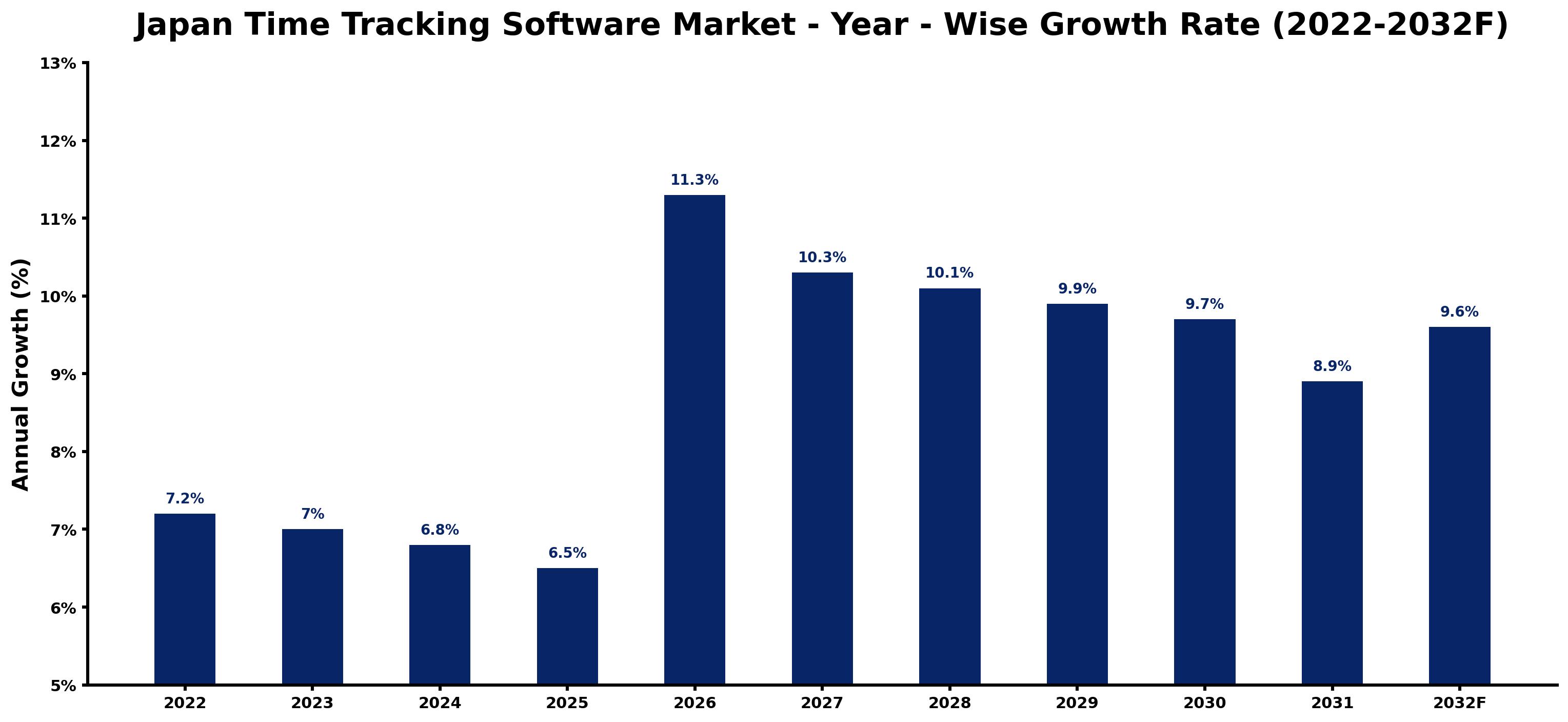
The table below sets out the estimated growth rate for each year and the main factor behind it.
| Year | Estimated Annual Growth (%) | Market Rationale |
| 2022 | 7.2 | The market experienced steady growth, reflecting increasing adoption among large enterprises. |
| 2023 | 7.0 | Growth slowed slightly as many companies continued to optimise existing systems. |
| 2024 | 6.8 | The market maintained a slower growth rate due to ongoing adjustments in workforce management practices. |
| 2025 | 6.5 | Growth continued to decelerate as businesses focused on cost management and efficiency. |
| 2026 | 11.3 | Growth is expected to accelerate sharply as investments in digital solutions surge across various sectors. |
| 2027 | 10.3 | The market is projected to see a slowdown as firms adjust to the rapid changes in technology. |
| 2028 | 10.1 | Growth is anticipated to slow further as companies consolidate their software investments and strategies. |
| 2029 | 9.9 | The market will continue to grow, albeit at a slower pace, as adoption stabilises. |
| 2030 | 9.7 | Growth is expected to slow as many businesses reach a saturation point in software usage. |
| 2031 | 8.9 | The market is projected to experience a slowdown as firms prioritise existing solutions over new purchases. |
| 2032 | 9.6 | Growth will pick up again as new technologies and standards emerge, driving fresh demand. |
Note: Market size estimations and growth projections presented in this report are based on 6Wresearch's proprietary forecasting methodology, utilizing the latest available industry data, government publications, and primary research inputs.
Japan Time Tracking Software Market Synopsis
Time tracking software serves as a digital tool that helps organizations monitor employee work hours and productivity, which is crucial for payroll processing and performance analysis. The Japan Time Tracking Software Market is growing due to increased adoption among large enterprises and small to medium-sized businesses, driven by the need for efficiency and compliance with labour regulations. With over 70% of large enterprises already using such software, government initiatives promoting digital transformation are supporting this market, aiming for 80% of businesses to adopt digital tools by 2025.
Market Dynamics Impact Analysis (2026–2032)
| Factor | Type | Impact | Primary Segment Affected |
| Increasing demand for efficient workforce management tools | Driver | High | Large Enterprises |
| Growing adoption among small and medium-sized enterprises | Driver | High | Small and Medium-Sized Enterprises |
| Rising need for compliance with labour laws | Opportunity | High | Time tracking/Recording |
| Investment in digital transformation initiatives | Opportunity | Medium | Timesheet |
| High costs associated with software implementation | Restraint | High | Small and Medium-Sized Enterprises |
| Limited awareness of software benefits among SMEs | Restraint | Medium | Time tracking/Recording |
| Challenges in integrating with existing systems | Challenge | High | Large Enterprises |
| Compliance with evolving data security standards | Challenge | Medium | Timesheet |
Evaluation of Drivers in Japan Time Tracking Software Market (2026–2032)
The main growth drivers and the segments they affect most are set out below.
| Drivers | Primary Segment Affected | Why It Matters (Evidence) |
| Increased workforce efficiency | Large Enterprises | Over 70% of large enterprises in Japan utilise time tracking software to streamline payroll processing and project management. |
| Rising adoption among SMEs | Small and Medium-Sized Enterprises | As of 2023, approximately 60% of SMEs have adopted time tracking software to enhance productivity. |
| Government initiatives promoting digital tools | Timesheet | The Digital Agency's establishment in 2021 aims to support businesses in adopting digital solutions. |
| Compliance with minimum wage regulations | Time tracking/Recording | Japan's national minimum wage rose to JPY 1,055 per hour, increasing demand for accurate time tracking. |
| Focus on data security standards | Timesheet | ISO/IEC 27001 standards are frequently adhered to by software developers, ensuring data protection. |
Orders keep climbing as investments in digital solutions rise, unlocking demand for time tracking software among various sectors. The average employee in Japan works about 1,700 hours annually, necessitating effective monitoring for payroll and productivity. Approximately 60% of SMEs have adopted such software, driven by a need for cost management and efficiency. The push for digital transformation encourages businesses to invest in these solutions, further driving market growth. With the national minimum wage set at JPY 1,055 per hour, the demand for accurate time tracking systems is increasing.
Evaluation of Restraints in Japan Time Tracking Software Market
The table below lists the restraints and the evidence behind each.
| Market Restraint | Primary Segment Affected | Why It Matters (Evidence) |
| High costs of implementation and maintenance | Small and Medium-Sized Enterprises | The average cost of time tracking software ranges from 5,000 to 15,000 JPY per month per user, limiting adoption. |
| Limited awareness of software benefits | Time tracking/Recording | Approximately 40% of SMEs lack knowledge about the advantages of time tracking software, hindering market growth. |
| Integration challenges with existing systems | Large Enterprises | Large enterprises often face difficulties integrating new software with legacy systems, delaying implementation. |
| Compliance with evolving data security standards | Timesheet | Compliance with ISO/IEC 27001 standards can require additional resources and investment. |
| Resistance to change within organizations | Small and Medium-Sized Enterprises | Some SMEs may resist adopting new technologies due to established practices and employee training needs. |
Japan Time Tracking Software Market Challenges
In 2023, about 60% of SMEs have adopted time tracking software, leaving a skills gap in the remaining 40% that limits effective workforce management. Many developers encounter issues with outdated technology, as the average cost of time tracking software ranges from 5,000 to 15,000 JPY per month per user, which restricts their ability to invest in modern solutions. Adhering to ISO/IEC 27001 standards complicates software deployment, causing delays for developers. Rising operational costs, driven by Japan's national minimum wage increase to JPY 1,055 per hour, further strain budgets for companies seeking to implement these tools.
Trends in the Japan Time Tracking Software Market
The following changes are redrawing the Japan Time Tracking Software Market.
- Shift towards Cloud-Based Solutions: Tokyo is seeing a notable shift towards cloud-based time tracking solutions, with over 60% of SMEs adopting these technologies to improve efficiency and accessibility.
- Increased Focus on Data Security: Large enterprises are prioritising data security in their time tracking solutions, complying with ISO/IEC 27001 standards to safeguard sensitive employee information.
- Rising Demand for Mobile Accessibility: Small and medium-sized enterprises are increasingly seeking mobile-friendly time tracking software, with a projected adoption rate of 45% in 2023, allowing for greater flexibility.
- Integration of AI in Time Tracking: The introduction of AI-driven features in time tracking software is gaining popularity, enhancing productivity analysis and reporting capabilities for businesses.
Investment Opportunities in the Japan Time Tracking Software Market
Below are the investment opportunities with the strongest case in the Japan Time Tracking Software Market.
- Small and Medium-Sized Enterprises Seeking Efficiency: SMEs are increasingly looking for cost-effective time tracking solutions, with a projected 45% adoption rate in 2023, presenting a market opportunity for providers.
- Partnerships for Software Development: Establishing joint ventures with local tech firms can facilitate entry into the Japanese market, especially in regions like Tokyo and Osaka, where demand is high.
- Investment in Digital Transformation: With the government's aim for 80% of businesses to adopt digital tools by 2025, there is a ripe opportunity for software providers to meet this demand.
- Focus on Customisation and Integration: The need for tailored solutions that integrate with existing systems is growing, especially among large enterprises looking to improve their operational efficiency.
Government Initiatives in the Japan Time Tracking Software Market
The Industrial Standardization Act, established in 1949 and amended in 2019, governs product and test standards for time tracking software, ensuring quality and compliance. The Digital Agency, established in September 2021, leads government initiatives to promote digital transformation across various sectors, encouraging businesses to adopt modern technologies.
The Small and Medium Enterprise Agency supports SMEs in adopting digital tools through various initiatives, providing funding and resources to improve productivity. The Ministry of Economy, Trade and Industry's 2022 program aims to boost productivity through technology, directly benefiting businesses seeking to implement time tracking solutions.
Future Insight of the Japan Time Tracking Software Market
The investment pipeline for digital solutions will broaden, driven by government initiatives targeting 80% business adoption of digital tools by 2025. This shift will generate increased demand for time tracking software, particularly among SMEs, with adoption projected to reach 45% by 2025. The Ministry of Internal Affairs and Communications will promote cloud-based solutions, improving accessibility for users. Productivity programs from the Ministry of Economy, Trade and Industry will encourage technology integration across various sectors.
Market Segmentation Analysis
Japan Time Tracking Software Market report covers a detailed analysis of the following market segments:
By Type – Timesheet Leads, Time tracking/Recording Expected to Grow Fastest
According to Dhaval Chaurasia, Assistant Manager at 6Wresearch, the largest type category in 2025 was Timesheet, at 55% of revenue. The Timesheet segment holds the largest share as it is essential for payroll processing and project management, critical components for business operations. For instance, over 70% of large enterprises in Japan rely on timesheets to effectively manage their workforce. Over 2026–2032, Time tracking/Recording is expected to post the fastest growth, at a CAGR of 13.2%. The Time tracking/Recording segment is growing rapidly as businesses recognise the importance of monitoring employee productivity and hours worked. This growth is supported by government initiatives that advocate for digital transformation, encouraging more companies to adopt these tools. Suppliers must focus on enhancing features that improve productivity monitoring to cater to the increasing demand in this segment.
By Application – Large Enterprises Lead, Small and Medium-Sized Enterprises Expected to Grow Fastest
Large Enterprises held 64% of the Japan Time Tracking Software Market by application in 2025. Large Enterprises dominate the market due to their complex workforce management needs that require comprehensive time tracking solutions. A significant portion of these enterprises already utilise time tracking software, which contributes to sustained growth in this segment. The quickest growth will come from Small and Medium-Sized Enterprises, forecast to expand at a CAGR of 12.6% between 2026 and 2032. Small and Medium-Sized Enterprises are experiencing the highest growth rate as they adopt time tracking software to enhance efficiency and manage costs effectively. Government programmes aimed at promoting digital tools for SMEs are facilitating this rapid adoption. Buyers in the SME sector should consider investing in time tracking solutions to enhance operational efficiency and stay competitive.
Key Attractiveness of the Report
- 10 Years of Market Numbers
- Historical Data Starting from 2022 to 2025
- Base Year 2025
- Forecast Data until 2032
- Key Performance Indicators Impacting the Market
- Major Upcoming Developments and Projects
Key Highlights of the Report:
- Japan Time Tracking Software Market Outlook
- Market Size of Japan Time Tracking Software Market, 2025
- Forecast of Japan Time Tracking Software Market, 2032
- Historical Data and Forecast of Japan Time Tracking Software Revenues & Volume for the Period 2022-2032
- Japan Time Tracking Software Market Trend Evolution
- Japan Time Tracking Software Market Drivers and Challenges
- Japan Time Tracking Software Price Trends
- Japan Time Tracking Software Porter's Five Forces
- Japan Time Tracking Software Industry Life Cycle
- Historical Data and Forecast of Japan Time Tracking Software Market Revenues & Volume By Type for the Period 2022-2032
- Historical Data and Forecast of Japan Time Tracking Software Market Revenues & Volume By Timesheet for the Period 2022-2032
- Historical Data and Forecast of Japan Time Tracking Software Market Revenues & Volume By Time tracking/Recording for the Period 2022-2032
- Historical Data and Forecast of Japan Time Tracking Software Market Revenues & Volume By Application for the Period 2022-2032
- Historical Data and Forecast of Japan Time Tracking Software Market Revenues & Volume By Large Enterprises for the Period 2022-2032
- Historical Data and Forecast of Japan Time Tracking Software Market Revenues & Volume By Small and Medium-Sized Enterprises for the Period 2022-2032
- Japan Time Tracking Software Import Export Trade Statistics
- Market Opportunity Assessment By Type
- Market Opportunity Assessment By Application
- Japan Time Tracking Software Top Companies Market Share
- Japan Time Tracking Software Competitive Benchmarking By Technical and Operational Parameters
- Japan Time Tracking Software Company Profiles
- Japan Time Tracking Software Key Strategic Recommendations
Market Covered
This report examines the market across the segments below.
By Type
- Timesheet
- Time tracking/Recording
By Application
- Large Enterprises
- Small and Medium-Sized Enterprises































