Japan Tire Cord Fabrics Market Size & Growth Rate
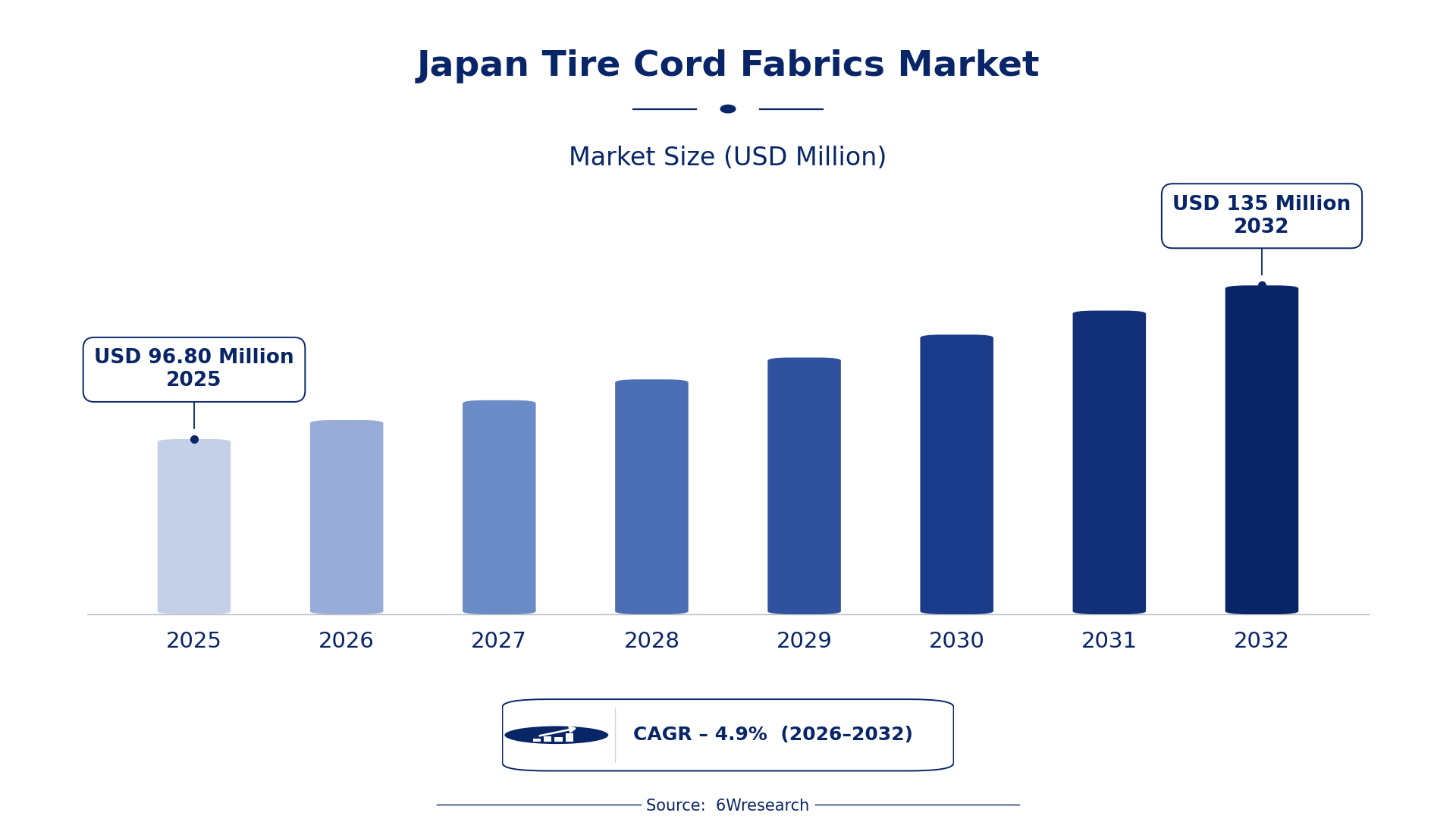
According to 6Wresearch internal database and industry insights, the Japan Tire Cord Fabrics Market was valued at USD 96.80 Million in 2025 and is projected to reach USD 135 Million by 2032, growing at a CAGR of approximately 4.9% during 2026–2032.
Japan Tire Cord Fabrics Market Highlights
| Report Metric | Details |
| Report Name | Japan Tire Cord Fabrics Market (2026-2032) |
| Market Size 2025 | USD 96.80 Million |
| Market Size 2032 | USD 135 Million |
| Absolute Growth 2025–2032 | USD 38.20 Million |
| CAGR 2026–2032 | 4.9% |
| Peak Annual Growth | 5.9% in 2027 |
| Forecast Period | 2026–2032 |
| Historical Data | 2022–2025 |
| Base Year | 2025 |
| Leading Material, 2025 | Nylon (45% share) |
| Leading Tire Type, 2025 | Radial (58% share) |
| Leading Vehicle Type, 2025 | Passenger Cars (53% share) |
| Leading Application, 2025 | OEM (55% share) |
| Fastest-Growing Material | Polyester (6.7% CAGR) |
| Fastest-Growing Vehicle Type | Commercial Vehicles (7.0% CAGR) |
| Fastest-Growing Application | Replacement (6.3% CAGR) |
| Growing Sector | Tire Manufacturing |
| Key End Users | Automotive manufacturers, Commercial vehicle producers, Tire manufacturers |
Japan Tire Cord Fabrics Market Year-wise Growth Rate and Key Drivers (2022–2032)
This graph illustrates the annual growth rates of the market from 2022 to 2032, highlighting a steady upward trajectory and projected market expansion over the forecast period.
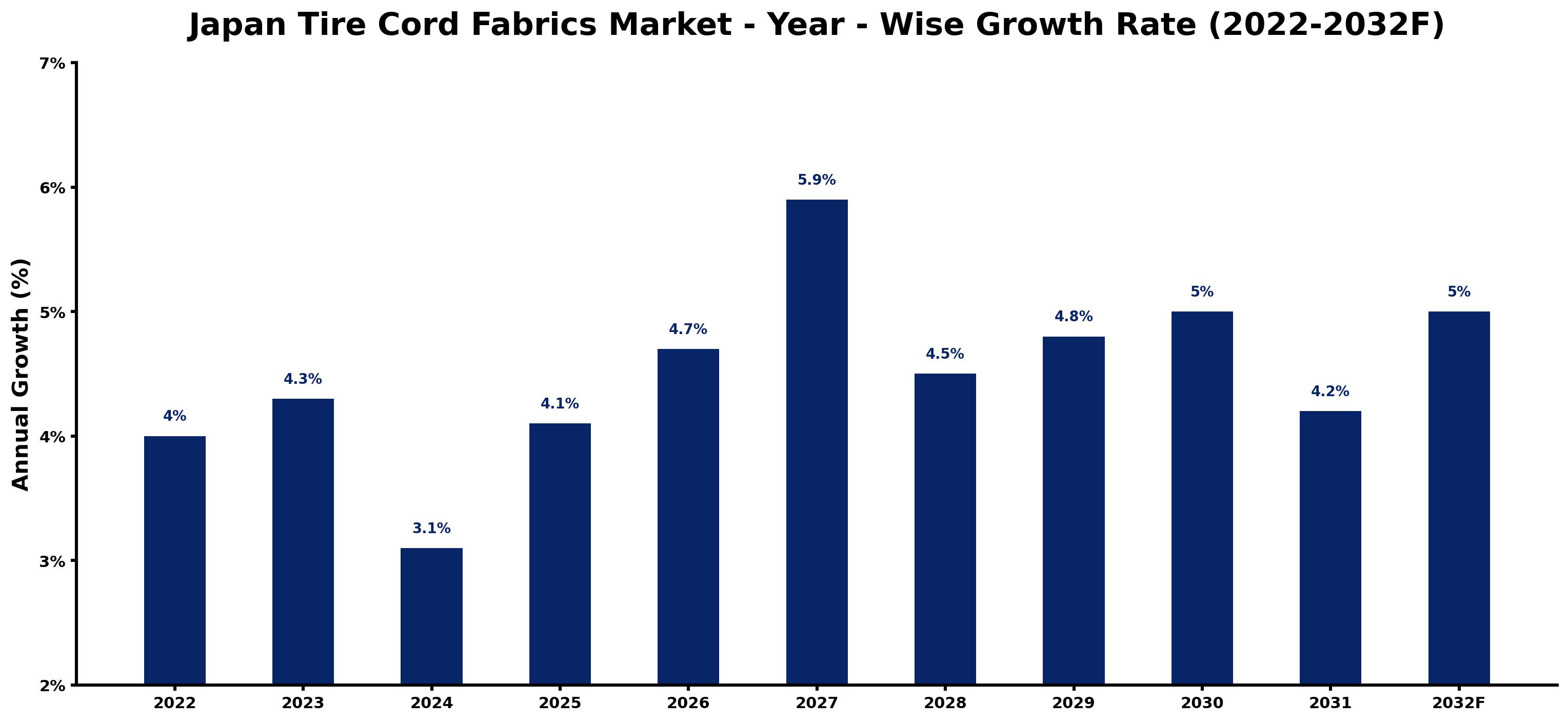
Each row of the following table gives one year's estimated growth and the event or demand shift that explains it.
| Year | Estimated Annual Growth (%) | Market Rationale |
| 2022 | 4.0 | The market showed steady growth, reflecting strong demand from the automotive sector. |
| 2023 | 4.3 | Growth accelerated due to increased production of tires for passenger vehicles. |
| 2024 | 3.1 | The market experienced a slowdown as production stabilised after previous gains. |
| 2025 | 4.1 | Demand rose again as tire manufacturers expanded their output capabilities. |
| 2026 | 4.7 | Growth is expected to continue as investments in tire technology improve production efficiency. |
| 2027 | 5.9 | The peak growth year will see heightened demand driven by consumer preferences for radial tires. |
| 2028 | 4.5 | Growth is projected to slow again as market conditions normalise after peak demand. |
| 2029 | 4.8 | Demand will increase as commercial vehicle production ramps up in response to market needs. |
| 2030 | 5.0 | The market is expected to grow steadily, supported by ongoing investments in tire manufacturing. |
| 2031 | 4.2 | Growth will slow slightly as the market adjusts to previous high levels of production. |
| 2032 | 5.0 | The market is expected to maintain steady growth driven by sustainable production initiatives. |
Note: Market size estimations and growth projections presented in this report are based on 6Wresearch's proprietary forecasting methodology, utilizing the latest available industry data, government publications, and primary research inputs.
Japan Tire Cord Fabrics Market Synopsis
Tire cord fabrics are specialized textiles used to reinforce tires, typically made from nylon and polyester through weaving and coating processes. The Japan Tire Cord Fabrics Market is expanding due to strong automotive production, with approximately 50 million tires produced in 2022. The automotive industry employs over 5 million people, driving demand for high-quality tire cord fabrics. Initiatives such as the 2023 sustainable tire production programme are promoting eco-friendly manufacturing practices and improving the industry's sustainability.
Market Dynamics Impact Analysis (2026–2032)
| Factor | Type | Impact | Primary Segment Affected |
| Strong automotive production | Driver | High | Nylon |
| Growing demand for radial tires | Driver | High | Radial |
| Sustainability initiatives in tire manufacturing | Opportunity | High | OEM |
| Rising demand for commercial vehicles | Opportunity | High | Commercial Vehicles |
| Cost pressures in raw material sourcing | Restraint | Medium | Polyester |
| Limited adoption of alternative materials | Restraint | Medium | Rayon |
| Competition from international markets | Challenge | High | Nylon |
| Technological advancements in tire production | Challenge | Medium | Radial |
Evaluation of Drivers in Japan Tire Cord Fabrics Market (2026–2032)
Below are the drivers that matter most for revenue growth, with supporting evidence.
| Drivers | Primary Segment Affected | Why It Matters (Evidence) |
| Increased tire production capacity | Nylon | Japan produced approximately 50 million tires in 2022, boosting demand for nylon fabrics. |
| Shift towards radial tires | Radial | The demand for radial tires increased by 20% over the last five years, driving fabric purchases in the OEM segment. |
| Investment in sustainable practices | OEM | The 2023 sustainable tire production programme encourages manufacturers to adopt eco-friendly materials, benefiting local suppliers. |
| Growth in commercial vehicle production | Commercial Vehicles | Commercial vehicles require specialized tires, leading to increased demand for durable tire cord fabrics, with a projected growth of 7%. |
| Focus on quality standards | Polyester | ISO 9001 is a key quality standard that drives manufacturers to invest in higher-grade materials and processes. |
Purchasing is picking up as the tire manufacturing sector expands, with approximately 50 million tires produced in 2022. This growth links to the increasing demand for nylon, which holds about 60% market share, driven by its strength and flexibility. The rise in radial tire demand, which has surged by 20% over the past five years, further boosts fabric purchases. The commercial vehicle segment also contributes significantly, requiring specialized tires that improve durability and load capacity, particularly in the Tokyo region.
Evaluation of Restraints in Japan Tire Cord Fabrics Market
Below are the constraints most often cited by buyers and suppliers, with the segment each affects.
| Market Restraint | Primary Segment Affected | Why It Matters (Evidence) |
| Rising costs of raw materials | Polyester | The cost of polyester has increased by 15%, affecting overall production expenses for manufacturers. |
| Limited use of rayon due to performance issues | Rayon | Rayon is less frequently used in tire cord fabrics due to its higher cost and lower performance, accounting for only 5% of the market. |
| Competition from cheaper imports | Nylon | Imported nylon fabrics can be cheaper, putting pressure on local manufacturers to remain competitive and reducing profit margins by 10%. |
| Slow adoption of new materials | Rayon | The market's slow transition to alternative materials limits growth opportunities for rayon fabrics, which have seen declining demand. |
| Regulatory compliance costs | OEM | Meeting quality standards such as ISO 9001 incurs additional costs of approximately 5% for manufacturers. |
Japan Tire Cord Fabrics Market Challenges
The primary obstacle in the tire cord fabrics market is outdated weaving technology, which raises production costs by 15% for producers, limiting their competitiveness. A shortage of skilled workers in advanced textile manufacturing leads to delays for producers, hampering their ability to meet market demands. Local manufacturers face pressure from lower-priced imports, which can shrink profit margins by 10% as they are compelled to reduce prices. Buyers encounter rising costs due to increased demand for high-quality tire cord fabrics, resulting in a projected 5% price increase as they seek durable options for commercial vehicles.
Trends in the Japan Tire Cord Fabrics Market
Buyers and suppliers in the Japan Tire Cord Fabrics Market are adjusting to the following trends.
- Shift towards Sustainable Manufacturing: The Tokyo region is leading a shift towards sustainable tire production, with a recent initiative promoting eco-friendly practices. This effort is expected to reduce waste and improve the industry's environmental footprint.
- Increased Demand for Radial Tires: The demand for radial tires has surged by 20% over the last five years, reshaping the tire cord fabric market, particularly in the OEM segment, as consumers prefer performance and durability.
- Growth in Commercial Vehicle Segment: Commercial vehicles are increasingly requiring specialised tires, with a projected growth rate of 7.0% from 2026 to 2032. This demand prompts manufacturers to improve their tire cord fabric offerings.
- Focus on Quality Standards: The implementation of ISO 9001 standards in tire manufacturing has become more pronounced since 2022. This focus on quality drives manufacturers to invest in higher-grade materials and processes.
Investment Opportunities in the Japan Tire Cord Fabrics Market
The openings below show where demand in the Japan Tire Cord Fabrics Market is visible and how suppliers can enter.
- OEM Manufacturers Seeking High-Quality Fabrics: OEM manufacturers are increasingly looking for high-quality tire cord fabrics to meet growing consumer expectations. With the market projected to grow, this presents a strong opportunity for suppliers.
- Timing for Sustainable Practices: With the 2023 sustainable tire production initiative in place, there is a strong push for eco-friendly materials. This creates a timely opportunity for suppliers to invest in sustainable tire cord fabrics.
- Partnerships with Local Manufacturers: Establishing joint ventures with local manufacturers can facilitate entry into the Japanese market. This approach allows for shared resources and local expertise, improving market penetration.
- Supply of Specialized Fabrics for Commercial Vehicles: The growing commercial vehicle segment necessitates specialised tire cord fabrics. Suppliers can focus on providing durable materials to meet this rising demand.
Government Initiatives in the Japan Tire Cord Fabrics Market
The GX Promotion Act of 2023 establishes a legal framework for promoting sustainable practices in tire manufacturing. This act builds on previous regulations, such as the Green Growth Strategy, which identifies growth sectors and sets targets for carbon neutrality by 2050. These measures encourage manufacturers to invest in eco-friendly technologies and materials, improving the overall sustainability of the tire cord fabric industry.
The Japan Automobile Manufacturers Association oversees initiatives to boost domestic production, including a programme targeting 150 GWh of battery manufacturing capacity by 2030. This agency also supports tire recycling initiatives, which aim to reduce waste and promote sustainability in the tire industry. By funding projects that focus on eco-friendly practices, the association enhances the competitiveness of local manufacturers.
Future Insight of the Japan Tire Cord Fabrics Market
Investment in advanced weaving technology will drive production capabilities, creating demand for tire cord fabrics by 2032. The government's sustainable tire production programme will encourage eco-friendly practices, attracting buyers who prioritise sustainability. Stricter quality standards will ensure that suppliers meet the automotive sector's rigorous requirements. As the automotive industry grows, the focus on durability and load capacity in tire cord fabrics will shape future production strategies.
Market Segmentation Analysis
Japan Tire Cord Fabrics Market report covers a detailed analysis of the following market segments:
By Material – Nylon Leads, Polyester Expected to Grow Fastest
According to Ravi Bhandari, Research Head at 6Wresearch, with 45% of material revenue in 2025, Nylon was the largest category. Nylon's strong position in the market arises from its extensive application in tire cord fabrics, valued for its strength and flexibility. This material is favoured by manufacturers, reflecting its significant presence in production processes. Polyester is projected to grow fastest, at a CAGR of 6.7% during 2026–2032. Polyester is witnessing rapid growth due to its cost-effectiveness and durability, making it an attractive option for manufacturers looking to optimise production. The increasing demand for durable tire solutions further fuels this trend. Suppliers should consider expanding polyester production capabilities to meet the rising market demand.
By Tire Type – Radial Leads and Records the Fastest Growth
The largest tire type category in 2025 was Radial, at 58% of revenue. Radial tires hold the largest share in the market, largely due to their superior performance characteristics and broad acceptance among consumers. Their advantages in fuel efficiency and safety features reinforce their leading status. Its lead should widen, with a projected CAGR of 6.6% during 2026–2032, the highest in this split. Radial tires are projected to continue their growth trajectory, supported by a notable 20% increase in demand over the last five years. This trend indicates a shift in consumer preferences towards radial designs. Manufacturers must prioritise continuous innovation in radial tire technology to sustain their market leadership.
By Vehicle Type – Passenger Cars Lead, Commercial Vehicles Expected to Grow Fastest
Passenger Cars took 53% of vehicle type revenue in 2025, more than any other category. Passenger cars represent the largest segment, driven by strong consumer demand and the high number of vehicles in operation. This segment significantly influences the overall tire cord fabric market dynamics. Over 2026–2032, Commercial Vehicles are expected to post the fastest growth, at a CAGR of 7.0%. Commercial vehicles are experiencing notable growth due to the need for specialised tires that ensure durability and load capacity. This growth is further propelled by the expanding logistics and transportation sectors. Suppliers should adapt their offerings to cater specifically to the needs of commercial vehicle manufacturers.
By Application – OEM Leads, Replacement Expected to Grow Fastest
OEM held 55% of the Japan Tire Cord Fabrics Market by application in 2025. OEM applications lead the market as they are the primary source of demand from tire manufacturers. The strong relationship between OEMs and suppliers ensures a consistent flow of orders for tire cord fabrics. Replacement is set to record the highest CAGR in this split, 6.3% over 2026–2032. The replacement market is expanding quickly as consumers increasingly seek to replace worn tires to ensure vehicle safety and performance. This trend is reinforced by the average lifespan of passenger car tires being around 4-5 years. Suppliers need to develop effective strategies to engage with the growing replacement market.
Key Attractiveness of the Report
- 10 Years of Market Numbers
- Historical Data Starting from 2022 to 2025
- Base Year 2025
- Forecast Data until 2032
- Key Performance Indicators Impacting the Market
- Major Upcoming Developments and Projects
Key Highlights of the Report:
- Japan Tire Cord Fabrics Market Outlook
- Market Size of Japan Tire Cord Fabrics Market, 2025
- Forecast of Japan Tire Cord Fabrics Market, 2032
- Historical Data and Forecast of Japan Tire Cord Fabrics Revenues & Volume for the Period 2022-2032
- Japan Tire Cord Fabrics Market Trend Evolution
- Japan Tire Cord Fabrics Market Drivers and Challenges
- Japan Tire Cord Fabrics Price Trends
- Japan Tire Cord Fabrics Porter's Five Forces
- Japan Tire Cord Fabrics Industry Life Cycle
- Historical Data and Forecast of Japan Tire Cord Fabrics Market Revenues & Volume By Material for the Period 2022-2032
- Historical Data and Forecast of Japan Tire Cord Fabrics Market Revenues & Volume By Nylon for the Period 2022-2032
- Historical Data and Forecast of Japan Tire Cord Fabrics Market Revenues & Volume By Polyester for the Period 2022-2032
- Historical Data and Forecast of Japan Tire Cord Fabrics Market Revenues & Volume By Rayon for the Period 2022-2032
- Historical Data and Forecast of Japan Tire Cord Fabrics Market Revenues & Volume By Others for the Period 2022-2032
- Historical Data and Forecast of Japan Tire Cord Fabrics Market Revenues & Volume By Tire Type for the Period 2022-2032
- Historical Data and Forecast of Japan Tire Cord Fabrics Market Revenues & Volume By Radial for the Period 2022-2032
- Historical Data and Forecast of Japan Tire Cord Fabrics Market Revenues & Volume By Bias for the Period 2022-2032
- Historical Data and Forecast of Japan Tire Cord Fabrics Market Revenues & Volume By Vehicle Type for the Period 2022-2032
- Historical Data and Forecast of Japan Tire Cord Fabrics Market Revenues & Volume By Passenger Cars for the Period 2022-2032
- Historical Data and Forecast of Japan Tire Cord Fabrics Market Revenues & Volume By Commercial Vehicles for the Period 2022-2032
- Historical Data and Forecast of Japan Tire Cord Fabrics Market Revenues & Volume By Others for the Period 2022-2032
- Historical Data and Forecast of Japan Tire Cord Fabrics Market Revenues & Volume By Application for the Period 2022-2032
- Historical Data and Forecast of Japan Tire Cord Fabrics Market Revenues & Volume By OEM for the Period 2022-2032
- Historical Data and Forecast of Japan Tire Cord Fabrics Market Revenues & Volume By Replacement for the Period 2022-2032
- Japan Tire Cord Fabrics Import Export Trade Statistics
- Market Opportunity Assessment By Material
- Market Opportunity Assessment By Tire Type
- Market Opportunity Assessment By Vehicle Type
- Market Opportunity Assessment By Application
- Japan Tire Cord Fabrics Top Companies Market Share
- Japan Tire Cord Fabrics Competitive Benchmarking By Technical and Operational Parameters
- Japan Tire Cord Fabrics Company Profiles
- Japan Tire Cord Fabrics Key Strategic Recommendations
Market Covered
The study includes the following segmentation.
By Material
- Nylon
- Polyester
- Rayon
- Others
By Tire Type
- Radial
- Bias
By Vehicle Type
- Passenger Cars
- Commercial Vehicles
- Others
By Application
- OEM
- Replacement































