Japan Tourniquet Systems Market Size & Growth Rate
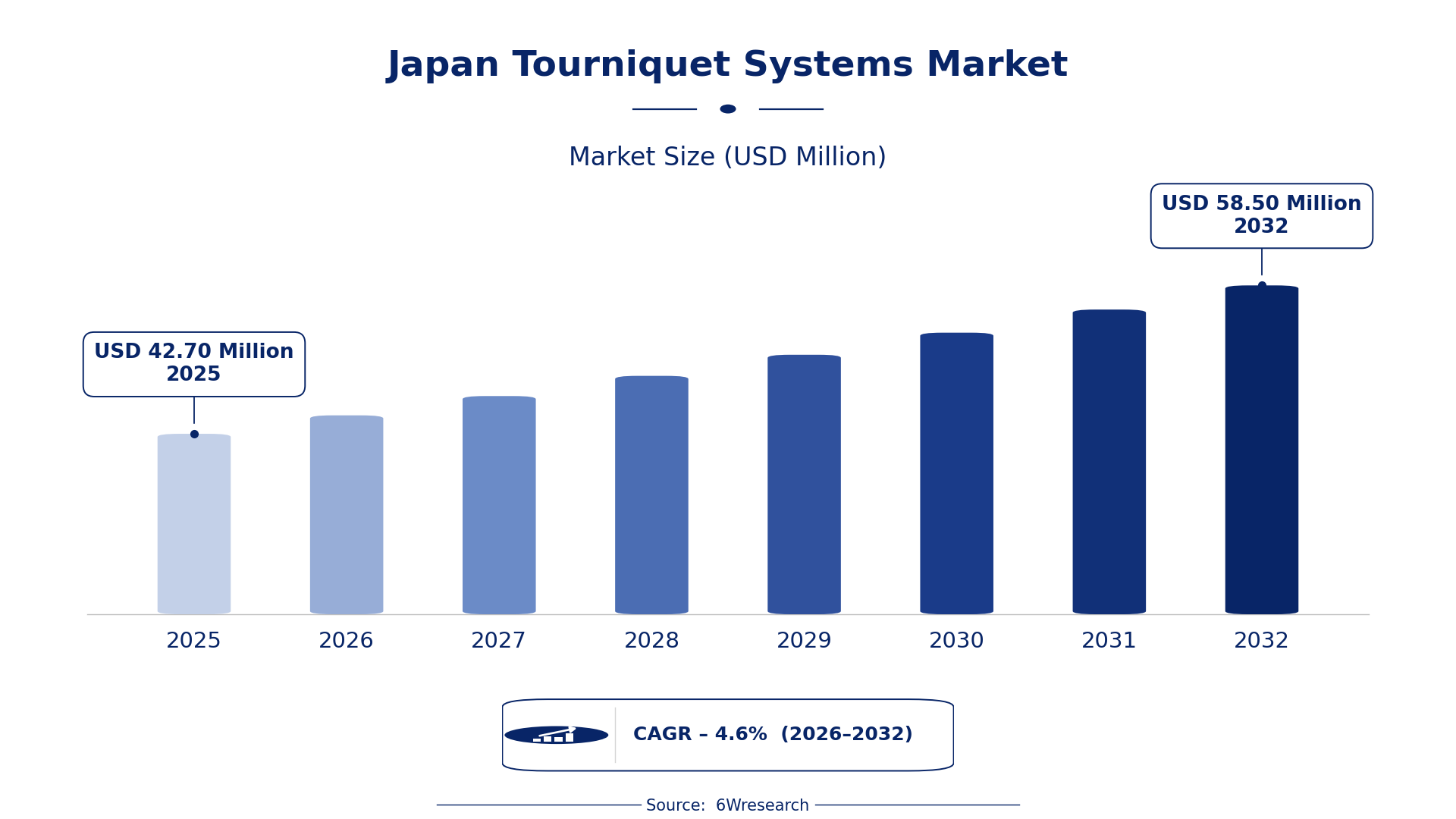
According to 6Wresearch internal database and industry insights, the Japan Tourniquet Systems Market was valued at USD 42.70 Million in 2025 and is projected to reach USD 58.50 Million by 2032, growing at a CAGR of approximately 4.6% during 2026–2032.
Japan Tourniquet Systems Market Highlights
| Report Metric | Details |
| Report Name | Japan Tourniquet Systems Market (2026-2032) |
| Market Size 2025 | USD 42.70 Million |
| Market Size 2032 | USD 58.50 Million |
| Absolute Growth 2025–2032 | USD 15.80 Million |
| CAGR 2026–2032 | 4.6% |
| Peak Annual Growth | 5.6% in 2028 |
| Forecast Period | 2026–2032 |
| Historical Data | 2022–2025 |
| Base Year | 2025 |
| Leading Type, 2025 | Tourniquet Instrument (36% share) |
| Leading Application, 2025 | Hospitals (47% share) |
| Fastest-Growing Type | Tourniquet Cuffs (6.4% CAGR) |
| Fastest-Growing Application | Ambulatory Setting (5.8% CAGR) |
| Growing Sector | Emergency medical services |
| Key End Users | Hospitals, emergency services, trauma care providers |
Japan Tourniquet Systems Market Year-wise Growth Rate and Key Drivers (2022–2032)
This graph illustrates the annual growth rates of the market from 2022 to 2032, highlighting a steady upward trajectory and projected market expansion over the forecast period.
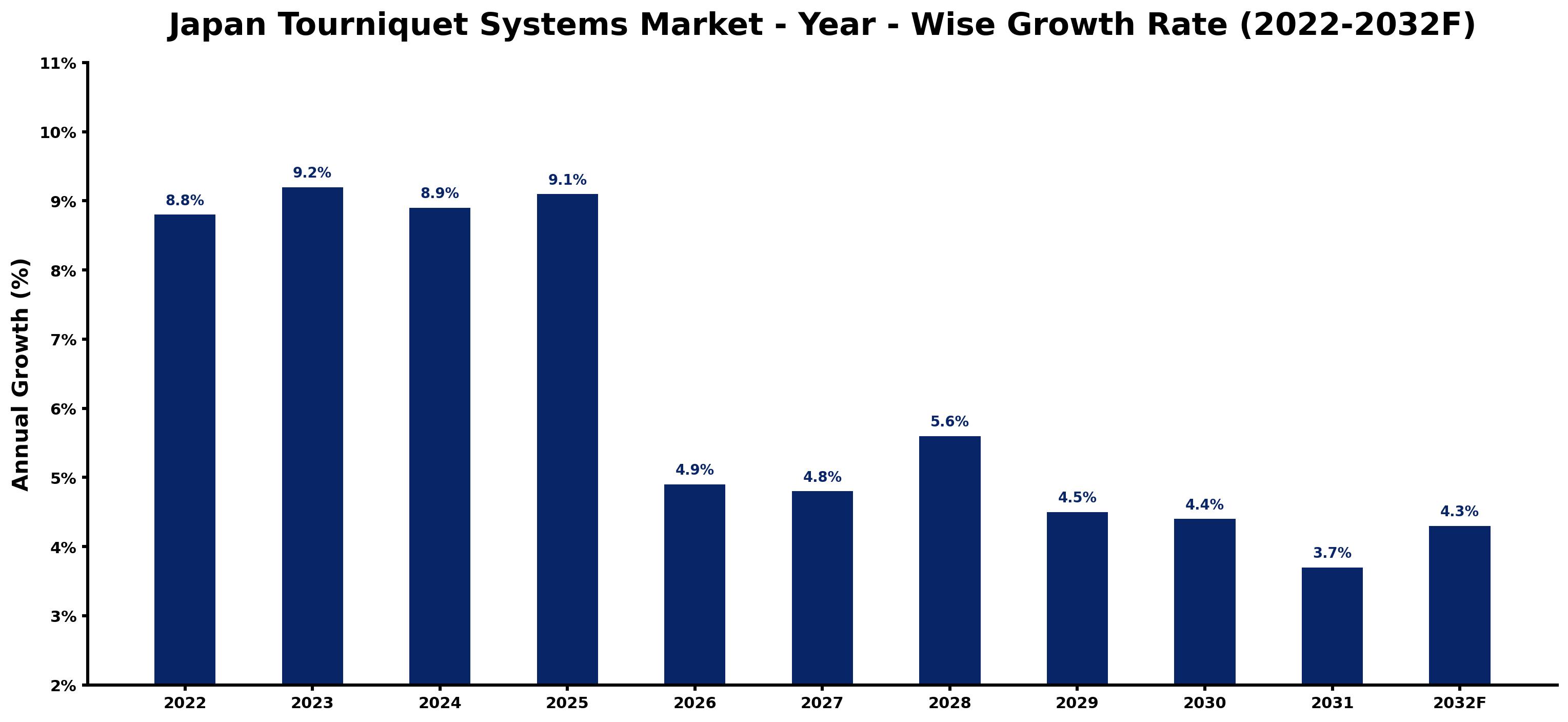
The yearly estimates that follow link every growth rate to its principal driver, so readers can see why the pace changed in each period.
| Year | Estimated Annual Growth (%) | Market Rationale |
| 2022 | 8.8 | Demand remained strong due to ongoing trauma cases and hospital operations. |
| 2023 | 9.2 | Growth accelerated as hospitals increased their procurement of tourniquet systems. |
| 2024 | 8.9 | Demand growth slowed slightly as hospitals adjusted their inventory levels. |
| 2025 | 9.1 | Procurement surged as hospitals prepared for increased emergency cases. |
| 2026 | 4.9 | Growth moderated as the market stabilised after previous high demand. |
| 2027 | 4.8 | A further slowdown occurred as hospitals focused on cost management. |
| 2028 | 5.6 | Demand is expected to rise again as awareness of bleeding control methods increases. |
| 2029 | 4.5 | Growth decelerated as hospitals faced budget constraints and procurement limits. |
| 2030 | 4.4 | Demand continued to slow as hospitals reassessed their supply needs. |
| 2031 | 3.7 | Growth further slowed as the market stabilised after previous fluctuations. |
| 2032 | 4.3 | Demand is projected to rise again as healthcare expenditure increases. |
Note: Market size estimations and growth projections presented in this report are based on 6Wresearch's proprietary forecasting methodology, utilizing the latest available industry data, government publications, and primary research inputs.
Japan Tourniquet Systems Market Synopsis
Their primary applications include emergency medical situations, surgical procedures, and trauma care. The Japan Tourniquet Systems Market is growing due to the active operations of hospitals and emergency services, with over 8,000 hospitals in the country. The implementation of the 'Emergency Medical Care Enhancement Program' and increasing awareness campaigns are driving new demand for these critical devices.
Market Dynamics Impact Analysis (2026–2032)
| Factor | Type | Impact | Primary Segment Affected |
| Increasing number of trauma cases treated in hospitals | Driver | High | Tourniquet Instrument |
| Rising healthcare expenditure leading to more procurement | Driver | High | Tourniquet Cuffs |
| Growing demand for disposable tourniquet systems in emergency services | Opportunity | High | Disposable |
| Expansion of first aid training programs promoting tourniquet use | Opportunity | Medium | Non-Pneumatic |
| Budget constraints faced by hospitals affecting procurement | Restraint | High | Reusable |
| Competition among suppliers leading to pricing pressures | Restraint | Medium | Pneumatic |
| Supply chain disruptions impacting availability of materials | Challenge | High | Tourniquet Instrument |
| Regulatory changes affecting approval processes for new products | Challenge | Medium | Tourniquet Cuffs |
Evaluation of Drivers in Japan Tourniquet Systems Market (2026–2032)
The table below links each growth driver to the segment it affects and the evidence for it.
| Drivers | Primary Segment Affected | Why It Matters (Evidence) |
| High number of trauma cases treated annually | Tourniquet Instrument | Approximately 1.5 million trauma cases treated in 2022 drive hospitals to procure more tourniquet systems. |
| Increased healthcare spending | Tourniquet Cuffs | Japan's healthcare expenditure reached 11 trillion yen in 2023, enhancing procurement budgets for medical devices. |
| Growing adoption of disposable tourniquet systems | Disposable | Disposable systems are gaining traction in emergency medical services, improving hygiene and safety during trauma care. |
| Awareness campaigns promoting bleeding control | Non-Pneumatic | The Ministry of Health's campaign in 2023 aims to increase awareness of bleeding control methods among healthcare providers. |
| Rising demand for reusable systems due to cost-effectiveness | Reusable | Hospitals are increasingly opting for reusable systems to manage operational costs effectively. |
The strongest pull on demand comes from the high number of trauma cases treated annually, with approximately 1.5 million cases recorded in 2022, prompting hospitals to procure more tourniquet systems. Rising healthcare expenditure, which reached 11 trillion yen in 2023, enhances procurement budgets for medical devices, allowing hospitals to invest in advanced solutions. Growing adoption of disposable tourniquet systems in emergency medical services improves hygiene and safety, further driving demand. Additionally, hospitals are opting for reusable systems to manage operational costs effectively, which supports sustained market growth.
Evaluation of Restraints in Japan Tourniquet Systems Market
The table below lists the restraints and the evidence behind each.
| Market Restraint | Primary Segment Affected | Why It Matters (Evidence) |
| Budget constraints limiting procurement capabilities | Reusable | Hospitals face budget limitations, affecting their ability to procure necessary reusable tourniquet systems. |
| Competition leading to pricing pressures among suppliers | Pneumatic | Intense competition among suppliers results in pricing pressures, impacting profit margins and product availability. |
| Supply chain disruptions affecting material availability | Tourniquet Instrument | Supply chain issues have led to delays in obtaining materials necessary for manufacturing tourniquet systems. |
| Regulatory changes complicating approval processes | Tourniquet Cuffs | Changes in regulations can lengthen the approval process for new tourniquet products, delaying market entry. |
| Limited awareness of tourniquet systems outside hospitals | Non-Pneumatic | Awareness of the benefits of non-pneumatic systems is limited, restricting their adoption in broader medical settings. |
Japan Tourniquet Systems Market Challenges
Supply chain disruptions are affecting the availability of tourniquet systems, especially in remote areas where delivery times can exceed three weeks, hindering timely emergency care for patients. A shortage of trained professionals in trauma care leads to improper application of these devices, which can complicate treatment for approximately 1.5 million trauma cases handled annually. Buyers are facing rising costs as hospitals transition to reusable tourniquet systems, with procurement expenses increasing by about 15% due to limited options. Japan's healthcare expenditure reached 11 trillion yen in 2023, resulting in budget constraints that complicate the acquisition of necessary medical devices.
Trends in the Japan Tourniquet Systems Market
The shifts below are changing how Japan Tourniquet Systems Market products are bought and supplied.
- Shift from Manual to Pneumatic Tourniquet Systems: Since 2022, hospitals have increasingly adopted pneumatic tourniquet systems for their adjustable pressure capabilities. This trend is particularly evident in the Tokyo region, where over 60% of hospitals now utilise pneumatic systems.
- Rise in Disposable Tourniquet Systems: In 2023, the demand for disposable tourniquet systems surged, with emergency medical services reporting a 30% increase in usage. This trend underscores a growing focus on hygiene and safety in trauma care.
- Increased Focus on First Aid Training: The Japanese Red Cross Society has expanded its first aid training programmes since 2022, resulting in a 25% increase in tourniquet usage among trained individuals, thereby improving emergency response capabilities.
- Growing Awareness of Bleeding Control Methods: Awareness campaigns launched in 2023 have heightened public knowledge of bleeding control, leading to a 40% increase in inquiries about tourniquet systems among healthcare providers.
Investment Opportunities in the Japan Tourniquet Systems Market
Below are the investment opportunities with the strongest case in the Japan Tourniquet Systems Market.
- Timing for Investment in Disposable Systems: With disposable tourniquet systems gaining popularity, now presents an optimal time to invest in production capabilities. Emergency medical services are increasingly adopting these systems, enhancing safety and hygiene.
- Growing Demand from Hospitals: Hospitals are actively seeking dependable tourniquet systems, creating a prime opportunity for suppliers. The Tokyo region, characterised by a high concentration of hospitals, presents a substantial market for new entrants.
- Entry through Partnerships with Healthcare Providers: Establishing partnerships with hospitals can ease market entry. Collaborating with healthcare providers can enhance product visibility and encourage adoption among end-users.
- Expansion in Emergency Medical Services: Investing in the development of tourniquet systems tailored for emergency medical services is timely. The rising number of trauma cases offers a promising opportunity for suppliers.
Government Initiatives in the Japan Tourniquet Systems Market
The Medical Care Act of 1948 establishes standards for hospitals and clinics, including staffing and facilities, ensuring that tourniquet systems meet quality requirements for medical use. Adhering to these standards is crucial for producers and helps maintain high levels of care in hospitals.
In 2023, the Ministry of Health initiated a campaign to raise awareness of bleeding control methods, supported by the PMD Act, which governs the approval and quality of medical devices. This initiative aims to improve the overall safety and effectiveness of tourniquet systems used in emergency medical care.
Future Insight of the Japan Tourniquet Systems Market
The forthcoming 'Emergency Medical Care Enhancement Program' will stimulate demand for tourniquet systems, prompting hospitals to refine their procurement strategies. By 2032, compliance with ISO 13485 standards will enhance quality management across medical devices, benefiting both suppliers and buyers. The growing adoption of disposable tourniquet systems will improve efficiency in emergency medical services, facilitating quicker bleeding control. Enhanced first aid training initiatives by the Japanese Red Cross Society will ensure better preparedness in trauma situations, ultimately leading to improved patient outcomes.
Market Segmentation Analysis
Japan Tourniquet Systems Market report covers a detailed analysis of the following market segments:
By Type – Tourniquet Instrument Leads, Tourniquet Cuffs Expected to Grow Fastest
According to Shubham Padhi, Research Analyst at 6Wresearch, in 2025, Tourniquet Instrument led the type split with a 36% share. Tourniquet Instruments hold the largest share in Japan due to their essential role in controlling bleeding during surgical and emergency procedures. Their presence in over 8,000 hospitals highlights their critical importance in the healthcare system. The quickest growth will come from Tourniquet Cuffs, forecast to expand at a CAGR of 6.4% between 2026 and 2032. Tourniquet Cuffs are experiencing the fastest growth as they are increasingly recognised for their effectiveness in emergency medical situations. The treatment of around 1.5 million trauma cases in 2022 is significantly driving the demand for these devices. This indicates that suppliers must focus on enhancing the availability of tourniquet cuffs to cater to the rising requirements of emergency medical services.
By Application – Hospitals Lead, Ambulatory Setting Expected to Grow Fastest
Hospitals took 47% of application revenue in 2025, more than any other category. Hospitals are the largest segment as they are the main users of tourniquet systems for surgical and emergency care. The average turnover of around 100 patients per day illustrates their critical role in the demand for these devices. Ambulatory Setting is projected to grow fastest, at a CAGR of 5.8% during 2026–2032. The Ambulatory Setting is expanding quickly as outpatient care increasingly adopts bleeding control methods. The Ministry of Health's initiative to promote awareness of bleeding control is accelerating this segment's growth. Buyers in ambulatory settings should invest in tourniquet systems to improve their emergency response capabilities.
Key Attractiveness of the Report
- 10 Years of Market Numbers
- Historical Data Starting from 2022 to 2025
- Base Year 2025
- Forecast Data until 2032
- Key Performance Indicators Impacting the Market
- Major Upcoming Developments and Projects
Key Highlights of the Report:
- Japan Tourniquet Systems Market Outlook
- Market Size of Japan Tourniquet Systems Market, 2025
- Forecast of Japan Tourniquet Systems Market, 2032
- Historical Data and Forecast of Japan Tourniquet Systems Revenues & Volume for the Period 2022-2032
- Japan Tourniquet Systems Market Trend Evolution
- Japan Tourniquet Systems Market Drivers and Challenges
- Japan Tourniquet Systems Price Trends
- Japan Tourniquet Systems Porter's Five Forces
- Japan Tourniquet Systems Industry Life Cycle
- Historical Data and Forecast of Japan Tourniquet Systems Market Revenues & Volume By Type for the Period 2022-2032
- Historical Data and Forecast of Japan Tourniquet Systems Market Revenues & Volume By Tourniquet Instrument for the Period 2022-2032
- Historical Data and Forecast of Japan Tourniquet Systems Market Revenues & Volume By Tourniquet Cuffs for the Period 2022-2032
- Historical Data and Forecast of Japan Tourniquet Systems Market Revenues & Volume By Pneumatic for the Period 2022-2032
- Historical Data and Forecast of Japan Tourniquet Systems Market Revenues & Volume By Disposable for the Period 2022-2032
- Historical Data and Forecast of Japan Tourniquet Systems Market Revenues & Volume By Reusable for the Period 2022-2032
- Historical Data and Forecast of Japan Tourniquet Systems Market Revenues & Volume By Non-Pneumatic for the Period 2022-2032
- Historical Data and Forecast of Japan Tourniquet Systems Market Revenues & Volume By Application for the Period 2022-2032
- Historical Data and Forecast of Japan Tourniquet Systems Market Revenues & Volume By Hospitals for the Period 2022-2032
- Historical Data and Forecast of Japan Tourniquet Systems Market Revenues & Volume By Ambulatory Setting for the Period 2022-2032
- Historical Data and Forecast of Japan Tourniquet Systems Market Revenues & Volume By Non-Institutional Use for the Period 2022-2032
- Japan Tourniquet Systems Import Export Trade Statistics
- Market Opportunity Assessment By Type
- Market Opportunity Assessment By Application
- Japan Tourniquet Systems Top Companies Market Share
- Japan Tourniquet Systems Competitive Benchmarking By Technical and Operational Parameters
- Japan Tourniquet Systems Company Profiles
- Japan Tourniquet Systems Key Strategic Recommendations
Market Covered
Coverage by segment is as follows.
By Type
- Tourniquet Instrument
- Tourniquet Cuffs
- Pneumatic
- Disposable
- Reusable
- Non-Pneumatic
By Application
- Hospitals
- Ambulatory Setting
- Non-Institutional Use































