Japan Transplantation Market Size & Growth Rate
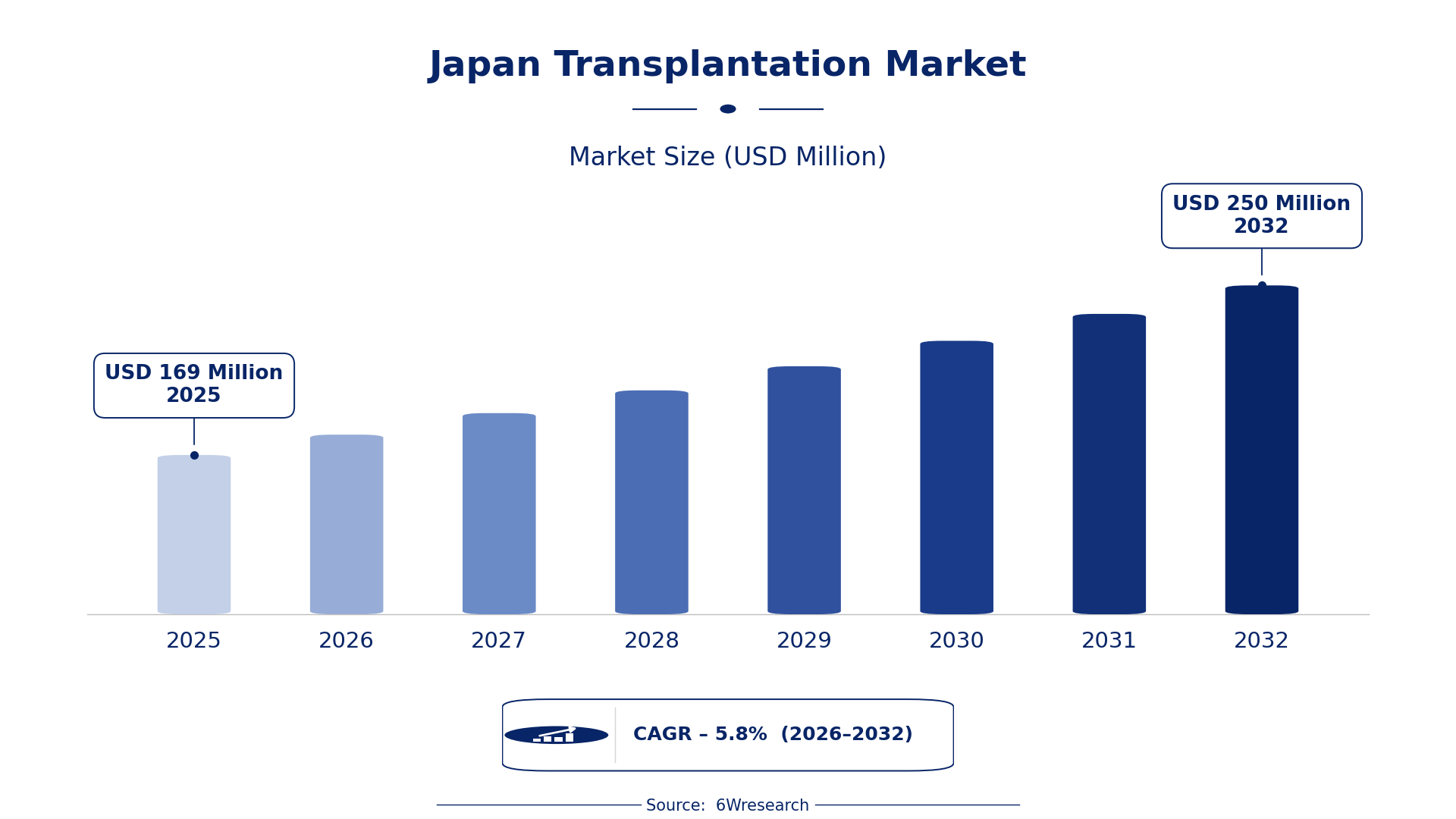
According to 6Wresearch internal database and industry insights, the Japan Transplantation Market was valued at USD 169 Million in 2025 and is projected to reach USD 250 Million by 2032, growing at a CAGR of approximately 5.8% during 2026–2032.
Japan Transplantation Market Highlights
| Report Metric | Details |
| Report Name | Japan Transplantation Market (2026-2032) |
| Market Size 2025 | USD 169 Million |
| Market Size 2032 | USD 250 Million |
| Absolute Growth 2025–2032 | USD 81 Million |
| CAGR 2026–2032 | 5.8% |
| Peak Annual Growth | 6.4% in 2027 |
| Forecast Period | 2026–2032 |
| Historical Data | 2022–2025 |
| Base Year | 2025 |
| Leading Product Type, 2025 | Tissue Products (46% share) |
| Leading Application, 2025 | Organ Transplantation (67% share) |
| Leading End-User, 2025 | Hospitals (48% share) |
| Fastest-Growing Product Type | Immunosuppressive Drugs (8.3% CAGR) |
| Fastest-Growing Application | Tissue Transplantation (7.5% CAGR) |
| Fastest-Growing End-User | Transplantation Centers (7.2% CAGR) |
| Growing Sector | Organ Transplantation |
| Key End Users | Hospitals, Transplantation Centers, Healthcare Providers |
Japan Transplantation Market Year-wise Growth Rate and Key Drivers (2022–2032)
This graph illustrates the annual growth rates of the market from 2022 to 2032, highlighting a steady upward trajectory and projected market expansion over the forecast period.
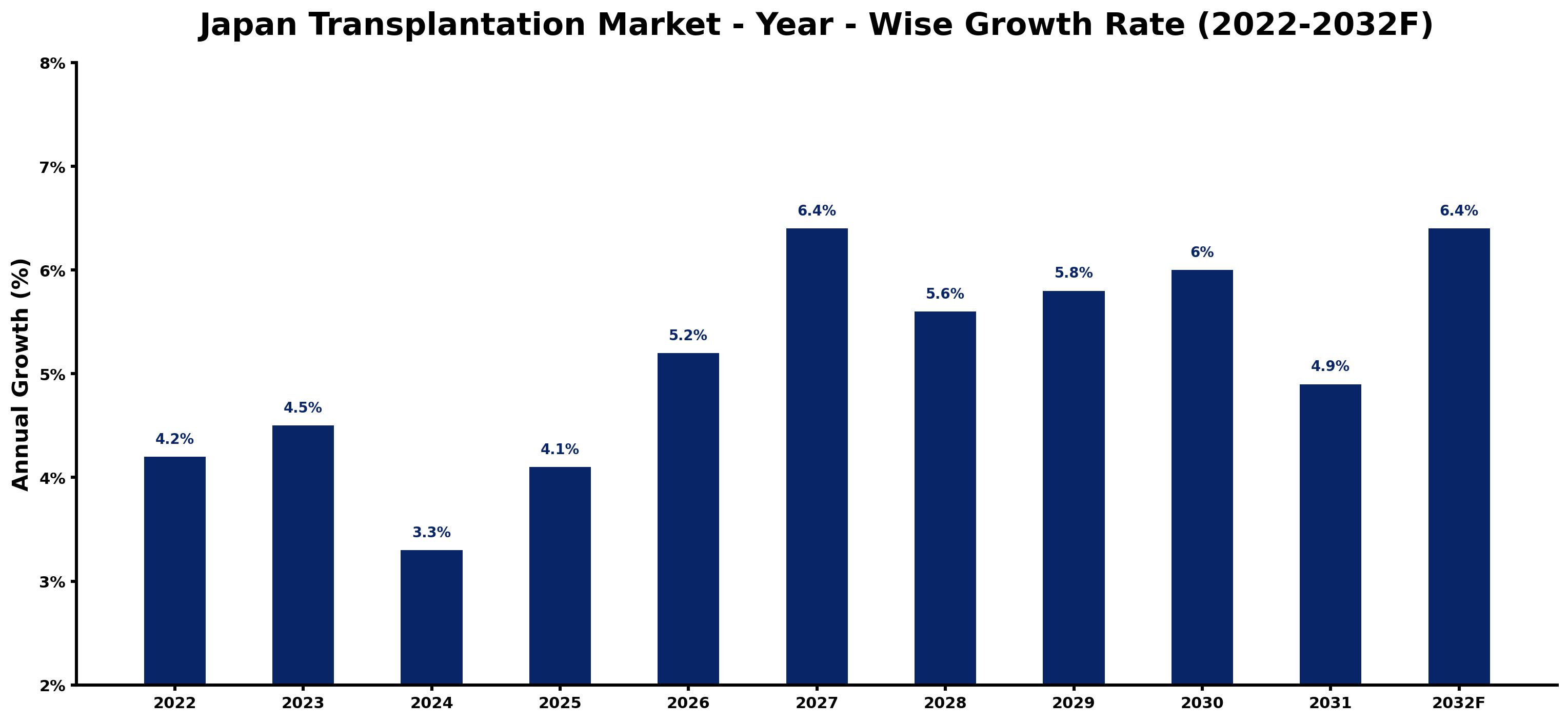
The yearly estimates that follow link every growth rate to its principal driver, so readers can see why the pace changed in each period.
| Year | Estimated Annual Growth (%) | Market Rationale |
| 2022 | 4.2 | The market experienced steady growth due to increased awareness of organ donation. |
| 2023 | 4.5 | Demand rose as more organ transplants were performed compared to the previous year. |
| 2024 | 3.3 | Growth slowed as the number of organ donors remained relatively low. |
| 2025 | 4.1 | Demand accelerated with the launch of new awareness campaigns for organ donation. |
| 2026 | 5.2 | Investment in transplantation research is expected to drive higher demand for products. |
| 2027 | 6.4 | The peak growth rate reflects rising organ transplant procedures and donor registrations. |
| 2028 | 5.6 | Growth is projected to slow as the market stabilises after reaching a peak in the previous year. |
| 2029 | 5.8 | Demand is projected to rise as hospitals expand their transplantation capacities. |
| 2030 | 6.0 | The market is expected to grow as new technologies improve transplant success rates. |
| 2031 | 4.9 | Growth is projected to slow as the market reaches a more mature phase. |
| 2032 | 6.4 | The market is expected to peak again with increased organ donation efforts. |
Note: Market size estimations and growth projections presented in this report are based on 6Wresearch's proprietary forecasting methodology, utilizing the latest available industry data, government publications, and primary research inputs.
Japan Transplantation Market Synopsis
Transplantation involves transferring organs or tissues for medical purposes, utilising advanced techniques and biotechnological processes. The Japan Transplantation Market is growing due to an increase in organ transplant procedures, driven by government initiatives and greater awareness of organ donation. In 2022, approximately 3,000 organ transplants were performed, while ongoing investments in transplantation research, including ¥1 billion allocated in 2023, are expected to further increase demand for immunosuppressive drugs and preservation solutions.
Market Dynamics Impact Analysis (2026–2032)
| Factor | Type | Impact | Primary Segment Affected |
| Rising organ transplant procedures | Driver | High | Organ Transplantation |
| Increased awareness of organ donation | Driver | High | Tissue Products |
| Growing need for advanced preservation solutions | Opportunity | Medium | Preservation Solutions |
| Expansion of specialized transplantation centers | Opportunity | Medium | Transplantation Centers |
| Limited number of registered organ donors | Restraint | High | Organ Transplantation |
| High costs associated with transplantation procedures | Restraint | Medium | Immunosuppressive Drugs |
| Insufficient supply of organs for transplantation | Challenge | High | Tissue Products |
| Slow adoption of new transplantation technologies | Challenge | Medium | Preservation Solutions |
Evaluation of Drivers in Japan Transplantation Market (2026–2032)
The table below links each growth driver to the segment it affects and the evidence for it.
| Drivers | Primary Segment Affected | Why It Matters (Evidence) |
| Increased investment in transplantation research | Immunosuppressive Drugs | Japan allocated ¥1 billion for transplantation research initiatives in 2023, boosting demand for related products. |
| Growing number of transplantation centers | Organ Transplantation | With over 160 centers nationwide, hospitals are increasing their capabilities to perform more transplants. |
| Rising organ transplant success rates | Tissue Products | In 2022, the success rate of organ transplants improved, encouraging more patients to undergo procedures. |
| Government awareness campaigns | Preservation Solutions | Since 2018, the government has supported organ donation awareness programs, increasing demand for preservation solutions. |
| Advancements in immunosuppressive drugs | Immunosuppressive Drugs | These drugs are critical for 90% of transplant patients, driving consistent demand from healthcare providers. |
Buyers are adding capacity as hospitals expand their transplantation services, supported by over 160 transplantation centers across Japan. In 2022, approximately 3,000 organ transplants were performed, creating a growing need for immunosuppressive drugs, essential for most transplant patients. The allocation of ¥1 billion for transplantation research in 2023 is expected to drive demand for preservation solutions. Improved techniques have led to higher success rates, encouraging more patients to opt for organ transplants. The increasing awareness of organ donation since 2018 has also contributed to rising demand for transplantation products.
Evaluation of Restraints in Japan Transplantation Market
The main factors holding the market back are set out below.
| Market Restraint | Primary Segment Affected | Why It Matters (Evidence) |
| Limited registered organ donors | Organ Transplantation | As of 2023, there are only 1,500 registered organ donors, constraining the supply for transplants. |
| High costs of transplantation procedures | Immunosuppressive Drugs | The financial burden of transplantation can deter patients from seeking necessary treatments. |
| Complexity of preservation methods | Preservation Solutions | The JIS Z 2300 standard governs preservation methods, complicating compliance for producers. |
| Slow adoption of new technologies | Tissue Products | Healthcare providers may hesitate to adopt new technologies due to cost and training requirements. |
| Limited public awareness of organ donation | Organ Transplantation | Despite government campaigns, many individuals remain unaware of the importance of organ donation. |
Japan Transplantation Market Challenges
Healthcare providers face challenges with outdated preservation technology, which risks organ viability and raises costs for hospitals. A shortage of registered organ donors persists, with only 1,500 available, resulting in an average wait time of three years for kidney transplants, causing frustration for patients and families. Transplantation centres encounter intense competition for limited donor organs, leading to delays that compromise patient outcomes and heighten operational pressures. Gaps in advanced surgical skills challenge producers' ability to meet rising demands, forcing clinics to seek external training, which can prolong procedures and elevate costs for patients.
Trends in the Japan Transplantation Market
Below are the shifts with the largest effect on the Japan Transplantation Market.
- Shift from Traditional to Advanced Preservation Techniques: Since 2021, hospitals have increasingly adopted advanced preservation solutions, improving organ viability during transport. Compliance with the JIS Z 2300 standard supports this shift.
- Increase in Specialized Transplantation Centers: The number of specialised transplantation centres has grown, with over 160 centres now operating nationwide. This expansion supports a higher volume of organ transplants annually.
- Rise in Organ Donation Awareness Campaigns: In 2021, Japan launched a national campaign to increase organ donation rates, resulting in a notable rise in registered donors. This initiative has positively impacted transplantation rates across the country.
- Emergence of Regenerative Medicine: Regenerative medicine is gaining traction, with ongoing research initiatives expected to improve organ transplantation outcomes. The Japan Society of Transplantation promotes advancements in this field.
Investment Opportunities in the Japan Transplantation Market
The following areas offer the clearest openings for investors and suppliers in the Japan Transplantation Market.
- Hospitals seeking to improve transplantation capabilities: With a growing number of organ transplants, hospitals need advanced immunosuppressive drugs to support patients. This creates a market opportunity for suppliers.
- Transplantation Centers aiming to enhance organ viability: As the average wait time for a kidney transplant is about three years, there is a pressing need for better preservation solutions to improve organ viability.
- Regions focusing on organ donation awareness: Tokyo and Osaka are key areas for increasing organ donation efforts, presenting opportunities for educational programs and partnerships.
- Timing for investments in transplantation research: With ¥1 billion allocated for research in 2023, now is an ideal time for investors to support new transplantation technologies.
Government Initiatives in the Japan Transplantation Market
The Medical Care Act of 1948 sets standards for hospitals and clinics, ensuring they meet necessary staffing and facility requirements for transplantation. The Clinical Trials Act, enacted in 2017, establishes rules for conducting and disclosing clinical research, facilitating advancements in transplantation techniques and therapies.
The Ministry of Health, Labour and Welfare oversees transplantation regulations and funds initiatives to improve organ donation rates. The PMDA reviews pharmaceuticals and medical devices, ensuring safety and efficacy in products used for transplantation.
Future Insight of the Japan Transplantation Market
New transplantation centres will emerge by 2032, as the government allocates ¥1 billion for research initiatives and campaigns to boost organ donation. The JIS Z 2300 standard will adapt, refining tissue preservation methods to improve organ viability. Advanced biotechnological processes will enhance organ matching, significantly reducing wait times for patients. With over 3,000 organ transplants performed in 2022, the sector will experience substantial progress in regenerative medicine, benefiting both buyers and suppliers.
Market Segmentation Analysis
Japan Transplantation Market report covers a detailed analysis of the following market segments:
By Product Type – Tissue Products Lead, Immunosuppressive Drugs Expected to Grow Fastest
According to Shubham Deep, Research Manager at 6Wresearch, Tissue Products held 46% of the Japan Transplantation Market by product type in 2025. Tissue products hold the largest share due to their direct application in organ transplants, essential for successful procedures. The high volume of approximately 3,000 organ transplants performed in 2022 highlights the critical role of these products in the healthcare system. Immunosuppressive Drugs are projected to grow fastest, at a CAGR of 8.3% during 2026–2032. Immunosuppressive drugs are experiencing rapid growth as they are vital for preventing organ rejection in 90% of transplant patients. The increasing number of organ transplants necessitates a higher demand for these drugs, ensuring their market expansion. Suppliers should focus on the growing demand for immunosuppressive drugs to capitalise on the expanding transplantation market.
By Application – Organ Transplantation Leads, Tissue Transplantation Expected to Grow Fastest
Organ Transplantation took 67% of application revenue in 2025, more than any other category. Organ transplantation dominates the market as it is the primary application for transplantation products, reflecting the urgent need for organ replacements. The average wait time of about 3 years for a kidney transplant underscores the critical demand for this application. The quickest growth will come from Tissue Transplantation, forecast to expand at a CAGR of 7.5% between 2026 and 2032. Tissue transplantation is growing quickly due to its importance in various medical procedures beyond organ transplants. The ongoing research and development in regenerative medicine are likely to further accelerate this segment's growth. Buyers should prepare for an increase in tissue transplantation services as demand continues to rise.
By End-User – Hospitals Lead, Transplantation Centers Expected to Grow Fastest
The largest end-user category in 2025 was Hospitals, at 48% of revenue. Hospitals hold the largest share as they are the primary facilities for conducting transplants, performing approximately 3,000 organ transplants annually. Their established protocols and extensive experience ensure a steady flow of patients requiring organ and tissue transplantation services. Transplantation Centers are set to record the highest CAGR in this split, 7.2% over 2026–2032. Transplantation centres are experiencing rapid growth due to their specialised focus on organ and tissue transplants, which is crucial as Japan's organ donation rates improve. This focus on specialised care is expected to further solidify their market position. This suggests that suppliers should focus on developing tailored solutions for hospitals and transplantation centres to address the increasing demand for transplantation services.
Key Attractiveness of the Report
- 10 Years of Market Numbers
- Historical Data Starting from 2022 to 2025
- Base Year 2025
- Forecast Data until 2032
- Key Performance Indicators Impacting the Market
- Major Upcoming Developments and Projects
Key Highlights of the Report:
- Japan Transplantation Market Outlook
- Market Size of Japan Transplantation Market, 2025
- Forecast of Japan Transplantation Market, 2032
- Historical Data and Forecast of Japan Transplantation Revenues & Volume for the Period 2022-2032
- Japan Transplantation Market Trend Evolution
- Japan Transplantation Market Drivers and Challenges
- Japan Transplantation Price Trends
- Japan Transplantation Porter's Five Forces
- Japan Transplantation Industry Life Cycle
- Historical Data and Forecast of Japan Transplantation Market Revenues & Volume By Product Type for the Period 2022-2032
- Historical Data and Forecast of Japan Transplantation Market Revenues & Volume By Tissue Products for the Period 2022-2032
- Historical Data and Forecast of Japan Transplantation Market Revenues & Volume By Immunosuppressive Drugs for the Period 2022-2032
- Historical Data and Forecast of Japan Transplantation Market Revenues & Volume By Preservation Solutions for the Period 2022-2032
- Historical Data and Forecast of Japan Transplantation Market Revenues & Volume By Application for the Period 2022-2032
- Historical Data and Forecast of Japan Transplantation Market Revenues & Volume By Organ Transplantation for the Period 2022-2032
- Historical Data and Forecast of Japan Transplantation Market Revenues & Volume By Tissue Transplantation for the Period 2022-2032
- Historical Data and Forecast of Japan Transplantation Market Revenues & Volume By End-User for the Period 2022-2032
- Historical Data and Forecast of Japan Transplantation Market Revenues & Volume By Hospitals for the Period 2022-2032
- Historical Data and Forecast of Japan Transplantation Market Revenues & Volume By Transplantation Centers for the Period 2022-2032
- Historical Data and Forecast of Japan Transplantation Market Revenues & Volume By Others for the Period 2022-2032
- Japan Transplantation Import Export Trade Statistics
- Market Opportunity Assessment By Product Type
- Market Opportunity Assessment By Application
- Market Opportunity Assessment By End-User
- Japan Transplantation Top Companies Market Share
- Japan Transplantation Competitive Benchmarking By Technical and Operational Parameters
- Japan Transplantation Company Profiles
- Japan Transplantation Key Strategic Recommendations
Market Covered
Coverage by segment is as follows.
By Product Type
- Tissue Products
- Immunosuppressive Drugs
- Preservation Solutions
By Application
- Organ Transplantation
- Tissue Transplantation
By End-User
- Hospitals
- Transplantation Centers
- Others































