Japan Turbine Air Filtration Market Size & Growth Rate
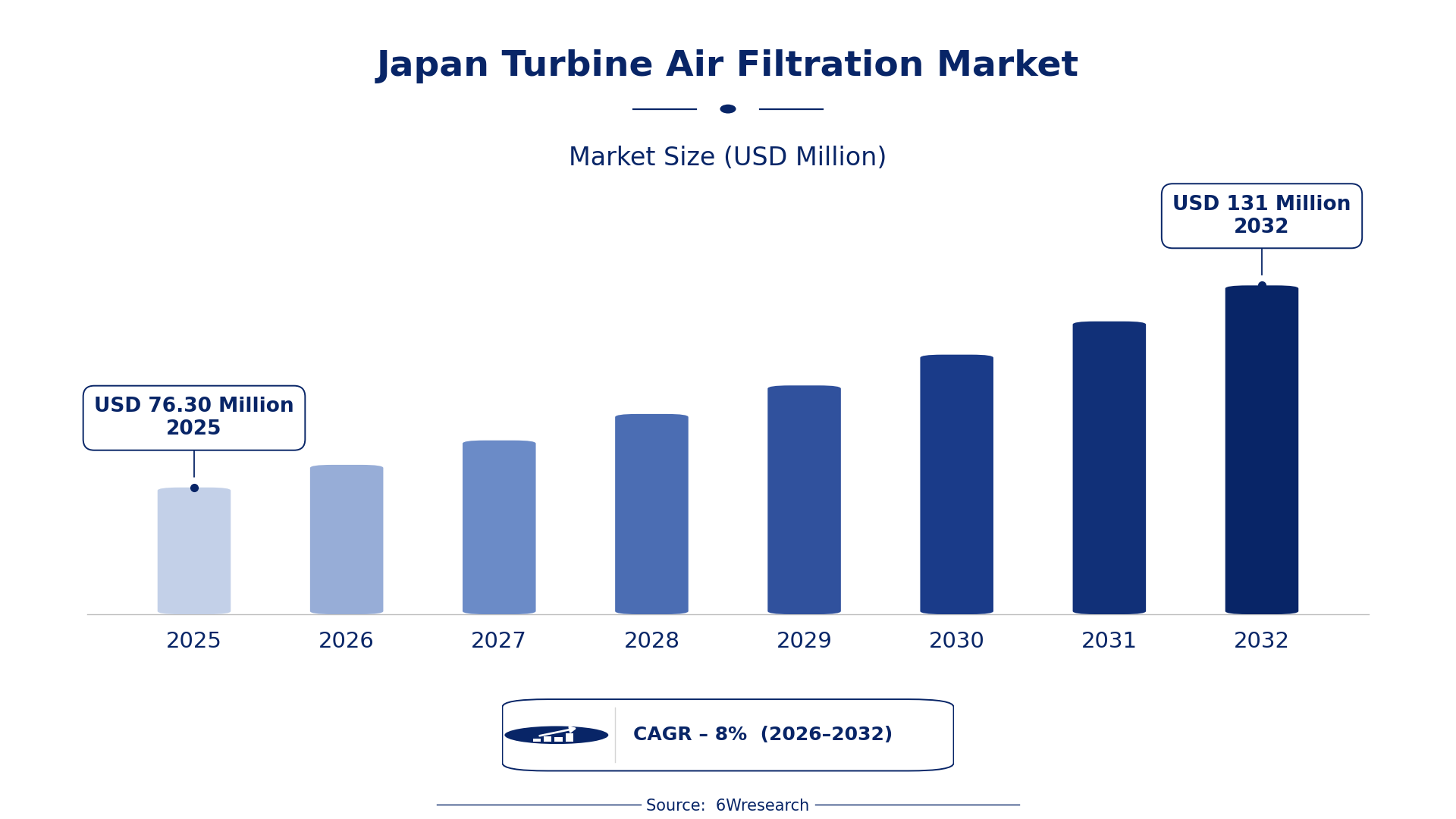
According to 6Wresearch internal database and industry insights, the Japan Turbine Air Filtration Market was valued at USD 76.30 Million in 2025 and is projected to reach USD 131 Million by 2032, growing at a CAGR of approximately 8% during 2026–2032.
Japan Turbine Air Filtration Market Highlights
| Report Metric | Details |
| Report Name | Japan Turbine Air Filtration Market (2026-2032) |
| Market Size 2025 | USD 76.30 Million |
| Market Size 2032 | USD 131 Million |
| Absolute Growth 2025–2032 | USD 54.70 Million |
| CAGR 2026–2032 | 8% |
| Peak Annual Growth | 8.8% in 2027 |
| Forecast Period | 2026–2032 |
| Historical Data | 2022–2025 |
| Base Year | 2025 |
| Leading Type, 2025 | Intake systems (33% share) |
| Leading Application, 2025 | Diesel and Gas Engines (43% share) |
| Fastest-Growing Type | Static air filters (11.6% CAGR) |
| Fastest-Growing Application | Gas Turbines (11.3% CAGR) |
| Growing Sector | energy sector |
| Key End Users | energy producers, manufacturers, industrial facilities, utility companies |
Japan Turbine Air Filtration Market Year-wise Growth Rate and Key Drivers (2022–2032)
This graph illustrates the annual growth rates of the market from 2022 to 2032, highlighting a steady upward trajectory and projected market expansion over the forecast period.
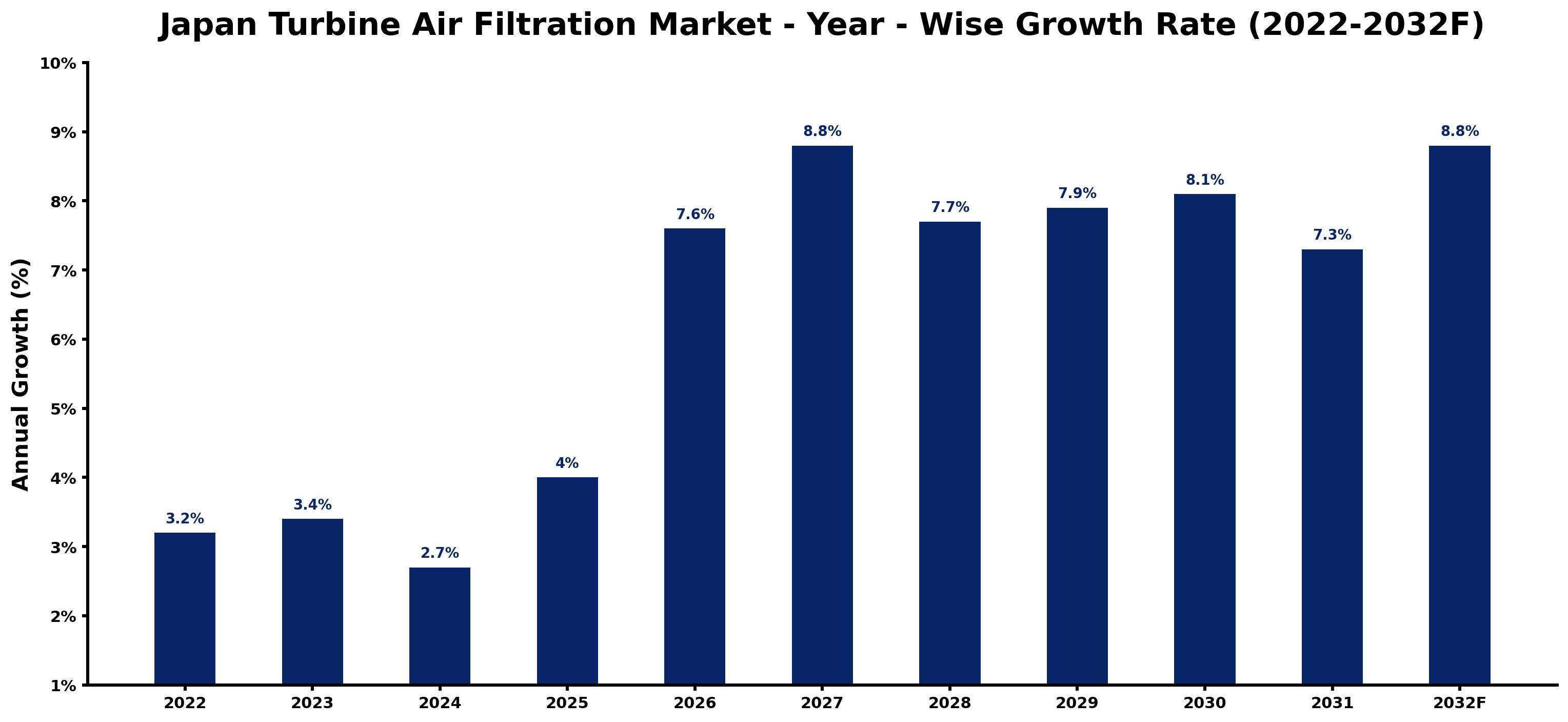
Each row of the following table gives one year's estimated growth and the event or demand shift that explains it.
| Year | Estimated Annual Growth (%) | Market Rationale |
| 2022 | 3.2 | The market showed steady growth due to ongoing industrial operations and energy sector demands. |
| 2023 | 3.4 | Demand increased as the energy sector continued to focus on cleaner technologies and efficient filtration solutions. |
| 2024 | 2.7 | Growth slowed slightly as market adjustments occurred following the previous year's surge in demand. |
| 2025 | 4.0 | The market experienced a notable increase as companies adopted high-efficiency filters to meet JIS standards. |
| 2026 | 7.6 | Demand is expected to accelerate as investments in energy efficiency and cleaner technologies gain traction. |
| 2027 | 8.8 | The market is projected to peak with heightened demand driven by advancements in filtration technologies and industrial applications. |
| 2028 | 7.7 | Growth is anticipated to slow as the market stabilises following peak demand in the previous year. |
| 2029 | 7.9 | Demand will pick up again as the energy sector continues to prioritise air quality and efficiency. |
| 2030 | 8.1 | Growth is expected to remain strong as technological advancements in filtration systems are widely adopted. |
| 2031 | 7.3 | The market will experience a slight slowdown as companies adjust to previous growth rates. |
| 2032 | 8.8 | Demand is projected to surge again as the adoption of advanced filtration technologies reaches new heights. |
Note: Market size estimations and growth projections presented in this report are based on 6Wresearch's proprietary forecasting methodology, utilizing the latest available industry data, government publications, and primary research inputs.
Japan Turbine Air Filtration Market Synopsis
Turbine air filtration systems filter air entering turbines, ensuring optimal performance and longevity. These systems are primarily used in gas turbines and diesel engines within the energy and manufacturing sectors. The Japan Turbine Air Filtration Market is expanding due to rising demand for high-efficiency filters that comply with stringent JIS standards and a national focus on cleaner technologies. The energy sector employs over 300,000 workers, driving the need for advanced filtration solutions, especially in regions such as Tokyo and Osaka. The adoption of eco-friendly technologies is further driving market expansion as industries aim to meet new regulations.
Market Dynamics Impact Analysis (2026–2032)
| Factor | Type | Impact | Primary Segment Affected |
| Rising industrial operations in the energy sector | Driver | High | Gas Turbines |
| Increased adoption of high-efficiency filters | Driver | High | Diesel and Gas Engines |
| Growing demand for eco-friendly technologies | Opportunity | High | Static air filters |
| Expansion of industrial facilities in urban areas | Opportunity | High | Generators and Utility Buildings |
| High initial investment costs for advanced filtration systems | Restraint | Medium | Cartridge filters |
| Stringent compliance with air quality regulations | Restraint | Medium | Nuclear Power Plants |
| Dependence on technological advancements | Challenge | High | Compact filters |
| Competition from alternative filtration solutions | Challenge | Medium | Pulse filters |
Evaluation of Drivers in Japan Turbine Air Filtration Market (2026–2032)
Below are the drivers that matter most for revenue growth, with supporting evidence.
| Drivers | Primary Segment Affected | Why It Matters (Evidence) |
| Increased energy sector employment | Gas Turbines | The energy sector employs over 300,000 workers, driving demand for efficient filtration systems to ensure optimal turbine performance. |
| Adoption of JIS standards | Diesel and Gas Engines | High-efficiency filters are required to meet stringent air quality regulations in the energy sector, particularly for gas turbines. |
| Investment in cleaner technologies | Static air filters | The emphasis on eco-friendly solutions is leading to increased purchases of advanced filtration systems, with growing investments in sustainable technologies. |
| Industrial expansion in urban areas | Generators and Utility Buildings | The concentration of facilities in regions like Tokyo is boosting demand for effective air filtration, with many companies upgrading their systems. |
| Growing awareness of air quality issues | Cartridge filters | As air quality concerns rise, industries are investing in filtration solutions to ensure compliance with regulations. |
The strongest pull on demand comes from the energy sector, which employs over 300,000 workers who require efficient filtration systems to maintain turbine performance. In 2023, the emphasis on cleaner technologies increased demand for high-efficiency filters, particularly in diesel and gas engines, which must comply with JIS standards. The growing awareness of air quality issues is prompting industries to invest in advanced filtration solutions. As a result, the market is expected to see sustained growth in the coming years, with substantial investments in cleaner technologies and upgrades to existing systems.
Evaluation of Restraints in Japan Turbine Air Filtration Market
The table below lists the restraints and the evidence behind each.
| Market Restraint | Primary Segment Affected | Why It Matters (Evidence) |
| High initial costs for advanced filtration systems | Cartridge filters | The high investment required can deter smaller manufacturers from upgrading their filtration systems. |
| Strict compliance with air quality regulations | Nuclear Power Plants | Meeting government regulations increases operational costs for facilities requiring specialized filtration. |
| Limited availability of advanced technologies | Compact filters | The reliance on advanced technology can restrict market access for some manufacturers. |
| Competition from alternative filtration solutions | Pulse filters | Emerging technologies may divert attention and investment away from traditional turbine air filtration systems. |
| Market saturation in certain regions | Static air filters | Intense competition in urban areas can limit growth opportunities for existing players. |
Japan Turbine Air Filtration Market Challenges
Japan's stringent JIS standards for gas turbine filters create supply constraints, as only a few manufacturers meet these requirements, delaying production timelines for energy sector producers. A shortage of skilled technicians in advanced filtration technologies hampers innovation, resulting in longer lead times for suppliers. Rising material costs for eco-friendly filtration systems are increasing expenses for clinics and industrial buyers, with some facing procurement cost hikes of up to 15%. Intense competition among producers for limited contracts drives down profit margins, forcing some to compromise on quality, which negatively affects operational efficiency for energy sector buyers.
Trends in the Japan Turbine Air Filtration Market
Four trends stand out in the Japan Turbine Air Filtration Market.
- Shift from Traditional to Advanced Filtration: Since 2023, Japan's energy sector has seen a clear shift towards advanced filtration technologies. The adoption of ISO 16890 standards is on the rise, with over 50 nuclear power plants requiring stringent measures for air quality.
- Transition to Eco-Friendly Filtration Solutions: The Japanese government is advocating for eco-friendly technologies, resulting in increased demand for sustainable filtration systems. In 2023, subsidies for filtration solutions in energy production have risen.
- Emergence of High-Efficiency Filters: The introduction of high-efficiency filters has become a priority for gas turbine applications, particularly in the Kanto region. This shift aligns with the industry's focus on meeting JIS standards and improving operational efficiency.
- Growing Demand for Filtration in Urban Areas: Industrial facilities in the Tokyo metropolitan area are increasingly investing in advanced filtration systems. The concentration of industries has led to a heightened demand for turbine air filtration solutions.
Investment Opportunities in the Japan Turbine Air Filtration Market
Where to invest in the Japan Turbine Air Filtration Market: the main openings are set out below.
- Industrial Facilities in Osaka: The Osaka region is experiencing strong demand for turbine air filtration due to its industrial base. With a market potential exceeding 76 million USD, suppliers can enter through local partnerships.
- Timing for Eco-Friendly Technologies: The current emphasis on cleaner technologies presents an opportunity for investment in advanced filtration systems. The energy sector is actively seeking solutions that comply with new regulations.
- Gap in Advanced Filtration Solutions: With a projected market size of 131 million USD by 2032, there is a clear gap for suppliers to fill in advanced filtration technologies. Companies can target the energy sector for growth.
- Entry through Joint Ventures: Establishing joint ventures with local firms can facilitate market entry for advanced filtration solutions. This approach allows for better alignment with regional standards and buyer expectations.
Government Initiatives in the Japan Turbine Air Filtration Market
The Act on the Rational Use of Energy, established in 1979, requires large energy users to improve their energy efficiency and report their consumption. This law has driven the need for improved filtration systems to meet energy standards, particularly in the industrial sector. In 2023, the GX Promotion Act was introduced, forming the legal framework for promoting eco-friendly technologies. The Ministry of the Environment supports initiatives that provide subsidies for advanced filtration systems in energy production, encouraging compliance with new regulations.
In 2024, the Hydrogen Society Promotion Act was enacted to support low-carbon hydrogen and ammonia supply chains with price-gap support. The Ministry of Economy, Trade and Industry (METI) oversees the implementation of these measures, ensuring that energy producers have access to the necessary resources to adopt cleaner technologies. This initiative is expected to further stimulate demand for advanced filtration systems in the energy sector.
Future Insight of the Japan Turbine Air Filtration Market
By 2032, the adoption of ISO 16890 standards will reshape demand for turbine air filtration systems, as manufacturers strive to meet enhanced air quality requirements. Government subsidies for eco-friendly filtration systems will encourage energy producers to upgrade their facilities, promoting cleaner technologies. Increased investment in advanced filtration solutions will stimulate innovation among suppliers, resulting in more efficient products. The energy sector, with over 300,000 workers, will increasingly focus on sustainable practices, improving operational performance across various industrial applications.
Market Segmentation Analysis
Japan Turbine Air Filtration Market report covers a detailed analysis of the following market segments:
By Type – Intake systems Lead, Static air filters Expected to Grow Fastest
According to Ravi Bhandari, Research Head at 6Wresearch, the largest type category in 2025 was Intake systems, at 33% of revenue. Intake systems hold the largest share due to their direct role in ensuring air quality for turbines, which is vital for optimal performance. The demand for high-efficiency filters in gas turbines to comply with JIS standards exemplifies this necessity. The quickest growth will come from Static air filters, forecast to expand at a CAGR of 11.6% between 2026 and 2032. Static air filters are experiencing rapid growth as they effectively eliminate particulates from air streams, essential for maintaining air quality in industrial settings. The increasing emphasis on cleaner technologies in Japan's energy policy is propelling the uptake of these filters. Suppliers must prioritise the development of high-efficiency static air filters to meet the rising demand in industrial applications.
By Application – Diesel and Gas Engines Lead, Gas Turbines Expected to Grow Fastest
In 2025, Diesel and Gas Engines led the application split with a 43% share. Diesel and Gas Engines dominate the market as they are crucial for engine performance within Japan's energy sector, which employs over 300,000 individuals. This reliance across various industrial applications drives a steady demand for effective filtration solutions. Gas Turbines are set to record the highest CAGR in this split, 11.3% over 2026–2032. Gas Turbines are the fastest-growing segment because they are essential for enhancing power generation efficiency, particularly as Japan transitions towards cleaner technologies. The ongoing implementation of advanced filtration systems in more facilities will likely sustain this growth. Buyers should invest in high-efficiency filtration solutions for gas turbines to ensure compliance with regulatory standards and improve operational performance.
Key Attractiveness of the Report
- 10 Years of Market Numbers
- Historical Data Starting from 2022 to 2025
- Base Year 2025
- Forecast Data until 2032
- Key Performance Indicators Impacting the Market
- Major Upcoming Developments and Projects
Key Highlights of the Report:
- Japan Turbine Air Filtration Market Outlook
- Market Size of Japan Turbine Air Filtration Market, 2025
- Forecast of Japan Turbine Air Filtration Market, 2032
- Historical Data and Forecast of Japan Turbine Air Filtration Revenues & Volume for the Period 2022-2032
- Japan Turbine Air Filtration Market Trend Evolution
- Japan Turbine Air Filtration Market Drivers and Challenges
- Japan Turbine Air Filtration Price Trends
- Japan Turbine Air Filtration Porter's Five Forces
- Japan Turbine Air Filtration Industry Life Cycle
- Historical Data and Forecast of Japan Turbine Air Filtration Market Revenues & Volume By Type for the Period 2022-2032
- Historical Data and Forecast of Japan Turbine Air Filtration Market Revenues & Volume By Intake systems for the Period 2022-2032
- Historical Data and Forecast of Japan Turbine Air Filtration Market Revenues & Volume By Static air filters for the Period 2022-2032
- Historical Data and Forecast of Japan Turbine Air Filtration Market Revenues & Volume By Cartridge filters for the Period 2022-2032
- Historical Data and Forecast of Japan Turbine Air Filtration Market Revenues & Volume By Compact filters for the Period 2022-2032
- Historical Data and Forecast of Japan Turbine Air Filtration Market Revenues & Volume By Pulse filters for the Period 2022-2032
- Historical Data and Forecast of Japan Turbine Air Filtration Market Revenues & Volume By Panel filters for the Period 2022-2032
- Historical Data and Forecast of Japan Turbine Air Filtration Market Revenues & Volume By Pre-cleaning filters for the Period 2022-2032
- Historical Data and Forecast of Japan Turbine Air Filtration Market Revenues & Volume By Application for the Period 2022-2032
- Historical Data and Forecast of Japan Turbine Air Filtration Market Revenues & Volume By Diesel and Gas Engines for the Period 2022-2032
- Historical Data and Forecast of Japan Turbine Air Filtration Market Revenues & Volume By Gas Turbines for the Period 2022-2032
- Historical Data and Forecast of Japan Turbine Air Filtration Market Revenues & Volume By Generators and Utility Buildings for the Period 2022-2032
- Historical Data and Forecast of Japan Turbine Air Filtration Market Revenues & Volume By Large Industrial Air Compressors for the Period 2022-2032
- Historical Data and Forecast of Japan Turbine Air Filtration Market Revenues & Volume By Nuclear Power Plants for the Period 2022-2032
- Japan Turbine Air Filtration Import Export Trade Statistics
- Market Opportunity Assessment By Type
- Market Opportunity Assessment By Application
- Japan Turbine Air Filtration Top Companies Market Share
- Japan Turbine Air Filtration Competitive Benchmarking By Technical and Operational Parameters
- Japan Turbine Air Filtration Company Profiles
- Japan Turbine Air Filtration Key Strategic Recommendations
Market Covered
The following segment groups are covered in the report.
By Type
- Intake systems
- Static air filters
- Cartridge filters
- Compact filters
- Pulse filters
- Panel filters
- Pre-cleaning filters
By Application
- Diesel and Gas Engines
- Gas Turbines
- Generators and Utility Buildings
- Large Industrial Air Compressors
- Nuclear Power Plants































