Japan Utility Billing Software Market Size & Growth Rate
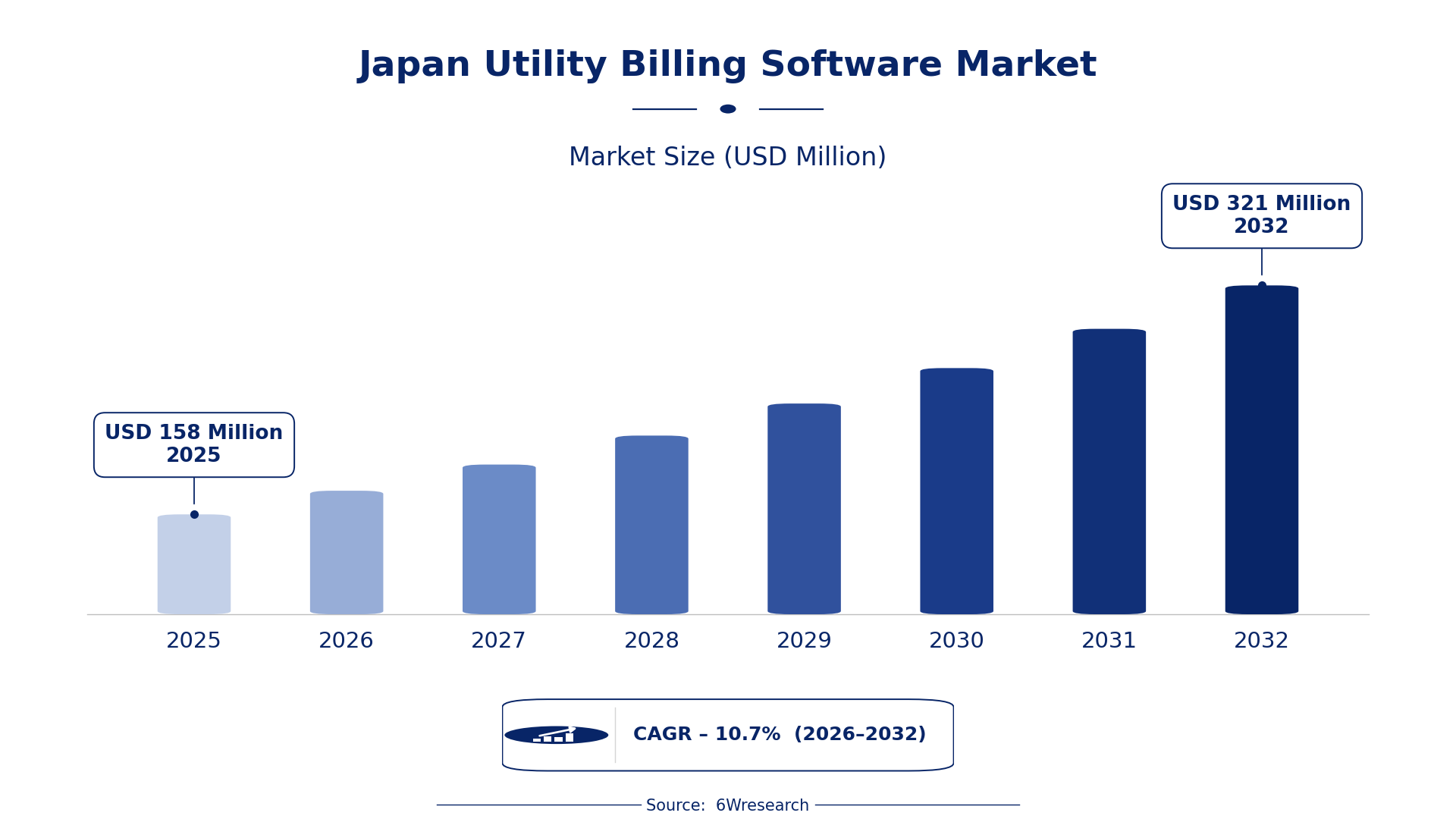
According to 6Wresearch internal database and industry insights, the Japan Utility Billing Software Market was valued at USD 158 Million in 2025 and is projected to reach USD 321 Million by 2032, growing at a CAGR of approximately 10.7% during 2026–2032.
Japan Utility Billing Software Market Highlights
| Report Metric | Details |
| Report Name | Japan Utility Billing Software Market (2026-2032) |
| Market Size 2025 | USD 158 Million |
| Market Size 2032 | USD 321 Million |
| Absolute Growth 2025–2032 | USD 163 Million |
| CAGR 2026–2032 | 10.7% |
| Peak Annual Growth | 12.5% in 2032 |
| Forecast Period | 2026–2032 |
| Historical Data | 2022–2025 |
| Base Year | 2025 |
| Leading Type, 2025 | Software as a Service (39% share) |
| Leading Application, 2025 | Power Company (54% share) |
| Fastest-Growing Application | Wind Energy (14.3% CAGR) |
| Growing Sector | utility management |
| Key End Users | water utilities, electricity providers, gas companies |
Japan Utility Billing Software Market Year-wise Growth Rate and Key Drivers (2022–2032)
This graph illustrates the annual growth rates of the market from 2022 to 2032, highlighting a steady upward trajectory and projected market expansion over the forecast period.
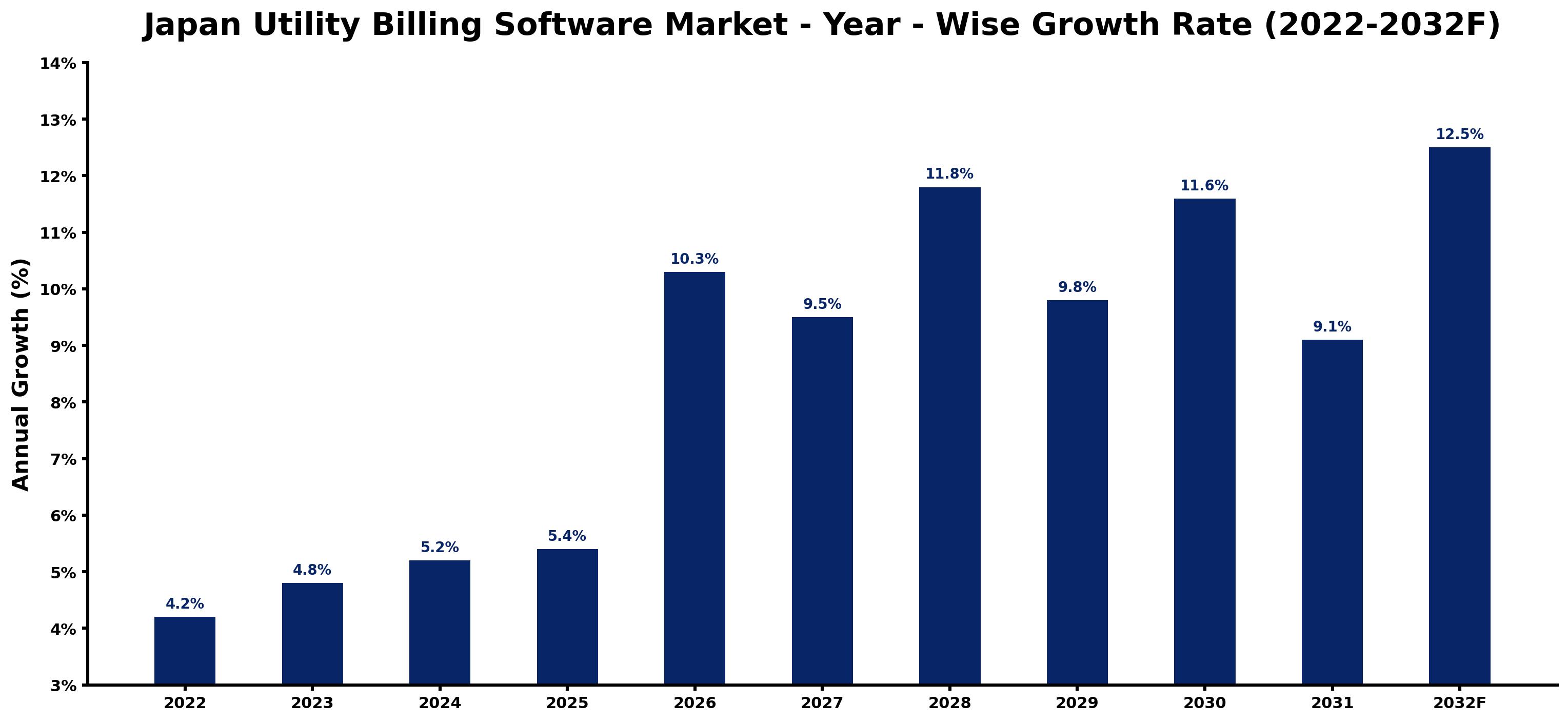
Year by year, the estimates below pair each growth rate with the development that shaped it.
| Year | Estimated Annual Growth (%) | Market Rationale |
| 2022 | 4.2 | The market showed steady growth with increasing adoption of utility billing software. |
| 2023 | 4.8 | Growth accelerated as more utilities sought to improve customer service capabilities. |
| 2024 | 5.2 | Demand continued to rise due to investments in smart grid technologies. |
| 2025 | 5.4 | The market peaked historically as utilities upgraded their billing systems. |
| 2026 | 10.3 | Growth surged as digital transformation initiatives are anticipated to gain momentum. |
| 2027 | 9.5 | Growth is projected to slow slightly as the market begins to stabilise after rapid expansion. |
| 2028 | 11.8 | Demand is expected to increase again as utilities focus on efficiency improvements. |
| 2029 | 9.8 | Growth will moderate as market saturation begins to set in. |
| 2030 | 11.6 | Demand is projected to pick up due to new technology integrations in billing systems. |
| 2031 | 9.1 | Growth is expected to decelerate as the market reaches a more mature phase. |
| 2032 | 12.5 | The market is projected to peak as utilities fully embrace cloud solutions. |
Note: Market size estimations and growth projections presented in this report are based on 6Wresearch's proprietary forecasting methodology, utilizing the latest available industry data, government publications, and primary research inputs.
Japan Utility Billing Software Market Synopsis
Utility Billing Software automates billing processes for essential services such as water, electricity, and gas. The Japan Utility Billing Software Market is projected to grow, reaching USD 321 million by 2032, driven by over 126 million residents relying on efficient utility management. Key factors include ongoing investments in smart grid technologies and the government's push for digitisation, highlighted by a ¥10 billion allocation for energy efficiency programs in 2023.
Market Dynamics Impact Analysis (2026–2032)
| Factor | Type | Impact | Primary Segment Affected |
| Increasing adoption of cloud-based solutions enhances billing efficiency. | Driver | High | Software as a Service |
| Rising demand for improved customer service drives software upgrades. | Driver | High | On-premise |
| Investment in smart grid technologies creates new software needs. | Opportunity | High | Power Company |
| Government initiatives to digitise utility processes open new markets. | Opportunity | High | Drinking Water Company |
| Regulatory compliance requirements can slow software updates. | Restraint | Medium | On-premise |
| High costs of implementation deter smaller utilities from upgrading. | Restraint | Medium | Software as a Service |
| Limited technical expertise in smaller utilities hampers adoption. | Challenge | High | Power Company |
| Competition from alternative billing solutions pressures pricing. | Challenge | Medium | Drinking Water Company |
Evaluation of Drivers in Japan Utility Billing Software Market (2026–2032)
The factors lifting demand, and the evidence behind each, are summarised below.
| Drivers | Primary Segment Affected | Why It Matters (Evidence) |
| Increased regulatory requirements necessitate software upgrades. | On-premise | Utilities must comply with standards like ISO 50001, promoting software investments for compliance. |
| Government funding for energy efficiency promotes software digitisation. | Drinking Water Company | In 2023, ¥10 billion was allocated for energy efficiency programs, driving software needs. |
| Rising electricity consumption necessitates efficient billing solutions. | Software as a Service | The average household in Japan uses approximately 280 kWh of electricity monthly, increasing billing complexity. |
| Growing customer bases require advanced billing capabilities. | Power Company | Utilities managing large volumes of customer data must invest in modern billing systems. |
| Adoption of smart grid technologies enhances billing processes. | Wind Energy | As the sector grows, utilities need software that integrates with smart grid solutions. |
Buyers are adding capacity as the utility sector embraces digital transformation, with over 126 million residents relying on efficient utility management. The average household consumes approximately 280 kWh of electricity monthly, necessitating advanced billing solutions. Compliance with standards drives demand for effective systems, particularly among utilities managing large customer bases. Ongoing investments in smart grid technologies further support the need for modernised billing processes.
Evaluation of Restraints in Japan Utility Billing Software Market
Below are the constraints most often cited by buyers and suppliers, with the segment each affects.
| Market Restraint | Primary Segment Affected | Why It Matters (Evidence) |
| High implementation costs deter smaller utilities from adopting new systems. | Software as a Service | Smaller utilities struggle with the financial burden of upgrading their software solutions. |
| Regulatory compliance can complicate software integration processes. | On-premise | Utilities face challenges in ensuring their systems meet standards like ISO 50001. |
| Limited technical expertise in smaller utilities hampers software adoption. | Power Company | Many smaller utilities lack the necessary IT skills to implement advanced solutions. |
| Market saturation leads to slower growth in software upgrades. | Drinking Water Company | As the market matures, fewer utilities seek to invest in new systems. |
| Competition from alternative solutions pressures pricing and margins. | Software as a Service | Utilities may opt for less expensive options, affecting premium software sales. |
Japan Utility Billing Software Market Challenges
Intense competition among utility billing software providers drives down prices, limiting revenue for suppliers and reducing their ability to invest in system improvements. Rapid technological advancements create pressure to upgrade systems, causing delays for utilities that find it challenging to implement new solutions. Rising operational costs, underscored by Japan's minimum wage increase to JPY 1,055 per hour, strain budgets for utilities, potentially leading to service cutbacks affecting over 126 million residents. Supply chain disruptions can impede the availability of crucial software updates, resulting in delays for utilities that rely on timely billing processes to ensure customer satisfaction.
Trends in the Japan Utility Billing Software Market
These developments are changing demand patterns in the Japan Utility Billing Software Market.
- Shift to Cloud-Based Billing Solutions: Since 2023, many utilities have transitioned to cloud-based billing systems to improve efficiency. The trend is driven by the need for scalable solutions, with the average water bill in Japan around ¥3,000 per month.
- Increased Focus on Customer Experience: As of 2023, utilities are prioritising customer service improvements through upgraded billing software. This shift is evident in the Tokyo metropolitan area, where high customer density demands efficient processes.
- Adoption of Smart Grid Technologies: Beginning in 2023, utilities have increasingly integrated smart grid technologies into their billing systems. This integration supports better energy management, aligning with the push for energy efficiency.
- Regulatory Compliance Driving Software Upgrades: In 2025, utilities began prioritising compliance with ISO 50001, leading to increased software investments. This focus ensures that systems meet necessary energy management standards.
Investment Opportunities in the Japan Utility Billing Software Market
Investors looking at the Japan Utility Billing Software Market should consider the following areas.
- Utility Billing Software: With the market gap for advanced software solutions, there is a chance for suppliers to meet demand. Partnering with local utilities can facilitate entry into this growing market.
- Cloud-Based Solutions: The shift to cloud-based billing systems offers an opportunity for software providers. Collaborating with power companies can improve service offerings and drive growth.
- Smart Grid Integration: Investing in software that supports smart grid technologies can meet demand. Utilities managing large customer bases represent key buyer groups for innovative solutions.
- Energy Efficiency Programs: With ¥10 billion allocated for energy efficiency in 2023, there is an opportunity to supply advanced billing solutions. Engaging with the Japan Water Works Association can facilitate market entry.
Government Initiatives in the Japan Utility Billing Software Market
The Act against Unjustifiable Premiums and Misleading Representations, enacted in 1962, prohibits misleading labelling and advertising of goods, impacting utility billing software producers by ensuring transparency in pricing and service offerings. This measure requires utilities to maintain accurate billing practices, benefiting consumers and building trust in utility services.
The Consumer Affairs Agency oversees compliance with regulations affecting utility billing software. This agency approves funding for projects that digitise utility billing processes, facilitating the adoption of innovative solutions by utilities.
Future Insight of the Japan Utility Billing Software Market
By 2032, Japan's utility sector will undergo a policy-driven shift towards smart energy systems, prompting suppliers to innovate their offerings. The government's recent launch of a program to digitize utility billing processes will streamline operations and improve efficiency. Increased adoption of ISO 50001 standards will drive utilities to enhance energy management practices. As these advancements unfold, buyers will benefit from improved customer service and more efficient billing cycles.
Market Segmentation Analysis
Japan Utility Billing Software Market report covers a detailed analysis of the following market segments:
By Type – Software as a Service Leads and Records the Fastest Growth
According to Sumit Sagar, AM at 6Wresearch, the largest type category in 2025 was Software as a Service, at 39% of revenue. Software as a Service holds the largest share because it is widely adopted among utility providers, offering scalable solutions that cater to various billing requirements. An example is the Tokyo Electric Power Company, which utilises this model to efficiently manage its extensive customer base. Its lead should widen, with a projected CAGR of 12.0% during 2026–2032, the highest in this split. The preference for Software as a Service will likely widen its lead, as utilities increasingly adopt cloud-based solutions for their flexibility and cost-effectiveness. The government's initiative to digitise utility billing processes further accelerates this trend. Suppliers should prioritise cloud-based offerings to meet the rising demand from utility providers.
By Application – Power Company Leads, Wind Energy Expected to Grow Fastest
Power Company held 54% of the Japan Utility Billing Software Market by application in 2025. The Power Company segment leads the application category as it is crucial for managing extensive customer data and billing processes efficiently. This is particularly highlighted by the Tokyo Electric Power Company, which exemplifies the need for robust billing solutions in a densely populated area. Over 2026–2032, Wind Energy is expected to post the fastest growth, at a CAGR of 14.3%. Wind Energy is witnessing rapid growth driven by heightened investments in renewable energy, with government initiatives actively promoting sustainable energy practices. As this sector continues to develop, the demand for tailored billing solutions will significantly increase. Suppliers should focus on developing advanced billing solutions to cater to the evolving needs of the wind energy sector.
Key Attractiveness of the Report
- 10 Years of Market Numbers
- Historical Data Starting from 2022 to 2025
- Base Year 2025
- Forecast Data until 2032
- Key Performance Indicators Impacting the Market
- Major Upcoming Developments and Projects
Key Highlights of the Report:
- Japan Utility Billing Software Market Outlook
- Market Size of Japan Utility Billing Software Market, 2025
- Forecast of Japan Utility Billing Software Market, 2032
- Historical Data and Forecast of Japan Utility Billing Software Revenues & Volume for the Period 2022-2032
- Japan Utility Billing Software Market Trend Evolution
- Japan Utility Billing Software Market Drivers and Challenges
- Japan Utility Billing Software Price Trends
- Japan Utility Billing Software Porter's Five Forces
- Japan Utility Billing Software Industry Life Cycle
- Historical Data and Forecast of Japan Utility Billing Software Market Revenues & Volume By Type for the Period 2022-2032
- Historical Data and Forecast of Japan Utility Billing Software Market Revenues & Volume By Software as a Service for the Period 2022-2032
- Historical Data and Forecast of Japan Utility Billing Software Market Revenues & Volume By Platform as a Service for the Period 2022-2032
- Historical Data and Forecast of Japan Utility Billing Software Market Revenues & Volume By Infrastructure as a Service for the Period 2022-2032
- Historical Data and Forecast of Japan Utility Billing Software Market Revenues & Volume By On-premise for the Period 2022-2032
- Historical Data and Forecast of Japan Utility Billing Software Market Revenues & Volume By Application for the Period 2022-2032
- Historical Data and Forecast of Japan Utility Billing Software Market Revenues & Volume By Drinking Water Company for the Period 2022-2032
- Historical Data and Forecast of Japan Utility Billing Software Market Revenues & Volume By Power Company for the Period 2022-2032
- Historical Data and Forecast of Japan Utility Billing Software Market Revenues & Volume By Gas Station for the Period 2022-2032
- Historical Data and Forecast of Japan Utility Billing Software Market Revenues & Volume By Wind Energy for the Period 2022-2032
- Japan Utility Billing Software Import Export Trade Statistics
- Market Opportunity Assessment By Type
- Market Opportunity Assessment By Application
- Japan Utility Billing Software Top Companies Market Share
- Japan Utility Billing Software Competitive Benchmarking By Technical and Operational Parameters
- Japan Utility Billing Software Company Profiles
- Japan Utility Billing Software Key Strategic Recommendations
Market Covered
The report covers the following segments.
By Type
- Software as a Service
- Platform as a Service
- Infrastructure as a Service
- On-premise
By Application
- Drinking Water Company
- Power Company
- Gas Station
- Wind Energy































