Japan Vaccine Logistics Market Size & Growth Rate
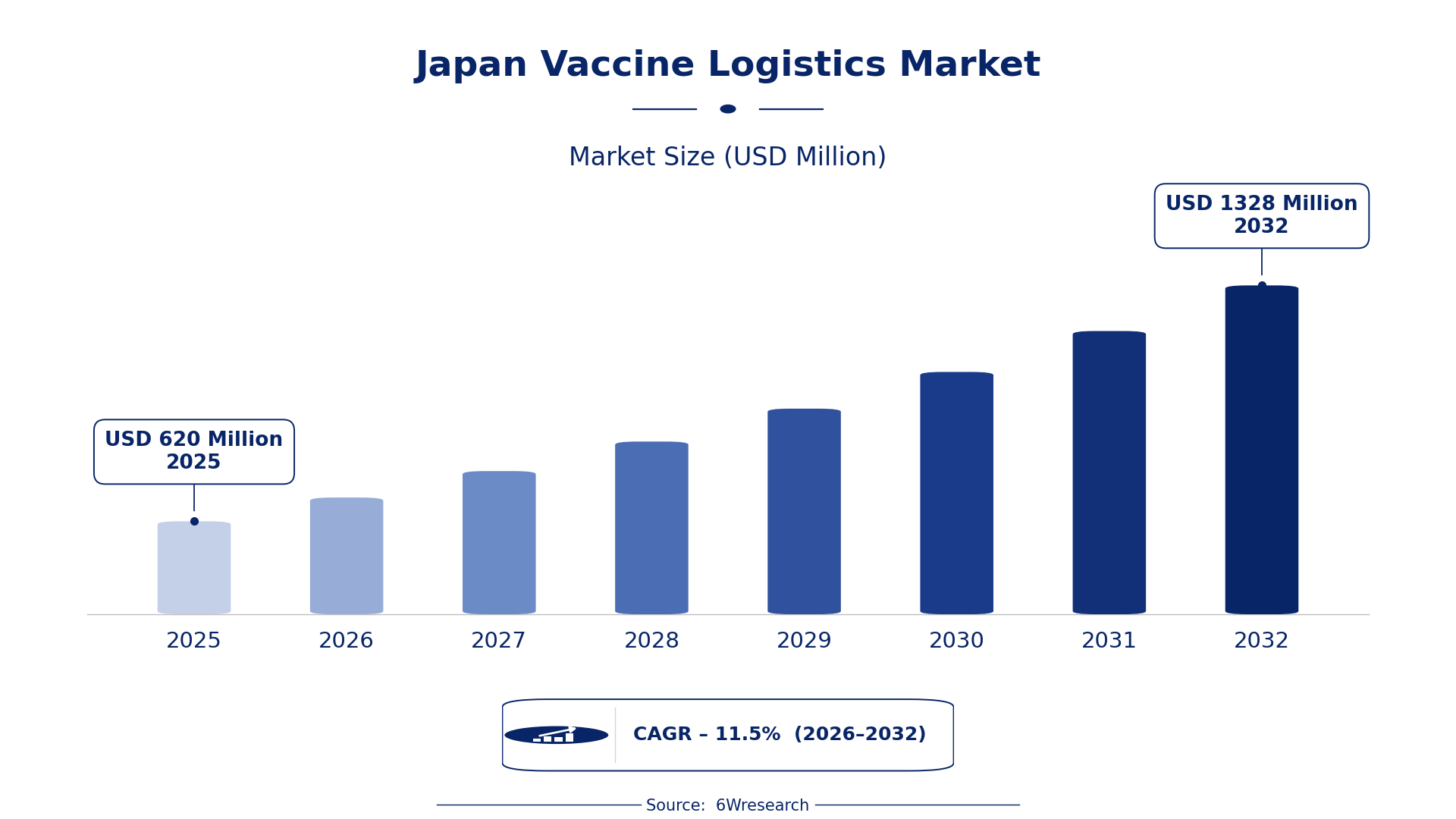
According to 6Wresearch internal database and industry insights, the Japan Vaccine Logistics Market was valued at USD 620 Million in 2025 and is projected to reach USD 1,328 Million by 2032, growing at a CAGR of approximately 11.5% during 2026–2032.
Japan Vaccine Logistics Market Highlights
| Report Metric | Details |
| Report Name | Japan Vaccine Logistics Market (2026-2032) |
| Market Size 2025 | USD 620 Million |
| Market Size 2032 | USD 1,328 Million |
| Absolute Growth 2025–2032 | USD 708 Million |
| CAGR 2026–2032 | 11.5% |
| Peak Annual Growth | 13.4% in 2032 |
| Forecast Period | 2026–2032 |
| Historical Data | 2022–2025 |
| Base Year | 2025 |
| Leading Type, 2025 | Refrigerated Storage (62% share) |
| Leading Application, 2025 | Covid-19 Vaccine (58% share) |
| Fastest-Growing Type | Cold Chain Logistics (15.7% CAGR) |
| Fastest-Growing Application | Other Vaccines (14.7% CAGR) |
| Growing Sector | Healthcare |
| Key End Users | Healthcare providers, public health agencies, logistics companies, hospitals |
Japan Vaccine Logistics Market Year-wise Growth Rate and Key Drivers (2022–2032)
This graph illustrates the annual growth rates of the market from 2022 to 2032, highlighting a steady upward trajectory and projected market expansion over the forecast period.
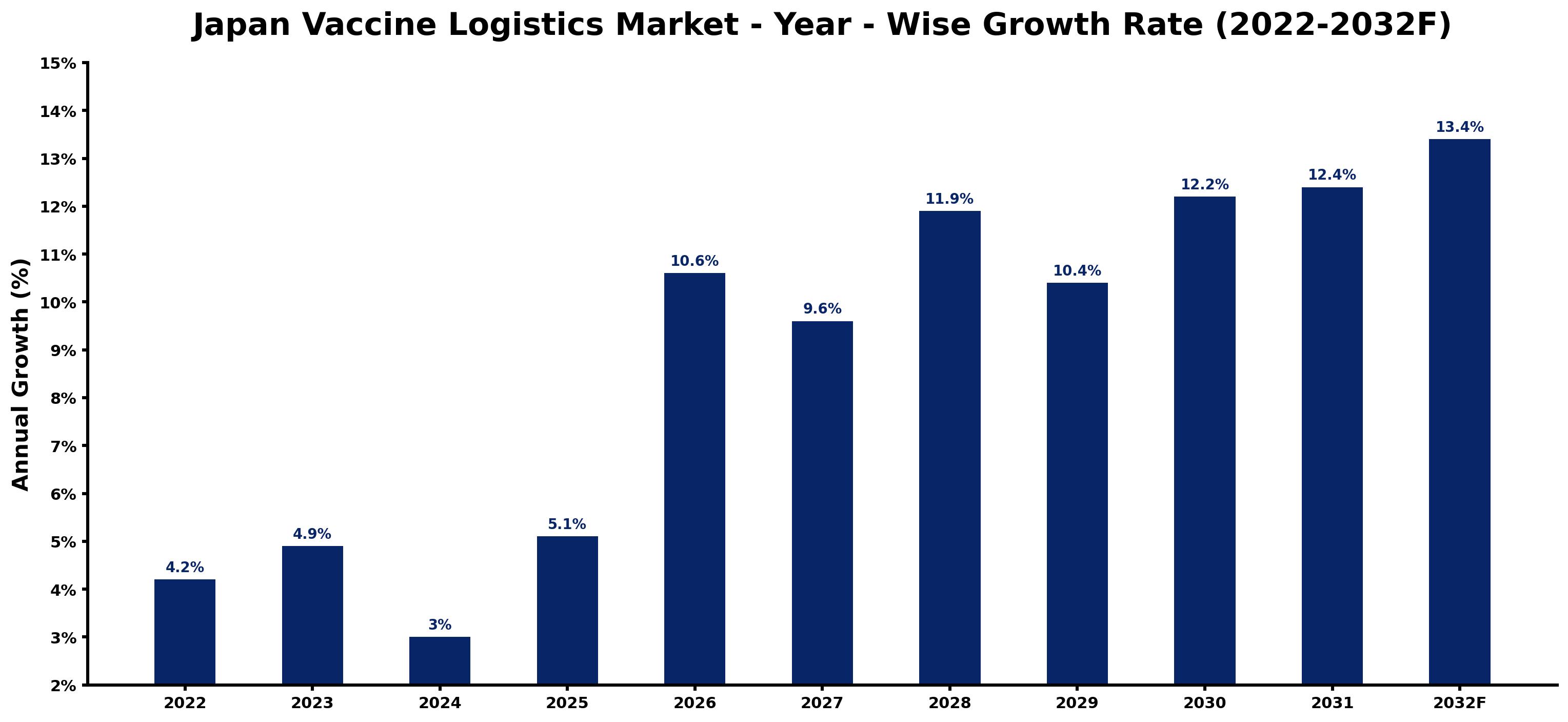
Each row of the following table gives one year's estimated growth and the event or demand shift that explains it.
| Year | Estimated Annual Growth (%) | Market Rationale |
| 2022 | 4.2 | The market experienced steady growth due to ongoing vaccination efforts. |
| 2023 | 4.9 | Demand increased as healthcare providers expanded their vaccination programmes. |
| 2024 | 3.0 | Growth slowed as logistical challenges emerged in distribution networks. |
| 2025 | 5.1 | A surge in vaccinations drove faster growth than before. |
| 2026 | 10.6 | Investment in cold chain infrastructure is expected to drive demand for logistics services. |
| 2027 | 9.6 | A slight slowdown is projected as the market adjusts to new capacities. |
| 2028 | 11.9 | Growth will pick up again due to rising demand for routine vaccinations. |
| 2029 | 10.4 | The market will continue to grow, albeit at a slower pace than previously. |
| 2030 | 12.2 | Demand is expected to surge as new vaccination campaigns are launched across the country. |
| 2031 | 12.4 | Growth will remain strong with increased focus on vaccine distribution efficiency. |
| 2032 | 13.4 | The market is projected to peak as public health initiatives expand. |
Note: Market size estimations and growth projections presented in this report are based on 6Wresearch's proprietary forecasting methodology, utilizing the latest available industry data, government publications, and primary research inputs.
Japan Vaccine Logistics Market Synopsis
Vaccine logistics encompasses the processes and systems for storing and transporting vaccines, ensuring they remain at required temperatures. In Japan, the industry thrives, supported by a robust healthcare system and ongoing vaccination efforts. The government allocated ¥100 billion for vaccine logistics infrastructure in 2023, underscoring its commitment to improving distribution networks. Demand is further propelled by routine immunisation programmes and adherence to ISO 9001 standards in cold chain logistics. With a population of approximately 125 million, extensive logistics solutions are crucial for public health.
Market Dynamics Impact Analysis (2026–2032)
| Factor | Type | Impact | Primary Segment Affected |
| Growing investment in cold chain infrastructure | Driver | High | Cold Chain Logistics |
| Increasing vaccination campaigns for Covid-19 and routine immunizations | Driver | High | Covid-19 Vaccine |
| Expansion of refrigerated storage facilities | Opportunity | High | Refrigerated Storage |
| Rising demand for vaccine distribution in urban areas | Opportunity | Medium | Cold Chain Logistics |
| Challenges in maintaining temperature control during transportation | Restraint | High | Cold Chain Logistics |
| Limited availability of trained personnel in logistics | Restraint | Medium | Refrigerated Storage |
| Supply chain disruptions affecting timely delivery | Challenge | High | Cold Chain Logistics |
| High operational costs for maintaining cold chain standards | Challenge | Medium | Refrigerated Storage |
Evaluation of Drivers in Japan Vaccine Logistics Market (2026–2032)
The factors lifting demand, and the evidence behind each, are summarised below.
| Drivers | Primary Segment Affected | Why It Matters (Evidence) |
| Investment in advanced cold chain technologies | Cold Chain Logistics | This investment improves the efficiency of vaccine transportation, leading to increased demand from healthcare providers. |
| Rising public health initiatives | Covid-19 Vaccine | These initiatives drive higher volumes of vaccine distribution, prompting greater logistics needs. |
| Growing population requiring vaccinations | Cold Chain Logistics | Japan's population of approximately 125 million necessitates extensive vaccine logistics solutions. |
| Implementation of ISO 9001 standards | Cold Chain Logistics | Adhering to these standards ensures quality control, increasing trust among healthcare providers. |
| Government funding for logistics infrastructure | Refrigerated Storage | The ¥100 billion allocated in 2023 supports the expansion of storage facilities, boosting capacity. |
Orders keep climbing as investment in advanced cold chain technologies improves vaccine transportation efficiency. Japan's population of approximately 125 million drives demand for extensive logistics solutions, particularly for vaccinations. Public health campaigns are increasing the volume of vaccines distributed, further boosting logistics needs. The implementation of ISO 9001 standards ensures quality control, increasing trust among healthcare providers. The ¥100 billion allocated for logistics infrastructure in 2023 facilitates the expansion of refrigerated storage facilities to meet rising demand.
Evaluation of Restraints in Japan Vaccine Logistics Market
The key brakes on demand, and where they bite hardest, are shown below.
| Market Restraint | Primary Segment Affected | Why It Matters (Evidence) |
| Temperature control challenges during transportation | Cold Chain Logistics | Maintaining required temperatures is critical, and failures can lead to vaccine spoilage, impacting public health. |
| Shortage of trained logistics personnel | Refrigerated Storage | The limited workforce affects operational efficiency, delaying vaccine distribution efforts. |
| High operational costs for cold chain maintenance | Cold Chain Logistics | These costs can deter smaller healthcare providers from investing in necessary logistics solutions. |
| Regulatory compliance complexities | Refrigerated Storage | Navigating compliance with various standards can slow down the implementation of new facilities. |
| Supply chain disruptions from global events | Cold Chain Logistics | Events can severely impact logistics networks, delaying vaccine delivery. |
Japan Vaccine Logistics Market Challenges
Producers face outdated cold chain technology, leading to inefficiencies in vaccine storage and transport. This issue arises from a lack of investment in modern systems, resulting in potential vaccine spoilage that can cost hospitals millions in wasted resources. Buyers encounter delays due to stringent regulations from the Ministry of Health, Labour and Welfare, which can extend distribution timelines and inflate operational expenses by up to 20%. Compliance with ISO 9001 standards requires additional staff training, diverting funds from critical patient care. Supply chain disruptions in key regions like Tokyo and Osaka can postpone deliveries, impacting immunisation schedules for over 8,000 hospitals.
Trends in the Japan Vaccine Logistics Market
These developments are changing demand patterns in the Japan Vaccine Logistics Market.
- Transition to Advanced Cold Chain Technologies: Japan is embracing advanced cold chain technologies to boost vaccine logistics efficiency. The implementation of IoT-enabled monitoring systems ensures better temperature control, preserving vaccine efficacy during transport.
- Increased Focus on Urban Vaccine Distribution: Healthcare providers are prioritising urban areas for vaccine distribution due to higher population density. In Tokyo, the government is investing in new refrigerated storage facilities to address this demand.
- Rising Adoption of ISO 9001 Standards: Vaccine logistics companies are increasingly aligning with ISO 9001 standards to guarantee quality. This trend is reflected in the growing number of certified facilities across Japan, enhancing trust in vaccine efficacy.
- Expansion of Public Health Initiatives: Public health campaigns are broadening to include routine immunisations alongside vaccinations. The Ministry of Health, Labour and Welfare is spearheading these initiatives, aiming to boost overall vaccination rates.
Investment Opportunities in the Japan Vaccine Logistics Market
Several openings in the Japan Vaccine Logistics Market merit attention from investors.
- Investment in Refrigerated Storage Facilities: There is a rising need for refrigerated storage solutions to support vaccine logistics. Healthcare providers in urban regions require these facilities to ensure efficient distribution, especially with a population of 125 million.
- Supply of Advanced Cold Chain Technologies: The demand for advanced cold chain technologies is increasing as healthcare providers seek efficiency. Facilities in Tokyo are looking for local partners to implement these technologies effectively.
- Development of Integrated Logistics Solutions: The current demand for integrated logistics solutions is substantial, particularly for urban healthcare providers. Investing in these solutions can streamline distribution processes and reduce costs.
- Enhancement of Training Programs for Logistics Personnel: With a shortage of trained personnel, there is an opportunity to develop training programmes. Targeting healthcare providers in Osaka can help cultivate a skilled workforce for vaccine logistics.
Government Initiatives in the Japan Vaccine Logistics Market
The Industrial Standardization Act, amended in 2019, regulates product and test standards for vaccine logistics. This law ensures that all facilities maintain high-quality standards, which is crucial for vaccine efficacy. Additionally, the NHI drug price standard, revised regularly, sets reimbursement prices for drugs, influencing logistics costs for healthcare providers. The GX Basic Policy, adopted in 2023, aims at substantial public-private decarbonisation investment over 10 years, further supporting logistics infrastructure.
In 2023, the government allocated ¥100 billion for vaccine logistics infrastructure, overseen by the Ministry of Health, Labour and Welfare. This funding facilitates the development of cold chain facilities, ensuring timely vaccine distribution across the country.
Future Insight of the Japan Vaccine Logistics Market
New refrigerated storage facilities will be established by 2032, driven by the government's commitment to improve vaccine logistics infrastructure. Advanced technologies will streamline storage and transport processes, ensuring faster access to vaccines for healthcare providers. The Japan Vaccine Association will promote best practices, leading to improved adherence to updated operational standards. Consequently, hospitals will experience reduced vaccine wastage and increased immunisation rates, positively impacting public health initiatives across the nation.
Market Segmentation Analysis
Japan Vaccine Logistics Market report covers a detailed analysis of the following market segments:
By Type – Refrigerated Storage Leads, Cold Chain Logistics Expected to Grow Fastest
According to Sumit Sagar, AM at 6Wresearch, Refrigerated Storage held 62% of the Japan Vaccine Logistics Market by type in 2025. Refrigerated storage holds the largest share as it is crucial for maintaining vaccine efficacy during storage. Facilities in Japan must comply with strict temperature regulations, ensuring vaccines remain effective for healthcare providers. Cold Chain Logistics is set to record the highest CAGR in this split, 15.7% over 2026–2032. Cold chain logistics is witnessing rapid growth due to its critical role in transporting vaccines under controlled conditions. The government's ¥100 billion investment in vaccine logistics infrastructure in 2023 indicates a strong commitment to improving distribution capabilities. Suppliers must focus on enhancing cold chain logistics to meet the increasing demand.
By Application – Covid-19 Vaccine Leads, Other Vaccines Expected to Grow Fastest
Covid-19 Vaccine took 58% of application revenue in 2025, more than any other category. The Covid-19 vaccine application leads the market due to its significant emphasis amid ongoing vaccination efforts across the country. With a population of approximately 125 million, efficient distribution of these vaccines is essential. The quickest growth will come from Other Vaccines, forecast to expand at a CAGR of 14.7% between 2026 and 2032. Other vaccines are seeing swift growth as they are necessary for routine immunization programs, which are vital for public health. The active involvement of the Japan Vaccine Association in promoting best practices further accelerates this segment's development. Suppliers should prepare for increasing demand in the other vaccines segment to align with public health initiatives.
Key Attractiveness of the Report
- 10 Years of Market Numbers
- Historical Data Starting from 2022 to 2025
- Base Year 2025
- Forecast Data until 2032
- Key Performance Indicators Impacting the Market
- Major Upcoming Developments and Projects
Key Highlights of the Report:
- Japan Vaccine Logistics Market Outlook
- Market Size of Japan Vaccine Logistics Market, 2025
- Forecast of Japan Vaccine Logistics Market, 2032
- Historical Data and Forecast of Japan Vaccine Logistics Revenues & Volume for the Period 2022-2032
- Japan Vaccine Logistics Market Trend Evolution
- Japan Vaccine Logistics Market Drivers and Challenges
- Japan Vaccine Logistics Price Trends
- Japan Vaccine Logistics Porter's Five Forces
- Japan Vaccine Logistics Industry Life Cycle
- Historical Data and Forecast of Japan Vaccine Logistics Market Revenues & Volume By Type for the Period 2022-2032
- Historical Data and Forecast of Japan Vaccine Logistics Market Revenues & Volume By Refrigerated Storage for the Period 2022-2032
- Historical Data and Forecast of Japan Vaccine Logistics Market Revenues & Volume By Cold Chain Logistics for the Period 2022-2032
- Historical Data and Forecast of Japan Vaccine Logistics Market Revenues & Volume By Application for the Period 2022-2032
- Historical Data and Forecast of Japan Vaccine Logistics Market Revenues & Volume By Covid-19 Vaccine for the Period 2022-2032
- Historical Data and Forecast of Japan Vaccine Logistics Market Revenues & Volume By Other Vaccines for the Period 2022-2032
- Japan Vaccine Logistics Import Export Trade Statistics
- Market Opportunity Assessment By Type
- Market Opportunity Assessment By Application
- Japan Vaccine Logistics Top Companies Market Share
- Japan Vaccine Logistics Competitive Benchmarking By Technical and Operational Parameters
- Japan Vaccine Logistics Company Profiles
- Japan Vaccine Logistics Key Strategic Recommendations
Market Covered
The report covers the following segments.
By Type
- Refrigerated Storage
- Cold Chain Logistics
By Application
- Covid-19 Vaccine
- Other Vaccines































