Japan Vacuum Fillers Market Size & Growth Rate
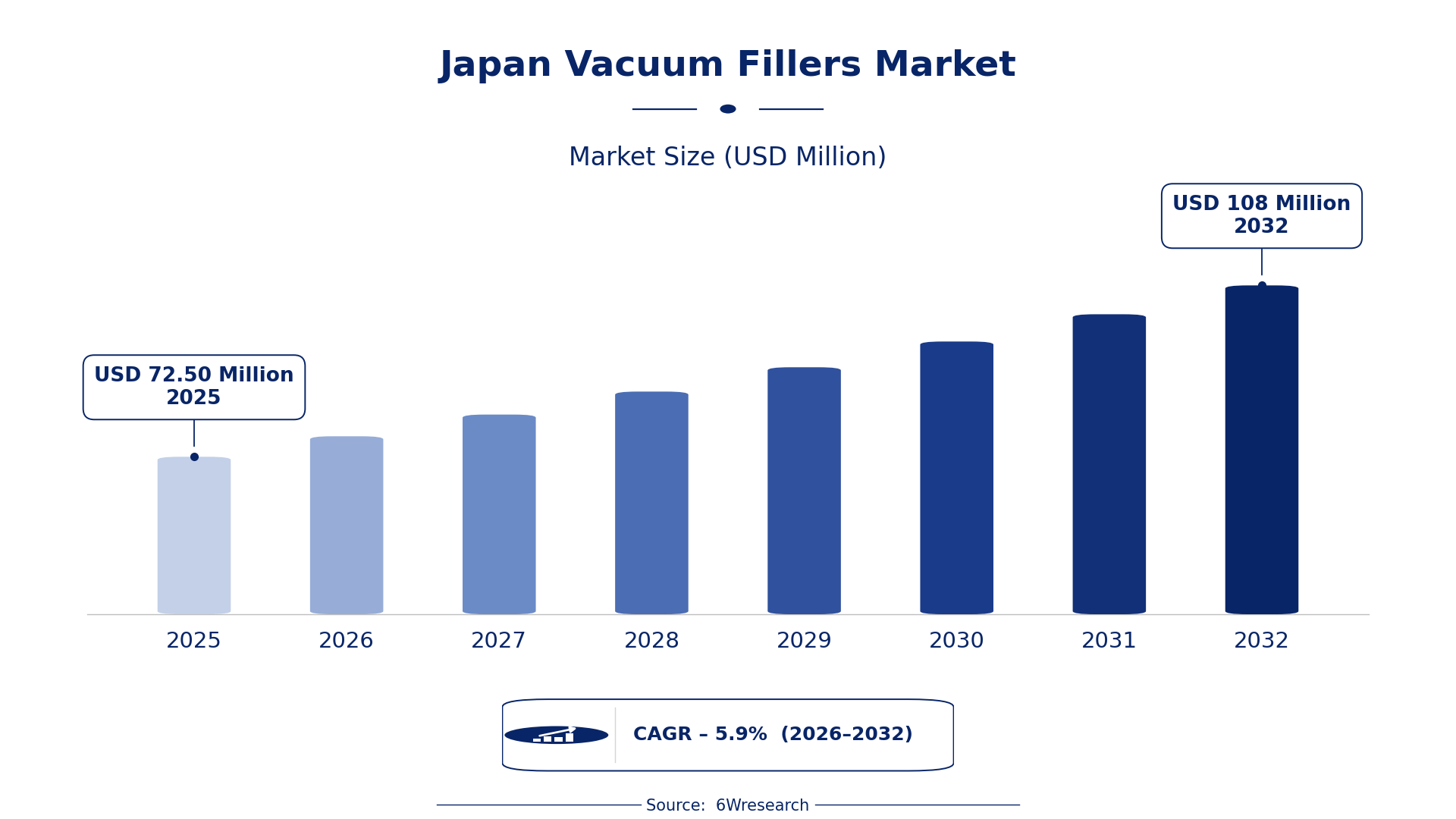
According to 6Wresearch internal database and industry insights, the Japan Vacuum Fillers Market was valued at USD 72.50 Million in 2025 and is projected to reach USD 108 Million by 2032, growing at a CAGR of approximately 5.9% during 2026–2032.
Japan Vacuum Fillers Market Highlights
| Report Metric | Details |
| Report Name | Japan Vacuum Fillers Market (2026-2032) |
| Market Size 2025 | USD 72.50 Million |
| Market Size 2032 | USD 108 Million |
| Absolute Growth 2025–2032 | USD 35.50 Million |
| CAGR 2026–2032 | 5.9% |
| Peak Annual Growth | 7.3% in 2026 |
| Forecast Period | 2026–2032 |
| Historical Data | 2022–2025 |
| Base Year | 2025 |
| Leading Type, 2025 | Automatic (63% share) |
| Leading Application, 2025 | Food & Beverages (45% share) |
| Fastest-Growing Type | Semi-automatic (8.1% CAGR) |
| Fastest-Growing Application | Chemicals (7.7% CAGR) |
| Growing Sector | Food Processing |
| Key End Users | Food manufacturers, pharmaceutical companies, cosmetics producers, chemical manufacturers |
Japan Vacuum Fillers Market Year-wise Growth Rate and Key Drivers (2022–2032)
This graph illustrates the annual growth rates of the market from 2022 to 2032, highlighting a steady upward trajectory and projected market expansion over the forecast period.
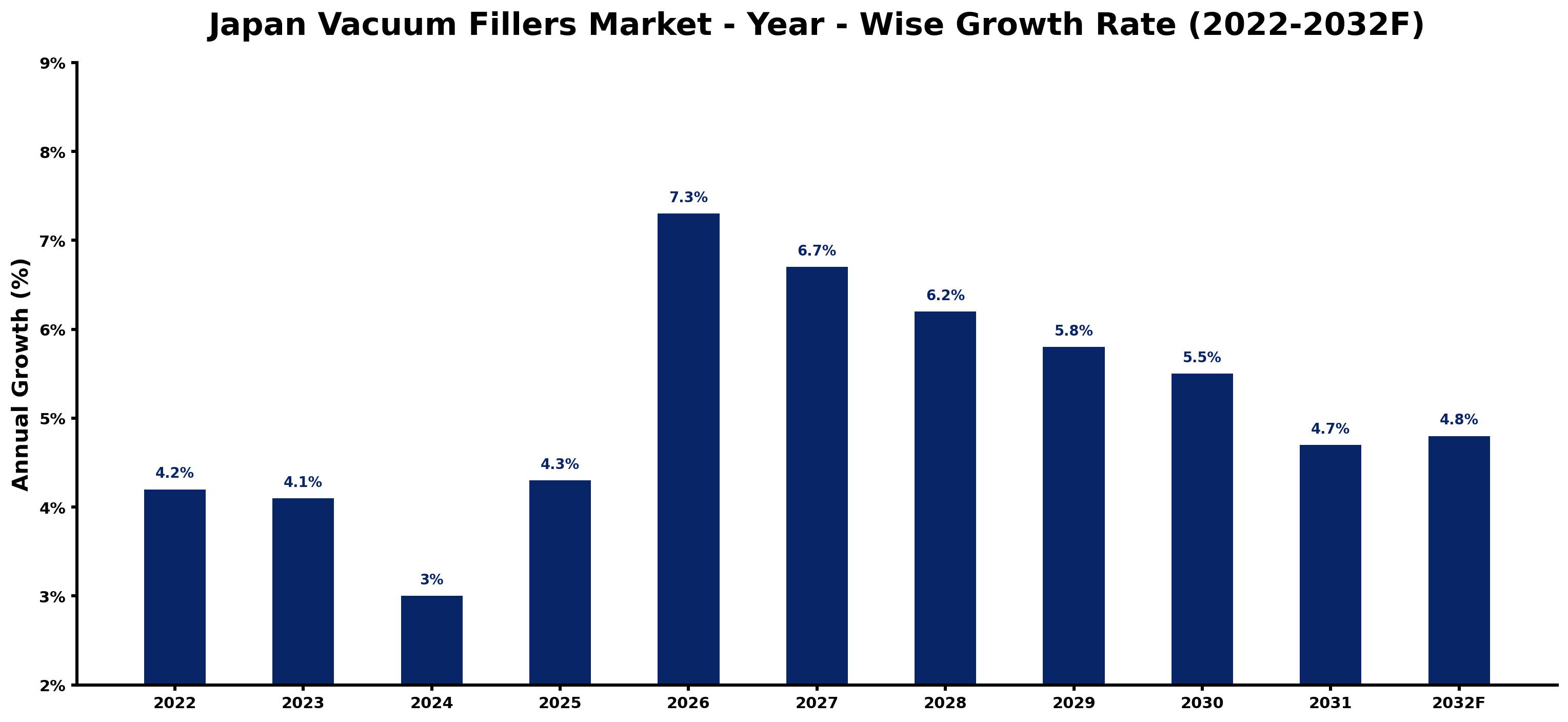
For each year, the table pairs the estimated growth rate with the leading influence on demand, showing how the drivers changed across the period.
| Year | Estimated Annual Growth (%) | Market Rationale |
| 2022 | 4.2 | The market exhibited stable growth, reflecting strong demand in food processing. |
| 2023 | 4.1 | Growth slowed slightly as manufacturers adjusted to changing consumer preferences. |
| 2024 | 3.0 | A further slowdown occurred as production faced challenges from supply chain disruptions. |
| 2025 | 4.3 | Growth accelerated due to increased investments in food safety technologies. |
| 2026 | 7.3 | The market peaked as demand surged for high-volume filling in food production. |
| 2027 | 6.7 | Growth is expected to decelerate slightly as competition intensifies among manufacturers. |
| 2028 | 6.2 | A continued slowdown is projected as market saturation begins to set in. |
| 2029 | 5.8 | Demand is expected to remain steady, supported by ongoing innovations in filling technologies. |
| 2030 | 5.5 | Growth is projected to slow further as manufacturers face rising operational costs. |
| 2031 | 4.7 | The market is expected to continue growing but at a reduced pace due to market maturity. |
| 2032 | 4.8 | Growth is projected to pick up slightly as new standards improve production efficiency. |
Note: Market size estimations and growth projections presented in this report are based on 6Wresearch's proprietary forecasting methodology, utilizing the latest available industry data, government publications, and primary research inputs.
Japan Vacuum Fillers Market Synopsis
Vacuum fillers are machines that fill products into containers under vacuum conditions, minimising air exposure. They play a crucial role in food processing, pharmaceuticals, and cosmetics, where product integrity is paramount. The Japan Vacuum Fillers Market is growing due to the food processing industry, valued at approximately 6 trillion yen, alongside the pharmaceutical sector's need for precision filling. The introduction of new food safety standards in 2023 further propels market growth, as manufacturers strive to comply with evolving regulations and improve product quality.
Market Dynamics Impact Analysis (2026–2032)
| Factor | Type | Impact | Primary Segment Affected |
| Rising demand for food safety compliance | Driver | High | Food & Beverages |
| Increasing investments in food processing technologies | Driver | High | Food & Beverages |
| Expanding pharmaceutical sector requiring precision filling | Opportunity | High | Pharmaceutical |
| Growing interest in specialty food products needing vacuum fillers | Opportunity | Medium | Food & Beverages |
| High operational costs impacting production | Restraint | High | Food & Beverages |
| Stringent regulations affecting equipment specifications | Restraint | Medium | Pharmaceutical |
| Supply chain disruptions delaying equipment availability | Challenge | High | Food & Beverages |
| Intense competition among manufacturers affecting pricing | Challenge | Medium | Food & Beverages |
Evaluation of Drivers in Japan Vacuum Fillers Market (2026–2032)
The main growth drivers and the segments they affect most are set out below.
| Drivers | Primary Segment Affected | Why It Matters (Evidence) |
| Strong growth in the food processing industry | Food & Beverages | Japan's food processing industry, valued at approximately 6 trillion yen, drives demand for vacuum fillers as manufacturers seek efficiency. |
| Increased focus on food safety standards | Food & Beverages | The introduction of new food safety standards in 2023 compels producers to invest in advanced filling technologies. |
| Expansion of the pharmaceutical sector | Pharmaceutical | Japan's pharmaceutical sector, valued as one of the largest globally, necessitates precision filling equipment to maintain product integrity. |
| Rising consumer interest in specialty foods | Food & Beverages | The growing trend for specialty food products increases demand for vacuum fillers tailored for unique applications. |
| Technological advancements in filling equipment | Pharmaceutical | Innovations in filling technology improve efficiency and precision, attracting pharmaceutical manufacturers to upgrade their equipment. |
What keeps demand rising is the strong growth in Japan's food processing industry, valued at approximately 6 trillion yen, which drives manufacturers to seek efficient vacuum fillers. The introduction of new food safety standards in 2023 compels producers to invest in advanced filling technologies, ensuring compliance and quality. The pharmaceutical sector, one of the largest globally, necessitates precision filling equipment to maintain product integrity. Rising consumer interest in specialty foods increases demand for vacuum fillers tailored for unique applications. Technological advancements in filling equipment improve efficiency and precision, attracting manufacturers to upgrade their systems.
Evaluation of Restraints in Japan Vacuum Fillers Market
Several factors work against faster growth; the main ones are summarised below.
| Market Restraint | Primary Segment Affected | Why It Matters (Evidence) |
| High operational costs impacting production | Food & Beverages | Rising operational costs due to inflation affect manufacturers' ability to invest in new equipment. |
| Stringent regulations affecting equipment specifications | Pharmaceutical | Regulations require manufacturers to adhere to strict standards, complicating the approval process for new equipment. |
| Supply chain disruptions delaying equipment availability | Food & Beverages | Global supply chain issues have led to delays in the delivery of essential components for vacuum fillers. |
| Limited availability of skilled labour | Food & Beverages | A shortage of skilled workers in the manufacturing sector hampers production efficiency and growth. |
| Market saturation limiting new entrants | Food & Beverages | The high level of competition and established players create barriers for new entrants in the market. |
Japan Vacuum Fillers Market Challenges
Producers in Japan's food processing sector face rising costs due to intense competition, compelling them to limit investments in advanced filling technology. Importers encounter delays as compliance with JIS standards necessitates substantial upgrades to their filling equipment, potentially disrupting supply chains for up to six months. Buyers face increased expenses because health regulations from the Ministry of Health, Labour and Welfare require costly modifications, raising prices by approximately 15%. Skills shortages in the workforce impede producers' ability to operate vacuum fillers efficiently, leading to lost production time and potential revenue declines of around 10%.
Trends in the Japan Vacuum Fillers Market
Buyers and suppliers in the Japan Vacuum Fillers Market are adjusting to the following trends.
- Shift in Food Processing Technologies in Tokyo: Tokyo is experiencing a shift towards advanced food processing technologies, highlighted by the annual Food & Beverage Expo. In 2023, this event showcased over 300 innovations, reflecting the industry's focus on efficiency.
- Emergence of Sustainable Filling Solutions: The introduction of ISO 9001 certification among manufacturers is promoting sustainable practices in filling technologies. This shift is expected to improve product quality and safety standards across the sector.
- Transition to Automation in Filling Processes: The trend towards automation is clear as manufacturers increasingly adopt automatic vacuum fillers. In 2022, automatic fillers accounted for 63% of the market, reflecting a preference for efficiency.
- Growing Demand for Specialty Food Products: The rise in consumer interest for specialty food products is reshaping the filling equipment market. In 2023, approximately 25% of new products launched were specialty items, driving innovation.
Investment Opportunities in the Japan Vacuum Fillers Market
The following opportunities in the Japan Vacuum Fillers Market pair current demand with a clear way in.
- Timing for Investment in Food Safety Technologies: With the introduction of new food safety standards in 2023, there is an opportunity to invest in compliance technologies. Food manufacturers are actively seeking solutions to meet these new requirements.
- Pharmaceutical Sector's Need for Precision Equipment: The pharmaceutical sector's growth presents an opportunity to supply precision filling equipment. Manufacturers are looking for advanced solutions to ensure product integrity and compliance.
- Gap in Specialty Food Filling Solutions: The increasing demand for specialty food products creates a gap in the market for tailored filling solutions. Food producers are eager to partner with suppliers offering innovative technologies.
- Entry into the Automatic Filling Equipment Market: Now is an opportune time to enter the automatic filling equipment market, which holds a significant share. Collaborating with local manufacturers can facilitate market entry and compliance.
Government Initiatives in the Japan Vacuum Fillers Market
The 2023 initiative to improve food safety standards builds upon the PRTR Law (1999) and the Chemical Substances Control Law (1973). This new program requires food processors to implement stricter safety protocols, ensuring that vacuum fillers meet the latest quality standards for consumer protection. The initiative aims to enhance overall food safety and quality across the industry, benefiting both producers and consumers.
The Ministry of Health, Labour and Welfare oversees pharmaceutical regulations, ensuring that filling equipment complies with safety standards. This agency plays a significant role in allowing producers to maintain product integrity while adhering to regulatory requirements. In 2023, the ministry approved numerous applications for new filling technologies, supporting innovation in the sector.
Future Insight of the Japan Vacuum Fillers Market
A policy-driven shift towards stricter food safety standards will compel suppliers to invest in vacuum fillers that meet new regulations, ensuring higher quality and safety for buyers. Technological advancements in filling processes will allow producers to enhance efficiency and output, improving product availability for consumers. By 2032, Japan's pharmaceutical sector will demand precise filling equipment, prompting suppliers to align their offerings with these needs. The annual Food & Beverage Expo will continue to serve as a key platform for showcasing innovations, influencing future buyer expectations and supplier strategies.
Market Segmentation Analysis
Japan Vacuum Fillers Market report covers a detailed analysis of the following market segments:
By Type – Automatic Leads, Semi-automatic Expected to Grow Fastest
According to Sumit Sagar, AM at 6Wresearch, in 2025, Automatic led the type split with a 63% share. Automatic vacuum fillers hold the largest share because they are essential for high-volume production in food processing. Facilities in Tokyo rely heavily on these machines to efficiently meet the demands of Japan's substantial food industry. Semi-automatic is set to record the highest CAGR in this split, 8.1% over 2026–2032. The semi-automatic segment is growing rapidly as smaller operations increasingly adopt these machines for specialty products. This trend is particularly notable in Osaka, where the rise of artisanal food producers creates a greater need for flexible filling solutions. Suppliers should prioritise developing both automatic and semi-automatic machines to address the varying needs of the market.
By Application – Food & Beverages Lead, Chemicals Expected to Grow Fastest
Food & Beverages took 45% of application revenue in 2025, more than any other category. The food and beverages application holds the largest share as it is essential for filling products like sauces and pastes, directly catering to Japan's extensive food processing industry. With the sector valued at approximately 6 trillion yen, these machines play a vital role in maintaining product quality and safety. Chemicals are projected to grow fastest, at a CAGR of 7.7% during 2026–2032. The chemicals application is witnessing the fastest growth due to rising demands for filling equipment in specialised markets. This surge is linked to Japan's chemical industry responding to stricter regulations, necessitating advanced filling technologies to meet compliance requirements. Suppliers should prioritise offering tailored filling solutions to meet the specific needs of buyers in the chemicals sector.
Key Attractiveness of the Report
- 10 Years of Market Numbers
- Historical Data Starting from 2022 to 2025
- Base Year 2025
- Forecast Data until 2032
- Key Performance Indicators Impacting the Market
- Major Upcoming Developments and Projects
Key Highlights of the Report:
- Japan Vacuum Fillers Market Outlook
- Market Size of Japan Vacuum Fillers Market, 2025
- Forecast of Japan Vacuum Fillers Market, 2032
- Historical Data and Forecast of Japan Vacuum Fillers Revenues & Volume for the Period 2022-2032
- Japan Vacuum Fillers Market Trend Evolution
- Japan Vacuum Fillers Market Drivers and Challenges
- Japan Vacuum Fillers Price Trends
- Japan Vacuum Fillers Porter's Five Forces
- Japan Vacuum Fillers Industry Life Cycle
- Historical Data and Forecast of Japan Vacuum Fillers Market Revenues & Volume By Type for the Period 2022-2032
- Historical Data and Forecast of Japan Vacuum Fillers Market Revenues & Volume By Automatic for the Period 2022-2032
- Historical Data and Forecast of Japan Vacuum Fillers Market Revenues & Volume By Semi-automatic for the Period 2022-2032
- Historical Data and Forecast of Japan Vacuum Fillers Market Revenues & Volume By Application for the Period 2022-2032
- Historical Data and Forecast of Japan Vacuum Fillers Market Revenues & Volume By Food & Beverages for the Period 2022-2032
- Historical Data and Forecast of Japan Vacuum Fillers Market Revenues & Volume By Chemicals for the Period 2022-2032
- Historical Data and Forecast of Japan Vacuum Fillers Market Revenues & Volume By Pharmaceutical for the Period 2022-2032
- Historical Data and Forecast of Japan Vacuum Fillers Market Revenues & Volume By Cosmetics for the Period 2022-2032
- Japan Vacuum Fillers Import Export Trade Statistics
- Market Opportunity Assessment By Type
- Market Opportunity Assessment By Application
- Japan Vacuum Fillers Top Companies Market Share
- Japan Vacuum Fillers Competitive Benchmarking By Technical and Operational Parameters
- Japan Vacuum Fillers Company Profiles
- Japan Vacuum Fillers Key Strategic Recommendations
Market Covered
Segments analysed in this report are listed below.
By Type
- Automatic
- Semi-automatic
By Application
- Food & Beverages
- Chemicals
- Pharmaceutical
- Cosmetics































