Japan Vapor Recovery Units Market Size & Growth Rate
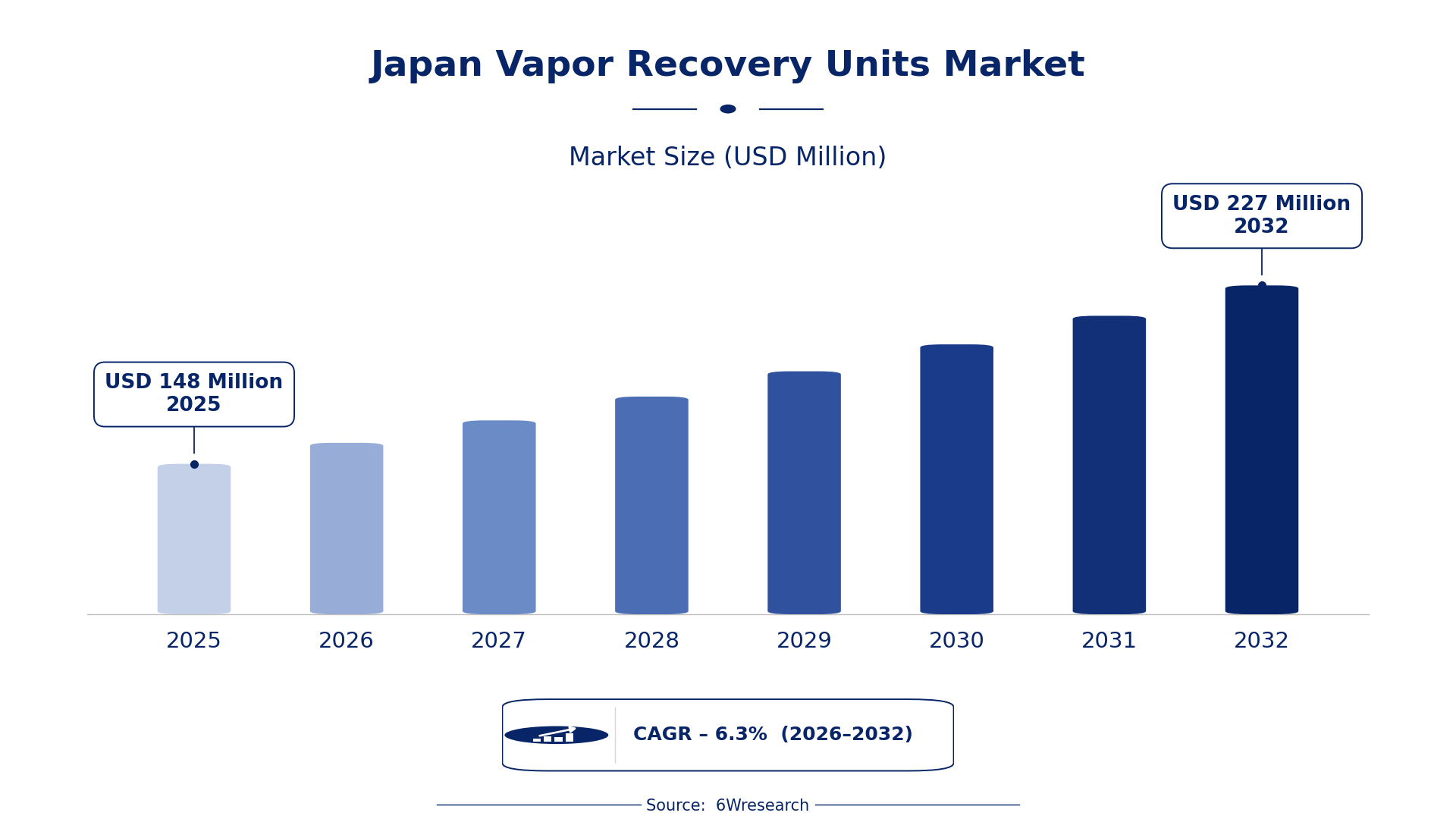
According to 6Wresearch internal database and industry insights, the Japan Vapor Recovery Units Market was valued at USD 148 Million in 2025 and is projected to reach USD 227 Million by 2032, growing at a CAGR of approximately 6.3% during 2026–2032.
Japan Vapor Recovery Units Market Highlights
| Report Metric | Details |
| Report Name | Japan Vapor Recovery Units Market (2026-2032) |
| Market Size 2025 | USD 148 Million |
| Market Size 2032 | USD 227 Million |
| Absolute Growth 2025–2032 | USD 79 Million |
| CAGR 2026–2032 | 6.3% |
| Peak Annual Growth | 7.0% in 2032 |
| Forecast Period | 2026–2032 |
| Historical Data | 2022–2025 |
| Base Year | 2025 |
| Leading Application, 2025 | Storage (50% share) |
| Leading End Use Industry, 2025 | Oil & Gas (59% share) |
| Fastest-Growing Application | Processing (8.4% CAGR) |
| Growing Sector | Oil & Gas |
| Key End Users | Oil producers, Gas companies, Environmental technology suppliers |
Japan Vapor Recovery Units Market Year-wise Growth Rate and Key Drivers (2022–2032)
This graph illustrates the annual growth rates of the market from 2022 to 2032, highlighting a steady upward trajectory and projected market expansion over the forecast period.
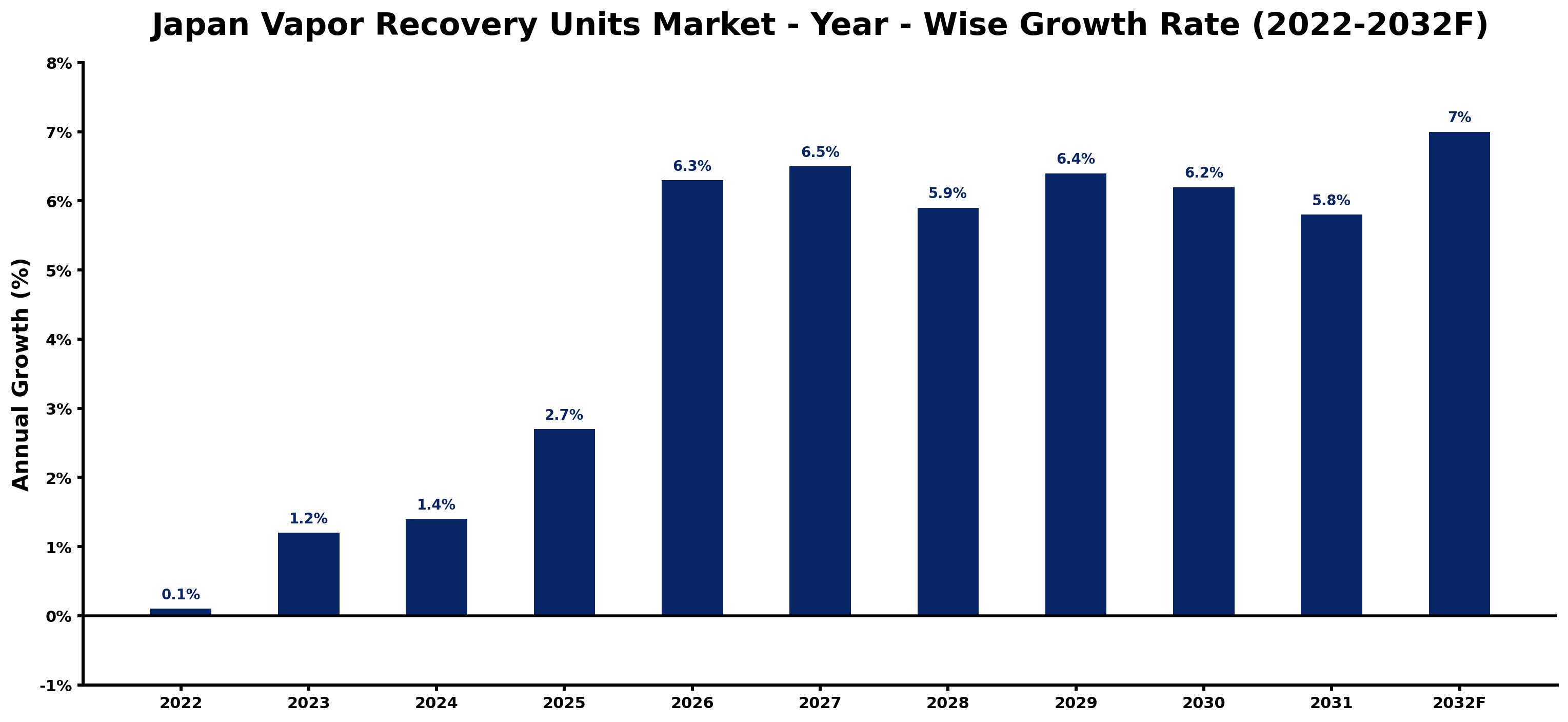
For each year, the table pairs the estimated growth rate with the leading influence on demand, showing how the drivers changed across the period.
| Year | Estimated Annual Growth (%) | Market Rationale |
| 2022 | 0.1 | The market experienced minimal growth as companies began to adopt emission control technologies. |
| 2023 | 1.2 | Increased awareness of environmental regulations spurred demand for vapor recovery units among users. |
| 2024 | 1.4 | The oil and gas sector showed stronger performance, leading to higher demand for emission control solutions. |
| 2025 | 2.7 | The implementation of stricter emission regulations boosted the adoption of vapor recovery units. |
| 2026 | 6.3 | Rising investments in environmental technologies will drive substantial growth in the vapor recovery units market. |
| 2027 | 6.5 | The trend towards sustainability will continue, prompting further demand for vapor recovery systems in facilities. |
| 2028 | 5.9 | Growth is expected to slow slightly as the market stabilises after rapid expansion in previous years. |
| 2029 | 6.4 | Increased production levels in the oil and gas industry will lead to renewed interest in vapor recovery technologies. |
| 2030 | 6.2 | The market will maintain growth, although at a slower rate, as companies adjust to new regulations. |
| 2031 | 5.8 | Demand is projected to remain steady, reflecting ongoing investments in emission reduction technologies across sectors. |
| 2032 | 7.0 | The market is expected to peak as the government pushes for significant reductions in greenhouse gas emissions. |
Note: Market size estimations and growth projections presented in this report are based on 6Wresearch's proprietary forecasting methodology, utilizing the latest available industry data, government publications, and primary research inputs.
Japan Vapor Recovery Units Market Synopsis
Vapor Recovery Units capture and reuse vapours emitted during hydrocarbon storage and transportation, utilising advanced engineering materials for efficiency. The Japan Vapor Recovery Units Market is driven by the oil and gas industry, which produced approximately 1.5 million barrels of oil per day in 2022. Stringent regulations on volatile organic compounds and initiatives from the Ministry of the Environment to reduce greenhouse gas emissions are propelling market growth, with over 100 units installed across various facilities as of 2023.
Market Dynamics Impact Analysis (2026–2032)
| Factor | Type | Impact | Primary Segment Affected |
| Growing regulatory pressure for emissions reduction | Driver | High | Oil & Gas |
| Increased investments in environmental technologies | Driver | High | Processing |
| Expansion of oil storage facilities in key regions | Opportunity | High | Storage |
| Rising demand for sustainable practices among end-users | Opportunity | High | Oil & Gas |
| High initial investment costs for vapor recovery systems | Restraint | Medium | Processing |
| Limited awareness among smaller operators about VRU benefits | Restraint | Medium | Storage |
| Supply chain disruptions affecting equipment availability | Challenge | High | Transportation |
| Technological advancements requiring constant upgrades | Challenge | Medium | Processing |
Evaluation of Drivers in Japan Vapor Recovery Units Market (2026–2032)
The table below links each growth driver to the segment it affects and the evidence for it.
| Drivers | Primary Segment Affected | Why It Matters (Evidence) |
| Stricter regulations on volatile organic compounds | Oil & Gas | Japan's stringent regulations on emissions drive oil and gas companies to invest in vapor recovery units, ensuring compliance with environmental standards. |
| Increased production levels in the oil and gas sector | Processing | Japan's oil production of approximately 1.5 million barrels per day necessitates effective vapor recovery solutions to manage emissions. |
| Government initiatives promoting environmental technologies | Storage | The ¥10 billion allocated for environmental technology development in 2023 supports the adoption of vapor recovery systems among industrial players. |
| Growing focus on sustainability among industrial players | Oil & Gas | The Petroleum Association of Japan encourages members to adopt VRU technologies to meet sustainability targets and reduce emissions. |
| Rising operational costs for emissions management | Processing | The average lifespan of a vapor recovery unit is around 15 years, necessitating regular upgrades to maintain operational efficiency. |
Most of the extra volume comes from Japan's oil and gas industry producing around 1.5 million barrels of oil per day, necessitating effective vapor recovery solutions to manage emissions. The focus on sustainability among industrial players will further drive the market, as companies strive to meet environmental targets and improve operational performance.
Evaluation of Restraints in Japan Vapor Recovery Units Market
Several factors work against faster growth; the main ones are summarised below.
| Market Restraint | Primary Segment Affected | Why It Matters (Evidence) |
| High initial investment costs for vapor recovery units | Processing | The average cost of installing a vapor recovery unit can be substantial, limiting adoption among smaller operators. |
| Limited awareness of VRU benefits among smaller operators | Storage | Many smaller oil and gas operators are unaware of the advantages of implementing vapor recovery systems, hindering market growth. |
| Supply chain disruptions affecting equipment availability | Transportation | Recent supply chain issues have delayed the delivery of critical components needed for vapor recovery units, impacting installation timelines. |
| Technological advancements requiring constant upgrades | Processing | The rapid pace of technology in vapor recovery systems necessitates regular upgrades, increasing operational costs for users. |
| Stringent regulations may lead to compliance challenges | Oil & Gas | Companies may struggle to meet evolving regulations on emissions, impacting their operational efficiency and increasing costs. |
Japan Vapor Recovery Units Market Challenges
Stringent regulations on volatile organic compound emissions create a supply challenge for producers of vapor recovery units, leading to project delays and compliance costs that can reach ¥1 billion per project. Limited access to advanced technology hampers the efficiency of VRUs, resulting in operational expenses that can increase by 20% for buyers relying on outdated systems. Intense competition among local manufacturers drives prices down, which may compromise quality and reliability for producers, ultimately causing performance issues in VRUs. Buyers face additional costs due to the average lifespan of 15 years for these units, necessitating frequent upgrades that can total ¥500 million over a decade.
Trends in the Japan Vapor Recovery Units Market
Four trends stand out in the Japan Vapor Recovery Units Market.
- Shift towards Advanced Emission Control Technologies: In 2023, Japan's oil and gas sector increasingly adopted advanced vapor recovery technologies, with over 100 units installed across facilities. This shift reflects the industry's commitment to reducing emissions and improving operational performance.
- Transition from Traditional to Sustainable Practices: The Petroleum Association of Japan has been promoting sustainable practices among its members since 2022, leading to a notable increase in vapor recovery unit installations. This trend aligns with Japan's goal to achieve a 26% reduction in greenhouse gas emissions by 2030.
- Emergence of Environmental Management Standards: The implementation of the ISO 14001 standard for environmental management in 2022 has driven many companies to adopt vapor recovery units, improving compliance and sustainability in operations.
- Growing Focus on Decarbonisation Initiatives: Since the adoption of the GX Basic Policy in 2023, there has been a surge in investments towards decarbonisation, including funding for vapor recovery technologies, which are essential for meeting emission reduction targets.
Investment Opportunities in the Japan Vapor Recovery Units Market
The following areas offer the clearest openings for investors and suppliers in the Japan Vapor Recovery Units Market.
- Oil & Gas Operators Seeking Compliance Solutions: Oil and gas operators in Japan are increasingly looking for vapor recovery units to comply with stringent regulations. The market gap for effective emission control solutions is notable, with over 100 units already installed.
- Investment in Environmental Technologies: With Japan allocating ¥10 billion for environmental technology development, there is a strong opportunity to supply advanced vapor recovery systems to meet growing demand from industrial players.
- Expansion in Chiba Prefecture's Oil Refineries: Chiba Prefecture, known for its concentration of oil refineries, presents a prime opportunity for suppliers of vapor recovery units, as facilities seek to improve emission control measures.
- Partnerships with Local Oil & Gas Companies: Forming joint ventures with local oil and gas companies can facilitate entry into the market, allowing for effective distribution of vapor recovery technologies.
Government Initiatives in the Japan Vapor Recovery Units Market
The Waste Management and Public Cleansing Act mandates strict environmental standards for waste treatment, impacting the adoption of vapor recovery units by requiring compliance with regulations that facilitate the reduction of emissions. This act ensures that producers implement necessary measures to capture and reuse vapors, which is essential for operational efficiency.
The Ministry of the Environment oversees initiatives that promote the adoption of vapor recovery technologies, approving funding for projects aimed at reducing greenhouse gas emissions. This support encourages companies to invest in environmental technologies, including vapor recovery systems, improving their compliance with regulations.
Future Insight of the Japan Vapor Recovery Units Market
Government initiatives aimed at reducing greenhouse gas emissions will drive the adoption of advanced vapor recovery technologies by 2032, prompting suppliers to enhance their offerings. The integration of the ISO 14001 standard will push facilities to elevate their environmental management practices, benefiting both buyers and suppliers. Increased collaboration between regulatory bodies and industry stakeholders will facilitate the development of efficient solutions. As demand for effective VRUs grows, suppliers will need to adapt to meet evolving regulatory standards and market needs.
Market Segmentation Analysis
Japan Vapor Recovery Units Market report covers a detailed analysis of the following market segments:
By Application – Storage Leads, Processing Expected to Grow Fastest
According to Ravi Bhandari, Research Head at 6Wresearch, Storage accounted for 50% of the market by application in 2025. The storage segment holds the largest share due to its critical role in minimising emissions at oil storage facilities, especially in the Tokyo Bay area, a key operational hub. With over 100 vapor recovery units installed, this segment is pivotal for compliance with stringent environmental regulations. Processing is projected to grow fastest, at a CAGR of 8.4% during 2026–2032. The processing segment is experiencing rapid growth as it is vital for capturing vapours during refining processes, which face increasing regulatory scrutiny. The rising emphasis on advanced technologies in oil refineries is driving this demand further. This suggests that suppliers should focus on creating customised solutions for both storage and processing applications to meet regulatory requirements.
By End Use Industry – Oil & Gas Lead and Record the Fastest Growth
With 59% of end use industry revenue in 2025, Oil & Gas was the largest category. The oil and gas industry dominates the market as it is the primary user of vapor recovery units for emission control, particularly in the Chiba Prefecture's refineries. This sector's reliance on VRUs is underscored by Japan's commitment to reducing greenhouse gas emissions. The same category are also set to grow fastest, at a CAGR of 8.0% during 2026–2032. The oil and gas sector is also the fastest-growing due to ongoing initiatives to improve environmental performance, supported by government funding for technology development. The industry's continuous push for compliance with ISO 14001 standards ensures sustained demand for VRUs. Buyers in the oil and gas sector must prioritise investments in VRU technologies to align with environmental goals and regulatory frameworks.
Key Attractiveness of the Report
- 10 Years of Market Numbers
- Historical Data Starting from 2022 to 2025
- Base Year 2025
- Forecast Data until 2032
- Key Performance Indicators Impacting the Market
- Major Upcoming Developments and Projects
Key Highlights of the Report:
- Japan Vapor Recovery Units Market Outlook
- Market Size of Japan Vapor Recovery Units Market, 2025
- Forecast of Japan Vapor Recovery Units Market, 2032
- Historical Data and Forecast of Japan Vapor Recovery Units Revenues & Volume for the Period 2022-2032
- Japan Vapor Recovery Units Market Trend Evolution
- Japan Vapor Recovery Units Market Drivers and Challenges
- Japan Vapor Recovery Units Price Trends
- Japan Vapor Recovery Units Porter's Five Forces
- Japan Vapor Recovery Units Industry Life Cycle
- Historical Data and Forecast of Japan Vapor Recovery Units Market Revenues & Volume By Application for the Period 2022-2032
- Historical Data and Forecast of Japan Vapor Recovery Units Market Revenues & Volume By Processing for the Period 2022-2032
- Historical Data and Forecast of Japan Vapor Recovery Units Market Revenues & Volume By Storage for the Period 2022-2032
- Historical Data and Forecast of Japan Vapor Recovery Units Market Revenues & Volume By Transportation for the Period 2022-2032
- Historical Data and Forecast of Japan Vapor Recovery Units Market Revenues & Volume By End Use Industry for the Period 2022-2032
- Historical Data and Forecast of Japan Vapor Recovery Units Market Revenues & Volume By Oil & Gas for the Period 2022-2032
- Historical Data and Forecast of Japan Vapor Recovery Units Market Revenues & Volume By Others for the Period 2022-2032
- Japan Vapor Recovery Units Import Export Trade Statistics
- Market Opportunity Assessment By Application
- Market Opportunity Assessment By End Use Industry
- Japan Vapor Recovery Units Top Companies Market Share
- Japan Vapor Recovery Units Competitive Benchmarking By Technical and Operational Parameters
- Japan Vapor Recovery Units Company Profiles
- Japan Vapor Recovery Units Key Strategic Recommendations
Market Covered
The report covers the following segments.
By Application
- Processing
- Storage
- Transportation
By End Use Industry
- Oil & Gas
- Others































